약 학 회 지 제 38권 제 6호 677-^682(1994) Yakhak Hoeji Vol. 38, No. 6
7-[3-
허드록시
-(4-메털티오 또는
4-에털티오에털
)퍼롤리디닐
:!퀴놀린
-3-카르복설산의 합성과 항균작용
이 재 욱 * • 손 호 정 • 이 규 삼 • 유 영 효
*(주) 대웅제약중앙연구소
(Received October 14, 1994)
윤 길 종
Synthesis and Antimicrobial Activity of 7-[3-Hydroxy-(4-methylthio or 4-methylthiomethyl)pyrrolidinyl] quinoline-3-carboxylic Acids
Jae W ook Lee 화, H o Ju n g Son, Kyu Sam Lee, Y oung Hyo Y u and Geal Ju n g Y oon
*R&D Center, Dae Woong Pharmaceutical Co. Ltd., 223-23 Sangdaewondong, Sungnam, Kyungido 462-120, Korea
Abstract — A number of 7-[3-hydroxy-(4-methylthio or 3-methylthiomethyl)pyrrolidinyl]quinoline- 3-carboxylic acids were synthesized by condensation of 7-fluoro substituted quinoline-3-carboxylic acid with 3-hydroxy-4-methylthiopyrrolidine or 3-hydroxy-4-methylthiomethylpyrrolidine. The in vitro antimicrobial activity of them were tested against twenty species of Gram-positive or Gram- negative microorganisms. It showed remarkable antibacterial activity, particularly against Gram- positive microorganisms. Among those l-cyclopropyl-5-amino-6,8-difluoro 7-(3-hydroxy-4-methylthio methylpyrrolidinyl)-l,4-dihydro-4-oxo-3-quinolinecarboxylic acid(12d) and l-cyclopropyl-6-fluoro-8- methoxy-7-(3-hydroxy-4-methylthiomethylpyrrolinyl)-l,4-dihydro-4-oxo-3-quinolinecarboxylic acid(l 2g) showed the most potent in vitro antibacterial activity, and 12d showed better antibacterial activity against MRSA compared to ciprofloxacin and sparfloxacin.
Keywords □ 3-hydroxy-4-methylthiopyrrolidine, lone antibacterial, antibacterial activity, MRSA.
3-hydroxy-4*methylthiomethylpyrrolidine, quino
경구용 항균제로 광범위한 항균활성을 갖고 있는 퀴놀론계 항균제는 퀴놀론 또는 나프티리딘 모핵외 7번 위치에 피페라진과 같은 디아민 형태의 처환기를 같고있다.*) 7번 위치의 처환기가 항균력과 항균범위에 큰 영향을 주기 때문에 새로운 처환기를 도입하여 항균력과 항균범위를 향상시키고자 하는 연구가 활 발히 진행되고 있다."* 현재 사용되고 있는 퀴놀론계 항균제들도 Gram 옴성균에 대한 항균력은 우수한데 비해 Gram 양성균에 대한 항균력은 다소 떨어지고, MRSA 등 내성균주에 대한 약효개선이 요구되고 있 다 .
본 저자들은 광범위한 항균활성을 갖는 신물질 개
*본 논문에 관한 문의는 이 저자에게로
발을 위헤 7번 위치에 새 로 운 치 환기를 갖고 있는 퀴놀론 유도체 외 합성 과 항균작용에 대 하여 연구하여 왔으며, 최근에 Gram 앙성균에 대 한 항균력이 매우 우 수한 새로운 퀴놀론 유도체외 합 성 과 항균작용에 대하여 보고하였 다.® 이 러 한 구조활성 관계로부터 항 균범위의 증진을 목 적으 로 7번 위처에 3-히 드록시- 4-메 틸티오피를리 딘과 3-히 드 록 시 -4-메 틸티오메 틸피 롤리딘이 치환된 새로운 퀴 놀 론 유 도 체 를 합성하여 항균활성을 검색하였다.
실 험
사용한 시 약들은 A ld ric h tt와 Fluka, Janssen, To
kyo Kasei 그리고 동 양 화 학 등의 전문 시 약 희 사 제품
677
이재욱* 손호정 • 이규삼* 유영효 • 윤길종
을 사용하였다- Thin layer chromatography(TLC)는 Kieselgel 6OF254를 사용했고 Column chromatogra- phy에 사용된 silica gel은 230^400 mesh 입 자크기 이다. 융점은 Gallenkamp melting point apparatus를 이용하여 측정하였고 온도보정은 하지 않았다. n m r 은 Bruker FT-80형을 사용하였고 Tetramethylsi- lane(TMS)를 내부 표준물질로 사용하였다.
N-rerr-Butoxycarbonyl-3,4-epoxypyrrolidine(3) 의 합성 一 물 2 0 m L 에 NaOH 0.64 g(16 mmole)을 녹인 용액 에 3-pyrroline(l) 1 g(14.5 mmole)을 가하고 0°C 로 냉각한다. Di-/^-butyl dicarbonate 3.5 g(16 mmole)을 dioxane 2 0 m L 에 녹인 용액을 적가한 후, 상온에서 15시간 교반하고 30% NaOH 용 액으로 pH 1 1로 조절 한 다 . 에틸에테르 80 m L을 가하고 유기충을 분리 하여 MgSO,로 건조하고* 감압농축하면 정량적 인 앙으로 N-ter궁-butoxycarbonyl-3-pyrroUne(2)을 얻는 다 . 화합물<2)을 디클로로메탄 2 0 m L을 가하고 O t 로 냉각한다. 3-Chloroperbenzoic acid(70^75% ) 4.1 g (23.8 mmole)을 디클로로메탄 2 0 m L 에 녹인 용액을 적가한 후, 상온에서 2 0시간 교 반한다. 침전물을 여 과하고 디 클로로메란 60 m L을 가한 후 포화 NaHC0 3 용액으 로 세척하고 MgSCX로 건조하였다. 용액을 감 압농축한 후 관크로마토그라피(에틸에테르 : n-렉산
= 1 :1)를 이용하여 무색 유상의 목적물 2.23g(수율 83% )을 얻었다.
^H-NMR(CDCl3):6 1.44(9H, s), 3.22-3.90(6H, m), N-r^-Butoxycarbonyl-3-hydroxy-4-methylthiopy- rrolidine(4)의 합성 一 N-^^-Butoxy carbonyl-3,4- epoxypyrroIidine(3) 2.1 g(11.34 mmole)과 sodium thiomethoxide 0.95 g(13.6 mmole)을 디 메 틸포름아 미드 2 0 m L 에 녹인 후 상온에서 10시간 교반하였다.
중류수 50 m L를 가하고 에 틸아세테이트로 추출한 후 유기층 을 MgS0 4로 건조하고 감압농측하여 연노랑 유상의 목적물 2.42 g(수 율 = 9 3 % )을 얻었다.
면 -N M R (CDCW: 5 1.46(9H, s), 2.17(3H, s), 2.7 4(1H, s), 2.96-3.40(3H, m), 3.63-3.96(2H, m), 4.
14-4.3K1H, m).
3-Hydroxy-4-methylthiopyrrolidine • TFA염 (5)의 합성 — N-terNButoxycarbonyl-3-hydroxy-4-methyl- thiopyrrolidine(4) 0.5 g(2.18 mmole)에 anisole 0.2 m L 를 가한다옴, trifluoroacetic acid 4 m L를 0°C 에 서 적가한 후 상온에서 2시간 동안 교 반한 다 . 반응액을
감암농측한 후, n-핵산(5 m L X 4 )으로 씻어준 다옴 감 압농측하여 같색 유상의 목적물 0 .5g(수율 = 9 4 %)을 얻었다.
"H-NMRCCDClvUO): 5 2.19(3H, s), 3.0-4.0K5H, m), 4.16-4.42(1H, m).
N-/err-Butoxycarbonyl-3-hydroxy-4-hydroxyine- thylpyrrolidine(7) 의 합성 — N-Benzyl-3-hydroxy-4- hydroxymethylpyrrolidine(6) 6 .6 g(0.03 mmole)을 메탄을 50 m L에 녹인 후, 5% Pd/C 0.4 요을 첨가하고 수소기압하에서 상온에서 15시 간 교반한다. 유기층을 여과하여 감압농측시킨 잔사에 증 류수 l O m L 을 가한 후 1N NaOH 수용액 2 0 m L 을 가하고 O t 로 냉각시 킨다. Di-/CTY-butyldicarbonate 8.28 g(0.038 mole)을 dioxane 2 5 m L 에 녹인 용액을 적가한 후, 상온에서 15시 간 교반하고 에 틸아세 테 이트로 추출한다. MgS04 로 건조하고 감압농측한 후 관크로마토그라피(에틸 아세테이트)을 이용하여 무색 유상의 목적물을 4.5g (수 율 =72.3%)을 얻었다.
'H-NMR(CDCl3/D2 0): 5 1.45(9H, s), 2.24-2.40(1 H, m), 3.07-3.87(6H, m), 4.12-4.47(1H, m).
N-f^it-Butoxycarbonyl-3-hydroxy-4-methansulfo- nyloxymethylpyrrolidine(8)^ 합성 — N-/^-Butoxy- carbonyl-3-hydroxy-4-hydroxymethylpyrrolidine(7) 4.48 g(0.02 mole)을 디클로로메란 2 5 m L 에 녹인 후 트티에틸아민 3.07 mL(0.02 mole)을 첨가하여 0°C로 냉각한다. Methanesulfonyl chloride 1.71 mL(0.02 mole)을 디클로로메탄 1 5 m L 에 녹인 용액을 적가하 고 O t 에 서 15시 간 교 반한다. 증 류 수 25 mL을 가하고 에틸아세테이트로 추출하여 MgS04로 건조하고 감 압농측한 후 관크로마토그라피 (에 틸아세 테 이트: n- 렉산= 1 : 1)을 이용하여 연노랑 유상의 목적물을 4.
I g (수 율 = 6 7 % )을 얻었다.
'H-NMR(CDCl3/D2 0): 5 L46(9H, s), 3.0(3H, s), 2.26-2.49(lH, m), 3.08-3.40(6H, m), 4.14-4.48 (IH , m).
N-rm-Butoxycarbonyl-3-hydroxy-4-methylthio- iiiethylpyrrolidine(9) 의 합성 一 N-/er^-Butoxycarbo- nyl-3-hydroxy-4-methansulfonyloxymethylpyrroli dine(8) 4 g(0.013 mole)과 소디움티 오메톡사이트 I.15 g(0.016 mole) 에 디메틸포름아미드 25 m L를 가 한 후 상온에서 1 0시간 교 반한다. 중류수 2 0m L을 가하고 에틸아세테이트로 추출한 후 MgSO^로 건조
J. Pharm . Soc. Korea
7-[3-히드록시-(4-메틸티오 또는 4-메팀티오메틸)피롤리디닐]퀴놀린-3-카르복실산의 함성과 항균작용
시키고 감압농측하면 황갈색 유상의 목적물을 2.9 g (수 율 = 8 7 %)을 얻었다.
'H-NMRCCDCy:8 1.47(9H, s), 2.16(3H, s), 2.27
~2.63(3H, m), 2.90(1H, br s), 2.97~3.35(2H, m), 3.58~3.79(2H, m), 4.07~4.22(m, IH).
3-Hydroxy-4-methylthiomethylpyrrolidine • TFA 염 (10)의 합성一화함물(9)을 출발물 질로 하여 화함 물(5)의 제조방범과 동일 한 방법으로 상기화합물을 황갈색 유상으로 93% 의 수 율 로 얻었다.
'H-NMRCCDCls/DaO): 6 2.18(3H, s), 2.29-2.66(3 H, m), 3.01~3.81(4H, m), 4.06~4.26(1H, m).
Quinolone 유도체 합성一Quinolone 유도체 함성 은 다옴과 같은 일반적인 방법으로 합성하였다. Qui
nolone 모핵 1당량을 아세토니토릴 용매에 현탁시킨 후 DBU 1당량을 가하여 10분 간 교반시 킨 후 C-7 아민 2당량과 트리에틸아민 4당량을 아세토니트릴 용매와 흔합후 상기 용액에 가하였다. 60°C 내외 또는 환류 하에서 6시간에서 48시간 반응 시 키 고 상온으로 온도 를 내린후 석출된 결정을 여과하여 디에틸에테르로 씻어주고 건조하여 목적물을 얻었다.
결과 및고찰
합성" 퀴놀론 및 나프티리딘 모핵외 7번 위치에 3-hydroxy-4-methylthiopyrrolidine sf 3-hydroxy-4- methylthiomethylpyrrolidine이 치환된 새로운 유도 체를 합성하여 항균제로서외 활성을 검색하였다. 3- Hydroxy-4-meththylthiopyrrolidine^ 3-hydroxy- 4-rnethylthiomethylpyrrolidine은 Scheme I, I I 에 나 타나 있는 바와 같이 합성을 하였다.
3-Hydroxy-4-inethylthiopyrrolidine의 합성一 Scheme I 에 있는 바와 같이 3-pyrroline(l)을 출발 물질로 헤서 Boc group으 로 보호시켜서 (2)번 화합 물을 얻고, MCPBA를 이용헤서 epoxide(3)을 만든다.
Boc)jO, NaOH
H2O - Dioxane Q CH2CI2
Boc
S C H j HO S C H j
V H T F A
y—( f) PcW; MeOH. H, 7~\
N ii) Boc)jO, NaOH N Et HjODioxhie
''SCH,
Scheme II
Scheme
Scheme III
Epoxide 화합물과 소 디 움 티 오 메 톡 사 이 드 를 D M F 에 서 반웅시켜 화합물(4)를 얻고 이 것을 trifluoroacetic acid로 탈보호시켜 목적 화 합 물 을 T FA 염 (5)으 로 합 성 하였 다 .
3-Hydroxy-4-methylthioinethylpyrrolidine의 합성
— Scheme I I 에 있는 바와 같이 N-benzyl 3-hyd- roxy-4-hydroxymethylpyrrolidineX6)을 출 발 물 질 로 헤서 benzyl 기를 탈보호시키고 Boc group으 로 보호 시켜서 (7)번 화합물을 만든 후 트 리 에 틸 아 민 과 메 탄 술포닐 클 로라 이드와 반응시 켜 화 합 물 (8)을 맡 든 다.
화 함 물(8)과 소디움 티 오 메 톡 사 이 드 를 D M F 에서 반 응시 켜 화합물(9)을 얻고 이 것을 trifluoroacetic acid 로 탈보호시켜 목적화합물을 TFA염 (10)으 로 합성하 였다.
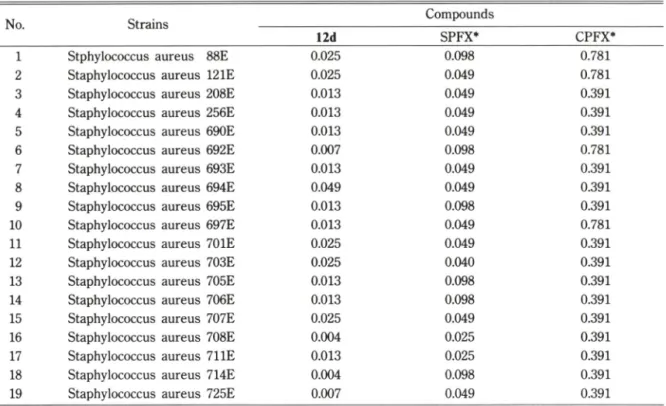
Quinolone 유도체 합성一 Quinolone 모핵 합성은 문헌에 알려진 방법으로 합 성 하 였 다 .^"®^ Quinolone 모 핵 과 C-7 아민 처환체와외 반 응 은 Scheme I I I 에 나타나 있는 바와 같이 아세토니토릴 용매에서 1,8- diazabicyclo[5.4.0]-undec-7-ene(DBU) 1당량, C-7 아민 2당량, 트리에틸아민 4당량을 사용하여 6 0 t 내 외 또 는 환류하에서 6시간에서 48시 간 정도 반응시 켜서 quinolone 유도체를 얻었다. 이렇게 만들어진 유도 체 는 Table I 에 나타내었다.
약효의 검색■합성된 화합물(12)은 Gram 앙성균 및 Gram 옴성균 20종에 대해서 항 균 활 성 을 시 험 하
Vol. 38, N o. 6, 1994
이재욱•손호정 •이규삼•유영효•윤길중
Table I — Synthesis of Quinolone and Naphthyridine Carboxylic Acids (12)
No n R X Z Yield(%) mpCc) 'H NMR 5(ppm)
1 2a 0 C-C3H5 CF H 70 218-219(dec.) DMSO-de/DA 0.82-1.4(4H, m), 2.15(3H, s), 3.39-4.27(6H, m), 5.43(1H, m), 7.70(1H, dd, J = 13.76 Hz, 1.78 Hz). 8.62(1H, s).
1 2b 0 C-C3H5 CF NH2 65 230(dec.) DMSO-ds/DA 0.8-1.4(4H, m), 2.18(3H, s), 3.34-^4.34(6H, m), 5.46(1H, m), 8.46(1H, s).
1 2c 1 C-C3H5 CF H 6 8 203-207 DMSO-ds/DzO: 1.01-1.30(4H, m), 2.13(3H, s), 2.20-2.84(3H, mX 3.02-4.02(5H, m), 5.33 (IH, m), 7.7K1H, dd, J = 14.02 Hz, 1.80 Hz), 8.62(1H, s).
1 2d 1 C-C3H5 CF NH2 6 8 198(dec.) DMSO-de/DzO: 0.9-1.39(4^ mX 2.15(3H, s), 2.23-2.9K3H, m), 3.2-4.4(5H, m), 5.25(1H, m), 8.46(1H, s).
1 2e 1 C-C3H5 N H 75 218-219(dec.) DMSO-de/DA 0.9~1.4(4H, m), 2.11(3H, sX 2.2-3.0(3H, m), 3.2-4.4(5H, m), 5.32(1H, m). 7.93(1H, d, J = 12.77 Hz), 8.55(1H, s).
1 2f 1 2,4-FsPh N H 78 199-200(dec.) DMSO-de/DA 2.09(3H, s), 2.28-2.59(3H, m), 3.2-4.4(4H, m), 5.24(1H, m), 7.2-7.95 (3H. mX 8.04(1H, d,J = 12.64 Hz), 8.76(1H, s).
1 2g 1 C-C3H5 COMe H 58 2 2 0-2 2 2(dec.) DMSO-dg/DzO: 0.8"-1.32(4H, m), 2.1(3H, s), 2.3~2.7(3H, m), 3.48(3H, sX 3.3~4.45(5H, mX 5.22(1H, m), 7.64(1H, d, J = 14.09 HzX 8.63(1H, s).
Table I I —Antibacterial Activity of New Quinolones and Naphthyridine Carboxylic Acids(MIC: |ig/m/)
No. Strains Compounds
1 2a 1 2b 1 2c 1 2d 1 2e 1 2f 1 2g CPFX*
1 S, Pyogenes A 308 3.125 3.125 3.125 0.391 3.125 3.125 0.049 1.563
2 S. Pyogenes A 77 3.125 0.781 1.563 0.391 1.563 0.391 0.049 0.391 3 S. faecium MD 8 6 12.5 6.25 1.563 0.391 1.563 0.781 0.049 0.391 4 S. aureus SG 511 0.391 0.391 0.098 0.004 0.098 0.098 0.013 0.195 5 S. aureus 285 0.781 0.391 0.098 0.013 0.098 0.025 0.013 0.781
6 S. aureus 503 0.391 0.195 0.049 0.004 0.098 0.098 0.007 0.391 7 E. coli 0 55 0.195 0.391 0.391 0.049 0.195 0.781 0.098 0.007
8 E. coli DC 0 12.5 12.5 12.5 6.25 12.5 1 0 0 6.25 0.195
9 E. coli DC 2 25 3.125 1.563 0.391 0.781 12.5 0.195 0.049
1 0 E. coli TEM 1.563 0.781 0.781 0.098 0.195 0.781 0.391 0.013
1 1 E. coli 1507 E 1.563 0.391 1.563 0.195 0.781 3.125 0.391 0.013
1 2 P. aeruginosa 9027 25 1 0 0 12.5 6.25 12.5 > 1 0 0 12.5 0.391 13 P. aeruginosa 1592 E 12.5 12.5 12.5 6.25 25 > 1 0 0 12.5 0.195 14 P. aeruginosa 1771 12.5 6.25 12.5 6.25 12.5 > 1 0 0 12.5 0.391 15 P. aeruginosa 1771 M 0.391 0.391 1.563 0.195 0.781 6.25 6.25 0.195 16 S. typhimurium 1.563 0.391 1.563 0.195 0.781 3.125 0.391 0.013 17 K. oxytoca 1082 E 6.25 0.781 0.391 0.049 0.098 0.781 0.025 0.004 18 K. aerogenes 1552 E 1.563 0.781 0.781 0.391 1.563 6.25 1.563 0.025 19 E. cloacae P 99 0.391 0.781 0.781 0.195 0.391 3.125 0.391 0.013
2 0 E. cloacae 1321 E 0.195 0.781 0.391 0.391 0.391 3.125 0.098 0.007 CPEX* = Ciprofloxacin
/ Pharm . Soc. Korea
7-[3-히드록시-(4-메틸티오 또는 4-메틸티오메틸)피롤리디닐]퀴놀린-3-카르복실산의 합성과 항균작용
Table I I I —Antibacterial Activity of New Quinolone against MRSA(MIC; |Jg/m/)
No. ^trQinc Compounds
wJ LX 01X10 --- -—
1 2d SPFX* CPFX*
1 Stphylococcus aureus 8 8E 0.025 0.098 0.781
2 Staphylococcus aureus 12 IE 0.025 0.049 0.781
3 Staphylococcus aureus 208E 0.013 0.049 0.391
4 Staphylococcus aureus 256E 0.013 0.049 0.391
5 Staphylococcus aureus 690E 0.013 0.049 0.391
6 Staphylococcus aureus 692E 0.007 0.098 0.781
7 Staphylococcus aureus 693E 0.013 0.049 0.391
8 Staphylococcus aureus 694E 0.049 0.049 0.391
9 Staphylococcus aureus 695E 0.013 0.098 0.391
1 0 Staphylococcus aureus 697E 0.013 0.049 0.781
1 1 Staphylococcus aureus 701E 0.025 0.049 0.391
1 2 Staphylococcus aureus 703E 0.025 0.040 0.391
13 Staphylococcus aureus 705E 0.013 0.098 0.391
14 Staphylococcus aureus 706E 0.013 0.098 0.391
15 Staphylococcus aureus 707E 0.025 0.049 0.391
16 Staphylococcus aureus 708E 0.004 0.025 0.391
17 Staphylococcus aureus 711E 0.013 0.025 0.391
18 Staphylococcus aureus 714E 0.004 0.098 0.391
19 Staphylococcus aureus 725E 0.007 0.049 0.391
*SPFX= Sparfloxacin, CPFX= Cirprofloxacin
였다. 이때의 항균시험외 시험방범은 Japanese Che
motherapy Society의 표준방법에 의해서 한천 폴레 이트 희석범으로 설시하였다.®^ 최소 발육저지 농도 (M IC : |jg/m/)는 대조물질로 사용한 ciprofloxacin과 비교하였다. 그 실험결과는 Table II에 나타내었다.
Table I I 에 나타 난 바와 같이 대조물질인 cipro- floxacin과 비교할때 Gram 앙성균에 대한 항균력은 동등하거나 우수하며 특히, Staphylococus aureus 에 대해서는 화합물 12d, 12g의 항균력이 3배에서 5배 우수한 항균력을 나타내었고는 Gram 옴성균에 대해 서는 ciprofloxacin에 비헤 떨어지는 약효를 보여주 었다. 화함물 12롤 내성균주인 M R SA 에 대한 항균 활성을 시험한 결과 대조물질인 ciprofloxacin과 spa- rfloxacin 보다 우수한 항균력을 보여주었고, 실험 결 과는 Table I I I 에 나타내었다. 결론적으로 7번 위처외 처환기에 0 H 기가 도입된 결과 Gram 음성균에 대한 항균력외 개선에 좋은 영향을 주지 못하는 것으로 나타났으며,^ 7번 위처의 처환기로 3-히드록시-4-메 틸티 오 메틸 피 롤 리 딘이 3-히 드 록 시 -4-메틸 티 오피 롤 리딘보다 약간 우수한 항균작용을 보여주었다.
문 헌
1) a) Koka, H., Itoh, A., Murayma, S., Suzue, S. and Irikura, T.: Structure activity relationships of an
tibacterial 6,7-and 7,8-disubstituted l-alkyl-l,4-di- hydro-4-oxo quinoline-3-carboxylic acids. J. Med.
Chem., 23, 1358 (1980).
b) Matsumoto, J., Miyamoto, T., Minamida, A., Ni- shimura, Y. and Egawa, H.: Pyridonecarboxylic acids as antibacterial agents: Synthesis and stru
cture activity relationships of 1,6,7-trisubstituted l,4-dihydro-4-oxo-l,8-naphthyridine-3-carboxylic acids, including enoxacin, a new antibacterial agent.
J. Med. Chem., 27, 292 (1984).
c) Wise, R., Andrew, J. and Edware, L : In vitro activity of Bay 09867, a new quinolone derivative, compared with those of other antimicrobial agents.
Antimicrob. Agents Chemother., 23, 559 (1983).
d) Sata, K., Matsuura, Y., Inoue, M., Une, T., Osada, Y., Ogawa, H. and Mitsuhashi,.: In vitro and in vivo activity of DL-8280, a new oxazine derivative, An
timicrob. Agents Chemother., 22, 548 (1982).
2) Wolfson, J., and Hooper, D. C.: Quinolone Antim i
crobial Agents: Am. Soc. Microbiol., Washington,
V ol 38, No. 6, 1994
이재욱•손호정 •이규삼•유영효•윤길중
DC, pp. 3 (1993).
3) a) Lee, J. W., Kang, T. C., Lee, K. S., Son, H. J., Yoon,
G. J., Yu, Y. H. and Kim, D. Y.; Synthesis and an
tibacterial activity of 7-[(3-methylthio or S-methy- lthiomethyl)pyrrolidinyI]quinoIone-3-carboxylic acids. J.Pharm. Soc. Korea, 38, 197 (1994).
b) Lee, J. W., Kang, T. C., Lee, K. S., Park, N. J.
and Kim, D. Y.: Synthesis and biological activity of 7-(3-amidinopyrrolidinyl)quinolone-3-carboxylic acids. Korean J. Med. Chem., 4, 35 (1994).
c) Yu, Y. H., Park. N. J., Kim, B. O., Choi, M. J., Shim, J. S,, Kang, T. C., Lee, J. W. and Kim, D. Y.:
In vitro and in vivo antibacterial activities of the new quinolone, DWQ-013, J. Pharm. Soc. Korea, 38,
265 (1994).
4) Jaeger, E. and Biel, J. H.: Pyrrolidinediols. 1-Sub- stituted 3-Hydroxymethyl-4-hydroxypyrroIidines and Derivatives. ]. Org. Chem., 26, 1519 (1961).
5) Sanchez, J. P., Domagala, J. M., Hagen, S. E., Hei
fetz, C. L, Hutt, M. P., Nichols, J, B., and Trehan, A. K. : Quinolone antibacterial agents. Synthesis and structure-activity relationships of 8-substituted quinolone-3-carboxylic acids and 1,8-naphthyri-
dine-3-carboxylic acids. J. Med. Chem., 31, 983
(1988).
6) Domagala, J. M., Heifetz, C. L, Hutt, M. P., Mich, T. R, Nichols, J. B., Solomon, M., and Worth, D.
F.: 1-Substituted 7-[3-(Ethylamino)-methyl]-l-py- rrolidinyi[6,8-difluoro-l,4-dihydro-4-oxo-3-quinoli- necarboxylic acids. New quantitative structure ac
tivity relationships at N l for the quinolone anti- bacterials. / Med. Chem., 31, 991 (1988).
7) Domagala, J. M., Bridges, S. J., Culbertson, T. P., Gambino, L., Hagen, S. E., Karrick, G., Porter, K., Sanchez, J. P., Sesnie, J. A., Spense, F. G., Szotek, D. D., and Wemple, J.; Synthesis and Biological activity of 5-amino-and 5-hydroxyquinolones, and the overwhelming influence of the remote N 1-su
bstituent in determining the structure activity re
lationship. J. Med. Chem., 34, 1142 (1991).
8) Masuzawa, K., Suzue, S., Hirai, K., and Ishizaki, T.:
Eur. Pat 0230295 (1987).
9) Japan Society of Chemotherapy( 0 :레 :뿔 투 솔 )
: 표# Chemotherapy., 23,
1-2 (1975).
/ P harm . Soc Korea