PMK-S005 Alleviates Age-Related Gastric Acid Secretion, Inflammation, and Oxidative Status in the Rat Stomach
Yoon Jeong Choi
1, Nayoung Kim
1,2, Ju Yup Lee
1, Ryoung Hee Nam
1, Ji Hyung Suh
1, Sun Min Lee
1, Min Hee Ham
1, Hyun Jin Jo
1, Young Kwang Shim
1, Yo Han Park
1, Jong-Chan Lee
1, Yoon Jin Choi
1, Hye Seung Lee
3, and Dong Ho Lee
1,21
Department of Internal Medicine, Seoul National University Bundang Hospital, Seongnam,
2Department of Internal Medicine and Liver Research Institute, Seoul National University College of Medicine, Seoul, and
3Department of Pathology, Seoul National University Bundang Hospital, Seongnam, Korea
Correspondence to: Nayoung Kim
Department of Internal Medicine, Seoul National University Bundang Hospital, 82 Gumi-ro 173beon-gil, Bundang-gu, Seongnam 13620, Korea Tel: +82-31-787-7008, Fax: +82-31-787-4051, E-mail: [email protected]
Received on November 13, 2015. Accepted on December 5, 2015. Published online May 16, 2016 pISSN 1976-2283 eISSN 2005-1212 http://dx.doi.org/10.5009/gnl15584
Background/Aims: The aim of this study was to evaluate the effect of the synthetic S-allyl- L -cysteine (SAC) PMK-S005 on gastric acid secretion, inflammation, and antioxidant en- zymes in aging rats. Methods: The rats were divided into four groups at 31 weeks of age and were continuously fed a diet containing a vehicle control, PMK-S005 (5 or 10 mg/kg), or lansoprazole (5 mg/kg). Gastric acid secretion and connec- tive tissue thickness of the lamina propria were evaluated at 74 weeks and 2 years of age. Tumor necrosis factor (TNF)-α, interleukin (IL)-1b, and COX-2 levels were measured by using enzyme-linked immunosorbent assays (ELISAs) or Western blot assays. Levels of antioxidant enzymes, including heme oxyganase 1 (HO-1) and NAD(P)H:quinone oxidoreductase 1 (NQO-1), were also measured. Results: As the rats aged, gastric acid secretion significantly decreased, and the con- nective tissue of the lamina propria increased. However, 74-week-old rats in the PMK-S005 group exhibited greater levels of gastric acid secretion than those of the control and lansoprazole groups. The increase of TNF-α, IL-1b, and COX- 2 expression in 74-week and 2-year-old control rats were inhibited by PMK-S005. In addition, the decrease in HO-1 and NQO-1 protein expression that occurred with aging was inhibited by PMK-S005 in the 74-week-old rats. Conclusions:
These results suggest that PMK-S005 has therapeutic po- tential as an antiaging agent to ameliorate age-related gas- tric acid secretion, inflammation, and oxidative stress in the stomach. (Gut Liver 2016;10:749-756)
Key Words: s-allyl- L -cysteine; Aging; Gastric acid; Anti-inflam- mation; Antioxidants
INTRODUCTION
The most common gastric disorders in the elderly individuals are gastritis and peptic ulcer disease which are significantly as- sociated with Helicobacter pylori infection and use of nonsteroi- dal anti-inflammatory drugs (NSAIDs).
1-3Several experimental and clinical studies have shown that aged gastric mucosa has impaired mucosal defense such as decreased mucus and bicar- bonate secretion, decreased prostaglandin generation, reduced nitric oxide synthase activity, and impaired sensory nerve re- sponse to luminal acid.
4-7Therefore, aged gastric mucosa has in- creased susceptibility to injury by a variety of damaging agents such NSAIDs, ethanol, and hypertonic solution.
6-8Especially, NSAID-induced gastric damage and its complications such as acute gastric erosion, ulceration, bleeding, and perforation are encountered very frequently in the old populations.
9,10In addition, reactive oxygen species (ROS) have been known to a major risk factor in tissue damage and aging.
11As digestive diseases, including peptic ulcer, are associated with mucosal lip- id peroxidation and oxidative damage, the upregulated activity of antioxidant enzymes may play an critical role against oxida- tive stress in gastrointestinal mucosa.
12-14Our group suggested that the lower part of rat gastric mucosa is replaced by connec- tive tissue with accumulation of oxidative products as the rats get old.
15In addition, impairment of apoptosis, angiogenesis, and sensory neuron activity via the activation of early growth response protein 1 (Egr-1), phosphatase, and tensin homolog (PTEN) might increase the susceptibility of gastric mucosal in- jury during aging.
15Phytochemicals such as polyphenols are common antioxi- dants found in food. It has been suggested that phytochemicals
This is an Open Access article distributed under the terms of the Creative Commons Attribution Non-Commercial License (http://creativecommons.org/licenses/by-nc/4.0)
which permits unrestricted non-commercial use, distribution, and reproduction in any medium, provided the original work is properly cited.
possess many beneficial features, such as antioxidant, anti- inflammatory, and anticancer properties.
16-18S-allyl- L -cysteine (SAC), the most abundant organic garlic compounds has long been used as a common dietary supplement and traditional medicine. PMK-S005 is a synthetic SAC, which is a sulfur-con- taining water soluble amino acid and SAC has been known to possess powerful antioxidant and anti-inflammatory activities in several studies.
16,17Aged garlic extract has been reported to increase lifespan and learning in mice,
19but the antiaging effect of SAC in the gastrointestinal tract has not been investigated.
Recently, we reported that the gastroprotective effects of PMK-S005 against ethanol- and NSAIDs-induced acute gastric damage rat model.
20,21The aim of this study was to evaluate the effect of PMK-S005 on gastric acid secretion and morphological changes with age. In addition, the molecular mechanism under- lying its antiaging effect in terms of proinflammatory cytokines, inflammatory mediator as well as antioxidant enzyme was ex- amined.
MATERIALS AND METHODS 1. Animals
Male Fischer 344 rats, H. pylori free and virus free, were purchased from Orient Co., Ltd., Seoul, Korea, and were raised at our institute. The 31-week-old rats were divided into four groups: control, PMK5, PMK10, and lansoprazole group (n=10 in each group) and housed in a cage maintained at 23
oC, with 12:12-hour light-dark cycles under specific pathogen-free con- ditions. The control group was fed with ad libitum only Purina rat chow and PMK5, PMK10, and lansoprazole group were fed with rat chow containing 5 mg/kg of PMK-S005, 10 mg/kg of PMK-S005, and 5 mg/kg of lansoprazole per day until sacrifice, respectively. All experimental procedures described here were approved by the Institutional Animal Care and Use Committee of Seoul National University Bundang Hospital (IACUC number:
BA1304-127/033-02).
2. Measurement of gastric acid secretion
The level of acid secretion was measured in each basal and stimulated rat. In the control group, basal and stimulated acid secretion level were measured at 6-, 31-, 74-week, and-year- old rats. In PMK5, PMK10, and lansoprazole groups, those were measured at 74-week and 2-year-old rats. The rats were starved but allowed water for 24 hours prior to the experiments. After measurement of body weight, the rats were anesthetized by zoletil and rompun mixture. The abdomen was gently opened and the esophagogastric junction and pyloric ring were ligated.
An overhead lamp was used to maintain core body temperature at 36
oC to 38
oC. Then the animals were subcutaneously injected with either phosphate-buffered solution for basal acid secretion or histamine (40 mg/kg) with carbachol (10 µg/kg) for stimu- lated acid secretion. After incubation for 2 hours, stomach was
extracted, and gastric juice was collected using 50 mL conical tube. The acid output (mmol H
+) was determined by titration with 0.1 N NaOH to pH 7.0. The gastric acid outputs were ad- justed by body weight in order to eliminate any effect of the difference of body weight. The results were expressed as mmol H
+/2h/mg body weight.
3. Mucosal histology
The obtained gastric specimens were fixed in 10% buffered formalin for histology. The specimens were embedded in paraf- fin and routinely processed and stained with hematoxylin and eosin (H&E). The area of the connective tissue was quantified in the lower one-third of the mucosa and the total area of each specimen by using Image-Pro Plus 7.0 (MediaCybernetics Inc., Rockville, MD, USA).
15Six specimens were analyzed in each in- dividual. The connective tissue area was expressed as a % of the total area.
4. Measurement of tumor necrosis factor α, and interleukin 1b An enzyme-linked immunosorbent assay (ELISA) was per- formed to measure the level of the cytokine expression using the appropriate kits from Hycult Biotechnology (Uden, The Nether- lands) and R&D systems (Minneapolis, MN, USA) by following the manufacturer’s instructions. All assays were performed in triplicate, and data are shown as mean±standard errors (SEM).
5. Western blotting for COX-2, heme oxyganase 1, and NAD(P)H:quinone oxidoreductase 1
Equal amounts of protein from gastric mucosal lysates were subjected to SDS-PAGE analysis, and immunoblotting using the appropriate antibodies was performed as we previously described.
15The incubation condition for each antibody is as follows: anti-COX-2 antibody (1:1,000; Cayman Chemical, Ann Arbor, MI, USA), anti-heme oxyganase 1 (HO-1) anti- body (1:1,000; Abcam Inc., Cambridge, UK), and anti-NAD(P) H:quinone oxidoreductase 1 (NQO-1) antibody (1:1,000; Abcam, Inc.).
6. Statistical analysis
All statistical calculations were performed using SPSS soft- ware version 18.0 (SPSS Inc., Chicago, IL, USA). The results were compared using the Mann-Whitney U test and the Wilcoxon rank sum test. All values are reported as means±SEM. Statistical significance was set at p-value <0.05.
RESULTS
1. Effect of PMK-S005 on age-related change of gastric acid secretion
Since the mean body weight of F344 rats are significantly
increased according to age, we corrected the result of acid
concentration by body weight. Weight-adjusted acid output
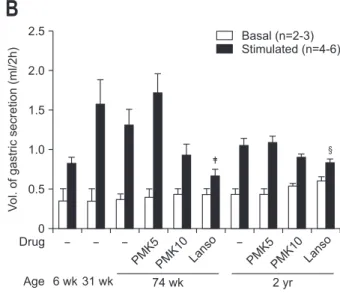
levels in both basal and stimulated groups were decreased with age (Fig. 1A). Under basal condition, gastric acid concentra- tion of 74-week and 2-year-old rats was significantly reduced as compared with 6-week-old rats (74 weeks, p=0.029; 2 years, p=0.012). Similarly under stimulated condition, gastric acid concentration of 74-week and 2-year-old rats was significantly lower than that of 6-week-old rats (74 weeks, p=0.01; 2 years, p=0.01) (Fig. 1A). In 74-week and 2-year-old rats, no significant differences were found among all experimental groups regard- ing the basal gastric acid concentration. However, in 74-week- old rats, stimulated gastric acid secretion in PMK5 group was significantly higher than that of control group (p=0.029) where- as this effect did not persist in 2-year-old rats. The stimulated gastric acid secretion in lansoprazole group was significantly lower compared with control group (74 weeks, p=0.009; 2 years, p=0.013), which could be explained by pharmacological action (Fig. 1A). The volume of stimulated gastric acid secretion was decreased with age (Fig. 1B). In 74-week-old rats, the volume of stimulated gastric acid secretion of PMK5 group was little bit
higher than control group but there was no statistical signifi- cance. The pH of stimulated gastric acid secretion was increased with age (Fig. 1C). In 74-week and 2-year-old rats, pH of gastric acid in PMK5 group was lower compared to control group but there was no statistical significance. Although there was no dose dependent effect of PMK-S005, these results indicate that continuous administration of 5 mg/kg of PMK-S005 may influ- ence to age-related change of gastric acid secretion.
2. Effect of PMK-S005 on age-related change of connective tissue area
Previously, we found that the thickness of connective tis- sue of lamina propria in the gastric mucosa was increased with age.
15Therefore, we examined whether the continuous adminis- tration of PMK-S005 could affect this age-related morphological change. As shown in Fig. 2, age-related thickening of connec- tive tissue was also confirmed in this experiment. In 74-week and 2-year-old rats, the connective tissue thickness of lamina propria in both PMK5 and PMK10 groups were lower compared
mmol H /2h/mg b.wt
+0 0.8
0.6
PMK5 0.4
0.2
Drug
Age
PMK10 Lanso PMK5PMK10 Lanso
74 wk 2 yr
6 wk 31 wk
Basal (n=2-3) Stimulated (n=4-6)
*
*,
*
*,
A
V ol. of gastric secretion (ml/2h)
0 2.5
2.0
1.5
1.0
0.5
PMK5 Drug
Age
PMK10 Lanso PMK5PMK10 Lanso
74 wk 2 yr
6 wk 31 wk
Basal (n=2-3) Stimulated (n=4-6)
B
pH of gastric acid
0 6
4
2
PMK5 Drug
Age
PMK10 Lanso PMK5PMK10 Lanso
74 wk 2 yr
6 wk 31 wk
Basal (n=2-3) Stimulated (n=4-6)
C
*,
Fig. 1. The effect of PMK-S005 on gastric acid secretion in aging rats. (A) Basal and stimulated acid concentration corrected by body weight. (B) The volume of gastric acid secretion. (C) The pH of gastric acid. The results are expressed as the means±SEM.
PMK5, 5 mg/kg of PMK-S005; PMK10, 10 mg/kg of PMK-S005; Lan-
so, 5 mg/kg of Lansoprazole. *p<0.05 compared with the 6-week-old
controls;
†p<0.05 compared with the 31-week-old controls;
‡p<0.05
compared with the 74-week-old controls;
§p<0.05 compared with the
2-year-old controls.
to control group but this discrepancy was statistically signifi- cant only in PMK5 group of 2-year-old rats. In the lansoprazole group of 74-week and 2-year-old rats, the connective tissue of lamina propria was similar to that of control group.
3. Effect of PMK-S005 on age-related change of proinflam- matory cytokines and COX-2 expression
Since old age itself is already in a state of exaggerated in- flammatory condition
22we expected that the proinflammatory mediators such as tumor necrosis factor α (TNF-α), interleukin (IL)-1b, and COX-2 in the old stomach might be increased. As shown in Fig. 3A and 3B, the production levels of TNF-α and IL-1b in the gastric mucosa were significantly increased with aging. In 74-week and 2-year-old rats, TNF-α and IL-1b levels in PMK5 and PMK10 groups were lower compared to those of control group. Especially, age-related increase of TNF-α and IL-1b levels were significantly attenuated in PMK10 group compared to control group (p=0.005 and p=0.001 in 74-week-
old rat, respectively; p=0.011 and p=0.007 in 2-year-old rat, re- spectively) (Fig. 3A and B). In addition, the inhibitory effects of TNF-α and IL-1b levels were maximized in PMK10 group which was more effective than PMK5 and lansoprazole groups as well.
The protein expression of COX-2 was also increased with age and this increase was significantly suppressed in rats fed with PMK-S005 until 74-week and 2-year-old (74 weeks, p=0.047; 2 years, p=0.048) (Fig. 3C and D). In the lansoprazole group, the TNF-α and IL-1b levels were lower than those of control group of 74-week and 2-year-old rats (Fig. 3A and B).
4. Effect of PMK-S005 on age-related change of antioxi- dant enzyme expressions
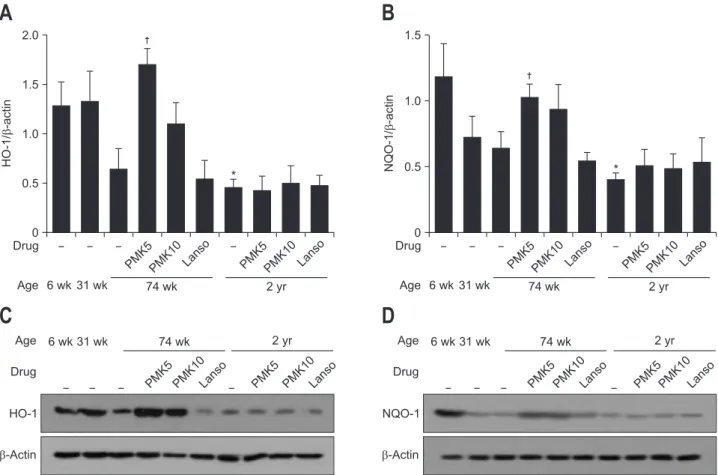
One hallmark of the aging process is oxidative stress due to increased prooxidant production and decreased antioxidative capacity. To determine whether the continuous administration of PMK-S005 could affect in oxidative stress status in gastric mucosa, we examined the protein level of antioxidant enzymes Fig. 2. Connective tissue area in the laminar propria. (A) Histological changes in the gastric mucosa demonstrated by hematoxylin and eo- sin staining (magnification, ×200). The arrows indicate the thickness of the connective tissue. (B) The connective tissue area was measured using a computerized video analysis system (Image-Pro Plus 7.0; Me- dia Cybernetic). The results are expressed as the means±SEM of seven animals per group.
PMK5, 5 mg/kg of PMK-S005; PMK10, 10 mg/kg of PMK-S005; Lan- so, 5 mg/kg of Lansoprazole; LP, lamina propria. *p<0.05 compared with the 6-week-old controls;
†p<0.05 compared with the 31-week- old controls;
‡p<0.05 compared with the 74-week-old controls;
§