다환방향족탄화수소류의 음식물을 통한 섭취량과 혈중농도
문찬석†
부산가톨릭대학교 산업보건학과
Dietary Intake and Venous Blood Concentration of Polycyclic Aromatic Hydrocarbons in Low-level Exposure
Chan-Seok Moon†
Department of Industrial Health, Catholic University of Pusan
ABSTRACT
Objectives: This study aims to evaluate the blood concentrations and dietary intake for 24-hour food duplicate of low level polycyclic aromatic hydrocarbons (PAHs).
Design: The geometric means of the blood concentrations and dietary intake of 16 PAHs in college student candidates were simply compared with instrumental detection.
Methods: The concentrations of 16 PAHs in venous blood and 24-hour food duplicates were analyzed with head-space solid phase microextraction (HS-SPME) of gas chromatography-mass spectrometry.
Results: Naphthalene, acenaphthylene, pyrene, benz(a)anthracene, chrysene, and acenaphthene among the 16 analyzed PAHs were simultaneously detected both in venous blood and 24-hour food duplicate samples.
Conclusion: The main exposure source of the six PAHs is thought to be oral intake from food through low level non-occupational exposure.
Keywords: non-occupational exposure, polycyclic aromatic hydrocarbons, blood, dietary intake, low level
I. 서 론
다환방향족화합물류 (PAHs)는 물에 대한 용해도 가 낮고 유기용매에 대한 용해도가 큰 물질로서 증 기압이 비교적 낮아 입자상 물질에 흡착되어 인체에 흡수된다. 생활 환경중 PAHs 노출은 단기간의 급성 노출보다는 저농도의 장기간의 지속적인 노출이다.
이러한 PAHs의 발생은 대부분의 경우 물질을 연소 시키는 과정에서 발생되고, 대도시의 경우에서는 소 각장의 소각로, 자동차 엔진의 배기가스, 또는 연소 공정이 필요한 공장을 들 수 있다. 직업적 노출의 대표적인 작업으로는 코크스로, 고로 등의 제철공업,
주물공업 및 알루미늄 제조, 아스팔트 도포 등이 있 고 이외에도 용접, 자동차정비, 화재진화 등이 있다.
PAHs는 직업적으로 노출되었을 때 암을 유발하는 물질로 알려져 있다. 표적 장기로는 주로 피부와 폐 조직에 암을 일으키는 것으로 보고되고 있고 그 외 에도 방광암, 후두암, 신장암 등의 발생증가에 대한 연구도 진행되고 있다. 단일 물질의 발암성 평가는 제한적이며 대부분 복합물질로 존재한다.1-6)
PAHs의 비직업적인 노출로서는, 크게 경구와 호흡 노출로 나눈다. 음식물 섭취를 통한 노출로는 가열 에 의해 굽거나 태워진 육류, 생선, 또는 잎이 넓은 야채류가 있으며, 일부의 한약이나 한약의 가열 조
†Corresponding author: Department of Industrial Health, Catholic University of Pusan, Tel: +82-51-510-0633, Fax:
+82-303-0941-0777, E-mail : [email protected]
Received: 10 May 2012, Revised: 12 July 2012, Accepted: 25 September 2012
제 시에 발생될 수 있다.7) 일반 성인에서 PAHs가 많이 함유된 음식의 섭취가 오염된 공기의 흡입을 통한 노출보다 실제 노출량에 기인하는 정도가 크다.8) 그리고 담배를 피우지 않는 일반 성인에게서 음식을 통한 PAHs의 노출은 총 PAHs의 90% 이상을 차지 하므로7) 비직업적인 노출로서 일반인의 PAHs를 평 가할 경우는 음식물 섭취에 의한 노출을 주로 고려 해야 한다.11)
현재까지의 연구는 인체 노출을 평가하기 위한 대 기 중 및 음식물 중의 노출농도에 관한 연구가 진 행되어 왔으며, 일반인의 PAHs 물질별 인체노출농 도 또는 인체 노출 경로에 관한 연구는 거의 없는 편이다. 본 연구에서는 20대 연구 참여자들의 음식 물을 통한 섭취량과 혈중농도의 수준을 도출하여 상 호 관련성을 파악하고자 한다.
II. 연구내용 및 방법 1. 연구참여자 및 연구디자인
본 연구는 2009년 4월에 실시하였으며, C교에 재 학하고 있는 22-26세의 건강한 학생 중 연구 참여 를 희망하는 남녀 25명 (남자 13명 여자 12명)을 대상으로 하였다. 이들 연구 참여자는 현재 한방약 섭취를 하고 있지 않고, 질병을 앓고 있지 않는 심 신이 건강한 자로서 연구 참여 동의를 받았다. 이 들은 PAHs의 비직업적인 인체 노출에 관한 지식이 있으며, 본인의 1일 복제 음식물의 수집, 운반, 섭 취 음식 항목별 중량 측정 및 연구과정중에 발생할 수 있는 PAHs 오염에 대한 충분한 사전교육을 받 은 후 연구에 임하였다. 음주력으로서 연구 참여자 모두 습관적인 음주를 하고 있지 않으며, 남자 참 여자의 경우는 전원이 흡연을 하고 있는 자들이다.
참여자는 조사 3일전부터 구운육류 및 생선류 및 한방약을 섭취하지 않았다. 참여자로부터 평소에 섭 취하고 있는 1일간의 섭취음식물과 동량 즉, 아침 에 기상하여 취침 시 까지의 모든 음식물의 동일양 을 24시간 음식물 복제시료(24-hour diet duplicate) 로 수집하였으며 음식물 수집 다음날 정맥혈을 채 혈하였다.9,10)이들 참여자의 음식물복제시료와 정맥 혈의 PAHs 농도를 산출하여 음식물을 통한 섭취량 과 이 섭취량을 통한 혈중농도간의 관련성을 검토 하였다.
2. 1일 음식물 및 정맥혈 시료의 수집 및 분석 수집한 음식물 시료는 PAHs 오염에 각별히 유의 하며, 음식물 혼합기 (homogenizer)를 이용하여 각 참여자의 1일간의 음용수를 포함한 음식물 모두를 혼합기로 혼화한 후 100 ml 용량의 밀폐용기 4개에 나누어 담아 냉동보관 (−18oC) 및 시료분석에 사용 하였다. 정맥혈은 헤파린이 들어 있는 진공튜브 (Vacutainer, Becton Dickinson, N.J., USA)를 사용하 여 채혈 후 분석에 사용하고 냉동보관 (−18oC)하였 다.11,28-30)
혼화된 음식물 (1 g)과 정맥혈 시료 (1 ml)는 headspace- solid phase microextraction (CTC CombiPAL 자동 시료주입기, 가스크로마토그래피용, Agilent Technologies, Inc., USA)법과 gas chromatography-mass spectrometry [HS-SPME/GC-MS (GCMS-QP2010, Shimadzu, Japan)]를 이용하여 분석하였다 (Aguinaga et al., 2007;
Campo et al., 2006). 헤드스페이스 바이알 (10 ml 용적)에 정맥혈 1 ml, 염화나트륨 100 mg K2CO3을 100 mg 넣고 내표준 용액으로서 phenanthrene-d10, pyrene-d10을 1 ppm 최종 농도가 되도록 하여 넣은 후 밀전하였다. 헤드스페이스 추출용 흡착 화이버는 65µm PDMS/DVB (Supelco)를 사용하였다. 흡착효 율을 증가시키기 위하여 흡착온도를 90oC에서 50 분 간 흡착하였다. 흡착한 화이버는 가스크로마토그래 피의 주입구에 삽입한 후 5분간 탈착하였으며, 주입 구 온도는 250oC로 하고 주입구 라이너는 내경 0.75 mm (Supelco, USA)를 사용하였으며 splitless 모드로 분석하였다. 가스크로마토그래피 분석에 사 용된 컬럼은 HP-5MS 캐필러리 GC 컬럼 (30 m, 내 경 0.25 µm, 필름두께 0.25 µm)을 사용하였으며, 캐 리어 가스는 초고순도 헬륨 (99.9999%)을 1 ml/min 의 유량으로 사용하였다. 컬럼온도는 40oC (2 분)에 서 분당 15oC씩 상승시키면서 최종 230oC까지 올리 고 2분간 온도를 고정하였으며, 다시 분당 10oC씩 최종 300oC까지 상승시킨 후 15분간 최종 온도를 고정하였다. 질량 분석계 (MS)는 transfer line 온도 를 280oC로 하고 이온 소스 온도는 200oC로 하였다.
검출기는 선택이온 모니터링 모드 (selected ion monitoring mode; SIM)로 하여 분석하였다.11,27)
3. 통계 분석
통계분석은 IBM SPSS 19.0 통계 프로그램을 사
용하여 16 PAHs의 각 물질별 혈중 농도와 음식물을 통한 섭취량을 기하평균과 기하표준편차로 나타내었 다. 물질별 기하평균치의 경우 불검출값은 그 물질 의 방법검출한계 (method detection limit; MDL)를 산출하고 이 값의 절반값을 적용하여 기하평균치와 기하표준편차를 산출하였다 (Table 1).
III. 결 과
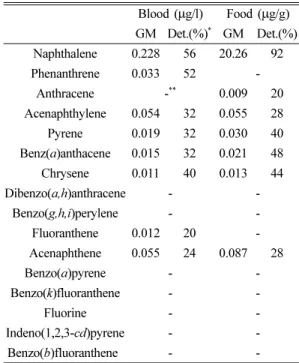
남녀 연구참여자 25인의 PAHs 혈중농도와 음식물 을 통한 섭취량을 Table 2에 나타내었다. 각 물질의 방법검출한계를 기준으로 하여 검출이 일어날 경우 기하평균을 나타내었다. 16종의 분석된 PAHs 중 6 종의 PAHs 즉, naphthalene, acenaphthylene, pyrene, benz(a)anthracene, chrysene, acenaphthene에서 혈중 농도와 음식물 모두 검출되었으며, 혈중농도와 음식 물을 통한 섭취량을 산출할 수 있었다. phenanthrene 과 fluoranthene의 경우는 혈액에서는 검출이 되었으 나 음식물 중에서는 연구참여자 25인 모두 검출되 지 않았다. anthracene은 음식물에서는 일부 검출이 일어났으며 혈액에서는 검출이 나타나지 않았다.
benzo(a)pyrene은 거의 모든 동물종에서 발암성을 나타
내는 물질이며 가장 관심도가 높은 물질중의 하나이 나, 본 연구결과에서는 혈액과 음식물 모두에서 검출 이 일어나지 않았다. IARC의 발암성 물질 분류기준상 의 A2 물질인 benzo(b)fluoranthene, benzo(k)fluoranthene 은 검출되지 않았다. 이외에 dibenzo(a, h)anthracene, benzo(g,h,i)perylene, fluorine, indeno(1,2,3-cd)pyrene 도 본 연구에서는 모두 불검출이었다. 각 물질별 혈 중 농도 및 음식물 섭취량의 기하평균은 각각 naphthalene이 0.228 µg/l, 20.26 µg/g, acenaphthylene 0.054µg/l, 0.055 µg/g, pyrene 0.019 µg/l, 0.030 µg/g, benzo(a)anthracene 0.015µg/l, 0.021 µg/g, chrysene 0.011µg/l, 0.013 µg/g, acenaphthene 0.055 µg/l, 0.087µg/g을 보였다.
6종의 검출된 물질을 중심으로 성별로 나누어 혈 중 및 음식물중 PAHs의 농도를 Table 3에 나타내었 다. naphthalene의 경우, 남자 참여자가 혈중 농도 0.302µg/l, 음식물을 통한 섭취량이 13.015 µg/g 이 었으며, 여자 참여자는 혈중 농도 0.169 µg/l, 음식물 을 통한 섭취량이 32.713 µg/g을 나타내었다. 나프탈 Table 1. Method detection limit (MDL) and half of
method detection limit in analyzed 16 PAHs of blood and diet duplicate samples (µg/l)
PAHs MDL 1/2 MDL
Naphthalene 0.134 0.067
Phenanthrene 0.013 0.006
Anthracene 0.010 0.005
Acenaphthylene 0.065 0.032
Pyrene 0.010 0.005
Benz(a)anthacene 0.019 0.009
Chrysene 0.011 0.005
Dibenzo(a,h)anthracene 0.539 0.269
Benzo(g,h,i)perylene 0.309 0.155
Fluoranthene 0.009 0.004
Acenaphthene 0.081 0.041
Benzo(a)pyrene 0.288 0.144
Benzo(k)fluoranthene 4.569 2.285
Fluorine 2.279 1.140
Indeno(1,2,3-cd)pyrene 2.803 1.401 Benzo(b)fluoranthene 0.063 0.031
Table 2. Instrumental detection (%) and geometric means of 16 PAHs in blood and diet duplicate samples (No.= 25)
Blood (µg/l) Food (µg/g) GM Det.(%)* GM Det.(%) Naphthalene 0.228 56 20.26 92
Phenanthrene 0.033 52 -
Anthracene -** 0.009 20
Acenaphthylene 0.054 32 0.055 28
Pyrene 0.019 32 0.030 40
Benz(a)anthacene 0.015 32 0.021 48
Chrysene 0.011 40 0.013 44
Dibenzo(a,h)anthracene - -
Benzo(g,h,i)perylene - -
Fluoranthene 0.012 20 -
Acenaphthene 0.055 24 0.087 28
Benzo(a)pyrene - -
Benzo(k)fluoranthene - -
Fluorine - -
Indeno(1,2,3-cd)pyrene - -
Benzo(b)fluoranthene - -
* instrumental detection (%)
** below the detection limit
렌 이외의 검출된 5종의 PAHs의 경우 혈중 농도가 0.007-0.073µg/l 수준의 농도이며, 음식물 섭취량의 경우는 0.009-0.134 µg/g 범위를 나타내었다.
IV. 고 찰
PAHs의 비직업적 노출로서 일반인의 경우는 음식 물을 통한 경구섭취이다. 일반 성인에게서 PAHs가 함유된 음식물의 섭취가 오염된 공기의 흡입을 통한 노출보다 실제 노출량에 기인하는 정도가 크며, 총 PAHs의 90% 이상을 차지한다.7,8) 본 연구에서는 20 대 참여자를 대상으로 하여 비직업적 노출에 의한 백그라운드 노출량을 음식물 섭취량과 혈중 농도를 중심으로 검토하였다. 혈중 농도의 경우는 6종의 PAHs에서 음식물과 동일하게 검출된 물질로서 naphthalene, acenaphthylene, pyrene, benz(a)anthracene, chrysene, acenaphthene의 6종이었다. 일반인의 혈중 농도에 관한 선행연구에서는 구운육류 및 생선류의 섭취 또는 간접흡연을 통하여 노출 가능한 PAHs 물 질들에 대한 검토를 하였다.11) 이 결과의 대조군과 본 연구결과를 비교하여 보았을 때, 본 연구결과상 의 6종의 PAHs 물질은 선행연구에서도 모두 검출 이 되었으나 naphthalene 이외의 5종의 물질들은 모 두 저농도로 검출되는 경향을 보였다. 문 등 (2010) 은 간접흡연을 통해 노출되는 물질로서 acenaphthylene, acenaphthene, fluorene pyrene을 추정하고 있고, 구 운 육류나 생선섭취에 의해서는 benzo(a)pyrene만이 특징적으로 섭취군에서 높게 나타남을 보고하였다.11) 본 연구결과와 비교하여 볼 때, acenaphthylene,
acenaphthene, pyrene의 3종의 물질은 본 연구의 결 과와 공동적으로 나타나고 있고, 본 연구에서는 연 구참여자가 구운 육류나 생선류의 섭취가 없었던 점 으로 미루어 benzo(a)pyrene의 생성이 한국인이 섭 취하고 있는 구운 육류와 생선류에서도 특징적으로 높게 나타나고 있음을 추정할 수 있었으며 이들 발 암성이 높은 물질로서 benzo(a)pyrene은 식품류의 조 리나 가공상의 발생원을 파악하기 위한 계속적인 연 구검토가 이루어져야 할 것이다.
음식물을 통한 노출원으로서, 발생 가능성이 높은 식품으로 원두커피와 유류를 들 수 있다. 원두커피 는 로스팅조건에 따라 benzo(b)fluoranthene과 benzo(a)pyrene의 검출이 특징적으로 나타나고 있고, dibenzo(a, h)anthracene은 미량 검출되고 있음을 보 고하고 있다.7,12)그리고 유류의 경우는 볶거나 튀기 는 조리과정에서 PAHs의 생성 가능성에 따른 경구 섭취를 보고하고 있다.13) 본 연구의 경우는 연구참 여자들에서 섭취가 나타나지 않았거나(원두커피) 거 의 나타나지 않은 식품류로서 본 연구결과와는 검출 패턴상의 차이를 나타내고 있었다. 본 연구의 대상 자들이 섭취한 24시간 음식물 중에 원두커피는 포 함되어 있지 않았으며 본 연구의 결과에서도 음식물 이나 혈중에서 상기의 원두커피 유래의 3종의 PAHs 물질은 검출되지 않았으나, 최근 원두커피를 액상추 출하여 판매하고 있는 판매점의 수가 점진적으로 증 가하고 있는 시점이며 젊은층에서 수요가 있으므로 PAHs 노출원으로서 원두커피는 추후 지속적으로 관 심을 가지고 검토되어야 할 것으로 생각된다.
일반인의 비직업적 노출에 있어 주요 노출원으로 Table 3. Geometric means of blood concentration and dietary intake of detected 6 PAHs between man and women
Man(13)a,b Women(12)a Total(25)a
blood Food blood Food blood Food
GM Max. GM Max. GM Max. GM Max. GM Max. GM Max.
Naphthalene 0.302 2.354 13.015 433.43 0.169 1.599 32.713 150.39 0.228 2.354 20.257 433.43 Acenaphthylene 0.042 0.146 0.045 0.504 0.073 0.509 0.069 0.875 0.054 0.509 0.055 0.875
Pyrene 0.026 1.469 0.010 0.646 0.014 1.261 0.102 2.275 0.019 1.469 0.030 2.275 Benzo(a)anthracene 0.010 0.039 0.014 0.027 0.024 0.803 0.031 0.059 0.015 0.803 0.021 0.059 Chrysene 0.007 0.035 0.009 0.020 0.019 0.734 0.019 0.043 0.011 0.734 0.013 0.043 Acenaphthene 0.042 0.138 0.058 0.291 0.072 3.264 0.134 1.225 0.055 3.264 0.087 1.225
aNumbers in parentheses are number of participants.
bsmokers
The units are µg/l in blood and µg/g in dietary intake, respectively.
서 흡연을 들 수 있다.14,15) 특히 20대 남자 대학생 의 경우 흡연을 하는 경우가 많으며,16) 본 연구에서 도 남자대상자 13명 전원이 하루에 10-20 개피의 담 배를 흡연하였다. 담배 1개피 당 평균 PAHs는 1~50 ng 이며 주요 구성분은 phenanthrene, naphthalene, benzo(a)pyrene, benzo(e)pyrene, fluoranthene, pyrene 이라고 보고되고 있으며,17) 20~40대 남성 흡연자 8 명에 대한 연구에서 하루 20개피의 담배를 피우면 담배 고형성분의 75%가 연소된다고 가정할 경우 benzo(a)pyrene 섭취량이 1일 150~750 ng 이라고 계 산하고 있다.18) 본 연구에서는 참여자의 수가 제한 적이므로, 흡연을 통한 남녀간의 차이에 관한 고찰 즉, 흡연자의 경우와 간접흡연 (environmental tobacco smoking)의 경우는 고려하지 않았다. 흡연의 입자상 에서 fluorene, phenanthrene, benzo(g,h,i)perylene이 검출되며, 증기상에서는 acenaphthene, acenaphthylene, fluorene, phenanthrene, fluoranthene과 pyrene이 검 출됨을 보고하고 있다.19) 본 연구결과에서 볼 때 혈 중 농도의 경우 음식물에서 검출되지 않으나 혈액에 서만 검출이 되는 물질로 phenanthrene과 fluoranthene 이 있었으며 이는 흡연에 의한 결과로 추정되었다.
흡연뿐만 아니라 음식물에서도 노출원을 가지고 있 는 물질은 acenaphthylene, pyrene, acenaphthene이 었다. Fluorine의 경우는 음식물에서 검출이 되지 않 았으며, 혈중에서도 검출이 되지 않았다. 결과적으로 혈액 중에 검출되는 PAHs의 경우 음식물 뿐 아니 라 흡연에도 높은 관련성을 가지고 있다고 생각된다.
흡연에서도 주요 노출물질로서 benzo(a)pyrene을 들 수 있으며,20) 일본의 비흡연 대학생들에서 pyrene, benzo(k)fluoranthene, and benzo(a)pyrene 농도 수준 이 일차적으로 음식물 섭취에서 비롯한다고 보고하고 있고, 스페인의 일반인에서도 benzo(a)pyrene은 음식 물이 노출원임을 보고하고 있다.21,22) 그리고 혈중 benzo(a)pyrene농도는 육류의 섭취나 육류조리방법에 밀접한 관련을 가지고 있음을 보고하고 있다.23-25) 본 연구결과에서는 음식물이나 혈액 모두 benzo(a)pyrene 이 나타나지 않았다. 이러한 결과는 현재의 시점에 서 20대 젊은층 또는 대학생들의 식습관에 따른 노 출원이 다른 연령층에 비해 특별한 경향을 가지는 지 에 관해서는 계속적인 연구가 필요하다.
식품과 관련하여 규격기준으로서 benzo(a)pyrene을 기준으로 하여 노출량을 제한하고 있다. 우리나라의
경우는 식약청 고시에 의하여 식용유지는 2.0 µg/kg 이하, 어패류는 2.0-10.0 µg/kg 이하, 훈제품은 5.0- 10.0µg/kg이하, 한약재의 경우는 5 µg/kg 이하이며, EU에서는 식품 중 1.0-10.0 µg/kg 건조중량으로 설 정하고 있고, 캐나다와 EU에서 먹는물 기준으로서 0.01µg/L, 미국에서는 해산물 중 0.035-0.143 mg/kg 으로 기준을 설정하고 있다. 국내 식약청 고시에 의 한 기준은 국외의 기준과 거의 동일하였다.26)본 연구 결과의 경우는 benzo(a)pyrene은 검출되지 않았으며, 16종 PAHs 물질중 독성등가치가 0.1인 benz(a)anthracene 의 경우도 국내외 기준에는 미치지 못하였다. 다만 본 연구가 비직업적 노출이며 식품 조리과정상 PAHs 발생이 거의 나타나지 않은 경우이므로 노출 물질별 노출경로에 관해서는 지속적인 연구가 필요하다.
V. 결 론
16종의 PAHs를 혈액과 24시간복제음식물에서 헤 드스페이스 미량고체추출법과 GC/MS를 이용하여 정량분석하였다. 음식물 섭취량과 혈중농도에서는 6 종의 PAHs (naphthalene, acenaphthylene, pyrene, benz(a)anthracene, chrysene, acenaphthene)가 동시에 검출되었으며 20대 참여자들의 비직업적 노출로서 PAHs의 음식물을 통한 노출을 확인하였다.
감사의 글
본 논문은 2010학년도 부산가톨릭대학교 교내학술 연구비 지원에 의하여 수행된 것임.
참고문헌
1. Boffetta P, Jourenkova N, Custavsson P. Cancer risk from occupational and environmental exposure to polycyclic aromatic hydrocarbons. Cancer Causes
& Control. 1997; 444-472.
2. International Agency for Research on Cancer. Cer- tain polycyclic aromatic hydrocarbons and heterocy- clic compounds. In: IARC monographs on the evaluation of carcinogenic risks to humans Vol. 3 Lyon, France: International Agency for Research on Cancer; 1973. p.271.
3. International Agency for Research on Cancer. Poly- nuclear aromatic compounds, Part 2 Carbon Blacks,
mineral oils (lubricant base oils and derived prod- ucts) and some nitroarenes. In: IARC Monographs on the evaluation of carcinogenic risks to humans).
Lyon, France: International Agency for Research on Cancer; 1984. p.245.
4. International Agency for Research on Cancer. Poly- nuclear aromatic compounds, Part 3 Industrial expo- sures in aluminium production, coal gasification, coke production, and iron and steel foundin. In IARC Nonographs on the evaluation of carcino- genic risks to humans Lyon, France: International Agency for Research on Cancer; 1984. p.219.
5. International Agency for Research on Cancer. Poly- nuclear aromatic compounds, Part 4: Bitumens, coal-tars and derived products, shale-oils and soots.
In IARC monographs on the evaluation of carcino- genic risks to humans. Lyon, France: International Agency for Research on Cancer; 1985. p.271.
6. National Toxicology Program. 9th Report on carcin- ogens. Revised edition. U.S. Department of Health and Human Services, Public Health Service, Research Triangle Park, North Carolina: National Toxicology Program; 2001.
7. WHO. Guideline for drinking-water quality Vol. 1 Recommendation. Geneva; 1984. p.67.
8. Lioy PJ, Waldman JM, Greenberg AR. The total human environmental exposure study (THESS) to benzo(a)pyrene: Comparison of the inhalation and food pathways. Archives of Environmental Health.
1988; 43: 304-312.
9. Acheson KJ, Campbell IT, Edholm OG, Miller DS, Stock MJ. The measurement of food and energy intake in man-an evaluation of some techniques.
The American Journal of Clinical Nutrition. 1980;
33: 1147-1154.
10. Yamada Y, Hirata H, Fujimura K, Ohtsuji K, Tani Y, Shimbo S, Imai Y, Watanabe T, Moon C-S, Ikeda M. Disappearance of differences in nutri- tional intake across two local cultures in Japan: A comparison between Tokyo and Kyoto. The Tohoku Journal of Experimantal Medicine. 1996; 180: 1-15.
11. Moon C-S, Jo EM, Lee C-K, Kim JM, Hong YS, Son B-S, et al. Blood concentration of polycyclic aromatic hydrocarbons from non-occupational expo- sure in farming town near metropolitan Busan, Korea: Environmental tobacco smoke and roasted food intake as influential factors. Journal of Korean Society of Occupational and Environmental Hygiene.
2010; 20(2):.111-118.
12. Nam H, Seo I, Shin H-S. Influence of roasting con- ditions on polycyclic aromatic hydrocarbon con-
tents in ground coffee bean. Korean Journal of Food Science and Technology. 2009; 41(4): 362- 368.
13. Rose M, White S, Macarthur R, Petch RG, Holland J, Damant AP. Single-laboratory validation of a GC/
MS method for the determination of 27 polycyclic aromatic hydrocarbons(PAHs) in oils and fats. Food Additives and Contaminants. 2007; 24(6): 635-651.
14. Ding YS, Yan XJ, Jain RB, Lopp E, Tavakoli A, Polzin GM et al. Determination of 14 polycyclic aromatic hydrocarbons in mainstream smoke from U.S. brand and non-U.S. brand cigarettes. Environ- mental Science & Technology. 2006; 404: 1133-1138.
15. Hu Y, Zhou Z, Xue X, Li X, Fu J, Cohen B et al.
Sensitive biomarker of polycyclic aromatic hydro- carbons (PAHs): urinary 1-hydroxypyrene glucu- ronide in relation to smoking and low ambient levels of exposure. Biomarkers. 2006; 11: 306-318.
16. Moon C-S and Paik JM. Dietary intake and body burden of cadmium and lead among Korean col- lege students. Journal of Korean Society of Occu- pational and Environmental Hygiene. 2011; 21(1):
25-32.
17. Gimmer G, Naujack KW, Dettbarn G. Gas chro- matographic determination of polycyclic aromatic hydrocarbons, aza-arenens, aromatic amines in the particle and vapor phase of mainstream and side stream smoke of cigarettes. Toxicology Letters.
1987; 35: 117-124.
18. Scherer G, Conze C, VonMeyerinck L, Sorsa M, Adlkofer F. Importance of exposure to gaseous and particulate phase components of tobacco smoke in active and passive smokers. International Archives of Occupupational and Environmental Health.
1990; 62: 459-466.
19. Lu H and Zhu L. Pollution patterns of polycyclic aromatic hydrocarbons in tobacco smoke. Journal of Hazardous Materials. 2007; A139: 193-198.
20. Reinik M, Tame T, Roasto M, Junkam K, Tenno T, Kiis A. Polycyclic aromatic hydrocarbons (PAHs) in meat products and estimated PAH intake by chil- dren and the general population in Estonia. Food Additives and Contaminants. 2007; 24: 427-437.
21. Ibez R, Agudo A, Berenguer A, Jakszyn P, Tormo MJ, Sanchz MJ, et al. Dietary intake of polycyclic aromatic hydrocarbons in a Spanish population.
Journal of Food Protection. 2005; 68: 2190-2195.
22. Suzuki K, Yoshinaga J. Inhalation and dietary expo- sure to polycyclic aromatic hydrocarbons and uri- nary 1-hydroxypyrene in non-smoking university students. International Archives of Occupupational
and Environmental Health. 2007; 81: 115-121.
23. Sinha R, Peters U, Cross AJ, Kulldorff M, Weiss- feld JL, Pinsky PF et al. Meat, Meat cooking meth- ods and preservation, and risk for colorectal adenoma. Cancer Research. 2005; 65: 8034-8041.
24. Kazerouni N, Shnha R, Hsu C-H, Greenberg A, Rothman N. Analysis of 200 food items for benzo(a)pyrene and estimation of its intake in an epidemiologic study. Food Chemical Toxicology.
2001; 39: 423-436.
25. Phillips DH. Polycyclic aromatic hydrocarbons in the diet. Mutation research - Genetic toxicology and environmental mutagenesis. 1999; 443: 139-147.
26. Korean Food and Drug Administration. Benzo(a)pyrene Risk profile. In: A series of hazardous materials.
Korean Food and Drug Administration; 2010.
27. National Institute of Environmental Research. Anal-
ysis manual for environmental contaminants in bio- logical samples. (11-1480523-000089-01). Incheon, Korea: National Institute of Environmental Research;
2006. p.220-248.
28. Paik J-M, Moon C-S. Concentration of Fe, Cu, Zn in 24-hour Food Duplicate Samples: Quantitative Analysis by Inductively Coupled Plasma - Atomic Emission Spectrometry Journal of Environmental Health Sciences; 2007. 33: 397-402.
29. Moon C-S. Evaluation of Cd and Pb intake and exposure routes in some Korean women. Journal of Environmental Health Sciences; 2007. 33: 353-358.
30. Moon C-S, Paik J-M. Estimation of PCDDs/PCDFs intake for Korean children and their mothers through daily foods. Journal of Environmental Health Sciences; 2007. 33: 11-15.