ORIGINAL ARTICLE
Analysis of Time Variations in Relative Humidity around a Water Area Using Bowen Ratio
Ki-Young Kim1), Kyu-Rang Kim2), Hae-Dong Kim1)*
1)Department of Global Environment, Keimyung University 704-701, Korea
2)Applied Meteorology Research Division, National Institute of Meteorological Research, KMA
Abstract
The time variations in relative humidity observed at the Gangjeong (Goryeong) Reservoir in the Nakdong River over a one-year period (September 2012–August 2013) were analyzed with the Bowen ratio. The thermal vertical scale of the reservoir was also evaluated following Yamamoto’s method. The study’s results showed that the relative humidity at the reservoir was higher than that of the Daegu Meteorological Observatory (inland) all year round. The difference was slightly larger at nighttime (17–20 %) than at daytime (13–15 %) in all seasons except summer. The quantitative order of latent heat flux was summer, spring, autumn, and winter. This finding signifies that the thermal vertical scale of the reservoir corresponds to that of a shallow lake. The Bowen ratio was smallest at midday of the summer season. In other words, the net radiation energy was converted more as latent heat flux than sensible heat flux during a higher temperature period.
Key words : relative humidity, Bowen ratio, sensible heat, latent heat, thermal vertical scale
1)1. Introduction
The major task of climate research on a local level is to examine the trends of changes in temperature and relative humidity and to clarify their causes (Kawamura and Ono, 1993). Among them, the increase or decrease in relative humidity is influenced not only by the temperature rise or drop, but also by the elevation or decline in the amount of evaporation from the earth’s surface. Temperature changes near the earth’s surface are largely brought about by changes in thermal exchanges (heat balance) between the earth’s surface and the atmosphere, accompanied by changes in the conditions of the earth’s surface (Hujibe, 2012). For such reasons, in order to understand
climate change on a local level, it is important to comprehend the heat balance relationship between the ground and the atmosphere. The net amount of radiation on the earth’s surface is redistributed into heat transferred to the ground, sensible heat, and latent heat. In ordinary cases, during daytime when the amount of solar radiation is large, these three types of heat have positive values. As a result, both the ground and the atmosphere are heated and the ground moisture is evaporated (Nishizawa, 2005).
However, even when the net amount of radiation is the same on the earth’s surface, the temperature and relative humidity near the earth’s surface vary significantly, according to how much the net amount of radiation is distributed to sensible and latent heat.
Received 25 August, 2014; Revised 13 October, 2014;
Accepted 20 October 2014
*Corresponding author : Hae-Dong Kim, Department of Global Environment, Keimyung University, Daegu 704-701, Korea
Phone: +82-53-580-5930 E-mail: [email protected]
ⓒ The Korean Environmental Sciences Society. All rights reserved.
This is an Open-Access article distributed under the terms of the Creative Commons Attribution Non-Commercial License (http://
creativecommons.org/licenses/by-nc/3.0) which permits unrestricted non-commercial use, distribution, and reproduction in any medium, provided the original work is properly cited.
The amount of radiation distributed to sensible heat, which directly heats the earth’s surface and the atmosphere, is largely dependent on latent heat, in other words, how well evaporation occurs (Kondo, 2000). A measurement indicator uses the Bowen ratio, which is the ratio of sensible to latent heat flux. When the evaporation source is sufficient on the earth’s surface, the Bowen ratio decreases as the temperature rises. In other words, a higher net amount of radiation is distributed to latent heat than to sensible heat. This means that the higher the temperature is, the higher the rate of energy used for evaporation becomes. The phenomenon may be intuitively and easily perceived from the fact that the drying speed of the earth’s surface after becoming wet due to precipitation is much faster during the summer with a high temperature than during the winter with a low temperature (Hujibe, 2012).
Paving the earth’s surface triggers the rapid outflow of rain and the decrease in evapotranspiration by vegetation (Henry and Dirks, 1985). Paving city spaces and covering urban streams lead to the loss of evaporation function of the earth’s surface; decreased greens reduce the evapotranspiration amount, lessening the amount of vapors supplied to the atmosphere. Therefore, understanding changes in the Bowen ratio is a useful tool to evaluate the progress of urban drying in a certain region (Hujibe, 2012). However, because the Bowen ratio differs according to the temperature even under the same condition of the earth’s surface, the heat exchange between the atmosphere and the earth’s surface varies. Thus, examining changes in the Bowen ratio according to the temperature under diverse conditions of the earth’s surface has considerable value in the area of micro-meteorology (Kondo, 1999).
Meanwhile, research on changes in relative humidity on a local level has been actively conducted to evaluate the contribution level of each factor
triggering an urban heat island (Inoue et al., 2004;
Park et al., 2011; Takane et al., 2011; Kim et al., 2013). Generally, the factor with the highest level of contribution to an urban heat island is assessed to be the decrease in evaporation source accompanying the paving of the earth’s surface (Landsberg, 1981; Park et al., 2007, 2010; Kai, 2012). The most common method to appraise the effect of the decrease in evaporation amount in urban areas is to assess the trend of urban dryness. As more areas of the earth’s surface are paved, the evaporation amount decreases and the rate of net radiation amount distributed to sensible heat is heightened (the Bowen ratio increases), raising urban temperature. Consequently, the relative humidity of the urban atmosphere declines, which is called urban dryness. On the other hand, when waterside space is sufficient in a given area, a higher net amount of radiation is distributed to latent heat than to sensible heat as the temperature rises;
therefore, the evaporation amount in the air and relative humidity increase, together with the temperature (Kondo, 1999).
To verify these facts with onsite observation data, this study interpreted the characteristics of changes in the relative humidity of a waterside area by season and time slot with the meteorological data observed near a reservoir (the Gangjeong Reservoir in Goryeong, constructed as part of the four-river project), using the temperature dependence of the Bowen ratio.
Additionally, this study investigated the characteristics of seasonal changes in evaporation amounts in the reservoir, whose water depth increased as a result of the four-river project. Domestically, Lee (2002) had observed evaporation amounts in certain areas over a long period for the performance evaluation of a large vaporimeter that he developed on his own; however, to date, no research has investigated evaporation amount characteristics according to the depth of lake water. In Japan, Yamamoto et al. (1964, 1968, 1972) assessed differences in evaporation amounts by
season according to water depth, using lake areas with very slow water speeds. They defined thermal vertical size by investigating the characteristics of changes in monthly latent heat (evaporation amount) of Japanese lakes with varying depths. Their research results showed that shallow lakes whose average water depth was 5 m or shallower had much latent heat during the summer and little latent heat during the winter, with not much difference between the spring and the autumn. Deep lakes whose average depth was 40 m or deeper had much latent heat during the autumn and the winter and little latent heat during the spring and the summer. The latent heat amount of middle-depth lakes tended to be in the middle of those of deep and shallow lakes; in terms of season, the latent heat amount was large in the order of summer, autumn, spring, and winter. The latent heat amount during the autumn was twice as large as that during the spring. In this regard, this study investigated the monthly changes in evaporation amount (latent heat) in a place where the construction of a reservoir led to a deeper water level.
The research results were also analytically compared with those of Yamamoto et al. (1964, 1968, 1972).
This study’s findings will be useful in examining changes in the climate environment (temperature, humidity, and wind velocity) on a local level according to territorial development, as well as their causes (Kondo, 2000; Hujibe, 2002; Park and Kim, 2007).
2. Study Data and Methods
2.1. Study Data
Figure 1 shows the land uses around the Gangjeong Reservoir and the meteorological observation locations. In Figure 1, AWS (red ) refers to the sites of automatic meteorological observations concerning temperature, humidity, wind direction, and wind speed; AWS & Flux (black ) indicates
where the elements of the automatic meteorological observation equipment and the earth’s surface fluxes are simultaneously observed. Water Temp (red ) signifies the locations where water temperature observations are made. The water temperature used in this study was from the data on the NW1 point, while the temperature, water temperature, and wind speed were from the data on the N5 point, spanning a one-year period from September 1, 2012 to August 31, 2013. For comparison with the data on these points, the meteorological data observed in the old Daegu Meteorological Observatory (in Sinam-dong) was used.
2.2. Methods
The formulas for sensible heat (1) and latent heat (2) needed to calculate the Bowen ratio were derived using the bulk method (Kondo, 1999).
H = CpρCHU(Ts-T) (1) lE = lρβCEU(qs-q) (2) CE ≒ CH = 1.2×10⁻³ (3)
In formula (1), Cpρ is the heat capacity per unit volume of air (Cp and ρ are constant-pressure specific heat and density, respectively). In formula (2), β refers to the surface evaporation efficiency (also called wet degree), ranging from zero to 1; β is 1 at the water surface and snowdrift surface. In formula (3), CH and CE indicate bulk transport coefficients of sensible heat and latent heat, and the function is of wind speed and stability, but Kondo (1994) proposed formula (3) because of the weak dependence of CH
and CE on wind velocity and the small changes in rapid air stability by surface heating on the water surface. In this study as well, an approximate value was used to simplify the calculation process. In formula (1), Ts is the temperature of the earth’s surface; in formula (2), qs refers to the saturation-
Gangjeong Reservoir
Fig. 1. Land uses in Daegu and AWS locations around Gangjeong Reservoir in Nakdong River.
specific humidity, while T and q indicate the specific humidity of the temperature and the atmosphere, and q and qs are calculated using the same method introduced by Kim and colleagues (1993). Utilizing the characteristics of temporal changes in sensible heat, latent heat, and the Bowen ratio calculated in such a way, this study attempted to analyze the differences in temperature and relative humidity between the areas of the Gangjeong Reservoir and the old Daegu Meteorological Observatory. This study also evaluated the thermal vertical size of the Gangjeong Reservoir based on the characteristics of the changes in seasonal latent heat amount of the Gangjeong Reservoir, using the method presented by Yamamoto et al. (1964, 1968, 1972).
3. Results
3.1. Temporal Changes in Temperature and Relative Humidity
To examine the characteristics of annual temperature changes in waterside areas near the Gangjeong Reservoir, the monthly average temperatures for a one-year period (June 2012 May 2013) were
compared between the reservoir and the Daegu Meteorological Observatory (Figure 2). The annual average temperatures obtained during the data analysis period in the two sites showed a difference of 2.2 , with 12.5 in the reservoir and 14.7 in the observatory. Regarding their temperature differences by season, the temperature readings for the reservoir were lower by 1.7 , 1.4 , 1.9 , and 2.5 during the spring (March May), summer (June August), autumn (September November), and winter (December February), respectively, than those for the observatory, with the difference smallest during the summer and largest during the winter.
The effects of the existence of the Gangjeong Reservoir on temporal changes in temperature were examined; the seasonal changes in average temperature by each time slot for one day are illustrated in Figure 3. Concerning the temporal changes in average temperature during the spring, the temperature of the reservoir was lower by about 1.5 from sunrise (7:00 a.m.) to sunset (5:00 p.m.) and by about 1.7 during nighttime (6:00 p.m. 6:00 a.m.) than that of the Daegu Meteorological Observatory. During the summer, the temperature of
Fig. 2. Monthly mean air temperatures observed at Gangjeong Reservoir (N11) and Daegu Meteorological Observatory (DMA) for one year (June 2012 May 2013).
the reservoir was lower by about 1.4 during daytime (7:00 a.m. 5:00 p.m.) and by about 1.2 during nighttime than that of the observatory. During the autumn, the temperature of the reservoir was lower by about 1.5 during daytime and by about 2.1 during nighttime than that of the observatory.
During the winter, the temperature of the reservoir was lower by about 2.1 during daytime and by about 2.8 during nighttime than that of the observatory. The temperature differences between the two areas were larger during nighttime than during daytime; however, during the summer and the spring, such differences were much smaller, compared to those during the autumn and the winter. During all the seasons, the observatory reached the daily minimum temperature at 6:00 a.m. and the daily maximum temperature at 2:00 p.m. (winter) or 3:00 p.m. (spring, summer, and autumn). The temporal changes in temperature observed in the reservoir were late by one hour. This finding showed the temperature phase delay at sea by about one hour, relative to changes in temperature on land, verifying the effect of heat storage (thermal sponge) in the Gangjeong Reservoir.
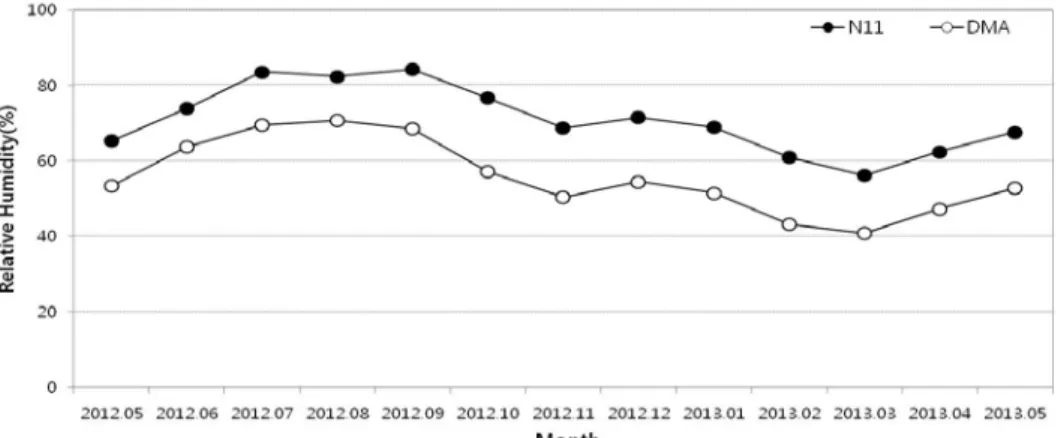
Figure 4 shows the monthly average relative humidity of the two locations; it was higher (mostly by over 15 %) in the Gangjeong Reservoir than in the
Daegu Meteorological Observatory. Comparing differences in seasonal average humidity, the relative humidity readings of the reservoir were higher by about 15.3 %, 12.0 %, 17.9 %, and 17.3 % during the spring, summer, autumn, and winter, respectively, than those for the observatory. The differences in monthly average humidity were smallest at about 7 % in June and large at about 20 % from October to March.
Figure 5 displays temporal changes in the seasonally averaged relative humidity of the two locations. The relative humidity of the Gangjeong Reservoir was very high at over 85 % from the night to early morning, suggesting a high possibility of mist formation. The relative humidity was higher in the Gangjeong Reservoir, a waterside area, than in the Daegu Meteorological Observatory in all time slots and seasons, but such differences were small during daytime and large during nighttime. The differences in relative humidity by each time slot were smaller during the summer than in other seasons, attributed to Korea’s wet summers and not because of the low evaporation effect in the reservoir. The difference in relative humidity between the two areas was about 12
% in all time slots, regardless of night or day during the summer. During other seasons, such differences were larger at about 13 15 % during daytime and
(a)
(b)
(c)
(d)
Fig. 3. Seasonal variations in temperatures through time at two positions, Gangjeong Reservoir (N11) and Daegu Meteorological Observatory (DMA), for one year (June 2012 May 2013); (a) spring, (b) summer, (c) autumn, and (d) winter.
Fig. 4. Same as Fig. 2 except for relative humidities.
about 17 20 % during nighttime. During the winter nights, the difference in relative humidity between the two locations was largest at over 20 %.
3.2. Temporal Changes in Sensible Heat, Latent Heat, and Bowen Ratio
The causes of the changes in relative humidity by time slot and season (subsection 3.1) were analyzed.
The water depth size was determined by using the technique of comparing the evaporation amounts by season in the Gangjeong Reservoir. Toward this end, sensible heat and latent heat by season in the reservoir were estimated using formulas (2) and (3) (Figures 6 and 7). The amount of sensible heat was large in the order of winter nights, spring and summer nights, and summer. The differences in the amounts between the autumn and the spring were small. During midday, the sensible heat amount was negative throughout the seasons (transmission from the air to underwater) and large in the order of winter, autumn, spring, and summer. The amount of negative sensible heat was largest at about 3:00 p.m. in all seasons except the summer.
The latent heat amount was positive in all time slots throughout all seasons and large in the order of summer, spring, autumn, and winter. The latent heat
amount was larger in the autumn than in the spring by approximately 30 % during daytime and about 100 % during nighttime. The latent heat amount was largest at about 90 W/m2 between 1:00 and 6:00 p.m.
in the summer. It was also the case for the springtime, but the amount was smaller than that for the summer by about 10 20 %. At night, the latent heat amounts during the spring and the summer were similar and much greater than those during the winter and the autumn. Nonetheless, the latent heat amount was much smaller during the night than during the day in all seasons.
In terms of the thermal vertical size using the characteristics of seasonal changes in latent heat in the Gangjeong Reservoir (based on the result of Yamamoto’s study), its thermal characteristics were close to those of a shallow lake.
The Bowen ratio was derived by calculating the ratio between the estimated sensible heat amount and latent heat amount (Figure 8). Because the latent heat amount was positive in all time slots of all seasons, the Bowen ratio was positive during the time slots when the sensible heat amount was positive;
conversely, the Bowen ratio was negative during the time slots when the sensible heat amount was negative. Although there were differences according
(a)
(b)
(c)
(d)
Fig. 5. Same as Fig. 3 except for relative humidities.
(a) Spring
(b) Summer
(c) Autumn
(d) Winter
Fig. 6. Seasonal variations in sensible heat fluxes (W/m2) through time at Gangjeong Reservoir (N11) for one year (June 2012 May 2013).
(a) Spring
(b) Summer
(c) Autumn
(d) Winter
Fig. 7. Same as Fig. 6 except for latent heat fluxes(W/m2).
(a) Spring
(b) Summer
(c) Autumn
(d) Winter
Fig. 8. Same as Fig. 6 except for Bowen Ratio.
to the seasons, the amount was largely negative from 9:00 to 10:00 a.m. and from 9:00 to 10:00 p.m. but positive in other time slots. The absolute value of the Bowen ratio was large in the order of winter, autumn, spring, and summer. In the summer, it was 0.1 to 0.5 in almost all time slots, with the ratio of latent heat much higher than that of sensible heat. In the winter, it was 1 to 3 at daytime and 4 to 9 at nighttime, with the ratio of sensible heat much higher than that of latent heat. The Bowen ratio was larger in the autumn than in the spring; however, at daytime, it was greater in the spring than in the autumn and at nighttime, it was larger in the autumn than in the spring. The differences in the Bowen ratio between the spring and the autumn (Figures 6 and 7) were largely due to the much smaller amount of latent heat during nighttime in the autumn than in the spring.
4. Conclusion
Using the meteorological and water temperature data observed from the Gangjeong Reservoir for one year (September 1, 2012 August 31, 2013), this study analyzed time variations in temperature and relative humidity between the waterside area near the reservoir and the old Daegu Meteorological Observatory, using Bowen ratios. Moreover, the thermal vertical size of the reservoir was evaluated.
The results are summarized as follows:
1) Temperature differences between the two areas were greater at nighttime than at daytime in all seasons except the summer and much smaller during the spring, compared to the autumn and the winter.
Throughout the seasons, the Daegu Meteorological Observatory reached the daily minimum temperature at 6:00 a.m. and the daily maximum temperature at 2:00 p.m. (winter) or 3:00 p.m. (spring, summer, and autumn). Temporal changes in temperature observed in the Gangjeong Reservoir were late by one hour due to the temperature phase delay at sea by about
one hour, relative to temperature changes on land, verifying the effect of heat storage (thermal sponge) in the reservoir.
2) Relative humidity was higher in the Gangjeong Reservoir than in the Daegu Meteorological Observatory in all time slots throughout all seasons, but the difference was small at daytime and large at nighttime. The difference in relative humidity (about 12 %) by each time slot was smaller in the summer than in the other seasons, and it is judged to be so due to Korea’s wet summers, not because of the low evaporation effect in the reservoir. In the other seasons, such differences were large at about 13 15
% during the day and at approximately 17 20%
during the night. Relative humidity was also high at over 85 % from dawn to early morning during the summer and autumn seasons.
3) The latent heat amount was large in the order of summer, spring, autumn, and winter. The latent heat amount was larger by about 30 % during the day and by about 100 % during the night in the autumn than in the spring. The latent heat amount was greatest between 1:00 and 6:00 p.m. in the spring but smaller by approximately 10 20 %, compared to the summer. The latent heat amounts were similar at 10 to 40 W/m2 between the summer and the spring at night but twice as large as those during the winter and the autumn at 5 to 10 W/m2. Judging the thermal vertical size in latent heat in the Gangjeong Reservoir from such facts, based on the results of a study by Yamamoto et al. (1964, 1968, 1972), the researchers found that its thermal characteristics were close to those of a shallow lake.
4) It was verified that the Bowen ratio of the Gangjeong Reservoir was very small in the summer during the day, in fact, in all time slots. This finding showed the thermal sponge effect, in which more heat was consumed due to latent heat when the temperature of the Gangjeong Reservoir was high.
This study intended to examine the changes in heat
balance, focusing on the changes in sensible heat and latent heat according to the construction of the Gangjeong Reservoir, as well as to evaluate its effect on the local meteorological environment. Nevertheless, there were some limitations in drawing conclusions:
the lack of observation data prior to the construction of the reservoir and the short period of onsite observation. Therefore, in the future, the researchers intend to recover the pre-construction observation data by using satellite data, as well as to study local meteorological conditions before and after the reservoir was built. Moreover, because very high relative humidity of over 85 % was identified from dawn to early morning in the summer and autumn seasons, as described in (2), the researchers will investigate the actual condition of mist formation and its mechanism.
Acknowledgment
This research was conducted as part of the "Advanced Research on Applied Meteorology" hosted by the National Institute of Meteorogical Research.
References
Henry, J. A., Dirks, S. E., 1985, Urban and Rural Humidity Distributions; Relationships to Surface Materials and Land Use, Journal of Climatology, 5, 53 63.
Hujibe, F., 2002, Long-term Humidity Changes on Hot Days in the Central Part of Tokyo, Tenki, 49, 473 476.
Hujibe, H., 2012, Urban Climate Variation and Abnormal Meteorology, Asakura Press.
Kai, K., 2012, Two Kinds of Warming, Seizando Press.
Kawamura, T., Ono, H., 1993, The Urban Dryness in Japan, Study Group for Climate Impact and Application Newsletter, 9, 39 42.
Kim, K. Y., Byun, J. Y., Kim, H. D., 2013, Heat Island Intensity in Seongseo, Daegu, South Korea a Rural Suburb Containing Large Areas of Water, Journal of Environmental Science International, 22, 1337 1344.
Kondo, J., 1994, Hydro-meteorology, Asakura Press. 161 pp.
Kondo, J., 2000, Surface Boundary Layer Meteorology, Tokyo University Press, 336 pp.
Lee, B., 2002, Daily Variation of Evaporation Observed by a Large-sized Vaporimeter, Journal of Environmental Sciences, 12, 196 199.
Lee, J. J., Lee, B. Y., Lee, H. S., Kim, Y. K., 2013, Automatic Observation of Evaporation at a Dam, Proceedings of the Korean Environmental Sciences Society, 22, 63 65.
Nishizawa, T., 2005, Field Research Method of Climate, Kokon Press, 122 pp.
Park, M. H., Kim, H. D., 2007, A Study on the Characteristics of Urban Dryness in Daegu, Journal of Environmental Sciences, 16, 171 178.
Yamamoto, G., Chein, T., Yasuda, N., Kondo, J., 1972, Evaporation from Deep Lakes in Japan, Journal of Meteorological Society of Japan, 50, 423 430.
Yamamoto, G., Kondo, J., 1964, Evaporation from Lake Towada, Journal of Meteorological Society of Japan, 42, 85 96.
Yamamoto, G., Kondo, J., 1968, Evaporation from Lake Nojiri, Journal of Meteorological Society of Japan, 46, 166 177.