- 1 -
Impact Assessment on the Forest Systems of the Korean Peninsula due to the Global Warming
Jung, Hui-cheul
1)․Jeon, Seong-woo
1)and Lee, Dong-kun
2)1)
Korea Environment Institute,
2)Sangmyung University
지구온난화로 인한 한반도 삼림의 영향 평가
정휘철
1)․전성우
1)․이동근
2)1)
Korea Environment Institute․
2)상명대학교 환경조경전공
ABSTRACT
우리나라의 기후변화연구에서 삼림생태계의 영향과 적응은 가장 중요한 관심사중 하나이 다. 지리적 위치와 통일문제 등을 고려할 때, 한반도는 역동적인 개발이 이루어질 지역이며 인구와 경제적 상황의 변화로 삼림 생태계에 급격한 변화가 예상된다. 기후변화의 영향은 이 러한 상황을 더욱 복잡하게 만들게 될 것이다. 본 연구에서는 이런 영향을 평가하기 위해, IS92a 시나리오의 GCMs(General Circulation Models)결과들을 이용하여 가능한 기온 증가 범위 내에서 삼림생태계의 변화를 예측하였다. 변화를 추정하기 위해 AIM/Impact[Korea](the Asian-Pacific Integrated Model) 모형을 이용하여 시기별 Holdridge 생물기후대를 예측하고 목 본식물의 이동속도를 고려한 지역삼림의 영향 및 적응 패턴을 분석하여 생태계 변화로 인한 경제적 가치 손실액을 추정하였다. 분석 결과는 다음과 같이 요약된다.
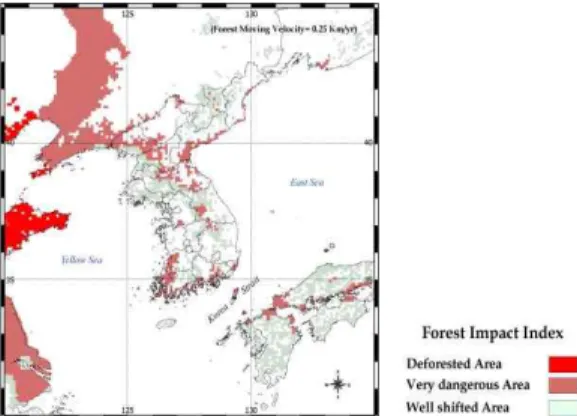
1) 목본식물의 추정 평균이동속도 0.25km/년의 경우, 한반도에서 삼림소실지역은 발생하지 않는 것으로 예측되었다. 그러나 인위적 개입이 없는 경우 고사의 위험이 높은 지역은 남한 의 경우 남한 총면적의 14%를 차지하였고, 북한은 18%정도의 면적이 고사 위험이 있는 것으 로 나타났다. 남한 고사위험지역의 80%는 난온대림 지역으로 주로 남해일원과 전라도 서해 안에서 발생하며, 북한은 고사위험지역의 대부분이 냉온대림지역으로 주로 평안도 내륙지역 과 중국 접경지경, 함경남도의 영흥만 북부에서 나타났다.
2) 목본식물의 이동속도 변화에 따라 남한은 매년 0~976백만불, 북한은 0~2,492백만불 범위
의 경제적 가치손실이 발생하는 것으로 예측되었다. 또한 목본식물의 추정 평균이동속도가
0.25km/년일 경우, 한반도 전체의 가치손실액은 매년 3,471백만불에 달했으며, 남한의 경우
목본식물의 이동속도가 0.5km/년 이상인 경우 삼림의 경제적 가치 손실은 발생하지 않았다
Key Words:AIM-model, global warming, GCM, forest vegetation impact, economic value
Ⅰ. INTRODUCTION
1. Background and Objectives
The natural forest system is a treasure house of global genes and bio-diversity. The impact study on forest carries a crucial importance due to the fact that forest provides diverse resources as well as plays an important role in climate stabilization (Costanza et al ., 1997). For South Korea where about 70% of the land area is covered by forest, the impact on forest sector carries a special significance on climate change impact assessment. In order to conserve forest ecosystems and to reduce the adverse social and economic influences from forest change triggered by climate change, the impact of climate change on forest ecosystems needs to be analyzed accurately using a number of highly credi
ble scenarios (IPCC, 1996, 1998).
Recently, there have been many direct impact studies on forest ecosystem in continental and global scale(AIM, 1997; Harasawa, 2000). These large-scale studies revealed a wide range of uncertainties in the impact assessment even if the analysis is restricted to the direct impacts. Most national scale impact studies conducted in Korea have overlooked such uncertainties of prediction;
moreover, failed to incorporate physical input pa
rameters, such as General Circulation Model (GCM) results (Kim, 1993).
This study attempted to predict the future change of forest distribution on the Korean Peninsula due to climate change by employing AIM (Asian- Pacific Integrated Model) Impact Model with 5 GCM results under IPCC's (United Nations Intergovernmental Panel on Climate Change) IS92s scernario (doubled CO
2levels). The impact on the forest ecosystem was evaluated by tree moving velocity using a correlative climate-vegetation model (Holdridge Life Zone model). The estimation of the economic impact on forest sector due to climate change was also attempted.
The study was conducted in following steps:
1. Using five different GCMs (General Circula
tion Models) of IS92a scenario of IPCC (United Nations Intergovernmental Panel on Climate Change), the climate change pattern around the Korean Peninsula was predicted.
2. Forest ecosystems were classified by the climatic biological characteristics using the Holdridge model. The possible impact on the forest on the Korean Peninsula by climate change at year 2100 was predicted. Also, the developed model was compared and verified using classification results by the Warmth Index and the representative tree species of Current Vegetation Map by the Ministry of Environment.
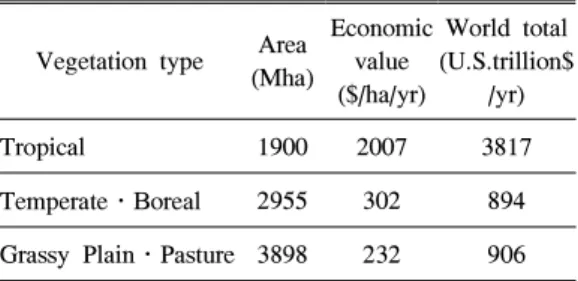
3. The economic value of forest ecosystem under changed climate was calculated with NCEAS (National Center for Ecological Analysis and Synthesis) method.
2. Impact Analysis Method
An impact assessment method taking forest movement into account is shown in Figure 1.
Bio-climate classification in 2100 was projected using GCM and AIM (Asian-Pacific Integrated Model) models. The size of affected area was calculated using GIS (Geographic Information System) (AIM, 1996, 1997). The adaptability of forest ecosystem was assessed based on the invasion possibility of an exotic plant and forest movement possibility (Munesue and Takahashi, 2000). Davis(2000) suggested that forest moving velocity is about 0~2 kilometers per year regardless of tree species along a movement route.
In this study, the average forest moving velocity was assumed to be 0.25km/year. Four different moving velocities of 0.25, 0.5, 1.0, and 2.0 km/
year were considered for the impact assessment in
this study. Finally, the economic value of forest
change was calculated using NCEAS (National
Center for Ecological Analysis and Synthesis) method.
Climate Change Scenario
Holdridge classification
Estimate econmic value change
Forest moving Velocity Forest impact assessment
GIS system 1. visualization 2. Estimation of area
GCM-runs
AIM-model
Davis(1989)
Assessment model development
NCEAS model