한국 성인의 3차 흡연으로 인한 아이의 건강 유해성 인식과 관련 요인
김정훈*
,** · 윤진하*** · 김지현*** · 이완형*** · 김영광*** · 이승현**** · 김규상*
†*서울의료원 의학연구소 환경건강연구실, **서울대학교 보건대학원 환경보건학과,
***연세대학교 보건대학원, ****일본 산업의과대학 내과
Factors Associated with Beliefs among Adults in Korea about the Health Effects of Thirdhand Smoke on Children
Jeonghoon Kim*
,**, Jin-Ha Yoon***, Jihyun Kim***, Wanhyung Lee***
,, Yeong-Kwang Kim***, Seunghyun Lee****, KyooSang Kim*
†*Department of Environmental Health Research, Seoul Medical Center, Seoul, Republic of Korea
**Department of Environmental Health Sciences, Graduate School of Public Health, Seoul National University, Seoul, Republic of Korea
***Graduate School of Public Health, Yonsei University College of Medicine, Seoul, Republic of Korea
****The Department of Internal Medicine, School of Medicine, University of Occupational and Environmental Health, Kitakyushu, Japan
ABSTRACTS
Objectives: Thirdhand smoke (THS) refers to residual tobacco smoke pollutants that remain after cigarette smoking. The purpose of this study was to determine predictors of the belief among adults in Korea that THS is harmful to children.
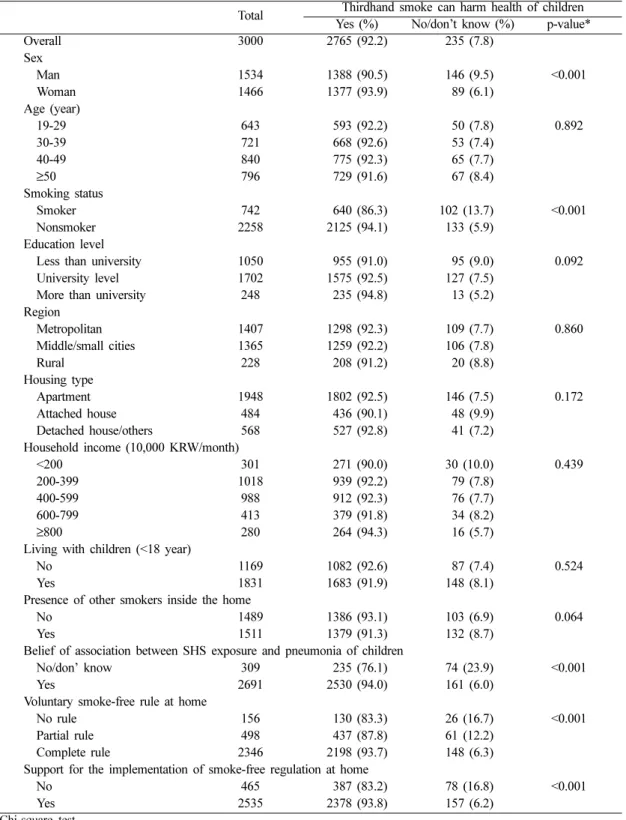
Methods: A population-based sample of 3,000 adults (≥19 years) among a web-based panel in Korea was obtained in November 2016. The respondents filled out questionnaires, including THS beliefs, smoking status, presence of voluntary smoke-free rules at home, and support for the implementation of smoke-free regulations at home. THS beliefs were assessed with a statement that staying in a room today where people smoked yesterday can harm the health of children.
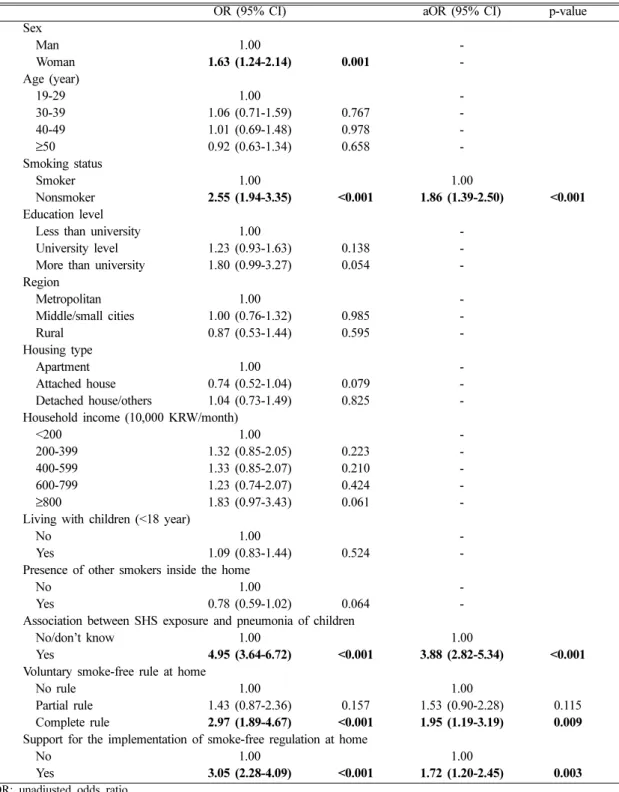
Results: Overall, 92.2 % of adults believed that THS exposure could harm the health of children. Respondents who were nonsmokers, believed that SHS exposure were associated with pneumonia of children, lived in home with complete smoke-free rule at home, and supported the implementation of smoke-free regulation at home were more likely to believe that THS could harm for health of children.
Conclusions: The majority of Korean adults believed that THS exposure could harm the health of children.
Predictors identified in the study can be useful to address the risk of THS beliefs and promote implementation of tobacco control policies.
Keywords: Thirdhand smoke, belief, smoke-free rule, smoke-free regulation, smoker
†