The Effect of Type of Largest Shareholder Change on Losses:
Focusing on Firm Risk
Hye-Ri Kim
Research Professor, Management Institute, Pusan National University
최대주주 변경의 유형이 적자보고에 미치는 영향:
기업위험을 중심으로
김혜리
부산대학교 경영연구원 연구교수
Abstract The purpose of this study is to empirically analyze the effect of information related to the largest shareholder's change on the likelihood of reporting a loss for firms listed on the Korea Exchange. Specifically, this study conducts a logit regression analysis to examine the firm's loss reporting with frequent changes in the largest shareholder among the largest shareholder change types.
So, it controls the impact of a firm's loss reporting, such as the previous year's loss reporting and discretionary accruals. As a result of the analysis, firms whose largest shareholder have changed more than 2 times in the accounting period are found to have higher firm risk in loss reporting than other firms. The results of this analysis confirm that frequent changes in the largest shareholder, which are disclosures of investment risks on the Korea Exchange, may result in investment risk situations such as loss reporting.
Key Words : Largest Shareholder, Firm Risk, Losses, Type of Largest Shareholder Change, Disclosure
요 약 본 연구의 목적은 한국거래소에 상장되어 있는 KOSPI기업과 KOSDAQ기업을 대상으로 최대주주의 변경과 관련된 정보가 적자보고에 미치는 영향을 실증분석하는 것이다. 구체적으로, 최대주주 변경 유형 중에서 최대주주의 잦은 변경이 나타난 기업의 적자보고를 살펴보기 위하여 기업의 적자보고에 미치는 영향을 통제하고 로짓 회귀분석의 방법을 적용하여 실증분석한다. 분석결과, 회계기간 내 2회 이상 최대주주가 변경된 기업은 적자보고의 기업위험이 다른 기업 보다 더 높은 것으로 나타났다. 이는 한국거래소의 투자위험 공시사항인 최대주주의 잦은 변동이 적자보고와 같은 투자위험 상황으로 나타날 수 있음을 나타낸다. 본 연구는 상장기업을 대상으로 최대주주 변경과 관련한 변동이 시장위험에 영향을 미친다는 증거를 제시하여 한국거래소 전자공시(KIND) 투자유의사항의 정보적 역할을 확인하였다 는 점에서 선행연구에 추가적인 공헌점을 가진다.
주제어 : 최대주주, 기업위험, 적자보고, 최대주주 변경의 유형, 공시
*This work was supported by the Ministry of Education of the Republic of Korea and the National Research Foundation of Korea (NRF-2017S1A5B5A01024400) - 이 논문은 2017년 대한민국 교육부와 한국연구재단의 지원을 받아 수행된 연구임 (NRF-2017S1A5B5A01024400)
*Corresponding Author : Hye-Ri Kim([email protected])
Received April 20, 2020 Revised May 7, 2020
Accepted June 20, 2020 Published June 28, 2020
1. Introduction
Despite the importance of separation of ownership and management required by modern corporations, Korea is a country with a governing form of the written law system. For this reason, many Korean managers have both ownership and control. Therefore, since the largest shareholder of Korean companies not only participate in management but also actually play the role of manager, information related to the largest shareholder is very important disclosure.
In 2016, the Financial Supervisory Service reported that if the largest shareholders of listed companies change frequently, the company's investment risk is high.
1)Market participants can identify changes in the stability and soundness of the invested firm by checking the voluntary disclosure of the firm or the status and change of the largest shareholder in the business report.
Therefore, for market participants, the information regarding the change of the largest shareholder is very useful for examining the situation of the company. Despite the fact that the largest shareholder's change is one of the most useful information for investors, firms have not properly reported the largest shareholder's change, and the market participants' damage is severe.
Penalties for unfaithful disclosure regarding changes in the largest shareholder are low and there are no obligations related to disclosure in cases where the largest shareholder is less than 5%. Therefore, it is difficult to identify the change situation when stocks are distributed to a variety of investors than those in the KOSDAQ market, such as the KOSPI market. Therefore, financial authorities encourage firms that make up the capital market to voluntarily disclose the
1) Financial Supervisory Service (2016.06.08.)「 The higher the risk of investment in listed companies and the largest shareholders, the higher the investment risk」
status and changes in the largest shareholder's interest in minority shareholders owned by minority investors other than shareholders.
However, because legal sanctions are not working properly, in order to effectively disclose the change in the largest shareholder, the academic community should provide empirical evidence that frequent change of the largest shareholder may adversely affect firm risk and financial soundness.
In line with such necessity, the purpose of this study is to examine whether frequent change of the largest shareholder affects the possibility of reporting losses. The frequent changes in the largest shareholder can affect the investment risks leading to the financial structure, resulting in a worsening of accounting profits. This study examines the possibility of reporting losses from the accounting perspective by approaching the risks of the largest shareholder change from a financial perspective. This study provides information useful for investor's rational decision making, in that the investor and external users use the disclosure information related to frequent change of the largest shareholder. Also, it is expected that this will contribute to the improvement of the disclosure structure of the capital market.
2. Prior research and Hypothesis setting
The theory of modern corporate roles and
functions derives from [1] separation of
ownership-management [2-4]. Based on this, a
number of previous studies related to the
interests between shareholders and managers
have been conducted, and there are typically
convergence-of-interest hypothesis and
entrenchment hypothesis [5]. The understanding
and hypothesis protection rights hypothesis
began with the separation of ownership and management. This can be seen not only in the interests of management and distributed minority shareholders, but also between the majority and minority shareholders who have easy access to information within the company [6-9]. This is due to the difference between common law and written law that governs governance and the law that protects minority shareholders [10]. Due to the nature of corporate governance in Korea, which represents the form of circular shareholding and mutual equity holdings among affiliates, the agent problem is more concentrated between the controlling and minority shareholders, including the largest shareholder, than between management and minority shareholders.
Depending on the interests of the largest and minority shareholders, the impact on firm value is different and the role of the largest shareholder is important as a corporate governance structure. Recently, a number of previous studies have shown that the change of the largest shareholder affects the management performance [11-13].
As the major public announcement of the Korea Exchange, the change in the largest shareholder is very important information regarding the stability and soundness of management. The change in the largest shareholder in normal business activities with respect to the ownership incentive effect can increase accounting transparency due to management's monitoring and control. [11]
reported that the change in the largest shareholder reduces the amount of discretionary accruals. However, frequent changes in the largest shareholder can adversely affect the company. [13] argued that firms whose largest shareholder changed more than 2 times during the accounting period do not operate stably due to frequent changes in management policies and business objectives, and adversely affect management performance and finance.
Accordingly, frequent changes of the largest shareholder as an indicator of stability in management can increase firm risk due to instability of internal management, change attempt in the share price of the largest shareholder, and impairment of accounting transparency due to the pursuit of private profits [14]. In addition, by changing managers, which may occur at the time of the largest shareholder change, CEOs can adjust profits such as Big Bath [15-18].
Firms with a low stake in the largest shareholder may be threatened by management rights, which may indicate a ‘frequent’change in the largest shareholder, which will likely lead to a loss, as it will lower management stability and accounting transparency.
2)Accordingly, this study establishes the following hypothesis 1 to provide empirical evidence that the frequent changes of the largest shareholder affects the possibility of loss reporting.
Hypothesis : Firms whose largest shareholder has changed more than 2 times in the accounting period are more likely to report losses than those who do not.
3. Research Design
3.1 Research model and variable definition This study empirically analyzes the hypothesis of the effect of the type of the largest shareholder change on loss reporting by reflecting previous studies on the possibility of loss reporting [19,20]. The research model for hypothesis is as follows.
2) [3] report that the largest shareholder with less
discrepancy between ownership and control has a
consensus effect and the largest shareholder with
control over excess ownership has the effect of
protecting the management right.
≤
Where,
= 1 if firm i reports negative income in year t, 0 otherwise.
= 1 if the number of largest shareholder changes is two or more in year t, 0 otherwise;
= the natural logarithm of total assets in year t;
= standard deviation of operating cash flow over the past five years;
= the ratio of market value to the book value of assets;
≤
= the ratio of total debts to total assets in year t.
= 1 if the external auditor is a Big4 accounting firm;
otherwise 0;
= growth rate of gross tangible asset, defined as PPE in year t minus PPE in t-1 and scaled by PPE in t-1.
= dummy variable in year t-1 loss report;
= discretionary accruals for year t (Modified Jones Model, Dechow et al. 1995)
= 1 for KOSPI firms, 0 for KOSDAQ firms;
= dummy variables by Industry;
= Dummy variable by year.
Equation is a model for hypothesis testing. The dependent variable in this study is the dummy variable (
) of the loss report.
is 1 if netincome is less than 0, or 0 otherwise. The main explanatory variables in Equation are dummy variable (
) that distinguishes the largest shareholder changes more than 2 times within the accounting period. Hypothesis of this study
predicts that firms with frequent major shareholder changes will have higher losses than those with no or one-time shareholder changes due to difficulties in stable management and deteriorating financial structure. Therefore,
coefficient expects a positive sign. This study confirms the change of the largest shareholder in the company's largest shareholder change report of the data analysis, retrieval and transfer system (DART). Using this,
is measured as dummy variables. The control variables of this study are set as follows according to the previous study [19-21]..
3.2 Sample and Data Selection
The sample for the study collected data considering the following requirements. The sample firms in this study are those listed on the Korea Exchange (KRX) at the end of each period.
The analysis period has been set since 2004, when the Company can obtain the 'largest shareholder change report' from the Data Analysis, Retrieval and Transfer System (DART).
3)In addition, financial sector firms were excluded because of difficulties in comparative analysis due to differences in the financial statements and settlement periods of general manufacturing firms. Most manufacturing firms settle the closing period as of December, so firms that are not closing in December are excluded for comparability with the entire sample. Financial data was obtained from the Korea Trade-In-Course Council's corporate information TS-2000, and data for measuring the market cap of the company was obtained using KIS-VALUE of NICE. The largest shareholder change report required for this study was found using DART's
3) The announcement of the change in the largest
shareholder began after 2004, when the Securities and
Exchange Law (current, Financial Investent Services
and Capital Markets Act) introduced sanctions on the
company's obligations to report unfaithfulness and
disclosure.
detailed search.
This study considered the effect of extreme value by adjusting the value of upper and lower 1% for each variable to upper and lower 1% for each continuous variable except dummy variable.
The final number of samples used in the empirical analysis for Hypothesis is 23,986.
4. Empirical Analysis Results
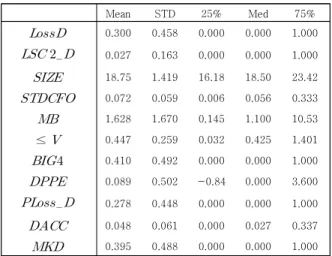
4.1 Descriptive Statistics and Correlation Table 1 shows the descriptive statistics for the main variables for the hypothesis 1 test. The average of the dependent variable loss report is 0.3008. This confirms that about 30% of all listed firms are reporting losses. Although not shown in the table, 22% of KOSPI firms and 35% of KOSDAQ firms reported losses. As a result of comparing the yearly report of losses, it was confirmed that the loss reporting was about 40%
in the 2008 financial crisis and reported about 30% per year. In addition, in the analysis of only the frims (N=2,369) that changed the largest shareholder, the average of was 0.6323. This shows that about 63% of firms that have changed their largest shareholders are reporting net loss.
Mean STD 25% Med 75%
0.300 0.458 0.000 0.000 1.000
0.027 0.163 0.000 0.000 1.000
18.75 1.419 16.18 18.50 23.42
0.072 0.059 0.006 0.056 0.333
1.628 1.670 0.145 1.100 10.53≤
0.447 0.259 0.032 0.425 1.401
0.410 0.492 0.000 0.000 1.000
0.089 0.502 -0.84 0.000 3.600
0.278 0.448 0.000 0.000 1.000
0.048 0.061 0.000 0.027 0.337
0.395 0.488 0.000 0.000 1.000Table 1. Descriptive Statistics
(1)
- 0.18***
(2)
0.18 -***
(3)
-0.27*** -0.15***(4)
0.18*** 0.11***(5)
0.08*** 0.07***(6)
≤
0.13*** 0.07***(7)
-0.15 -0.08*** ***
(8)
-0.15*** -0.03***(9)
0.48 0.18*** ***
(10)
0.11*** 0.04***(11)
-0.14*** -0.07****p<.0.1, **p<0.05, ***p<0.01
Table 2. Correlation matrix
Table 2 presents the correlation analysis results of the main variables used in this study.
The lower section shows the results of the Spearman correlation. The correlation coefficients of
and
), which are the main variables of interest in this study, were 0.1784, which were significant at p < 0.01. The spearman correlation coefficient between
and the control variable (
,
,
,
≤
,
,
,
,
,
) was –0.2728, 0.1755, 0.0769, 0.1298, -0.1495, -0.1494, 0.4813, 0.1065, -0.1430, which was significant at p < 0.01. Through this, the loss reporting firm's characteristics are as follows.
First, firm size, audit recognition rate, and tangible
asset growth rate are low. Second, operating cash
flow fluctuations, market overvaluation, debt ratio
and discretionary accruals are high. Third, the loss
reporting ratio is higher for KOSDAQ firms than
for KOSPI firms. When all correlation coefficients
among variables were included as explanatory
variables of the above-mentioned research model,
there were no variables that could concern
multicollinearity due to high correlation. In
addition, as a result of confirming variance inflation factors shown in the linear regression analysis before performing logistic regression, which will be described later, it is determined that all of the values are 3 or less, so that there is no problem of multicollinearity.
4.2 Empirical Analysis of Hypothesis The purpose of this study is to examine the effects of frequent changes in the largest shareholder and the largest shareholder change from individual to corporation.
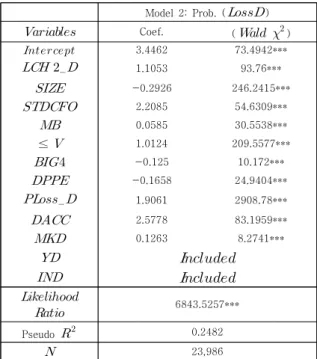
Table 3 shows the results of the empirical analysis of Hypothesis 1 that a firm whose largest shareholder has changed more than 2 times during the accounting period is more likely to report losses than other firms. The coefficient estimate (
) indicating the effect of
on
was 1.1053, which showed a positive result at p < 0.01. This analysis suggests that frequent changes in the largest shareholder increase firm risk, such as reporting losses, as discussed earlier in the hypothesis setting. These findings can help investors identify that a firm is likely to report a loss if the firm's largest shareholder is frequently changed, under controlled circumstances such as the reporting of last year's loss and incentives to earnings adjustments.
The results of the hypotheses of this study are summarized as follows. Frequent changes in the largest shareholder increase the risk of loss reporting because it can destabilize managerial rights and cause firms to face serious risks.
Therefore, users of the largest shareholder change disclosure information need to carefully examine the reasons for the change of the largest shareholder of the company whose largest shareholder has changed. It also implies that investors should be cautious about firms with frequent changes in the largest shareholder in the accounting period.
Model 2: Prob. (
)
Coef. (
)
3.4462 73.4942***
1.1053 93.76***
-0.2926 246.2415***
2.2085 54.6309***
0.0585 30.5538***≤
1.0124 209.5577***
-0.125 10.172***
-0.1658 24.9404***
1.9061 2908.78***
2.5778 83.1959***
0.1263 8.2741***
6843.5257***Pseudo
0.2482
23,986*p<.0.1, **p<0.05, ***p<0.01
Table 3. Hypothesis results
5. Summary and Conclusions
This study empirically analyzes the effect of the largest shareholder's change type on loss reporting, which is a proxy for firm risk, to provide market participants with useful information to consider investment risks and publicly disclosed firms listed on the Korea Exchange (KRX). It is expected that it can be used as the supporting data for the system revision.
As a result of the analysis, firms whose maximum shareholders have changed more than 2 times in the accounting period are found to have higher firm risk in loss reporting than other firms. The results of this analysis confirm that frequent changes in the largest shareholder, which are disclosures of investment risks on the Korea Exchange, may result in investment risk situations such as loss reporting.
This study has the following contribution. First,
the previous research on the change of the
largest shareholder has been focused on accrued
earnings adjustment and actual earnings
adjustment to confirm the quality of accounting profit. This study empirically analyzes the effect on loss reporting, which is a result of the frequent change of the largest shareholder.
Management's earning management, which appears to be due to the weakness of the governance structure due to frequent changes in the largest shareholder, has been enoughly studied in previous studies. Investors considering short-term investment may not realize that earning management is a risk factor for the firm's existence in the future if it is to increase operating profit and expand the company.
Therefore, this study can provide the basis for practical and direct judgment in the decision-making of investors who are users of market disclosure information by confirming that frequent changes of the largest shareholder increase loss reporting as firm risk.
REFERENCES
[1] A. A. Jr. Berle & G. C. Means. (1932). The modern corporation and private property. Macmillan, New York.
[2] T. D. Warfield, J. J. Wild, & K. L. Wild. (1995).
Managerial ownership, accounting choices, and informativeness of earnings, Journal of Accounting and Economics, 20(1), 61-91.
[3] S. Claessens, S. Djankov, & L. H. Lang. 2000. The separation of ownership and control in East Asian corporations. Journal of financial Economics, 58(1), 81-112.
[4] J. I. Park. (2003). Corporate Governance and Earnings Management: View from the Largest Shareholder`s Holding. Korean Accounting Review, 28(2), 135-172.
[5] Morck, R. A. Shleifer, & R. W. Vishny. (1988).
Management ownership and market valuation: An empirical analysis, Journal of Financial Economics 20 (Jan.-Mar.), 293-315.
[6] Shleifer, A. & R. W. Vishny. 1986. Large shareholders and corporate control. Journal of political economy, 94(3), 461-488.
[7] R. La Porta, F. Lopez-de-Silanes, A. Shleifer, & R.
Vishny. 2000. Investor Protection and Corporate Governance. Journal of Financial Economics, 58, 3-27.
[8] Bebchuk, L. A., R. Kraakman, & G. Triantis. (2000).
Stock pyramids, cross-ownership, and dual class equity: the mechanisms and agency costs of separating control from cash-flow rights. In Concentrated corporate ownership, University of Chicago Press: 295-318.
[9] Dahya, J., O. Dimitrov, & J. J. McConnell. 2008.
Dominant shareholders, corporate boards, and corporate value: A cross-country analysis. Journal of Financial Economics 87(1): 73-100.
[10] La Porta, R., Lopez-de-Silanes, A. Shleifer, & R.
Vishny. 1998. Law and Finance. Journal of Political Economy 106: 1113-1155.
[11] J. A. Kim. (2010). Majority Shareholder Turnover and Earnings Management on Corporations Listed at KOSDAQ. Accounting Information Review, 28(3), 131-161.
[12] Y. S. Kim & K. J. Hwang. (2015). The Effect of the Largest Shareholder and Auditor Change on the Remediation of Internal Control Review Opinion.
Korean Accounting Review, 40(1), 117-152.
[13] H. C. Son & S. K. Park. (2016). The Effect of Frequent Change of the Largest Shareholder and Embezzlement and Misappropriation on Earnings Management.
Korean Accounting Journal, 25(3), 485-522.
[14] H. R. Kim. (2018). The Effect of the Type of Largest Shareholder Change on Firm Risk. The Journal of Business Education, 32(1), 71-98.
[15] Elliott, J. A., and W. H. Shaw. (1988). Write-offs as accounting procedures to manage perceptions.
Journal of accounting research 26: 91-119.
[16] Pourciau, S. (1993). Earnings management and nonroutine executive changes. Journal of accounting and economics 16(1-3), 317-336.
[17] A. Y. Lee, S. B. Chun, & S. S. Park. (2007). CEO Turnover and Earnings Management. Korean Accounting Review, 32(2), 117-150.
[18] Y. M. Kwak & J. S. Choi. (2011). Earnings Management Associated with Types of CEO Turnover. Korean Accounting Review, 36(2), 129-184.
[19] Francis, J. R., & D. Wang. 2008. The joint effect of investor protection and Big 4 audits on earnings quality around the world. Contemporary accounting research 25(1), 157-191.
[20] Francis, J. R., P. N. Michas, & S. E. Seavey. (2013).
Does audit market concentration harm the quality of audited earnings? Evidence from audit markets in 42 countries. Contemporary Accounting Research 30(1):
325-355.
[21] J. H. Baek & J. S. Choi. (2017). The Effect of
Transaction to the Related-party on the Earnings
Management by Considering Controlling Shareholders
Ownership. Journal of Digital Convergence, 15(1),
209-216.
김 혜 리(Hye Ri Kim) [정회원]