Original Article
Database for Patient Information Management in Radiation Oncology Department
Sangwook Lim*, Kyubo Kim † , Sohyun Ahn ‡ , Sang Hoon Lee § , Rena Lee † , Samju Cho †
*Department of Radiation Oncology, Kosin University College of Medicine, Busan, † Department of Radiation Oncology, Ewha Womans University School of Medicine, ‡ Department of Radiation Oncology, Yonsei University College of Medicine, § Cheil General Hospital &
Women's Healthcare Center, Seoul, Korea
Received 30 January 2018 Revised 29 March 2018 Accepted 29 March 2018
Corresponding author Samju Cho
([email protected]) Tel: 82-2-2650-5335 Fax: 82-2-2654-0363
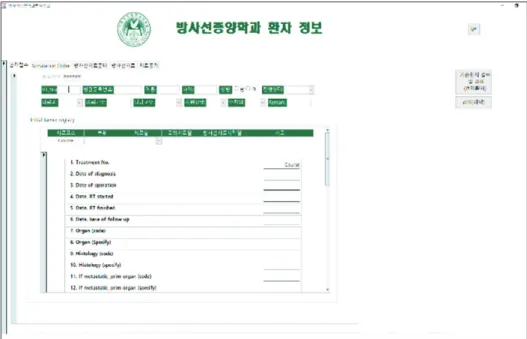
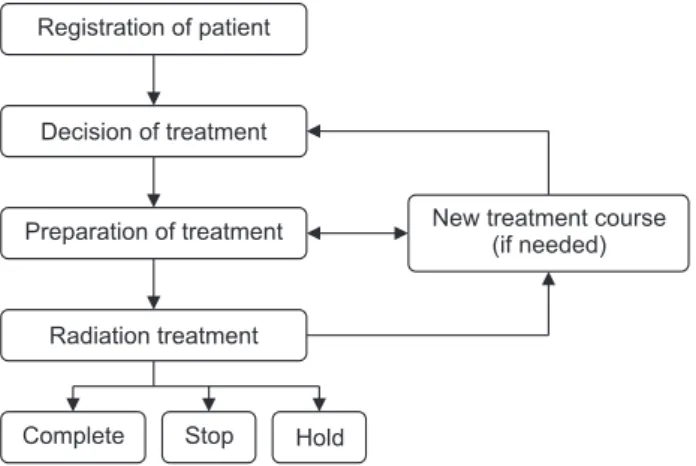
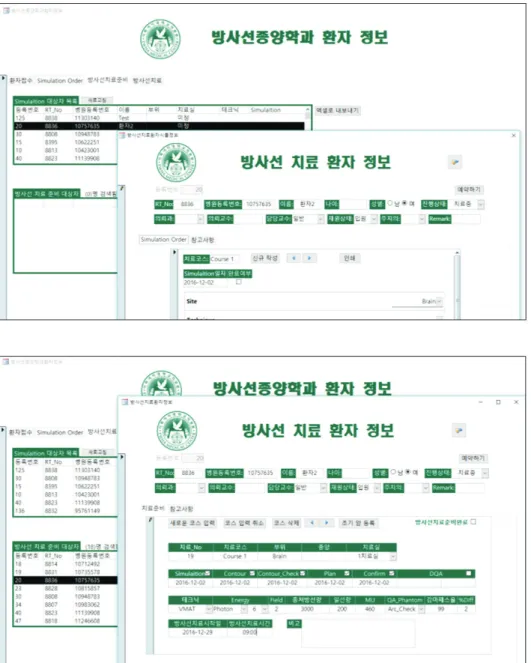
The purpose of this study is to build a database of patient information for efficient radiotherapy management. Microsoft Office Access was used to build the database owing to its convenience and compatibility. The most important aspect when building the patient database is to make the input and management of patient information efficient at every step of radiotherapy process. The information input starts from the patient ’s first visit to the radiation therapy department and ends upon completion of the radiotherapy. The forms for each step of radiotherapy process include the patient information form, the radiotherapy schedule form, the radiotherapy information form, the simulation order form, and the patient history form. Every form is centrically connected to the radiation oncology department ’s patient information form. A test revealed that the database was found to be efficient in managing patient information at each step. An important benefit of this database is improved efficiency in radiotherapy management. Information on patients who received radiotherapy is stored in a database. This means that this clinical data can be found easily and used in future, which will be helpful in research studies on the radiation oncology department. Benefits such as these will potentially contribute to improved radiotherapy quality.
Keywords: Database, Radiation therapy, Patient information
Copyright © 2018 Korean Society of Medical Physics
CC