Heterogeneous growth of the triploid Pacific oysters Crassostrea gigas created by chemical
inhibition of polar body release
Qtae Jo, Jong-Chul Han, Yong-Baek Hur, Soon Kyu Byun, and Tae-Seok Moon
Southeast Sea Fisheries Research Institute, NFRDI, Tongyeong, Kyeongnam 650-943, KoreaABSTRACT
Triploids have several potential advantages over diploids in aquaculture, drawing an elevated commercial reaction into the realistic application of the techniques despite we are still in the early stage of triploid industry for the Pacific oysters Crassostrea gigas. We traced the growth performance of the triploid C. gigas for over a year from hatchery spats, which was created by manipulations of chemicals (Cytochalasin B, CB or 6-Dimethylaminopurine, 6-DMAP). The growth was clearly marked by an initial longer dormancy and following a great magnitude of heterogeneity. The dormancy was almost 9 to 10-month long or even longer and was considered as a downside of the creation. The heterogeneity was magnified by appearance of extraordinarily growing oysters in part during summer season, which could be a representative upside of the triploids. Overall, however, the results were not as positive as were expected. The longer dormancy and following heterogeneity observed in our practice could be marked as an additional negative sign of the chemical use. The present study, thus, might be highly indicative in the introduction of biological cross between tetraploid and diploid to produce natural triploid embryos.
Key words: Heterogeneity, growth performance, chemical triploid, Crassostrea gigas
INTRODUCTION
Polyploidy referred to as a genetic state having extra sets of chromosomes beyond the normal 2, can be arisen from spontaneous somatic chromosome duplication or as a result of cytokinetic failure during meiosis. Although it is a lethal state for some higher animals, polyploidy has shown some promising results in the field of aquaculture, particularly for shellfish aquaculture (Allen and Downing, 1986; Dunham, 2004;
Kong et al., 2007; Rasmussen and Morrissey, 2007).
Triploid shellfish if they survive the cytokinetic manipulation, grow faster and larger than diploids, primarily because triploids are reproductively sterile in
theory. As such, they put all their energy into growth instead of reproduction. Sterile status of triploids also makes them marketable year round even during reproductive season for diploids.
The techniques for creating triploid oysters were first developed in the early 1980s for Crassostrea virginica using cytochalasin B as a cytokinetic inhibitor of meiotic division (Stanley et al., 1981).
Since then, shellfish polyploidy has been a research priority (Nell, 2002; Wang et al., 2003), creating numbers of triploid shellfish including C. gigas. The estimated benefits of triploids have been visualized over many shellfish, raising a great potential for aquaculture (Allen et al., 1986; Rasmussen and Morrissey, 2007). The beneficial aspects of the triploids might be bigger for C. gigas as the species are notable for their exceptional fecundity, accounting for up to 55% of the total dry tissue weight (Andrews, 1979;
Perdue, 1983).
In spite of the potential for use of triploidy in aquaculture, several downsides have been witnessed.
Received: December 5, 2014; Revised: December 20, 2014;
Accepted: December 24, 2014 Corresponding author : Qtae Jo
Tel: +82 (55) 640-4731 e-mail: [email protected] 1225-3480/24559
This is an Open Access article distributed under the terms of the Creative Commons Attribution Non-Commercial License with permits unrestricted non-commercial use, distribution, and reproducibility in any medium, provided the original work is properly cited.
[단보, Short communication]
Fail-safes of the sterility or stabilities of triploid state have been doubted. In other words, some of the induced triploids return back to diploids and exhibited reproductive behaviors (Allen and Downing, 1990; Guo, 1991; Wang and others 2003; Dunham 2004). More importantly, the triploids often show reduced performance for some traits and negatively affect survival rates, compared to their diploid counterparts (Dunham, 2004). A considerable part of the downsides might be attributed to chemical toxicity of the cytokinetic inhibitor such as cytochalasin B to gamete physiology (Guo et al., 1990).
For our growth performance study of strain-different C. gigas in the submerged cages, we were collecting 5 strains of seeds, two hatchery strains (a diploid and a triploid) and three habitat-different wild seeds strains.
In the process, two hatchery strains came and kept in oyster bags earlier the wild strains which were still growing on seed collectors at their own habitats. In our earlier management of the two hatchery strains, the triploids stayed dormant while the diploids were growing. Their dormancy made them excluded from our study as they lost size balance by the time of the experiment. But the triploids were kept under our regular management at our study station at sea. It was about 10 months when they first exhibited a growing sign.
In the present study, we report the unique growth performance of the triploid strain. The triploid growth was also compared with longline diploids.
MATERIALS AND METHODS
1. Study site
All the oysters tested are facilitated at Shellfish Experimental Station, Southeast Sea Fisheries Research Institute located mouth of Goseong Bay, Gyeongnam, Korea.
2. Oysters
In August, 2013, about 100,000 triploid C. gigas were delivered into our study station at sea from Namhae Hatchery of NFRDI, principally created by the method of Allen and Downing (1986) using CB
(cytochalasin B) or 6-DMAP (6-dimethylaminopurine) (See MOF, 2013 for detailed procedure). The control diploids were hardened wild oysters growing in the neighboring longline at our study station.
3. Oyster culture and measurement
On arrival, the triploids were contained in a commercial oyster bag (size, 45 × 90 × 10 cm; mesh, 5-13 mm; oyster density, about 3000 seeds/bag) which was suspended within 3 meters deep from longline of our study station. The oyster bags were cleaned on monthly basis, using water jets under about 100 bar pressure. Managements, otherwise mentioned, followed NFRDI Standard for Individual Oyster Culture. Shell height measurement (expressed as mean ± SD, n = 200) was monthly in our 3-replication experiment.
RESULTS AND DISCUSSION
Growth performance of the triploid C. gigas seeds was summarized in Fig. 1 and 2. It was clearly marked by an initial longer dormancy and following heterogeneity. The dormancy persisted for almost 10 months. A variety of abnormal growth performances for triploid shellfish have been reported (see Rasmussen and Morrissey, 2007). It is, however, striking to find the oysters stayed that longer Fig. 1. Size distribution of the test triploid oysters
Crassostrea gigas created by chemical exposure and then maintained in the hatchery for 3 months.
dormancy in normal waters. It is more striking to realize that some of oysters remained in the dormant phase while others entered into the growing phase.
Thus, it remains as a future research.
A representative abnormality of triploid shellfish is heterogeneous growth. Fig. 2 details the heterogeneity.
The range of the heterogeneity was wider than any other range observed so far. The oysters at the left edge of the unimodal growth exhibited very slow growth or dormancy, while oysters at the other side exhibited extraordinary growth. For example, oysters at left edge of the unimodal growth were still 2 cm in shell height, but the oysters at right edge were about 11 cm in shell height (see Fig. 2). The size extremes achieved after 5-month culture are highly indicative of further study for a successful introduction of triploid oysters in aquaculture.
Principally speaking, the advantage of triploidy comes from the induced “sterility” which allows for reproductive energy to be diverted toward somatic
growth, resulting in higher growth rates for triploids.
This advantage has been fully realized in the shellfish aquaculture industry. At the same time, controversies are emerging in the aquaculture businesses.
Representative controversies are appearance of results standing against the expected benefit. Some triploids are growing slower, at the same rate, or faster than diploids. These are much frequent in triploid fish (Dunham 2004). Shellfish, however, are not the exception (Philippe et al., 1996; Rasmussen and Morrissey, 2007). It has been marked as a downside of the triploid shellfish aquaculture.
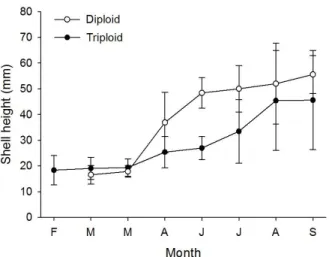
The triploid growth was further compared with diploid growth (Fig. 3). The control diploids used as a control were hardened late seeds from Tongyeong oyster seed beds. The late hardened seeds outgrew the sizes of the test triploids by the time of the experiment. Thus, we selected the oyster seeds which exhibited retarded growth on the clutches and then contained them in the same cages for a comparable Fig. 2. Monthly change of size distribution of the triploid Crassostrea gigas after 10-month dormancy in the oyster
bags suspended from oyster longline.
test. The growth comparison of the two oysters might not be reasonable as they had different growth stages.
The triploids were 3 months older than the diploids.
Fig. 3 verifies the heterogeneity of the triploid growth.
The great magnitude of the heterogeneity, which was visualized by the measurement of higher values of error bars for triploids, surprised us with “the growth performance after that longer dormancy”.
It is now widely accepted that triploid C. gigas can grow much better than diploid ones whether the triploids are created by chemical treatments or tetraploid breeding. It is also accepted that the created triploids exhibit heterogeneous growth as a negative side of the creation. As far as the negative side of the creation is attributed largely to long term chemical damage on the oysters (Philippe et al., 1996), our finding recommends using breeding methods for the creation of the triploids (Guo et al., 1996; Eudeline et al., 2000a,b).
ACKNOWLEDGEMENTS
This is a part of research results of NFRDI Research Project entitled “Aquaculture technology development for individual and triploid oysters in the suspended cages and longlines”.
REFERENCES
Allen Jr., S.K. and Downing S.L. (1986) Performance of triploid Pacific oysters, Crassostrea gigas (Thunberg).
I. Survival, growth, glycogen content, and sexual maturation in yearlings. Journal of Experimental Marine Biology and Ecology, 102: 197-208.
Andrews, J.D. (1979) Pelecypoda: Ostreidae. In: Giese, A.C., Pearse, J.S. (Eds.), Reproduction of marine invertebrates, Academic Press, New York, 293-341 pp.
Dunham, R.A. (2004) Aquaculture and fisheries biotechnology: genetic approaches. Cambridge, Mass.:
CABI Publishing. 372 pp.
Eudeline, B., Allen Jr., S.K. and Guo, X. (2000a) Optimization of tetraploid induction in Pacific oysters, Crassostrea gigas, using first polar body as a natural indicator. Aquaculture, 187: 73-84.
Eudeline, B., Allen Jr., S.K. and Guo, X. (2000b) Delayed meiosis and polar body release in eggs of triploid Pacific oysters, Crassostrea gigas, in relation to tetraploid production. Journal of Experimental Marine Biology and Ecology, 248: 151-161.
Guo, X. (1991) Studies on Tetraploid Induction in the Pacific Oyster, Crassostrea gigas (Thunberx). Ph.D.
Dissertation, University of Washington, Seattle, Washington. 167 pp.
Guo, X., DeBrosse, G.A., Allen Jr., S.K. (1996) All-triploid Pacific oysters (Crassostrea gigas Thunberg) produced by mating tetraploids and diploids. Aquaculture, 142: 149-161.
Guo, X., Hershberger, W.K. and Myers, J. (1990) Survival and growth of intrastrain and interstrain rainbow trout (Onchnrynchus mykiss) triploids.
Journal of World Aquaculture Society, 21: 250-256.
Kong, L., Wang, Z., Yu, R., Li, Q. and Wang, R. (2007) Seasonal variation of the glycogen enzyme activity in diploid and triploid Pacific oyster gonad during sexual maturation. Journal of Ocean University of China, 6: 383-386.
MOF (2013). Seed production technology for the individual culture of the Pacific oysters on the mud flats. NFRDI Publication TR-2012-AQ-043, Busan, Korea, 304pp.
Nell, A.N. (2002) Farming triploid oysters. Aquaculture, 210: 69-88.
Perdue, J.A. (1983) The relationship between the gametogenic cycle of the Pacific oyster, C. gigas, and the summer mortality phenomenon in strains of selectively bred oysters. Ph.D. Dissertation, University of Washington, Seatle, WA, 205 pp.
Philippe, G., Jean-Pierre, J., Andre G., Eric L.G., Jacques M., Jean-Marie, P., Serge, H, Pascal, P.
(1996) Performance of triploid Pacific oysters Crassostrea gigas (Thunberg) reared in high carrying capacity ecosystem : survival, growth and proximate biochemical composition. Haliotis, 25: 1-12.
Rasmussen, R.S. and Morrissey, M.T. (2007) Fig. 3. Growth profile of the test triploid Crassostrea gigas in
the submerged oyster bags. No. measured: 200 for triploids, 30 for diploids. Replication: 3 times. Error bar:
mean ± SD.
Biotechnology in Aquaculture: Transgenics and Polyploidy. Comprehensive Reviews in Food Science and Food Safety, 6: 1-16.
Stanley, J.G., Allen Jr., S.K., Hidu, H. (1981) Polyploidy induced in the American oyster Crassostrea virginica, with cytochalasin B. Aquaculture, 12: 1-10.
Wang, Z., Li ,Y., Yu, R., Gao, Q., Tian, C., Zheng, X.
and Wang, R. (2003) Growth comparison between triploid and diploid Pacific oyster during the reproductive season. American Fisheries Society Symposium, 38: 285-9.