1. INTRODUCTION
Abalone, a kind of edible sea snail, has been rec- ognized as one of the most highly-valued seafood, especially in Asian countries, which can be attrib- uted to its delicious taste and nutritional richness.
China is endowed with abundant seafood resources.
This paper aims to study the Haliotis discus dis- tributed in Bohai Sea [1,2]. The Haliotis discus species has contained protein, fat, vitamins, glyco-
gen, and many other trace elements, which has high nutritional value and is thereby widely used for healthcare [3]. The abalone aquaculture pro- duction has grown rapidly in China in recent years, which gives rise to the emergence of new products (such as ready-to-eat abalone) as consumer favorites. Characteristics, including texture, aroma, color, appearance, and size, are of great importance to evaluate the quality of ready-to-eat abalone un- der different heat treatments. The existing re-
Construction of Abalone Sensory Texture Evaluation System Based on BP Neural Network
Xiaochen Li†, Yuyang Zhao††, Renjie Li†††, Ning Zhang††††, Xueheng Tao†††††, Lee Eung-Joo††††††
ABSTRACT
The effects of different heat treatments on the sensory characteristics of abalones are studied in this study. In this paper, the sensory evaluation of abalone samples under different heat treatment conditions is carried out, and the evaluation results are analyzed. The three-dimensional (3D) scanning and reverse engineering are used in tooth modeling of the sensory evaluation of abalone samples under different heat treatment conditions. Besides, the chewing movement models are simplified into three modes, including the cutting mode, compressing mode and grinding mode, which are simulated using finite element simulation. The elastic modulus of the abalone samples is obtained through the compression testing using a texture analyzer to distinguish their material properties under different heat treatments and to obtain simulated mechanical parameters. Finally, taking the mechanical parameters of the finite element simulation of abalone chewing as input and sensory evaluation parameters as the output, BP neural network is established in which the sensory texture evaluation model of abalone samples is obtained.
Through verification, the neural network prediction model can meet the requirements of food texture evaluation, with an average error of 9.12%.
Key words: Abalone, Heat Treatment, Sensory Evaluation, Finite Element Simulation, BP Neural Network.
※ Corresponding Author : Lee Eung-Joo, Address: 428, Sinseon-ro, Nam-gu, Busan, Korea, TEL : +82-51-629- 1143, FAX : +82-, E-mail : [email protected]
Receipt date : May 29, 2019, Approval date : June 25, 2019
†††Dept of Mechanical Engineering, Dalian Polytechnic University, China (E-mail : [email protected])
†††Dept of Mechanical Engineering, Dalian Polytechnic University, China (E-mail : [email protected])
†††Dept of Mechanical Engineering, Dalian Polytechnic University, China (E-mail : [email protected])
††††††Dept of Information Communications Engineering, Tongmyong University, Korea
(E-mail : [email protected])
††††††Dept of Mechanical Engineering, Dalian Polytechnic University, China (E-mail : [email protected])
††††††Dept of Information Communications Engineering, Tongmyong University, Korea
※ The authors acknowledge the National Engineering Research Center of Seafood. This work is supported by Public Science and Technology Research Funds Projects of Ocean, China (no.201505029).
search on the quality evaluation of abalone meat mainly focused on the sensory evaluation, Texture profile analysis methods and the electronic sensing technology. Of them, sensory evaluation was a rel- atively accurate evaluation method, which could evoke measure, analyze and explain product ac- cording to responses through vision, olfaction, feeling, taste, and hearing. However, such a meth- od was time consuming, laborious and error-prone during the evaluation process. On the other hand, the Texture profile analysis method had been used to evaluate the physical or mechanical indicators of food using a texture analyzer, which could es- tablish the relationship between the test signal and the texture parameters to analyze the food texture.
This method was fairly objective; However, its re- sults were far removed from expectations as a re- sult of the different instrumental structures and human masticatory organs. With the recent rapid development of electronic technology, an increas- ing number of researchers had applied the elec- tronic sensing technologies, including electromy- ography and the piezoelectric-film sensor, in the texture analysis of food [4]. In the meantime, many kinds of bionic equipment had emerged (like the electronic tongue), which could simulate the human perception methods for testing [5]. However, these methods were expensive and complicated, which did not align with the requirements of the enter-
prise.
In this study, the effects of heat treatment con- ditions on the sensory characteristics of abalones are analyzed. Concretely, the mechanical properties of abalone are measured under different treatment conditions through the finite element simulation.
Furthermore, an evaluation model is established based on the back propagation (BP) artificial net- work to predict the sensory hardness, springiness, and smell using the mechanical properties obtained from the finite element simulation.
2. MATERIALS AND METHODS
2.1 Materials and Sample preparation
Fresh abalones (Haliotis discus hannai Ino), 70
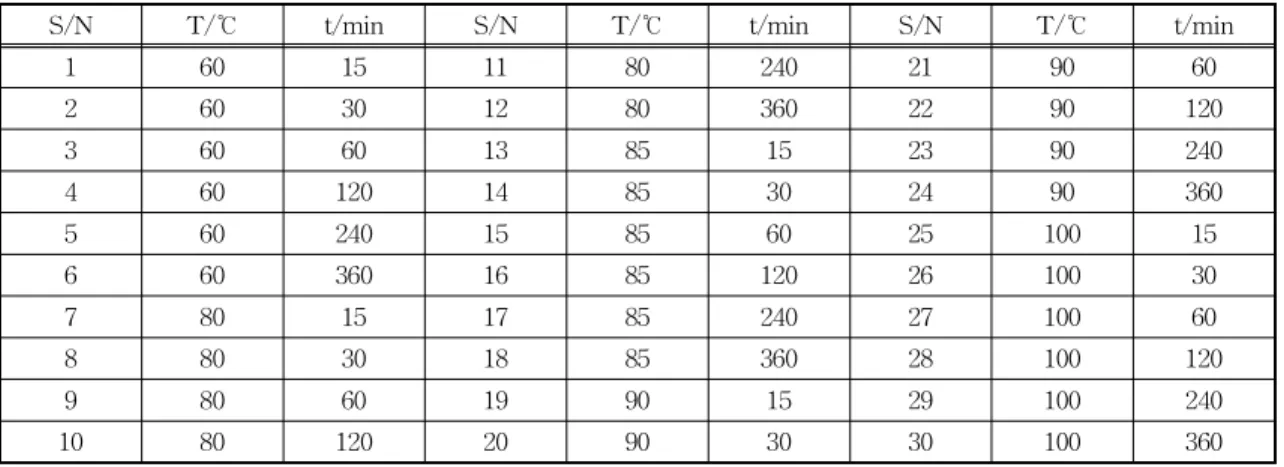
± 5 g (including shell) in weight and 8±1 cm in length, are purchased from the Dalian seafood market. The abalone meat is removed from the shell and the viscera is preserved in icy water prior to the experiments [6]. All processed abalone meat is divided into 30 groups, followed by thermal treatment using a thermostat at a power of 1500 W in a water bath (HH-4 Changzhou Rui Zhibo equipment manufacture Co. Ltd.) at 60, 80, 85, 90 and 100℃ for 15, 30, 60, 120, 240 and 360 min, re- spectively [7]. In addition, an experiment table con- taining 30 sets of experiments is shown in Table 1, while meat processing in the water bath is pre-
Table 1. Factors and levels table for experimental design.
S/N T/℃ t/min S/N T/℃ t/min S/N T/℃ t/min
1 60 15 11 80 240 21 90 60
2 60 30 12 80 360 22 90 120
3 60 60 13 85 15 23 90 240
4 60 120 14 85 30 24 90 360
5 60 240 15 85 60 25 100 15
6 60 360 16 85 120 26 100 30
7 80 15 17 85 240 27 100 60
8 80 30 18 85 360 28 100 120
9 80 60 19 90 15 29 100 240
10 80 120 20 90 30 30 100 360
sented in Fig. 1, and the processed abalone samples are displayed in Fig. 2.
2.2 Methods
2.2.1 Sensory Evaluation
The abalone meat used for sensory evaluation is cut into cubes at the dimension of 14×14×14 mm.
Typically, a sensory evaluation team including 6 men and 5 women with good distinctions and de- scriptive abilities, is established to carry out the sensory evaluation according to the double-blind method in the well-ventilated and partition booths under fluorescent light. Concretely, the hardness, springiness, and chewiness of the abalone meat are evaluated using a 5-point scale. The sensory eval-
uation index criteria are shown in Table 2.
2.2.2 Determination of Mechanical Properties The constitutive properties of food are generally quite complex, but most mechanical properties of food before breaking are close to the linear elas- ticity. On this account, the abalone samples are as- sumed to be materials with isotropy and linear elasticity. The Poisson's ratio of all processed samples is set at 0.4 and the density is set at 1.2 g/cm3. Obviously, the abalone samples under dif- ferent heat treatments have different material properties, which can be distinguished by the elas- tic modulus measure through the compression experiments. Specifically, the elastic modulus is measured according to the following method.
Firstly, the tested abalone samples are cut into cylinders about 12 mm (diameter) ×10 mm (height) in size. The upper sample surface is the stress sur- face, which is perpendicular to the muscle fiber.
Five duplicates are set for each sample. Secondly, a texture analyzer (FTC, Virginia, USA) fitted with a P/100 probe is used for compression experi- ments, as shown in the Fig. 3. Each sample under- goes compression experiment at a compression Fig. 1. The thermal processing of abalone meat.
Fig. 2. The processed abalone samples.
Table 2. Sensory index criteria of abalone meat
Sensory score 5 4 3 2 1
hardness Very good good Moderate Bad Very bad
springiness Moderate A little hard Hard A little soft Soft
chewiness Very good good Moderate Bad Very bad
Fig. 3. TPA texture experimental device.
level of 60% (relative to sample height), a test speed of 60 mm/min and the triggering stress of 0.1 N [8].
Finally, when the degree of compression is less than 30%, if the stress-strain curve can be used as a straight line fitting based on MATLAB, the elastic modulus of the sample can be easily calcu- lated according to Hooke's law.
The calculation formula is as follows:
∆ (1)
Where
is the elastic modulus;
represents the effective area;
stands for the stress;
∆ indicates the strain;
2.2.3 Reconstruction of the Tooth Surface Model The dental model of healthy adult men is taken as a sample. A set of reference points on the object surface are applied to assist in measuring the object. Moreover, the 3D data of the incremental reference point and density point clouds are ac- quired using the ATOS 3D optical scanner, as shown in Fig.4. The point cloud model is then en- capsulated into a polygon that is repaired and smoothed. Besides, the 3D solid model of the sam- ple is reconstructed using the scan to the 3D func- tion of Solidworks (Fig. 5).
2.2.4 The Simplified Chewing Movement Model Chewing movement is a complex phenomenon
involving the mandible, masticatory muscles, and temporomandibular joint (TMJ). In this study, the simplified chewing movement models are con- structed based on the modern occlusion theory and temporomandibular articulation movement theory, which are further divided into three movements, including cutting movement, compressing move- ment and grinding movement. The whole process of chewing and crushing food is then simulated [9,10].
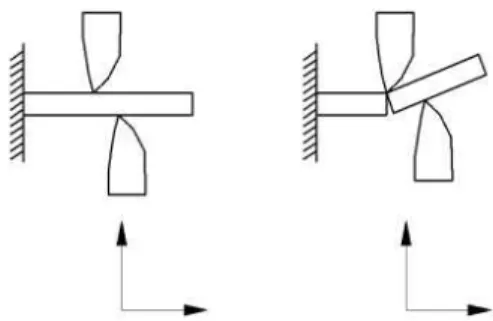
Cutting movement is the beginning stage of chewing movement, in which one end of food is fixed and the other one is restricted by the upper incisor. Food will be distorted due to the horizontal and vertical displacement of the lower incisor, as shown in Fig. 6.
Compressing movement can further break the food into smaller food particles through the molars.
In this process, food is supported and maintained by the protruding part of the molar. Due to the dif- ference in the shape of upper and lower molars, the deformation will occur when the food bottom is subjected to the vertical extrusion of the lower mo-
Fig. 4. Working diagram of ATOS optical scanner.
Fig. 5. The reconstruction diagrams of incisor and molar three-dimensional models.
Fig. 6. The simplified diagrams of cutting movement.
lars, which can be ascribed to the difference in the shape between the upper and lower molars, as shown in Fig. 7.
Molars begin to grind food that has been squeezed into small particles. The material will be clamped at the upper and lower teeth and remains at rest. Later, the lower molars begin to move hori- zontally and vertically, which can thereby crush food, as shown in Fig. 8.
2.2.5 Simulation of Chewing Movement
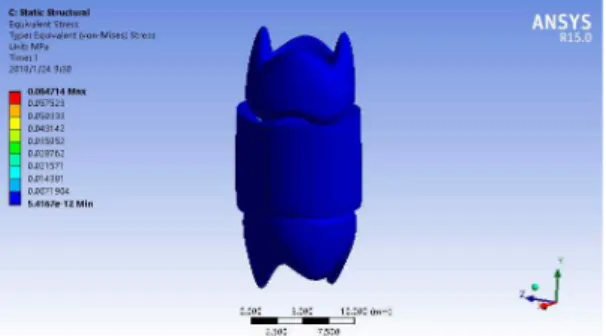
The chewing movements, including cutting movement, compressing movement, and grinding movement, are simulated and analyzed with the application of ANSYS 15. The simulation process of an incisor in cutting food is shown in Fig. 9.
In the cutting movement, the upper incisor remains immobile, while the lower ones are subjected to a displacement of 1.2 mm in both horizontal and ver- tical directions. Fig. 10 has shown the compressing movement of molars to press food. During this process, the lower molars only have a displacement of 1.2 mm in a vertical direction. The grinding
movement is achieved through the upper and lower molars under the comprehensive effects of ex- trusion, cutting and tearing, resulting in food de- struction. Moreover, the food grinding movement process is also simulated, as shown in Fig. 11.
Typically, the lower molars have a displacement of 1.2 mm in both horizontal and vertical directions.
30 groups of abalone samples are simulated
Fig. 7. The simplified diagrams of compressing move- ment.
Fig. 8. The simplified diagrams of grinding movement.
Fig. 9. Simulation of movement process in the cutting mode.
Fig. 10. Simulation of movement process in the com- pressing mode.
Fig. 11. Simulation of movement process in the grinding mode.
through the three chewing movement models un- der different heat treatment processes. The stress value of food can be calculated after tooth occlusion with Ansys software.
2.2.6 Neural Network Analysis
The neural network is the abbreviation of an ar- tificial neural network (Artificial neural network, ANN), which is a computer system with artificial intelligence that mimics the biological process of the brain. It has broad application prospects in many academic fields. The neural network is cal- culated by a large number of artificial neurons con- nected in parallel in a certain form, and most of them can be classified as an adaptive system that changes the internal structure according to ex- ternal information. Some scholars had theoretically demonstrated that the three-layer neural network could approximate any function with arbitrary pre- cision, and the neural network with more than three layers could accurately complete the classi- fication of any non-orthogonal set.
So far, more than 40 kinds of neural networks had been used by researchers at high frequencies and could be roughly divided into Hopfield net- works, BP networks, and RBF networks. The BP ( Back Propagation) neural network is short for er- ror backpropagation neural network [11]. It is a multi-layer feedforward neural network trained according to the error backpropagation algorithm which is simple, can be modeled with fewer data and can be approximated by learning. Nonlinear mapping is also the most extensive and successful neural network in current applications. Xiaodan Wang analyzed the correlation between texture parameters and tenderness of beef. The neural net- work model was constructed by MATLAB soft- ware to achieve a rapid and non-destructive evalu- ation of meat tenderness grade which was vali- dated. Hui Zhao used the MATLAB toolbox to construct a prediction model of corn quick-freezing time and combined with the genetic algorithm to
optimize the BP neural network. The accuracy of the model was verified by verification. The BP neural network structure is shown in Fig. 12.
In this study, this network is used to establish the prediction equations of sensory parameters, and the mechanical parameters obtained from the simulation analysis of chewing movement are used as the inputs, whereas the sensory evaluation data serves as the desired outputs. Additionally, the mechanical parameters of maximum von-mises stress and maximum shear stress are selected as the input layer neurons, while the sensory evalua- tion parameters of hardness, springiness, and chewiness are used as the output layer neurons.
To be specific, parameters of the training model are as follows: the allowable error of 1×10⁻⁶, the learning rate of around 0.01, the dynamic constant of roughly 0.8, and the maximum number of iter- ations of approximately 1000 [12].
3. RESULTS AND ANALYSIS
3.1 Effects of Different Heating Conditions on Sensory Evaluations
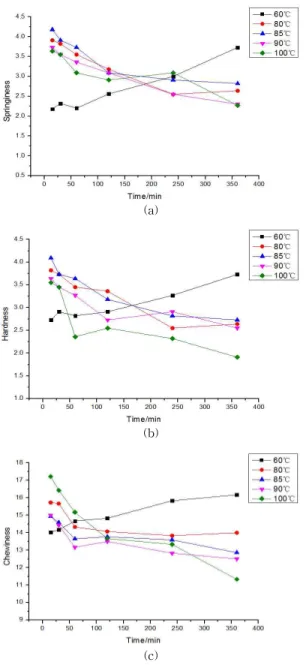
Fig. 13 has displayed the changes in the hard- ness, springiness, chewiness, and smell of abalone meat under different heat treatments. The results suggest that, during high-temperature heating (≥
80℃), the hardness, springiness, and chewiness of abalone meat are decreased with the extension of
Fig. 12. BP neural network structure.
heating time. In addition, it is also found that a higher heating temperature will lead to a more ob- vious reduction tendency. Furthermore, Fig. 13 demonstrates that the springiness and hardness tend to be abnormal at 60℃ compared with those at the higher heating temperatures. Such abnormal phenomena may be explained by its microstructure [13, 14]. Typically, the network structure becomes
a honeycomb after 60 min of heating, and the tight- er network structure of honeycomb can increase the hardness, springiness, and chewiness of ab- alone meat.
3.2 Determination of Elastic Modulus
The proportional coefficient of stress and strain in elastic deformation is referred to as the elastic modulus, which can be used to indicate the diffi- culty of elastic deformation. In this study, the com- pression experiments of abalone samples under different heating treatments are carried out using the texture analyzer. Taking sample 1 as an exam- ple, the stress-strain curve is shown in Fig. 14.
When the compression ratio range is less than 30%, 30%∼50% and 50%∼60%, the curves are fit- ted to three linear elastic curves, I, II and III, re- spectively [15]. This is caused by the change in water loss rate of abalone. Along with the whole compression process, the change of water loss rate can be divided into three stages: the rising stage, the constant speed stage and descending stage [16]. In the rising stage, the water content de- creases rapidly from inside to outside. The reason is that the water content of abalone is higher in the early stage, and most of the free water and a small part of the equilibrium water are quickly ex- truded under compression. In the constant speed stage, the free water content of abalone is less, and the loss of equilibrium water is the main factor, so the water content decreases slowly compared with the rising stage, and the water loss rate is constant [17]. In the descending stage, the water (a)
(b)
(c)
Fig. 13. Sensory changes in abalone meat during the heating process.
Fig. 14. Stress-Strain curves of the compression.
content of abalone has approached the equilibrium moisture content, the smaller the water gradient, and the smaller the power of water transfer [18], so the water loss rate slowly decreases. In addition, the relation coefficient between the regression equation and the stress-strain curve is over 0.95.
According to Hooke's law, the slope of the linear regression equation is the elastic modulus.
The regression equation of sample 1 part I (<30%):
(2)
The elastic modulus of sample 1 is calculated to be 2.73×10⁴Pa, while that of the other samples can be obtained by the same method, as shown in Table 3.
3.3 Simulation Analysis of Chewing
The Von-Mises stress and shear stress of the 30 groups of abalone samples are measured in three chewing simulation models, as shown in Table 4-6.
Of them, S′ is the vector sum of the vertical and horizontal displacement of moving teeth; while Mises and shear represent the Von-Mises stress and shear stress, respectively.
It can be found from Table 4 and 5 that, the compressing movement will produce greater shear stress and Von-Mises stress when the displace- ment vector is less than the cutting movement.
This can potentially explain for the reason why people tend to use molars to break hard food.
Afterward, the grinding movement will produce greater shear stress and Von-Mises stress than those of the compressing movement (Tab.6), in- dicating that grinding movement may play an im- portant role in breaking elastic food.
3.4 Analysis of the Predictive Sensory Evaluation Model
3.4.1 Correlation Analysis
Correlation between the mechanical character- istics of the chewing simulation system and the sensory evaluation is analyzed using the Pearson correlation. The results have indicated all good correlations, with the correlation coefficients (r) of over 0.71 (Tab.7). As a result, the mechanical char- acteristics of abalone samples can be used to pre- dict the sensory hardness, springiness, and chewi- ness.
Only the statistically significant correlation co- efficients upon Pearson correlation analysis are presented. *p≤0.05; **p ≤0.01.
3.4.2 Determining the Hidden Layer Nodes The number of neurons in the hidden layer will greatly affect the accuracy of the prediction model;
However, it is quite difficult to determine the num-
Table 3. Elastic Modulus under different heating conditions
S/N Elastic Modulus
S/N Elastic Modulus
S/N Elastic Modulus
Ⅰ Ⅱ Ⅲ Ⅰ Ⅱ Ⅲ Ⅰ Ⅱ Ⅲ
1 27287 83424 182450 11 47236 100219 318374 21 48569 106549 326834
2 27966 90831 200609 12 25108 84632 235453 22 38293 96770 299242
3 28777 96143 212438 13 33592 94248 263958 23 44986 115906 395806
4 32217 110022 240664 14 40700 98763 296418 24 29745 91284 284951
5 34624 106694 304583 15 56534 163513 376613 25 33019 103169 323894
6 32879 100622 281630 16 46729 107421 307090 26 43796 95654 373286
7 30738 103360 284249 17 41822 102413 270929 27 39278 99638 342031
8 35885 106222 300499 18 42670 99752 301598 28 41045 105333 294413
9 54459 186794 430923 19 36459 95832 293463 29 39669 100366 324091
10 41732 98032 305158 20 36459 91485 285258 30 38064 109374 359986
bers of hidden neurons. In our study, as can be ob- served from the results, the number of hidden layer nodes is 17.
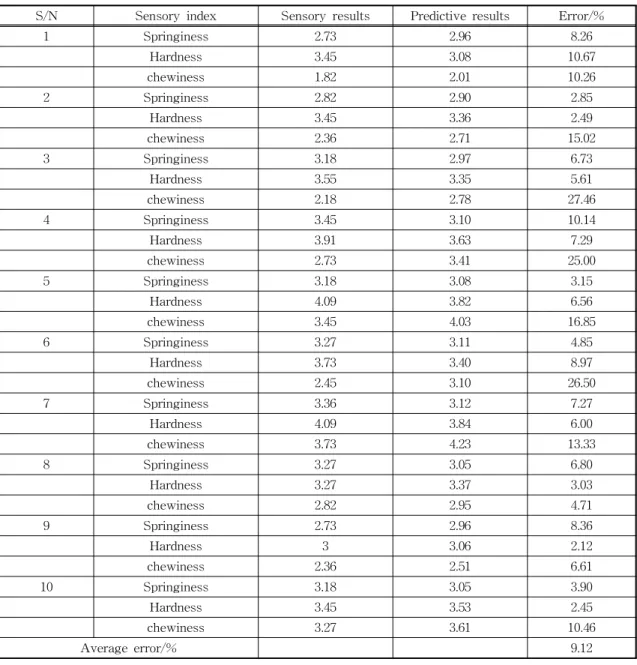
3.4.3 Validation of the Predictive Texture Model The sensory evaluation data of abalone meat are predicted using the BP neural network. The results show little difference between the predicted and
measured values, with relatively small average calculation error.
According to the data displayed in Table 8, the maximum error is 27.46%, while the minimum is 2.12%, and the average is 9.12%. These results demonstrate that the established BP neural net- work has a good prediction effect, which is also associated with the superiority of high prediction Table 4. Influence of heating processing on the cutting effect
S/N T/℃ t/min S′/mm Mises/104Pa Shear/104Pa
Ⅰ Ⅱ Ⅲ Ⅰ Ⅱ Ⅲ
1 60 15 2.82 3.00 4.20 5.67 1.73 2.40 3.20
2 60 30 2.82 3.02 4.29 5.91 1.74 2.44 3.32
3 60 60 2.82 3.04 4.41 6.06 1.75 2.51 3.41
4 60 120 2.82 3.44 4.64 6.45 1.97 2.62 3.64
5 60 240 2.82 3.48 4.56 7.40 2.00 2.60 4.16
6 60 360 2.82 3.45 4.47 7.05 1.98 2.55 3.96
7 80 15 2.82 3.09 4.51 7.07 1.78 2.55 3.97
8 80 30 2.82 3.51 4.56 7.33 2.01 2.60 4.11
9 80 60 2.82 3.64 5.72 9.20 2.07 3.25 5.13
10 80 120 2.82 3.60 4.42 7.38 2.06 2.52 4.15
11 80 240 2.82 3.68 4.46 7.59 2.11 2.54 4.26
12 80 360 2.82 2.94 4.22 6.40 1.69 2.40 3.59
13 85 15 2.82 3.46 4.38 6.78 1.99 2.48 3.80
14 85 30 2.82 3.59 4.43 7.27 2.06 2.53 4.09
15 85 60 2.82 3.78 5.38 8.40 2.09 3.04 4.71
16 85 120 2.82 3.68 4.58 7.43 2.11 2.60 4.19
17 85 240 2.82 3.60 4.50 6.91 2.07 2.56 3.87
18 85 360 2.82 3.62 4.45 7.34 2.07 2.54 4.12
19 90 15 2.82 3.52 4.40 7.24 2.02 2.49 4.06
20 90 30 2.82 3.52 4.30 7.11 2.02 2.45 4.00
21 90 60 2.82 3.70 4.56 7.72 2.12 2.59 4.32
22 90 120 2.82 3.55 4.41 7.33 2.03 2.51 4.12
23 90 240 2.82 3.65 4.73 8.70 2.09 2.69 4.87
24 90 360 2.82 3.06 4.30 7.10 1.76 2.45 4.00
25 100 15 2.82 3.45 4.51 7.64 1.98 2.56 4.28
26 100 30 2.82 3.63 4.40 8.38 2.08 2.49 4.68
27 100 60 2.82 3.56 4.45 7.92 2.04 2.54 4.43
28 100 120 2.82 3.59 4.55 7.24 2.06 2.57 4.06
29 100 240 2.82 3.57 4.46 7.66 2.05 2.54 4.30
30 100 360 2.82 3.54 4.61 8.17 2.03 2.60 4.58
efficiency. Thus, the mechanical characteristics of the chewing simulation system can be used to pre- dict the human sensory evaluation results using the BP neural network model [19].
4. CONCLUSIONS
In this study, the sensory characteristics of ab-
alone meat are analyzed under different heat treatments. Our findings suggest significant re- ductions in springiness, hardness and chewiness of abalone meat at a shorter heating time (<60 min), which may reach the appropriate range. Mean- while, an extended heat treatment (>120 min) will result in a slow downward trend. Moreover, the heating condition at 60℃ is abnormal compared to Table 5. Influence of heating processing on the compressing effect
S/N T/℃ t/min S′/mm Mises/104Pa Shear/104Pa
Ⅰ Ⅱ Ⅲ Ⅰ Ⅱ Ⅲ
1 60 15 2 3.48 10.65 23.26 1.84 5.64 12.30
2 60 30 2 3.57 11.60 25.60 1.89 6.12 13.52
3 60 60 2 3.67 12.26 27.12 1.94 6.48 14.34
4 60 120 2 4.11 14.04 30.71 2.17 7.41 16.24
5 60 240 2 4.42 13.60 38.84 2.33 7.20 20.52
6 60 360 2 4.19 12.83 35.95 2.22 6.78 19.00
7 80 15 2 3.92 13.17 36.26 2.07 6.97 19.16
8 80 30 2 4.58 13.55 38.34 2.42 7.18 20.27
9 80 60 2 6.95 23.84 54.98 3.67 12.60 29.60
10 80 120 2 5.32 12.51 38.92 2.81 6.62 20.56
11 80 240 2 6.02 12.78 40.60 3.19 6.75 21.44
12 80 360 2 3.20 10.81 30.01 1.69 5.70 15.87
13 85 15 2 4.28 12.02 33.68 2.27 6.35 17.80
14 85 30 2 5.19 12.61 37.80 2.74 6.66 19.98
15 85 60 2 7.21 20.85 48.02 3.81 11.01 25.36
16 85 120 2 5.96 13.71 39.16 3.15 7.26 20.70
17 85 240 2 5.33 13.06 34.54 2.82 6.90 18.26
18 85 360 2 5.44 12.72 38.47 2.88 6.73 20.32
19 90 15 2 4.65 12.23 37.45 2.46 6.46 19.80
20 90 30 2 4.65 11.67 36.40 2.46 6.16 19.24
21 90 60 2 6.19 13.58 41.70 3.28 7.18 22.01
22 90 120 2 4.88 12.34 38.16 2.58 6.52 20.15
23 90 240 2 5.74 14.79 50.50 3.03 7.83 26.70
24 90 360 2 3.79 11.64 36.36 2.01 6.15 19.20
25 100 15 2 4.21 13.16 41.32 2.23 6.96 21.83
26 100 30 2 5.59 12.22 47.60 2.95 6.45 25.16
27 100 60 2 5.01 12.70 43.62 2.65 6.70 23.05
28 100 120 2 5.24 13.44 37.56 2.77 7.11 19.84
29 100 240 2 5.06 12.81 41.34 2.68 6.78 21.85
30 100 360 2 4.86 13.95 45.93 2.57 7.38 24.26
that at higher temperatures, which may be resulted from changes in chemical forces.
The stress-strain curve of the sample is ob- tained by a compression test using a texture ana- lyzer, which is fitted using MATLAB software and the elastic modulus of the abalone sample is ob- tained. Also, reverse engineering technology is used to reconstruct the 3D models of incisors and
molars; At the same time, the chewing movement models have been simplified and divided into three modes, including cutting mode, compressing mode and grinding mode. Subsequently, the whole proc- ess of chewing and crushing abalone is simulated using the finite element simulation, which allows obtaining the mechanical properties of abalone samples under different heat treatments.
Table 6. Influence of heating processing on the grinding effect
S/N T/℃ t/min S′/mm Mises/104 Pa Shear/104 Pa
Ⅰ Ⅱ Ⅲ Ⅰ Ⅱ Ⅲ
1 60 15 2.82 5.37 16.45 35.94 2.79 8.56 18.70
2 60 30 2.82 5.50 17.89 39.50 2.86 9.31 20.54
3 60 60 2.82 5.66 18.92 41.84 2.95 9.84 21.76
4 60 120 2.82 6.34 21.66 47.40 3.30 11.26 24.64
5 60 240 2.82 6.81 21.02 60.00 3.54 10.93 31.21
6 60 360 2.82 6.47 19.80 55.48 3.37 10.31 28.85
7 80 15 2.82 6.05 20.36 55.97 3.15 10.60 29.12
8 80 30 2.82 7.06 20.92 59.17 3.67 10.88 30.78
9 80 60 2.82 10.72 36.80 84.88 5.58 19.14 44.14
10 80 120 2.82 8.21 19.31 60.11 4.27 10.05 31.26
11 80 240 2.82 9.30 19.74 62.71 4.84 10.26 32.61
12 80 360 2.82 4.94 16.66 46.36 2.57 8.67 24.11
13 85 15 2.82 6.61 18.55 51.99 3.44 9.65 27.05
14 85 30 2.82 8.01 19.44 58.37 4.17 10.12 30.35
15 85 60 2.82 11.13 32.21 74.17 5.79 16.75 38.56
16 85 120 2.82 9.20 21.16 60.48 4.78 11.00 31.45
17 85 240 2.82 8.23 20.18 53.35 4.28 10.51 27.75
18 85 360 2.82 8.40 19.64 59.41 4.37 10.21 30.90
19 90 15 2.82 7.18 18.88 57.82 3.73 9.82 30.07
20 90 30 2.82 7.18 18.00 56.15 3.73 9.36 29.20
21 90 60 2.82 9.56 20.99 64.36 4.97 10.92 33.48
22 90 120 2.82 7.54 19.06 58.94 3.92 9.90 30.64
23 90 240 2.82 8.85 22.80 77.95 4.61 11.86 40.54
24 90 360 2.82 5.85 17.96 56.12 3.05 9.35 29.20
25 100 15 2.82 6.50 20.30 63.80 3.38 10.56 33.18
26 100 30 2.82 8.62 18.84 73.52 4.48 9.80 38.24
27 100 60 2.82 7.73 19.62 67.35 4.02 10.21 35.03
28 100 120 2.82 8.08 20.74 57.98 4.20 10.78 30.14
29 100 240 2.82 7.81 19.76 63.84 4.06 10.28 33.20
30 100 360 2.82 7.49 21.54 70.91 3.90 11.21 36.89
Table 7. Correlation matrix Cutting
Mises Cutting
Shear compressing
Mises compressing
Shear grinding
Mises grinding Shear
springiness 0.712** 0.710** 0.744** 0.736** 0.872** 0.854**
hardness 0.820** 0.819** 0.755** 0.755** 0.930** 0.931**
chewiness 0.820** 0.819** 0.756** 0.755** 0.930** 0.930**
Using Pearson's correlation analysis method, it is found through correlation analysis that the cor- relation between the elasticity of sensory texture evaluation and the simulation cutting mode ex- ceeds 0.71, which proves that the two have good correlation. Therefore, the chew simulation test re- sults can be used to predict the springiness, hard- ness, and chewiness of the sensory texture evalua- tion. Thus, the BP neural network is introduced to
predict the sensory evaluation parameters (including sensory hardness, springiness, and chewiness) based on the mechanical properties obtained from chewing simulation analysis. Our findings indicate that the average error of the prediction model can reach 9.12%. To sum up, this method is associated with great advantages and application prospects, which can be attributed to its simplicity, handling convenience, and high accuracy.
Table 8. Comparison of predictions using the BP neural network model with the actual results
S/N Sensory index Sensory results Predictive results Error/%
1 Springiness 2.73 2.96 8.26
Hardness 3.45 3.08 10.67
chewiness 1.82 2.01 10.26
2 Springiness 2.82 2.90 2.85
Hardness 3.45 3.36 2.49
chewiness 2.36 2.71 15.02
3 Springiness 3.18 2.97 6.73
Hardness 3.55 3.35 5.61
chewiness 2.18 2.78 27.46
4 Springiness 3.45 3.10 10.14
Hardness 3.91 3.63 7.29
chewiness 2.73 3.41 25.00
5 Springiness 3.18 3.08 3.15
Hardness 4.09 3.82 6.56
chewiness 3.45 4.03 16.85
6 Springiness 3.27 3.11 4.85
Hardness 3.73 3.40 8.97
chewiness 2.45 3.10 26.50
7 Springiness 3.36 3.12 7.27
Hardness 4.09 3.84 6.00
chewiness 3.73 4.23 13.33
8 Springiness 3.27 3.05 6.80
Hardness 3.27 3.37 3.03
chewiness 2.82 2.95 4.71
9 Springiness 2.73 2.96 8.36
Hardness 3 3.06 2.12
chewiness 2.36 2.51 6.61
10 Springiness 3.18 3.05 3.90
Hardness 3.45 3.53 2.45
chewiness 3.27 3.61 10.46
Average error/% 9.12
REFERENCES
[ 1 ] J. Dong, X. Fang, H. Wang, X. Zhang, and X.
Tao, "Abalone Muscle Texture Evaluation and Prediction Based on TPA Experiment,"
Journal of Food Quality, Vol. 2, No. 1, pp. 1-9, 2017.
[ 2 ] B. Zhu,Research on the Theory and Technol- ogy of Seafood Processing, Science Press, 16 Donghuangchenggen North Street, Beijing, 2010.
[ 3 ] Y. Wang, W.L. Kang, S.G. Xin, and W.Q.
Xing, "Analysis of Trace Elements in Abalone and Sea Cucumber," Spectroscopy and Spectral Analysis, Vol. 29, No. 2, pp. 511-514, 2009.
[ 4 ] Z. Sun, Y. Sun, Y. Li, J. Liu, and J. Li, "Design and Experiment of Bionic Food Texture Analyzer,"Transactions of the Chinese Soci- ety for Agricultural Machinery, Vol. 43, No.
1, pp. 230-234, 2012.
[ 5 ] P. António, D. Luis, T.P. Barcelos, S.M. Jorge, and M. Adelio, "An Electronic Tongue for Juice Level Evaluation in Non-alcoholic Bev- erages," Procedia Chemistry, Vol. 1, No. 1, pp.
1023-1026, 2009.
[ 6 ] G. Xiao, B. Zhu, X. Dong,X. Chen, and S.
Chen, "Effects of Hot Processing Conditions on Partial Processing Properties of Abalone,"
J ournal of Dalian Institute of Light Industry, Vol. 31, No. 1, pp. 1-7, 2012.
[ 7 ] B. Zhu, X. Dong, L. Sun, G. Xiao, X. Chen, Y. Murata, et. al., "Effect of Thermal Treat- ment on the Texture and Microstructure of Abalone Muscle (Haliotis Discus)," Food Science and Biotechnology, Vol. 20, No. 6, pp.
1467-1473, 2011.
[ 8 ] W. Cheng, Y. Zhou, J. Zhang, and Y. Ruan,
“Effects of Additives on Elasticity Modulus of Fish Balls Prepared by Broken Rice and Aristichys Nobilis,” China Food Additives, Vol. 2, No. 6, pp. 205-209, 2012.
[ 9 ] L. Chen, Y. Sun, J. Liu, and G. Xie, "Simula-
tion Analysis of Food Materials Damage Effect Based on Chewing Movement,"Modern Food Science and Technology, Vol. 1, No. 5, pp. 147-152, 2014.
[10] J. Chen, "Food Oral Processing-A Review,"
Food Hydrocolloids, Vol. 23, No. 1, pp. 1-25, 2009.
[11] L. Chen, Y. Sun, J. Liu, and G. Xie, "Simulation Analysis of Food Materials Damage Effect Based on Chewing Movement,"Modern Food Science and Technology, Vol. 30, No. 1, pp.
147-152, 2014.
[12] Y. Jia, C. Ji, X. Luo, and N. Chen, "Classifying Beef Muscle and Fat Pixels Using Bp-ga Neural Network," Transactions of the Chinese Society of Agricultural Engineering, Vol. 11, No. 6, pp. 216-219, 2007.
[13] L. Deng, Y. Li, X. Dong, Y. Wang, Q. Xin, and J. Pan, "Chemical Interactions and Textural Characteristics of Abalone Pleopod Muscle Protein during Heating," Transactions of the Chinese Society of Agricultural Engineering, Vol. 30, No. 18, pp. 307-316, 2014.
[14] Y. Zhang, X. Gao, J. Xu, Y. Sun, Y. Chang, and C. Xue, "Comparative Study on Natural Drying and Hot-air Drying of Abalone,"
Transactions of the Chinese Society of Agri- cultural Engineering, Vol. 24, No. 1, pp. 296- 299, 2008.
[15] Y. He, "The Research on Piecewise Linear Fitting of Tool Wear Curver,"Mechanical and Electrical Engineering Technology, Vol. 44, No. 12, pp. 88-89, 2015.
[16] Z. Gao, Study on Drying Technology and P roduct Characteristics of Abalone, PhD Thesis of Fujian Agriculture and Forestry University, 2011.
[17] S. Huang and L. Fan, "A Kinetics Study on the Combined Drying of the Osmotic Dehy- dration and Vacuum Frying for the Carrot Chips,"Modern Food Science and Technol- ogy, Vol. 29, No. 2, pp. 223-225, 2013.
[18] F. Jia and Y. Zhou, "Study on Moisture Diffusion Regularity of Brown Rice under Storage Conditions," J ournal of the Chinese Cereals and Oils Association, Vol. 27, No. 1, pp. 87-90, 2012.
[19] R.Y. Zhan and E.J. Lee, "Human Face Recog- nition used Improved Back-Propagation (BP) Neural Network,"Journal of Korea Multime- dia Society, Vol. 21, No. 4, pp. 471-477, 2018.
Xiaochen Li
received her B. S. at Dalian Pol- ytechnic University in China (2013-2017). Currently, she is studying in Department of Me- chanical Engineering from Dalian Polytechnic University in China for M. S. Her main research areas are computer vision and image processing.
Yuyang Zhao
received his B. S. at Dalian University in China(2013-2017).
Currently, he is studying in De- partment of Mechanical Engin- eering from Dalian Polytechnic University in China for M. S.
His main research area is elec- tromechanical product design and control technology.
Renjie Li
received his B. S. at Jilin Insti- tute of Chemical Technology in China(2011-2015). Currently, he is studying in Department of Mechanical Engineering from Dalian Polytechnic University in China for M. S. His main re- search area is electromechanical product design and control technology.
Ning Zhang
received his B. S. at Dalian Polytechnic University in China (2008-2012), and received his master degree at Busan Tong- myong University in Korea (2014- 2016). Currently, he is studying in Department of Information and Communications Engineering Tongmyong Uni- versity, Korea for doctoral degree. His main research areas are image processing and pattern recognition.
Xueheng Tao
received his B. S. degrees from Dlian Institute of Light Industry University, China, in 1985, and received his M. S. and Ph. D.
from Dalian University of Te- chnology, China, in 1988 and 1997. From March to April 2003, as a visiting scholar at the National Kanazawa Univer- sity, Japan, engaged in experimental research on new composite materials. From may to June 2006, as a vis- iting scholar at the European Institute of Technology, France, engaged in computer engineering and pro- fessional education research. From February to July, as a senior visiting scholar at the University of Michigan, America, engaged in higher education man- agement and engineering education research.
Eung-Joo Lee
received his B. S., M. S. and Ph.
D. in Electronic Engineering form Kyungpook National University, Korea, in 1990, 1992, and Aug.
1996, respectively. Since 1997 he has been with the Department of Information & Communications Engineering, Tongmyong University, Korea, where he is currently a professor. From 2000 to July 2002, he was a president of Digital Net Bank Inc. From 2005 to July 2006, he was a visiting professor in the Depart- ment of Computer and Information Engineering, Dalian Polytechnic University, China. His main research in- terests include biometrics, image processing, and com- puter vision.