Real-time Heart Rate Measurement based on Photoplethysmography using Android
Smartphone Camera
N.V. Hoan†, Jin-Hyeok Park†, Suk-Hwan Lee††, Ki-Ryong Kwon†††
ABSTRACT
With the development of smartphone technologies enable photoplethysmogram (PPG) acquisition by camera and heart rate (HR) measurement. This papers presents improved algorithm to extract HR from PPG signal recorded by smartphone camera and to develop real-time PPG signal processing Android application. 400 video samples recorded by Samsung smartphone camera are imported as input data for further processing and evaluating algorithm on MATLAB. An optimized algorithm is developed and tested on Android platform with different kind of Samsung smartphones. To assess algorithm’s performance, medical device Beurer BC08 is used as reference. According to related works, accuracy parameters includes 90% number of samples that has relative errors less than 5%, Person correlation (r) more than 0.9, and standard estimated error (SEE) less than 5 beats-per-minutes (bpm).
Key words: Photoplethysmogram, Heart Rate, Mobile Devices, MATLAB, Android..
※ Corresponding Author : Ki-Ryong Kwon, Address:
(608-737) (599-1) Daeyeon-3dong, Namgu, Busan, Korea, TEL : +82-51-629-6257, FAX : +82-51-629-6230, E-mail
Receipt date : Jan. 10, 2017, Approval date : Feb. 3, 2017
†††Dept. of IT Convergence and Applications Eng., Pukyong Nat’l Univ. (E-mail : [email protected]) (E-mail : [email protected])
†††Dept. of Information Security, Tongmyong University (E-mail : [email protected])
†††Dept. of IT Convergence and Applications Eng., Pukyong Nat’l Univ.
※ This research was supported by the Technological Innovation R&D Program (C0407372) funded by the Small and Medium Business Administration(SMBA, Korea)" and by the MSIP(Ministry of Science, ICT and Future Planning), Korea, under the Grand Information Technology Research Center support program (IITP-2016- R71181610050001002) supervised by the IITP(Institute for Information & communications Technology Promotion) and the ICT R&D program of MSIP/IITP. [R0126-16- 1112, Development of Media Application framework based on Multi-modality which enables Personal Media Reconstruction.
1. INTRODUCTION
Monitoring vital parameters such as heart rate, blood pressure plays a very important role in de- tection, recognition the dangerous situation and prevent of any health diseases [1]. An approach to monitor HR is through the use of pulse oximeter, which is a small device that uses photopleth- ysmography (PPG) to capture blood volume changes by illuminating the finger with a light emitting di- ode (LED) and measure the changes in skin illumi- nated light by transmitting it through photodiode.
Another approach is replacing the photodiode, used
in pulse oximeter, by a smartphone camera that enables PPG imaging as shown in Fig. 1 [2]. While it is easy to position on the finger, pulse oximeters are somewhat obtrusive and impractical for inter- mittent use throughout the day, smartphones are so much more portable and practical.
To program a real-time application on mobile devices, further analysis and optimization are car- ried on MATLAB for evaluate the robustness, simplicity, and accuracy of algorithms. In this study, the approach of real-time PPG signal proc- essing application on Android smartphone is presented.
Fig. 1. Methodology of PPG on mobile devices.
Fig. 2. Smartphone-based system architecture.
Our paper is organized as follows. In section 2, we discuss the related works and in section 3, we explain heart rate measurement methodology in detail. Then, in section 4 we perform experiments and discuss about the experimental results, eval- uate the performance of algorithm. Finally, we conclude this paper in section 5.
2. RELATED WORKS
The current generation of smartphones includes video recording capabilities using a photodetector with an accompanying light-emitting diode (LED) light source positioned close to or surrounding the photodetector lens. This is very similar to the PPG imaging technology therefore these smartphones can directly measure some vital characteristics.
Nowadays, there are smartphone-based commer- cial applications such as Instant Heart Rate, Heart Rate Tester, Cardiograph, etc. that allow evaluat- ing HR. However, while they provide a PPG-like waveform in the ideal usage conditions, they often fail when something goes wrong [3]. Pelegris et.al proposed a novel method to detect heart beat rate using a mobile phone, and the authors reported a performance problem of the Android-based smart- phone [4]. Jonathan and Leahy used a Nokia E63 smartphone for pulse rate measurement, and they assessed that the green channel provides a stron- ger PPG signal than the red one [5].
The objective of this paper is to develop an Android application to measure the PPG waveform and calculate the heart rate based on video re- corded by a smartphone. Therefore, related works for a smartphone-based PPG acquisition system are evaluated. Later, a new method is proposed on
the development of robust algorithm suitable for Samsung smartphone models that address motion artifacts by distant constraints and RGB threshold.
The Android application utilizes the original equip- ment manufacturers video hardware and software.
The experimental tests are performed on different Samsung smartphones with a comparison to medi- cal device (Beurer BC08 wrist blood pressure mon- itors) with given maximum error of 2 beats per mi- nute (bpm).
3. HEART RATE MEASUREMENT METH- ODOLOGY
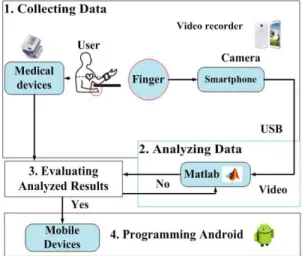
This work describes a smartphone-based heart rate estimation technique using PPG signal. In oth- er words, the photodiode and light source, used in pulse oximeter, are replaced by built-in smart- phone camera and LED to record video data of fin- gertips that enables PPG signal acquisition. The HR estimation using smartphone-based PPG sys- tem consists of four phases as described in Fig.
Fig. 3. Block diagram of PPG signal processing.
2. The first phase is to collect data including the video data of user’s fingertip and HR results by medical devices simultaneously. Nextly, the video data is transmitted to computer by USB-port for post-processing by applying the proposed algo- rithm to measure HR on MATLAB in analyzing data step. Particularly, MATLAB version R2011a is used to post-processing the proposed method.
Then, the HR results acquired from MATLAB are evaluated with HR reference by medical devices.
If the accuracy requirements are achieved, the al- gorithm will be programmed in Android platform- Android platform v4.2.1- in the last phase. In de- tails, the application is developed using Android Developer Tools (ADT) software- Android SDK and ADT v22.3. This Android application is sup- ported for devices with flash near camera and run Android OS 4.0 or higher. Note that, the Android applications are tested in several Samsung models from mid-end to high-end smartphones. In the end, the final optimization by adjust the proposed algo- rithm and video recording settings is to stabilize operation of real-time HR measurement application on Samsung devices.
3.1 Data Collection
400 video samples with duration from 15 to 20 seconds are taken from a group of 20 people be- tween 18 and 50 years old, with an average age of 26.3 years old. Particularly, subjects are asked to wear Beurer BC08 cuff in the left hand and si- multaneously hold the smartphone in the right hand and put index finger over smartphone rear- camera len and flash LED. The experiments are conducted in laboratory environment and under supervision to ensure that every configurations is well-setup during the measurement. Moreover, different Samsung smartphones are used to eval- uate developed application and device influences.
3.2 Smartphone-based photoplethsmography The HR measurement system is initially simu-
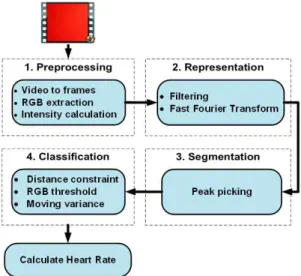
lated on MATLAB using videos of fingertip cap- tured from the camera as input data. In details, the proposed algorithm for calculating HR based on PPG signal includes four main parts as shown in Fig. 3.
A brief description of PPG signal processing is presented as follows. In the pre-processing stage, video goes through video-to-frames and RGB ex- tracting block to obtain sequence of frames with separate Red Green Blue (RBG) channel. In the representation stage, mean brightness of each frame is calculated which Red channel is preferred one to obtain PPG signal. Then, PPG signals are transformed (i.e. moving average filter, or FFT) in order to highlight the peaks. Subsequently, apply- ing peak picking is of purpose to look for candi- dates peaks in segmentation stages. In classi- fication stage, candidates peaks are reclassified based on distance constraints and RBG threshold to counter motion artifacts (i.e., noise of unstable finger) before calculating HR in the last stage.
In details, video samples which are recorded by smartphone-based PPG system with camera and flashlight share some configuration parameters in- cluding resolution, channel, frame rate and number of frames (or recording duration) as shown in Table 1.
Table 1. Video Parameters.
Video Parameters Formular Examples Video data
Resolution
×
320×240
Channel {Red, Green, Blue}
Number of frames
Frame rate 30(fps)
T Video-to-Frames RGB Extraction
Video
M
N
M
F
Fig. 4. Detailed pre-processing step.
The developed smartphone application acquires 320×240 pixels resolution with an effective frame rate of 30 frames per second (fps) sampling rate.
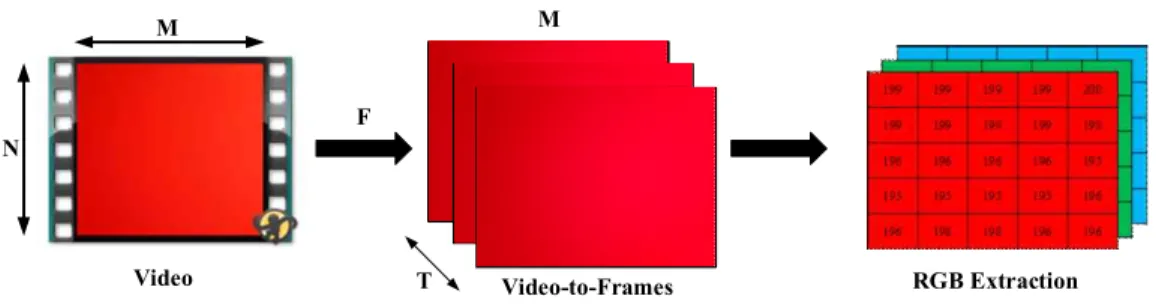
Although these configurations are not the current highest available setting, these setting are pref- erable for our experiments as it reduces the com- putational cost in Android programming. The number of frames (T) is equal to “recording dura- tion (t) multiple to frame rate (F)”. Video is ex- tracted into T frames, and each frames consists of three color channels (c), namely Red Green Blue (RGB) represented as three matrix of pixel sepa- rately as shown in Fig. 4.
Each of frames is a matrix of pixels with size
× , and the corresponding matrix for each chan- nel has elements’s value from 0 to 255 repre- senting brightness of relative pixels
. Then, the mean brightness for each channel frames is calculated as in Eq.(1)
×
(1) where × is video resolution, is corre- sponding matrix for each RGB channel with 320×240 resolution, refers to RGB channel, is the total frames obtained from recording at 30 fps.
This technique is based on determining only Red channel variation to calculate HR. An alternative techniques is to process data from all channels in RGB mode [6], or as in [5] only green channel in- tensity is used to obtain pulse wave. In addition, this main target of this paper is to develop Android application with limited resources both in terms of processing power, hardware and memory, it is rea- sonable to acquire the input data simple as long as the results maintain highly accurate. Experi- ments on different Samsung smartphone cameras indicate that Red channel provides stably valuable information to extract HR compared to Green and Blue channels due to the effect of natural noise in these channels as described in Fig. 5.
In representation step, this paper presents opti- mized coefficients of Moving Average Filter (MAF) with window size with coefficients
, and the output of MAF is calculated as follow
(2)
where is mean red brightness, is moving average filter coefficients, is window size.
Fig. 5. Diagram of different color channel signal recorded by Samsung smartphones.
0 20 40 60 80 100
26 28 30 32
Crude signal
0 20 40 60 80 100
60 65 70
75 Filtered signal
Fig. 6. Mean brightness of crude signal and filtered signal.
Fig. 6 illustrate the briefly fluctuation of crude signal due to inteference of natural noise or motion artifacts, and the smoothness of filtered signal. The main purpose of filter is to surpass the noise and highlight the peak of PPG signal to increase accu- racy of peak picking algorithm.
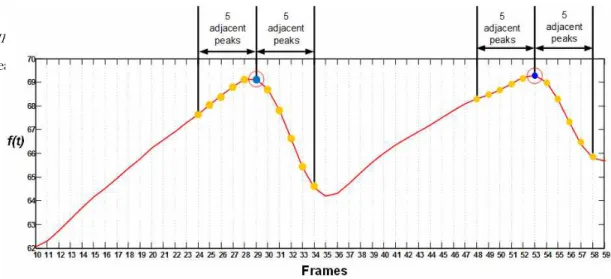
In segmentation step, the peak picking algorithm namely Local Maxima/Minimum Detection is ap- plied to count the number of candidate peak as shown in Fig. 7. The peaks are selected if their brightness is higher than 5 adjacent peaks forward and backward as in Eq.(3)
(3) In classification step candidates peaks are re- classified based on distance constraints to calculate more accurate HR by eliminate false detection peaks, and RGB threshold to counter motion arti- facts (e.g., noise of unstable finger). Fig. 8 shows the diagram of PPG signal due to the effect of mo- tion artifacts in different scenarios (i.e., slight movement of finger, remove finger out of camera len) and the normal stable finger as comparison.
As for distance constraints, a minimum
m i n × and maximum m ax × (F is the frame rate of camera) are used to classify candidates peaks whose distance from one of ad- jacent peaks are not included in distance range
m i nm ax. These distance corresponds to heart rate from 50 to 200 bpm. Then, the peaks whose distances in range m i nm axare reclassified again by remove peaks, that distance to one of the ad- jacent peaks differs from the mean value of the distances for more than max_diff (i,e. 25%) percentage. As for RGB threshold, the mean brightness of red channel threshold is set to 180, that classifies the accepted and invalid frames as illustrated in Fig. 9.
Finally, HR is calculated as:
× × (3), where is the number of peaks, is the frame rate, and is the distance
Fig. 7. Diagram of peak-picking algorithm with 11 coefficient adjacent peaks.
Fig. 8. Effects of motion artifacts to PPG signal as comparison to normal case.
Fig. 9. RGB threshold classifies (a) as accepted frame, (b) and (c) as invalid frames.
User Interface Block
PPG Signal Receiving
Block
Processing Block
Obtaning PPG signal
Smoothing Filter
Picking Peaks
Show HR result Preview
Screen
Calculating HR
Draw signal
Calculating mean R of frames YUV Image Format to RGB
Pixel Array
Extracting R pixel values
Distance Constraint and RGB Threshold
Fig. 10. Block diagram of HR measurement application.
Fig. 11. GUI of developed Android application.
between two adjacent peaks in the set of peaks.
3.3 Android developed application
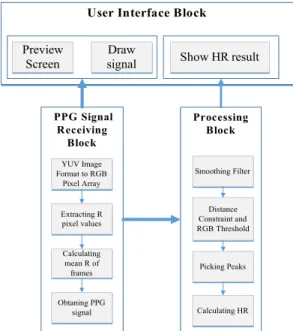
The main blocks of the developed Android appli- cation that acquire PPG signal from processing frame-to-frame image camera and process to cal- culate HR are shown in Fig. 10.
Firstly, smartphone application acquires frame
image in YUV420sp format with NV21 encoding.
Then, a Java script is executed for converting the Android YUV buffer to RGB pixel array following the equation in Eq.(4).
(4)
Secondly, the Red component of pixel array is extracted and averaged to obtain PPG waveform.
Then, the improved algorithm for PPG signal clas- sification and heart rate estimation are pro- grammed following signal processing procedure on MATLAB as presented in part 3.2. To evaluate smartphone application signal processing, three modes are programmed including fast measure- ment about 5 or 10 seconds, free mode with un- limited time duration, and noise mode that allows users with some movement artifacts of fingertips.
Finally, the optimized version of heart rate applica- tion are tested on real-time to provide experimental results. Fig. 11 presents GUI of developed Android application while idle, working with PPG diagram display and obtain final result of HR.
4. EXPERIMENTAL RESULTS
In this section, the performance of the proposed
Fig. 12. Evaluation of proposed algorithm on MATLAB based on relative errors.
Table 2. The performance for proposed algorithm and conventional algorithms on MATLAB with Pearson correlation and SEE.
Accuracy Parameters HR results on MATLAB
This work MAF7[7] SDF23[8] MVW[9]
r 0.9525 0.8390 0.9486 0.9380
SEE 2.4480 4.3738 2.5428 2.786
Table 3. The performance for proposed algorithm on Android with Pearson correlation and SEE.
Accuracy Parameters HR results on Android Application
S3 S4 Note3 Mega
r 0.9064 0.9675 0.9221 0.8453
SEE 2.4268 1.8071 1.6666 1.6567
Fig. 13. Evaluation of developed Android application.
algorithm is compared to three PPG signal proc- essing algorithm [7-9] and a commercial medical device Beurer BC08 with a given maximum error of 2 beats per minute (bpm). The algorithm de- scribed in [7] proposed to filter signal with a mov- ing average filter [MAF], which split the filtered signal into windows of fixed length and calculated the HR by determining the number of peaks and multiplying the peak count with ratio of 60 to the window length. In [8] authors proposed smooth differentiation filter (SDF) which normalized the signal to calculate HR by multiplying the number of peaks of the normalized signal with the ratio of 60 and dividing by the length of the signal. The main idea of algorithm in [9] was to calculate the mean distance between adjacent peaks as input of
moving variance window (MVW), which the HR was calculated by multiplying frame rate of video recorder by 60 and divided the mean distance.
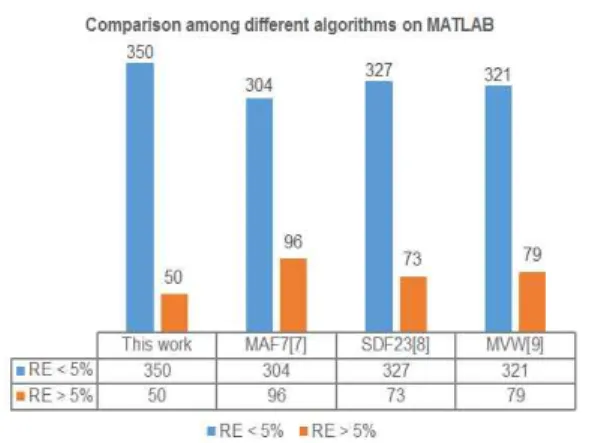
Since there was not given any information about filter parameters and peak detection in [7-9], pa- rameters are chosen to achieve the least number of errors. The relative error was used in [7-9] to evaluate performance of HR algorithms, and ac- cording to [10], the HR tested were considered to be valid if the Pearson correlation between the recorded heart rate and the corresponding pulse oximeter was more than 0.9 and with a standard error of estimate less than 5 beats per minutes
. This proposed algorithm achieves higher accuracy than related works with the highest number of cases (350 over 400) which has relative errors less than 5%, the Pearson correlation and
the standard error of estimate as 0.9525 and 2.4480 respectively as in Fig. 12 and Table 2.
Four different Samsung smartphone models in- cluding S3, S4, Note3 and Mega are used to ex- perimental tests with 50 samples to evaluate the performance of developed application as in Fig. 13 and Table 3. This developed application is eval- uated to work stably and accurately on different kind of Samsung smartphones.
5. CONCLUSION
In this paper, a review of existing algorithms for heart rate measuring using mobile phones is evaluated. The objective of this proposed algorithm is to develop Android application to measure HR in real time with duration about 10 seconds that optimizes for Samsung smartphones. Thus this method proposes a simple moving average filter with only 7 coefficients to reduce complexity when developing on Android platform but achieves af- fordable accuracy with classification stage with distant constraints and RGB threshold that out- performed some previous works with the same 400 video samples as input data and works stably on different Samsung mobile devices with 50 sample tests.
REFERENCE
[ 1 ] T.H. Yoon, S.W. Yoon, J.H. Ko and H.K. Kim,
“Research and Design of Smart Phone Sensor- based Context-aware System,“ J ournal of Korea Multimedia Society, Vol. 18, No. 3, pp.
408-418, 2015.
[ 2 ] C.G. Scully, J. Lee, J. Meyer, A.M. Gorbach, D.G. Fraser, Y. Mendelson, et al., “Physio- logical Parameter Monitoring from Optical Recordings with a Mobile Phone,” IEEE Transactions on Biomedical Engineering,
Vol. 59, No. 2, pp. 303-306, 2012.
[ 3 ] Y. Kurylyak and D. Grimaldi, Smartphone Based Photoplethysmogram Measurement, River Publishers, Aalborg, 2012.
[ 4 ] P. Pelegris, K. Banitsas, T. Orbach, and K.
Marias. “A Simple Algorithm to Monitor HR for Real Time Treatment Applications,”
P roceedings of the 9thInternational Confer- ence on Information Technology and Applica- tions in Biomedine, pp. 151-156, 2009.
[ 5 ] E. Jonathan and M Leahy, “Cellular Phone Based Photoplethysmographic Imaging,”Jour- nal on Biophotonics, Vol. 4, No. 5, pp. 293- 296, 2011.
[ 6 ] D. Grimaldi, Y. Kurylyak, F. Lamonaca, and A. Nastro. “Photoplethysmography Detection by Smartphone’s Videocamera,”Proceedings of IEEE International Conference Intelligent Data Acquisition and Advanced Computing Systems, pp. 488-491, 2011.
[ 7 ] R. Dantu,Measuring Vital Signs Using Smart P hones, Doctor‘s Degree of University of North Texas, 2010.
[ 8 ] P. Pelegris, K. Banitsas, T. Orbach, and K.
Marias, “A Novel Method to Detect Heart Beat Rate using a Mobile Phone,”Proceedings of 32nd IEEE Annual International Conference on Merging Medical Humanism and Tech- nology, pp. 5488-5491, 2010.
[ 9 ] D. Laure, “Heart Rate Measuring Using Mobile Phone’s Camera,”Proceedings of the 12th Conference of Open Innovations Associ- ation, Vol. 12, pp. 272-273, 2012.
[10] A. Moore, S. Lee, M. Greenisen, and P. Bishop,
“Validity of Heart Rate Monitor During Work in the Laboratory and on the Space Shuttle,”
American Industrial Hygiene Association J ournal, Vol. 5, pp. 299-301, 1997.
Nguyen Viet Hoan He received his bachelor from School of Electronics and Tele- communications in Hanoi Uni- versity of Science and Technol- ogy, Vietnam in July 2014. Since September 2015, he’s a Master degree student in the depart- ment of IT Convergence and Application Engineering in Pukyong National University. His research interest is Signal Processing and Image Processing.
Jin-Hyeok Park
He received a B.S from Depar- tment of Computer Engineering from Donguei University, Korea in 2013. And received a M.S in Pukyong Nation University in 2015. Currently, he’s a Ph.D de- gree student in the department of IT Convergence and Application Engineering in Pukyong National University. His research interest is Signal Processing and Data Compression.
Suk-Hwan Lee
He received a B.S., a M.S., and a Ph. D. degrees in Electrical Engineering from Kyungpook National University, Korea in 1999, 2001, and 2004 respectively.
He is currently an associate pro- fessor in Department of Infor- mation Security at Tongmyong University. His re- search interests include multimedia security, digital image processing, and computer graphics.
Ki-Ryong Kwon
He received the B.S., M.S., and Ph.D. degrees in electronics en- gineering from Kyungpook Na- tional University in 1986, 1990, and 1994 respectively. He worked at Hyundai Motor Company from 1986-1988 and at Pusan University of Foreign Language from 1996-2006. He is currently a professor in Department of IT Convert- gence and Application Engineering at the Pukyong National University. He has researched University of Minnesota in USA in 2000-2002 with Post-Doc. and Colorado State University on 2011-2012 with visiting professor. He was the President of Korea Multimedia Society in 2015-2016. His research interests are in the area of digital image processing, multimedia security and watermarking, bioinformatics, weather radar in- formation processing, and machine learning.