The Accumulation of Rare Earth Elements Fertilizer and its Subsequent Effects on Apple Fruit Quality
at Harvest and During Storage
Wei-Wei Zheng1, Mu-Young Park2, Peter Hirst3, Tae-Myung Yoon4, and Ik-Jo Chun1*
1Horticulture and Breeding, School of Bioresource Sciences, Andong National University, Andong 760-749, Korea
2Apple Experiment Station, NIHHS, R.D.A., Gunwi 716-812, Korea
3Department of Horticulture, Prudue University, West Lafayette, IN, USA
4Division of Plant Biosciences, Kyungpook National University, Daegu 702-701, Korea
Abstract. Rare earth elements fertilizer and Ca were sprayed on eight-year-old ‘Fuji’/M.9 apple trees dur- ing two consecutive seasons, and fruit quality was quantified at harvest and 5-month long storing in a com- mercial cooling house at 4oC and 80~85% RH. In the first season, single-sprayed of rare earth elements fertilizer showed appreciable accumulations of its elements (La, Pr, Gd, and Nd) in the fruit. In the follow- ing season, application of higher doses accumulated higher amount, indicating that the accumulation of rare earth elements was dose-dependent. However, rare earth elements did not affect the accumulations of Ca, Mg, and K in ‘Fuji’ apple fruit showed that there was no interaction between rare earth elements and these macronutrients. Double-spray of 0.2% rare earth elements increased fruit redness at harvest and had exhib- ited better color. Although at harvest it did not show significant effects on fruit weight, pulp firmness and titratable acidity (TA), but had pronounced effects on inhibiting fruit softness and retarded decrease of TA during storing. Furthermore, it reduced respiration rate and inhibited ethylene production during storing indi- cated that rare earth elements may be an alternative for prolonging the shelf life of ‘Fuji’/M.9 apple fruit.
Key words : Ca, firmness, rare earth elements, SSC/TA, TA
Introduction
Rare earth elements belongs to IIIA element family (Henke, 1977), which have characteristics and tend to be present naturally as a group. However, fractionation between light (La from Eu) as well as heavy (Gd from Lu) rare earth elements were observed during transpor- tation in bioaccumulation processes (Xu et al., 2002;
Wyttenbach et al., 1998). The property and structure of rare earth elements are very similar to Ca2+. They replace or compete with Ca2+ at their low concentration for bind- ing sites and affect the function of some enzymes in cell membrane, enhance absorption, utilization and transfor- mation of nutrients (Brown et al., 1990).
Zhu et al. (1987) reported that rare earth elements acted as nutrients for crops at low levels. Based on this, fertilizers containing rare earth elements have been
applied in agriculture since 1980s. Rare earth fertilizer comprises including La, Ce, Pr, and Sm elements, and its stimulation effects are the contribution of all elements.
Re(NO3)3 is aninorganic compound of rare earth fertil- izer which is categorized as a kind of microelement by its function, and have been widely applied to agricultural crops (Wang et al., 2001). To date, several considerable researches have been done on the application of rare earth elements for improving wheat (Ding et al., 2006;
Zhang and Shan, 2001) and maize (Xu et al., 2002) pro- duction.
Pre-harvest calcium applications have been commer- cially used for delaying senescence and control of many physiological disorders in apple fruit during storing (Con- way et al., 1994; Poovaiah, 1986). Although rare earth elements have similar characteristics of Ca2+, there is no report about the effect of rare earth on apple quality.
Dose-effect of rare earth elements has been observed in corn (Wang et al., 2001) but not in apple. Therefore, in this study rare earth elements fertilizer was applied as
*Corresponding author: [email protected]
*Received October 24, 2010; Revised November 2, 2010;
*Accepted November 22, 2010
foliar spray on ‘Fuji’/M.9 apple during growing season to examine its bioaccumulation and effects on the quality of fruit.
Materials and Methods
The experiments were carried out on eight-year-old
‘Fuji’/M.9 apple trees that were grown in an orchard of Andong Agricultural Technological Center during two consecutive years. A standard randomized block design with six replications was used and tested trees were iso- lated by one untreated guard trees. All spray applications were performed in the morning by a hand sprayer fol- lowing doses 20 L/six trees. In the first year, a prelimi- nary experiment was done by applying water (control treatment) and single spray of 0.1% rare earth elements solution.
In the second year, treatments were made with water (control), double-spray of 0.2% rare earth elements solu- tion (in the first two timings), triple-spray of 0.1% and 0.2% rare earth elements solution, triple-spray of 0.2%
calcium solution, and the treatments were applied on 10th June, 29th July and 19th September i.e. 40, 90 and 140 days, respectively after anthesis.
The contents of rare earth elements fertilizer used in this study were listed in Table 1. To examine the uptake of minerals in apple, fruits were collected at commercial harvest time and then washed with deionized water. Fruit pulps were dried in an air-forced oven at 65 ± 3oC, pow- dered in a stainless steel mill and then stored in paper bags until analysis. Each sample contained with an amount of 0.5 g powder was burnt in Muffle furnace at 500oC for 5 h, and then the ashes were dissolved in 10%
HNO3. Therefore, Ca, Mg, S, and K were analyzed by inductively coupled plasma (ICP), and La, Ce, Pr, Gd, Nd, Sm were analyzed by inductively coupled plasma- mass spectrometry (ICP-MS) (Yuan et al., 2001).
Fruit firmness was measured by compression of indi- vidual fruit with a fruit texture analyzer (GUSS.ZA/GS- 14). Apple juice was collected for analysis of soluble
solid concentration (SSC) using a digital refractometer (PR-101, Cat. No. 3412, ATAGO, Japan), and titratable acidity (TA) by a digital fruit acidity analyzer (Model:
GMK-708, GVK, South Korea). Fruit color was deter- mined by using a Color-Reader (KONICA MINOLTA SENSING, INC. Japan) which recorded the spectrum of reflected light and converted it into a set of color coor- dinates (Hunter L, a, and b value).
For measurement of CO2 and ethylene production rate, fruits were incubated in a 2-L sealed plastic jar for 30 min, and therefore, well-mixed headspace gas sam- ples were obtained from the jar and analyzed by GC (5890a Series Π; Hewlett Packard Rockville, MD). The GC column used for CO2 was CTR 1 (Alltech Associ- ates, Deerfield, ) with a thermal conductivity detector (TCD), and an activated alumina column with a flame ionization detector (FID) was used for ethylene. Temper- ature maintained in the column was 80oC and the carrier gas was N2 at a flow rate of 20 ml/min.
All trials and observations were replicated three times.
T-test was carried out for each group of measurements to determine whether there is significant difference between sprayed and control treatments. For the second year, sta- tistical comparisons were made by one-way analysis of variance (ANOVA) followed by Duncan’s multiple range test (DMRT) using SAS 9.1 version (SAS, Inc., Cary, NC, USA).
Results and Discussions
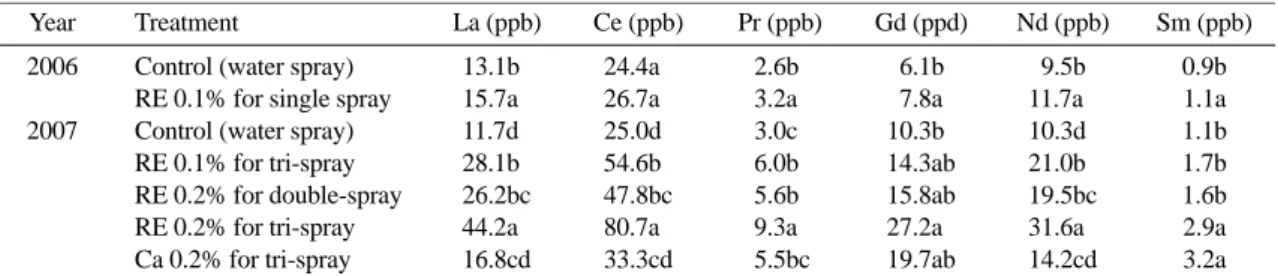
Generally, concentrations of rare earth elements in plants are variable even within the same plant (Ding et al., 2006). In our first year study, rare earth elements fer- tilizer was sprayed at low concentration (0.1%) only before harvest but significant accumulations of the ele- ments, La, Pr, Gd, Nd and Sm were found in treated fruits (Table 2). However, Ce did not significantly accu- mulate in fruit, which may be due to its lower absorption efficiency compared to others. Application of rare earth elements at low concentrations on tomato, cucumber,
Table 1. The characteristics of rare earth elements fertilizer used in this study.
Mg (ppm) S (ppm) Ca (ppm) K (ppm) La (ppb) Ce (ppb) Pr (ppb) Gd (ppb) Nd (ppb) Sm (ppb)
2406.3 5287.5 3308.8 94250 890 1161.3 905 784.6 1013.8 918.7
kidney beans, cabbage and Chinese cabbage showed accumulation of its elements (Wen et al., 2001). In the second year, La, Ce, Pr, Gd, Nd, and Sm showed signif- icantly higher accumulations in ‘Fuji’/M.9 fruits com- pared to control (Table 2). The highest concentration of La, Ce, Pr, Gd, Nd, and Sm elements were observed in
‘Fuji’ apple fruit treated with triple spray of 0.2% rare earth. This indicated that accumulation of rare earth ele- ments in ‘Fuji’/M.9 fruit is dose-dependent. There was no remarkable difference between double and triple spray of 0.2% and 0.1%, respectively. On the contrary, triple- spray resulted in higher accumulations than that of dou- ble spray. It showed consistent with the report of Zhang and Shan (2001) who applied rare earth elements on wheat and found that accumulation of La, Ce, Pr, and Nd increased with increasing number of spray.
In both the season, concentrations of Mg and K in
‘Fuji’ apple fruit (Table 3) did not differ significantly which demonstrated that use of rare earth elements fer- tilizers did not affect the absorption of these nutrients.
However in the second year, concentrations of Mg, S,
Ca, and K were much lower than that of the first year, which may be due to the heavier rainfall in the second year. In our study, foliar spray of Ca showed its signifi- cantly higher absorption which is in agreement with pre- vious results on plum (Alcaraz-Lopez et al., 2003) and apple (Raese and Drake, 2000). There are report on extreme high doses (100 kg/ha) of rare earth elements fertilizer had significant reduction of minerals in maize grains (Xu et al., 2002). In our study foliar spray of rare earth elements did not affect mineral concentration (Ca, Mg, K) indicated that application concentrations were not toxic to ‘Fuji’ apple trees.
Although rare earth elements were accumulated in
‘Fuji’ fruit but no detrimental effects were found on fruit weight (Fig. 1). In 2007, triple spray of 0.2% rare earth elements resulted in better redness with a-value of 27.16 at harvest (Fig. 2). The redness of stored apple fruits was gradually decreased during storage. It is consistent with the findings of Rosso and Mercadante (2007) who observed a decreased a-value during storing of tropical fruits.
Results regarding storing intervals showed that double- Table 2. The accumulations of rare earth elements in ‘Fuji’ apple sprayed with rare earth elements fertilizer.
Year Treatment La (ppb) Ce (ppb) Pr (ppb) Gd (ppd) Nd (ppb) Sm (ppb)
2006 Control (water spray) 13.1b 24.4a 2.6b 06.1b 09.5b 0.9b
RE 0.1% for single spray 15.7a 26.7a 3.2a 07.8a 11.7a 1.1a
2007 Control (water spray) 11.7d 25.0d 3.0c 10.3b 10.3d 1.1b
RE 0.1% for tri-spray 28.1b 54.6b 6.0b 14.3ab 21.0b 1.7b
RE 0.2% for double-spray 26.2bc 47.8bc 5.6b 15.8ab 19.5bc 1.6b
RE 0.2% for tri-spray 44.2a 80.7a 9.3a 27.2a 31.6a 2.9a
Ca 0.2% for tri-spray 16.8cd 33.3cd 5.5bc 19.7ab 14.2cd 3.2a
*The means within column with the same letter are not significantly different at P = 0.05 according to t-test (2006) and Dun- can’s multiple range tests (2007). Data are the mean ± SE of 10 fruits in triplicate.
*RE: rare earth elements fertilizer.
Table 3. Effect of rare earth elements or calcium on mineral concentrations of ‘Fuji’ apple.
Year Treatment Mg (ppm) S (ppm) Ca (ppm) K (ppm)
2006 Control (water spray) 242.8a 610.2a 293.3a 0.83a
RE 0.1% for single spray 244.8a 624.4a 293.8a 0.87a
2007 Control (water spray) 188.8a 466.4c 192.6b 0.66a
RE 0.1% for tri-spray 212.7a 627.4ab 212.8b 0.71a
RE 0.2% for double-spray 196.7a 595.2b 206.2b 0.70a
RE 0.2% for tri-spray 199.9a 674.5a 222.3b 0.65a
Ca 0.2% for tri-spray 197.1a 609.6ab 285.5a 0.68a
*The means within column with the same letter are not significantly different at P = 0.05 according to t-test (2006) and Dun- can’s multiple range tests (2007). Data are the mean ± SE of 10 fruits in triplicate.
*RE: rare earth elements fertilizer.
spray of 0.2% rare earth elements exhibited better expres- sion on maintaining redness of ‘Fuji’ fruit color. How- ever, at the end of storing, triple spray of 0.2% rare earth elements resulted in somehow lower a-value (less red- ness) than that of double spray, indicated that double spray should be optimal for ‘Fuji’ fruit.
Rare earth elements or Ca did not affect fruit firmness at the time of harvest but had significant effects on inhib- iting fruit softness during storing. Among the treatments, 0.2% rare earth had the best performance in retarding fruit softness and similar effect was also found in Ca treated fruit (Fig. 3). In our study foliar spray of Ca did not increased fruit firmness at the time of harvest which showed agreement with the previous report on peach (Manganaris et al., 2005). On the contrary, Siddiqui and Bangerth (1995) found favorable effect of calcium on
‘Golden Delicious’ apple firmness. Our results showed that softness of ‘Fuji’ fruit was retarded during storing, although there was no highly accumulation of Ca in the fruits (Table 3). This indicated that fruit firmness is not
always correlated with Ca concentration (Manganaris et al., 2005) but may be caused by the accumulations of rare earth elements, such as La, Ce, Pr, Gd, and Nd. The efficacy of rare earth elements on firmness may be related with competition of La3+ and Ce3+ with Ca2+ for binding sites at low concentrations to form new chemicals (Fedirko et al., 1998), which might strengthen molecular binding between constituents of cell wall.
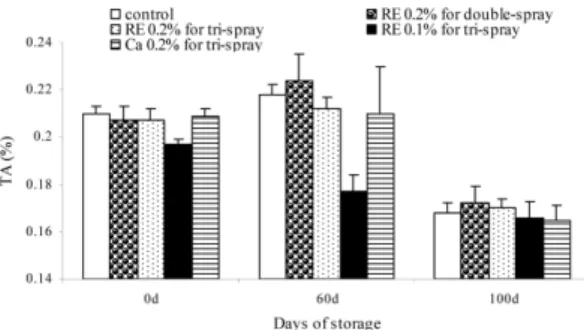
Rare earth elements or Ca did not show significant effect on titratable acidity (TA) at the time of harvest (Fig. 4) suggested that the foliar spray of rare earth ele- ments or Ca did not affect the fruit ripening on the tree.
Whereas storing intervals had a decreasing trend of titrat- able acidity which showed accordance with the previous report of Hayat et al. (2005) who had observed that acid- ity percentage decreased with increasing storing period.
Among the treatments, double-spray of 0.2% rare earth elements proved powerful for retarding the decrease of TA toward the end of storage.
The ratio between SSC and TA is considered a good Fig. 1. Individual fruit weight of ‘Fuji’/M.9 apple treated
foliar spray of rare earth elements, or calcium in growth season in 2007. The bar indicated SE.
Fig. 3. Fruit firmness of ‘Fuji’/M.9 apple treated foliar spray of rare earth elements, or calcium during 5-month storage in 2007. The bar indicated SE.
Fig. 2. Fruit redness (Hunter a value) of ‘Fuji’/M.9 apple treated foliar spray of rare earth elements, or calcium dur- ing 5-month storage in 2007. The bar indicated SE.
Fig. 4. TA value of ‘Fuji’/M.9 apple receiving foliar spray of rare earth elements, or calcium during 5-month stor- age in 2007. Data are the mean ± SE of 10 fruits in tripli- cate.
index for the evaluation of fruit quality (Serrano et al., 2004). In our study, ‘Fuji’ apples that had double sprayed with 0.2% rare earth elements exhibited the highest SSC/
TA value at the end of storage (Fig. 5) indicated that this treatment proved better than others.
Ethylene production of ‘Fuji’ apple fruit was signifi- cantly inhibited by foliar spray of rare earth elements at harvest (Table 4). Ca-treated fruits also showed signifi- cantly lower ethylene production compared to control.
Ferguson (1984) reported that calcium sprays decreased ethylene production in apples, which could be attributed to a decrease in ACC oxidase activity (Guan et al., 1991).
At the end of shelf life ethylene production remarkably increased in all treatment groups but rare earth elements maintained the lowest rate. Rare earth elements reduced respiration rate at harvest (Table 4) which is critical in extending shelf-life of ‘Fuji’ apple (Lee et al., 2003; Sur- jadinata and Cisneros-Zevallos, 2003). Both rare earth elements and Ca treated fruits showed decreased CO2
production at the end of shelf life is an agreement with the report that calcium delayed ripening and senescence
of fruits by lowering the respiration rate (Singh et al., 1993).
Effects of foliar spray of rare earth elements on ‘Fuji’
apple indicated improved fruit redness at harvest which strongly favored fruit marketing. Although foliar spray of rare earth elements did not show significant difference on individual fruit weight, mineral accumulations, firmness, SSC/TA ratio, and TA at harvest but retarded the decrease in firmness and TA in the storage. Furthermore, during storing, rare earth elements showed lower respi- ration rate and ethylene production as Ca indicated that rare earth elements may be an alternative for extending postharvest life of ‘Fuji’ apple fruit.
Acknowledgement
This study was supported by Research Fund of Min- istry for Food, Agriculture, Forestry and Fisheries.
Literature Cited
1. Alcaraz-Lopez, C., M. Botia, C.F. Alcaraz, and F.
Riqelme. 2003. Effects of foliar sprays containing cal- cium, magnesium and titanium on plum (Prunus domestica L.) fruit quality. J. Plant Physiol. 160:1441- 1446.
2. Brown, P.H., A.H. Rathjen, R.D. Graham, and D.E.
Tribe. 1990. Rare earth elements in biological sys- tems. In: Gschneidner K.A. Jr. and Eyring L. (eds.), Handbook on the physics and chemistry of rare earths, vol. 13. Elsevier Science Publishers, Amesterdam, 423-452.
3. Conway, W.S., C.E. Sams, and A. Kelman. 1994.
Enhancing the natural resistance of plant tissues to postharvest diseases through calcium applications.
HortScience 29:751-754.
Table 4. Effects of rare earth elements or calcium on ethylene production and respiration rate of ‘Fuji’ apple at harvest and end of shelf life (160 days after harvest).
Treatments Ethylene Production (ml kg−1 h−1) Respiration rate (ml g−1 h−1) At harvest End of shelf life At harvest End of shelf life
Control 0.62a 31.58a 7.01ab 4.84ab
Re 0.2% for double-spray 0.30c 28.71c 6.46ab 4.07ba
Ca 0.2% for tri-spray 0.48b 30.37b 7.01ab 4.36ab
* The means within column with the same letter are not significantly different at P = 0.05 according to Duncan’s multiple range tests. Data are the mean ± SE of 10 fruits in triplicate.
*RE: rare earth elements fertilizer.
Fig. 5. SSC/TA ratio of ‘Fuji’/M.9 apple receiving foliar spray of rare earth elements, or calcium during 5-month storage in 2007. Data are the mean ± SE of 10 fruits in triplicate.
4. Ding, S.M., T. Liang, C.S. Zhang, L.J. Wang, and Q.
Sun. 2006. Accumulation and fractionation of rare earth elements in a soil-wheat system. Pedosphere 16:
82-90.
5. Fedirko, N., M. Klevets, and V. Manko. 1998. Modu- lation influence of Cd2+ and La3+ on Na+-dependent Ca2+ influx in exocrine secretory cells and secretory process. Pathophysiol. 5: 134.
6. Furguson, I.B. 1984. Calcium in plant senescence and fruit ripening. Plant Cell. Environ. 7:477-489.
7. Guan, J.F., H.R. Shu, and T.D. Huang. 1991. The effect of calcium on ethylene production in ‘Starkin- son’ apple. Acta Hort. Sinica 18:205-209.
8. Hayat, I., T. Masud, and H.A. Rathore. 2005. Effect of coating and wrapping materials on the shelf life of apple (Malus domestica Borkh). Int. J. Food Safety 5:24-34.
9. Henke, G. 1977. Activation analysis of rare earth ele- ments in opium and cannabis samples. J. Radioanal.
Nucl. Chem. 39:69-83.
10. Lee, J.Y., H.J. Park, C.Y. Lee, and W.Y. Choi. 2003.
Extending shelf-life of minimally processed apples with edible coatings and antibrowning agents. Lebensm.- Wiss. Technol. 36:323-329.
11. Manganaris, G.A., M. Vasilakakis, I. Mignani, G. Dia- mantidis, and K. Tzavella-Klonari. 2005. The effect of preharvest calcium sprays on quality attributes, physic- ochemical aspects of cell wall components and suscep- tibility to brown rot of peach fruits (Prunus persica L.
cv. Andross). Sci. Hort. 107:43-50.
12. Poovaiah, B.W. 1986. Role of calcium in prolonging storage life of fruits and vegetables. Food Technol. 40:
86-89.
13. Raese, J.T. and S.R. Drake. 2000. Effect of calcium spray materials, rate, time of spray application, and rootstocks on fruit quality of ‘Red’ and ‘Gold deli- cious’ apple. J. Plant Nutr. 23:1435-1447.
14. Rosso, V.V. and A.Z. Mercadante. 2007. Evaluation of colour and stability of anthocyanins from tropical fruits in an isotonic soft drink system. Innov. Food Sci. Emerg.
Technol. 8:347-352.
15. Serrano, M., D. Martinez-Romero, S. Castillo, F.
Guillen, and D. Valero. 2004. Effect of preharvest sprays containing calcium, magnesium, titanium on the quality of peaches and nectarines at harvest and dur- ing postharvest storage. J. Sci. Food Agric. 84:1270- 1276.
16. Siddiqui, S. and F. Bangerth. 1995. Effect of pre-har- vest application of calcium on flesh firmness and cell- wall composition of apples- influence of fruit size. J.
Hort. Sci. 70:263-269.
17. Singh, R.P., D.K. Tandon, and S.K. Kalra. 1993. Change in post-harvest quality of mangoes affected by pre-har- vest application of calcium salts. Sci. Hort. 54:211- 219.
18. Surjadinata, B.B. and L. Cisnereos-Zevallos. 2003.
Modeling wounding induced respiration of fresh-cut carrots (Daucus carots L.). J. Food Sci. 68:2735-2740.
19. Wang, Z.J., D.F. Liu, P. Lu, and C.X. Wang. 2001.
Accumulations of rare earth elements in corn after agricultural application. J. Environ. Qual. 30:37-45.
20. Wen, B., D.A. Yuan, X.Q. Shan, F.L. Li, and S.Z.
Zhang. 2001. The influence of rare earth element fertil- izer application on the distribution and bioaccumulation of rare earth elements in plants under field conditions.
Chem. Spec. Bioavail. 13:39-48.
21. Wyttenbach, A., V. Furrer, P. Schlepp, and L. Tobler.
1998. Rare earth elements in soil and in soil-grown plants. Plant Soil 199:267-273.
22. Xu, X.K., W.Z. Zhu, Z.J. Wang, and G.J. Witkamp.
2002. Distributions of rare earths and heavy metals in field-grown maize after application of rare earth-con- taining fertilizer. Sci. Total Environ. 293:97-105.
23. Yuan, D.A., X.Q. Shan, Q. Huai, B. Wen, and X.R.
Zhu. 2001. Uptake and distribution of rare earth ele- ments in rice seeds cultured in fertilizer solution of rare earth elements. Chemosphere 43:327-337.
24. Zhang, S.Z. and X.Q. Shan. 2001. Speciation of rare earth elements in soil and accumulation by wheat with rare earth fertilizer application. Environ. Pollut. 112:
395-405.
25. Zhu, Y.Y., J.J. Chen, and G.Z. Song. 1987. Uptake, dis- tribution and accumulation of rare earth elements in wheat. J. Chin. Rare Earth Soc. 5:61-65 (in Chinese).
희토류비료 시비가 사과 과실내 축적과 수확 및 저장 중 사과품질에 미치는 영향
정위위1·박무용2·피터 허스트3·윤태명4·전익조1*
1국립안동대학교 원예육종학과, 2국립원예특작과학원 사과시험장,
3미국 퍼듀대학교 원예학과, 4경북대학교 원예과학과
적 요. 본 연구는 희토류비료 시비가 8년생 ‘후지’/M.9 사과의 미량원소 변화 및 사과의 수확 품질과 5개월간 4 저장 후 과실 품질에 미치는 영향을 알아보기 위해 수행하였다. 1년차 희토류 비료의 시비는
‘후지’ 사과 과실내 란타늄, 프라세오디뮴, 가돌리늄 및 네오디뮴을 축적하였다. 또한 2년차 연구에서 높은 농도의 희토류비료 시비는 보다 많은 량의 희토류 성분을 과실에 축적하여 과실내 희토류의 축적은 희토 류비료의 시비량에 비례하였다. 이러한 희토류비료의 시비는 과실내의 다른 미량원소인 칼슘, 마그네슘과 칼륨의 농도에는 영향을 미치지 않았다. 희토류비료 시비에 따른 과실 품질조사에 있어, 희토류비료 0.2%
의 엽면살포는 수확기 사과 과피의 붉은 색을 증가시켰으나, ‘후지’ 과실의 과중, 경도 및 산도는 변화가 없었다. 저장 사과의 희토류비료 시비효과를 조사한 결과, 희토류비료 처리된 사과의 경우 무처리에 비해 5개월 저장 후 과실의 연화 및 적정산도의 감소를 지연시키며, 호흡률과 에틸렌발생을 감소시켰다.
주제어 : 경도, 당산비, 산도, 칼슘, 희토류