韓 國 水 資 源 學 會 論 文 集 第43卷 第11號․2010年 11月
pp. 995~1009
분포형 수문모형을 이용한 침식 및 퇴적의 시·공간 변동성 분석
Analysis on Spatiotemporal Variability of Erosion and Deposition Using a Distributed Hydrologic Model
이 기 하 * / 유 완 식 ** / 장 창 래 *** / 정 관 수 ****
Lee, Gi Ha / Yu, Wan Sik / Jang, Chang Lae / Jung, Kwan Sue
...
Abstract
Accelerated soil erosion due to extreme climate change, such as increased rainfall intensity, and human-induced environmental changes, is a widely recognized problem. Existing soil erosion models are generally based on the gross erosion concept to compute annual upland soil loss in tons per acre per year.
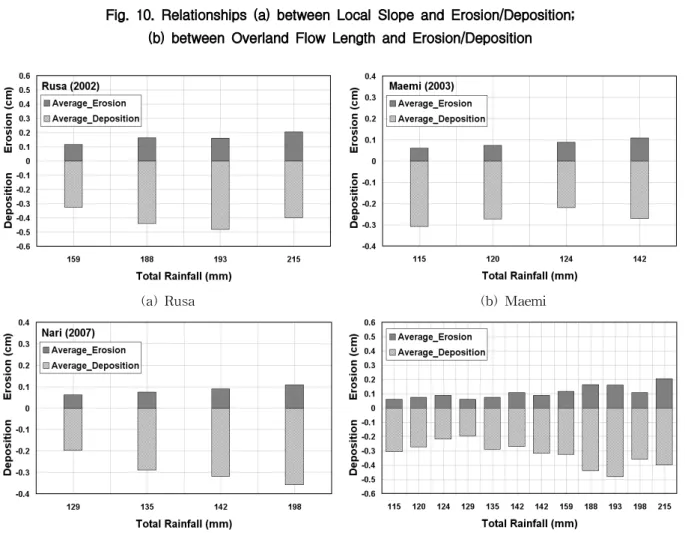
However, such models are not suitable for event-based simulations of erosion and deposition in time and space. Recent advances in computer geographic information system (GIS) technologies have allowed hydrologists to develop physically based models, and the trend in erosion prediction is towards process- based models, instead of conceptually lumped models. This study aims to propose an effective and robust distributed rainfall-sediment yield-runoff model consisting of basic element modules: a rainfall-runoff module based on the kinematic wave method for subsurface and surface flow, and a runoff-sediment yield-runoff model based on the unit stream power method. The model was tested on the Cheoncheon catchment, upstream of the Yongdam dam using hydrological data for three extreme flood events due to typhoons. The model provided acceptable simulation results with respect to both discharge and sediment discharge even though the simulated sedigraphs were underestimated, compared to observations. The spatial distribution of erosion and deposition demonstrated that eroded sediment loads were deposited in the cells along the channel network, which have a short overland flow length and a gentle local slope while the erosion rate increased as rainfall became larger. Additionally, spatially heterogeneous rainfall intensity, dependant on Thiessen polygons, led to spatially-distinct erosion and deposition patterns.
Keywords : soil erosion, rainfall-sediment yield-runoff model, unit stream power, spatial distribution of erosion and deposition
...
요 지
기후변화에 의해 집중호우의 빈도 및 강도가 증가하고 지속적인 유역개발에 따른 토지이용의 증가는 토양침식 및 토 사유출로 인한 재해 및 환경문제를 야기한다. 현재 광범위하게 사용되고 있는 토양침식량 산정기법은 대부분 대상유역 내의 평균 토양침식량을 산출하는 총량적 개념의 경험식이므로 호우기간동안의 침식 및 퇴적의 시·공간적 변화양상을
* 충남대학교 건설방재연구소 post-doc 연구원 (e-mail: [email protected])
Research Associate, Construction and Disaster Research Center, Chungnam National Univ., Daejeon 305-764, Korea
** 충남대학교 공과대학 토목공학과 석사
Graduated student, Dept. of Civil Engrg., Chungnam National Univ., Daejeon 305-764, Korea (e-mail: [email protected])
*** 교신저자, 충주대학교 공과대학 토목공학과 조교수 (e-mail: [email protected])
Corresponding Author, Assistant Prof. Dept. of Civil Engrg., Chungju National Univ., Chungju 380-702, Korea
**** 충남대학교 공과대학 토목공학과 교수 (e-mail: [email protected])
Professor, Dept. of Civil Engrg., Chungnam National Univ., Daejeon 305-764, Korea