국내 건설기업 경영성과의 핵심성과지표 도출에 관한 연구
The Management Evaluation Key Performance Indicators of Korean Construction Firms
이 동 훈1
김 선 형2
권 기 덕2
김 만 기3
김 선 국4*
Lee, Dong-Hoon1 Kim, Seon-Hyung2 Kwon, Gi-Deoc2 Kim Man-Ki3 Kim, Sun-Kuk4*
Department of Architectural Engineering, Kyung-Hee University, Kiheung-Gu, Suwon, 446-701, Korea 1 Department of Architectural Engineering, Kyung-Hee University, Kiheung-Gu, Suwon, 446-701, Korea 2
Dong-Bu Corporation, KangNam-Gu, Seoul, 135-523, Korea 3
Department of Architectural Engineering, Kyung-Hee University, Kiheung-Gu, Suwon, 446-701, Korea 4
Abstract
Business performance measurement is used as an important tool to evaluate management performance, control human resources, and implement strategies. It can be measured simply in terms of finance including net profit, return on investment, and return on equity, but this is not sufficient because the performance outside of finance such as internal business process and informatization cannot be examined. Therefore this study defined a KPI(Key Performance Indicators) applicable to local construction companies ranked in the top 30 in construction capability, and also introduced differentiated results from the earlier studies by reflecting more realistic corporate management based on the existing studies and interviews with business experts.
Keywords : Key Performance Index, Management Performance, Construction Firms
1. 서 론
1.1 연구의 배경 및 목적1)
국내 건설 대기업이 처해있는 국내외 환경은 경영성과에 지대 한 영향을 미치고 있다. 예를 들어, 국제적으로 원유를 비롯하여 원자재 값 급등에 따른 공사원가 상승, 2004년부터 시작된 국제 플랜트 프로젝트 발주량 급등에 따른 해외 수주의 증가, 2008년 미국 발 금융위기에 따른 국내 분양시장의 침체는 물론 해외 플랜 트 시장의 일시적 침체 등 다양한 요인들이 경영에 영향을 미치고 있다. 한편 한국의 주택금융 규제 및 지방의 공급 과잉에 따른 미 분양 아파트의 급증, 인구구성 및 소득수준의 변화에 따른 상품형 태의 변화, 일관적이지 못한 정부 정책 및 제도의 변화에 따른 건
Received : November 11, 2010 Revision received : December 10, 2010 Accepted : December 17, 2010
* Corresponding author : Kim, Sun-Kuk
[Tel: 82-31-201-3366, E-mail: [email protected]]
ⓒ2011 The Korea Institute of Building Construction, All rights reserved.
설시장의 혼란 등의 요인은 경영환경에 악영향을 미쳤으며, 이와 함께 앞에 열거한 국제 환경변화는 직 간접적으로 국내 대기업의 경영성과에 영향을 끼쳤다.
급변하는 경영환경에서 건설기업은 생존과 경쟁우위를 위하여 자기업 경영성과의 평가 및 전략수립이 필요하다. 기업의 경영성 과는 경영전략과 목표에 반영된다. 중ㆍ장기전략 뿐 아니라 연도 별 그리고 반기별 전략을 자체적으로 수립 및 수행한다. 기간별 전략 수립의 근거는 전기 경영성과와 외부환경변화이며 수립된 전략의 수행 후 기업은 다시 성과측정을 통해 경영목표의 달성 여 부와 차기 경영전략 수립의 근거를 마련하게 된다. 기업 활동에 있어 성과측정은 경영성과의 평가, 인적자원의 관리 및 전략이행 의 중요한 도구로 사용된다[1]. 특히 최근의 복잡해진 경영환경은
“측정할 수 없다면, 관리할 수도 없다”는 표현으로 성과측정의 중요성을 부각시키고 있다[2,3].
기업의 경영성과 측정은 당기 순이익, 투자수익률, 자기자본 이익률과 같이 단순히 재무적 관점에서 성과를 측정하는 방법[4]
과 매출액 증대와 함께 이익목표 달성여부를 평가하는 양적⋅재 무적 성과측정 방법을 제시한 연구[5]가 있으나 기업의 내부프로
The Management Evaluation Key Performance Indicators of Korean Construction Firms
세스나 정보화와 같은 재무외적 성과를 측정할 수 없어 부족함이 있다. 1990년대 이후 정보화 사회로 발전하면서 경영효율의 기저 를 이루는 지적자산에 대한 중요성이 대두되었으며, 기업이 보유 하고 있는 지적자산에 대한 평가항목과 성과측정 방법에 대한 연 구가 이루어졌다[2].
기업의 자산은 크게 유형자산(tangible assets)과 무형자산 (intangible assets)으로 나눌 수 있다. 무형자산은 재무제표에 인식되지 않으면서 기업 내에 존재하는 자산으로 인식할 수 있으 며 기업이미지, 브랜드파워 등이 대표적인 무형자산이다. 국내 건 설기업의 경우 시장가치 대비 무형자산(시장가치-순자산)의 비율 이 1단위 증가할 때 건설기업의 순이익은 약 75억원 증가하며, 매출액은 약 850억원 증가한다는 연구[6]가 있다. 이것은 건설기 업의 무형자산 가치가 기업의 경쟁력에 직접적인 영향을 미치는 것을 증명한다. 따라서 기업의 경영성과 측정은 이러한 무형자산 도 고려되어야 하며, Kaplan and Norton[2]은 이러한 무형자산 을 크게 고객(customers), 내부 프로세스(internal business processes), 학습과 성장(learning and growth)의 3가지로 제안 하였다. 이들은 이 3가지 항목과 함께 유형자산인 재무항목을 경 영성과 평가를 위한 균형성과지표(Balanced Scorecard, 이하 BSC)로 제안하였다.
지금까지 국내 건설기업의 경영성과 분석을 위한 대부분의 연 구가 Kaplan and Norton[2]이 제안한 균형성과지표를 기준으로 수행되었다[7,8,9,10,11]. 따라서 일반기업과 같이 건설기업의 경우에도 재무, 고객, 내부프로세스, 학습과 성장과 같이 4개의 BSC로 경영성과를 분석 하는 것에 대한 별도의 검증 없이 적용하 였다. 다만, 이들을 구성하는 성과영역 및 측정지표(Key Performance Indicators, 이하 KPI)는 기업의 규모와 특성에 따 라 다르므로 BSC의 세부 내용도 달리 구성되어야 한다. 그러나 현재까지의 연구는 수주산업인 건설업의 특성이 충분히 반영되지 못하였다. 따라서 기업에서 실제로 사용되고 있는 성과지표와 기 존연구에서 도출한 성과지표의 차이가 발생하였다. 기업에서 사 용되고 있는 성과지표 역시 평가 요소간 계층구조의 순위역전현 상과 중복 그리고 프로젝트 단위 평가요소가 혼재하는 등 한계가 있다. 따라서 본 연구는 국내 건설기업의 실정을 반영하며 지표 간 균형을 맞춘 핵심성과지표의 도출을 목적으로 한다.
1.2 연구의 범위 및 방법
본 연구는 국내의 시공능력순위 30위 이내의 건설기업에 적용 가능한 핵심 성과지표를 도출하며, 기업의 경영성과 측정에 핵심 이 되는 KPI(Key Performance Indicators)와 가중치 그리고 항 목별 평가방법은 기존의 연구와 기업 전문가의 설문을 반영하여 보다 현실적인 기업의 경영을 반영하며 기존의 연구와 차별된 결 과를 도출하였다.
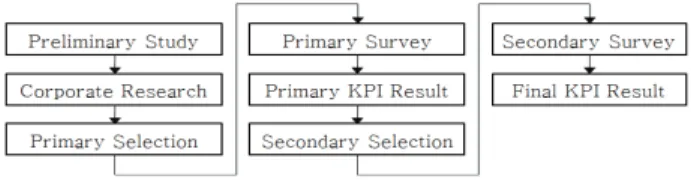
대형 건설기업의 KPI 도출을 위하여 본 연구는 figure 1과 같
이 문헌고찰을 통하여 선행연구에서 도출된 KPI를 분석하고 건설 기업에서 사용되고 있는 경영성과 측정지표를 조사하여 중복 항 목과 불필요한 항목을 제거하고 유사항목을 통합하여 1차로 KPI 를 선별한다.
선별된 1차 KPI항목을 기초로 하여 국내 대형건설기업의 경영 실무자와 경영자를 대상으로 1차 설문을 실시하고 결과를 분석 및 종합하여 2차 선별 및 정리를 실시한다. 이후 선별된 KPI항목 의 적정성, 균형 그리고 추가가 필요한 항목에 대한 2차 설문을 실시하여 실질적인 국내 대형건설기업의 경영성과 핵심성과지표 를 도출하고자 한다.
figure 1. Research methods
2. 이론 및 기존연구 고찰
기업은 자산, 자본, 투하자산 등 재무적 자원에 대한 효율성을 주요 사업지표로 사용해왔다. 경영 성과율은 경영자의 시간, 노력 과 같은 조직 내 주요 자원투입에 대한 효율성을 측정하기 위해 고안된 것이다. 즉 경영자와 종업원들이 회사 전략의 실행에 얼마 나 집중하고 있는가를 판단하는 것이다. 자기자본수익률, 총자산 수익률과 같은 지표에 대한 경영 성과율은 Equation (1)과 같이 분자가 크고 분모가 작으면 그 수치가 커진다. 반면 경영 성과율 을 저해하는 부정적 요인이 작거나 긍정적 요인이 많아지면 수치 가 커질 수 있다.
and
2.1 경영성과 측정
대부분의 기업이 경영성과 측정지표로 당기 순이익, 투자수익 률, 자기자본 이익률 등의 재무적 측정치들을 사용하고 있다[4].
특히, 매출액이나 외형중시의 확대성장전략을 구사하는 경우에는 매출액이나 이익목표가 주된 성과평가의 항목으로 규정되는 등 양적인 재무적 평가에 초점이 맞추어졌다[5].
1990년대 이후 지적 자산에 대한 개념이 응용되면서 많은 학자 와 기업이 실제적인 지적자산에 대한 평가항목과 적용방법을 연구 해왔다. 이러한 연구는 기존의 재무 중심의 성과 평가항목들을 보 완하는 방법으로, 전략적 관리회계, 전략적 원가관리 및 비재무적
적 목표의 실천을 지원 할 수 있는 성과측정지표를 만들기 위하여 Kaplan and Norton(1992)[2]은 균형성과표를 제안하였다.
균형성과표는 기업으로 하여금 추구하는 전략적 목표나 주요 성과요인을 제대로 이해하고 현재 진행 중인 사업에 대해 종합적 인 시각을 갖게 한다. 균형성과표의 4가지 관점 중 재무관점은 재 무적 측정지표들을 이용하여 성과를 측정하는 관점이다. 현금 흐 름, 매출액 증가, 사업별 영업 이익률, 부문별 시장 점유율, 자산 수익률, 투자수익률, 경제적 부가가치(EVA), 수익성 등과 같은 기준의 재무 측정지표를 사용한다[12].
Kaplan and Norton[2]의 균형성과표(BSC)는 실행 결과를 나타 내는 재무측정지표와 이를 보완하면서 미래의 재무성과에 영향을 주는 운영활동인 고객만족, 내부 프로세스, 조직의 학습 및 개선 능력 등과 관계된 세 가지의 운영측정지표가 포함되어 있다. 균형성과표는 기업의 성과를 네 가지 관점으로 살펴볼 수 있다. 균형성과표의 특징은 측정지표의 개수를 줄여 정보의 양을 최소화하여 가장 중요한 측정지표에 집중할 수 있도록 유도한다.
영국에서는 TQM(Total Quality Management) 활동을 목적 으로 개발된 EFQM (European Foundation for Quality Management)의 엑설런스 모델이 성과측정의 도구로 주로 활용 되어 왔다[1]. EFQM 엑설런스 모델은 “위에 열거한 개념을 얼 마나 우수하게 달성하였는가?”를 평가하기 위하여 개발되었다.
EFQM 모델은 9개의 영역으로 이루어져 있으며 각 영역의 리더 쉽(leadership)으로부터 출발한다.
2.2 기존연구 고찰
Cha et al.은 프로젝트의 효율적 관리를 위한 KPI를 비용, 공 기, 품질, 안전, 환경, 생산성, 리스크(risk containment), 보안 (security) 등 8개의 부문으로 구분하고 이들을 다시 27개의 측정 항목으로 구분하여 제시하였다. 각 측정항목은 비교적 정량적으 로 쉽게 산정할 수 있도록 제안하여 활용하기가 용이하나, Kaplan and Norton의 BSC에서 언급한 고객, 내부 프로세스, 학습 및 성장과 관련된 내용을 포함하지 않았다. 내부 프로세스 및 학습과 성장은 기업 차원에서 다룬다 하더라도 건설업에서 고 객만족은 프로젝트 성과에서 비롯 되는 것이므로 이 부분이 누락 된 것은 문제가 있다고 판단된다. 이 부분은 Shenhar et al.[13]
가 프로젝트 성과측정에서 고객을 중요한 것으로 인식하는 것과 대조가 된다.
Ryu et al.[14]은 KPI의 후보가 존재하는 경우에 대해 AHP기 법을 이용한 쌍대비교를 통해 KPI에 기여도가 높은 프로세스 KPI를 발견하고 BPM(Business Process Management) 측면에 서 프로세스를 개선하면서 동시에 전략의 실현에 기여하는 방안
검 사항을 도출하여 건설관련 전문가의 의견 수렴을 거쳐 국내 건 설 사업 발주자 관점의 체크리스트를 제안하는 방식의 연구가 진 행된 바 있다. 이러한 연구는 기업의 경영이 아닌 프로젝트 단위 의 연구로서 본 연구와는 개념 및 접근방법에 차이가 크다.
기업의 경영성과 측정에 관하여 Kaplan and Norton의 BSC 개발 이후 다양한 연구가 진행되었다. Kim et al.[15]은 BSC를 활용한 서울시내 특1급 호텔의 KPI 개발에 관한 연구에서 델파이 기법을 이용한 전문가 조사를 통하여 리조트 사업의 KPI를 개발 하였으며 Park et al.[16]은 택배기업의 핵심 성과지표 결정요인 연구에서 기업의 경영자 특성, 경영환경 특성 그리고 경영자원 특 성이 조직운영 메커니즘 가운데 하나인 핵심성과지표 운용에 미 치는 영향을 고찰하였다.
Yu et al.[9]은 다른 나라의 선행사례들을 분석하여 국내건설 산업 차원의 성과지수 개발의 필요성을 제시하고 성과지수 관리 에 적합한 PMS Framework를 제안하며 KPI를 주요 결과로 제 시하였다. 또한 2006년 건설기업들의 성과를 측정하고 지표들의 다양한 분석을 통하여 KPI를 제시하였으며 회귀분석과 상관분석 을 실시하였다. 건설기업의 규모에 따른 경영성과 측정을 위한 성 과지표별 가중치를 분석하는 Jung et al.의 2005년 연구는 설문 조사의 결과를 바탕으로 AHP 분석을 실시하여 중요도를 산출하 였으며 중소기업과 대기업 간의 가중치 차이를 도출하였다. Jung et al.[10]의 연구는 분석기법의 차이 뿐 아니라 대상 기업, 설문 방식 그리고 도출결과에서 본 연구와 많은 차이를 보인다.
3. 경영성과 지표 분석
3.1 경영성과 평가지표 조사
대형건설기업의 경영성과 지표를 도출을 위한 가장 효과적인 방법은 기업에서 사용하고 있는 경영성과 측정 방식을 조사하여 분석하는 것이다. 기업의 경영성과 측정 방식은 기업별로 평가항 목과 평가방식의 차이가 있으나 평가의 목표와 흐름은 유사하다.
이는 기업이 경쟁력 향상과 전략의 수립을 위해 오랜 기간 시행착 오를 거치며 다듬어진 결과이며 국내와 국외의 유사한 시장에서 경영하며 획득하였기 때문에 기업의 경영성과 지표를 도출하기 위한 효과적인 근거가 될 수 있다.
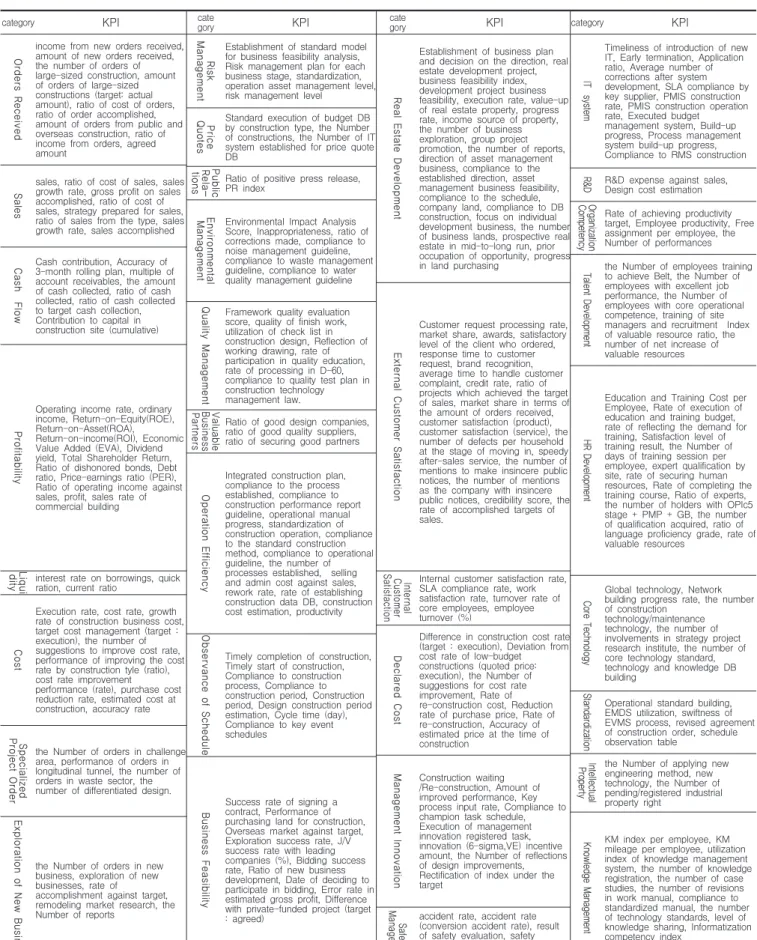
국내 대형건설기업 중 3개 기업(2010년 시공능력순위 15위 이 내)의 경영성과 측정지표를 카테고리와 KPI로 분류하여 table 1 과 같이 조사하였다. table 1의 성과지표는 조사대상 기업에서 사 용되었던 모든 성과지표이며 상황에 따라 적용되지 않는 부분도 포함되어 있다. 총 32개의 카테고리와 카테고리 별 KPI로 조사되 었으며 기업별로 중복되는 성과지표가 많았다. 이러한 기업의 성
The Management Evaluation Key Performance Indicators of Korean Construction Firms
category KPI gorycate KPI category KPI category KPI
Orders Received
income from new orders received, amount of new orders received, the number of orders of large-sized construction, amount of orders of large-sized constructions (target: actual amount), ratio of cost of orders, ratio of order accomplished, amount of orders from public and overseas construction, ratio of income from orders, agreed amount
Risk Management
Establishment of standard model for business feasibility analysis, Risk management plan for each business stage, standardization, operation asset management level, risk management level Real Estate Development
Establishment of business plan and decision on the direction, real estate development project, business feasibility index, development project business feasibility, execution rate, value-up of real estate property, progress rate, income source of property, the number of business exploration, group project promotion, the number of reports, direction of asset management business, compliance to the established direction, asset management business feasibility, compliance to the schedule, company land, compliance to DB construction, focus on individual development business, the number of business lands, prospective real estate in mid-to-long run, prior occupation of opportunity, progress in land purchasing
IT system
Timeliness of introduction of new IT, Early termination, Application ratio, Average number of corrections after system development, SLA compliance by key supplier, PMIS construction rate, PMIS construction operation rate, Executed budget management system, Build-up progress, Process management system build-up progress, Compliance to RMS construction
Price Quotes Standard execution of budget DB
by construction type, the Number of constructions, the Number of IT system established for price quote DB
Sales
sales, ratio of cost of sales, sales growth rate, gross profit on sales accomplished, ratio of cost of sales, strategy prepared for sales, ratio of sales from the type, sales growth rate, sales accomplished
PublicRela-tions
Ratio of positive press release, PR index
R&D
R&D expense against sales, Design cost estimation
EnvironmentalManagement
Environmental Impact Analysis Score, Inappropriateness, ratio of corrections made, compliance to noise management guideline, compliance to waste management guideline, compliance to water quality management guideline
Organization Competency
Rate of achieving productivity target, Employee productivity, Free assignment per employee, the Number of performances
Cash Flow
Cash contribution, Accuracy of 3-month rolling plan, multiple of account receivables, the amount of cash collected, ratio of cash collected, ratio of cash collected to target cash collection, Contribution to capital in construction site (cumulative)
Talent Development
the Number of employees training to achieve Belt, the Number of employees with excellent job performance, the Number of employees with core operational competence, training of site managers and recruitment Index of valuable resource ratio, the number of net increase of valuable resources
External Customer Satisfaction
Customer request processing rate, market share, awards, satisfactory level of the client who ordered, response time to customer request, brand recognition, average time to handle customer complaint, credit rate, ratio of projects which achieved the target of sales, market share in terms of the amount of orders received, customer satisfaction (product), customer satisfaction (service), the number of defects per household at the stage of moving in, speedy after-sales service, the number of mentions to make insincere public notices, the number of mentions as the company with insincere public notices, credibility score, the rate of accomplished targets of sales.
Quality Management
Framework quality evaluation score, quality of finish work, utilization of check list in construction design, Reflection of working drawing, rate of participation in quality education, rate of processing in D-60, compliance to quality test plan in construction technology management law.
Profitability
Operating income rate, ordinary income, Return-on-Equity(ROE), Return-on-Asset(ROA), Return-on-income(ROI), Economic Value Added (EVA), Dividend yield, Total Shareholder Return, Ratio of dishonored bonds, Debt ratio, Price-earnings ratio (PER), Ratio of operating income against sales, profit, sales rate of commercial building
HR Development
Education and Training Cost per Employee, Rate of execution of education and training budget, rate of reflecting the demand for training, Satisfaction level of training result, the Number of days of training session per employee, expert qualification by site, rate of securing human resources, Rate of completing the training course, Ratio of experts, the number of holders with OPIc5 stage + PMP + GB, the number of qualification acquired, ratio of language proficiency grade, rate of valuable resources
Valuable Business Partners
Ratio of good design companies, ratio of good quality suppliers, ratio of securing good partners
Operation Efficiency
Integrated construction plan, compliance to the process established, compliance to construction performance report guideline, operational manual progress, standardization of construction operation, compliance to the standard construction method, compliance to operational guideline, the number of processes established, selling and admin cost against sales, rework rate, rate of establishing construction data DB, construction cost estimation, productivity
Liquidity
interest rate on borrowings, quick
ration, current ratio Satisfaction Customer Internal
Internal customer satisfaction rate, SLA compliance rate, work satisfaction rate, turnover rate of core employees, employee turnover (%)
Core Technology
Global technology, Network building progress rate, the number of construction
technology/maintenance technology, the number of involvements in strategy project research institute, the number of core technology standard, technology and knowledge DB building
Cost
Execution rate, cost rate, growth rate of construction business cost, target cost management (target : execution), the number of suggestions to improve cost rate, performance of improving the cost rate by construction tyle (ratio), cost rate improvement performance (rate), purchase cost reduction rate, estimated cost at construction, accuracy rate
Declared Cost
Difference in construction cost rate (target : execution), Deviation from cost rate of low-budget constructions (quoted price:
execution), the Number of suggestions for cost rate improvement, Rate of re-construction cost, Reduction rate of purchase price, Rate of re-construction, Accuracy of estimated price at the time of construction
Observance of Schedule
Timely completion of construction, Timely start of construction, Compliance to construction process, Compliance to construction period, Construction period, Design construction period estimation, Cycle time (day), Compliance to key event schedules
Standardization
Operational standard building, EMDS utilization, swiftness of EVMS process, revised agreement of construction order, schedule observation table
Specialized Project Order the Number of orders in challenge
area, performance of orders in longitudinal tunnel, the number of orders in waste sector, the number of differentiated design.
Intellectual Property
the Number of applying new engineering method, new technology, the Number of pending/registered industrial property right
Management Innovation
Construction waiting /Re-construction, Amount of improved performance, Key process input rate, Compliance to champion task schedule, Execution of management innovation registered task, innovation (6-sigma,VE) incentive amount, the Number of reflections of design improvements, Rectification of index under the target
Business Feasibility
Success rate of signing a contract, Performance of purchasing land for construction, Overseas market against target, Exploration success rate, J/V success rate with leading companies (%), Bidding success rate, Ratio of new business development, Date of deciding to participate in bidding, Error rate in estimated gross profit, Difference with private-funded project (target : agreed)
Knowledge Management
KM index per employee, KM mileage per employee, utilization index of knowledge management system, the number of knowledge registration, the number of case studies, the number of revisions in work manual, compliance to standardized manual, the number of technology standards, level of knowledge sharing, Informatization competency index
Exploration of New Business
the Number of orders in new business, exploration of new businesses, rate of
accomplishment against target, remodeling market research, the Number of reports
SafetyManagement
accident rate, accident rate (conversion accident rate), result of safety evaluation, safety accident PQ construction evaluation score
Table 1. KPI(Key Performance Index) Applied to Large-Sized Construction Companies
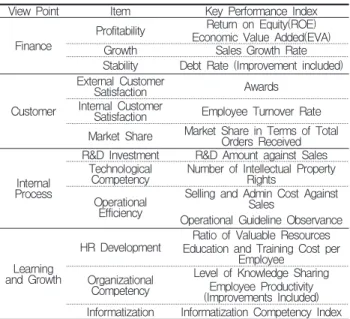
또한 기존의 연구 역시 경영성과 지표를 도출하기 위한 기초 데이터로 활용하였다. Yu et al.[1]은 ‘Analysis of Quantified Characteristics of the Performance Indicators for Construction Companies’에서 건설기업 BSC를 바탕으로 table 2와 같이 핵 심성과 지표를 도출하고 AHP기법을 통해 성과 영역별 가중치를 산정하였다. 이 논문에서는 건설기업의 BSC를 기초로 12개의 성 과영역에서 16개의 KPI를 도출하였다. 건설기업의 비전과 목표 를 분석하여 BSC의 세부항목으로 12개의 성과영역을 제시하였으 며 성과영역 하부에 포함되는 여러 후보지표들 중 지표의 타당성, 측정가능성, 비교가능성을 만족시키는 KPI를 제시하였다[1].
Yu et al.[9]은 ‘Key Performance Indicators for Developing Construction Performance Index’에서 건설기업의 전략 및 추진 목표를 분석하여 측정대상이 되는 성과영역을 도출한 후 각 성과영역을 대표할 수 있는 KPI를 선정하였다. 12개의 성과영역 에 16개의 KPI를 설문조사와 전문가 검증을 거쳐 적정성을 확인 하였다. 또한 Yu et al.[8]은 ‘A Framework of the Comparable Performance Measurement in the Construction Industry'에서 전문가 설문을 통하여 발주자, 시공자 측면에서 KPI 를 각각 제시하였다. 이는 모두 BSC의 4가지 관점별로 선정이 되 었으며 발주자는 모두 10개의 성과영역의 27개 KPI가, 시공자는 9 개 성과영역의 26개의 KPI가 산정되었으며, 설계자는 8개 성과영 역의 27개 KPI가 각각 도출되었다. Oh et al.[1]은 ‘BSC Perspective of an Exploratory study of Developing CSF/KPI Pool in Korean Construction Industry’에서 문헌조사를 통해 총 42개의 KPI항목을 도출하였다.
View Point Item Key Performance Index
Finance
Profitability Return on Equity(ROE) Economic Value Added(EVA)
Growth Sales Growth Rate
Stability Debt Rate (Improvement included)
Customer
External Customer
Satisfaction Awards
Internal Customer
Satisfaction Employee Turnover Rate Market Share Market Share in Terms of Total
Orders Received
Internal Process
R&D Investment R&D Amount against Sales Technological
Competency Number of Intellectual Property Rights
Operational Efficiency
Selling and Admin Cost Against Sales
Operational Guideline Observance
Learning and Growth
HR Development Ratio of Valuable Resources Education and Training Cost per
Employee Organizational
Competency
Level of Knowledge Sharing Employee Productivity (Improvements Included) Informatization Informatization Competency Index Table 2. Performance Measurement Index System(Yu et al.[9])
있어 약간의 차이가 존재한다. 따라서 신뢰성을 높이기 위해 각각 의 논문에서 공통적으로 언급되는 항목을 바탕으로 유사한 항목 은 하나로 통합 혹은 삭제하였으며, 문헌고찰을 통해 추가적으로 요구되는 항목은 추가하였다.
3.2 경영성과의 평가영역 구성
전술한 바와 같이 평가지표체계는 평가영역과 평가지표(KPI) 로 구성된다. 3.1절에서 조사한 기업과 기존연구자료를 바탕으로 평가영역을 구성하였다. 평가영역은 현재 가장 많이 사용되며 영 역간의 균형을 고려한 Kaplan and Norton[2]의 균형성과표 (BSC)를 기준으로 분류하였다. 평가영역이 많을 경우 경영성과 평가 시 유사성이 많은 영역이 분리되어 있을 경우 가중되어 평가 될 수 있으며 인식성이 떨어질 수 있어 유사영역을 통합하여 중복 을 제거하였다. table 1의 카테고리 중 공사원가와 원가 항목은 범위의 차이이며 기업의 경영 측면에서 개별 프로젝트의 공사원 가는 크게 영향을 주지 못하므로 단일항목인 원가로 통합할 수 있 다. 또한 인재육성과 인력양성의 경우에도 두가지 카테고리간 유 사성이 높기 때문에 인력양성의 단일 영역으로 통합하고 KPI를 분류하는 것이 바람직하다. 이와 같은 방식으로 기업 경영측면의 성과측정을 고려하고 중복을 제거하는 방식으로 평가영역을 분류 하였다. 평가영역의 분류 기준은 다음과 같다.
1) 본 연구에서 도출하고자 하는 핵심성과지표는 기업의 경 영성과를 측정하는 지표이므로 프로젝트 단위의 성과측정 은 기업경영 단위로 수정하거나 삭제하였다.
2) 영역간의 유사성이 강하거나 중복되는 영역은 통합하였다.
3) 영역의 범위가 협소하거나 계층 구조상 하위의 평가지표에 적합한 경우 영역이 아닌 성과지표 항목으로 수정하였다.
평가 영역은 BSC(Balanced Scorecard)의 4가지 분야에 각각 다음 table 3과 같이 분류하였다.
BSC (Balanced
Scorecard) Performance BSC
(Balanced
Scorecard) Performance
Finance
Profitability
Internal Process
R&D Investment
Growth Technology
Competency Stability
Activity Operational
efficiency Productivity
Learning and Growth
HR development Orders Received
Customer
External Customer Satisfaction
Organizational competency Internal
Customer
Satisfaction Informatization
Market Share
Table 3. Evaluation Elements of Management Performance
The Management Evaluation Key Performance Indicators of Korean Construction Firms
(Balanced BSC
Scorecard) Performance KPI
(Key Performance Indicators)
(Balanced BSC
Scorecard) Performance KPI
(Key Performance Indicators)
Finance
Profitability
ROE (Return-on-Equity), ROIC (Return-on-invested capital), Net income of current period, Cost reduction, Turnover of trade receivables
Internal Process
R&D Investment
R&D cost against sales, investment cost growth rate, R&D investment amount, effectiveness against new technology development cost, promotion of sustainable management innovation
Growth Domestic sales growth rate, Overseas sales growth rate, Growth of orders,
Total asset growth rate Technology
Competency
Application of self-developed technology, Construction delay rate, Construction period observation rate, Rate of achieving the target cost rate, Holding of intellectual property rights, Defect rate
Stability Debt ratio, Dependency on borrowings, Debt-to-equity ratio
Operational Efficiency
Selling and admin cost against sales, Compliance to operational guideline, Operation processing speed, Performance management of partners, Volume of orders by company, Accident rate(safety
management process), the Number of environmental accidents, Reuse/Recycle of wastes (environmental management process) Liquidity Total assets turnover, Operating income,
Balance of order, Corporate value improvement
Productivity Rate of accomplishing the target collection of receivables, rate of sales target accomplished
Order Rate of order target accomplished, amount of new orders
Customer
External Customer Satisfaction
Awards, customer satisfaction after moving in the building, customer satisfaction at the time when they move to the building, customer satisfaction before they move to the building, company image, responses to customer request, after-sales service cost, defect
rate, ethic management Learning
and Growth
HR Development
Index of valuable resource ratio, education and training cost per employee,
appropriateness of training method, trainee satisfaction, participation in training
Organizational Competency
knowledge sharing level, per-capita sales, organizational structure, establishment of knowledge management system, level of employee suggestions, the number of patents per year, paper publications Internal
Satisfaction
employee turnover rate, employee satisfaction rate, employee welfare, work environment, accident rate, organizational culture activation
Informatization Securing of core technology, Informatization base, utilization of information system, support for Informatization
Market Share
domestic market share, overseas market share, rate of target accomplished in terms of order, advance into the new market
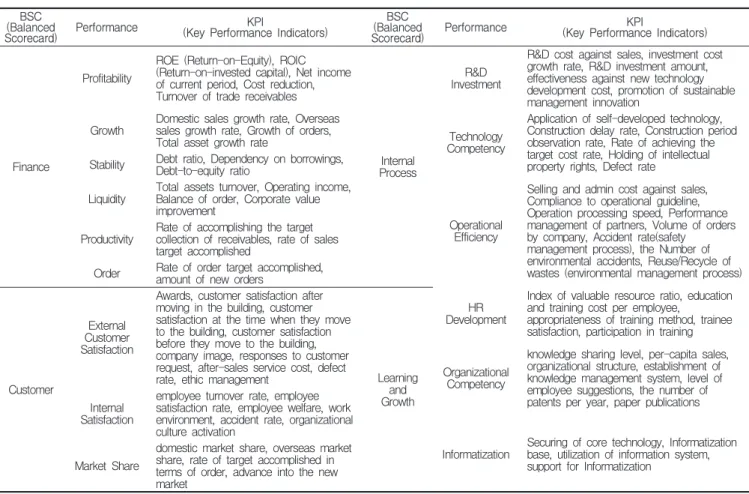
Table 4. Primary KPI Selection in Finance
재무분야는 수익성, 성장성, 안정성, 활동성 및 생산성의 기업 재무성과를 평가하는 대표적인 5가지의 평가영역에 추가로 기업 에서 중요시하는 수주영역을 삽입하였다. 이러한 6가지 영역은 기존에 기업경영 측면에서 많이 사용되던 5개 영역에 수주를 포 함시킨 것으로 수주가 기업경영에 미치는 영향을 고려할 때 경영 성과 측정에 반드시 필요한 구성이라고 판단된다. 기업과 기존 연 구 결과를 분석하면 재무 분야에 6가지 항목에 관련 평가영역을 모두 중복없이 포함시킬 수 있다. 특히 원가관련 항목들이 수익성 과 성장성으로 분류되었으며 직원역량의 일인당 매출액을 생산성 에 포함하였다.
고객 분야는 외부고객 만족과 내부고객 만족 그리고 시장 점유 율의 3가지 평가영역으로 구성하였다. 3가지 영역은 table 1과 같이 기존 Yu et al.[1]의 연구에서도 같은 방식으로 적용되었던 형식으로 내부고객은 직원 및 관리자를 의미하는 것이며 시장점 유율은 외부고객과 내부고객의 만족에 따라 증가하기 때문에 고 객의 영역에 포함하였다.
성과지표의 차이는 있으나 재무분야를 제외한 고객, 내부프로 세스 그리고 학습 및 성장분야는 기존 Yu et al.[1]의 연구와 분 류 형태가 동일하다. 이 3가지 분야의 평가유형 분류방식이 동일
한 것은 기업의 자료와 기존연구를 검토한 결과 이러한 분류방식 이 균형있고 모든 평가지표를 포함할 수 있기 때문이다. 내부 프 로세스 분야의 평가영역은 table 3과 같이 연구개발 투자와 기술 능력 그리고 업무의 효율성으로 평가영역을 구분하였다.
연구개발 투자는 주로 연구개발비에 의해 평가 가능하며 기술 능력은 자체기술 개발 적용 또는 지적 재산권의 보유 현황 등 자 사의 기술역량과 활용을 포함한다. 업무의 효율성은 기업내부의 업무처리 효율을 정량화하여 평가하는 영역이다.
학습 및 성장 분야의 평가영역은 인력양성과 조직역량 그리고 정보화의 3가지 영역으로 구분하였으며 기업의 경쟁력 향상을 위 한 인적자원과 정보화 시스템에 대한 평가를 하는 분야이다.
3.3 경영성과의 평가지표 구성
Table 1의 기업의 경영성과 평가지표 조사자료와 기존 연구그 리고 3.2 절의 평가영역을 바탕으로 table3과 같이 1차 성과지표 를 선별하였다. 성과지표의 선별은 다음과 같은 3가지 기준에 의 하여 실시하였다.
1) 중복된 경영성과 지표를 삭제하였다.
2) 다른 지표에 의해 산정 가능한 지표를 삭제하였다. 예를
는 항목이므로 삭제하였다.
3) 기업 경영이 아닌 프로젝트 단위의 성과측정 지표는 삭제 하였다.
재무분야의 성과지표는 table 3과 같이 6개 영역에 걸쳐 20개 의 성과지표를 선별하였다. 매출액 증가율은 국내와 국외를 따로 분리하였으며 수주영역에도 수주목표 달성률과 신규 수주금액이 선정되었다. 고객분야는 table4와 같이 3개의 성과영역에 19개 평가지표로 선별 구성하였다. 외부고객 만족영역은 대외수상실적, 기업 이미지 등 간접적으로 평가할 수 있는 지표도 포함하였다.
내부프로세스 분야의 1차 선별 지표는 3개 영역 15개의 평가지표 로 구성하였으며 업무의 효율성에 재해율과 폐기물 재사용 및 재 활용 항목을 포함시켜 안전관리 프로세스와 환경관리프로세스의 효율을 평가 할 수 있도록 하였다. 학습 및 성장 분야는 3개 분야 16개 성과지표로 우수인력 비율지수와 직원 1인당 교육 훈련비를 비롯한 지식 공유수준, 조직구조 등 영역별 성과측정을 위한 지표 로 구성하였다.
1차 선별은 15개 성과영역의 74개의 성과지표를 선정하였다.
중복된 지표와 성격이 다른 지표는 삭제하였으나 지표의 중요도 와 균형이 반영되지 않은 상태이므로 필요 없는 항목의 삭제와 필 요 성과지표의 누락여부 그리고 지표간의 균형을 반영해야 한다.
4. 경영성과 평가지표 선정
4.1 1차 설문 조사
3장에서 선별한 경영성과 평가지표를 바탕으로 기업의 경영인 과 경영 실무자를 대상으로 설문조사를 실시하였다. 설문조사는 성과영역을 제외한 평가지표만을 대상으로 하였으며 평가지표의 채택여부와 근거를 서술식으로 실시하였다. 1차 설문의 목적은 중요도가 기준이하로 떨어지는 항목을 평가지표에서 제외하는 것 으로 설문의 채택여부와 채택 근거를 고려하여 성과지표(KPI)를 2차 선정하였다. 2010년 시공능력 평가 기준 20위권 이내의 기 업중 4개 기업의 경영자와 경영실무자 19명이 설문에 응답하였으 며 5명 이상이 채택한 지표를 선정하였다.
4.2 2차 설문 조사
Table 5의 2차 KPI는 기업의 자료와 기존연구를 바탕으로 실 시된 1차 설문에 의해 선별되었다. 많은 항목 중 중요도를 기준으 로 점수가 낮은 항목은 삭제되었다. 이러한 과정으로 선별된 2차 KPI는 전체적인 균형이 고려되지 않았고 누락된 항목이 있을 수 도 있기 때문에 기업경영성과를 평가하기 위한 지표로 활용하기 에는 무리가 있다. 따라서 2차 KPI의 전반적인 균형과 추가 또는
BSC (Balanced
Scorecard) Performance KPI
(Key Performance Indicators)
Finance
Profitability
ROIC (Return-on-Invested Capital) Ratio of Cost of Sales
Ordinary Income Cost Reduction Growth
Prospect
Domestic Sales Growth Overseas Sales Growth
Stability Debt Ratio
Rate of cash reception target accomplished Liquidity Total assets turnover Productivity Rate of sales target accomplished
Order
Received Amount of new orders Rate of accomplished target of order
Customer
External Customer Satisfaction
Awards Customer Satisfaction
Company Image Social Contribution Internal
Satisfaction
Employee Turnover Rate Organizational Culture Activation
Work Environment Market
Share Domestic Market Share
Overseas Market Share
Technology Competency
R&D Investment
R&D cost against sales, Effectiveness against new technology
development cost Technology
Competency
Application of Self-Developed Technology
Holding of Intellectual Property Rights
Operational Efficiency
Selling and Admin Cost Against Sales Compliance to Work Guideline Accident rate (safety management
process) Reuse/Recycle of Wastes (Environmental Management Process)
Learning and Growth
HR Developmen
t
Index of Valuable Resource Ratio Education and Training Cost per
Employee Trainee Satisfaction Organization
al Competency
Knowledge sharing level Sales per employee Employee productivity Informatizati
on Informatization Competency Index Table 5. Secondary KPI Selection
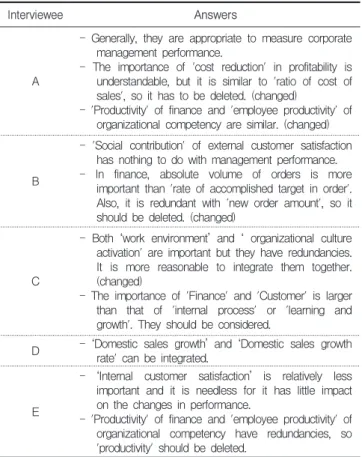
설문의 결과는 table 6과 같이 10명의 설문자 중 5명이 수정이 필요하다고 답변하였다. 나머지 5명은 기업경영성과 지표로서 적 합하다고 답변하였다. 답변자 A는 전반적으로 적합하나 원가절감 항목이 매출원가율과 유사항목이므로 삭제해야 한다고 지적하였 다. 또한 재무의 생산성과 직원 생산성 항목이 중복되므로 삭제 또는 통합하여야 한다고 답변하였다. 원가절감과 매출원가율이
The Management Evaluation Key Performance Indicators of Korean Construction Firms
유사하므로 원가절감 항목을 삭제하였고 직원생산성 항목도 같은 이유로 삭제하였다. 답변자 B는 외부고객 만족 영역의 사회적 기 여가 경영성과와 무관하다고 하였으나 기업의 사회적 의무가 중 시되는 사회전반의 흐름을 고려할 때 후에 평가를 위한 가중치 반 영에서 가중치를 적게 부여하더라도 반드시 필요한 항목이라고 판단되어 유지하였다. 또한 수주목표 달성률 역시 지적한 것과 같 이 중복성이 있기 때문에 삭제하였다.
답변자C는 업무환경과 조직문화 활성화는 모두 중요한 항목이 나 유사하므로 통합하여야 한다고 지적하였고 유사성이 크다고 판단하여 업무환경 및 조직문화 활성화의 단일항목으로 구성하였 다. 재무분야나 고객분야의 중요성에 대한 지적은 후에 경영성과 평가를 위한 계층별 가중치 부여 시 충분히 반영할 수 있는 것으 로 본 연구와는 관련없는 사항이다. 답변자 D의 국내 매출액 증 가율과 국외 매출액 증가율은 성장성 측면에서 매출액 증가율의 단일 항목으로 통합할 수 있으나 국내 시장과 국외시장의 성격이 다르고 기업의 확장전략에 따라 두 시장이 다른 의미를 지니므로 통합하지 않았다. 답변자 E는 ‘내부고객만족’의 중요성에 대하 여 언급하였는데 기존 연구에서 검증된 바 있고 기업 조사자료 및 1차 설문에서도 충분히 중요성이 인정되었다고 판단하여 유지하 도록 하였다. 또한 재무의 생산성과 직원생산성 항목은 전술한 것 과 같이 생산성 항목을 삭제하여 반영하였다.
Interviewee Answers
A
- Generally, they are appropriate to measure corporate management performance.
- The importance of 'cost reduction' in profitability is understandable, but it is similar to 'ratio of cost of sales', so it has to be deleted. (changed)
- 'Productivity' of finance and 'employee productivity' of organizational competency are similar. (changed)
B
- 'Social contribution' of external customer satisfaction has nothing to do with management performance.
- In finance, absolute volume of orders is more important than 'rate of accomplished target in order'.
Also, it is redundant with 'new order amount', so it should be deleted. (changed)
C
- Both ‘work environment’ and ‘ organizational culture activation' are important but they have redundancies.
It is more reasonable to integrate them together.
(changed)
- The importance of 'Finance' and 'Customer' is larger than that of 'internal process' or 'learning and growth'. They should be considered.
D - ‘Domestic sales growth’ and ‘Domestic sales growth rate' can be integrated.
E
- ‘Internal customer satisfaction’ is relatively less important and it is needless for it has little impact on the changes in performance.
- 'Productivity' of finance and 'employee productivity' of organizational competency have redundancies, so 'productivity' should be deleted.
Table 6. Answers to Secondary Survey
5. 경영성과 핵심성과지표
4가지의 BSC는 전술한 바와 같이 각각의 성과영역 및 KPI로 구성하였다. 재무 분야는 수익성, 성장성, 안정성, 활동성 그리고 수주의 5가지 성과영역으로 구성하였다. 수익성 영역은 ROIC(Return On Invested Capital), 매출원가율 및 경상이익 의 3가지 KPI로 구성되었으며 성장성 영역은 국내 매출액증가율 과 국외 매출액 증가율로 구성되었다. 국외 매출액 증가율은 최 근 국외 시장 진출의 급격한 증가추세가 기업에 반영된 것으로 판 단된다. 또한 안정성 영역은 부채비율과 수금목표 달성률로 그리 고 활동성 영역과 수주영역은 각각 총자본회전율과 신규수주금액 으로 구성되었다.
BSC Performance Area KPI
Finance
Profitability
ROIC Ratio of Cost of Sales
Ordinary income Growth Prospect Domestic Sales Growth
Overseas Sales Growth
Stability
Debt Ratio Rate of cash reception target
accomplished Liquidity Total Asset Turnover
Order Amount received from new orders Table 7. Selection of Performance Measurement Index in Finance Area
기업의 성과측정지표 중 주목해야하는 부분이 BSC의 ‘고 객’ 부문이다. 기존의 KPI와는 달리 기업은 내․외부고객의 만족 에 많은 성과비중을 둔다. 기존 KPI는 ‘고객’부문이 3개의 KPI로 구성되어 있으나 본 연구에서는 기업의 성과측정지표를 반 영하여 table 8과 같이 3개 성과영역 8개 KPI로 구성하였다. 3가 지 성과영역은 외부고객만족, 내부고객만족 그리고 시장 점유율 이며 이중 외부고객 영역은 대외수상실적, 고객만족도, 기업이미 지 및 사회적 기여로 구성하였다. 내부고객만족은 직원이직률과 업무환경 및 조직문화 활성화로 구성하였으며 시장점유율은 국내 와 국외 시장점유율로 구성하였다.
BSC Performance Area KPI
Customer
External Customer Satisfaction
Awards Customer Satisfaction
Company Image Social Contribution Internal
Customer Satisfaction
Employee Turnover Rate Work Environment and Organizational
Culture Activation
Market Share
Market Share in Terms of Amount of Domestic Orders Market Share in Terms of Amount of
Overseas Orders
Table 8. Selection of Performance Measurement Index in Customer Area
율성으로 구성하였고 연구 개발투자 영역의 KPI는 매출액 대비 연구개발비와 신공법 개발 비용 대비 효과로 구성하였다. 기술능 력 영역은 자체 기술개발 적용실적과 지적재산권 보유의 2가지 KPI로 구성하였다. 마지막으로 업무의 효율성 영역은 매출액 대 비 판매 관리비, 업무지침 준수도, 재해율 그리고 폐기물 재사용 및 재활용으로 구성된다.
BSC Performance
Area KPI
Internal Process
R&D Investment
R&D cost against sales Effectiveness against New Technology Development Cost Technology
Competency
Application of Self-Developed Technology Holding of Intellectual Property
Right
Operational Efficiency
Selling and Admin Cost Against Sales
Compliance to Operational Guideline Accident Rate Reuse/Recycle of Wastes Table 9. Selection of Performance Measurement Index in the
Area of Internal Process
학습 및 성장 분야는 table 10과 같이 인력양성, 조직역량 그 리고 정보화의 3가지 성과영역과 총 5개의 KPI로 구성된다. 인력 양성 영역은 기업의 우수인력 비율지수와 직원 1인당 교육훈련비 그리고 교육생 만족도로 구성하였으며 조직역량은 직원간 지식의 공유수준으로 구성하였다. 학습 및 성장의 마지막 성과영역인 정 보화 영역은 정보화역량지수로 성과를 분석한다.
BSC Performance
Area KPI
Learning and Growth
HR Development
Index of valuable resource ratio Education and training cost per
employee Trainee satisfaction Organizational
Competency
Knowledge sharing level Sales per Employee Informatization Informatization Competency Index Table 10. Selection of Performance Measurement Index in the
Area of Learning and Growth
요컨대 건설기업의 경영성과 측정을 위한 성과영역 및 성과지 표는 table 7 ∼ table 10과 같이 총 14개 영역과 31개 성과지표 로 구성되었다. table 7 ∼ table 10은 BSC별로 분리되어 있으
류된 31가지의 핵심성과지표를 측정하며 중요도에 따라 가중하여 평가하여야 한다. 본 연구에서 도출된 핵심성과지표는 대형건설 기업의 경영성과를 평가하기 위한 기준으로 기업의 경영자 및 경 영실무자의 검증을 거친 실질적인 항목으로 구성하였으며 기업의 특성과 전략에 따라 다소 수정될 수는 있으나 공통적으로 적용할 수 있는 일반화된 성과지표라 할 수 있다.
6. 결 론
본 연구는 기존연구와 기업에서 적용하는 성과지표를 기초로 기업 경영자와 경영 실무자의 반복적인 설문과 수정 과정을 거쳐 국내 대형건설기업의 경영성과 측정을 위한 성과지표를 도출하였 다. 적용 기업의 특성과 전략에 따라 다소 수정될 수는 있으나 공 통적으로 적용할 수 있는 일반화된 성과지표라 할 수 있다.
본 연구의 핵심성과지표는 BSC를 기준으로 구성 하였으며 성 과영역은 기업의 자료와 기존연구를 바탕으로 중복을 제거 또는 통합하며 계층 구조상 하위에 해당하는 것은 제외하여 구성하였 다. 성과지표는 기존연구와 3개의 대형 건설기업의 자료를 기초 로 2회의 설문을 통해 구성하였다. 첫 번째 단계는 중요도에 따른 선별 단계로 설문결과에 따라 중요도를 분석하고 기준에 미달하 는 항목은 삭제하였다. 두 번째 단계는 선별된 지표의 타당성과 누락항목 및 추가항목에 대한 설문을 통해 성과지표의 전반적인 수정을 실시하였다. 모든 과정을 통해 도출된 성과지표는 table7
∼ table10과 같이 14개의 영역 31개의 지표로 구성되었다.
대형건설기업의 경영성과 측정을 위한 본 성과지표는 기업의 경 영성과를 측정하고 평가하기 위한 기준이 될 수 있다. 향후 연구 과제로 본 연구에서 도출된 성과지표를 대형건설기업의 연도별 실 적데이터에 적용하여 평가지표 효율을 분석하는 연구가 필요하다.
요 약
기업 활동에 있어 성과측정은 경영성과의 평가, 인적 자원의 관리 및 전략이행의 중요한 도구로 사용된다. 기업의 경영성과 측 정은 당기 순이익, 투자수익률, 자기자본 이익률과 같이 단순히 재무적 관점에서 측정할 수 있으나 기업의 내부프로세스나 정보 화와 같은 재무외적 성과를 측정할 수 없어 부족함이 있다. 따라 서 본 연구는 국내의 시공능력순위 30위 이내의 건설기업에 적용 가능한 핵심 성과지표(KPI:Key Performance Indicators)를 도 출하였으며, 기존의 연구와 기업 전문가의 설문을 반영하여 보다 현실적인 기업의 경영을 반영하며 기존의 연구와 차별된 결과를 도출하였다.
The Management Evaluation Key Performance Indicators of Korean Construction Firms
키워드 : 핵심성과지표, 경영성과, 건설기업
Acknowledgement
This research was supported by the Basic Science Research Program through the National Research Foundation of Korea(NRF) funded by the Ministry of Education, Science and Technology (NO.R11-2010-0001860)
References
1. Yu IH, Kim KR, Jung YS, Chin SY. Analysis of Quantified Characteristics of the Performance Indicators for Construction Companies, Korea Journal of Construction Engineering & Management, 2006;7(4):154-163.
2. Kaplan RS, Norton DP. The Balanced Scorecard-Measures that Drive Performance, Harvard Business Review, January-february 1992.
3. Niven PR, Balanced scorecard step-by-step, John Wiley &
Sons, New York, 2002.
4. Ittner CD, Larcker DF. Innovations in performance mea- surement: Trends and research implications. Journal of Management Accounting Research 1998;10:205-238.
5. Lee KH, Pyo JH. strategic achievement evaluation system, 21th Books, 1996.
6. Hyun JS. Cause of Success or failure of Construction Management after IMF, Construction Economy Research Institute of Korea, 2002;1-84.
7. Cha HS, Kim TK. Developing Measurement System for Key Performance Indicators on Building Construction Projects, Korea Journal of Construction Engineering & Management, 2008;9(4):120-130.
8. Yu IH, Kim KR, Jung YS, Chin SY, Kim YS. A Framework of the Comparable Performance Measurement in the Construction Industry, Korea Journal of Construction Engineering & Management, 2004;5(5):172-182.
9. Yu IH, Kim KR, Jung YS, Chin SY. Key Performance Indicators for Developing Construction Performance Index, Architectural Institute of Korea , 2005;21(2):139-150.
10. Jung WJ, Yu IH, Kim KR, Shin DW. Analysis of the Weights of Performance Measurement Index according to the Size of Construction Companies, Architectural Institute of Korea, 2005;21(8):121-128.
11. Oh IJ, Lee JH, Lee CC. BSC Perspective of an Exploratory study of Developing CSF/KPI Pool in Korean Construction
Industry, Korea Society of IT Services, 2006;5(1):35-46.
12. Son MH. A Comparative Analysis of the Whights of Balanced Scorecard Performance Measures According to Corporate life Cycle, The Korean Operations Research and Management Science Society, 2003;28(1):79-96.
13. Shenhar A, Levy O, Dvir D. Mapping the dimensions of project success, Project Management Journal, 1997;28(2):5-13.
14. Ryu SW, Ahn BJ, Ryu MW. Deductions of KPIs for BSC and Process KPIs for BPM in Railway Construction, Koeran society for railway, 2006;9(4):388-393.
15. Kim DK, Kim HJ, Park YW. A Study on the Development of KPI in the Super Deluxe Hotel Business in Seoul Korea Using BSC, Korean Academic Society of Hospitality Administration, 2009;18(3):133-151.
16. Park MS, Kwon KH, Kwon JH. Courier company's key performance indicators (KPI) Determinants, Korea information society development institute, 2004;1-29.
17. Lee DH, Kim SK, Shin DH. A Correlation Analysis between the Change of Managerial Environment and the Business Performance of Domestic Construction Firms, The Korea Institute of Building Construction, 2009;9(1):111-121.
18. Lee DH. An Evaluation Technique of Corporate Management Performance Using Project Information, 2010.
19. Cha WC, Lee JS, Kwon W, Lee JS, Chun JY. Assessment Model of a Construction Company's Management Performance, Architectural Institute of Korea, 2008;28(1):661-664.
20. Robert JW, Thomas JP, Julien RP. Structure is not organization, Business Horizons, 1980;23(3):14-26.