
A Study on the Evaluation and Improvement of Student Convenient Facilities at University Campuses, based on Universal Design Concept - Focused on the university campuses in Texas, U.S.A. -
10
0
0
전체 글
(2) 김원필. often associated with those good and bad school days and. 1.2 Research Area and Method. a distinctive place where most of the students can have a. For an investigation of student-oriented facilities in. fun and spend their good times. It became for most. campus through the concept of universal design, four. students a space of memories imprinted by a strong sense. major universities in Texas, of the U.S. were selected. of attachment and a sense of belonging by an academic. For this purpose, this research firstly reviewed how the. atmosphere of unique group activities or by night light. current concept of universal design applied to school. activity that used to take place or just from a gift. facilities and their issues in Korea and the United States.. purchased by someone special.. In-depth literature review sets the stage for collecting. In order to accomodate these various objectives,. diverse evaluation and checklist for the physical environ-. student-oriented buildings in campus should be designed. mental attributes of universal design. For an assessment. in a way to promote easy and convenient access for all. of student halls, 76 indices were used for universal design. users regardless of their age, gender or physical condi-. concept. Secondly, field survey for US college facilities. tions. Consequently, universal design concept is a widely. were performed to investigate what components are. accepted terminology in school facility design with. influencing on the level of universal design in student. increased supportive accessibility and safety consideration. halls. Finally, the analyses focused on the cross-cultural. for the general school population and those with disabi-. effects of the application on the principle of universal. lities. Student oriented facilities at colleges are especially. design and suggest additional design guideline for UD. good examples for the adaptation of universal design. application to student hall design in Korea.. concept because they require wide range application of supportive, adaptable, accessible, and safety-oriented. 2. Universal Design and Literature Review. design concept which were already defined by the Center 2.1 Background of Universal Design Concept. for Universal Design, North Carolina State University. Kim's research (2009)1) already made an assessment on. In the United States, designing school facilities requires. a few student halls of universities in Seoul area and. more expanding concept of specific design guideline,. contended that accessibility to main entry areas, main. encompassing UD(universal design) and accessibility. entry doors, stairs, and handicapped parking were positively. compliance. If UD recommend design guidelines for the. evaluated, while information signage for the handicapped,. general building throughout their life spans in the United. handicapped public toilet, and corridors lacked some notion. States, the concept of accessibility design is attained. of supportive and accessible design, implying that a. through legal compliance with local, state and national. coherent access system needed to implement. Further,. building standards that secures a minimum level of. based on universal design principles, it is not well known. universal design necessary to provide specific people with. whether student buildings in U.S. provide convenient. disabilities.. access for the general public as well as the disabilities.. From the technical point of view, the U.S. Congress. Therefore, based on UD(universal design), this research. passed ADA(Americans with Disabilities Act) in 1990 to. aims to evaluate student hall facilities in U.S. and the. address a public concern with discrimination against. results will provide an useful design guidelines for the. people with disabilities, supported by local enforcement. students and other users in the future physical design of. agency with relevant regulations. On the other hand, such. student hall and wellbeing facilities in Korea.. a building code as ANSI A117.1 (The American National standard Institute) is a substantial criteria required for. 1) Kim, W.P. A Study on the Evaluation and Improvement of Student Convenient Facilities in University Campus based on Universal Design Concept, Journal of the Korean Institute of Educational Facilities, 19(5), 2012. pp.11-20.. legal compliance for a certain type of area. Therefore, each particular campus in the United States must comply with a variety of federal-level laws and. 20 한국교육시설학회논문집 제21권 제3호 통권 제100호 2014년 5월.
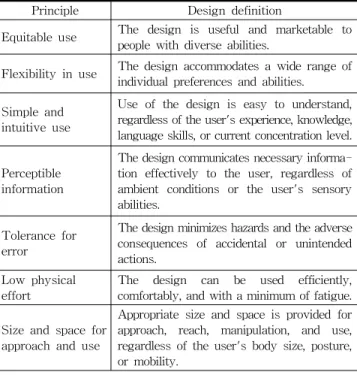
(3) 유니버설디자인 개념에 의거한 대학내 학생편의시설 평가 및 개선방향에 대한 연구. regulations, depending on the financing resource. Apartment. 2.2 Previous Research. from the application of UD, it is true that ADA(Americans. Previous research in domestic and overseas regarding. with Disabilities Act) covers all higher education facilities. UD and accessibility of campus facilities mainly dealt with. and requires access to programs, facilities, and services. class room, housing, library, public toilets, student hall/. that are provided and open to the public.2) In particular,. retail, and indoor and public outdoor areas. Sui (2011)4). Title II of ADA Standards for accessible design. identified deficiencies in public toilets and suggested. establishes the criteria for the design of campus facilities. evolving concepts of universal design in seven principles. which is called the 2010 Standards.. for specific improvement. Murray and Lombardi (2010)5). At the same time, the overall goal of UD(universal. noted that minimizing barriers and willingness to. design) is to create convenient access for the general. accommodate and adopt UD principles in their study of. populace including disabilities. According to North Carolina. university faculty attitude.. State University Center, the intent of universal design is. In fact, meeting minimum building code and design. to simplify life for everyone by making products,. standard is thought to be the least approach beyond. communications, and the built environment more usable. compliance with ADA guidelines. Utilizing UD and. by as many people as possible at little or no extra cost.. creating a welcoming user-friendly campus may appeal to. Universal design benefits people of all ages and abilities. new categories of students with disabilities, contributing. for Universal Design.3) As indicated Table 1, each of this. to campus diversity and expanding opportunities for many. principles contributes to basic design and functionality for. students.6). more people with disabilities and the general populace.. universities are especially good facilities for the application. Further,. Salmen(2011)7). maintained. that. of UD because they accommodate a wide range of Table 1. Seven principles of Universal Design Principle. transient users. He further emphasized that the application. Design definition. of UD needed to be appropriate to the institutional's scale,. Equitable use. The design is useful and marketable to people with diverse abilities.. facility type, and program for it to be completely effective.. Flexibility in use. The design accommodates a wide range of individual preferences and abilities.. Simple and intuitive use. Use of the design is easy to understand, regardless of the user's experience, knowledge, language skills, or current concentration level.. and design that may limit how far inequalities of access. The design communicates necessary information effectively to the user, regardless of ambient conditions or the user's sensory abilities.. In domestic research, Cho(2008) found that the. Perceptible information. Tolerance for error. The design minimizes hazards and the adverse consequences of accidental or unintended actions.. Low physical effort. The design can be used efficiently, comfortably, and with a minimum of fatigue.. Appropriate size and space is provided for Size and space for approach, reach, manipulation, and use, approach and use regardless of the user's body size, posture, or mobility. Source: From North Carolina State University Center for Universal Design, 1997.. 2) Salmen, John, Universal Design for Academic Facilities, New Directions for Student Services, no 134, 2011. pp.13-20. 3) http://www.ncsu.edu/ncsu/design/cud/about_ud/about_udhtm. It is common perception that UD provides a useful understanding of the interrelationships between disability to the built environment can be overcome.8) percentage of UD application to university libraries were 4) Sui, Kin, Public toilets for visually impaired persons: application of the principles of universal design, The International Journal of Interdisciplinary Social Sciences, 6 (2), 2011. pp.117-126. 5) Lombardi, A. & Murray, C., Measuring university faculty attitudes toward disability: Willingness to accommodate and adopt universal design principles, Journal of Vacational Rehabilitation, 34, 2011. 6) Watson, E., Bartleft, F., Sacks, C., & Davidson, D., Implementing Universal Design: A collaborative approach to designing campus housing, The Journal of College and University Student Housing, 40(1), 2013. pp.158-171. 7) Salmen, p.13 8) Imrie, R., Universalism, universal design and equitable access to the built environment. Disability & Rehabilitation, 34(10), 2012, pp.873-882. 한국교육시설학회논문집 제21권 제3호 통권 제100호 2014년 5월 21.
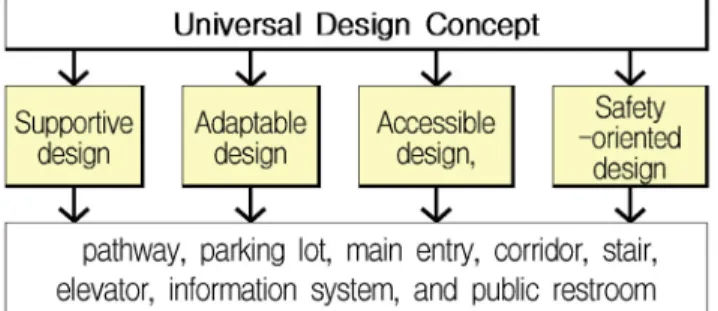
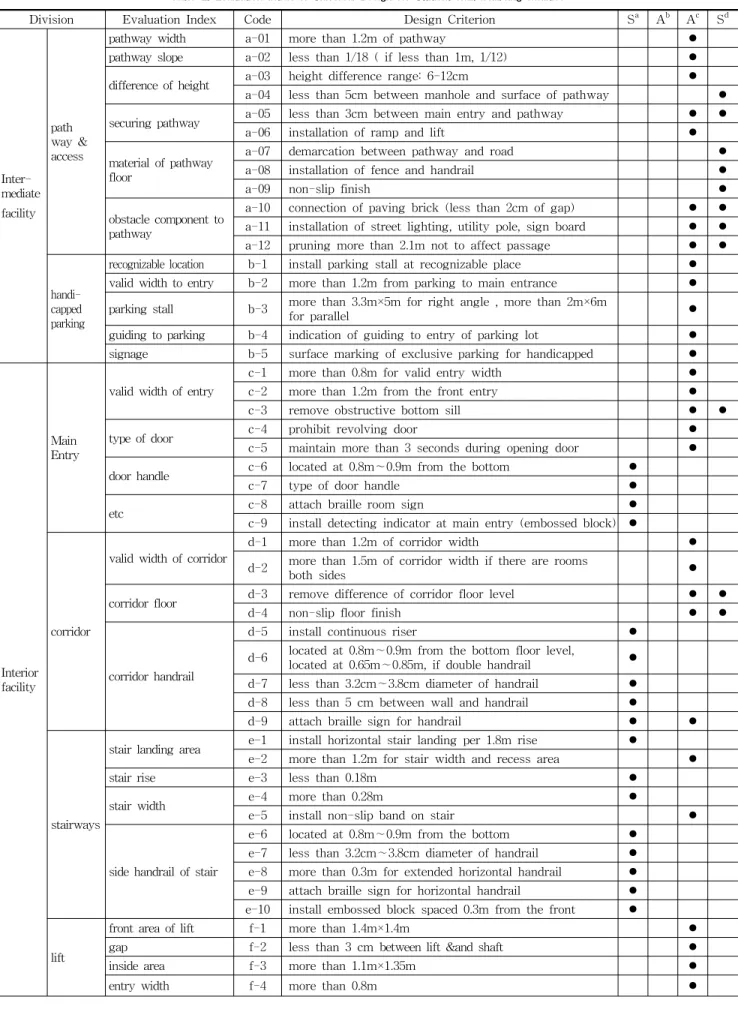
(4) 김원필. low and did not provide visitors of diverse demographic. In summary, review of literature on UD and university. profiles with convenient access.9) For his research, he. facilities mentioned that even though all universal design. developed UD checklist which consisted of four major UD. requirement could not be equally applied to the general. principles. Kim(2009) investigated classrooms in univer-. populace and people with disabilities, basics and specific. sities and contended that minimum security for the. design guidelines should be guaranteed at minimum level. security and developing detailed guidelines were needed to. of standard. Further, it also concluded that UD approach. support accessibility with mid- and long-term perspectiv. is the most practical way to ensure such code compliance. e.10) UD is considered as multi-constraint task because of. as laws, regulations, standards and certifications, while. the many requirement and the complexities that are. improving accessibility and usability for the entire. caused by the interaction of principles. Park and Lee. academic campus.. (2011)11), approached barrier free educational facilities in three concept and emphasized on the same conditions both. 3. Data Collection and Analysis. for disabilities and non-disabilities.; A law of conveniency promotion, Manual of barrier free certification, and. 3.1 Overview. Universal design.. For a study on the level of application of UD to student. In the study of classrooms and student halls, Kwon and. halls, four major university in Texas were selected to. et al. (2011)12) asserted that basic accessibility should be. investigate on January 2014; Univ. of Texas at Austin,. provided for students with disabilities in university. Texas A&M University, University of Houston, and. facilities, and special concern needed to be also given for. University of Texas at Dallas.. visually impaired students. In regard to campus facilities, Kim(2012) concluded that accessibility to main entry areas, main entry doors, stairs, and handicapped parking were positively evaluated, while information system for handicapped, handicapped public bath, and corridors lacked some notion of supportive and accessible design in student halls of many university campus.13) Moreover, he noted that precise application of universal design concept is needed to secure coherent pathway for overall inception of. Figure 1. Four major universal design concepts. a building. 9) Cho, Young-Hang, An evaluation of universal design principles in the university libraries- focused on National universities located in Busan, Journal of the Architectural Institute of Korea, 24 (10), 2008, pp.21-29. 10) Kim, D., Kim S., Lee, H., Won, S., Park, J., & Ha, M. A study on application of the universal design principles to classrooms in universities, Journal of the Architectural Institute of Korea, 25 (2), 2009, pp.123-132. 11) Park, S. & Lee, J, Examination of educational facilities standards for integrated education based on barrier free, Spring conference proceeding, Journal of the Architectural Institute of Korea, 31(1), 2011. pp.97-98. 12) Kwon, O, Lee, Y, & Kim, H. An analysis of space usage and user's needs for improvement of university facilities by students with disabilities, Journal of the Architectural Institute of Korea, 27 (5), 2011, pp.61-71. 13) Kim, Won-Pil, pp.11-20.. Based upon the concept of universal design, four major components were used to evaluate academic facilities; supportive design, adaptable design, accessible design, safety-oriented design(see Figure 1). A level of evaluation was established as three-point Li-kert scale; good(3 pts), fair(2 pts), poor(1 pts). This analysis tool of checklist was explored through previous research and the principles of universal design (North Carolina State University Center for Universal Design, 1997; Cho, 2008; Kim, 2009; Ministry of Education and Technology, 2009; Kim 2012). The checklist consists of such major area as pathway, parking lot, main entry, corridor, stair, elevator, information system, and public toilets including the handicapped (See Table 2).. 22 한국교육시설학회논문집 제21권 제3호 통권 제100호 2014년 5월.
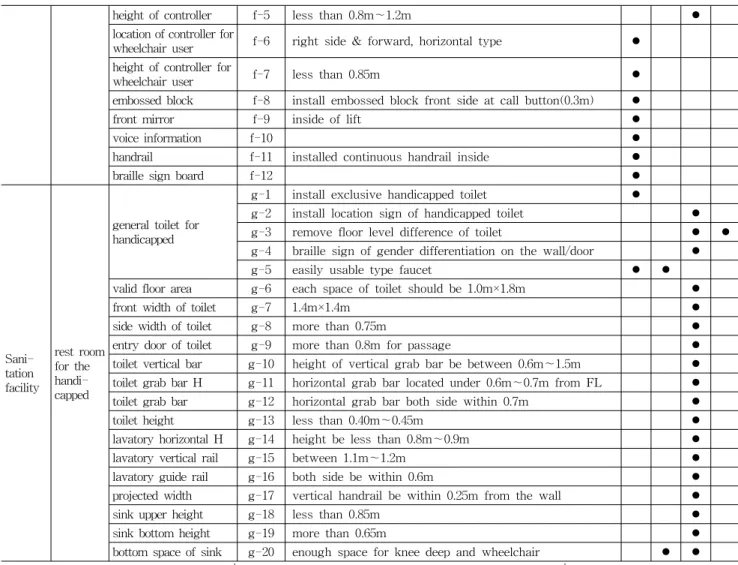
(5) 유니버설디자인 개념에 의거한 대학내 학생편의시설 평가 및 개선방향에 대한 연구 Table 2. Evaluation Index of Universal Design for Student Hall/wellbeing facilities Division. Evaluation Index. Intermediate facility. a-01. pathway slope. a-02. less than 1/18 ( if less than 1m, 1/12). a-03. height difference range: 6-12cm. securing pathway material of pathway floor obstacle component to pathway. handicapped parking. less than 3cm between main entry and pathway. a-06. installation of ramp and lift. a-07. demarcation between pathway and road. a-08. installation of fence and handrail. a-09. non-slip finish. a-10. connection of paving brick (less than 2cm of gap). a-11. installation of street lighting, utility pole, sign board. a-12. pruning more than 2.1m not to affect passage install parking stall at recognizable place. b-2. more than 1.2m from parking to main entrance. parking stall. b-3. more than 3.3m×5m for right angle , more than 2m×6m for parallel. guiding to parking. b-4. indication of guiding to entry of parking lot. signage. b-5. surface marking of exclusive parking for handicapped. c-1. more than 0.8m for valid entry width. c-2. more than 1.2m from the front entry. c-3. remove obstructive bottom sill. c-4. prohibit revolving door. c-5. maintain more than 3 seconds during opening door. c-6. located at 0.8m~0.9m from the bottom. c-7. type of door handle. c-8. attach braille room sign. c-9. install detecting indicator at main entry (embossed block). d-1. more than 1.2m of corridor width. d-2. more than 1.5m of corridor width if there are rooms both sides. d-3. remove difference of corridor floor level. d-4. non-slip floor finish. d-5. install continuous riser. d-6. located at 0.8m∼0.9m from the bottom floor level, located at 0.65m∼0.85m, if double handrail. d-7. less than 3.2cm∼3.8cm diameter of handrail. d-8. less than 5 cm between wall and handrail. d-9. attach braille sign for handrail. e-1. install horizontal stair landing per 1.8m rise. e-2. more than 1.2m for stair width and recess area. e-3. less than 0.18m. e-4. more than 0.28m. e-5. install non-slip band on stair. e-6. located at 0.8m∼0.9m from the bottom. e-7. less than 3.2cm∼3.8cm diameter of handrail. e-8. more than 0.3m for extended horizontal handrail. e-9. attach braille sign for horizontal handrail. e-10. install embossed block spaced 0.3m from the front. etc. valid width of corridor. corridor floor corridor. corridor handrail. stair landing area stair rise stair width stairways. side handrail of stair. lift. less than 5cm between manhole and surface of pathway. valid width to entry. door handle. Interior facility. a-04 a-05. b-1. type of door. S. a. A. b. A. c. d. S. more than 1.2m of pathway. recognizable location. valid width of entry. Main Entry. Design Criterion. pathway width. difference of height path way & access. Code. front area of lift. f-1. more than 1.4m×1.4m. gap. f-2. less than 3 cm between lift &and shaft. inside area. f-3. more than 1.1m×1.35m. entry width. f-4. more than 0.8m. 한국교육시설학회논문집 제21권 제3호 통권 제100호 2014년 5월 23.
(6) 김원필. height of controller. f-5. less than 0.8m~1.2m. location of controller for wheelchair user. f-6. right side & forward, horizontal type. height of controller for wheelchair user. f-7. less than 0.85m. embossed block. f-8. install embossed block front side at call button(0.3m). front mirror. f-9. inside of lift. voice information. f-10. handrail. f-11. braille sign board. f-12. general toilet for handicapped. Sanitation facility. installed continuous handrail inside. g-1. install exclusive handicapped toilet. g-2. install location sign of handicapped toilet. g-3. remove floor level difference of toilet. g-4. braille sign of gender differentiation on the wall/door. g-5. easily usable type faucet. valid floor area. g-6. each space of toilet should be 1.0m×1.8m. front width of toilet. g-7. 1.4m×1.4m. side width of toilet. g-8. more than 0.75m. entry door of toilet. g-9. more than 0.8m for passage. g-10. height of vertical grab bar be between 0.6m~1.5m. g-11. horizontal grab bar located under 0.6m~0.7m from FL. rest room toilet vertical bar for the handitoilet grab bar H capped toilet grab bar. g-12. horizontal grab bar both side within 0.7m. toilet height. g-13. less than 0.40m~0.45m. lavatory horizontal H. g-14. height be less than 0.8m~0.9m. lavatory vertical rail. g-15. between 1.1m~1.2m. lavatory guide rail. g-16. both side be within 0.6m. projected width. g-17. vertical handrail be within 0.25m from the wall. sink upper height. g-18. less than 0.85m. sink bottom height. g-19. more than 0.65m. bottom space of sink. g-20. enough space for knee deep and wheelchair. Note 1: Sa indicates Supportive design, Ab indicates Adaptable design, Ac indicates Accessible design, Sd indicates Safety-oriented design Note 2: This checklist was based on the modification of Kim's (2012) results, Cho's checklist(2008), and M.E.T.(2009).. 3.2 Analysis and discussion. were as followings.. Physical characteristics of selected student hall/retail facilities are as followings;. 1) Pathway and access path. Major components of evaluation on the level of UD. As shown in Table 2, among 12 elements regarding. application to university student hall and adjacent facilities. pathway and access condition, most of the design. Table 3. Physical Characteristics of Student Hall/Retail Center, Texas, U.S. Division Bldg. name Main usage. Univ. of Texas, Austin. Texas A&M University. University Unions. University Center. campus store, food court, theatre, show room, copy center, catering,. honor lounge, food court grill, guest suite, ATM, copy center, campus store. University of Houston Univ. Center(Book store). Univ. of Texas, Dallas Student Services Bldg.. food court, club room, copy food court, health center, center, student office student office, fitness lounge, office, center, campus store,. Project scale. 5 story, basement. 14 story, basement. 2 story, basement. 3 story, basement. Enrollment. 51,112 students. 56,256 students. 31,587 students. 21,193 students. Overview. 24 한국교육시설학회논문집 제21권 제3호 통권 제100호 2014년 5월.
(7) 유니버설디자인 개념에 의거한 대학내 학생편의시설 평가 및 개선방향에 대한 연구. principles were fully complied to UD concept; good (96%). indicated that most of off-site parking lot for disabilities. and fair (4%). Every school has spacious pathway and. were spaciously well installed, while many of them were. provided easy access to main entry area, while some of. located far away from the student hall buildings, resulting. sub-entry did not have access ramp.. in recognizing problem of the space location. It is found. Table 4. UD application of pathway and access path (%) Index. that good application of UD was 90%, fair 4%, and poor 6%.. Code. Good. Fair. Poor. Total. pathway width. a-01. 12(100). 0(0). 0(0). 12(100). pathway slope. a-02. 12(100). 0(0). 0(0). 12(100). 3) Main Entry. difference of height. a-03. 12(100). 0(0). 0(0). 12(100). a-04. 12(100). 0(0). 0(0). 12(100). Most student building have provided supportive size,. a-05. 12(100). 0(0). 0(0). 12(100). a-06. 9(82). 2(18). 0(0). 11(100). width, door type, and door handle were assessed to be. a-07. 12(100). 0(0). 0(0). 12(100). useful and safe, except detecting indicator at main entry. a-08. 12(100). 0(0). 0(0). 12(100). a-09. 12(100). 0(0). 0(0). 12(100). (installation of embossed block) and braille room sign.. a-10. 9(82). 2(18). 0(0). 11(100). As shown Table 6, UD Application of main entry. a-11. 9(82). 2(18). 0(0). 11(100). shows 91% of good level, and 9% of poor level. The. a-12. 12(100). 0(0). 0(0). 12(100). reason why they do not consider braille room sign for. securing pathway material of pathway floor obstacle component to pathway. and enough space for passage at main entry area. Valid. visually impaired persons is due to their possessions of portable electronic GPS navigation system. Table 6. UD Application of Main Entry (%) Index. Figure 2. Main entry of every school provided easy access, while some of sub-entry at UH(left) and UTD didn't provide ramp.. valid width of entry type of door. 2) Handicapped parking stall Handicapped parking is major design issue in U.S. school facilities, because of the scarcity of mass. door handle etc. transportation in automobile-oriented culture. Field survey. Code. Good. Fair. Poor. Total. c-1. 12(100). 0(0). 0(0). 12(100). c-2. 12(100). 0(0). 0(0). 12(100). c-3. 12(100). 0(0). 0(0). 12(100). c-4. 12(100). 0(0). 0(0). 12(100). c-5. 12(100). 0(0). 0(0). 12(100). c-6. 12(100). 0(0). 0(0). 12(100). c-7. 12(100). 0(0). 0(0). 12(100). c-8. 0(0). 0(0). 4(100). 4(100). c-9. 0(0). 0(0). 4(100). 4(100). Table 5. UD Application of Handicapped Parking Stall (%) Code. Good. Fair. Poor. Total. recognizable location. Index. b-1. 0(0). 2(40). 3(60). 5(100). valid width to entry. b-2. 12(100). 0(0). 0(0). 12(100). parking stall. b-3. 12(100). 0(0). 0(0). 12(100). guiding to parking. b-4. 12(100). 0(0). 0(0). 12(100). signage. b-5. 12(100). 0(0). 0(0). 12(100). Figure 4. The entry door at most buildings has wide enough, but do not provide braille signage(UTD).. 4) Corridor Except for corridor handrail and its accessories, valid width of corridor and corridor floor showed easily accessible environment; good (80%) and poor(20%). It is analyzed that spacious width of corridor and wheelchair Figure 3. Handicapped parking tend to be spacious, but far from the student buildings.(UTD, left; UT, Austin, right). dependence do not require additional supportive handrail as shown in Figure 5. 한국교육시설학회논문집 제21권 제3호 통권 제100호 2014년 5월 25.
(8) 김원필 Table 7. UD Application of Corridor Area (%) Index valid width of corridor corridor floor. corridor handrail. 6) Lift. Code. Good. Fair. Poor. Total. d-1. 12(100). 0(0). 0(0). 12(100). d-2. 12(100). 0(0). 0(0). 12(100). d-3. 12(100). 0(0). 0(0). 12(100). shown in Figure 7, most lifts provided convenient. d-4. 12(100). 0(0). 0(0). 12(100). location of controller for wheelchair users, but no braille. d-5. 0(0). 0(0). 4(100). 4(100). d-6. 0(0). 0(0). 4(100). 4(100). sign. Overall application of UD concept to this design. d-7. 0(0). 0(0). 4(100). 4(100). d-8. 0(0). 0(0). 4(100). 4(100). d-9. 0(0). 0(0). 4(100). 4(100). Most student building were equipped with lift which is closely located to main lobby/hall. Furthermore, as. element was evaluated as 72%. Table 9. UD Application of Lift (%) Index front area of lift. Figure 5. Most corridors are wide (TAMU) and had no handrail on the wall nor braille sign (UTD).. 5) Stairways Building code standard in U.S. is ≥ 4"(10.16cm) and ≤7"(17.8cm) for riser and ≥ 10"(25.4cm) for tread. As. Code. Good. Fair. Poor. Total. f-1. 12(100). 0(0). 0(0). 12(100). gap between shaft/frame. f-2. 12(100). 0(0). 0(0). 12(100). inside area. f-3. 12(100). 0(0). 0(0). 12(100). entry width. f-4. 12(100). 0(0). 0(0). 12(100). height of controller. f-5. 12(100). 0(0). 0(0). 12(100). location of controller for wheelchair user. f-6. 6(67). 2(22). 1(11). 9(100). height of controller for wheelchair user. f-7. 6(67). 2(22). 1(11). 9(100). embossed block. f-8. 0(0). 0(0). 4(100) 4(100). front mirror. f-9. 0(0). 0(0). 4(100) 4(100) 4(100) 4(100). voice information. f-10. 0(0). 0(0). handrail. f-11. 12(100). 0(0). braille sign board. f-12. 0(0). 0(0). 0(0). 12(100). 4(100) 4(100). shown Table 8, in most cases, stairways complied with basic dimensions of rise and tread height, but handrails of most buildings were rated somewhat poor. Table 8. UD Application of Stairway Area (%) Index stair landing area stair rise stair width. side handrail of stairways. Code. Good. Fair. Poor. Total. e-1. 12(100). 0(0). 0(0). 12(100). e-2. 12(100). 0(0). 0(0). 12(100). e-3. 12(100). 0(0). 0(0). 12(100). e-4. 12(100). 0(0). 0(0). 12(100). e-5. 12(100). 0(0). 0(0). 12(100). e-6. 12(100). 0(0). 0(0). 12(100). 7) Handicapped rest room. e-7. 12(100). 0(0). 0(0). 12(100). e-8. 12(100). 0(0). 0(0). 12(100). Every public restroom was evaluated as good condition. e-9. 0(0). 0(0). 4(100). 4(100). e-10. 0(0). 0(0). 4(100). 4(100). Figure 7. Most lifts provided convenient location of controller for wheelchair users, but no braille sign.(TAMU, UTA). except for lavatory. As shown Figure 8, any users with disabilities can easily access to general toilet facilities, while design of lavatory is not provided. Overall score of UD application was found to be 87%. Most features and public sanitary environment in student hall is seemed to be simple by avoiding complicated pathways. and direct door locking mechanism that can be easily operated.. Figure 6. Stairways with handrail(UH), but no braille sign(UTD). 26 한국교육시설학회논문집 제21권 제3호 통권 제100호 2014년 5월.
(9) 유니버설디자인 개념에 의거한 대학내 학생편의시설 평가 및 개선방향에 대한 연구 Table 10. UD Application of handicapped restroom (%) Index. Code. Good. Fair. Poor. Total. g-1. 12(100). 0(0). 0(0). 12(100). g-2. 12(100). 0(0). 0(0). 12(100). g-3. 12(100). 0(0). 0(0). 12(100). g-4. 12(100). 0(0). 0(0). 12(100). g-5. 12(100). 0(0). 0(0). 12(100). valid floor area. g-6. 12(100). 0(0). 0(0). 12(100). front width of toilet. g-7. 12(100). 0(0). 0(0). 12(100). side width of toilet. g-8. 12(100). 0(0). 0(0). 12(100). entry door of toilet. g-9. 12(100). 0(0). 0(0). 12(100). toilet vertical bar. g-10. 12(100). 0(0). 0(0). 12(100). toilet grab bar H. g-11. 12(100). 0(0). 0(0). 12(100). toilet grab bar. g-12. 12(100). 0(0). 0(0). 12(100). corridor handrails show low adaptation of UD concept. toilet height. g-13. 12(100). 0(0). 0(0). 12(100). lavatory horizontal H. g-14. 0(0). 0(0). 4(100). 4(100). (63%) (See Figure 9). Further it also found that four. lavatory vertical rail. g-15. 0(0). 0(0). 4(100). 4(100). universities selected showed slight differences in the. lavatory guide rail. g-16. 0(0). 0(0). 4(100). 4(100). application of UD concept. This might be resulted from. projected width. g-17. 0(0). 0(0). 4(100). 4(100). their code compliance rather than the negligence of the. sink upper height. g-18. 12(100). 0(0). 0(0). 12(100). sink bottom height. g-19. 12(100). 0(0). 0(0). 12(100). minimum standard. From the standpoint of their cultural. bottom space of sink. g-20. 12(100). 0(0). 0(0). 12(100). general toilet for handicapped. Figure 9. Application level of UD concept on each area. background and professional practice in U.S., most universal design concept are fully applied to the existing facilities because there are spacious planning and room arrangement. Texas Universities that want their facilities to go beyond the minimum guidelines of the ADA(Americans with Disabilities Act) and other standards have embraced. Figure 8. Public restroom for the handicapped (TAMU). the. universal. design. concept,. in. which. physical. environments are designed to be easily usable and. 4. Design Implication and Conclusion. approached by the general populace. Through the investigation of student halls in U.S., some useful design. University center has always been a focal point for. guidelines were explored.. student activities, serving various needs of student. Firstly, based upon the cross-cultural background,. customers and the general customers. Previous review of. application of UD concept and code compliance approach. literature in Korea found that minimum legal requirements. might be a little different. For example, design. were enforced to apply universal design details to specific. consideration for VIP(visually impaired person) in student. type of public building planning for the disabilities. Kim's. buildings or other university facilities at campus. study(2012) reported that in overall assessment of UD on. environment, can be differently approached; U.S. tends to. student halls in Seoul area, most public rest room lacked. use portable navigation device while Korea enforces the. some supportive and accessible design consideration,. installation of embossed floor block or braille sign to. while requiring to provide well-organized and coherent. public. circulation for VIP(visually impaired person).. development of navigation and wireless electronic. facilities.. Therefore,. with. the. technology. In the study of student halls in Texas, U.S., based on. detection devices, it is necessary to review Korean laws. the checklist developed by Korean conceptual design. and regulations for an efficient application of UD with the. standard, it appears that pathway/access to the building is. assistance of personal electronic devices.. the most satisfactory application of UD (98%), while. Secondly, the best demonstration of universal design in 한국교육시설학회논문집 제21권 제3호 통권 제100호 2014년 5월 27.
(10) 김원필. student buildings of U.S. can be seen in spacious flat 4.. pathway, easy access through ramp and wide entry area, necessary for people in wheel-chairs, but used by all. Further, public space such as lounge and corridor area are large enough to accommodate all volume of traffics and circulations inside. It implies that it is necessary to. 5.. increase the ratio of public space to overall building area in Korea. Thirdly, one of the good universal design features in U.S. buildings is an attractive physical environment rather. 7.. than institutional appearance, in which they ultimately will support and completely adaptable at optimal levels by everyone. Public rest room in U.S. buildings embraces stylish design and attractiveness that can improve overall. 8.. comfortable atmosphere as well as its accessibility to everyone. Creating the art of aesthetic features that make the place more marketable can be a substantial competitive benefit from UD application. Fourthly, consistent maintenance and management. 9.. maximizes the potential of UD principles and minimize physical limitations since UD takes a much more holistic view of life spans and upgrades to be functional at. 10.. changing society trend. Since this research takes on four limited cases of university in Texas, there exists limitation to generalize the results. However, it is maintained that implications, generating from cross-cultural concept will complement. 11. 12.. our local UD standard in a way to promote the wellbeing of all users. References 13. 1. Cho, Young-Hang, An evaluation of universal design principles in the university libraries-focused on National universities located in Busan, Journal of the Architectural Institute of Korea, 24 (10), 2008, pp. 21-29. 2. Imrie, R., Universalism, universal design and equitable access to the built environment. Disability & Rehabilitation, 34(10), 2012, pp. 873-882. 3. Kim, Dae-Jin, Kim, Sung-Jun, Lee, Hyo-Chang, Won, Sun-Young, Park, Jung-Ah, & Ha, Mi-Kyoung. A study on application of the universal design principles to classrooms in universities, Journal of the Architectural 28 한국교육시설학회논문집 제21권 제3호 통권 제100호 2014년 5월. Institute of Korea, 25 (2), 2009, pp. 123-132. Kim, Won-Pil. A Study on the Evaluation and Improvement of Student Convenient Facilities in University Campus based on Universal Design Concept, Journal of the Korean Institute of Educational Facilities, 19(5), 2012. pp. 11-20. Kwon, Oh-Jung, Lee, Yong-Min, & Kim, Hyoung-Woo, An analysis of space usage and user's needs for improvement of university facilities by students with disabilities, Journal of the Architectural Institute of Korea, 27 (5), 2011, pp. 61-71. Lombardi, A. & Murray, C., Measuring university faculty attitudes toward disability: Willingness to accommodate and adopt universal design principles, Journal of Vacational Rehabilitation, 34, 2011. Park, Sang-Hyuk & Lee, Jee-Hee, Examination of educational facilities standards for integrated education based on barrier free, Spring conference proceeding, Journal of the Architectural Institute of Korea, 31(1), 2011. pp. 97-98. Salmen, John, Universal Design for Academic Facilities, New Directions for Student Services, no 134, 2011. pp. 13-20. Sui, Kin, Public toilets for visually impaired persons: application of the principles of universal design, The International Journal of Interdisciplinary Social Sciences, 6 (2), 2011. pp. 117-126. Patterson, T.L., Illustrated 2003 Building code handbook, NY: McGraw-Hill. Watson, E., Bartleft, F., Sacks, C., & Davidson, D., Implementing Universal Design: A collaborative approach to designing campus housing, The Journal of College and University Student Housing, 40(1), 2013. pp. 158171. http://www.ncsu.edu/ncsu/design/cud/about_ud/aboutud htm. 접수 2014. 4. 10 1차 심사완료 2014. 5. 8 게재확정 2014. 5. 16.
(11)
수치
+4


관련 문서
The purpose of this study is to examine the service quality of a tennis court which is one of public sport facilities and analyze a difference in
That is, the dry powder of the sludge wastes, generated during the decommissioning of nuclear power plants, were compacted, and a study, focused on
This study aims for investigating the relationship between the satisfaction based on one’s participation in physical education class and a physical self-concept
출처 : IAEA 발표 자료(Comprehensive inspection exercise at bulk handling facilities, “U-235 Enrichment measurements by gamma-ray spectroscopy”) 13. Uranium
In addition, it is the purpose of this study to analyze social and historical background and the characteristics on the establishment of the varied
Therefore, in this study, based on the media facade expression characteristics and expression techniques, evaluation factors through satisfaction analysis on
In order to derive a new fuzzy controller, a fixed design-parameter fuzzy PID controller was surveyed in view of deriving a control law based on the
The main effect according to the results of the repeated measures ANOVA on physical fitness based on test time showed a significant difference in grip
