• 검색 결과가 없습니다.

Operational characteristics analysis of a 8 mH class HTS DC reactor for an LCC type HVDC system

N/A
N/A
Protected

Academic year: 2021

Share "Operational characteristics analysis of a 8 mH class HTS DC reactor for an LCC type HVDC system"

Copied!
4
0
0

로드 중.... (전체 텍스트 보기)

전체 글

(1)

pISSN 1229-3008 eISSN 2287-6251

Progress in Superconductivity and Cryogenics

Vol.17, No.1, (2015), pp.32~35 http://dx.doi.org/10.9714/psac.2015.17.1.032

```

1. INTRODUCTION

Various high temperature superconducting (HTS) devices are being extensively developed in many countries, such as HTS power cable, superconducting fault current limiter, superconducting transformer, HTS rotating machine and so on, because they have several advantages including extremely low power loss and compactness [1], [2]. High voltage direct current (HVDC) transmission system needs DC reactor that reduces the DC ripple current to prevent it from becoming discontinuous at low power levels and protects the converter valve during a commutation failure [3]. However, generally, metal-based DC reactors cause electrical losses during system operation.

Thus, it is being undertaken to apply HTS devices to an HVDC transmission system for economical transmission.

[4-7]. It should be tested to apply HTS devices to the HVDC system under a similar environment as a real system for ensuring the effectiveness of the devices.

The authors have developed a 8 mH class HTS DC reactor and a model-sized line-commutated converter (LCC) type HVDC transmission system and applied the HTS DC reactor to the HVDC system to analyze its operational characteristics. The HTS DC reactor was designed using a single pancake coil (SPC). The HVDC system was designed in the form of a mono-pole system

with 12-pulse converter, transformers and AC reactors.

The voltage and current in both sides of AC and DC on HVDC system and voltage at both ends of the reactor were measured and analyzed to examine the effects of the HTS DC reactor on the HVDC system. In addition, two 5 mH copper DC reactors instead of the HTS DC reactor were connected to the HVDC system in series to compare the results of operational characteristics.

In this paper, the operational characteristics of the HTS DC reactor in the HVDC system were analyzed and described with comparison results between the 10 mH copper DC reactor and the 8 mH class HTS DC reactor under the same system conditions. Through the results, the applicability of an HTS DC reactor was confirmed in an HVDC system.

2. EMBODYING AN HVDC SYSTEM WITH AN HTS DC REACTOR

2.1. Design of the HTS DC reactor

The 8 mH class HTS DC reactor was designed and fabricated to analyze its operational characteristics in connection with an HVDC system. The HTS DC reactor has taken the form of D-shape SPC using 2G HTS wire.

The HTS DC reactor consists of coil bobbin, HTS wire, support plate, support stick for straight section and terminations. The structure design results are shown in Fig.

1. The design parameters are described in Table I.

Operational characteristics analysis of a 8 mH class HTS DC reactor for an LCC type HVDC system

S.K. Kim a , B.S. Go a , M.C. Dinh a , J.H. Kim b , M. Park a , and I.K. Yu *, a

a Changwon National University, Changwon, Korea

b Daejeon University, Daejeon, Korea

(Received 20 January 2015; revised or reviewed 16 March 2015; accepted 17 March 2015)

Abstract

Many kinds of high temperature superconducting (HTS) devices are being developed due to its several advantages. In particular, the advantages of HTS devices are maximized under the DC condition. A line commutated converter (LCC) type high voltage direct current (HVDC) transmission system requires large capacity of DC reactors to protect the converters from faults. However, conventional DC reactor made of copper causes a lot of electrical losses. Thus, it is being attempted to apply the HTS DC reactor to an HVDC transmission system. The authors have developed a 8 mH class HTS DC reactor and a model-sized LCC type HVDC system. The HTS DC reactor was operated to analyze its operational characteristics in connection with the HVDC system. The voltage at both ends of the HTS DC reactor was measured to investigate the stability of the reactor. The voltages and currents at the AC and DC side of the system were measured to confirm the influence of the HTS DC reactor on the system. Two 5 mH copper DC reactors were connected to the HVDC system and investigated to compare the operational characteristics. In this paper, the operational characteristics of the HVDC system with the HTS DC reactor according to firing angle are described. The voltage and current characteristics of the system according to the types of DC reactors and harmonic characteristics are analyzed. Through the results, the applicability of an HTS DC reactor in an HVDC system is confirmed.

Keywords: DC reactor, HTS, HVDC, Magnet

* Corresponding author: [email protected]

(2)

S.K. Kim, B.S. Go, M.C. Dinh, J.H. Kim, M. Park, and I.K. Yu

Fig. 1. Design results of the HTS DC reactor: structural shape and material of each part for the reactor.

Fig. 2. Configuration of the HVDC system: schematic diagram of the system.

2.2. Design of the LCC type HVDC system

A model-sized LCC type HVDC transmission system was designed as a test-bed. The HVDC system consists of thyristor-based converters including rectifier and inverter, 3-phase step-down transformers, 3-phase AC reactors and short length DC cables as shown in Fig. 2. The specifications of each component for the HVDC system are described in Table II. Rectifier and inverter of the HVDC system consist of twelve thyristors to reduce the ripple of current and voltage in DC side of the system. The HVDC system is connected with 3-phase 380 V power network through the transformers.

3. EXPERIMENT AND THE RESULTS 3.1. System configuration

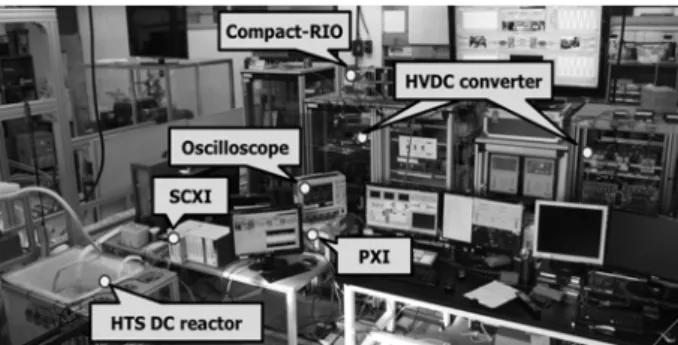
The 8.1 mH HTS DC reactor was connected to the HVDC transmission system and placed between DC cables in series. The HTS DC reactor was operated in liquid nitrogen condition. Total system was being monitored

Fig. 3. Experimental setup to analyze the operational characteristics of the HTS DC reactor, which consists of HVDC system, HTS DC reactor and monitoring devices.

through LabVIEW based program and devices including Compact-RIO, SCXI and PXI as shown in Fig. 3.

3.2. Operational characteristic analysis of the system The model-sized LCC type HVDC system was operated with two kinds of DC reactors including copper-based reactor and HTS-based reactor. The DC voltage and current of the HVDC system were changed according to firing angle from 90° to 53.2°. The turned-on timing of the HVDC system was a little erratic even using the same reactor, however overall characteristics about system as voltage and current were the same according to the type of reactors as shown in Fig. 4. The duration of the HVDC system for current ramping from zero to steady-state was 0.14 s as shown in Fig. 5. It shows that the LCC type HVDC

Fig. 4. Firing angle dependent operational characteristics of the HVDC system with HTS DC reactor.

Fig. 5. Starting characteristic of the HVDC system.

TABLE II

T HE SPECIFICATIONS OF THE HVDC SYSTEM .

Parameters Values

AC power network 3Φ 380 V, 60 Hz

Transformer 3Φ 380/25 V (Y-Y, Y-D)

AC reactor 3Φ 0.1 mH

Total resistance of DC cables 26.4 mΩ TABLE I

DESIGN PARAMETERS OF THE HTS DC REACTOR .

Parameters Values

Width of HTS wire 4 mm

Thickness of HTS wire 0.32 mm (Insulated wire)

Number of turns 82 turns

Total length of HTS wire 135 m

Critical current of SPC 110 A (@self-field, 77 K)

Inductance of SPC 8.1 mH

33

(3)

Operational characteristics analysis of a 8 mH class HTS DC reactor for an LCC type HVDC system

system responds with time delay to the firing angle control.

The voltage at both ends of the HTS DC reactor was measured to investigate the stability of the reactor depending on the variation of the DC current. The voltage of the reactor was not changed during the operation.

When DC current level of the HVDC system was about 50 A, the voltages and currents in both sides of AC and DC were measured with different types of reactors as shown in Fig. 6. The magnitudes of ripple in DC currents are different according to the types of DC reactor because the copper DC reactor and HTS DC reactor have different inductance as 10 mH and 8.1 mH, respectively. However, the waveform of DC current is the same even though the different types of DC reactor are connected to the HVDC system. In the two cases of the results, the DC voltages, AC voltages and currents have the same characteristics since the HVDC system is connected with the same power network and the switching devices and the processes for power converting are the same. It means that the different material types of DC reactor have no effects on the HVDC system operation characteristics.

The DC currents include harmonic components caused by switching process of the converters. The DC currents were analyzed to separate the harmonic components from reference frequency 60 Hz using fast Fourier transform (FFT).

(a) Operation results with 10 mH copper DC reactor

(b) Operation results with 8.1 mH HTS DC reactor Fig. 6. Voltage and current characteristics of the HVDC system according to the types of DC reactors.

(a) FFT results with 10 mH copper DC reactor

(b) FFT results with 8.1 mH HTS DC reactor Fig. 7. Harmonic characteristics of the HVDC system in the form of magnitude according to the DC current level.

(a) FFT results with 10 mH copper DC reactor

(b) FFT results with 8.1 mH HTS DC reactor Fig. 8. Harmonic characteristics of the HVDC system in the form of ratio to DC current according to the DC current level.

34

(4)

S.K. Kim, B.S. Go, M.C. Dinh, J.H. Kim, M. Park, and I.K. Yu

When the level of DC current is low, the harmonic components caused by switching of 12-pulse converters are big for pure DC component regardless of reactor types as shown in Fig. 7. In the form of ratio of harmonic to DC current, the ratios of harmonic components are bigger than those of the others as the level of DC current decreased as shown in Fig. 8. The ratios of harmonic components are different according to the types of DC reactor as shown in Fig. 8, which is due to the difference of inductance.

Although, in the case of the HTS DC reactor, the ratios are bigger than those in the results of copper DC reactor, the trends of ratios for harmonic components are similar. It means that the types of DC reactor have no effects on HVDC system even the level of DC current is changed.

4. CONCLUSIONS

In this paper, the authors designed an HTS DC reactor in connection with an HVDC system. The reactor was applied to the HVDC system to investigate operational characteristics of the system with the HTS DC reactor and the results were compared with the results of copper DC reactor. The HVDC system had the same firing angle dependent characteristics with two different types of DC reactor. The voltages and currents at the AC and DC side of the HVDC system were measured regarding the different types of reactor with the same level of DC current condition.

The voltages and currents characteristics are the same regardless of the reactor types connected to the HVDC system. Consequently, an HTS DC reactor guarantees advanced transmission environment like low power loss, compactness and easiness in winding to get the large inductance with the same functional properties as a conventional DC reactor. The authors confirmed the potential of the HTS DC reactor through this study and it will be installed in an HVDC system in the near future.

ACKNOWLEDGMENT

This research was supported by Basic Science Research Program through the National Research Foundation of Korea (NRF) funded by the Ministry of Education (NRF-2013R1A1A1010676)

REFERENCES

[1] T. Hamajima, N. Hu, H. Ozcivan, S. Soeda, T. Yagai, and M. Tsuda,

“Balanced three-phase distributions of tri-axial cable for transmission line,” IEEE Trans. Appl. Supercond., vol. 19, pp.

1748-1751, 2009.

[2] J. Cho, K. D. Sim, J. H. Bae, H. J. Kim, J. H. Kim, K. C. Seong, H.

M. Jang, C. Y. Lee, and D. Y. Koh, “Design and experimental results of a 3 phase 30 m HTS power cable,” IEEE Trans. Appl.

Supercond., vol. 16, pp. 1602-1605, 2006.

[3] C. K. Kim, V. K. Sood, G. S. Jang, S. J. Lim, and S. J. Lee, HVDC transmission(power conversion applications in power systems), Wiley-IEEE Press, 2009.

[4] Y.J. Won, J.G. Kim, A.R. Kim, G.H. Kim, M. Park, I.K. Yu, K.D.

Sim, J. Cho, S. Lee, K.W. Jeong, K. Watanabe, “Power system analysis of Hanlim superconducting HVDC system using real time digital simulator,” Physica C, vol. 471, pp. 1290-1294, 2011.

[5] H. Zhao, J. Jin, and X. Lu, “Advantage of HTS DC power transmission,” IEEE International Conference on Applied Superconductivity and Electromagnetic Devices, pp. 403-406, Sept, 2009.

[6] G. Venkataramanan, B. K. Johnson, “A superconducting DC transmission system based on VSC transmission technologies,”

IEEE Trans. Appl. Supercond., vol. 13, 2003.

[7] B.W. McConnell, “Applications of high temperature superconductors to direct current electric power transmission and distribution,” IEEE Trans. Appl. Supercond., vol. 15, 2005.

.

35

수치

Fig. 1.  Design results of the HTS DC reactor: structural  shape and material of each part for the reactor

참조

관련 문서

3-13 The arc-induction-type DC circuit breaker modelling according to existence and nonexistence of the induction needle ··· 30 Fig.. 3-14 The flowing a magnetic field

- The level of radioactivation, along with other radioactivity aspects such as the T inventory will be a key factor in determining the environmental impact of fusion

- The level of radioactivation, along with other radioactivity aspects such as the T inventory will be a key factor in determining the environmental impact of fusion

Hakim, The Story of Science – – Newton at the Center, Newton at the Center, Smithsonian Books, Washington DC, USA, 2005.. Smithsonian Books, Washington

3.3 Measured current-voltage waveform and high-speed camera images during the constant voltage DC-AC pulse tandem GMAW welding · · · ·20 Fig.. 3.4 Comparison of

The rectifier is a circuit that acts as a dc voltage source by converting the ac voltage from a standard wall outlet to a dc voltage. This voltage is effectively applied

 Rule #1: Express currents in terms of node voltages: Count the number of unknown node voltages and the required number of KCL equations to solve..  Rule #2: If a node

1 John Owen, Justification by Faith Alone, in The Works of John Owen, ed. John Bolt, trans. Scott Clark, "Do This and Live: Christ's Active Obedience as the