Ⅰ. 서 론
디지털 환경에서 살고 있는 오늘날 유아들의 스마트 폰 사용이 크게 증가 하고 있다(Holloway, Green, &
Livingstone, 2013). 2014년 Ryu의 연구에 따르면 유아
의 65.9%가 24개월 이전부터 스마트폰을 사용하여 스마 트폰 사용 연령이 빠르게 하향화 되고 있는 것으로 나타 났다. 스마트폰 사용에서의 긍정적인 측면은 손의 조작 능력을 향상시키고(Lee, 2011), 유아의 흥미를 높여 탐구능력에 효과적이지만(Yoo, 2012), 국제암연구소
대한감각통합치료학회지 제18권 1호
The Journal of Korean Academy of Sensory Integration 2020 Vol. 18. No. 1
http://dx.doi.org/10.18064/JKASI.2020.18.1.34
스마트폰 중독 위험군 유아의 스마트폰 사용시간에 따른 감각처리능력의 비교
김윤경
*, 김경미
***인제대학교 대학원 작업치료학과 석사과정
**인제대학교 보건의료융합대학 작업치료학과 교수
국문초록
목적 : 스마트폰 중독 위험군 유아의 스마트폰 사용시간에 따른 스마트폰 중독 정도와 감각처리능력의 차이 를 알아보고자 하였다.
연구방법 : 연구 대상자는 스마트폰 중독 위험군 유아 124명이었고, 연구 기간은 2019년 9월부터 동년 12 월까지이었다. 연구 방법은 설문조사로 일반적 특성, 유·아동 스마트폰 중독 관찰자 척도, 단축감각프로 파일을 사용하였다. 분석방법은 스마트폰 사용시간에 따른 스마트폰 중독의 차이와 중독군에 따른 감각 처리능력의 차이를 비교하기 위해 독립표본 t-test를 사용 하였다.
결과 : 스마트폰 사용시간에 따른 집단 간 스마트폰 중독의 차이는 스마트폰 중독합계(p=.000)와 현저성 (p=.027), 충동·강박적 사용(p=.019), 금단(p=.046), 내성(p=.003), 대인 간 갈등(p=.046)에서 유 의한 차이를 보였다. 집단 간 감각처리능력의 차이는 SSP 총점(p=.000) 및 하위영역 모두에서 유의한 차이를 보였다(p=.000∼.042).
결론 : 본 연구는 유아의 스마트폰 사용시간에 따른 스마트폰 중독과 감각처리능력의 차이가 있는 것을 확 인하였다. 이를 통해 유아의 스마트폰 사용에 대한 교육의 필요성을 제기하였다는 점에서 의의를 갖는다.
주제어 : 감각처리능력, 스마트폰 사용시간, 스마트폰 중독, 유아
교신저자: 김경미([email protected])
접수일: 2020.05.01. ∥ 심사일: 2020.05.22. ∥ 게재확정일: 2020.06.19.
(International Agency for Research on Cancer)는 스 마트폰 사용 시 발생하는 전자파를 발암 가능 물질로 분 류한 바 있다(Park, 2019). 스마트폰의 과도한 사용은 시력 저하 및 뇌 건강(Lee, 2013), 문제행동(Heo, 2016), 사회적 고립(Muhammad & Tariq, 2013)등의 문제를 야 기 시키고 있어 스마트폰 사용은 생활상의 편리함을 가 져오는 이면에 스마트폰 중독에 대한 우려를 낳고 있다 (National Information Society Agency, 2011). 스마트폰 중독이란 스마트폰의 과다사용으로 스마트폰에 대한 의 존이 높고 일상생활에 어려움이 나타는 것으로 정의된다 (Son, 2012). 유아는 자기조절능력이(self-regulation) 부족하여 습관적이고 반복적으로 스마트폰을 사용함으 로써 중독에 더 쉽게 노출 되고 있다(Park & Kim, 2015). 2017년 유아의 스마트폰 중독 위험군은 19.1%이 며 최근 3년간 가장 큰 폭으로 증가하고 있다(National Information Society Agency, 2018). 이러한 결과는 유 아의 스마트폰 중독을 개선하기 위한 사회적 관심과 중 재가 시급히 요구되고 있음을 시사한다.
Jang과 Jeong(2015)에 의하면 유아의 스마트폰 사용 시간은 스마트폰 중독의 주요한 관련 요인이고, Troseth, Russo와 Strouse(2016)는 스마트폰의 최초 이용 연령이 어릴수록 사용시간이 길고 스마트폰 중독 청소년으로 성 장할 가능성이 높다고 하였다. 이와 관련하여 2016년 미 국소아과학회(America Academy of Pediatrics)는 18개 월 미만의 유아는 스마트폰 사용을 금지하도록 해야 하 며 만 3세∼6세 아동은 하루에 1시간 이내로 스마트폰을 사용하길 권고하였다. Hong(2012)은 미국 대학생의 스 마트폰 사용시간에 따른 뇌의 회백질(gray matter) 두 께를 자기공명영상장치(MRI)로 확인한 결과, 스마트폰 을 2시간 사용한 뇌에 비해 10시간 사용한 뇌의 회백질 두께가 빠르게 얇아진다 하였다. 즉, 스마트폰 사용시간 이 증가 할수록 뇌의 회백질 크기가 줄어든다(Kim, Lee, Kim, & Yang, 2016). 뇌의 회백질의 두께나 부피는 클 수록 뇌 기능이 우수하며(Kang, 2018), 뇌의 회백질 손 상은 감각처리와 관련이 있다(Rahkonen et al, 2015).
감각처리(sensory processing)는 신체로 입력된 감각을 효과적으로 등록, 조직화 하여 의미 있는 발달을 이끌어 내는 신경학적 과정이다(Ayres, 1979). 감각처리와 개인 의 행동 및 환경은 상호 연관성을 가지고 감각처리능력 은 유아의 행동에 영향을 미친다(Dunn, 2001). 즉 감각
처리의 어려움은 유아의 발달과 성숙을 지연시키게 된다 (Shin, 2019).
선행연구에 의하면 유아의 스마트폰 중독은 감각추구 (Choi, 2019; Lee, 2014; Park & Kim, 2015)와 같은 개 인적 요인과 어머니의 스마트폰 중독 경향성이 높은 경 우 유아의 스마트폰 중독에 정적 영향을 미치는 환경적 요인과 관련이 있다(Ki, 2016; Kim, 2015; Kim &
Moon, 2015). 감각추구는 새롭고 다양한 경험이나 감각 을 추구하려는 욕구로(Zuckerman, Kolin, Price, &
Zoob, 1964) Park & Kim(2015)은 스마트폰 중독일수록 유아의 감각추구가 높아진다 하였고, Choi(2019)에 연구 에 의하면 감각추구성향이 높을수록 스마트폰 사용시간 이 증가하였다. 이러한 결과를 바탕으로 스마트폰 사용 시간과 스마트폰 중독, 감각처리는 관계가 있는 것으로 해석되어 연구의 필요성이 제기된다. 특히 만 3세∼6세 유아는 기능면에서 빠르게 변화가 일어나는 발달시기에 있으며(Kim, 2015) 스마트폰 중독은 이러한 중요한 시 기에 있는 유아의 발달을 방해하는 주요한 원인이 될 수 있다(Liberati et al., 2009). 따라서 발달에 기초가 되 는 감각처리능력은 스마트폰 사용시간에 따라 어떠한 차 이가 있는지 연구되어야 한다. 그러나 선행연구에서는 유아의 스마트폰 중독과 감각추구(Choi, 2019; Lee, 2014; Park & Kim, 2015)에 관한 연구만 이루어졌을 뿐 스마트폰 사용시간과 관련하여 전반적인 감각처리능력 에 대한 연구는 이루어지지 않았다. 따라서 본 연구는 스 마트폰 중독 위험군 유아를 대상으로 스마트폰 사용실태 를 알아보고 스마트폰 사용시간에 따른 스마트폰 중독 정도와 감각처리능력의 차이를 검증함으로써 유아의 스 마트폰 사용시간 감소 및 중독 예방을 위한 기초자료를 마련하고자 하였다.
Ⅱ. 연구 방법 1. 연구대상
본 연구는 경북 지역 내에 소재한 어린이집 3곳과 유 치원 5곳에 재원 중인 만 3세∼6세의 스마트폰 중독 위 험군 유아 124명을 대상으로 하였다. 대상자는 스마트폰 에 노출된 경험이 있는 만 3세∼6세 유아, 연구의 목적
을 이해하고 동의한 부모였다. 신경학적 손상이 있는 유 아, 발달지연이나 장애진단을 받은 유아, 정기적인 약물 복용 중인 유아는 대상자에서 배제되었다. 총 334명의 유아 중 스마트폰 중독척도를 사용하여 잠재적 위험 사 용자군과 고위험 사용자군 124명을 연구 대상자로 최종 선정하였다. 스마트폰 사용시간 정도에 따른 집단을 구 분하기 위하여 평균±표준편차를 기준으로 1집단과 2집 단으로 구분하였다. 구체적인 연구대상 집단의 구분은 Table 1과 같다.
2. 연구도구
본 연구에서 사용한 연구도구는 설문지이었다. 설문 지는 일반적 특성 16문항, 유·아동 스마트폰 중독 관찰 자척도 30문항, 단축감각프로파일 38문항을 포함한 총 84문항으로 구성되었다.
1) 유·아동 스마트폰 중독 관찰자 척도
본 연구에서는 스마트폰 중독을 측정하기 위하여 2016년 한국정보화진흥원에서 개발한 ‘유·아동 스마트 폰 중독 관찰자 척도’를 Park과 Hyun(2018)이 적용한 척도를 사용하였다. 이 척도는 현저성(5문항), 충동·강 박적 사용(4문항), 금단(5문항), 내성(5문항), 문제(6문 항), 대인 간 갈등(5문항)으로 총 30문항으로 구성되어 있다. 현저성은 일상생활에서 스마트폰 사용이 가장 중 요한 요소가 되며 행동과 정서, 사고를 지배하게 되는 정 도이다. 충동·강박적은 스마트폰을 수시로 꺼내 확인하 는 정도이며, 금단은 스마트폰을 사용하지 못하면 불안 해하거나 짜증을 내는 정도이다. 내성은 스마트폰을 사 용할수록 더욱 반복적으로 사용하게 되는 정도이며, 문 제는 스마트폰 사용으로 인한 비행, 신체적 문제나 일탈 의 정도를 의미한다. 대인 간 갈등은 스마트폰 사용으로 가족 등 주변 사람과의 갈등 정도를 말한다. 문항은 4점 Likert 척도로 기록하고 역 문항은 역 채점을 실시한다.
점수가 높을수록 스마트폰 중독 정도가 높음을 의미하며 정상 사용자군, 잠재적 위험사용자군, 고위험 사용자군 으로 분류된다. 본 연구에서는 고위험, 잠재적 위험 사용 자군을 대상으로 하였다. 도구의 전체 신뢰도는 .958이 었다(Park & Hyun, 2018).
2) 단축감각프로파일(Short Sensory Profile; SSP)
단축감각프로파일은 감각처리 문제와 관련하여 아동의 기능적 행동을 판별하는 도구로 감각프로파일(Sensory Profile)을 기초로 개발 되었다(McIntosh, Miller, Shyu,
& Dunn, 1999). 3∼10세 아동이 일상생활에서 감각처 리능력과 관련된 아동의 행동을 측정하고 감각처리에 어 려움이 있는 아동을 선별하기 위한 도구로 7개의 하위영 역으로 구성되어 있다. 하위영역의 문항 수는 촉각 민감 성(tactile sensitivity) 7문항, 맛/냄새 민감성(taste/
smell sensitivity) 4문항, 움직임 민감성(movement sensitivity) 3문항, 과소반응/특정 자극을 찾는 행동 (underresponsive/seeks sensation) 7문항, 청각 여과 하기(auditory filtering) 6문항, 활력이 부족하고 허약 함(low energy/weak) 6문항, 시각/청각 민감성(visual/
auditory sensitivity) 5문항으로 총 38문항으로 구성되 어 있다. 점수가 낮을수록 감각처리능력에 어려움이 있 는 것으로 해석된다. 각 문항은 1점에서 5점으로 점수를 부여할 수 있으며 Likert 5점 척도로 점수를 산출하고 총점은 190점이다. 정상군(Typical Performance)은 190점-155점, 문제가능성군(Probable Difference)은 154-142점, 확실한 문제군(Definite Difference)은 141-38점으로 분류된다. 본 연구에서는 Kim(2001)이 번안한 단축감각프로파일을 사용하였다. 도구의 내적 신뢰도 Cronbach's α값은 .89이며, 내적 타당도는 .43-.76이다(Kim, 2004).
Criteria
N
(%)1Group Smartphone usage group of less than 3 hours per day 64 (51.6) 2Group Smartphone usage group of more than 3 hours per day 60 (48.4)
Total 124 (100.0)
Table 1. Categorization criteria of subjects
3. 연구절차
본 연구는 2019년 09월부터 동년 12월까지 경북 지역 에 있는 어린이집 3곳, 유치원 5곳을 통해 대상자 모집 을 하였다. 기관의 원장이나 교사를 접촉하여 연구의 목 적과 참여방법을 설명한 후 연구 참여 의사를 밝힌 기관 을 대상으로 연구자가 방문하여 기관장 및 교사들을 대 상으로 연구에 관한 설명을 하였고 서면으로 된 동의서 를 읽고 서명한 원아의 부모를 대상으로 설문조사를 실 시하였다. 설문지는 총 334부 회수되었고 스마트폰 중독 척도로 고위험 사용자군과 잠재적 위험 사용자군을 대상 자로 선정하여 총 124명의 자료를 본 연구에 사용하였 다. 본 연구는 인제대학교 생명윤리위원회 사전승인 하 에 수행되었다(2019-04-083-003).
4. 분석방법
본 연구는 IBM SPSS Statistics 22.0 프로그램을 사 용하여 통계자료를 분석하였다. 본 연구에서 통계학적 유의수준은 p<.05로 하였다.
첫째, 대상자의 일반적 특성, 스마트폰 중독, 단축감 각프로파일의 평균과 표준편차는 기술통계를 통해 분석 하였다.
둘째, 스마트폰 사용시간에 따른 스마트폰 중독의 차 이를 비교하기 위하여 독립표본 t-test를 사용하였다.
셋째, 스마트폰 사용시간에 따른 감각처리능력의 차 이를 비교하기 위하여 독립표본 t-test를 사용하였다.
Ⅲ. 연구 결과 1. 연구대상자의 일반적 특성
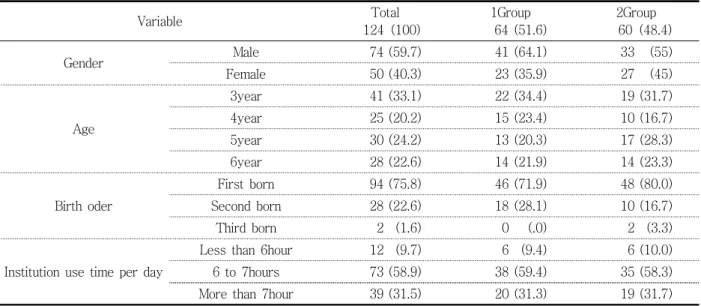
연구대상자는 총 124명으로 남아 74명(59.7%), 여아 50명(40.3%)이었다. 전체 연구대상 중 만 3세는 41명 (33.1%), 만 4세 25명(20.2%), 만 5세 30명(24.2%), 만 6세 28명(22.6%)으로 만 3세가 가장 많았다. 전체 대상 자 중 1집단은 64명(51.6%), 2집단은 60명(48.4%)으로 비슷한 분포를 이루었다. 출생순위는 첫째 94명(75.8%) 으로 가장 많았고, 기관 이용 시간은 6-7시간을 이용하 는 아동이 73명(58.9%)으로 가장 높은 빈도로 나타났다 (Table 2).
2. 스마트폰 중독 위험군 유아의 스마트폰 사용 실태
본 연구에 참여한 유아의 스마트폰 사용실태 결과는 다음과 같다(Table 3). 스마트폰 중독 위험군 유아의 스 마트폰 최초 사용 시기는 만1세 미만이 가장 많았다. 스 마트폰 사용 기간은 3년 이상, 스마트폰 주중 사용 빈도 는 매일 사용하는 아동이 가장 높은 빈도로 나타났다. 스
Variable Total
124 (100)
1Group 64(51.6)
2Group 60 (48.4)
Gender Male 74 (59.7) 41 (64.1) 33 (55)
Female 50 (40.3) 23 (35.9) 27 (45)
Age
3year 41 (33.1) 22 (34.4) 19 (31.7)
4year 25 (20.2) 15 (23.4) 10 (16.7)
5year 30 (24.2) 13 (20.3) 17 (28.3)
6year 28 (22.6) 14 (21.9) 14 (23.3)
Birth oder
First born 94 (75.8) 46 (71.9) 48 (80.0)
Second born 28 (22.6) 18 (28.1) 10 (16.7)
Third born 2 (1.6) 0 (.0) 2 (3.3)
Institution use time per day
Less than 6hour 12 (9.7) 6 (9.4) 6 (10.0)
6 to 7hours 73 (58.9) 38 (59.4) 35 (58.3)
More than 7hour 39 (31.5) 20 (31.3) 19 (31.7)
Table 2. General characteristics of the subjects Unit:
N
(%)마트폰 최초 제공자와 스마트폰 사용 시 함께하는 사람 은 부모에 의해서가 가장 많았다. 스마트폰 하루 평균 사 용시간은 3.31±1.19 시간이며 1집단은 2.33±.64시간, 2집단은 4.37±.58시간으로 나타났다.
3. 스마트폰 사용시간에 따른 스마트폰 중독의 차이
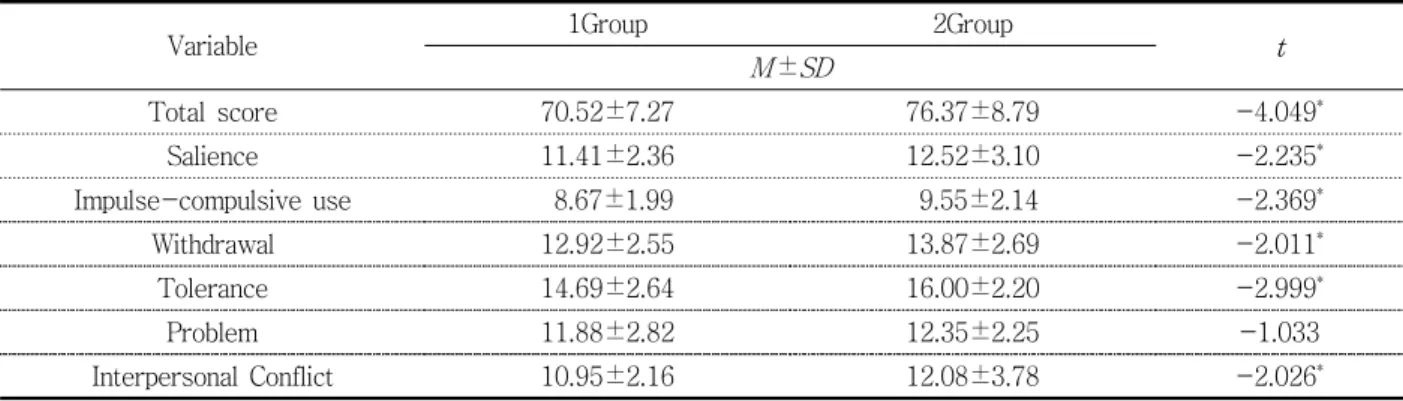
스마트폰 사용시간 집단에 따른 스마트폰 중독과 하위 영역의 결과는 다음과 같다(Table 4).
스마트폰 중독 합계(p=.000) 및 하위영역의 현저성 (p=.027), 충동·강박적 사용(p=.019), 금단(p=.046), 내성(p=.003), 대인 간 갈등(p=.046)에서 집단 간 유의 한 차이가 있었다. 스마트폰 중독의 합계와 하위 영역 모 두에서 2집단의 스마트폰 중독 점수가 높았다.
Variable 1Group 2Group
M
±SD
tTotal score 70.52±7.27 76.37±8.79 -4.049*
Salience 11.41±2.36 12.52±3.10 -2.235*
Impulse-compulsive use 8.67±1.99 9.55±2.14 -2.369*
Withdrawal 12.92±2.55 13.87±2.69 -2.011*
Tolerance 14.69±2.64 16.00±2.20 -2.999*
Problem 11.88±2.82 12.35±2.25 -1.033
Interpersonal Conflict 10.95±2.16 12.08±3.78 -2.026*
*
p
<.05,M
±SD
: Mean±Standard DeviationTable 4. Differences of smartphone addiction between groups
Variable Total 1Group 2Group
Age of first smartphone usage
1year 99 (79.8) 51 (79.7) 48 (80.0)
2year 21 (16.9) 12 (18.8) 9 (15.0)
3year 4 (3.2) 1 (1.6) 3 (5.0)
Period of smartphone usage
3month to 1year 9 (7.3) 8 (12.5) 1 (1.7) 1 to 2year 33 (26.6) 18 (28.1) 15 (25.0) 2 to 3year 34 (27.4) 14 (21.9) 20 (33.3) More than 3year 48 (38.7) 24 (37.5) 24 (40.0)
First smartphone provider
Father 36 (29.0) 20 (31.3) 16 (26.7)
Mother 74 (59.7) 36 (56.3) 38 (63.3)
Siblings 6 (4.8) 3 (4.7) 3 (5.0)
Friend 4 (3.2) 1 (1.6) 3 (5.0)
Grandparent 3 (2.4) 3 (4.7) 0 (.0)
Cousin 1 (.8) 1 (1.6) 0 (.0)
Who they use smartphone with
Father 26 (21.0) 14 (21.9) 12 (20.0)
Mother 52 (41.9) 27 (42.2) 25 (41.7)
Alone 33 (26.6) 16 (25.0) 17 (28.3)
Siblings 13 (10.5) 7 (10.9) 6 (10.0)
Frequency of using smartphone
1 times/week 5 (4.0) 4 (6.3) 1 (1.7)
1-2 times/week 13 (10.5) 6 (9.4) 7 (11.7) 3-4 times/week 28 (22.6) 17 (26.6) 11 (18.3) 5-6 times/week 14 (11.3) 6 (9.4) 8 (13.3)
Everyday 64 (51.6) 31 (48.4) 33 (55.0)
Average daily smartphone usage
(hour, mean±standard deviation) 3.31±1.19 2.33±.64 4.37±.58
Table 3. Characteristics of smartphone usage Unit:
N
(%)4. 스마트폰 사용시간에 따른 감각처리능력의 차이
스마트폰 사용시간 집단에 따른 감각처리능력의 결과 는 다음과 같다(Table. 5). SSP 총점(p=.000) 및 촉각민 감성(p=.019), 맛/냄새 민감성(p=.031), 움직임 민감성 (p=.020), 과소반응/특정자극을 찾는 행동(p=.003), 청 각 여과하기(p=.042), 활력이 부족하고 허약함(p=.006), 시각/청각민감성(p=.023)에서 집단 간 유의한 차이가 있었다. SSP 총점과 하위영역 모두 2집단의 평균 점수 가 낮았다.
Ⅳ. 고 찰
본 연구에서는 124명의 스마트폰 중독 위험군 유아를 대상으로 스마트폰 사용시간에 따른 스마트폰 중독 정도 와 감각처리능력의 차이를 알아보고자 하였다. 연구결 과, 스마트폰 중독 위험군 유아의 스마트폰 최초 사용 시 기는 만1세 미만(79.8%)이 현저하게 높았다. 이는 Oh와 Park(2019)의 연구와 같은 결과를 보였다. 이러한 결과 는 본 연구에서 스마트폰 중독 위험군을 대상으로 하였 기 때문이며, 이른 시기에 스마트폰을 사용하게 되면 스 마트폰 중독이 될 확률이 높다고 한 Chun(2015), Lee(2013)의 연구를 뒷받침하는 결과이다. 스마트폰 사 용횟수는 매일 사용하는 비율이 가장 높아(51.6%) 과다 한 스마트폰 사용빈도를 보여 주었다. 이는 Ki(2016), Lee(2014), Cho(2015)의 연구와 같은 결과를 보였다.
스마트폰 하루 평균 사용시간은 3.31±1.19 시간으로
3시간 미만은 1집단, 3시간 이상은 2집단으로 구분하였 다. 각 집단의 스마트폰 사용시간은 2집단(4.37±.58시 간)이 1집단(2.33±.64시간)보다 평균 2배 정도로 나타 났다. 미국소아과협회에서는 유아의 스마트폰 하루 평균 사용시간을 1시간으로 권고하였다(America Academy of Pediatrics, 2016). 그러나 본 연구에서는 권고한 시 간보다 많은 시간을 사용하고 있는 것으로 나타나 유아 의 스마트폰 사용시간 감소에 대한 적극적인 중재와 노 력이 필요하다고 사료된다.
스마트폰 사용시간에 따른 스마트폰 중독 점수를 비교 한 결과, 하위영역 중 문제 영역만을 제외 하고 집단 간 에 유의한 차이가 있었다. 스마트폰 중독 합계와 하위영 역인 현저성, 충동·강박적 사용, 금단, 내성, 문제, 대 인 간 갈등 영역 모두에서 2집단의 스마트폰 중독 점수 가 높게 나타나 스마트폰 사용시간이 2배 더 많은 2집단 의 중독 정도가 심각한 것으로 나타났다. 이는 스마트폰 사용시간이 증가할수록 유아의 스마트폰 중독이 높다는 선행연구와 같은 결과를 보였다(Jang & Jeong, 2015;
Lim, 2013; Na, 2013).
스마트폰 사용시간에 따른 감각처리능력을 비교한 결 과 SSP총점과 하위영역 모두에서 집단 간 유의한 차이 가 있었다. 이는 Park과 Chang(2015)의 연구와 일부 일 치한 결과이다. Park과 Chang(2015)의 연구에서는 대 학생의 시각처리, 촉각처리, 활동수준 영역이 유의한 차 이가 있었다. Hong과 Lee(2018)의 연구에서는 남녀 대 학생의 스마트폰 사용시간에 따른 감각처리에 통계학적 차이는 없어 본 연구의 결과와는 달랐다. 이는 대상자의 연령과 인원수의 차이에서 비롯되어 추후 관련 연구가 필요할 것으로 사료된다. 두 집단의 SSP 총점에 따라 분
Variable 1Group 2Group
M
±SD t
SSP total scores 144.63±9.35 132.92±9.53 6.905*
Tactile sensitivity 27.48±3.83 25.72±4.41 2.387*
Taste/smell sensitivity 14.34±3.70 12.87±3.83 2.182*
Movement sensitivity 12.61±2.55 11.45±2.94 2.349*
Underresponsive/seeks sensation 25.48±3.55 23.58±3.34 3.066*
Auditory filtering 22.72±3.63 21.17±4.76 2.050*
Low energy/weak 24.17±3.52 22.33±3.75 2.816*
Visual/auditory sensitivity 17.81±5.36 15.80±4.29 2.300*
*
p
<.05,M
±SD
: Mean±Standard Deviation, SSP: Short Sensory Profile Table 5. Differences of Short Sensory Profile between groups류한 결과, 1집단에서는 표준점수대가 ‘정상아동과 감각 반응의 차이가 있음’을 나타내는 문제가능성군에, 2집단 에서는 표준점수대가 ‘감각반응이 현저하게 다름’으로 확실한 문제군에 속하였다. 이러한 결과는 스마트폰 사 용시간이 증가할수록 감각처리능력의 어려움이 나타나 는 것으로 해석된다. 본 연구는 유아의 스마트폰 사용시 간이 증가할수록 스마트폰 중독은 높아지고 감각처리능 력은 낮아지는 것을 확인하였다.
본 연구의 제한점과 후속연구를 위한 제안점은 다음과 같다.
첫째, 연구자가 접근 가능한 일부 지역의 유아를 대상 으로 연구하여 일반화하기에는 어렵다. 차후 연구에서는 연구 결과의 일반화를 위하여 전국의 유아를 대상으로 한 연구가 이루어져야 할 것이다.
둘째, 본 연구에서 사용한 도구는 부모보고식 설문으 로 전문가에 의한 평가 보다 객관성 확보에 단점이 있다.
그러나 연구자가 평가에 대한 사전 교육을 충분히 하여 설문조사의 한계를 최소화하려고 하였다.
셋째, 본 연구는 스마트폰 사용시간이 증가할수록 감 각처리능력에 문제가 있는 것으로 확인했지만 스마트폰 사용시간과 감각처리능력의 인과관계에 대한 검증은 어 려운 설계이다. 따라서 스마트폰 사용시간이 감각처리능 력에 영향을 미치는 지에 대한 정확한 인과관계를 확인 할 수 있는 연구 설계와 반복측정을 통한 후속 연구가 요 구된다.
Ⅴ. 결 론
본 연구는 스마트폰 중독 위험군 유아에서 스마트폰 사용시간에 따른 중독정도와 감각처리능력의 차이를 알 아보았다. 연구결과는 다음과 같다.
첫째, 스마트폰 하루 평균 사용시간은 3.31±1.19 시 간으로 1집단(2.33±.64시간), 2집단(4.37±.58시간)이 었다.
둘째, 스마트폰 사용시간에 따른 집단 간 스마트폰 중 독의 차이는 스마트폰 중독합계(p=.000)와 현저성 (p=.027), 충동·강박적 사용(p=.019), 금단(p=.046), 내성(p=.003), 대인 간 갈등(p=.046)에서 유의한 차이 를 보였다.
셋째, 스마트폰 사용시간에 따른 집단 간 감각처리능 력의 차이는 SSP 총점(p=.000) 및 하위영역 모두에서 유의한 차이를 보였다(p=.000 ∼ .042).
본 연구는 유아의 스마트폰 사용시간에 따른 스마트폰 중독과 감각처리능력의 차이가 있는 것을 확인하였다.
이를 통해 유아의 스마트폰 사용에 대한 교육의 필요성 을 제기하였다는 점에서 의의를 갖는다.
참고 문헌
American Academy of Pediatrics (2016). Media and young minds. Pediatrics, 138(5), e20162591.
https://doi.org/10.1542/peds.2016-2591
Ayres, J. (1979). Sensory Integration and the Child.
Los Angeles, CA: Western Psychological Services.
Cho, J. J. (2015). The effect of young children's excessive immersion in smartphone games on their prosocial behavior and problematic behavior.
Master's thesis, Seoul Theological University, Gyeonggi.
Choi, M. K. (2019). Smartphone usage analysis using sensory processing model: Focusing on the mediating effect of perceived media richness and smartphone use differences by sensory processing thresholds and behavioral responses. Doctoral dissertation, Sogang University, Seoul.
Chun, H. Y. (2015). Relations of smart phone usage level to developmental characteristics and time diaries, and variables predicting the usage level groups of four year old children. Journal of Korean Child Care and Education, 1(6), 153-175.
https://doi.org/10.14698/jkcce.2015.11.153 Dunn, W. (2001). The sensation of everyday life:
Empherical, thepretical, and paragmatic consideration, 2001 eleanor clarke slagle lecture.
American Journal of Occupational Therapy, 55, 608-620. https://doi.org/10.5014/ajot.55.6.608 Heo, E. Y. (2016). The differences of toddlers' problem behavior based on the time and the
type of smart device usage. Master's thesis, Sookmyung Women’s University, Seoul.
Holloway, D., Green, L., & Livingstone, S. (2013).
Zero to eight: Young children and their internet use. London, LSE: EU Kids Online.
Hong, E. K., & Lee, H. R. (2018). The correlation between smartphone addiction and sensory processing feature depending on gender in college students. Journal of Korean Academy of Sensory Integration, 16(3), 1-10. http://dx.doi.org/10.18064/
JKASI.2018.16.3.001
Hong, S. D. (2012). The harmful and countermeasures of smart devices in information society. Korea Institute of Information Technology Magazine, 10(1), 23-29.
Jang, J. J., & Jeong, I. S. (2015). Related factors of smartphone addiction among preschool children. Journal of Korean Society for school
& Community Health Education, 16(1), 65-81.
Kang, K. W. (2018). The neural basis of creative thinking process in the brain. Journal of the Korean Society for the Gifted and Talented, 16(4), 53-78.
Ki, H. O. (2016). Study on characteristics of mothers influential to smartphone uses of children:
Parenting stress, adult attachment, mother’s smartphone Addiction. Master's thesis, Dongduk Women's University, Seoul.
Kim, K. M. (2004). A study on the validity of short sensory profile for children without disability.
Journal of Korean Academy of Sensory Integration, 2(1), 1-10.
Kim, K. S. (2015). Analysis of relationships between young children's attention deficit/hyperactivity disposition and numeracy/life scientific concepts.
Korean Journal Early Childhood Special Education, 15(3), 27-50.
Kim, M. G., Lee, N. M., Kim, E. H., & Yang, M. H.
(2016). Ethical practice of digital communication through the quest for humat value of koreans.
Seoul, NRC: National Research Councle for Economics Humanities and Social Sciences.
Kim, M. H. (2015). The effects of maternal parenting behavior, smart devices addiction, and children's self regulation on their use of smart devices.
Journal of Korean Child Care and Education, 11(6), 131-151. http://dx.doi.org/10.14698/jkcce.
2015.11.133
Kim, M. S. (2001). A comparison of the sensory processing skills of typically developing children with developmental disability children. Master's thesis, Ewha Womans University, Seoul.
Kim, M. S., & Moon, H. J. (2015). A study on parental influences and analysis of young children’s smart-phone usage. Korea Journal of the Human Development, 22(1), 77-99.
https://doi.org/10.15284/kjhd.2014.22.1.77 Lee, J. Y. (2011). A survey on parent's perception
of smartphone apps for early childhood education.
Master's dissertation, Kyunghee University, Seoul.
Lee, M. J. (2013). Utilization of smart devices in, young children for developmental impact on the mother's perception. Master's theis, Seoul National University, Seoul.
Lee, Y. L. (2014). The actional condition and mother's perception of infant's smart-phone use. Master's thesis, Wonkwang University, Jeonbuk.
Liberati, A., Altman, D. G., Tetzlaff, J., Mulrow, C., Gotzsche, P. C., Ioannidis, J. P. A., et al.
(2009). The PRISMA statement for reporting systematic reviews and meta-analyses of studies that evaluate health care interventions:
Explanation and elaboration. Annals of Internal Medicine, 151(4), 65-94. https://doi.org/10.7326/
0003-4819-151-4-200908180-00136
Lim, S. Y. (2013). Status and infants from home using your smartphone mother's permission and recognition focusing on gyeyang infant.
Master's thesis, Chungang University, Seoul.
McIntosh, D. N., Miller, L. J., Shyu, V., & Dunn, W. (1999). Overview of the short sensory profile. In: W. Dunn (Ed.), The sensory profile:
Examiner's manual (pp. 59-73). San Antonio, TX: The Psychological Cooperation.
Muhammad, S., & Tariq, R. S. (2013). Impact of smartphone's on society. European Journal of Scientific Research, 98(2), 216-226.
Na, Y. S. (2013). The effects of the parents’
child-rearing attitude on the smartphone addiction of small children. Journal of Early Childhood Education & Educare Welfare, 17(3), 32-53.
National Information Society Agency (2011). 2011 Survey on the internet usage. Seoul: National Information Society Agency.
National Information Society Agency (2018). 2017 Survey on smartphone overdependence. Seoul:
National Information Society Agency.
Oh, J. H., & Park, Y. W. (2019). A study on pre-schooler's smart media use and parent's perception. International Journal of Child Care and Education Policy, 13(3), 3-26. http://doi.
org/10.5718/kcep.2019.13.3.3
Park, J. A., & Hyun, E. J. (2018). Analysis on the structural relationships of young children‘s smartphone overdependence, young children‘s aggression, mothers parenting stress, and mothers smartphone addiction tendency. Journal of Children's Literature and Education, 19(2), 219-248. https://doi.org/10.22154/jcle.19.2.9 Park, M. J., & Kim, K. W. (2015). A review on the
concepts within and individual psychological variables and clinical intervention available for smartphone addiction among korean children and youth: Focusing on studies published in Korea from 2011 to 2015. Korean Journal of Play Therapy, 18(2), 97-113. https://doi.org/10.17641/
kapt.18.2.2
Park, Y. H. (2019). Factors affecting smartphone exposure time of preschoolers. Journal of
Learner-Centered Curriculum and Instruction, 19(1), 159-174. https://doi.org/10.22251/jlcci.
2019.19.1.159
Park, Y. J., & Chang, M. Y. (2015). The correlation between smartphone addiction and sensory processing feature, self-efficacy in college students. Journal Korean Academy of Sensory Integration, 13(2), 43-51. http://dx.doi.org/10.
18064/JKASI.2015.13.2.043
Rahkonen, P., Aulikiki, L., Pesonen, A. K., Raikkonen, K., Vanhatalo, S., Autti, T., et al.
(2015). Atypical sensory processing is common in extremely low gestational age children.
Foundation Acta Paediatrica, 104(5), 522-528.
https://doi.org/10.1111/apa.12911
Ryu, M. H. (2014). A study of infant/toddler's use of smartphones and their mother's perceptions on smartphone using. Korean Journal of Child Care and Education, 86, 207-329.
Shin, M. K. (2019). Development and validation of a sensory processing evaluation tool for preschool children based on the sensory environment of Home. Doctoral dissertation, Yonsei University, Seoul.
Son, E. H. (2012). Research on awareness and prevention of smartphone addiction. Master's thesis, Chungang University, Seoul.
Troseth, G., Russo, C., & Strouse, G. (2016). What’s next for research on young children’s interactive media? Journal of Children and Media, 10(1), 54-62. https://doi.org/10.1080/17482798.2015.
1123166
Yoo, K. J. (2012). A study on the development of program by using smart phones and tablet PC and its effects on scientific thinking of young children. Journal of Korea open Association for Early Childhood Education, 17(3), 85-110.
Zuckerman, M., Kolin, E. A., Price, L., & Zoob, I.
(1964). Development of a sensation seeking scale.
Journal of Consulting Phsychology, 28, 477-482.
Abstract
A Comparison of Sensory Processing Ability Depending on the Smartphone Usage of Toddlers in the “Smartphone Addiction” Risk Group
Kim, Yun-Kyeong*, BS, O.T., Kim, Kyeong-Mi**, Ph.D., O.T.
*Dept. of Occupational Therapy, Graduate School of Inje University
**Dept. of Occupational Therapy, College of Health and Medical Affairs, Inje University
Objective : The purpose of this study was to investigate the difference between smartphone addiction and sensory processing ability depending on the time of smartphone usage by at risk of smartphone addiction.
Methods : Participants of this study were 124 toddlers in a The data collection period was from September 2019 to December 2019. Measurements in this study included a questionnaire on general information about the subject, a smartphone addiction scale, and a short sensory profile. Methods for the data analysis included descriptive statistics and an independent t-test using SPSS 22.0.
Results : There were significant differences between groups depending on smartphone usage time in terms of total smartphone addiction, salience, impulse-compulsive use, withdrawal, tolerance, and interpersonal conflict among toddlers. There were also significant difference in sensory processing ability between groups according to the total Short Sensory Profile score (and in all sub-domains;
p=.000 ∼ .042).
Conclusion : This study found that there was a difference in smartphone addiction and sensory processing ability depending on the smartphone usage time of toddlers at risk of smartphone. It is meaningful because it raises the need for education on the use of smartphones by toddlers.
Key words : Sensory Processing Ability, Smartphone Addiction, Smartphone Usage Time, Toddlers