Korean Academy of Esthetic Dentistry
Laminate veneer restorations using indirect resin composite
Naomi Tanoue, DDS, PhD /Division of Fixed Prosthodontics, Nagasaki University Hospital, Japan
Introduction
Laminate veneer restoration has been used for more than 30 years.1,2) In the early days of laminate veneer restorations, indirect resin composite3,4) or feldspar porcelain5,6) was often used. In recent years, however, there have been many improvements and advancements in materials suitable for laminate veneer restorations, and hence there is now a wide range of options when fabricating laminate veneers.
The application of the photo-polymerization method into resin composite allowed the high-density filling of the filler, and its mechanical properties have improved drastically.9) The indirect resin composite, which can be used for various metal-free restorations, such as laminate veneer,10-13) is one useful prosthetic technique. One of the advantages of using indirect resin composite is its simple manufacturing process, which results in low cost. Many dentists have therefore used indirect composite as the material and technique of choice when fabricating laminate veneers. This clinical report presents the results of laminate veneer restorations made using indirect resin composite technique.
Case report
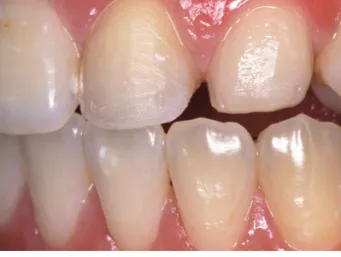
A 25-year-old Japanese female patient with an unremarkable medical history was initially examined at our university hospital with the chief complaint of aesthetic disturbance of the maxillary left central incisor and crossbite at the maxillary left lateral incisor (Fig. 1). Both teeth were vital, and the uneven texture of composite resin filling and secondary caries were seen in the labial surface of the central incisor. Although the lateral incisor was intact, the patient
This clinical report shows the importance of selecting appropriate materials in fabricating laminate veneer restorations.
Such cases should be carefully selected to ensure bonding durability, providing consistently reliable prognosis. (J Korean Acad Esthet Dent 2013;22:4-8)
Key words: laminate veneer, indirect composite, microleakage
Journal of the Korean Academy of Esthetic Dentistry did not like the appearance of her anterior crossbite. Removal and refilling of the composite resin of the central incisor and orthodontic treatment were initially recommended to avoid tooth reduction, but the patient selected treatment geared towards aesthetics and the appearance of her anterior crossbite.
After clinical examination, some prosthodontic treatment plans were proposed, and the patient selected indirect resin composite laminate veneer restorations because of the advantages of minimal tooth reduction and low cost.
The facial surfaces of the incisors were prepared (Fig. 2). A 0.5 mm tooth reduction was performed by creating a chamfer cervical finish line, using a high-speed rotary cutting instrument with diamond points (ISO 199/014 and 199/016, Shofu Inc., Kyoto, Japan) and a water coolant. All tooth preparations were completed without any sharp line angles. A shade was selected using the Vita Lumin Vacuum Shade Guide (Vita Zahnfabrik, Bad Säckingen, Germany).
An impression of the entire maxilla was prepared with silicone elastomeric materials (Exafine Putty and Injection, GC Corp., Tokyo, Japan) by using a stock tray and poured on a die stone (Fuji Rock, GC Corp.). A facebow transfer was used to mount the maxillary cast onto a semi-adjustable articulator (Spacy Articulator, YDM Corp., Tokyo, Japan), and a centric relation record was registered using a vinyl polysiloxane impression material (Exabite II, GC Corp.) for Fig. 1. Pre-treatment view. Fig. 2. Preparation for laminate veneer restorations.
Fig. 3. Completed laminate veneers on working cast. Fig. 4. Post-treatment view of the maxillary left incisors.
6 Vol. 22. 2013
mounting the opposing cast onto the articulator. Protrusive records were prepared with the impression material (Exabite II), and the sagittal and lateral condylar paths were adjusted on the articulator. The laminate veneer restorations were then fabricated to accurately simulate the appearance of the other incisors by using an indirect resin composite system (Belleglass HP, Sybron Dental Specialties, Inc., Orange, CA, USA) according to the manufacturer’s directions (Fig. 3).
After completion of fabrication and adjustment, the laminate veneers were placed on the prepared teeth to evaluate their fit. The inner surfaces to be bonded were air-abraded (Jet Blast II, J. Morita Corp., Suita, Japan) with 50-70 µm alumina (Hi-Aluminas, Shofu Inc.) for 10 seconds, treated with a silane primer (Estenia C&B Add-on Primer, Kuraray Medical Inc., Tokyo, Japan), and conditioned with the bonding agent (Estenia C&B Modeling Liquid, Kuraray Medical Inc.) including 10-methacryloyloxydecyl dihydrogen phosphate (MDP) monomer as a functional monomer.
The prepared enamel surfaces were etched with 40% phosphoric acid (K-Etchant, Kuraray Medical Inc.) for 30 seconds, washed and air-dried with an air syringe, and primed with a bonding agent (Clearfil Photo Bond, Kuraray Medical Inc.). The laminate veneers were then luted with a dual curable composite luting agent (Clapearl DC, Universal, Kuraray Medical Inc.). Photopolymerization was performed with a light polymerizing unit (Quicklight, J. Morita Corp.) for 60 seconds each for the incisal, mesial, and distal surfaces. Fig. 4 shows the post-treatment view of the restoration.
The patient was satisfied with the treatment, both aesthetically and functionally.
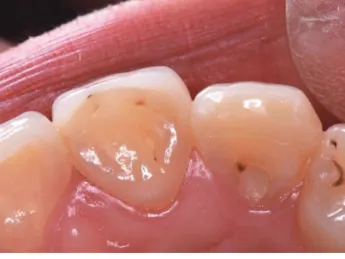
The patient was followed-up at 6-month intervals for oral hygiene. Four years after insertion, secondary caries was recognized in her central incisor by the dentist at a follow-up appointment (Fig. 5). A black spot of caries was distinguished from the labial side through the indirect resin material, although the caries started from the palatal side (Fig.
6). Refabrication of the laminate veneer was suggested, but the patient refused since the caries seemed small to her. A fluoride mouth rinse was instead recommended. The laminate veneers are now functioning although the caries has not been treated.
Discussion
Restorations using laminate veneers can minimize aggression to the tooth structure of the vital tooth. Additional preparations for mechanical retention are usually unnecessary since tooth and restoration can be chemically bonded.
The bond strength between tooth substance and restoration should be reliable to functionalize the restoration for long- Fig. 5. Facial view 4 years after insertion. The secondary
caries was recognized in the central incisor.
Fig. 6. Palatal view 4 years after insertion. The black spot was recognized between the restoration and central incisor.
Journal of the Korean Academy of Esthetic Dentistry term clinical use. In the adhesion between tooth and restoration, there are two interfaces: tooth substance-cement interface and restoration-cement interface. The tooth substance-cement interface is unrelated to the restoration materials.
In addition, the adhering area of the tooth is mostly enamel for laminate veneer restoration. There is a long history and much evidence showing that enamel bonding is highly reliable.14)
However, the bond strength of restoration-cement interface greatly depends on the type of restoration materials.
Regarding the feldspar porcelain, which has often been used for laminate veneer restoration, the application of the silane coupling agent such as 3-trimethoxysilylpropyl methacrylate is well-known to be effective for the adhesion to silicon oxide in feldspar porcelain. Many researchers have reported the reliable bonding durability of the porcelain.6,15,16)
Nevertheless, in cases where the bonding of indirect resin composite had already been polymerized and the unpolymerized layer removed, any existence of the resin matrix that consists of organic materials acts disadvantageously for the bonding process. According to Hisamatsu et al.,17) even the bond strength of the indirect composite with high inorganic filler content of 92wt% decreases conspicuously by thermocycling. The inorganic filler content of indirect composite used for this case was lower (73-74wt%). Although the silane coupling agent was used for silicon oxide and the bonding agent including MDP was also applied for bonding to the other metal oxide fillers, the resin composite included approximately 25% of organic materials. The conversion of this indirect composite is so high (98.5% according to manufacturer) that the copolymerization between cement and unpolymerized resinous matrix of the composite cannot be expected. Although the resin composite was air-abraded and treated with a silane coupling agent and bonding agent, complete adhesion was not accomplished. Hence, it is thought that the secondary caries in this case was caused by the microleakage at the resin composite-cement interface.
Within the limitation of this report, both the selection of indirect resin composite and the pretreatment of the bonding surface might be inappropriate. For laminate veneer restoration, we should select other inorganic materials, not indirect resin composite. If we should use indirect resin composite for some reason, we should consider other more effective processing methods.
References
1. Faunce FR, Myers DR. Laminate veneer restoration of permanent incisors. J Am Dent Assoc. 1976;93(4):790-2.
2. Burke FJ. Survival rates for porcelain laminate veneers with special reference to the effect of preparation in dentin:
a literature review. J Esthet Restor Dent. 2012;24(4):257-65.
3. Avery DR. The use of preformed acrylic veneers for the aesthetic treatment of severely discoloured anterior permanent teeth. Int Dent J. 1980;30(1):49-53.
4. Ehrnford L. Composite laminate veneers with a continuous inorganic phase comprising microporous sintered glass fiber networks. Acta Odontol Scand. 1983;41(5):265-70.
5. Rada RE. Perio-prosthetic rehabilitation of a geminated central incisor. Pract Periodontics Aesthet Dent.
1991;3(7):23-6.
6. Matsumura H, Aida Y, Ishikawa Y, Tanoue N. Porcelain laminate veneer restorations bonded with a three-liquid silane bonding agent and a dual-activated luting composite. J Oral Sci. 2006;48(4):261-6.
7. Chen S, Wei YJ, Chen MM, Zhang ZT. Bilateral treatment: a strategy for enhancing the mechanical strength of machinable veneers. Dent Mater. 2010;26(10):961-7.
8. Alghazzawi TF, Lemons J, Liu PR, Essig ME, Janowski GM. Evaluation of the optical properties of CAD-CAM generated yttria-stabilized zirconia and glass-ceramic laminate veneers. J Prosthet Dent. 2012;107(5):300-8.
8 Vol. 22. 2013
9. Han B, Dong Y, Gao X, Wang X, Tian F. Effect of filler content on the microtensile bond strength of composite resin and dentin in Class I cavities. Quintessence Int. 2012;43(2):e16-22.
10. Ozcan M, Mese A. Fracture strength of indirect resin composite laminates to teeth with existing restorations: an evaluation of conditioning protocols. J Adhes Dent. 2009;11(5):391-7.
11. Cetin AR, Unlu N. Clinical wear rate of direct and indirect posterior composite resin restorations. Int J Periodontics Restorative Dent. 2012;32(3):e87-94.
12. Jongsma LA, Kleverlaan CJ, Feilzer AJ. Clinical success and survival of indirect resin composite crowns: results of a 3-year prospective study. Dent Mater. 2012;28(9):952-60.
13. Monaco C. A Clinical Case Report on Indirect, Posterior Three-unit Resin-bonded FRC FPD. J Adhes Dent.
2012;14(5):479-83.
14. Pashley DH, Tay FR, Breschi L, Tjäderhane L, Carvalho RM, Carrilho M, Tezvergil-Mutluay A. State of the art etch-and-rinse adhesives. Dent Mater. 2011;27(1):1-16.
15. de Carvalho RF, Martins ME, de Queiroz JR, Leite FP, Ozcan M. Influence of silane heat treatment on bond strength of resin cement to a feldspathic ceramic. Dent Mater J. 2011;30(3):392-7.
16. Trakyali G, Malkondu O, Kazazoğlu E, Arun T. Effects of different silanes and acid concentrations on bond strength of brackets to porcelain surfaces. Eur J Orthod. 2009;31(4):402-6.
17. Hisamatsu N, Tanoue N, Yanagida H, Atsuta M, Matsumura H. Twenty-four hour bond strength between layers of a highly loaded indirect composite. Dent Mater J. 2005;24(3):440-6.