Clinical Outcomes of Tigecycline in the Treatment of Multidrug-Resistant Acinetobacter baumannii Infection
Jung Ar Shin, Yoon Soo Chang, Hyung Jung Kim, Se Kyu Kim, Joon Chang, Chul Min Ahn, and Min Kwang Byun
Department of Internal Medicine, Yonsei University College of Medicine, Seoul, Korea.
Received: August 17, 2011 Revised: November 29, 2011 Accepted: November 30, 2011
Corresponding author: Dr. Min Kwang Byun, Department of Internal Medicine, Gangnam Severance Hospital, Yonsei University College of Medicine, 211 Eonju-ro, Gangnam-gu, Seoul 135-720, Korea.
Tel: 82-2-2019-3454, Fax: 82-2-3463-3882 E-mail: [email protected]
∙ The authors have no financial conflicts of interest.
© Copyright:
Yonsei University College of Medicine 2012 This is an Open Access article distributed under the terms of the Creative Commons Attribution Non- Commercial License (http://creativecommons.org/
licenses/by-nc/3.0) which permits unrestricted non- commercial use, distribution, and reproduction in any medium, provided the original work is properly cited.
Purpose: Acinetobacter baumannii (A. baumannii) has emerged as a major cause of nosocomial pneumonia and sepsis in seriously ill patients. Multidrug-resistant A. baumannii (MDRAB) is increasing in frequency, and the management of it’s infections is consequently difficult. Therefore, tigecycline is considered to be the drug of choice for MDRAB treatment. The aim of our study was to evaluate the microbiological eradication and clinical effectiveness of tigecycline against MDRAB in seriously ill patients, including patients with ventilator-associated pneumonia (VAP). Materials and Methods: We conducted a retrospective study including patients with A. baumannii infections who were treated with tigecycline between April 1, 2009 and March 31, 2010. We treated 27 patients with tigecy- cline for MDRAB infections. Results: The mean age of patients was 66.2 years, and 20 (74.1%) patients were male. The median length of stay at hospital was 74.6 days. MDRAB was eradicated from the site of infection in 23 cases (85.2%), how- ever, only 17 cases (63.0%) showed positive clinical responses. Overall, an in-hos- pital mortality rate of 51.9% was observed, and 4 cases of death were attributable to sepsis. The combination therapy showed better clinical and microbial success rates than the monotherapy without significant difference. Conclusion: We ob- served the relatively low clinical success rate although the microbial eradication rate was high, probably due to superinfections in VAP and bacteremia. We suggest that clinicians should limit tigecycline monotherapy for MDRAB infection in criti- cally ill patients, until large controlled clinical trials should be conducted.
Key Words: Acinetobacter baumannii, bacteremia, multidrug resistance, tigecy- cline, ventilator-associated pneumonia
INTRODUCTION
Acinetobacter baumannii (A. baumannii) has emerged as a major cause of nosoco- mial pneumonia [particularly ventilator-associated pneumonia (VAP)], blood- stream infection and sepsis in immunocompromised and seriously ill patients.1,2 Mortality of critically ill patients with A. baumannii infections is high.3-7 Further- more, multidrug-resistant A. baumannii (MDRAB) is increasing in frequency and
ing organisms other than MDRAB. For polymicrobial in- fections, patients were included only if tigecycline treat- ment was determined by the presence of MDRAB.
Data recorded for each patient included the following: age, gender, associated co-morbidities and previous antimicrobial regimens, site of infection, major reason for hospital admis- sion and length of intensive care unit stay. Disease severity was assessed by Acute Physiology and Chronic Health Eval- uation II (APACHE II) scores upon ICU admission and on day 1 of tigecycline therapy.
Definitions
MDRAB was defined if A. baumannii isolate was resistant to representative antibiotics of at least three different classes of antimicrobial agents such as aminoglycosides, anti-pseu- domonal penicillins, carbapenems, cephalosporins, quino- lones, colistin, ampicillin/sulbactam and/or tetracyclines.20,21 We defined MDRAB infection as clinical findings of pneu- monia such as fever, changing patterns of sputum or signs of SIRS and identification of MDRAB in the respiratory or blood samples with suspected pathogen by attending physi- cians.22-24 We defined management as tigecycline adminis- tration and followed up the patients until tigecycline admin- istration was stopped, without regard to clinical outcome of success or failure.
Clinical outcomes were evaluated by attending physicians using data from patient files in cooperation with the investi- gators. The decisions to begin and end the tigecycline treat- ment were made by the attending physician. The duration of tigecycline treatment was decided according to its clini- cal responses.
Clinical response at the end of treatment was defined as success (complete or partial resolution of signs/symptoms) or failure (no improvement or deterioration of signs/symp- toms of infection). Microbiological response was defined as success (eradication/sterile culture results during or after the course of antibiotic therapy) or failure (continuously posi- tive culture results or the development of a superinfection due to treatment). In polymicrobial infections, microbiolog- ical response was considered positive if MDRAB was erad- icated from the primary site of infection.
VAP, bloodstream infections (BSI), and sepsis were de- fined according to American Thoracic Society/Centers for Disease Control and Prevention clinical diagnostic criteria.25
All-cause mortality during 14 days from the start of tige- cycline treatment was recorded. Death caused by primary infection was defined as death occurring without resolution it’s management can consequently be difficult.4,8-10 Carbap-
enems have become the therapy of choice for serious A.
baumannii infections, however, carbapenem-resistant or- ganisms are also becoming more common.11-14
Many MDRAB strains remain susceptible to tigecycline in vitro.15 However, reports of MDRAB are increasing, as confirmed by a European study group16 and an American study group17 that showed 51-67% resistance to quinolones and 40-63% resistance to third generation cephalosporins.
Moreover, carbapenem resistance has increased to 12-47%.
Resistance to colistin is also reported to be up to 22%, and the nephrotoxicity of colistin limits its usage in many seri- ously ill patients with renal failure.16,17 Therefore, when these drugs are not effective in MDRAB infections, tigecycline is considered as the drug of choice.
Even though some observational studies have shown that VAP caused by MDRAB was an important indication for the use of tigecycline,18-21 the role of tigecycline in VAP con- trol is still uncertain. Extended clinical experience in criti- cally ill patients with MDRAB infections is poor, and most of the available publications are retrospective with small numbers of patients or with assorted co-administered anti- biotics. Therefore, experience with tigecycline in the treat- ment of critically ill patients, including patients with VAP, is lacking.
The aim of this retrospective study was to report our ex- perience of the microbiological and clinical effectiveness of tigecycline against MDRAB infections in seriously ill pa- tients, including those with VAP.
MATERIALS AND METHODS
Study design and data collection
A retrospective study was conducted at Gangnam Sever- ance Hospital, Seoul, Korea. This study was approved by the Institutional Review Board, Gangnam Severance Hos- pital, Yonsei University College of Medicine (IRB Num- ber: 3-2011-0017).
The enrolled patients were intensive care unit (ICU) ad- mitted adults (age ≥18 years) with MDRAB infections who were treated with tigecycline between April 1, 2009 and March 31, 2010. Tigecycline was administered intravenous- ly at a dose of 50 mg every 12 hours after a loading dose of 100 mg. Exclusion criteria were as follows: age <18 years, duration of tigecycline treatment <5 days, administration of tigecycline as empirical treatment or for infections involv-
Drug susceptibility test revealed resistance to imipenem and meropenem in 85% (22/27) and 81% (23/27) of cases, re- spectively. Resistance to colistin was observed in 22.2%
(6/27, 5 of resistance and 1 of intermediate) of cases (Table 3).
Twenty-six patients had been treated with antibiotics pri- or to the current hospitalization, and 18 of these patients (69.0%) were treated with more than two antibiotics. Piper- acillin-tazobactam, respiratory quinolones, carbapenems, and third/fourth generation cephalosporins were the most frequently used prior antibiotics (37.0%, 33.3%, 25.9% and 25.9%, respectively) (data not shown). The average length of treatment was 14.5±7.5 days.
Tigecycline was administered in 17 patients (54.4%) as monotherapy and in combination with other antibiotics in 10 patients. In combination therapy group, 2 cases adminis- tered another antibiotics or antifungal agents for other patho- gens prior to MDRAB identification. Metronidazole was the most common concomitant antibiotic (30.0%). It was not for MDRAB infection, but overlap maintenance for pri- or clinically suspected anaerobic infection. Three patients in the combination therapy group were treated with anti- fungal agents such as fluconazole and/or amphotericin B.
There were no significant differences in the APACHE II scores at ICU admission between the monotherapy group and the combination therapy group (27.0±8.2 vs. 26.5±7.3);
however the APACHE II scores on day 1 of treatment (23.4±
5.5 vs. 29.6±4.0) and the duration of treatment (11.5±5.3 vs.
19.5±8.2, days) were significantly different between the groups, suggesting that clinicians tend to choose combination therapy for clinically deteriorated patients (Table 1 and 2).
Median duration between ICU admission and beginning of treatment was 33.8±28.6 days, and there was no statisti- cal difference between monotherapy group and combina- tion group (37.1±33.7 vs. 27.9±16.0 days, p=0.453) (data not shown). Some patients were admitted to ICU for vari- ous reasons and infected with MDRAB during the ICU stay. Therefore, the duration between ICU admission and the beginning of tigecycline treatment for MDRAB infec- tion did not show clinical significance.
Treatment outcomes
In 23 cases (85.2%), MDRAB was eradicated from the site of infection, however, only 17 cases (63.0%) showed posi- tive clinical response. Four patients died within 14 days of initiating treatment, representing a crude mortality rate of 14.8%. One of these deaths was attributable to sepsis. An overall in-hospital mortality rate of 51.9% was observed, of signs and symptoms of infection and with no other cause
identified.
Nephrotoxicity was defined as an increase in serum cre- atinine level of more than 50% above baseline (recorded on the first day of tigecycline treatment) at a value above the upper normal limit (>1.3 mg/dL). Underlying chronic renal failure was defined by a baseline creatinine clearance rate of less than 60 mL/min/1.73 m2.
Statistical analysis
Data were analyzed with SPSS version 18.0 statistical soft- ware (SPSS, Chicago, IL, USA). All tests were two-sided.
Categorical variables were compared by Fisher’s exact test and Pearson’s chi-square test as appropriate. Continuous variables were compared with Student’s t-test. A p-value
≤0.05 was considered statistically significant.
RESULTS
Patient characteristics
A total of 27 patients received tigecycline for MDRAB in- fections between April 1, 2009 and March 31, 2010. All pa- tients were treated with the standard regimen of a 100 mg loading dose followed by 50 mg intravenous tigecycline every 12 hours. Tigecycline administration was started in ICU, but some patients were transferred to general ward during management while clinically improved. Patient and pathogen characteristics are recorded in Table 1. The mean patient age was 66.2±10.8 years (44-83 years), and 20 (74.1%) patients were male. The median APACHE II score upon ICU admission was 26.8±7.7 and 25.7±5.8 on day 1 of tigecycline treatment. The median length of stay was 74.6 days (range, 11-135) (Table 2).
Tigecycline was considered to be the drug of choice for MDRAB infection because 5 patients showed colistin-re- sistant MDRAB infection and 7 patients showed renal fail- ure (eGFR <60 mL/min/BSA). Fifteen patients could not be treated with colistin due to the instability in stock of the drug in Korea at the time (data not shown).
Four patients were treated with tigecycline for MDRAB as a single pathogen and 23 patients were treated for poly- microbial infections. Methicillin-resistant coagulase-nega- tive staphylococci (33.3%, 9/27) were the most common co-infected organisms, followed by Pseudomonas aerugi- nosa (29.6%, 8/27) and methicillin-resistant Staphylococ- cus aureus (MRSA) (22.2%, 6/27) (Table 1 and 2).
Table 1. Characteristics of Patients Treated with Tigecycline for Infections Involving MDRAB Patient no.Age (yrs)SexCo-morbiditiesAPACHE II score (on treatment)LOS (days)Primary infectionSuperinfecting pathogenSpecimenLOT (days)Co-administered antibioticsPrevious antibioticsPrevious car- bapenem use 154MHypertension, renal cell carcinoma post--radiotherapy28112 CAPStaphylococcus aureus (MS)Sputum31Metronidazole, Amphotericin B≥2No 268MVHD, CHF, CKD, parkinson28 54 VAPEnterobacter cloacaeSputum19No 1No 361FHypertension, DM24 65 CAPCandida albicans Klebsiella pneumoniaeSputum10Fluconazole 1No 477MHypertension, parkinson, IHD post- CABG22 54 VAPKlebsiella pneumoniae Enterobacter aerogenes Sputum13No≥2No 583MHypertension, lung cancer, atrial fibrillation, old cerebrovascular infarction32129 BSIKlebsiella pneumoniae Pseudomonas aeruginosa Coagulase negative staphylococcus (MS)Sputum, blood34Metronidazole≥2Yes 670MParkinsonism30 68 VAPStaphylococcus aureus (MR) Pseudomonas aeruginosaSputum18Cefperazone≥2No 766MHypertension, DM, IHD, CHF34 67 BSIPseudomonas aeruginosa Coagulase negative staphylococcus (MS)Sputum, blood 7No≥2Yes 871FNo36107 VAPEnterobacter cloacae Stenotrophomonas maltophiliaSputum14Teicoplanin 1No 970MHypertension, traumatic aortic dissection post-graft stent insertion32 11 BSIEnterobacter cloacaeSputum, blood 6No≥2No 1068MHypertension, IHC, atrial fibrillation, VHD aortic dissection24 76 VAPPseudomonas aeruginosaSputum 8No≥2No 1183MHypertension, lung cancer, atrial fibrillation, old cerebrovascular infarction25129 VAPSerratia marcescensSputum 7No≥2Yes 1278MNo28120 VAPPseudomonas aeruginosaSputum19Meropenem 1Yes 1372MOld cerebrovascular infarction21 85 VAPEnterobacter aerogenes Coagulase negative staphylococcus (MR)Sputum 7 NoNoNo 1472MLiver cirrhosis, CKD, post-subtotal gastrectomy31 25 VAPCoagulase negative staphylococcus (MR)Sputum12No≥2No 1568MHypertension, thymoma26 76 VAPStaphylococcus aureus (MR) Coagulase negative staphylococcus (MR)Sputum13No 1Yes
Table 1. Continued Patient no.Age (yrs)SexCo-morbiditiesAPACHE II score (on treatment)LOS (days)Primary infectionSuperinfecting pathogenSpecimenLOT (days)Co-administered antibioticsPrevious antibioticsPrevious car- bapenem use 1644F Thymoma19 90 BSI Pseudomonas aeruginosa Stenotrophomonas maltophilia Staphylococcus aureus (MR) Coagulase negative staphylococcus (MR)Sputum, blood 6No 1No 1748MNo15 88 BSIEnterococcus faecium Coagulase negative staphylococcus (MR) Pseudomonas aeruginosaSputum, blood17No 1No 1856MHypertension16 49 BSI Enterococcus gallinarum Coagulase negative staphylococcus (MR) Klebsiella pneumoniae Sputum, blood 5No≥2No 1976MHypertension, DM, old pulmonary tuberculosis, parkinsonism23 36 VAP Staphylococcus aureus (MR) Coagulase negative staphylococcus (MR)Sputum 7No≥2Yes 2072MDM, colon cancer 32 80 VAP Klebsiella pneumoniae Escherichia coli Staphylococcus aureus (MR)Sputum10Ciprofloxacin ≥2No 2154F Lung cancer post-radiotherapy, MALToma 22118 VAP NoSputum19No≥2No 2261MPancreatic cancer 17135 VAPEscherichia coli Stenotrophomonas maltophilia Pseudomonas aeruginosaSputum19No≥2No 2362MHypertension, DM, old pulmonary tuberculosis 33 61 BSI NoSputum, blood 14Fluconazole≥2No 2467MAsthma 20 22 CAPNoSputum13No≥2No 2562F Cholangiocellular carcinoma post-Whipple's operation 22 52 CAP Staphylococcus aureus (MR) Coagulase negative staphylococcus (MR)Sputum18No≥2No 2679F Hypertension, DM, IHD30 40 BSINoSputum, blood 23Ciprofloxacin 1No 2745F Hypertension, DM, old pulmonary tuberculosis, Eisenmenger syndrome, post-bilateral lung transplantation23 66 VAPCoagulase negative staphylococcus (MR)Sputum22Metronidazole, Ganciclovir, Fluconazole≥2No no., number; APACHE II score, Acute Physiology and Chronic Health Evaluation II score; LOS, length of inpatient stay; LOT, length of treatment with tigecycline; DM, diabetes mellitus; M, male; F, female; IHD, ischemic heart disease; VHD, valvular heart disease; CHF, congestive heart failure; CKD, chronic kidney disease; MS, methicillin sensitive; MR, methicillin resistant; CAP, community-acquired pneumonia; VAP, ventilator-associated pneumonia; BSI, bloodstream infection; MDRAB, multidrug-resistant Acinetobacter baumannii.
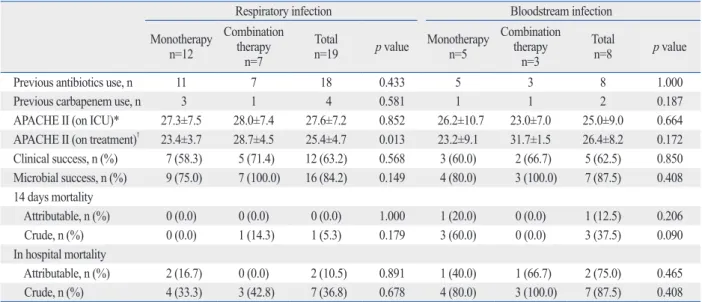
infection. In BSI, MDRAB was isolated from blood and sputum in all patients. Five of eight patients received mono- therapy and others received combination therapy including tigecycline. The overall successful clinical response rate was 62.5%, and the microbial response rate was 87.5%.
Two patients with clinical failure died due to superinfection (Table 5).
DISCUSSION
Tigecycline has been approved for the treatment of compli- cated intra-abdominal infections, complicated skin and soft tissue infections, and community-acquired bacterial pneu- monia.26 However, the role of tigecycline in VAP is uncer- tain and it has been considered an optional treatment for and death in four cases was attributable to sepsis (Table 4).
Subanalysis by treatment group and infection
The combination therapy group showed better clinical and microbial success rates without statistical significance. For 14-day mortality and in-hospital mortality, there were no significant differences between the monotherapy and com- bination therapy groups. Clinical and microbial success rate were not affected by infection type (Table 4).
In respiratory infections, 4 of 19 patients were treated for community-acquired pneumonia and others were treated for VAP. Twelve of 19 patients received monotherapy with tigecycline and others received combination therapy in- cluding tigecycline. Overall, the successful clinical re- sponse rate was 63.2%, and the microbial response rate was 84.2%. Two patients with clinical failure died due to super- Table 2. Characteristics of Patients Treated with Tigecycline
Variable Treatment group p value
Total (n=27) Monotherapy (n=17) Combination (n=10)
Age (yrs, ±SD) 66.2±10.8 67.5±11.9 65.4±10.3 0.635
Sex (M/F) 20/7 14/3 6/4 0.201
APACHE II score (±SD)
ICU admission 26.8±7.7 27.0±8.2 26.5±7.3 0.875
Day 1 of treatment 25.7±5.8 23.4±5.5 29.6±4.0 0.004
Duration of treatment (days, ±SD) 14.5±7.5 11.5±5.3 19.5±8.2 0.005
Total length of stay (days, ±SD) 74.6±34.5 68.7±36.4 84.8±29.9 0.248
Reason of hospitalization 27 17 10 0.714
Renal insufficiency 1 0 1
Heart/vascular disease 5 3 2
Malignancy 3 2 1
Chronic respiratory disease 2 2 0
Neurologic disease 4 3 1
Microbial infection 4 3 1
Orthopedics or minor surgery 3 1 2
Gastroenteologic problem 5 3 2
Type of infection 0.974
Respiratory infection 19 12 7
Bloodstream infection 8 5 3
Pathogens
Acinetobacter baumannii 27 17 10
Klebsiella pneumoniae 5 3 2 0.239
Enterobacter cloacae 5 4 1 0.382
MRSA 6 4 2 0.831
MRCNS 9 8 1 0.049
Pseudomonas aeruginosa 8 5 3 0.974
Stenotrophomonas maltophilia 3 2 1 0.888
EGNB 3 2 1 0.888
Fungus 1 0 1 0.184
ICU, intensive care unit; MRSA, methicillin-resistant Staphylococcus aureus; MRCNS, methicillin-resistant coagulase-negative Staphylococci.; EGNB, en- teric gram-negative bacillus; SD, standard variation; M, male; F, female; APACHE II score, Acute Physiology and Chronic Health Evaluation II score.
Table 3. Clinical and Microbiological Outcomes of Patients Treated with Tigecycline Patient
no. Age Sex
Drug susceptibility Co-administered
antibiotics Microbial
response Clinical
response 14 day
mortality Hospital mortality
Death at- tributable
to sepsis AMK CIP GEN IMP MEP CEF TZB COL
1 54 1 R R R S S R R R Combination Successful Successful No Yes No
2 68 1 R R R R R R R R Monotherapy Successful Successful No No No
3 61 2 R R R R R R R R Combination Successful Successful No No No
4 77 1 R R R R R R R R Monotherapy Successful Successful No No No
5 83 1 R R R R R R R S Combination Successful Failure No Yes Yes
6 70 1 I R R R R R R R Combination Successful Failure No No No
7 66 1 I R R R R R R S Monotherapy Successful Successful Yes Yes No
8 71 2 R R R R R R R S Combination Successful Successful No Yes No
9 70 1 S R S R R R R I Monotherapy Successful Successful Yes Yes No
10 68 1 R R R R R R R S Monotherapy Failure Failure No Yes No
11 83 1 R R R R R R R S Monotherapy Failure Failure No Yes Yes
12 78 1 S R R R R R R S Combination Successful Successful No No No
13 72 1 R R R S S I R S Monotherapy Successful Successful No No No
14 72 1 R R R R R R R S Monotherapy Successful Successful No No No
15 68 1 R R R R R R R S Monotherapy Successful Successful No No No
16 44 2 R R R R R R R S Monotherapy Failure Successful No No No
17 48 1 R R R S S R R S Monotherapy Successful Failure No Yes No
18 56 1 R R R R R R R S Monotherapy Successful Failure Yes Yes Yes
19 76 1 R R R S S R R S Monotherapy Successful Successful No No No
20 72 1 R R R R R R R S Combination Successful Failure Yes Yes No
21 54 2 R R R R R R R S Monotherapy Successful Successful No No No
22 61 1 R R R R R R R S Monotherapy Successful Failure No Yes Yes
23 62 1 R R R R R R R S Combination Successful Successful No Yes No
24 67 1 R R R S R I R S Monotherapy Successful Failure No No No
25 62 2 R R R R R R R S Monotherapy Failure Failure No Yes No
26 79 2 R R R R R R R S Combination Successful Successful No Yes No
27 45 2 R R R R R R I S Combination Successful Successful No No No
no., number; AMK, amikacin; CIP, ciprofloxacin; GEN, gentamicin; IMP, imipenem; MEP, meropenem; CEF, cefperazone; TZB, tazolactam/sulbactam; COL, colistin; R, resistance; I, intermediate; S, sensitive.
Table 4. Clinical Outcome and Mortality in Patient Treated with Tigecycline
Variable Total
n=27
Treatment group Infection type
Monotherapy n=17
Combination therapy
n=10 p value Respiratory
infection n=19
Bloodstream infection
n=8 p value
Previous antibiotics use, n 26 16 10 0.434 18 8 0.508
Previous carbapenem use, n 6 4 2 0.711 4 2 0.373
APACHE II (on ICU)* 26.8±7.7 27.0±8.2 26.5±7.3 0.875 27.6±7.2 25.0±9.0 0.439
APACHE II (on treatment)† 25.7±5.8 23.4±5.5 29.6±4.0 0.004 25.4±4.7 26.4±8.2 0.689
Clinical success, n (%) 17 (63.0) 10 (58.8) 7 (70.0) 0.561 12 (63.2) 5 (62.5) 0.974 Microbial success, n (%) 23 (85.2) 13 (76.5) 10 (100.0) 0.097 16 (84.2) 7 (87.5) 0.826 14 days mortality
Attributable, n (%) 1 (3.7) 1 (5.9) 0 (0.0) 0.260 0 (0.0) 1 (12.5) 0.080
Crude, n (%) 4 (14.8) 3 (17.6) 1 (10.0) 0.589 1 (5.3) 3 (37.5) 0.031
In hospital mortality
Attributable, n (%) 4 (14.8) 3 (17.6) 1 (10.0) 0.711 2 (10.5) 2 (75.0) 0.064
Crude, n (%) 14 (51.9) 8 (47.1) 6 (60.0) 0.516 7 (36.8) 7 (87.5) 0.033
n, number of patient; ICU, intensive-care unit; APACHE II score, Acute Physiology and Chronic Health Evaluation II score.
*On ICU: APACHE II score on 1st day of intensive care unit admission.
†On treatment: APACHE II score on 1st day of treatment with tigecycline.
tion between clinical and microbiological outcomes increas- es the debate regarding the inherent pathogenicity of A.
baumannii.
In respiratory infection, the clinical success rate was only 63.2% with or without concomitant antibiotics (58.3% vs.
71.4%), despite the fact that 84.2% showed microbial erad- ication. Interestingly, in the BSI group the microbial eradi- cation rate was 87.5% and the clinical success rate was 62.5%
regardless of concomitant antibiotic treatment (60.0% vs.
66.7%). We, therefore, hypothesize that tigecycline mono- therapy was ineffective in several patients because most clinical failures were due to superinfection and there was a high Pseudomonas aeruginosa infection rate (29.6%). Al- though multidrug resistant Pseudomonas aeruginosa was expected to be the most important and common pathogen in superinfections, we found that patients with superinfec- tions tended to have lower previous or concomitant use of carbapenems and colistin. In addition, probable pharmacoki- netic concerns might be related to the failure to improve in- fections caused by sensitive microorganisms. Acquired re- sistance to tigecycline and superinfections, due to intrinsically resistant pathogens to tigecycline, supports the possible benefits from combination therapy, as hypothe- sized in large prospective and randomized studies.30 Mean- while, selection of patients to receive tigecycline remains important.
Above all, most of the respiratory infections (15/19) and BSI (7/8) represented hospital acquired pneumonia includ- ing VAP, and we cannot at present affirm the efficacy of ti- VAP caused by MDR organisms, except for Pseudomonas
aeruginosa.
Accumulated evidence has identified that tigecycline has considerable microbiological activity against MDRAB, in- cluding carbapenem-resistant Acinetobacter spp. Neverthe- less, many studies have revealed that the activity of tigecy- cline is not optimal, suggesting that the use of tigecycline may not comprise a definitive solution of the growing prob- lem of MDRAB. Nonetheless, the utility of tigecycline should not be disregarded because other antimicrobial agents, ex- cept polymyxins, are not reliably active against carbapen- em-resistant A. baumannii isolates.27 Recently, the Food and Drug Administration (FDA) determined that tigecy- cline resulted in increased mortality risk, especially in hos- pital-acquired pneumonia, compared with other antibiotics.
We studied only tigecycline-treated patients infected with MDRAB, but not patients with VAP in general.
We examined the microbiological activity and clinical ef- fectiveness of tigecycline against MDRAB infections in 31 seriously ill patients, including patients with VAP, and ob- served a weak correlation between microbiological clear- ance and clinical outcome. Overall, only 63.0% had positive clinical outcomes, whereas 85.2% had microbial eradica- tion. A recent systematic review27 found an overall response rate of 76% to tigecycline for a wide range of MDRAB in- fections. Several studies on the treatment of VAP have been reported; the proportion of global clinical success is 69- 88%28-30 and microbiological eradication is 80%28 with or without concomitant antibiotic therapy. The lack of correla-
Table 5. Subanalysis of Clinical Outcome and Mortality in Patient according to Infection Type
Respiratory infection Bloodstream infection
Monotherapy n=12
Combination therapy
n=7
Total
n=19 p value Monotherapy n=5
Combination therapy
n=3
Total
n=8 p value
Previous antibiotics use, n 11 7 18 0.433 5 3 8 1.000
Previous carbapenem use, n 3 1 4 0.581 1 1 2 0.187
APACHE II (on ICU)* 27.3±7.5 28.0±7.4 27.6±7.2 0.852 26.2±10.7 23.0±7.0 25.0±9.0 0.664 APACHE II (on treatment)† 23.4±3.7 28.7±4.5 25.4±4.7 0.013 23.2±9.1 31.7±1.5 26.4±8.2 0.172 Clinical success, n (%) 7 (58.3) 5 (71.4) 12 (63.2) 0.568 3 (60.0) 2 (66.7) 5 (62.5) 0.850 Microbial success, n (%) 9 (75.0) 7 (100.0) 16 (84.2) 0.149 4 (80.0) 3 (100.0) 7 (87.5) 0.408 14 days mortality
Attributable, n (%) 0 (0.0) 0 (0.0) 0 (0.0) 1.000 1 (20.0) 0 (0.0) 1 (12.5) 0.206
Crude, n (%) 0 (0.0) 1 (14.3) 1 (5.3) 0.179 3 (60.0) 0 (0.0) 3 (37.5) 0.090
In hospital mortality
Attributable, n (%) 2 (16.7) 0 (0.0) 2 (10.5) 0.891 1 (40.0) 1 (66.7) 2 (75.0) 0.465 Crude, n (%) 4 (33.3) 3 (42.8) 7 (36.8) 0.678 4 (80.0) 3 (100.0) 7 (87.5) 0.408 n, number of patient; ICU, intensive-care unit; APACHE II score, Acute Physiology and Chronic Health Evaluation II score.
*On ICU: APACHE II score on 1st day of intensive care unit admission.
†On treatment: APACHE II score on 1st day of treatment with tigecycline.