SYMMETRIC CURRENTS OF A
TWO-LAYER FLUID WITH FREE SURFACE OVER AN ELLIPTIC OBSTRUCTION
J. W. CHdI
1. Introduction
This paper concerns the symmetric wave solutions between two im- miscible, inviscid, and incompressible fluids of differ~ntbut constant densities in the presence of small elliptic obstruction of compact sup- port at the rigid bottom when the effect of gravity is considered (Fig.
1). We assume that the upper boundary is a free surface and the two dimensional obstruction is moving along the lower rigid boundary at a constant speed. By choosing a coordinate system moving with the ob- ject, the fluid motion becomes steady. Two critical speeds are obtained, near either one of which an FKdV for steady flow can be derived and has been studied extensively in [1] and [2]. Forbes [3], Belward and Forbes [4], Sha and Vanden-Broeck [5], and Moni and King [6] studied steady flow of a two layer fluid over a bump or a step bounded by a free
z*=HO++ll*f(x*) _ _ _ _ _ _ _ _ _ _ _
0*-,-00< x*<ooJP....
---_.../"'...-_---
Fig. 1. Fluid Domain
Received March 28, 1996.
1991 AMS Subject Classification: 76B25.
Key words: Symmetric currents, two layer, obstruction.
of rigid boundary numerically. An asymptotic approach for the case of a rigid upper boundary was developed without surface tension by Shen [7] on the basis of FKdV theory, and with surface tension by Choi et.al. [8]. The case of free upper boundary was studied with surface tension by Choiet.al. [9] asymptotically on the basis of EKdV theory.
In the case considered here, when the wave speed is near the smaller critical speed for internal wave, the nonlinear term in the FKdV may vanish and the derivation of FKdV fails. To overcome this difficulty, a refined asymptotic methodisused to derive the Steady Modified K-dV equation with forcing term (SFMKdV) in the following form:
(ATJ~
+
B)TJ2:c+
CTJ2:c:c:c+
Db:c = 0,where AtoD are constants depending on several parameters and b(x) is a function with compact support due to the obstruction on the rigid lower boundary. We investigate solutions of the SFMKdV, which rep- resent possible interfacial wave forms.
Insection 2, we formulate the problem and develop the asymptotic scheme to derive the SFMKdV. In section 3, existence theorems are proved and numerical solutions of soliton-like solutions and symmetric wave solutions are presented for different values of parameters. The parameters are determined along the density ratios of the two fluids, depth ratio of the two, and the perturbation of horizontal velocity at far upstream.
2. Formulation and Successive Approximate Equations We consider steady internal gravity waves between two immiscible, . inviscid and mcompressible fluids of constant but different densities bounded above by a free surface and below by a horizontal rigid bound- ary with a small obstruction of compact support. The domains of the upper fluid with a constant densityp*+ and the lower fluid with a con- stant density p*- are denoted by
n*+
andn*-
respectively (Fig. 1).Assume that the small obstructionismoving with a constant speedC.
In reference to a coordinate system moving with the obstruction, the flow is steady and moving with the speed C far upstream.. The gov- erning equations and boundary conditions are given by the following Euler equations:
at the free surface, y*
=
h*++
TJi,U*+TJ~x. - v*+
=
0, p*+ = 0;at the interface, y* = TJ2'
at the rigid bottom, y* = -h*-
+
b*(x*),whereu*± andv*± are horizontal and vertical velocities,p*± are pres- sures, 9 is the gravitational acceleration constant. We define the fol- lowing nondimensional variables:
£
=
H/L «1, TJl=
£-I TJi/h*-, TJ2=
£-I TJ2 /h*-, p± =pd/(gh*-p*-), (x,y)=
(£x*,y*)/h*-,(u±,v±)
=
(gh*-)-1/2(ud ,£-lv*±),p+
=
p*+ /p*- < 1, p-=
p*- /p*-=
1, U=
C/(gh*-)1/2, h=
h*+ /h*-, b(x)=
b*(x*)(h*- £3)-1,whereL is the horizontal scale,H is the vertical scale, b(x)
=
b*(x)(h*-£3)-1, h*+ and h*- are the equilibrium. depths of the upper and lower fluids at x* = - 0 0 respectively, andy* = -h*- +b*(x) is the equation
of the obstruction. In terms of the nondimensional quantities, the above equations become inn±,
(1) (2) (3)
at y = h+E'T/b (4)
(5)
at y = E1]2,
(6) (7) (8)
p+=o,
EU+1]Ix - v+ = 0;
EU-1]2x - v- =0, EU+1]2x - v+ = 0, p+ -p-=0;
(9) v- = E3Ubx,
whereb(x) has a compact support.
In the following, we use a unified asymptotic method to derive the equations for 'T/I(X) and 'T/2(X). We assume that u±,v±,and p± are functions of x,y near the equilibrium state u±
=
Uo, v± = O,p+ =-p+y+p+handp- = -p-y+p+h,whereUois a constant, and possess asymptotic expansions:
(10)
( ±u ,v ,p± ±) - (- Uo, ,-p y+p
°
± +h)+E U I ,vI(± ±,PI±)2( ± ± ±) 3( ± ± ±) Q( 4)
+
E U2' v2 ,P2+
E U3' v3 ,P3+
E .By inserting (10) into (1) to (4) and (7) to (9) and arranging the re- sulting equations according to the powers ofE,it follows that(uo,0,-p±
y
+
p+h) are the solutions of the zeroth order system of equations and the equations of the order Eare as follows:(11) (12)
·(13)
at y
=
h, (14) at y=
0,(15) (16) at y =-1 (17)
± ± 0
ulx +v ly = ,
± ± / ±
uoulx = -Plx P ,
± ..• O·
Ply
= ;
+
-+
(+ -)-0PI - PI 'l}2 POy - POy - , UO'l}2x - v i = 0;
VI =0.
Hereafter for the sake of convenience we shall use p to denote p+
and set p- equal to1. From (13),
pr
are functions of x only. pt =P'f/l by (14) and PI=
P'f/l+
172(1 - p) by (15). We can findvf
by using(11), (12), (15), and (17) so that
(18)
vt
= Y('I}lx/UO) +UO'l}2x,vI = (y
+
1)(P'f/lx+
(1- p)'I}2x)/UO.Uf
are also derived from (11)(19)
ut
=-171/
Uo,
ul = (-P'f/l - (1-p)'I}2)/UO,
where we assume 171(x = -00) ='l}2(X =-00) =0, ur(x =-00) =O.
S· '1 1lml ar y, we can fi dn P2'± v2 , u 2 ,P3± ± ±,v3 ,u3± ±.III terms 0f 171 and 'l}2
without using the kinematic con.dltions (5) and (6). From (5) and(6), and the asymptotic expansion ofU- and v-, we have
at y = h, (20)
and at y =0, (21)
U0172x - vI
+
€(uI172x -172Vly - v2")+ €2(u2"172x
+
172172xUly - V~yl7~ -172V2"y - Vg)+
O(€3) =o.
Then we make use of these equations to find the equations of the free surface l7l(X) and the interface 172(X). By substituting uo,uf,vt,u~, v~,
vt
into (20) and (21) and eliminating171, we obtain(22) (uo - pcduo - (1 - p)juO)172x
+
€(E172172x) +€2(Fll7~172x+
F2172x+
F3172xxx+
F4bx) +O(€3) = 0,where if we let Cl = (2u5 - (1-p))j(P+u5 - h), Dl =uoj(p+ u5 - h), A
=
u~(-00), and R=
PCl+
1-p, thenE = - (R2
+
2Ru~)u(J3 - pDl((hci - R 2)u04+
(2ci - 2R - 2Cl)U02),Fl = - pD1U01((3c~-3ci
+
R 2j2)u03+
(3hcV2 - 3R3j2)u05 + 3Dl (PUOl+
pRu( 3)((3Rj2+
Cl - ci)uOl+ (R2j2 - hci;2)u
o
3) - 3R2uo
3j2 - 3R3uo
5j2),F2 = A((-pDluOl )(2
+
Ruo
2 - Cl - hC1U(2)+
(1+
Ru( 2)),F3= (-pDluOl )(-Cl(ph2j2
+
pj3)uOl - (u~ph+
(1- p)j3)uOl+
(Cl(ph3j3)juop)+
uoh2j2)- Cl(ph2j2
+
pj3)uOl - (u~ph+
(1-p)j3)uOl ,F4 = pDl-Uo.
3. Steady Modified KdV Equation with Forcing (SFMKdV)
From the zeroth order term of (22), we obtain Uo - (pcduo) - (1-p)juo = 0, . and by the expression for clin. (22), itfollows that
(23) and
u6 - (1
+
h)u5+
h(l- p) =0,u5 = (1
+
h± ((1 - h)2+
4ph)l/2)j2.We denote the two values ofu5byU5l andU52 respectively correspond- ing to the plus and minus signs. Without loss of generality we assume UOl and U02 are both positive and call them critical speeds, near each of which a nonlinear theory for the motion of the interface has to be developed.
Next we consider the coefficientsof'r/2'r/2x in the first order terms of the equation (22). IfE in (22) is not zero, an FKdV can be derivedifwe assumeb(x)
=
b*(x*)(h*-E2)-l andx=
El/2X*jh*- in nondimensional varibles and similar results as in [1] can be obtained. However, E may vanish. First, let us simplify the expression ofE,E = -((pCl +1-p)2 jug) - 2((pCl +1-p)juo) - pDd-2((pCl
+
1-p)jUO) - ((pCl - P+
l?jug) + 2(ci;uo)+
h(ci;ug) - 2(cduo)]juo=3(uOp)-l(u5
+
p - h) (p(u5h - U6 - u5+
1) - u6+
2u5 - 1),=3uo(1- u5)(ph(u5
+
p - h))-l(u6+
(1-2h)u5+
h2 - 1).Then E = 0 impliesu6
+
(1-2h)u5+
h2-1 = O. LetUo = UOl orU02.Then (24)
U6l
+
(1-2h)u5l+
h2-1 = 1+
hp+(2 - h)((l- h?+
4ph)l/2, (25)U62
+
(1-2h)u52+
h2-1 = 1+
hp - (2 - h)((l- h?+
4ph)l/2.Equation (24) tells us that E does not vanish if we take UOI as a critical speed. Suppose both sides of (24) vanish. Then realU5Iimplies h < 5/4 and the right hand side of (24) is greater than zero. This is a contradiction. Thus the only possible case forE = 0 is that the critical speed u5 isequal toU52' and it is easy to show that E =0 ifu5 =U52'
and
(26) 1
+
hp= (2 - h)((l - h)2+
4ph)I/2.With the conditions (21) and (25), from (22), we obtain a Steady FMKdV,
(27) where
FI =3uo(4p
+
3h - u~) ,F2 = A(2(1
+
h)u~ - 4h(1 - p»U02,F3= u
o
l(h(l+
h) - u~(h2+
1+
3ph) ,F4 =uo(h- u
5)·
The coefficients FI to F4 here are the simplified forms of FI to F4 in the previous section by using (23). The sign of F3FI determines the existence of solutions of (27). In the following sections, we assume F3FI > 0 and the case for F3FI < 0 is considered in subsequent study
[10].
3.1. SYlDIIletric ~oIiton-lik~WClves
We assume U = Uo
+
AE2+
O({3) and consider (27) for FI/F3 >0 and F2 /F3 < O. (27) can be rewritten as(28)
where Al
=
FI/F3 > 0, A2=
-F2/F3 > 0, A3 = -F4/F3. When bx - 0, (28) has soliton solutions whose value is 0 at x = ±oo for A2 2:0:(29)
For A2 :s 0, there is no soliton solution. The solutions in (29) are obtained as in the classical case by taking the limit of elliptic functions in the periodic solutions of (28) for bx = 0 when the wave length tends to infinity_ Next we consider (28) when bx # 0 but of compact support.
We look for a solution'TJ2(X) such that A2> 0 and lim {Cljdx)i1J2(X} ==0 j :0,1; 2.
Ix1-->00
Integrating (28) from -00 to x, itfollows that
(30) A2'TJ2 - 'TJ2xx = Al'TJ~- A3b(x), -00 <x < 00.
(30) can be converted to the following integral equation:
'TJ2(X) =
i: K(x,€)(Al'TJ~(€)/3 - A3b(€))cIe,
where K(x,€) = exp(-VA2lx - €1)/(2VA2) is a Green function of A2K(x,€) - Kxx(x,€) = hex,€),-00 < x< 00.
Define
T('TJ2) =
i: K(x,€)(Al'TJ~(€)/3 - A3b(€))d€,
lIull = lIull
oo=
sup1'TJ2(X)1 ,xE!R
H = {u IuE C(~),11exp(y'A;/xnull < oo} , BM = {u
I
uE H,lIull :s M,O < M < oo} .Then clearly H is a complete metric space and BM is a closed ball in H.
LEMMA 1. T: BM ~ BM ifA1M 2
/3 +
IlA3b(x)II/M:s A2- Proof.IIT('TJ2)1I :SIlA1'TJV3 - A3bll
~~~i:
exp(-y'A;lx - €1)/(2y1A;)d€:S(A1M3
/3
+
IIA3bll)/A2 :sM ifA1M2/3+
IIA3b(x)II/M:sA
2 -Next we show thatT('TJ2) decays rapidly, so that we may consider the behavior of exp(VA2lxl) IT('TJ2)(X)
I
when Ixl is large.LEMMA 2. SUPxElRexp(.;A2lxl)a2)(x)1 < 00 fOr'rf2 E BM.
Proof It suffices to prove for x >
o.
Let N =m8.X{ElR
1-
A3b(~)I·exp(y0i;x)IT('rf2)(x)1
=Il~
exp(y0i;~)(AI'rf~(~)/3
-A3b(~))d{
+
100
exp(.Jji;(2x -~))(AI'rf~(~)/3
-A3b(~))d~I/(2.Jji;)
~ exp(-.Jji;x)SUp('rf2(X) exp(y0i;x)3 /(6A2) xElR
+
1
Nexp(y0i;~)d{/(2.Jji;)
< 008uppb(x)
since'rf2 EH. Hence sUPx>oexp(.;A2x)IT('rf2)(x)1 <00 since'rf2 E BM.
Similarly one can showsUPx~oexp(-.;A2x)IT('rf2)(x)1 < 00
THEOREM 1. (30) has a solution in C3(~) which decays exponen- tiallyat Ixl = 00 ifA2 issufEciently large.
Proof IIT('rfI)-T('rf2)1I ~ sUPXElRAlJ~ooK(x,~)I'rfr+'rf1'rf2+'rf~II'rfI
'rf21d{ ~ AIM211'rf1 - 'rf211/A2. Hence, by the contraction mapping the- orem, Lemma 1, and Lemma 2, 'rf2 = T('rf2) has the unique solu- tion inBM . Now 'rf2xx(X) = J~ooKxx(x,~)(AI'rf~(~)/3- A3b(~))d{ = J~ooA2K(x,~)(AI'rf~(~)/3-A3b(~))d~-AI'rf~(x)/3+A3b(x)=A2'rf2(X)
-AI'rf~(X) + A3b(x) where K(x,~) - Kxx(x,~) = <5(x,~). Hence 'rf2 E C2(~), and it follows from. the right side of the above equation. that 'rf2 E C3(~).
We have shown that (28) has an exponentially decaying solution as x tends to ±oo. In the following we use numerical computation to find symmetric soliton-like solutions of (28) when the obstruction b(x) is given by b(x) = R(1 - x2)1/2 for Ixl ~ 1 and b(x) = 0 for Ixl > 1, where R is a given constant.
Let
where Xo is a phase shift. To find a solution in
Ixl
~ 1, we need only consider (31) in -1::; x ~ 0 subject to ("72(x»2 = -A1"7i!6+
A2"7~ at x = -1and"72(x)=
0 atx=
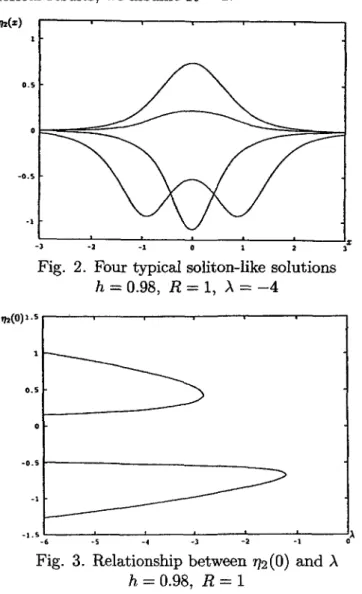
O. This problem can be solved numerically by a shooting method and the phase shift Xo is determined by (31) for x = -1. The numerical results are given in Fig. 2 and Fig. 3. Four typic!l.l so]it,{)n-Jik:esolu,tion~ ~.rli;)giYeninFig: 2 .and Fig" 3 show the relation between the value of soliton-like. solution at x = 0 and A. In both numerical results, we assume R = 1.'12(")
0.5
·0.5
, I
.':-)- - - - ' , ' : - 2- - . . . 1 . .
1----'---'---'---1,...
Fig. 2. Four typical soliton-like solutions h= 0.98, R = 1, A= -4
'12(0)1.5~~---.----,----.---,.---...----,
o
-0.5r - - - _
·1
'1.5.L• - -..., 5 - - - - ' -.•- -..., ) - - - ' - . 2 - - - , - ' - 1 - - - ' 0 . ) .
Fig. 3. Relationship between"72(0) and A h = 0.98, R= 1
3.2. Symmetric waves with zero behind and ahead of the obstruction
Similar to the section 3.1, we consider the equation (32)
where Al = FdF3 >O,A2 :::; -F2/F3' A3= -F4/F3. Integrating(32) from -00 to x, we obtain
(33)
where b(x) is assumed to have compact support and 1]2 (-00) = O.
We assume 'fJ2
=
0 in (-oo,x_) where [x_,x+] is the support of the obstruction. In the following, we show that the solution of(33) exists with initial values 1]2(X-) =1]2x(X-) =O.THEOREM 2. 1]2xx = -AI1]V3+A2'fJ2+A3b(X), Al >0with 1]2(X-)
=
1]2x(X-) = 0 has a C2solution for x_ ~ xs:
x+_Proof It suffices to show that 1]2 is bounded in [x_, x+]. For sim- plicity we assume x_ = -1 and x+ = 1. By multiplying 1]2x to the given equation and integrating it from -1 to x
s:
1,('fJ2x)2
=
-(Ad6)'fJi(x)+ A2'fJ~(X)
-21: A3b(t)'fJ~(t)dt
=
-(Ad6)(1]~
- 3A2/Ad2+
3AV(2Ad -21: A3b(t)1]~(t)dt.
Hence
(1]2x)2
s:
3AV(2AI )+ 21: IA3b(t)1]~(t)ldt ~
3AV(2AI)+ 1:(8I A3b(t)12+ 1'fJ~(t)12/8)dt,
by Young's inequality, where' = d/dt. Suppose 1]2 is not bounded in (-l,lJ. Then there is Xo E (-l,lJ such that 11]2\ ~ 00 as x tends to Xo and Xo > x_
+
€ for some € > 0 by the existence theorem in the theory of ordinary differential equations. Let Xo = infde
E[-1,l]11limx->~-'TJ2(x)1 = oo}. Choose 8 so that -1 < 8 < xo. Then the solution of the given differential equation exists in [-1,8], and by the above inequality, 'TJ~x :::; (1/8)(1+8) SUP_l<t<O(1'TJ2x(t)12+ 64M2)+ 3A~/(2Al) for x E [-1,6), where M is sup
8uppA
3b(x).Hence sUP_l<t<ol'TJ2xI2 :::; 64M2
+
3A~/(2Ad/(1 - (1+
8)/8) <64M2+ 12A~,/(7J1dfbreveryo'witJh ~r <5 <
xo.
Thus 172(X) isbounded whenx E [-1,xo], and'TJ2(X) =J~l'TJ2(t)dt is bounded which contradicts to 1'TJ2(x)l-t 00 as x - t xo. Therefore,'TJ2(X) is bounded in
[-1,1) and the solution of the given equation exists.
'12(0:) 0.02
0 1 - - - . . . .
·0.02
-0.04
-0.06
·0.08
-0.1
-0.12
.'-)- -..._2---...1 - - 4 - - - ' - - - ' - - - ' ) 0 :
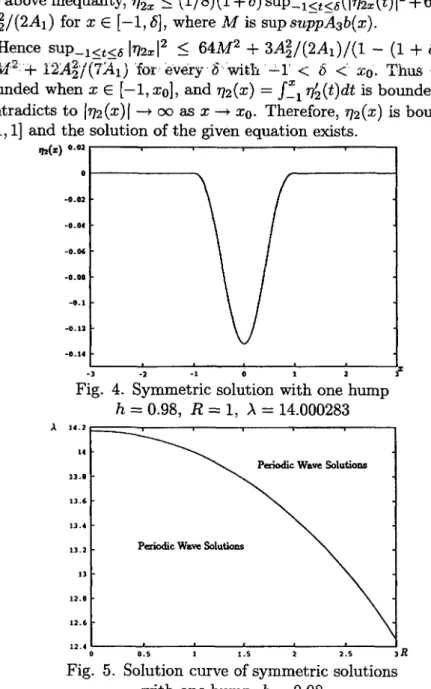
Fig. 4. Symmetric solution with one hump h = 0.98, R = 1, A= 14.000283
>. 14.2F===::::::'---,---~----,r---.--___,
14
Periodic Wave Solutious
13.8 13.6
13.4 13.2 13
12.8 12.6
Periodic Wave Solutions
12.40' -- -...o.-s- - - ' - - - 1...S - -...- - 2...S - - - - ' ) R
Fig. 5. Solution curve of symmetric solutions with one hump, h =0.98
We have shown that the solution of (33) exists and is bounded. In the following, we use numerical computation to find symmetric wave solution of (33) which is zero behind and ahead of the elliptic obstruc- tion. Similar methods as in section3.1 is used to find the solutions of this problem. To find a solution in
Ix! ::;
1, we need only consider (33) in -1 ::;x::; 0 subject to'TJ2(x)=
'TJ2(X)=
0 at x=
-1 and 'TJ2x(X)=
0at x = O. Same assumption as in section 3.1 has been given for ob- struction and the numerical results are shown in Fig. 4 and 5. Fig. 4 shows the symmetric solutions for positive values ofA. The relations between R, which represents the hight of the obstruction, and 'TJ2(0) are given in Fig. 5. We note that, for a givenR, symmetric solution is embedded in periodic solutions.
ACKNOWLEDGEMENT. This research was supported by Korean Sci- ence and Engineering Foundation under Grant KOSEF951-0101-033-2.
References
1. Shen, S. P., Shen, M. C., Sun, S. M., A model equation for steady surface waves over a bump,J. Eng. Math. 23 (1989),315-323.
2. Sun, S. M., Shen, M. C., Exact theory of secondary supercritical solutions for steady surface waves over a bump,Physica D 67 (1993), 301-316.
3. Forbes, L. K., Two-layer critical flow over a semi-circular obstruction, J. Eng.
Math. 23 (1989), 325-342.
4. Belward, S. R. and Forbes, L. K., Fully non-linear two-layer flow over arbitrary topography, J.Eng. Math. 27 (1993), 419-432.
5. Sha, H~ Y., Vanden-Broeck, J;-M., Two layer flows past a semi-circular ob- struction,Phys. Fluids A 5 (1993), 2661-2668.
6. Moni, J. N., King, A. C., Interfacial flow over a step, Phys. Fluids A 6 (1994), 2986-2992.
7. Shen, S. P., Forced solitary waves and hydraulic falls in two-layer flows, J.
Fluid Mech. 234 (1992), 583-612.
8. Choi, J. W., Sun, S. M., Shen, M. C., Steady capillary-gravity waves of a two-layer fluid with a free surface over an obstruction- Forced modified KdV equation, J. Eng. Math. 28 (1994), 193-210.
9. Choi, J. W., Sun, S. M., Shen, M. C., Internal capillary-gravity waves on the interface of a two-layer fluid over an obstruction- Forced extended KdV equation, Physics of Fluids A. 8 (1996), 397-404.
10. Choi, J. W., Free surface waves of a two-layer fluid over a bump - Hydraulic
fal~submitted.
Department of Mathematics College of Science
KOfe,a,Univer~ity
Seoul, 136-701, Korea