Comparison of Rhythm and Rate Control Strategies for Stroke Occurrence in a Prospective Cohort
of Atrial Fibrillation Patients
Yu Jeong Choi1*, Ki-Woon Kang1*, Tae-Hoon Kim2, Myung-Jin Cha3, Jung-Myung Lee4, Junbeom Park5, Jin-Kyu Park6, Jaemin Shim7, Jae-Sun Uhm2, Jun Kim8, Hyung Wook Park9, Eue-Keun Choi3,
Jin-Bae Kim4, Changsoo Kim10, Young Soo Lee11, and Boyoung Joung2
1Division of Cardiology, Eulji University Hospital, Eulji University College of Medicine, Daejeon;
2Division of Cardiology, Department of Internal Medicine, Severance Cardiovascular Hospital, Yonsei University College of Medicine, Seoul;
3Department of Internal Medicine, Seoul National University Hospital, Seoul;
4Division of Cardiology, Department of Internal Medicine, Kyung Hee University Hospital, Kyung Hee University, Seoul;
5Department of Cardiology, School of Medicine, Ewha Womans University, Seoul;
6Department of Cardiology, Hanyang University Seoul Hospital, Seoul;
7Division of Cardiology, Department of Internal Medicine, Korea University Medical Center, Seoul;
8Heart Institute, Asan Medical Center, University of Ulsan College of Medicine, Seoul;
9Department of Cardiology, Chonnam National University Hospital, Chonnam National University Medical School, Gwangju;
10Department of Preventive Medicine, Yonsei University College of Medicine, Seoul;
11Division of Cardiology, Department of Internal Medicine, Daegu Catholic University Medical Center, Daegu, Korea.
Purpose: Comparisons of rhythm and rate control strategies for stroke prevention in patients with atrial fibrillation (AF) are still inconclusive. We compared differences in clinical outcomes between the rhythm and rate control strategies.
Materials and Methods: The COmparison study of Drugs for symptom control and complication prEvention of Atrial Fibrillation (CODE-AF) registry prospectively enrolled 6000 patients who were treated for AF using real-world guideline adherence at multi- ple referral centers. In total, 2508 (41.8%) patients were clinically followed up for over six months. Of these, 1134 (45.2 %) patients treated by rhythm control and 1374 (54.8 %) patients treated by rate control were analyzed for clinical outcomes, including stroke and cardiovascular outcomes.
Results: Among all patients (age, 68±10 years; male, 62.4%), those treated with the rhythm control strategy were significantly younger, had more symptomatic paroxysmal AF, and a shorter AF duration, and were less likely to have diabetes, renal dysfunc- tion, and heart failure, compared to those treated with the rate control strategy (CHA2DS2-VASc score 2.4±1.5 vs. 3.1±1.7, p<0.001).
Even though oral anticoagulation was similarly prescribed in both groups, occurrence of stroke was less likely to occur in the rhythm control strategy group (0.0% vs. 0.7%, p=0.015). Multivariate Cox hazard regression showed that only age, especially more than 75 years old, were significantly correlated with the occurrence of stroke, regardless of the strategy used for treatment.
Conclusion: In this prospective AF cohort, compared with the rate control strategy, the rhythm control strategy was associated with fewer cardiovascular events and strokes in a short-term period.
Key Words: Atrial fibrillation, rhythm control, rate control, stroke
Received: August 30, 2017 Revised: December 7, 2017 Accepted: December 12, 2017
Co-corresponding authors: Dr. Ki-Woon Kang, Division of Cardiology, Eulji University Hospital, Eulji University College of Medicine, 95 Dunsanseo-ro, Seo-gu, Daejeon 35233, Korea.
Tel: 82-42-611-3081, Fax: 82-42-611-3083, E-mail: [email protected] and
Dr. Boyoung Joung, Division of Cardiology, Department of Internal Medicine, Severance Cardiovascular Hospital, Yonsei University College of Medicine, 50-1 Yonsei-ro, Seodae- mun-gu, Seoul 03722, Korea.
Tel: 82-2-2228-8460, Fax: 82-2-393-2041, E-mail: [email protected]
*Yu Jeong Choi and Ki-Woon Kang contributed equally to this work.
•The authors have no financial conflicts of interest.
© Copyright: Yonsei University College of Medicine 2018
This is an Open Access article distributed under the terms of the Creative Commons Attribution Non-Commercial License (http://creativecommons.org/licenses/by-nc/4.0) which permits unrestricted non-commercial use, distribution, and reproduction in any medium, provided the original work is properly cited.
pISSN: 0513-5796 · eISSN: 1976-2437 Yonsei Med J 2018 Mar;59(2):258-264
https://doi.org/10.3349/ymj.2018.59.2.258
INTRODUCTION
Atrial fibrillation (AF) is the most common sustained arrhyth- mia, which reduces the quality of life, and is mainly associated with the major complication of stroke.1,2 Current practical guide- lines recommend a risk-stratified approach using only oral anticoagulation treatment (OAC) based on CHA2DS2-VASc scores for the prevention of stroke occurrence.2,3 In a meta-analysis, warfarin significantly reduced the risk of stroke occurrence,4-6 and a new OAC had an additional significant benefit of reduc- ing stroke occurrence, compared with warfarin.6 However, principally, a restored and maintained sinus rhythm with re- duced AF burden is expected to reduce the risk of stroke and to offer good prognosis.7 Nevertheless, the superiority of rhythm control over the rate control strategy for AF management has not been proven as having a preventive effect for the occur- rence of stroke.8-11 A few studies have shown that the rhythm con- trol strategy is associated with favorable outcomes and a signifi- cantly lower risk of stroke12,13 beyond symptomatic care in AF treatment. Therefore, we investigated whether the rhythm con- trol strategy prevents the occurrence of stroke and has more favorable outcomes, compared with the rate control strategy, in patients with AF in a prospective national cohort that ad- hered to current guidelines.
MATERIALS AND METHODS
Study design and enrolled patients
The COmparison study of Drugs for symptom control and complication prEvention of Atrial Fibrillation (CODE-AF) is a prospective, multicenter, observational study performed at 10 tertiary centers that encompass all geographical regions of Ko- rea. The aim of the CODE-AF registry is to describe the clinical epidemiology of patients with AF and to determine the diag- nostic and therapeutic processes (including the organization of programs for AF management) applied to these patients and their clinical outcomes. The registry was designed and coordi- nated by the Korea Heart Rhythm Society, which provides sup- port to related committees, national coordinators, and partici- pating centers. Data are entered into a common electronic database that limits inconsistencies and errors and provides online help for key variables. Each center can see its own data and data from all other participating centers. The study was approved by the ethics committee of each center (EMC 2016- 05-003), and all patients provided informed consent for their inclusion. This study was registered at ClinicalTrials.gov (NCT02786095).
From June 2016 to April 2017, each center started to pro- spectively enroll 6000 patients with nonvalvular AF who were
>18 years of age, attended an outpatient clinic, and were hos- pitalized on the same day for AF. Of these, 2508 (41.8%) patients were clinically followed up for over six months (Supplementary
Fig. 1, only online). Finally, the CODE-AF enrolled patients who were clinically followed up consisted of 1134 (45.2%) pa- tients treated with the rhythm control strategy and 1374 (54.8%) patients treated with the rate control strategy.
The CHA2DS2-VASc and Hypertension, Abnormal renal/liver function, Stroke, Bleeding history or predisposition, Labile in- ternational normalized ratio, Elderly, Drugs/alcohol concom- itantly (HAS-BLED) scores were calculated for all patients with nonvalvular AF. Chronic kidney disease was defined as a glo- merular filtration rate less than 60 mL/min/1.73 m2 according to the Chronic Kidney Disease Epidemiology Collaboration.14 Oral anticoagulation strategy
According to the 2016 European Society of Cardiology and 2014 American Heart Association/American College of Cardi- ology/Heart Rhythm Society guidelines for patients with AF,2,15 AF patients without clinical stroke risk factors are not to un- dergo antithrombotic therapy, whereas patients with stroke risk factors (i.e., a CHA2DS2-VASc score of 1 and 2 for men and women, respectively) are recommended to be prescribed OAC.
Rhythm and rate control strategies
For the rate-control strategy of AF treatment, beta-blockers, digoxin and diltiazem, or verapamil were selected to control the heart rate in patients with AF. For the rhythm control strat- egy of AF treatment, dronedarone, flecainide, propafenone, so- talol, and amiodarone were selected to maintain the sinus rhythm according to structure heart disease. For active rhythm control, electrical cardioversion and catheter ablation were con- sidered in selected patients2,3,16,17 at each center.
Clinical outcome
A follow-up visit was scheduled every 6 months, and a personal interview by phone was planned for those who could not make the follow-up visit, although no actual phone interviews were conducted during the study. We assessed the following out- comes at follow up: 1) all-cause death, 2) hospitalization, 3) myocardial infarction, 4) stroke, systemic embolization, or tran- sient ischemic attack, and 5) bleeding.
Definition of bleeding
Major bleeding was defined as fatal bleeding, symptomatic bleeding in a critical area or organ, and bleeding causing a de- cline in hemoglobin level of 20 g/L or more or leading to trans- fusion of two or more units of whole blood or red cell.18 Non- major bleeding was defined as any sign or symptom of hemorr- hage, including bleeding found by imaging alone, which does not fit the criteria for major bleeding.19
Statistical analysis
Continuous variables are expressed as means±standard devi- ations, and categorical variables are reported as frequencies (percentage). Multivariable Cox regression hazard models were
constructed to assess the independent relationship of stroke and clinical outcomes adjusting for demographic variables.
Statistical analyses were performed using SPSS ver. 20.0 (IBM Corp., Armonk, NY, USA) and MedCalc (MedCalc software, version 12.3, Acacialaan, Ostend, Belgium). A p value <0.05 was considered statistically significant.
RESULTS
Baseline characteristics
AF patients treated with the rhythm control strategy were younger than those treated with the rate control strategy (65±
10 vs. 70±10, p<0.001), and the proportions of men were 64.9%
and 60.1%, respectively.
AF patients treated with the rhythm control strategy more frequently had hypertension, symptomatic paroxysmal AF, a
shorter duration, electrical external cardioversion, and expe- rienced catheter ablation, compared to those treated with the rate control strategy. However, AF patients treated with the rate control strategy more frequently had diabetes, dyslipid- emia, chronic kidney disease, heart failure, and a larger left atrium size than those treated with the rhythm control strategy.
The CHA2DS2-VASc score for patients treated with the rhythm control strategy was lower than in those treated with the rate control strategy (2.4±1.5 vs. 3.1±1.7, p<0.001) (Table 1).
Oral antithrombotic agents and rate and rhythm control The majority of patients were treated with one or more anti- thrombotic agents. Warfarin and a new OAC (17.3% vs. 57.8%) were the most prescribed antithrombotic agents, followed by an anti-platelet agent, all of which were similarly prescribed in both groups (Supplementary Table 1, only online). In the rate control strategy group, beta-blockers were the most commonly Table 1. Comparison of the Baseline Characteristics of Patients Treated with the Rhythm and the Rate Control Strategy
Variables All (n=2508) Rhythm control (n=1134) Rate control (n=1374) p value
Age (yr) 68±10 65±10 70±10 <0.001*
Male, n (%) 1564 (62.4) 737 (64.9) 827 (60.1) 0.013*
BMI (kg/m2) 24.6±3.4 24.7±3.1 24.6±3.6 0.728
Hypertension, n (%) 1564 (62.4) 737 (64.9) 827 (60.1) 0.001*
Diabetes mellitus, n (%) 682 (27.2) 265 (23.3) 417 (30.3) 0.001*
Dyslipidemia, n (%) 855 (34.1) 362 (31.9) 493 (35.8) 0.033*
Previous MI, n (%) 91 (3.6) 35 (3.0) 56 (4.0) 0.276
Previous HF, n (%) 313 (12.5) 110 (9.7) 203 (14.7) <0.001*
Previous CKD, n (%) 251 (10.0) 78 (6.8) 173 (12.5) <0.001*
Previous ICD, n (%) 30 (1.2) 10 (0.8) 20 (1.4) 0.277
Previous PPM, n (%) 168 (6.7) 73 (6.4) 95 (6.9) 0.634
Previous cancer, n (%) 256 (10.2) 102 (8.9) 154 (11.2) 0.068
Previous stroke, n (%) 451 (18.0) 188 (16.5) 263 (19.1) 0.163
Previous ECV, n (%) 523 (20.9) 253 (22.3) 270 (19.6) 0.119
Previous AFCA, n (%) 510 (20.3) 273 (24.0) 237 (17.2) <0.001*
CHA2DS2-VASc score 2.8±1.6 2.4±1.5 3.1±1.7 <0.001*
HAS-BLED score 1.8±1.0 1.6±0.9 1.9±1.0 <0.001*
Systolic BP (mm Hg) 120±15 121±14 120±15 0.200
Diastolic BP (mm Hg) 73±11 72±10 73±11 0.200
Heart rate (bpm) 74±15 71±14 77±15 0.001*
LA size (mm) 43±8 41±7 45±8 0.001*
Ejection fraction (%) 60±9 61±7 59±10 0.001*
Baseline AF, n (%) 465 (55.4) 272 (23.9) 193 (13.0) 0.001*
AF duration <48 hrs, n (%) 493 (19.7) 268 (23.6) 225 (16.3) <0.001*
Symptomatic AF, n (%) 1453 (57.9) 660 (58.2) 793 (57.7) 0.026*
AF type, n (%) <0.001*
Paroxysmal AF 1593 (63.5) 827 (72.9) 766 (55.7)
Persistent AF 770 (30.7) 291 (25.6) 479 (34.8)
Permanent AF 145 (5.8) 16 (1.4) 129 (9.3)
BMI, body mass index; MI, myocardial infarction; HF, heart failure; CKD, chronic kidney disease; ICD, intracardiac defibrillator; PPM, permanent pacemaker; ECV, electrical cardioversion; AFCA, atrial fibrillation catheter ablation; BP, blood pressure; LA, left atrium; AF, atrial fibrillation.
Data are presented as a mean±standard deviation or number (percentage).
*Statistically significant.
prescribed medication, followed by non-hydropyridine calci- um channel blockers and digoxin. In the rhythm control strat- egy group, flecainide was the most commonly prescribed med- ication, followed by amiodarone and propafenone (Table 2).
Comparison of clinical outcomes between the rate control and the rhythm control groups
The mean follow-up durations were 5.9±1.2 and 5.8±1.2 months in the rhythm control and the rate control groups, respectively.
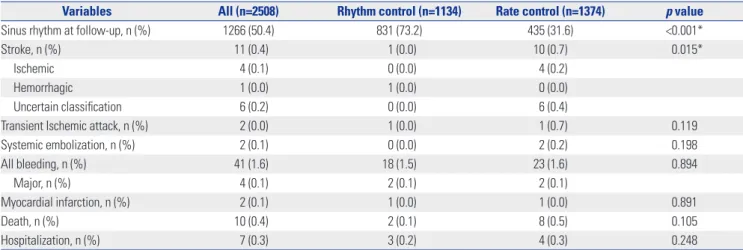
Significantly more patients treated with the rhythm control strategy maintained a sinus rhythm than those treated with the rate control strategy (73.2% vs. 31.6%). Clinical outcomes including hospitalization, myocardial infarction, and death and bleeding were similar between all patients treated with rhythm control and with rate control. However, the incidence of stroke in the rhythm control group was 0%, compared with 0.7% in the rate control group (p=0.015).
In Cox regression analysis, although non-rhythm control was associated with a higher risk of stroke [hazard ratio (HR) 9.04; 95% confidence interval (CI), 1.15−70.6] in univariate anal- ysis, it was not associated with higher risk of stroke (HR 0.27;
95% CI, 0.03−2.33) in the multivariate analysis.
DISCUSSION
Main findings
In our study with an AF prospective cohort, although non- rhythm control was significantly associated with stroke in uni- variate analysis, it was not significantly associated with stroke in multivariate analysis.
Comparison of differences between the rate and the rhythm control strategies for cardiovascular mortality Several trials have demonstrated that the rhythm control strate- gy offers no benefit on cardiovascular mortality in patients with AF, compared with the rate control strategy, and two meta- analyses reported overall risk ratios of 0.95 (95% CI 0.76−1.19) and 1.15 (95% CI 0.15−1.88).8,9,20-22 These negative results for the rhythm control strategy have been attributed to the ineffi- ciency of the antiarrhythmic drugs to maintain a sinus rhythm and to the fact that the beneficial effects of antiarrhythmic drugs are offset by their adverse effects.7 Unlike previous designed rhythm control in AF treatment, our study showed that an ac- tive rhythm control strategy that included electrical cardiover- sion or catheter ablation applied to medically refractory AF pa- tients or to patients with antiarrhythmic drug-related adverse Table 2. Comparison of Treatments in the Rhythm and the Rate Control Strategy Groups
Variables All (n=2508) Rhythm control (n=1134) Rate control (n=1374) p value
Warfarin, n (%) 434 (17.3) 185 (16.3) 249 (18.1) 0.233
Dabigatran, n (%) 374 (14.9) 180 (15.8) 194 (14.1) 0.219
Apixaban, n (%) 582 (23.2) 249 (21.9) 333 (24.2) 0.178
Ribaroxaban, n (%) 404 (16.1) 161 (14.1) 243 (17.6) 0.018*
Edoxaban, n (%) 90 (3.6) 33 (2.9) 57 (4.1) 0.097
Aspirin, n (%) 377 (15.0) 196 (17.2) 181 (13.1) 0.004*
Clopidogrel, n (%) 178 (7.2) 86 (7.5) 92 (6.6) 0.407
Statin, n (%) 944 (37.6) 406 (35.8) 538 (39.1) 0.084
ARB, n (%) 953 (37.9) 393 (34.6) 541 (39.3) 0.013*
Beta-blocker, n (%) 0.002*
Bisoprolol 612 (24.4) 273 (24.0) 339 (24.6)
Carvedilol 392 (15.6) 165 (14.5) 227 (16.5)
Metoprolol 11 (0.4) 6 (0.5) 5 (3.6)
Nebivolol 118 (4.7) 46 (4.0) 72 (5.2)
Propranolol 91 (3.6) 38 (3.3) 53 (3.8)
Atenolol 198 (7.9) 105 (9.2) 93 (6.7)
Non-hydropyridine CCB, n (%) 736 (29.3) 299 (26.3) 437 (31.8) 0.002*
Digoxin, n (%) 183 (7.3) 13 (1.1) 170 (12.3) <0.001*
Propafenone, n (%) 222 (8.9) 222 (19.5) 0
Flecainide, n (%) 579 (23.0) 579 (51.0) 0
Pilsicanide, n (%) 35 (1.3) 35 (3.0) 0
Dronedarone, n (%) 75 (3.0) 75 (6.6) 0
Amiodarone, n (%) 238 (9.4) 238 (20.9) 0
Sotalol, n (%) 23 (0.9) 23 (2.2) 0
ARB, angiotensin receptor blocker; CCB, calcium channel blocker.
Data are presented as a mean±standard deviation or number (percentage).
*Statistically significant.
events minimized the need for antiarrhythmic drugs and hence prevented antiarrhythmic toxicities. In real practice with guide- line adherence,2,15,23 a physician considers the optimal choice among the use of antiarrhythmic drugs and catheter ablation to minimize risk and to maximize benefits in order to restore and maintain a sinus rhythm. However, in our study, even though the rhythm control strategy group was younger, had a smaller proportion of heart failures and chronic kidney diseases, and was significantly superior for maintaining a sinus rhythm at follow-up (73.2% vs. 31.6%, p<0.001), the rhythm control strat- egy exhibited no benefit for cardiovascular mortality, com- pared with the rate control strategy, over a short-term follow up duration, as has been previously reported.8,11,22
Comparison of differences between the rate and the rhythm control strategies for stroke
Two meta-analyses comparing the pharmacological rhythm and the rate control strategy reported that the incidence of st- roke was found to be statistically similar between the two
groups with an overall odds ratio of 0.99 (95% CI 0.75−1.30) and a risk ratio of 0.96 (95% CI 0.68−1.34).8,22 However, recent studies have demonstrated that the rhythm control strategy including catheter ablation was associated with lower rates of stroke among patients with AF.12,13,24 This reduced risk of stroke associated with an optimal rhythm control including catheter ablation was implicated to maintain a sinus rhythm and to re- duce the burden of AF.1,12,25 In our study, patients with the rhythm control strategy showed a significantly lower risk of stroke, compared with those with the rate control strategy [1 (0%) vs.
10 (0.7%), p=0.015], at the short-term follow-up duration (Table 3). However, rhythm control group was associated with better prognosis due to better patient baseline characteristics in the rhythm control group (Tables 1 and 4).
OACs are the main contributor to the prevention of stroke.5,26 Warfarin reduced stroke overall by 60% to 70%, and new OACs have a beneficial effect on additional significant reductions of overall 20% relative to warfarin.6 In our study, a new OAC was mostly used (71%) and similarly prescribed between the pa- Table 3. Comparison of Clinical Outcomes for the Rhythm and the Rate Control Strategy Groups
Variables All (n=2508) Rhythm control (n=1134) Rate control (n=1374) p value
Sinus rhythm at follow-up, n (%) 1266 (50.4) 831 (73.2) 435 (31.6) <0.001*
Stroke, n (%) 11 (0.4) 1 (0.0) 10 (0.7) 0.015*
Ischemic 4 (0.1) 0 (0.0) 4 (0.2)
Hemorrhagic 1 (0.0) 1 (0.0) 0 (0.0)
Uncertain classification 6 (0.2) 0 (0.0) 6 (0.4)
Transient Ischemic attack, n (%) 2 (0.0) 1 (0.0) 1 (0.7) 0.119
Systemic embolization, n (%) 2 (0.1) 0 (0.0) 2 (0.2) 0.198
All bleeding, n (%) 41 (1.6) 18 (1.5) 23 (1.6) 0.894
Major, n (%) 4 (0.1) 2 (0.1) 2 (0.1)
Myocardial infarction, n (%) 2 (0.1) 1 (0.0) 1 (0.0) 0.891
Death, n (%) 10 (0.4) 2 (0.1) 8 (0.5) 0.105
Hospitalization, n (%) 7 (0.3) 3 (0.2) 4 (0.3) 0.248
Data are presented as means±standard deviations or numbers (percentage).
*Statistically significant.
Table 4. Cox Regression Analyses for the Prediction of Stroke Occurrence
Variables Univariate Multivariate
HR 95% CI p value HR 95% CI p value
Age 1.12 1.04–1.21 0.002* 1.06 0.97–1.17 0.170
Age ≥65 years 1.16 0.02–1.32 0.090
Age ≥75 years 3.58 1.66–7.77 0.001*
Female 0.92 0.27–3.14 0.896 0.51 0.13–1.94 0.324
AF type† 3.08 1.33–7.11 0.008* 2.71 0.66–11.01 0.162
Non-rhythm control 9.04 1.15–70.6 0.035* 0.27 0.03–2.33 0.235
Heart failure 1.09 0.97–1.23 0.136 0.86 0.16–4.46 0.862
Hypertension 0.21 0.02–1.65 0.139 0.40 0.04–3.50 0.411
Diabetes mellitus 0.97 0.88–1.05 0.498 0.22 0.03–1.22 0.083
LA size (mm) 1.08 1.01–1.14 0.015* 1.03 0.97–1.11 0.188
CHA2DS2-VASc 1.01 0.99–1.04 0.142 1.53 0.92–2.54 0.101
HR, hazard ratio; CI, confidence interval; AF, atrial fibrillation; LA, left atrium.
*Statistically significant, †Paroxysmal type as the reference category.
tients in the rhythm control group and those in the rate con- trol group among the 73% OAC-indicated study patients.
In the J-Rhythm registry with Japanese patients,27 the inci- dence rate of ischemic stroke was 13.4 per 1000 person-year. A previous stroke (HR 3.25), age ≥75 years (HR 2.31), and incr- eased CHA2DS2-VASc score were considered as independent risk factors for ischemic stroke in the multivariate analysis.27 Si- milar with other Western registries that compared the rhythm and the rate control strategy,25,28 patients treated with the rhythm control strategy were younger in age and had a small- er proportion of underlying diseases and a lower CHADS2 or CHA2DS2-VASc score than those treated with the rate control strategy. In RECORDAF, significantly more patients in the rhythm control group had maintained a sinus rhythm than those in the rate control group (80% vs. 33%, p<0.001) and had a lower occurrence of stroke than those in the rate control group (1.7% vs. 2.8%, p=0.008) at the 1-year follow-up. How- ever, in ORBIT-AF, the rhythm control group had a significantly smaller proportion of OACs than that of the rate control group (68% vs. 74%, p<0.001). However, the incidence of stroke was similar between the two groups [1.1% vs. 1.5%, adjusted HR 0.87 (95% CI 0.66−1.16), p=0.345].
In our study, the incidence rate of stroke was 9.0 per 1000 person-years as previously reported by J-Rhythm registry. Pa- tients treated with the rhythm control strategy were younger and had less underlying cardiovascular disease and stroke risk factors, while those treated with the rate control strategy were older and had more stroke risk factors, including diabe- tes, dyslipidemia, heart failure, and chronic kidney disease, and a higher CHA2DS2-VASc score. In addition, catheter ablation for anti-arrhythmic refractory AF rhythm control was more fre-
quently undertaken in our study, compared with other previ- ous registries. However, the rhythm control strategy might not be attributed to lower stroke, compared with the rate control strategy, in the multivariate analysis until the CABNA results are available (Catheter Ablation vs. Anti-arrhythmic Drug Therapy for Atrial Fibrillation Trial) for stroke prevention.1,24 In our study, the patients with rhythm control that included cath- eter ablation were younger, had a lower risk of stroke (mean of CHA2DS2-VASc score 2.8±1.6), and significantly more often maintained sinus rhythm at follow-up, compared with those treated with the rate control strategy. In the Kaplan-Meier curve (Fig. 1), patients treated with the rhythm control strate- gy seemed to be significantly associated with a higher stroke- free survival rate during over 6 months of follow up. However, in Cox regression multivariate analysis, only AF patients aged over 75 years was indicated as an independent risk factor for stroke occurrence (Table 4). We noted that 82% (9/11) of all stroke have occurred in the AF patients aged over 75 years and that the effect of rhythm control strategy could be offset by age.
In addition, with the on-going CODE-AF trial, our data had only a short mean follow-up of 5.8 months, and a longer fol- low-up duration is needed to assess the differences between rhythm and rate control strategies in stroke prevention.
Our study has several limitations. First, our study has short follow-up duration and unknown confounding factors. Sec- ond, the data used for the analysis cannot quantify AF burden, which may have differed between the rhythm and the rate control strategy groups. Third, there are concerns for a suffi- cient power of association for stroke occurrence in this study.
In conclusions, in this prospective AF cohort with guideline adherence, the rhythm control strategy showed no benefit on cardiovascular mortality, but seemed to lower the risk of st- roke compared, to the rate control strategy. However, only age, especially older than 75 years, was deemed an indepen- dent risk factor for the occurrence of stroke, regardless of which control strategy was applied.
ACKNOWLEDGEMENTS
This study was supported by research grants from the Basic Science Research Program through the National Research Foundation of Korea funded by the Ministry of Education, Science and Technology (NRF-2017R1A2B3003303, 2012R1A2A2A02045367), and grants from the Korean Health- care Technology R&D project funded by the Ministry of Health
& Welfare (HI16C0058, HI15C1200, HI11C1606).
ORCID
Yu Jeong Choi https://orcid.org/0000-0003-1372-2080 Ki-Woon Kang https://orcid.org/0000-0002-1361-0022 Boyoung Joung https://orcid.org/0000-0001-9036-7225 Fig. 1. Kaplan-Meier survival curve showing the comparison of the
rhythm and rate control strategies for stroke occurrence.
100
95
90
85
80
Time from enrollment (months) p=0.010
Survival free from stroke (%)
0 1 2 3 4 5 6 7 8
1134 1134 1134 1131 1068 890 569 157 39 1374 1372 1370 1368 1246 1030 652 161 39 Number at risk
Group : Rhythm control strategy Group : Rate control strategy
Rhythm control strategy Rate control strategy
REFERENCES
1. Bunch TJ, Crandall BG, Weiss JP, May HT, Bair TL, Osborn JS, et al. Patients treated with catheter ablation for atrial fibrillation have long-term rates of death, stroke, and dementia similar to pa- tients without atrial fibrillation. J Cardiovasc Electrophysiol 2011;
22:839-45.
2. Kirchhof P, Benussi S, Kotecha D, Ahlsson A, Atar D, Casadei B, et al. 2016 ESC Guidelines for the management of atrial fibrillation developed in collaboration with EACTS. Eur Heart J 2016;37:
2893-962.
3. January CT, Wann LS, Alpert JS, Calkins H, Cigarroa JE, Cleveland JC Jr, et al. 2014 AHA/ACC/HRS guideline for the management of patients with atrial fibrillation: a report of the American College of Cardiology/American Heart Association Task Force on practice guidelines and the Heart Rhythm Society. Circulation 2014;130:
e199-267.
4. Hart RG, Pearce LA, Aguilar MI. Meta-analysis: antithrombotic therapy to prevent stroke in patients who have nonvalvular atrial fibrillation. Ann Intern Med 2007;146:857-67.
5. Freedman B, Potpara TS, Lip GY. Stroke prevention in atrial fibril- lation. Lancet 2016;388:806-17.
6. Ruff CT, Giugliano RP, Braunwald E, Hoffman EB, Deenadayalu N, Ezekowitz MD, et al. Comparison of the efficacy and safety of new oral anticoagulants with warfarin in patients with atrial fibril- lation: a meta-analysis of randomised trials. Lancet 2014;383:955-62.
7. Rolf S, Kornej J, Dagres N, Hindricks G. What can rhythm control therapy contribute to prognosis in atrial fibrillation? Heart 2015;
101:842-6.
8. Al-Khatib SM, Allen LaPointe NM, Chatterjee R, Crowley MJ, Du- pre ME, Kong DF, et al. Rate- and rhythm-control therapies in pa- tients with atrial fibrillation: a systematic review. Ann Intern Med 2014;160:760-73.
9. Wyse DG, Waldo AL, DiMarco JP, Domanski MJ, Rosenberg Y, Schron EB, et al. A comparison of rate control and rhythm control in patients with atrial fibrillation. N Engl J Med 2002;347:1825-33.
10. Scheinman MM. Atrial fibrillation therapy: rate versus rhythm con- trol. Pacing Clin Electrophysiol 2003;26:1175-7.
11. Gillinov AM, Bagiella E, Moskowitz AJ, Raiten JM, Groh MA, Bow- dish ME, et al. Rate control versus rhythm control for atrial fibril- lation after cardiac surgery. N Engl J Med 2016;374:1911-21.
12. Tsadok MA, Jackevicius CA, Essebag V, Eisenberg MJ, Rahme E, Humphries KH, et al. Rhythm versus rate control therapy and sub- sequent stroke or transient ischemic attack in patients with atrial fibrillation. Circulation 2012;126:2680-7.
13. Bunch TJ, May HT, Bair TL, Weiss JP, Crandall BG, Osborn JS, et al. Atrial fibrillation ablation patients have long-term stroke rates similar to patients without atrial fibrillation regardless of CHADS2 score. Heart Rhythm 2013;10:1272-7.
14. Stevens PE, Levin A; Kidney Disease: Improving Global Outcomes Chronic Kidney Disease Guideline Development Work Group Members. Evaluation and management of chronic kidney disease:
synopsis of the kidney disease: improving global outcomes 2012 clinical practice guideline. Ann Intern Med 2013;158:825-30.
15. January CT, Wann LS, Alpert JS, Calkins H, Cigarroa JE, Cleveland JC Jr, et al. 2014 AHA/ACC/HRS guideline for the management of patients with atrial fibrillation: a report of the American College of Cardiology/American Heart Association Task Force on Practice Guidelines and the Heart Rhythm Society. J Am Coll Cardiol 2014;
64:e1-76.
16. Calkins H, Brugada J, Packer DL, Cappato R, Chen SA, Crijns HJ, et al. HRS/EHRA/ECAS expert Consensus Statement on catheter and surgical ablation of atrial fibrillation: recommendations for per- sonnel, policy, procedures and follow-up. A report of the Heart Rhythm Society (HRS) Task Force on catheter and surgical abla- tion of atrial fibrillation. Heart Rhythm 2007;4:816-61.
17. Kim H, Kim TH, Cha MJ, Lee JM, Park J, Park JK, et al. A Prospective survey of atrial fibrillation management for real-world guideline adherence: COmparison study of Drugs for symptom control and complication prEvention of Atrial Fibrillation (CODE-AF) Regis- try. Korean Circ J 2017;47:877-87.
18. Schulman S, Kearon C; Subcommittee on Control of Anticoagula- tion of the Scientific and Standardization Committee of the Inter- national Society on Thrombosis and Haemostasis. Definition of major bleeding in clinical investigations of antihemostatic medici- nal products in non-surgical patients. J Thromb Haemost 2005;3:
692-4.
19. Kaatz S, Ahmad D, Spyropoulos AC, Schulman S; Subcommittee on Control of Anticoagulation. Definition of clinically relevant non- major bleeding in studies of anticoagulants in atrial fibrillation and venous thromboembolic disease in non-surgical patients:
communication from the SSC of the ISTH. J Thromb Haemost 2015;13:2119-26.
20. Hohnloser SH, Kuck KH, Lilienthal J. Rhythm or rate control in atri- al fibrillation--Pharmacological Intervention in Atrial Fibrillation (PIAF): a randomised trial. Lancet 2000;356:1789-94.
21. Hagens VE, Vermeulen KM, TenVergert EM, Van Veldhuisen DJ, Bosker HA, Kamp O, et al. Rate control is more cost-effective than rhythm control for patients with persistent atrial fibrillation--re- sults from the RAte Control versus Electrical cardioversion (RACE) study. Eur Heart J 2004;25:1542-9.
22. Chatterjee S, Sardar P, Lichstein E, Mukherjee D, Aikat S. Pharma- cologic rate versus rhythm-control strategies in atrial fibrillation: an updated comprehensive review and meta-analysis. Pacing Clin Electrophysiol 2013;36:122-33.
23. Shin DG, Cho I, Hartaigh Bó, Mun HS, Lee HY, Hwang ES, et al.
Cardiovascular events of electrical cardioversion under optimal anticoagulation in atrial fibrillation: the multicenter analysis. Yon- sei Med J 2015;56:1552-8.
24. Saliba W, Schliamser JE, Lavi I, Barnett-Griness O, Gronich N, Rennert G. Catheter ablation of atrial fibrillation is associated with reduced risk of stroke and mortality: a propensity score-matched analysis. Heart Rhythm 2017;14:635-42.
25. Camm AJ, Breithardt G, Crijns H, Dorian P, Kowey P, Le Heuzey JY, et al. Real-life observations of clinical outcomes with rhythm- and rate-control therapies for atrial fibrillation RECORDAF (Reg- istry on Cardiac Rhythm Disorders Assessing the Control of Atrial Fibrillation). J Am Coll Cardiol 2011;58:493-501.
26. Sherman DG. Stroke prevention in atrial fibrillation: pharmaco- logical rate versus rhythm control. Stroke 2007;38(2 Suppl):615-7.
27. Suzuki S, Yamashita T, Okumura K, Atarashi H, Akao M, Ogawa H, et al. Incidence of ischemic stroke in Japanese patients with atrial fibrillation not receiving anticoagulation therapy--pooled analy- sis of the Shinken Database, J-RHYTHM Registry, and Fushimi AF Registry. Circ J 2015;79:432-8.
28. Steinberg BA, Holmes DN, Ezekowitz MD, Fonarow GC, Kowey PR, Mahaffey KW, et al. Rate versus rhythm control for manage- ment of atrial fibrillation in clinical practice: results from the Out- comes Registry for Better Informed Treatment of Atrial Fibrilla- tion (ORBIT-AF) registry. Am Heart J 2013;165:622-9.