Staphylococcus pseudoxylosus strain 14AME19 isolated from meju, a Korean fermented soybean food, exhibited weak hemolytic activity on a sheep-blood supplemented agar plate and a strong lipolytic activity on an agar plate containing 1% tributyrin (v/v) and 2% NaCl (w/v). Its complete genome contains a single circular 2,910,290-bp chromosome and 4 circular plasmids of sizes 22,548 bp, 23,177 bp, 46,422 bp, and 9,771 bp. The G + C content of chromosome is 32.78% and those of plasmids are
≤ 30.05.
Keywords: Staphylococcus pseudoxylosus, genome, hemolysis, lipase activity, meju
Our recent research on the roles of bacteria during the ripening process of doenjang, a traditional Korean high-salt-fermented soybean food, identified coagulase-negative staphylococci (CNS) as a populous bacterial group, together with bacilli and enterococci (Jeong et al., 2014b). We stored the isolated CNS strains as stock cultures and later identified Staphylococcus xylosus as a predominant bacterial species of meju, the major raw material used for doenjang manufacture (Jang et al., 2019).
Recent progress in phylogenomic analysis has clearly consoli-
dated and differentiated closely related Staphylococcus species and introduced a novel taxon, Staphylococcus pseudoxylosus (MacFadyen et al., 2019). Staphylococcus pseudoxylosus type strain S04009
Twas isolated from a case of bovine mastitis and initially identified as S. xylosus. Its 16S rRNA gene analysis revealed a close relationship to the coagulase-negative S.
saprophyticus, S. caeli, S. edaphicus, and S. xylosus. We re-characterized the S. xylosus strains in our stocks through gmk (guanylate kinase) and gap (glyceraldehyde 3-phosphate dehydrogenase) sequence analyses and some of them were confirmed as S. pseudoxylosus by current taxonomic standards.
We assessed the safety of our stocks of S. xylosus and S.
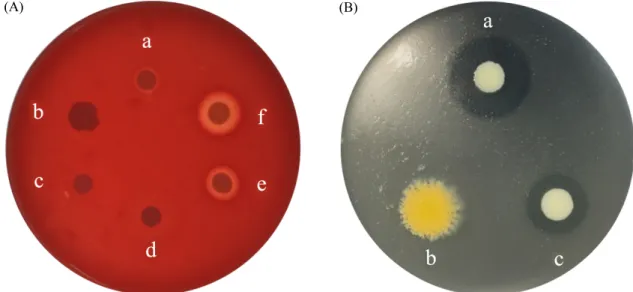
pseudoxylosus by antibiotic resistance and hemolytic activity to assess their potential as starter cultures in the production of fermented soybean foods of Korea (data not shown). In the course of experiment, we identified S. pseudoxylosus strain 14AME19 as exhibiting weak hemolytic activity on tryptic soy agar (BD Diagnostic Systems) supplemented with 5% sheep blood (MB cell) (Fig. 1A). This strain also exhibited strong lipolytic activity on 1% tributyrin agar (Sigma-Aldrich) containing 2%
NaCl (Fig. 1B).
Whole-genome sequencing of strain 14AME19 performed using the PacBio RSII platform (Pacific Bioscience) at ChunLab,
Korean Journal of Microbiology (2021) Vol. 57, No. 2, pp. 109-111 pISSN 0440-2413
DOI https://doi.org/10.7845/kjm.2021.1016 eISSN 2383-9902
Copyright ⓒ 2021, The Microbiological Society of Korea
Complete genome sequence of Staphylococcus pseudoxylosus 14AME19 exhibiting a weak hemolytic activity
Haram Kong
1†, Do-Won Jeong
1†, Jingxian Liu
1, and Jong-Hoon Lee
1*
1
Department of Food Science and Biotechnology, Kyonggi University, Suwon 16227, Republic of Korea
2
Department of Food and Nutrition, Dongduk Women’s University, Seoul 02748, Republic of Korea
약한 용혈 활성을 나타내는 Staphylococcus pseudoxylosus 14AME19의 유전체 염기 서열
공하람
1†・ 정도원
2†・ 리우징시엔
1・ 이종훈
1*
1
경기대학교 식품생물공학과,
2동덕여자대학교 식품영양학과
(Received March 16, 2021; Revised April 6, 2021; Accepted April 8, 2021)
†
These authors contributed equally to this work.
*For correspondence. E-mail: [email protected];
Tel.: +82-31-249-9656; Fax: +82-31-253-1165
110 ∙ Kong et al.
미생물학회지 제57권 제2호
Inc. allowed construction of five contigs from a hybrid assembly of reads generated using the PacBio system (86,701 reads and 369.38× coverage) and assembled using the CLC Genomics Workbench ver. 7.5.1 (CLC Bio) with the HGAP2 algorithm and SMRT Link (ver. 7.0.1; Pacific Bioscience). The NCBI Prokaryotic Genome Annotation Pipeline was used for genome annotation and Glimmer 3 to predict open reading frames. A search against the Clusters of Orthologous Groups (COG) database was performed to determine putative protein functions.
The complete 14AME19 genome is a single circular 2,910,290- bp chromosome and 4 22,548-bp, 23,177-bp, 46,422-bp, and 9,771-bp circular plasmids (Table 1). The chromosome G + C
content is 32.78% and each plasmid content is ≤ 30.05%. The genome was predicted to contain 2,876 protein-coding sequences, 60 tRNA genes, and 22 rRNA genes. The COG results allowed functional assignment of 2,721 genes.
Staphylococcus pseudoxylosus 14AME19 genome has no α-hemolysin, β-hemolysin, or enterotoxin gene homologs characteristic of pathogenic Staphylococcus aureus (Kane et al., 2018). The genome has an annotated hemolysin III family protein gene (Gene locus: JMB28_RS04245) but the homologs are also found in the genomes of non-hemolytic S. xylosus strains S170 (AWC37_RS08370) and SMQ-121 (SXYLSMQ121_
RS03710) (Fig. 1A). We attributed the weak hemolytic activity
(A)
(B)
Fig. 1. Hemolytic (A) and lipolytic (B) activities of Staphylococcus pseudoxylosus strain 14AME19. Staphylococcus xylosus S170 was kindly provided by the Rural Development Administration of Korea (Hong and Roh, 2018). Staphylococcus xylosus SMQ-121 was purchased from the Université Laval in Canada (Labrie et al., 2014). Staphylococcus aureus Newman and S. aureus USA300-P23 were used as positive controls and S. aureus RN4220 was used as a negative control for the hemolytic activity test (Jeong et al., 2014a). Strains: a, S. pseudoxylosus 14AME19; b, S. xylosus S170; c, S. xylosus SMQ-121; d, S. aureus RN4220; e, S. aureus Newman; f, S. aureus USA300-P23.
Table 1. Genome features of Staphylococcus pseudoxylosus 14AME19
Feature Value
Genome Chromosome p14AME19-1 p14AME19-2 p14AME19-3 p14AME19-4
Size (bp) 3,012,208 2,910,290 22,54823,177 46,422 9,771
G + C content (%) 32.69 32.7829.33 30.05 29.52 28 .8 9
Open reading frames 2,876 2,751 22 2861 14
CDSs assigned by COG 2,721 2,615 14 24 57 11
rRNA genes 22 22 ‒ ‒ ‒ ‒
tRNA genes 60 60 ‒ ‒ ‒ ‒
GenBank accession CP068712 CP068713 CP068714 CP068715 CP068716
Abbreviations: CDS, coding DNA sequence; COG, Cluster of Orthologous Groups of proteins.
Staphylococcus pseudoxylosus genome ∙ 111
Korean Journal of Microbiology, Vol. 57, No. 2 of strain 14AME19 to its strong lipolytic activity that led to
degradation of erythrocyte membrane phospholipids (Winkler and Miller, 1980; Vahedi et al., 2020). Strain 14AME19 possesses two annotated triacylglycerol lipase genes (JMB28_RS03160, JMB28_RS12575) and three annotated lysophospholipase genes (JMB28_RS05925, JMB28_RS08195, JMB28_RS10310). Further studies are required to clarify the correlation between the weak hemolytic activity and strong lipolytic activity of strain 14AME19.
Nucleotide sequence accession numbers
The complete genome sequence of S. pseudoxylosus 14AME19 has been deposited in the DDBJ/ENA/GenBank under accession numbers CP068712‒CP068716, and the strain has been deposited in the Korean Culture Center of Microorganisms under accession number KCTC 43303.
적 요
메주에서 분리한 Staphylococcus pseudoxylosus 14AME19 균주는 양혈액을 첨가한 배지에서 약한 용혈 현상을 나타냈 고, 1% tributyrin (v/v)과 2% NaCl (w/v)을 첨가한 배지에서 강 한 지방 분해 활성을 나타냈다. 유전체 분석 결과, 14AME19 균주는 2,910,290 bp 크기의 chromosome과 22,548 bp, 23,177 bp, 46,422 bp, 9,771 bp 크기의 plasmid를 보유하고 있었다.
14AME19 균주의 chromosome G + C 함량은 32.78%였고, 4 개의 plasmid는 30.05% 이하의 함량을 가지고 있었다.
Acknowledgments
This work was supported by the National Research Founda- tion of Korea (NRF) [NRF-2016R1D1A1B01011421 and NRF-2019R1A2C1003639]. Haram Kong was supported by Kyonggi University’s Graduate Research Assistantship 2021.
Conflict of Interest
We have no conflict of interest to report.
References