359
Korean Circulation J 2007;37:359-364 ⓒ 2007, The Korean Society of Circulation
The Effect of Isosorbide Dinitrate Intravenous Injection on the Hemodynamics and Arterial Stiffness of Patients with Isolated Systolic Hypertension
Seung-Jin Lee, MD1, Chang-Gyu Park, MD2, Se-Whan Lee, MD1, Won-Yong Shin, MD1, Dong-Gyu Jin, MD1, Hong-Seog Seo, MD2 and Dong-Joo Oh, MD2
1Department of Internal Medicine, Soonchunhyang University College of Medicine, Cheonan,
2Department of Internal Medicine, Korea University College of Medicine, Seoul, Korea
ABSTRACT
Background and Objectives:In clinical practice, isolated systolic hypertension (ISH) is common for elderly patients and it is correlated with cardiovascular mortality. However, it is difficult to control the systolic blood pressure (BP) with using the currently available antihypertensive drugs without influencing the diastolic BP. The purpose of this study is to evaluate the effect of isosorbide dinitrate on the central BP and arterial stiffness by performing invasive testing. Subjects and Methods:Thirty subjects who had ISH and who underwent coronary angiography were enrolled in this study. The invasively measured central blood pressure, pulse pressure and pulse wave velocity were obtained after isosorbide dinitrate was injected intravenously and these values were analyzed in relation to age, gender, the body mass index, diabetes mellitus, dyslipidemia, smoking and the current dosing with antihypertensive drugs. Results:One minute after intravenous injection of isosorbide dinitrate, the central systolic BP was significantly decreased compare to the baseline value (142.23±12.32 mmHg vs 164.97±14.43 mmHg, respectively, p<0.001), and this change was sustained for 5 minutes (141.05±14.84 mmHg vs 164.97±
14.43 mmHg, respectively, p<0.001). The mean values, during the 5 minute period, of the pulse pressure (65.99
±13.63 mmHg vs 87.30±13.71 mmHg, respectively, p<0.001) and the pulse wave velocity (11.22±3.20 m/sec vs 12.91±4.11 m/sec, respectively, p<0.001) also revealed significant changes. Yet there was no significant decrease of the diastolic BP. Analysis of subgroups that were classified by gender, age, BMI, diabetes mellitus, dyslipidemia, smoking, the degree of the systolic BP and PWV, and taking antihypertensive drugs showed a similar pattern.
Conclusion:Isosorbide dinitrate was very effective for selective control of the systolic BP in ISH patients. It is also expected to prevent cardiovascular complications by improving arterial stiffness. (Korean Circulation J 2007;
37:359-364
KEY WORDS:Hypertension;Systolic pressure;Isosorbide dinitrate.
Introduction
Isolated systolic hypertension(ISH) is defined as a systolic BP above 140 mmHg and a diastolic BP below 90 mmHg, and this is a common type of hypertension, especially in elderly patients. In America, about 2/3 of all hypertensive patients in their seventh decade have ISH and about 3/4 of all hypertensive patients over
the age of 75 have ISH.1) Compared with hypertension in the young for whom the diastolic BP usually increases due to high peripheral vascular resistance, the main cause of hypertension in elderly patients is the increase in central arterial stiffness.2) It is known that the ISH is closely related to the increase in the pulse wave velocity (PWV), which reflects aortic stiffness,3) so ISH increases cardiovascular complications more than does the dia- stolic BP.4)5) However, it is difficult to control a systolic BP below 140 mmHg, and a sudden excessive drop in BP causes a decrease in the diastolic BP and coronary blood flow, which finally causes an increase in the risk of ischemic heart disease.6) All the calcium channel blockers,7)8) angiotensin converting enzyme inhibitors (ACE inhibitors), angiotensin II receptor blockers(ARBs)9)
Received:May 14, 2007 Revision Received:June 28, 2007 Accepted:July 2, 2007
Correspondence:Chang-Gyu Park, MD,Department of Internal Medicine, Korea University College of Medicine, 80 Guro-dong, Guro-gu, Seoul 152-050, Korea
Tel: 82-2-818-6635, Fax: 82-2-864-3062 E-mail: [email protected]
and diuretics,10) which are broadly used in clinics, not only decrease the systolic BP, but they also decrease the diastolic BP. So it is important to choose drugs that act selectively on the systolic BP. Nevertheless, there are no guidelines similar to the JNC-7 that recommend the drugs to control ISH.11) It has been known that nitrates are very useful for selective control of the systolic BP,12)13) but the use of nitrates is limited by the diurnal variation of BP due to nitrates’ short half-life, drug tolerance and side effects, and there is no evidence that a decrease in the BP via nitrates is accompanied by a decrease in the PWV.
In our study, we planned to validate the amount of decrease of the BP and the onset time and whether or not a decrease in PWV is observed after intravenous injection of isosorbide dinitrate. We also intended to understand the effect of nitrate when this is given to patients in combination with already prescribed anti- hypertensive drugs.
Subjects and Methods
Study patients
Among the patients who underwent coronary an- giography from September 2005 to January 2007 at Soon- chunhyang University Cheonan Hospital and Korea University Guro Hospital, 30 patients who showed no significant stenosis(less than 50% of the reference diameter) and a systolic BP above 140 mmHg with a diastolic BP less than 90 mmHg were enrolled in this study. The following patients were excluded: patients who had cardiac arrhythmia, an ejection fraction less than 60%, significant valvular heart disease, a serum creatinine level above 1.5 mg/dL, a tortuous aorta or a positive response to the ergonovine provocation test.
Measurement of the central arterial blood pressure and pulse wave velocity
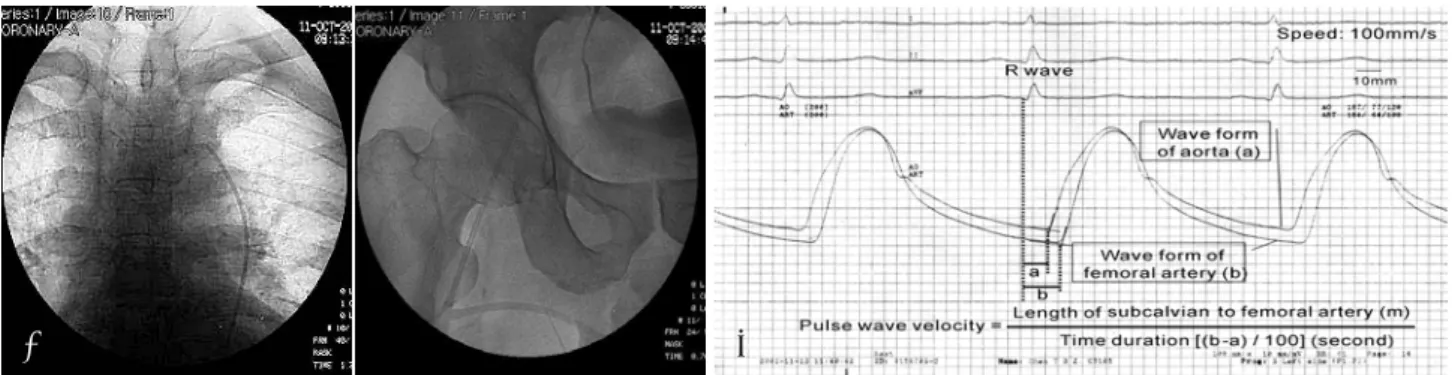
A 5 Fr. Judkins Right(JR) catheter was placed just distal to the origin of the left subclavian artery. The pulse wave velocity and surface electrocardiography were
recorded simultaneously at a speed of 100 mm/sec via the JR catheter, and a 6 Fr. sheath was placed in the right iliac artery using a fluid-filled system(Fig. 1). After in- travenous injection of 2 mg isosorbide dinitrate(Schwarz Pharma AG), thos method was repeated every 1 minute for 5 minutes. The pulse wave velocity was defined as the distance/pulse wave transition time. The distance was defined as the length of the catheter exposed out- side and the length of the sheath(12 cm) subtracted from the total length of the catheter(100 cm). The pulse wave transition time was obtained as follows: subtract the transition time of the descending aorta from that of the right iliac artery with using the foot-to-foot method, and measure the time duration between the beginning of the QRS wave and the starting position of the first increase in the pulse wave on surface electrocardiography (Fig. 2). To minimize error in measuring the transition time, we used the mean value measured from 3 conse- cutive pulse waves.
Cardiovascular risk factors
We obtained the medical histories of those patients with diabetes mellitus or dyslipidemia, those who smoked and those who were taking antihypertensive drugs. To evaluate the patients’ degree of obesity, we calculated the body mass index(BMI): the body weight(kg) was divided by the square of the height(m2).
Statistical analysis
Statistical analysis was performed using SPSS(Version 13.0). Continuous variables are analyzed with t-tests, and the nonparametric method was used in the sub- group analysis due to the relatively small number of patients. Continuous data are presented as means±
SDs, and p<0.05 were deemed statistically significant.
Results
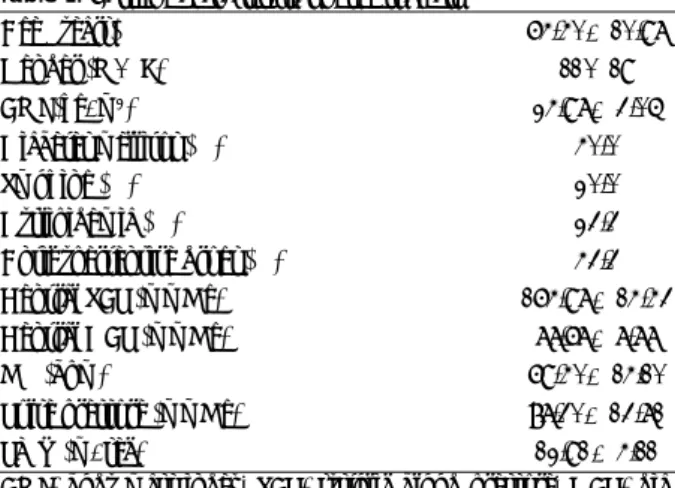
Baseline characteristics of the subjects(Table 1) The mean age was 64.4±11.0 years and 11 subjects were male(36.7%). The prevalence of diabetes mellitus,
Fig. 1. A 5 Fr. Judkins catheter was placed just distal to the origin of the left subclavian artery. A: to calculate the distance between the pulse waves of the aorta and right iliac artery. B: the length of the sheath (12 cm) and the catheter exposed to outside of the sheath was subtracted from the total length of the catheter (100 cm).
A B
dyslipidemia and smoking was 40.0%, 23.3% and 20.0%, respectively. Thirteen patients(43.3%) were taking antihypertensive drugs, 6 of 13 patients were taking 3 antihypertensive drugs and 3 patients were taking 2 drugs. Only 4 patients were taking 1 drug and 3 of them were taking beta-blockers. The median central systolic and diastolic BP measurements were 164.97±14.43 mmHg and 77.67±7.77 mmHg, respectively. The me-
dian heart rate was 69.40±14.10 bpm. The median pulse pressure and PWV measurements were 87.30±13.71 mmHg and 12.91±4.11 m/sec, respectively.
Change after isosorbide dinitrate injection(Fig. 2) One minute after the isosorbide dinitrate intravenous injection, the central systolic BP significantly decreased compared to the baseline value(142.23±12. 32 mmHg vs 164.97±14.43 mmHg, respectively, p<0.001); this trend was sustained for 5 minutes. There was a signifi- cant difference between the mean value during the 5 minute period and the baseline values (141. 05±14.84 mmHg vs 164.97±14.43 mmHg, respectively, p<0.001).
However, there was no significant difference between the mean and baseline values for the diastolic BP(76.15
±7.69 mmHg vs 77.67±7.77 mmHg, respectively, p=
0.091). The heart rate increased after 1 minute, and the mean value was also higher(72.82±13.20 bpm vs 69.40±14.10 bpm, respectively, p=0.004). The pulse pressure decreased after 1 minute(66.60±12.80 mmHg vs 87.30±13.71 mmHg, respectively, p<0.001), and the mean was also lower(65.99±13.63 mmHg vs 87.30±
13.71 mmHg, respectively, p<0.001). The PWV also showed a significant decrease at 1 minute(11.30±3.83 m/sec vs 12.91±4.11 m/sec, respectively, p=0.001), and
Table 1. Baseline characteristics of the subjects
Age (years) 64.40±10.97 Gender (M:F) 11:19
BMI (kg/m2) 24.97±3.05
Diabetes mellitus (%) 40.0
Smoking (%) 20.0
Dyslipidemia (%) 23.3
Antihypertensive drugs (%) 43.3
Central SBP (mmHg) 164.97±14.43
Central DBP (mmHg) 77.67±7.77
HR (bpm) 69.40±14.10
Pulse pressure (mmHg) 87.30±13.71
PWV (m/sec) 12.91±4.11
BMI: body mass index, SBP: systolic blood pressure, DBP: dia- stolic blood pressure, HR: heart rate, PWV: pulse wave velocity
Fig. 2. The change of parameters after the injection of isosorbide dinitrate. The decrease of the systolic pressure (A), pulse pressure (D) and pulse wave velocity (E) were significant just 1 minute after injection and the mean value for 5 minutes was also significantly lower compare to the baseline level. However, the diastolic blood pressure was not change (B). The heart rate was increased at 1 minute and mean from the baseline (C). SBP:
systolic blood pressure, DBP: diastolic blood pressure, HR: heart pressure, PWV: pulse wave velocity.
p<0.001 Minute
mmHg
SBP
0 1 2 3 4 5 Mean 185
175 165 155
145
135 125
mmHg
A B
p<0.001
p<0.001
DBP
Minute
0 1 2 3 4 5 Mean 90
80
70
60
50
p=0.082
bpm
HR
Minute
0 1 2 3 4 5 Mean 120
100
80
60 40
20 0
C
0 1 2 3 4 5 Mean
mmHg
Pulse pressure
Minute 140
120 100 80 60 40 20 0
D
p<0.001
Minute
0 1 2 3 4 5 Mean 19
18 17 16 15 14 13 12 11 10 9 8 7
m/s
E
p=0.001
p=0.091
p<0.001
p=0.004
PWV
p<0.001
the mean value was decreased(11.22±3.20 m/sec vs 12.91±4.11 m/sec, respectively, p<0.001).
Subgroup analysis
We analyzed the differences of the subgroups that were classified by gender, age, BMI, diabetes mellitus, dyslipidemia, smoking, the degree of the systolic BP and PWV, and taking antihypertensive drugs. The sub- jects were divided into groups younger than 65 years and older than 65 years, and the subjects were also divided according to the BMI, systolic BP and PWV that were divided on the basis of 25, 165 mmHg and 13 m/sec, respectively. There was no difference in the mean heart rate compared to the baseline value in the subgroups of subjects younger than 65 years, and the subgroups with a BMI less than 25, nondiabetes mellitus, dyslipidemia and those currently taking antihyperten- sive drugs. The mean value for the central diastolic BP was significantly less than the baseline for the subgroups of subjects with a BMI of less than 25(p=0.023) and those who were nonsmokers(p=0.02). However, the change in the central systolic BP, pulse pressure and PWV in all subgroups, including those currently taking anti- hypertensive drugs(Fig. 3), showed similar patterns to those revealed for the total group.
Discussion
ISH is a risk factor for developing coronary artery disease,14) heart failure15) and cerebrovascular disease,16) and it is closely related to an increase in aortic stiffness.
According to a survey performed in 2001, 4.3% of adult Koreans have ISH, and this is related to the increase in their age and BMI.17) There is much evidence that car- diovascular complications could be decreased if the systolic BP were effectively controlled. On a meta ana- lysis that specifically combined data on individuals 80 years or older from the SHEP, SHEP-pilot, Syst-Eur, and STOP-Hypertension studies, active treatment was associated with a 39% reduction in congestive heart
failure, a 34% reduction in stroke and a 22% reduct- ion in cardiovascular disease.18) But it is difficult to control systolic BP without causing a drop in the dia- stolic BP, and usually more than two antihypertensive drugs in combination must be taken to reach the target systolic BP.11) It is rare that the systolic BP was effe- ctively controlled by various antihypertensive drugs to less than 150 mmHg in many large-scaled clinical trials.
The structure of the aorta changes with aging. Initially, the endothelial function and the production of intrinsic nitric oxide decreases, and this is accompanied by an increase in collagen production, decreases and destruction of elastin and proliferation of vascular smooth muscle cells, which all results in an increase in arterial stiff- ness and a decrease in the compliance of arteries.19)
It is difficult to control the systolic BP because many antihypertensive drugs can not decrease the arterial stiff- ness directly and effectively. PWV, which directly reflects the arterial stiffness, is very important as a marker of atherosclerosis and as a prognostic factor.20) So, it would be ideal if antihypertensive drugs could decrease not only the systolic BP, but also the PWV. In general, di- uretics, calcium channel blockers, ACE inhibitors and ARBs are used in the treatment of the ISH, and they usually decrease the PWV, though the response is vari- able according to the individual drugs. The systolic BP lowering effects were evaluated in one clinical trial per- formed on patients with a systolic BP higher than 150 mmHg and the patients used diuretics, calcium channel blockers, ACE inhibitors and beta-blockers. Diuretics and calcium channel blockers were most effective, fo- llowed by the ACE inhibitors; the beta-blockers were least effective.21) Drugs having superior antihyperten- sive effects decrease the central BP more than the bra- chial BP. While they also decrease the diastolic BP to some degree, they don’t decrease the systolic BP very much. For example, in one clinical study, when the subjects were given eprosartan 600 mg for 10 weeks, the systolic BP decreased by 17.5±14.5 mmHg and the diastolic BP also decreased by 5.0±7.9 mmHg.22) Ni-
p=0.002
m/s
SBP
Minute 185
175 165 155 145
135 125
A 0 1 2 3 4 5 Mean p=0.002
m/s
Minute
B 0 1 2 3 4 5 Mean PWV
19 18 17 16 15 14 13 12 11 10 9 8 7
p=0.016 p=0.001
Fig. 3. The systolic blood pressure (A) and pulse wave velocity (B) in patients taking antihypertensive drugs were significantly decreased at 1 minute and the mean from the baseline. SBP: systolic blood pressure, PWV: pulse wave velocity.
trates decrease the systolic BP in an endothelial inde- pendent manner even though the endothelial function is impaired, but they have little effect on the diastolic BP. It is expected that nitrates can reduce arterial sti- ffness because it was observed that nitrates can decrease the augmentation index.23) However, when nitroglycerin was injected intravenously in normotensive subjects, the acute changes in BP produced the expected changes in PWV, yet in hypertensive subjects, although the BP was reduced, there was no detectable reduction in the PWV.24)
In our study, the finding that the systolic BP dropped by more than 20 mmHg was similar to the results of a previous study that used oral nitrates. In addition, the response was observed within 1 minute after injection, so can be used preferentially when a prompt drop in BP is needed. Isosorbide dinitrate is recommended as the drug of choice, especially for surgical patients. When the patient is under general anesthesia, the coronary perfusion can be impaired due to a decrease in the dia- stolic BP.25) It was also proved that this drug relieves aortic stiffness, according to the observation that the PWV was also decreased. It has been known that the decrease in elasticity and increase in stiffness in the arteries in diabetic patients was caused by advanced glycation end products.26) In our study, the results of the diabetic subgroup were similar to the results of the total subjects. The results for the subgroup of subjects who had a PWV greater than 13 m/s were also similar, which implies that isosorbide dinitrate is useful in patients who have shown a poor response to antihy- pertensive drugs due to their far advanced atherosclero- sis. The systolic BP often cannot reach the targeted BP, even when two or more drugs are used. The results of the subgroup of subjects who were already taking anti- hypertensive drugs verified that isosorbide dinitrate has an additional BP-lowering effect. Unfortunately, because most of them were taking two or more antihy- pertensive drugs, we could not identify which drug showed synergistic effects when isosorbide dinitrate was injected. However, the fact that the systolic BP, which had not been controlled by any other drugs, decreased to the target BP when isosorbide dinitrate was used, suggests that this drug is superior to other drugs for controlling the systolic BP in ISH patients.
The limitation of this study is that the subgroup analy- sis has limitations due to the small number of subjects.
Yet it is estimated that because the p value is definite, the results will be similar when the number of subjects is sufficient. To discriminate between two antihyper- tensive drugs, a study comparing the effects on the central BP and PWV under the condition of the same brachial BP is needed.
In conclusion, a significant reduction of the central systolic BP was observed without any change of the dia-
stolic BP by intravenous injection of isosorbide dini- trate in patients with ISH, which suggests that more active treatment with using this drug is necessary in clinics.
This study was supported by a grant from the Korean Society of Cir- culation 2005 and Seoul R & BD program (10526).
REFERENCES
1) Burt VL, Cutler JA, Higgins M, et al. Tends in the prevalence, awareness, treatment, and control of hypertension in the adult US population: data from the health examination surveys, 1960 to 1991. Hypertension 1995;26:60-9.
2) Franklin SS. Systolic blood pressure: it’s time to take control. Am J Hypertens 2004;17:49S-54S.
3) Schiffrin EL. Vascular stiffening and arterial compliance: implic- ations for systolic blood pressure. Am J Hypertens 2004;17:39S- 48S.
4) Stamler J, Stamler R, Neaton JD. Blood pressure, systolic and dia- stolic, and cardiovascular risks: US population data. Arch Intern Med 1993;153:598-615.
5) Franklin SS, Larson MG, Khan SA, et al. Does the relation of bl- ood pressure to coronary heart disease risk change with aging?
Circulation 2001;103:1245-9.
6) Lee JW. Pulse pressure and systolic blood pressure. Korean Circ J 2002;32:293-8.
7) Staessen JA, Fagard R, Thijs L, et al. Randomised double-blind comparison of placebo and active treatment for older patients with isolated systolic hypertension. Lancet 1997;350:757-64.
8) Liu L, Wang JG, Liu G, Staessen JA. Comparison of active trea- tment and placebo in older Chinese patients with isolated sys- tolic hypertension. J Hypertens 1998;16:1823-9.
9) White WB, Giles T, Bakris GL et al. Measuring the efficiency of antihypertensive therapy by ambulatory blood pressure monit- oring in the primary care setting. Am Heaet J 2006;151:176-84 10) SHEP Cooperative Research Group. Prevention of stroke by an-
tihypertensive treatment in older persons with isolated systolic hy- pertension: final results of Systolic Hypertension in the Elderly Program (SHEP). JAMA 1991;265:3255-64.
11) Chobanian AV, Bakris GL, Black HR, et al. The Seventh Report of the Joint National Committee on Prevention, Detection, Eval- uation, and Treatment of High Blood Pressure: The JNC 7 report.
JAMA 2003;289:2560-72.
12) Stokes GS, Ryan M, Brnabic A, Nyberg G. A controlled study of the effects of isosorbide mononitrate on arterial blood pressure and pulse wave form in systolic hypertension. J Hypertens 1999;
17:1767-73.
13) Starmans-Kool MJ, Kleinjans HA, Lustermans FA, Kragten JA, Breed JG, van Bortel LM. Treatment of elderly patients with isolated systolic hypertension with isosorbide dinitrate in an asymmetric dosing schedule. J Hum Hypertens 1998;12:557-61.
14) Neaton JD, Wentworth D. Serum cholesterol, blood pressure, cig- arette smoking, and death from coronary heart disease: overall fi- ndings and differences by age for 316,099 white men. Arch Int- ern Med 1992;152:56-64.
15) Haider AW, Larson MG, Franklin SS, Levy D. Systolic blood pressure, diastolic blood pressure, and pulse pressure as predi- ctors of risk for congestive heart failure in the Framingham He- art Study. Ann Intern Med 2003;138:10-6.
16) Qureshi AI, Suri MF, Mohammad Y, Guterman LR, Hopkins LN.
Isolated and borderline isolated systolic hypertension relative to long-term risk and type of stroke: a 20-year follow-up of the na-
tional health and nutrition survey. Stroke 2002;33:2781-8.
17) Kim JA, Kim SM, Choi YS, et al. The prevalence and risk fa- ctors associated with isolated untreated systolic hypertension in Korea: the Korean National Health and Nutrition Survey 2001. J Hum Hypertens 2007;21:107-13.
18) Gueyffier F, Bulpitt C, Boissel JP, et al. Antihypertensive drugs in very old people: a subgroup meta-analysis of randomised con- trolled trials. Lancet 1999;353:793-6.
19) Park CG. Hypertension and vascular aging. Korean Circ J 2006;
36:477-81.
20) Kim YK, Kim DM. The relation of pulse wave velocity with Fr- amingham risk score and SCORE risk score. Korean Circ J 2005;
35:22-9.
21) Morgan TO, Anderson AI, MacInnis RJ. ACE inhibitors, beta- blockers, calcium blockers, and diuretics for the control of syst- olic hypertension. Am J Hypertens 2001;14:241-7.
22) Teitelbaum I, Chilvers M, Reiz RJ. The angiotensin receptor blo- cker eprosartan mesylate reduces pulse pressure in isolated sys- tolic hypertension. Can J Cardiol 2004;20(Suppl C):11C-6C.
23) Stokes GS, Barin ES, Gilfillan KL. Effects of isosorbide mono- nitrate and AII inhibition on pulse wave reflection in hyperten- sion. Hypertension 2003;41:297-301.
24) Stewart AD, Jiang B, Millasseau SC, Ritter JM, Chowienczyk PJ.
Acute reduction of blood pressure by nitroglycerin does not nor- malize large artery stiffness in essential hypertension. Hypert- ension 2006;48:404-10.
25) Wongprasartsuk P, Sear JW. Anaesthesia and isolated systolic hy- pertension: pathophysiology and anaesthesia risk. Anaesth In- tensive Care 2003;31:619-28.
26) Os I, Gudmundsdottir H, Kjeldsen SE, Oparil S. Treatment of is- olated systolic hypertension in diabetes mellitus type 2. Diabetes Obes Metab 2006;8:381-7.