Veterinary Science
DOI: 10.4142/jvs.2010.11.3.243
Received: 17 Sep. 2009, Accepted: 25 Mar. 2010
Original Article
*Corresponding author
Tel: +98-261-4502849; Fax: +98-261-4552194
E-mail: [email protected]
Sequence and phylogenetic analysis of the non-structural 3A and 3B protein-coding regions of foot-and-mouth disease virus subtype A Iran 05
Saber Jelokhani-Niaraki
1, Majid Esmaelizad
2,*, Morteza Daliri
4, Rasoul Vaez-Torshizi
1, Morteza Kamalzadeh
3, Mohsen Lotfi
3
1
Department of Animal Science, Faculty of Agriculture, Tarbiat Modares University, Tehran, Iran
2
Departments of Biotechnology, and
3Quality Control, Razi Vaccine & Serum Research Institute, Karaj, Iran
4
Department of Animal Biotechnology, National Institute for Genetic Engineering and Biotechnology, Tehran, Iran
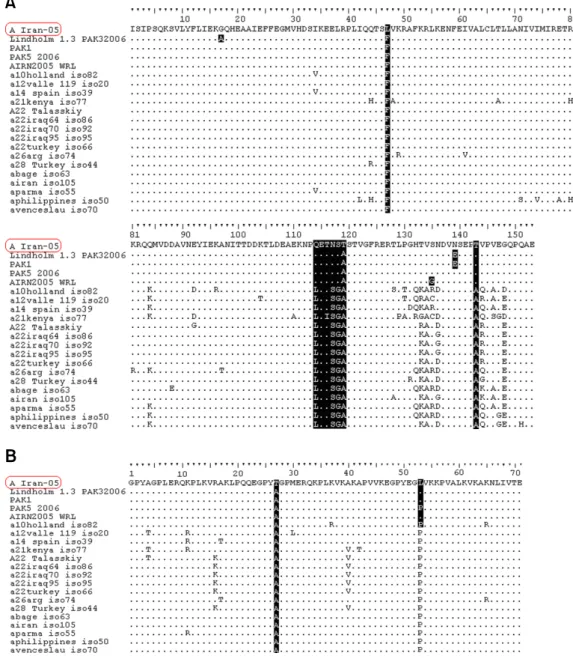
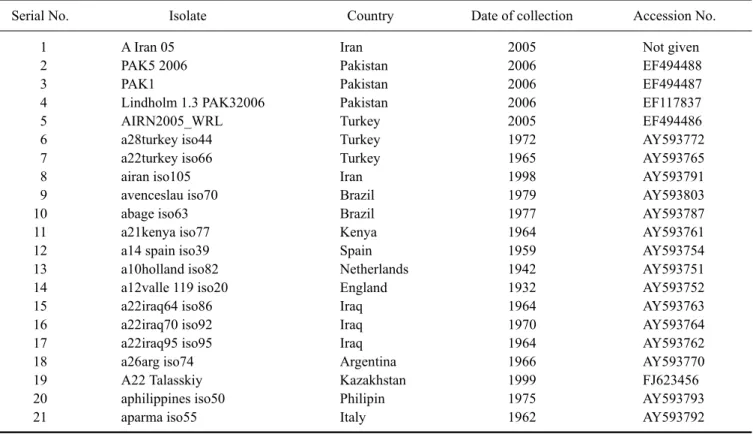
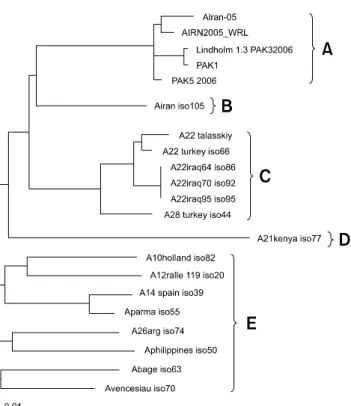
The A Iran 05 foot-and-mouth disease virus (FMDV) subtype was detected in Iran during 2005 and has proven to be highly virulent. This study was undertaken to focus on molecular and phylogenetic analysis of 3A and 3B coding-regions in the A Iran 05 field isolate. To assess the genetic relatedness of A Iran 05 isolate the nucleotide and predicted amino acid sequences of the 3AB region of type A FMDV isolates were compared with twenty previously described type A FMDV isolates. The phylogenetic tree based on the 672 bp 3AB gene sequences of type A FMDV from thirteen different locations clustered them into five distinct lineages. The A Iran 05 isolate clustered in lineage A along with four type A variants and was closely matched with viruses isolated in Turkey and Pakistan during 2005∼2006. The number of protein sequence differences exhibited by each of the isolates revealed that A Iran 05 isolate contains three amino acid substitutions at positions 47 and 119 of 3A and 27 of the 3B coding region. The nucleotide identity between A Iran 05 and the other four isolates of lineage A was estimated to be 98%.
Keywords: A Iran 05, FMDV, non-structural protein 3A, non- structural protein 3B, sequencing
Introduction
Foot-and-mouth disease (FMD) is a highly contagious viral disease of cloven-hoofed animals, both domestic and wild [8,18]. The disease is caused by FMD virus (FMDV), which is one of two species in the genus Aphthovirus in the family of Picornaviridae, an important group of mammalian RNA viruses [3,11]. FMD has been endemic in many continents, including Africa, South America and Asia. It has had a
dramatic impact on the farming industry leading to tremendous economic losses particularly in countries which are naturally FMD-free [20]. Previous studies have shown that Iran has one of the highest reported rates of FMD cases per year. The high incidence of FMD (including serotypes A, Asia 1 and O) has allowed the identification of new variants of the virus over the last 7 years. [16]. Furthermore, due to high error rates in the process of genome replication, FMDV is genetically highly variable. It has been grouped into seven serological serotypes (O, A, C, Asia 1, SAT 1, SAT 2 and SAT 3) and multiple subtypes, with more than 60 subtypes of the virus now characterized [13]. This large antigenic variation is considered one of the major obstacles for the control of FMD by vaccination in endemic areas [1,4,9]. Non-enveloped FMDV contains a single-stranded, positive-sense RNA genome with approximately 8,500 nucleotides. The open reading frame (ORF) encodes a single polyprotein which can be cleaved into four structural proteins (VP4, VP2, VP3, and VP1) and eight non-structural proteins (L, 2A, 2B, 2C, 3A, 3B, 3C, and 3D) [6,17]. In general, structural proteins are more variable than non-structural proteins. Mutations or deletions in structural proteins may help FMDV to evade an immune response produced by the host, whereas mutations or deletions in the non-structural proteins could be detrimental to viral replication and protein processing [7]. In the non- structural protein regions, the 2A, 2B, 2C, 3C, and 3D proteins are highly conserved, while the 3A and 3B proteins are less conserved among serotypes, probably due to their functions or actions with host factors [12]. The wide variation of serotypes across different geographical areas points to the need for urgent identification of regional serotypes for outbreak control and vaccine development.
The purpose of this study was to determine the full-length
nucleotide sequence of genes encoding 3A and 3B proteins
of A Iran 05 subtype, and to compare it with available
corresponding sequences deposited in the GenBank database.