
Design and Development of a Granite Information System Prototype
12
0
0
전체 글
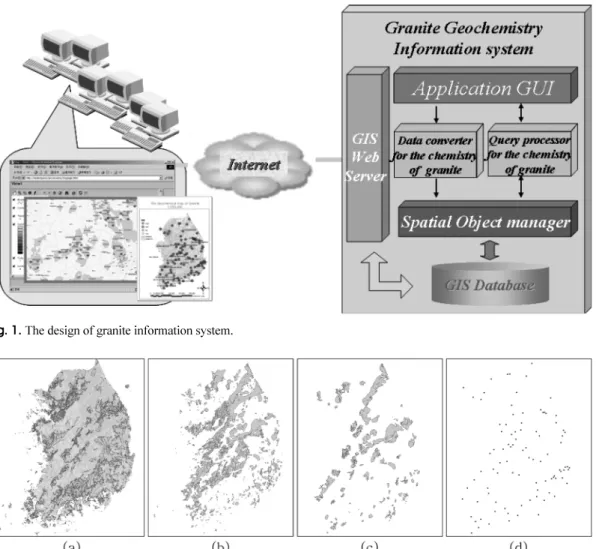
(2) 황재홍·지광훈·정원석·홍영국·류근호 맞게 이용하기 위해서는 추가적인 노력이 들어간다. 따 대하기 때문에 이번 연구에서는 비교적 분포 면적이 라서 이러한 여러 참고문헌 내의 암석학적인 분석 자 넓고 데이터가 단순한 화강암체에 대해서만 다루었다. 료들을 데이터베이스(database)화 하여 여러 연구자로 이 연구의 목적은 최근까지 발행된 국내 화강암 연구 하여금 편리하게 이용하게 할 필요성이 있다. 이러한 에서 측정된 화강암 분석 자료를 저장, 관리, 도시할 데이터베이스 구축이 다른 나라에서도 수행되고 있다 수 있는 지질정보시스템(GIS; Geological Information System)을 개발하는 것이다. 이를 위해 국내외 연구동 (BGS, 2007). 이러한 데이터베이스는 컴퓨터의 발달로 인해 다양한 통계 분석 및 시각적인 도출이 가능하다. 향을 참고하여 화강암 연구 자료의 검수를 통한 표준 현재 유럽 및 아메리카에서는 암석 분석 정보에 대 화된 데이터베이스 체계를 마련하고자 한다. 또한 표 한 전자 지도 서비스를 지난 수십 년 동안 인터넷을 준화된 데이터베이스 체계에 따라 화강암의 공간정보 통해 서비스해 오고 있다. 영국의 경우, 환경을 위한 및 속성정보를 구축하여 최종사용자에게 제공한다. 암석 관련 기초 조사는 현재 영국 지질조사소(British Geological Survey; BGS)의 핵심 전략 프로젝트의 하 화강암 정보 시스템 설계 나이며 광물 탐사와 관련하여 1960년대 후반부터 수행 하여 오고 있다(BGS, 2005). 이것은 유럽연합의 수자 화강암 정보 시스템은 우리나라 화강암의 지화학 및 원 기초법(Water Framework Directive)과 Part lla와 모드 분석 정보를 취급한다. 이를 위하여 국내에서 연구 같은 환경보호법규와 관련이 있다. 영국지질조사소는 발표된 화강암의 분석 정보가 포함된 논문들을 수집 및 암석 정보의 주요자료로 환경 관련 기반데이터를 이용 분석하여 공통 데이터 요소 및 모든 데이터 요소들을 하였고 이를 통해서 고해상도의 암석 정보 및 멀티미디 추출하였다. 논문에서 추출한 데이터는 미량원소, 주성 어 자료를 생산하였다. 데이터베이스에 이용될 시료들 분 원소 및 희토류 원소를 포함하는 지화학 자료와 현 은 매 km 마다 침식 퇴적물, 물, 토양을 수집한 것이며 미경 분석 자료인 모드(mode)를 공간 데이터로 구축하 2003년까지 영국전역의 80%를 샘플링 한 것이다(BGS, 였다. 화강암의 지화학 데이터 및 모드 데이터는 지역의 2006). 미국지질조사소(United States Geological Survey; 특징에 따라 측정값이 달라지는 공간 데이터의 일종이 USGS)에서 수행하는 NGMDB(National Geologic Map 다. 따라서 지화학 데이터 및 모드 데이터의 관리를 위 Database) 프로젝트는 지구물리학정보, 해양지질학정보, 해서는 공간 데이터베이스의 이용이 필수적이다. 공간 자원정보, 재해정보, 지구화학정보를 포함하는 지질정보 데이터베이스 시스템은 현실 세계에 존재하는 다양한 공 에 대한 핵심 컨텐츠로 구분된다. 또한 정보시스템은 구 간 객체들을 효과적으로 처리할 수 있는 장점을 가진다. 글 어스를 이용하여 도시 및 조회할 수 있도록 2006년 이 연구에서는 공간 데이터베이스에서 가장 중요한 도 현재 원형(prototype) 시스템으로 개발 중에 있다. 공간 데이터 모델링을 통하여 데이터베이스 스키마를 이 시스템은 NGMDB의 지도 카탈로그(Catalog)의 검 작성한다. 그리고 공간 데이터베이스 구축에 자주 이 색 페이지를 개선시켜 검색 속도 향상 및 검색 컨텐츠 용되는 GIS의 개념 및 활용 분야를 조사 분석한다. 의 업그레이드 등을 수행하고 있다(David ., 2004). GIS 데이터는 국내에 지금까지 연구된 우리나라의 화 아직 우리나라에서는 이러한 데이터베이스 구축이 강암에 대한 지화학 성분 분석 논문들을 조사 및 분석 초기단계에 있다. 또한 구축되어 있는 데이터베이스에 을 통하여 획득하고 화강암 정보시스템을 설계 및 구 는 암석학적으로 중요하게 이용할 수 있는 자료인 화 현한다. 화강암 정보시스템은 클라이언트/서버 환경으 학분석자료와 현미경분석자료는 구축되어 있지 않은 실 로 구축하며, 서버는 GIS 데이터베이스, 공간 객체 관 정이다. 지금까지 국내 화강암 연구에서 관측된 다양 리기, 데이터 변환기, 질의 실행 모듈, GIS 웹 서버로 한 자료를 저장·관리·도시할 수 있는 화강암 정보 구성하고, 클라이언트는 웹 브라우저를 이용하여 GIS 시스템이 없다. 또한 지화학 분석자료는 표준화되지 않 웹 서버로부터 화강암 분석 데이터를 검색 및 질의할 고 산재(散在)되어 있기 때문에 그 활용성이 매우 떨어 수 있도록 한다. 그리고, 검색 결과에 대한 다양한 시 지고 있다. 다만 현재 서비스되는 웹기반 지구화학도 각화 방법을 연구한다. 다음 Fig. 1은 화강암 정보시스템의 주요 요소들의 는 주성분 원소 14종, 전기전도도, 수소이온농도(pH), 구성 시스템 설계 내용이다. 알카리니티(HCO ) 등이 서비스되고 있다. 현재 남한에 관련된 암석학적인 문헌은 전국을 다 이 연구에서 우리는 지금까지 연구된 화강암에 대한 덮을 수 있을 정도로 충분하다. 따라서 그 자료가 방 각종 분석 데이터를 DB 스키마 작성을 통해 DB로 252. 2.. 2. et al. 3.
(3) 화강암정보시스템의 설계 및 구축. Fig. 1.. 253. The design of granite information system.. The converting process from granite polygon to granite point using 1:250,000 digital geological map in South Korea. (a) The selection of all granites from the geological map, (b) the extraction of all granites, (c) the extraction of target granite polygons and (d) the conversion from target granite polygons to points geometry. Fig. 2.. 저장하고 관리할 수 있는 데이터 관리체계 뿐만 아니 라 차트, 테이블, 그래프 및 지도를 질의를 통하여 그 결과를 생성할 수 있도록 시스템을 구축할 것이다. 또 한 이 공간데이터는 기존의 1:25만 수치 지질도와 중 첩될 수 있도록 관련데이터를 1:25만 데이터를 추출하 여 최종적으로 화강암 분석 자료에 대한 다양한 표현. 이 가능하도록 구현한다. 3.. 화강암 정보시스템의 구축. 남한 지역의 화강암 데이터 추출 기존연구를 통하여 지질시대 및 암석단위의 1:25만 3.1.. Point symbols for analytical values of granites. The type of elements Mode Element Major Element. Table 1.. Symbololgy. Trace Element. Rare Earth Element.
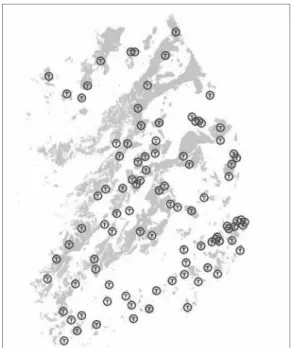
(4) 황재홍·지광훈·정원석·홍영국·류근호 수치지질도를 이용하여 화강암에 해당하는 지질지물 내의 화강암 범주의 폴리곤(polygon)들을 선택한다(Fig. (feature)을 공간질의(spatial query)를 통하여 우리나라 2a). 선택한 화강암들을 제외한 나머지 폴리곤을 제거 하여 화강암을 추출한다(Fig. 2b). 그리고 각 지명에 따른 화강암의 위치를 확인하여 화강암 범주의 해당 폴리곤을 추출(Fig. 2c)한 후 이를 다각형을 점으로 변환(Polygon to point) 기능을 이용하여 점으로 변환 하여 표현한다(Fig. 2d). 점 심벌은 모드(mode) 데이터, 주성분원소(major element), 미량원소(trace element), 희토류원소(REE; Rare Earth Element)를 대상으로 Table 1과 같이 문 자를 상징화하여 제작하였다. 이렇게 제작된 점 심벌(point symbol)은 Fig. 2의 (d)의 공간데이터인 점 기하(point geometry)와 1:1 대 응 시켜서 공간적으로 표현한다. 다음 Fig. 3은 미량원 소의 심볼을 화강암들의 점기하에 대응한 것이다. 254. ‘. ’. 화강암에 대한 주요 데이터 요소의 개념 정의 연구에 이용한 화강암의 주요 데이터 요소인 모드 데이터, 주성분원소, 미량원소, 희토류원소에 대한 값 은 Table 3과 같다. 4개의 주요 데이터 요소 중에서 모드 데이터는 21개 성분, 주성분 원소는 29개 성분, 미량원소는 27개 성분 그리고 희토류 원소는 15 성분 3.2.. Fig. 3.. Korea.. Fig. 4.. Representation of trace element symbols in South. The principal input data set for granites..
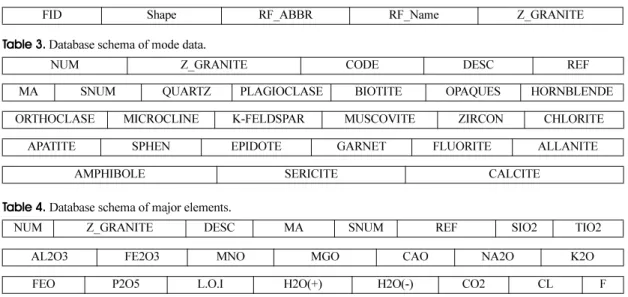
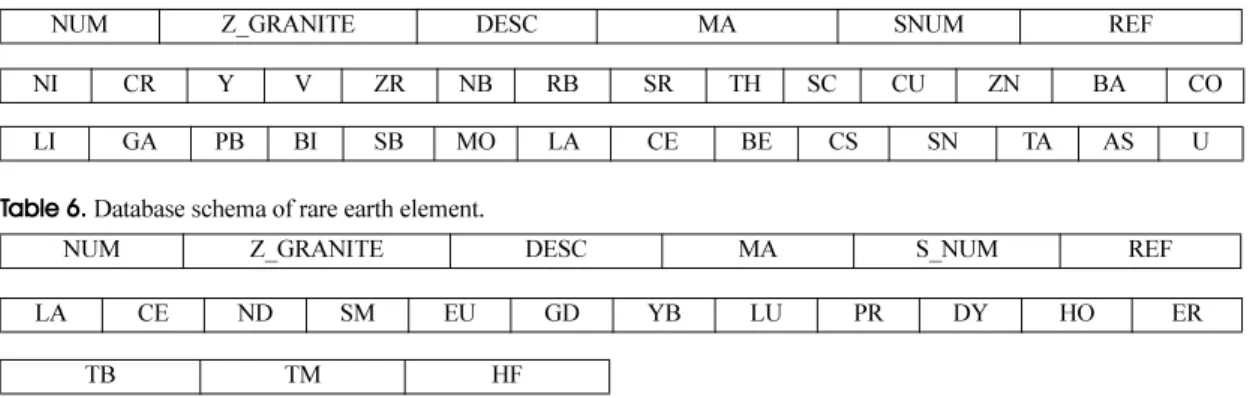
(5) 화강암정보시스템의 설계 및 구축 Database schema of source data. FID Shape. 255. Table 2.. Table 3.. RF_ABBR. RF_Name. Database schema of mode data. NUM Z_GRANITE. MA. SNUM. ORTHOCLASE APATITE. QUARTZ. CODE. PLAGIOCLASE. MICROCLINE. GARNET. HORNBLENDE. ZIRCON. CHLORITE. FLUORITE. SERICITE. Database schema of major elements. NUM Z_GRANITE DESC. REF. OPAQUES. MUSCOVITE. EPIDOTE. AMPHIBOLE. DESC. BIOTITE. K-FELDSPAR. SPHEN. Z_GRANITE. ALLANITE. CALCITE. Table 4.. AL2O3 FEO. FE2O3 P2O5. MA. MNO L.O.I. MGO H2O(+). 으로 추출하였다. 다음 Fig. 4는 모드 데이터, 주성분 원소, 미량원소, 희토류원소의 주요 성분들 추출한 것 이다. 모드 데이터는 암석의 실제 광물 조성, 흔히 질량이 나 부피 백분율로 표현된다. 주성분원소 분석은 규소 (Si), 알루미늄(Al), 철(Fe), 마그네슘(Mg), 칼슘(Ca), 나 트륨(Na), 칼륨(K), 망간(Mn), 인(P), 티탄(Ti)의 10개 원소를 산화물 형태의 중량 백분율(wt.%)로 나타낸다. 이에 추가적으로 분석 결과에 따라서 유체의 성분 (H O, CO , Cl, F)과 분석당시 시료의 손실량(LOI: Loss On Ignition)이 들어간다. 미량원소는 암석이나 광물 속에 미량으로 들어 있는 원소로서 흔적 원소라고도 한다. 지각의 평균 화학조 성을 논할 때는 주원소를 제외한 그 밖의 모든 원소를 의미한다. 여기서는 주원소와 희토류원소 14개를 제외 한 모든 원소를 미량원소로 분류했다. 분석단위는 1/ 1,000,000(ppm) 이다. 희토류원소는 주기율표에서 란탄족에 속하는 원자번 호 57에서 71까지의 15개 원소를 의미한다. 이것들의 분석치는 미량원소와 마찬가지로 ppm 단위를 이용한다. 화강암에 대한 주요 속성정보의 스키마 구성 추출된 데이터 항목은 영문화하여 필드명을 정의하 였다. 남한지역 화강암의 포인트 데이터에 있는 원본 데이터 아이템(item)들은 Table 2와 같이 공간 식별자 (FID; Feture Identifier), 공간 기하(Shape), 암상약어 (RF_ABBR), 암상명(RF_Name) 및 지역별 화강암명 2. 3.3.. SNUM. 2. DB. REF CAO. SIO2. TIO2. NA2O. H2O(-). CO2. K2O CL. F. (Z_GRANITE)으로 각 지화학 포인트들과 모드 데이터 의 공통데이터 요소가 된다(Table 2). 모드 데이터에 대한 분석 아이템은 석영(QUARTZ), 사장석(PLAGIOCLASE), 흑운모(BIOTITE), 불투명광물 (OPAQUES), 각섬석(HORNBLENDE), 정장석(ORTHOCLASE), 미사장석(MICROCLINE), 칼륨장석(KFELDSPAR), 백운모(MUSCOVITE), 저콘(ZIRCON), 녹니석(CHLORITE), 인회석(APATITE), 설석(SPHEN), 녹렴석(EPIDOTE), 석류석(GARNET), 형석(FLUORITE), 갈렴석(ALLANITE), 각섬석(AMPHIBOLE), 견운모 (SERICITE), 방해석(CALCITE)으로 총 20개로 정의. 하고 다음과 같이 조성광물의 분포에 대한 데이터 스 키마를 정의하고 이에 따라 모드 테이블을 엑셀로 작 성하였다(Table 3). 주성분원소에 대한 아이템은 이산화규소(SIO ), 산화 티탄(TIO ), 알루미나(AL O ), 산화철(FE O ), 망가나 이트(MNO), 산화마그네슘(MGO), 산화칼슘(CAO), 산 화나트륨(NA2O), 산화칼륨(K O), 일산화철(FEO), 무 수인산(P O ), 물(H O(+), H O(-)) 손실량(L.O.I), 염 소(CL), 플르오르(F)로 총 17개로 정의하고 다음과 같 이 주성분원소에 대한 데이터 스키마를 정의하고 주성 분원소 테이블을 엑셀로 작성하였다(Table 4). 미량원소에 대한 아이템은 니켈(NI), 크롬(CR), 이트 륨(Y), 바나듐(V), 지르코늄(ZR), 니오브(NB), 루비듐 (RB), 스트론튬(SR), 토륨(TH), 스칸듐(SC), 구리(CU), 아연(ZN), 바륨(BA), 코발트(CO), 리튬(LI), 갈륨(GA), 납(PB), 비스무트(BI), 안티몬(SB), 몰리브덴(MO), 라듐 (LA), 세륨(CE), 베릴륨(BE), 세슘(CS), 주석(SN), 탄탈 2. 2. 2 3. 2 3. 2. 2 5. 2. 2.
(6) 황재홍·지광훈·정원석·홍영국·류근호. 256. Database schema of trace element. NUM Z_GRANITE. Table 5.. DESC. MA. NI. CR. Y. V. ZR. NB. RB. SR. LI. GA. PB. BI. SB. MO. LA. CE. Database schema of rare earth element. NUM Z_GRANITE. SNUM. TH. SC. BE. REF. CU. CS. ZN SN. BA. CO. AS. U. TA. Table 6.. LA. CE. ND. TB. SM. DESC. EU. TM. GD. al. YB. S_NUM. LU. PR. REF. DY. HO. ER. HF. (Ta), 비소(AS), 우라늄(U)으로 총 28개로 정의하고 다 음과 같이 미량원소에 대한 데이터 스키마를 정의하고 주성분원소 테이블을 엑셀로 작성하였다(Table 5). 희토류원소에 대한 아이템은 라듐(LA), 세륨(CE), 네오디뮴(ND), 사마륨(SM), 유로퓸(EU), 가돌리늄 (GD), 이테르븀(YB), 루테튬(LU), 프라세오디뮴(PR), 디스프로(DY), 홀뮴(HO), 에르븀(ER), 테르븀(TB), 톨 륨(TM), 플루오르화수소(HF)로 총 15개로 정의하고 다음과 같이 희토류원소에 대한 데이터 스키마를 정의 하고 주성분원소 테이블을 엑셀로 작성하였다(Table 6). Table 2의 데이터 스키마와 모드 데이터, 주성분원소, 미량원소 및 희토류원소의 데이터 스키마를 테이블 조 인 연산(the operation of table join)을 통하여 각각 의 테이블로 만들었다. 조인하고자하는 두 테이블에 있 는 외부참조키(foreign key)인 Z_GRANITE 항목은 이 테이블 조인 연산을 수행하기 위해서 작성되었다. 이렇게 작성된 데이터 스키마들은 국내외 화강암의 지 화학 분석 논문들에 포함된 화강암 분석 데이터를 입 력하였다(Koh ., 1996; Kim ., 2000; Kim et. MA. et. ., 1984; Kim ., 1990; Kim ., 1992; Kim ., 2005; Kim ., 1986, 1989, 1993, 1996, 1994; Kim ., 1994; Kim ., 1997; Kim ., 1994, 1992, 1995; Kim ., 1996; Kim ., 1998; Min ., 1996; Moon 1992; Park ., 1997, 2001; Yun ., 1986a, 1986b, 1991, 1993, 1994, 1995, 1990, 1999, 2002, 2004; Lee ., 1987, 1990; Lee ., 1992, 1994; Lee ., 1992; Lee ., 1991; Lee ., 2002; Lee ., 1990, 2003; Lee, 1994; Yun ., 1990; Lee ., 2000; Lee, 1995; Lee ., 1996; Lee ., 1995; Lee ., 1994; Lee ., 2004; Lee ., 1992; Wee ., 2005; Lee ., 1992; Cho, 2000; Youn ., 1995; Sagong ., 1997, 1988; Suh ., 1986; Shin ., 1994, 1998; Chang ., 1990, 1991; Jwa, 1990, 2000; Kwon, 1995; Cho ., 1992; Cheong ., 1998; Choi ., 1994; Choe ., 1998; Cheong ., 1996; Chin ., 1995; Chang ., 1991; Hong, 1983, 1984, 1985, 1989, 1986, 1984). et al. et al. al. et. et. et al. et. al. al. et. al. et. et al. al. al. et al. et. et. al. et. al. et. et. et. et. al. et. al. et. et al. al. et. et. al. et. al. et. al. al. et al. al. et. et al. et al. al. al. et. et al. et. al. al. al. et al. et al. et al. et al. et. al. et. et al. al. et al. et. al. al. The map representation for analytical data of granites in South Korea. (a) mode data, (b) major elements, (c) rare earth elements and (d) trace elements. Fig. 5..
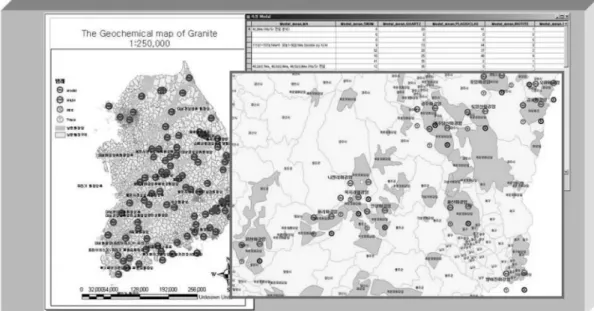
(7) 화강암정보시스템의 설계 및 구축 역 화강암들이 갖는 지화학 정보들을 비교하여 검색할 결 과 수 있다. 지화학 포인트 심벌에 대한 도식 표현 레이어 구성은 시군구읍면동 레이어 및 우리나라의 모드 데이터, 주성분원소, 미량원소 그리고 희토류원 지역별 화강암 분포도 레이어를 기본 데이터로 이용한 소와 같은 우리나라 화강암의 지화학 정보를 보다 쉽 다. 모드 데이터, 주성분원소, 미량원소 그리고 희토류원 게 볼 수 있고 통계 분석 및 비교분석이 가능하도록 소에 대한 점 기하 정보와 그와 연결된 모드데이터 및 조성광물의 분포, 주성분원소, 미량원소, 희토류원소도 지화학 속성정보를 통하여 다양한 속성 질의 뿐 아니라 로를 작성하였다(Fig. 5). 이를 통해서 우리나라 각 지 지역별 화강암에 대한 공간 분석이 가능하다(Fig. 6). 257. 4.. 4.1.. Fig. 6.. Legend, attribute table and spatial information of granites.. Fig. 7.. The distribution map of mode data for granites using bar charts..
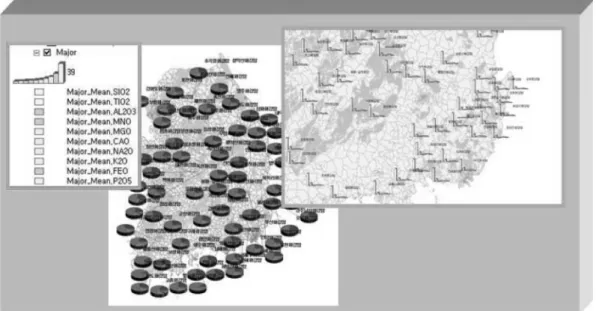
(8) 황재홍·지광훈·정원석·홍영국·류근호 우리나라 화강암의 지화학 정보 분석 4.2.2. 주성분원소 분석 우리나라 화강암에 대한 주성분원소의 분포를 우리나 4.2.1. 모드 분석 라 지역별 바 차트로 표현하여 각 지역별로 비교가 가능 우리나라 화강암에 대한 조성광물의 분포를 우리나 하다. 한 예로 각 지역별 화강암의 주성분 원소중 이산화 라 지역별 바 차트로 표현하여 각 지역별로 비교가 가 규소화가 월등이 우세하게 나타나고, 알루미늄이 두 번째 능하다. 한 예로 서울화강암을 위시한 쥬라기 화강암 로 높은 것으로 나타남을 볼 수 있으며 나머지 원소는 소 은 K-장석이 우세하고 언양-유천 화강암을 포함한 백 량으로 나타나는 것을 아래 그림에서 볼 수 있다(Fig. 8). 악기 화강암에서는 사장석의 함량이 높은 것을 한 눈 에 볼 수 있다(Fig. 7). 4.2.3. 미량원소 분석 우리나라 화강암에 대한 미량원소의 분포(니켈, 크롬,. 258. 4.2.. Fig. 8.. The distribution map of major elements for granites using pie charts.. Fig. 9.. The distribution map of trace elements for granites using pie charts..
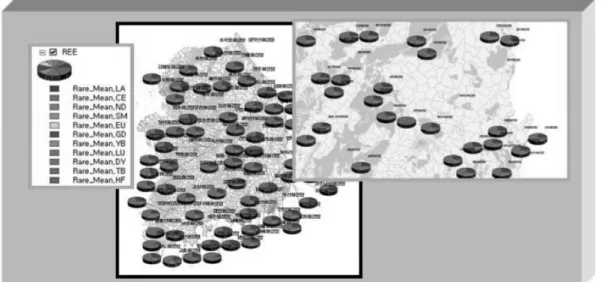
(9) 화강암정보시스템의 설계 및 구축. Fig. 10.. The distribution map of rare earth elements for granites using pie charts.. 이트륨, 바나듐, 지르코늄, 니오브, 루비듐, 스트론튬, 토 륨, 스칸듐, 구리, 아연, 바륨, 코발트, 리튬, 갈륨, 납, 비 스무트, 안티몬, 몰리브덴, 라듐, 세륨, 베릴륨, 세슘, 주 석, 칼륨, 비소)를 우리나라 지역별 파이 차트로 표현하 여 각 지역별로 비교가 가능하다. 한 예로 우라나라 화 강암에서 분포하는 미량원소 중, 주로 바륨의 함량이 높 은 것으로 나타나며, 옥천 및 보은화강암의 경우에는 루 비디늄(Rb)이 우세한 것으로 나타난다(Fig. 9). 4.2.4. 희토류 원소 분석 우리나라 화강암에 대한 희토류원소의 분포(라듐, 세 륨, 네오디뮴, 사마륨, 유로퓸, 가돌리늄, 이테르븀, 루 테튬, 프라세오디뮴, 디스프로, 홀뮴, 에르븀, 바륨, 테 르븀, 톨륨, 우라늄, 탄탈, 플루오르화수소) 를 우리나 라 지역별 바 차트로 표현하여 각 지역별로 비교가 가 능하다. 그림에서와 같이 우리나라 화강암에 대한 희 토류원소의 전반적인 분포를 살펴보면 첫 번째 세슘 (Ce), 두 번째 란타늄(La) 그리고 세 번째로 니오디늄 (Nd)이 우세한 것으로 나타난다(Fig. 10). 5.. 259. 결 론. 이 연구에서는 화강암 정보 시스템의 1차 프로토타 입으로 현재까지 국내에서 발표된 논문들의 화강암 분 석값들을 이용한 화강암 정보 시스템을 설계 및 구축 하였다. 이 시스템은 사용자 인터페이스, 데이터 변환 기, GIS 데이터베이스, 공간 객체 관리기, 질의 실행. 모듈로 구성되었으며, 클라이언트/서버 환경을 지원한 다. 구축 시스템은 Windows 2000서버와 GIS 도구인 ArcGIS 9.0을 이용하여 개발했다. 이 연구는 우리나라의 암석 데이터베이스 구축의 일 환으로 비교적 암상이 단순하고 분포면적인 넓은 화강 암 정보시스템 개발을 수행하였다. 우선 화강암 분석 정보를 크게 모드데이터 및 지화학 데이터로 나누고 데이터 항목들을 정형화하여 공간데이터베이스를 구축 하였다. 이렇게 구축된 화강암 정보 시스템은 우리나 라 전역의 모드데이터, 주성분 원소, 미량원소 및 희토 류 원소에 대해 공간 질의를 통한 데이터 검색이 가능 하도록 하였다. 특히, 질의 결과에 대해 챠트, 그래프 등의 다양한 표현을 통하여 모드데이터 및 지화학 분 석정보에 대해 우리나라의 지역별 분포를 비교 및 평 가할 수 있었다. 향후 연구에서는 우리나라의 화산암, 변성암 및 퇴적암에 대해 분석된 속성정보들을 순차적 으로 표준화하여 구축할 예정에 있다.. 사 사 이 연구는 소방방재청 자연재해저감기술개발사업(과 제명: 사이버 자연재해 기술정보 통합센터 구축) 연구 비 지원으로 수행되었으며 이에 감사드립니다.. 참고문헌 British Geological Survey(BGS), 2005, Proposals for the.
(10) 260. 황재홍·지광훈·정원석·홍영국·류근호. British Geological Survey Core Strategic Programme(2005-2010). p.1-9. British Geological Survey(Unpublished Webpage: www. bgs.ac.uk/programmes/infoserv/im/geochem.html) Chang, H.W. and Lee, K.S. (1991) Behavior of Elements in Hydrothermal Alteration Zones of Granitic Rocks : Examples from the Mugeug Granodiorite and the Naeduckri Granite, South Korea. Jour. Geol. Soc. Korea, vol.27, p.156-170. Chang, H.W. and Lee, K.S. (1991) Behavior of Elements in Hydrothermal Alteration Zones of Granitic Rocks : Examples from the Mugeug Granodiorite and the Naeduckri Granite, South Korea. Jour. Geol. Soc. Korea, vol.27, p.156-170. Chang, H.W. and Lee, K.S. (1991) Behavior of Elements in Hydrothermal Alteration Zones of Granitic Rocks: Examples from the Mugeug Granodiorite and the Naeduckri Granite, South Korea. Jour.Geol.Soc.Korea, vol. 27, p.156-170. Chang, H.W., Lee, M.S. and Cho, D.J. (1990) Comparison of Geochemical Characteristics of the Shinyemi Granite and the Imog Granite, Northeastern Part of South Korea. Jour. Geol. Soc. Korea, vol.26, p.313-323. Cheong, C.S. and Chang, H.W. (1996) Tectono - magmatism, - metamorphism, and - mineralization of the central Ogcheon belt, Korea (I) : Sr, Nd and Pb isotopic systematics and geochemistry of granitic rocks in the Boeun area. Jour. Geol. Soc. Korea. vol.32, p.91116. Cheong, C.S. and Chang, H.W. (1996) Geochemistry of the Daebo Granitic Batholith in the Central Ogcheon Belt, Korea: A Preliminary Report. Econ. Environ. Geol. vol.29, p.483-493. Cheong, C.S., Kwon, S.T., Kim, J.M. and Chang, B.U. (1998) Geochemical and Isotopic Study of the Onjeongri Granite in the Northern Gyeongsang Basin, Korea: Comparison with Cretaceous to Tertiary Granitic Rocks in the Other Part of the Gyeongsang Basin and the Inner Zone of Southwest Japan. Jour. Petrol. Soc. Korea, vol.7, p.77-97. Chin, H.I., Min, K.W., Chon, H.T. and Park, Y.S. (1995) EEG vol.28, p.123-137. Chin, H.I., Min, K.W., Chon, H.T. and Park, Y.S. (1995) Petrogeochemistry of Granitic Rocks Distributed in the Geumsan District, Korea. Econ. Environ. Geol. vol.27, p.123-137. Cho, D.L. (1992) A dissertation submitted in partial fulfillment of the requirements for the degree of Doctor of Philosophy in Geological Science, pp.189. Cho, K.S. (2000) Petrochemical Study on the Granitic Gneiss in the Gurye-Suncheon, Korea. Econ. Environ. Geol. vol.33, p.173-180. Choe, W.H. and Jwa, W.J. (1998) Petrochemical Characteristics of the Granites in the Jeomchon area. Jour. Petrol. Soc. Korea, vol.7, p.37-52. Choi, S.H. and Wee, S.M. (1994) Petrochemical Study of the Gadaeri Granite in Ulsan Area, Kyeongsang Province. Econ. Environ. Geol. vol.27, p.459-467. David R. Soller, Thomas M. Berg, and Nancy R. Stamm, USGS (2004), The National Geologic Map Database Project: Overview and Progress, p.2-4. Hee, S.G. and Jwa, Y.J. (1997) Mineral chemistry and. major element geochemistry of the granitic rocks in the Cheongsan area. Jour. Petrol. Soc. Korea, vol.6, p.185-209. Hong, Y.K. (1984) Petrology and Geochemistry of Jurassic Daejeon and Nonsan Granitoids in the Ogcheon Fold Belt, Korea. Jour. Korean Inst. Mining Geol. vol.17, p.179-195. Hong, Y.K. and Lee, B.J. (1989) Geochemical and Microstructural Studies on the Sunchang Foliated Granodiorite at a Shear Zone in the SW Part of the Ogcheon Fold Belt, Korea. Jour. Geol. Soc. Korea, vol.25, p.294-311. Hong, Y.K. (1985) Petrogenesis of the Proterozoic Granitic Rocks in the Buncheon-Seogpo Area, NE Korea. Jour. Geol. Soc. Korea, vol.21, p.196-209. Hong, Y.K. (1986) Geochemistry and K-Ar Age of the Imog Granite at the southwestern Part of the Hambaeg Basin, Korea. Jour. Korean Inst. Mining Geol. vol.19, p.97-107. Hong, Y.K. (1984) Petrology and Geochemistry of Jurassic Seoul and Anyang Granites, Korea. The journal of the Geological Society of Korea, vol. 20, p.51-71. Hong, Y.K. (1983) Petrology and Geochemistry of the Cretaceous Palgongsan Granite, Southern Korea. Jour. Korea Inst. Mining geol. vol.16, p.83-109. Hong, Y.K. (1985) Geochemistry of the Cretaceous Eonuang and Yoocheon granites in the Southeastern Korea. The Journal of the Geological Society of Korea, vol.21, p.90-108. Jwa, Y.J. and Jacques Moutte (1990) A Study on Jurassic Granitic Rocks inthe Inje-HongCheon District, South Korea. I. Trace and Rare Earth Elements Geochemistry. Jour. Geol. Soc. Korea, vol.26, p.418-427. Jwa, Y.J. and Kim, K.K. (2000) Petrology of host granites and enclaves from the Bohyeonsan area, Euiseong Basin. Jour. Petrol. Soc. Korea, vol.9, p.187-203. Kim. C.B. and Park, Y.S. (1996) The Petrochemistry and Geochronology of Plutonic Rocks in the Beolkyo Area, Chonnam. Jour. Korean Earth Science Society, vol.17, p.227-240. Kim, C.B., Yoon, C.H., Kim, J.T., Park, J.B., Kang, S.W. and Kim, D.J. (1994) Petrochemistry of Mesozoic Granites in Wolchulsan Area. Econ. Environ. Geol. vol.27, p.375-385. Kim, J.S., Lee, J.D. and Yun, S.H. (1998) Magma mingling evidence of the granitic rocks in the Geoje-island: Petrographical characteristics. Journal of the Geological Society of Korea, vol.34, p.105-121. Kim, J.S., Lee, J.D., Kim, I.S., Paik, I.S. and Choi, B.S. (2000) Petrology of enclaves in the granite around Bangeujin, Ulsan. Journal of the Geological Society of Korea. vol.36, p.73-92. Kim, J.W., and Lee, Y.J. (1984) Petrology of Granitoid in Mt. Hwawang and Mt. Young chu Area. Jour. Geol. Soc. Korea, vol.20, p.1-14. Kim, H.N., Shin, I.H., Ahan, K.S., Park W.S. and Lee, C.S. (1997) Petrochemistry and Sr · Nd Isotopic Compositions of Granitoids in the Gangjin-Jangheung Areas, Korea. Jour. Korean Earth Science Society, vol.18, p.433-442. Kim, H.N., Shin, I.H. and Ahn, K.S. (1994) Lithogeochemical Features of Granite Mass and Their.
(11) 화강암정보시스템의 설계 및 구축 Relation to Mineralization in the Dolsan Area. Jour. Korean Earth Science Society, vol.15, p.439-451. Kim, H.N. (1992) Petrochemical Study of Productive Plutons in Southern Part of Korea : with Emphasis on Granitoids in the Kwangyang, Dolsan, and Namhae areas. Jour. Korean Earth Science Society, vol.13, No.2, p.226~246. Kim, H.N. and Park, C.Y. (1995) Lithogeochemical and Mineral Chemistry Features of Granitoids and their Relation to Mineralization in the Namhae Area. Jour. Korean Earth Science Society, vol.16, p.522-535. Kim, J.S., Park, M.E. and Kim, G.S. (1998) A Geochemical Study of the Alkali Granite in the Kyeomyeongsan Formation. Econ. Environ. Geol. vol.31, p.349360. Kim, K.H. and Shin, Y.S. (1990) Petrochemistry of the Granitic Rocks in the Chungju, Wolaksan and Jecheon Granite Batholiths. Jour. Korean Inst. Mining Geol, vol.23, p.245-259. Kim, K.K., Kim, J.S. and Jwa, Y.J. (2005) Petrological Study of Cretaceous Granitic Rocks in the Waryongsan Area, Southwestern Gyeongsang Basin: Compositional Change of Granitic Rocks by Magma Mingling. Jour. Petrol. Soc. Korea, vol.14, p.12-23. Kim, S.J., Lee, H.K., Lee, C.H. and Tetsumaru Itaya (1999) K-Ar Ages and Geochemistry of Granitic Rocks in the Northeastern Gyeongsang Basin. Econ. Environ. Geol. vol.32, p.141-150. Kwon, S.T., Shin, K.B., Park, H.K. and Mertzman, S.A. (1995) Geochemistry of the Kwanaksan alkali feldspar granite: A-type granite?. Jour. Petrol. Soc. Korea, vol.4, p.31-48. Kwon, S.T., Cho, D.L., Lan, C.Y., Shin, K.B., Lee, T. and Mertzman, S.A. (1994) Petrology and geochemistry of the Seoul granitic batholith. Jour. Petrol. Soc. Korea, vol.3, p.109-127. Kim, Y.J., Cho, D.L. and Hong, S.S (1986) Petrochemical Study of Alkali Granite in northern Area of the Uljin Mine. Jour. Korean Inst. Mining Geol. vol.19, p.123131. Kim, Y.J., Park, Y.S., Choo, S.H. and Oh, M.S. (1989) The Study on the Igneous Activity in the Southeastern Zone of the Ogcheon Geosynclinal Belt, Korea(I) with the Igneous Activity in Namweon-Geochang-Sangju Area. Jour. Korean Inst. Mining Geol. vol.22, p.355370. Kim, Y.J., Oh, M.S. and Park, J.B. (1993) Petrochemical Study On the Kwangju Granite Body. Jour. Korean Inst. Mining Geol. vol.26, p.83-96. Kim, Y.J., Cho, D.L. and Lee, C.S. (1998) Petrology, Geochemistry and Tectonic Implication of the A-type Daegang granite in the Namwon area, Southwestern part of the Korean Peninsula. Econ. Environ. Geol. vol.31, p.399-413. Kim, Y.J., Oh, M.S. and Kang, S.W. (1994) Petrochemistry of Igneous Rocks in the Haenam-Gangjin Area. Jour. Korean Earth Science Society, vol.15, p.341-355. Koh, J.S., Yun, S.H. and Lee, S.W. (1996) Petrology and Geochemical Characteristics of A-type Granite with Particular Reference to the Namsan Granite, Kyeongju. Jour. Petrol. Soc. Korea, vol.5, p.142-160. Moon S.H., Park, H., Ripley, E.M. and Hur, S.D. (1998). 261. Petrochemistry and stable isotopes of granites around the Eonyang rock crystal deposits. Journal of the Geological Society of Korea, vol.34, p.211-227. Lee, C.H. and Lee, S.W. (1996) Petrology and Petrochemistry of the Granitoids in the Geoje Island, Korea. Jour. Korean Earth science Society, vol.20, p.61-79. Lee, C.L., Lee, Y.J. and Masao Hayashi. (1992) Petrology of Jurassic Granitoids in the Hamyang-Geochang Area, Korea. Jour. Korean Inst, Mining Geol. vol.25, p.447-461. Lee, C.L., Lee, Y.J. and Masao Hayashi. (1990) Petrology of Granitoids in the Vicinity of Mt. Baegma-Unnam, Southeast Kimchon, Korea. Jour. Geol. Soc. Korea, vol.26, p.527-540. Lee, C.S., Kim, Y.J., Park, C.Y. and Lee, C.J. (1992) Geochemistry of Granitoids in the KwangyangSeungju Area. Jour. Korean Inst. Mining Geol. vol.25, p.51-60. Lee, J.D., Kim, J.S., Woo, S.J., Hwang, B.H., Kim, I.S., Kim, J.S. and Paik, I.S. (2000) The Petrological Study on the Granitic Rocks in Kyeongju-Kampo Area. Jour. Petrol. Soc. Korea, vol.9, p.70-83. Lee, J.I. and Lee, M.S. (1991) Mineralogy and Petrology on the Granitic Rocks in the Youngju Area, Kyoungsang Buk-Do, Korea. Jour. Geol. Soc. Korea, vol.27, p.626-641. Lee, J.I. (1994) Major Element Geochemistry of the Shallow-depth Emplaced Granitic Rocks, Southern Part of the Kyeongsang Basin, Korea. Jour. Geol. Soc. Korea, vol.30, p.482-496. Lee, J.K. and Lee, J.Y. (1994) Trace Elements Geochemistry and Copper Mineralization of Jindong Granitic Rocks. Jour. Geol. Soc. Korea, vol.30, p.455-466. Lee, J.W. and Lee, J.G. (1992) A Geochemical Study on Trace Elements of the Onjong Granite in Relation to Mineralization, Pyeonghae Area. Jour. Korean Inst. Mining Geol. vol.25, p.245-258. Lee, J.Y. and Lee, I.H (1995) A Geochemical Study on the Behaviors of Major and Trace Elements in the Ulsan Granite and Its Contact Serpentinite. Econ. Environ. Geol. vol.28, p.53-67. Lee, J.Y., Lee, J.K., Lee, I.H. and Kim, S.W. (1994) Mineralization of Hydrothermal Ore Deposits in Relation to Chemical Variation of the Cretaceous Granitoids in the Gyeongsang Basin. Econ. Environ. Geol. vol.27, p.363-373. Lee, M.J., Lee, J.I. and Lee, M.S. (1995) Mineralogy and Major Element Geochemistry of A-type Alkali Granite in the Kyeongju Area, Korea. Jour. Geol. Soc. Korea, vol.31, p.583-607. Lee, M.S., Chang, H.W. and Kim, W.S. (1987) A Study on Samhwa Granite in the Northern Park of Mt. Taebaeg Area. Jour. Korean Earth Science Society, vol.8, p.143155. Lee, M.S., Chang, H.W. and Lee, Y.J. (1990) Geochemical Characteristics of the Imog Granite. Jour. Geol. Soc. Korea, vol.26, p.82-90. Lee, S.W., Lee, J.D. and Kim, J.J. (1992) Contact Metamorphism from the Aureoles of the Granitic Rocks, Ulsan-Eonyang Region. Jour. Korean Inst. Mining Geol. vol.25, p.463-477..
(12) 262. 황재홍·지광훈·정원석·홍영국·류근호. Lee, Y.J., Park, S.J., Jang, Y.S., Chung, W.W., Kim, J.W., Hwang, S.K. and Yun, S.H. (2004) Zircon Morphology and Petrochemistry of Mesozoic Plutonic rocks in Seonsan Area, Korea. Jour. Petrol. Soc. Korea, vol.13, p.81-102. Lee, Y.J., Ku, J.G., Jang, Y.S., Chung, W.W., Koh, I.S. and Kim, S.W. (2002) Petrology of the Cretaceous granitoids in the Gumi District, Korea. Journal of the Geological Society of Korea. vol.38, p.67-85. Min, K.W. and Kim, S.B. (1996) Geochemistry and Petrogenesis of the granitic Rocks in the Vicinity of the Mt. Sorak. Jour. Petrol. Soc. Korea vol.5, p.35-51. Natural Environment Research Council, BGS (2006), GBASE Geochemical Baseline Survey of the Environment, p.2. Park, Y.S., Kim, J.K. and Kim, J. (2001) Petrochemistry of Granitoids in the Younggwang-Kimje area, Korea. Econ. Environ. Geol. Korea, vol.34, p.55-70. Park, Y.S., Kim, C.B., Yoon, C.H. and Ahn, K.S. (1997) The Petrochemistry and Geochronology of Cretaceous Plutonic Rocks in the Koheung Area, Chonnam. Jour. Korean Earth Science Society, vol.18, p.7083. Raymond, Loren A., 2001, Petrology 2/E - The Study of Igneous Sedimentary & Metamorphic Rocks, McGraw-Hill. Sagong, H., Kwon, S.T., Jeon, E.Y. and Mertzman, S.A. (1997) Petrology and geochemistry of the Hwacheon granite. Jwa, Y.J. Ph.D Thesis in Tokyo Univ. Journal of the Geological Society of Korea. vol.33, p.99-110. Shin, I.H., Nam, K.S., Kim, H.N., Park, Y.S. and Ahn, K.S. (1994) Petrochemical Study on the Micrographic Granite in the Wando Area. Econ. Environ. Geol., vol.27, p.181-190. Shin, I.H., Park, Y.S., Park, C.Y., Jeong, Y.J. and Shigeru lizumi. (1998) Petrochemistry and Sr · Nd Isotopic Compositions of Boeun Granite, Korea. Jour. Korean Earth Science Society, vol.19, p.632-640. Suh, K.S. and Park, H.I. (1986) Mesozoic Igneous Rocks in the Bupyeong District. Jour. Korean Inst. Mining Geol., vol.19, p.179-192. Wee, S.M., Park, S.M., Choi, S.G. and Ryu, I.C. (2005) Geochemical Study of the Cretaceous Granitic Rocks in Southwestern Park of the Korean Peninsula. Econ. Environ. Geol. vol.38. Youn, S.T. and Park, H.I. (1995) Petrochemical and Fluid Inclusion Study on the Porphyritic Granite in the Yonghwa-Seolcheon Area. Econ. Environ. Geol.. vol.28, p.445-454. Yun, H.S. (1994) Physical and Chemical Characteristics of Pinkish Granite Core in the Mungyeong Area. Jour. Petrol. Soc. Korea, vol.3, p.234-240. Yun, H.S. and Kim, S.E. (1990) Petrology and Petrochemistry of the Cretaceous Granites in the Southern Mungyeong Area. Jour. Korean Inst. Mining Geol. vol.23, p.343-352. Yun, H.S. (1991) Trace Element and Mineral Chemistry of the Cretaceous Granites in the Southern Mungyeong Area. Jour. Korean Inst. Mining Geol. vol.24, p.379-391. Yun, S.H. (1986b) Petrochemiccal Study on the Cretaceous Granitic Rocks in the Southern Area of Hambaeg Basin. Jour. Korean Inst. Mining Geol. vol.19, Spec. Iss. p.175-191. Yun, S.H. (1995) Occurrence and petrochemistry of the granites in the Pocheon-Euijeongbu area. Jour. Petrol. Soc. Korea, vol.4, p.91-103. Yun, S.H. and Hwang, I.H. (1990) Petrology and Geochemical Characteristics of the Granitic Rocks in Namsan Area, Kyeongju. Jour. Korean Earth Science Society, vol.11, p.51-66. Yun, H.S. and Hong, S.S. (2003) Geochemistry of Granites in the Southern Gimcheon Area of Korea. Jour. Petrol. Soc. Korea, vol.12, p.16-31. Yun, H.S. and Hong, S.S. (2004) Petrochemical and Physical Characteristics of the Cretaceous Pink Granites in the Jinan Area. Jour. Petrol. Soc. Korea, vol.31, p.16-177. Yun, H.S., Hong, S.S. and Lee, Y.S. (2002) Petrology and petrochemistry of the Jurassic Daebo granites in the Pocheon-Gisanri area. Jour. Petrol. Soc. Korea, vol.11, p.1-16. Yun, H.S., Kim, D.O. and Park, S.H. (1999) Geochemical characteristics of Ogcheon granite in Ogcheon area. Jour. Petrol. Soc. Korea, vol.8, p.81-91. Yun, H.S. and Lee, D.S. (1986a) Petrochemical Study on the Precambrian Granitic Rocks in the Basement Area of Hambaeg Basin. Jour. Korean Inst. Mining Geol, vol.19, p.35-55. Yun, H.S., Park, Y.S., Lee, C.O., Lee, B.D. and Kim, K.S. (1993) Petrological characteristics of the granitic building stone in the Mungyeong-Sangju area. Jour. Petrol. Soc. Korea, vol.2, p.32-40. 2007년 4월 3일 원고접수, 2007년 4월 13일 게재승인..
(13)
수치
+4
관련 문서
