• 검색 결과가 없습니다.

Optimal Antithrombotic Strategy in Patients With Atrial Fibrillation After Coronary Stent Implantation

N/A
N/A
Protected

Academic year: 2022

Share "Optimal Antithrombotic Strategy in Patients With Atrial Fibrillation After Coronary Stent Implantation"

Copied!
5
0
0

로드 중.... (전체 텍스트 보기)

전체 글

(1)

578

Open Access

Optimal Antithrombotic Strategy in Patients

With Atrial Fibrillation After Coronary Stent Implantation

Sung-Won Jang, MD, Tai-Ho Rho, MD, Dong-Bin Kim, MD, Eun Joo Cho, MD, Beom-June Kwon, MD, Hun-Jun Park, MD, Woo-Seung Shin, MD, Ji-Hoon Kim, MD, Jong-Min Lee, MD,

Keon-Woong Moon, MD, Yong-Seog Oh, MD, Ki-Dong Yoo, MD, Ho-Joong Youn, MD, Man-Young Lee, MD, Wook-Sung Chung, MD, Ki-Bae Seung, MD, and Jae-Hyung Kim, MD

Division of Cardiology, Department of Internal Medicine, The Catholic University of Korea School of Medicine, Seoul, Korea

ABSTRACT

Background and Objectives: Little evidence is available on the optimal antithrombotic therapy following percutaneous cor- onary intervention (PCI) in patients with atrial fibrillation (AF). We investigated the outcomes of antithrombotic treatment strategies in AF patients who underwent PCI. Subjects and Methods: Three hundred sixty-two patients (68.0% men, mean age: 68.3±7.8 years) with AF and who had undergone PCI with stent implantation between 2005 and 2007 were enrolled.

The clinical, demographic and procedural characteristics were reviewed and the stroke risk factors as well as antithrombotic regimens were analyzed. Results: The accompanying comorbidities were as follows: hypertension (59.4%), diabetes (37.3%) and congestive heart failure (16.6%). The average number of stroke risk factors was 1.6. At the time of discharge after PCI, warfarin was prescribed for 84 patients (23.2%). Cilostazol was used in addition to dual antiplatelet therapy in 35% of the pa- tients who did not receive warfarin. The mean follow-up period was 615±385 days. The incidences of major adverse cardiac events (MACE), stroke and major bleeding were 11.3%, 3.6% and 4.1%, respectively. By Kaplan-Meier survival analysis, war- farin treatment was not associated with a lower risk of MACE (p=0.886), but it was associated with an increased risk of major bleeding (p=0.002). Conclusion: Oral anticoagulation therapy after PCI may increase hemorrhagic events in Korean AF patients. (Korean Circ J 2011;41:578-582)

KEY WORDS: Atrial fibrillation; Angioplasty; Stents; Anticoagulants; Platelet aggregation inhibitors.

Received: August 20, 2010

Revision Received: December 11, 2010 Accepted: January 12, 2011

Correspondence: Tai-Ho Rho, MD, Division of Cardiology, Department of Internal Medicine, The Catholic University of Korea School of Medi- cine, 505 Banpo-dong, Seocho-gu, Seoul 137-040, Korea

Tel: 82-2-958-2450, Fax: 82-2-968-7250 E-mail: [email protected]

• The authors have no financial conflicts of interest.

cc
This is an Open Access article distributed under the terms of the Cre- ative Commons Attribution Non-Commercial License (http://creativecom- mons.org/licenses/by-nc/3.0) which permits unrestricted non-commer- cial use, distribution, and reproduction in any medium, provided the origi- nal work is properly cited.

Introduction

Atrial fibrillation (AF) is the most common cardiac arrhy- thmia and it is associated with an increased risk of thrombo- embolic events. Oral anticoagulation with warfarin should be considered for the patients with AF and who have multiple risk factors to prevent ischemic stroke.

1)

Several meta-analy-

ses have shown that warfarin treatment in patients with non- valvular AF is associated with a lower risk of ischemic stroke and cardiovascular events, but it is also associated with an el- evated risk of major hemorrhage.

2)3)

Antithrombotic strategies become problematic when AF pa- tients who require warfarin subsequently have to undergo percutaneous coronary intervention (PCI) with stent impl- antation. The 2006 American College of Cardiology/Ameri- can Heart Association/European Society of Cardiology guide- lines on AF management

1)

suggest that the maintenance re- gimen should consist of a combination of clopidogrel plus warfarin for 9 to 12 months, followed by warfarin monoth- erapy in the absence of a coronary event. However, others have suggested different management guidelines

4)

and none of the issued guidelines have been based on prospective randomized trials.

The aim of this study was to investigate whether the use of

oral anticoagulants is associated with better clinical outcomes

(2)

in Korean AF patients who undergo PCI with stenting.

Subjects and Methods

We performed this retrospective analysis using the infor- mation obtained from the registry databases at five cardio- vascular centers. The study subjects were AF patients who un- derwent PCI with stent implantation between January 2005 and December 2007. All patients with a previous diagnosis of paroxysmal, persistent or permanent AF were enrolled, and those who developed new onset AF at the time of admission for PCI were also included.

We reviewed the procedural, patient, clinical and demo- graphic characteristics. The stroke risk factors and the anti- thrombotic therapy administered on admission and at disch- arge were recorded. The stroke risks were assessed by using the CHADS

2

scoring system (1 point each is assigned for cardiac failure, hypertension, an age over 75 years and diabetes while 2 points are assigned for a history of stroke or transient isch- emic attack).

5)

The left ventricular ejection fraction was re- corded, as was measured by transthoracic echocardiography using the modified Simpson’s method.

The individual patient management decisions were made by the attending cardiologists. All coronary procedures were decided on by the attending interventional cardiologists, as were the strategies for oral anticoagulation and antiplatelet drugs at discharge, which was based on the type of AF, the st- roke risk factors, the revascularization procedures and the types of implanted stents.

Patients were followed up at 1 to 2 month intervals in an outpatient clinic setting. The patients who were administered warfarin were monitored for prothrombin time. The warfarin doses were adjusted to maintain an international normaliz- ed ratio (INR) target range of 2.0 to 3.0. We collected total INR data for each patient and determined whether they were above, below or within the therapeutic range (2.0-3.0). The percentage of each range was averaged in all patients. Infor- mation was obtained by reviewing the medical records and by conducting telephone interviews with the patients or the patients’ families. Death was determined from the family mem- bers or from the hospital discharge summaries.

The study protocol was approved by the institutional ethics committee of each center, and written informed consent for the procedure was obtained from all patients.

End point definitions

The primary end point was defined as the occurrence of major adverse cardiac events (MACEs), which included dea- th, myocardial infarction and target vessel revascularization.

The secondary safety end points were defined as major ad- verse events (MAEs), which included any MACE, a bleeding episode or stroke during follow-up. Myocardial infarction was

diagnosed if a typical rise and fall in cardiac biochemical mar- kers {troponin or creatine kinase-MB (CK-MB)} was accom- panied by at least one of the following: symptoms of ische- mia, electrocardiography (ECG) changes indicative of new ischemia (new ST-T changes or new left bundle branch blo- ck), the development of pathological ECG Q waves, imaging evidence of a new loss of viable myocardium or a new regio- nal wall motion abnormality. Stent thrombosis was defined as symptoms suggestive of an acute coronary syndrome and angiographic confirmation of thrombosis.

Major bleeding was defined as a decrease in hemoglobin of 2 g/dL or more over a 24-hour period, the need for a tr- ansfusion of two or more units of packed red blood cells, ble- eding leading to death and bleeding at the following critical sites: intracranial, intraspinal, intraocular, pericardial, intra- articular, retroperitoneal or intramuscular bleeding with com- partment syndrome. Minor bleeding was defined as acute cli- nically overt bleeding that did not meet the criteria for major bleeding, such as nasal or gastrointestinal bleeding, hematu- ria, ecchymosis or hemoptysis.

Statistical analysis

Statistical analyses were performed using Statistical Pack- age for the Social Sciences (SPSS) version 12.0 (SPSS Inc., Chi- cago, IL, USA). The continuous variables with normal distri- butions were expressed as means±SDs and these were com- pared using an unpaired Student’s t-test and nonparametric variables were compared using a Mann-Whitney U test. Ca- tegorical variables were compared with a Fisher’s exact test or the χ

2

test, as appropriate. All comparisons were two-sided, and p<0.05 were regarded as being statistically significant.

Event-free survivals were estimated using the Kaplan-Me- ier method and they were compared using the log-rank test.

Multivariate analysis was performed using the Cox propor- tional hazard model (the ‘Enter method’). Variables that sh- owed a p<0.15 on the univariate analysis or that could influ- ence the clinical outcomes regardless of the univariate p were entered in the multivariate analysis. Variables included in the multivariate analysis were age, type of AF, hypertension, dia- betes, the previous use of clopidogrel and/or warfarin, and the total number of stents.

Results

Baseline characteristics

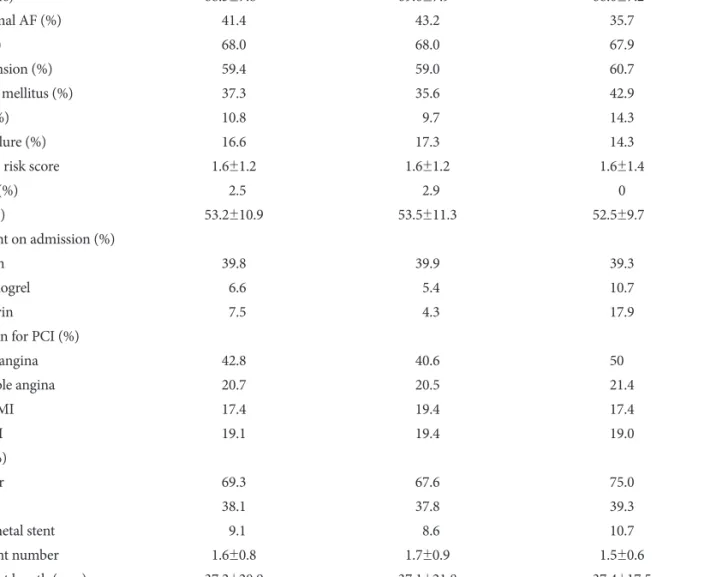
We reviewed the records of 362 patients (68.0% men, mean

age: 68.3±7.8 years). The characteristics of the study popula-

tion in relation to the use of oral anticoagulants at discharge

are shown in Table 1. The anticoagulation group was slightly

younger than the non-anticoagulation group. Of the 362 pa-

tients, 150 (41.4%) had paroxysmal AF. In total, 45.5% of pa-

tients had a CHADS

2

score of ≥2. The indications for PCI

(3)

were chronic stable angina (43%) and acute coronary syn- drome (57%). Drug-eluting stents were used in most cases and a Cypher stent (Cordis Corporation, Miami, FL, USA) was used more frequently than a Taxus stent (Boston Scienti- fic, Natick, MA, USA). Two or more stents were implanted in 43.8% of the patients.

The antithrombotic drug regiment at discharge The antithrombotic regimens used at discharge are sum-

marized in Table 2. Anticoagulation with warfarin was used in 23% of the patients. Cilostazol was used in 35% of the pa- tients who did not receive warfarin. None of the patients re- ceived monotherapy at discharge. In the anticoagulation gr- oup, 17% of the patients discontinued warfarin within 1 year due to side effects or poor compliance. Aspirin, clopidogrel and cilostazol were usually administered at least 1 year after the procedure regardless of the type of stent used. Patients on oral anticoagulation therapy had INR values in the therapeu- Table 1. Baseline characteristics classified by anticoagulation therapy at discharge

Whole cohort (n=362) Not anticoagulated (n=278) Anticoagulated (n=84) p

Age (years) 68.3±7.80 69.0±7.90 66.0±7.20 0.003

Paroxysmal AF (%) 41.4 43.2 35.7 0.224

Male (%) 68.0 68.0 67.9 0.982

Hypertension (%) 59.4 59.0 60.7 0.778

Diabetes mellitus (%) 37.3 35.6 42.9 0.229

Stroke (%) 10.8 09.7 14.3 0.236

Heart failure (%) 16.6 17.3 14.3 0.520

CHADS

2

risk score 1.6±1.2 1.6±1.2 1.6±1.4 0.997

Dialysis (%) 02.5 02.9 0 0.116

LVEF (%) 53.2±10.9 53.5±11.3 52.5±9.70 0.505

Treatment on admission (%)

Aspirin 39.8 39.9 39.3 0.916

Clopidogrel 06.6 05.4 10.7 0.086

Warfarin 07.5 04.3 17.9 <0.001

Indication for PCI (%) 0.237

Stable angina 42.8 40.6 500.

Unstable angina 20.7 20.5 21.4

NSTEMI 17.4 19.4 17.4

STEMI 19.1 19.4 19.0

Stents (%)

Cypher 69.3 67.6 75.0 0.199

Taxus 38.1 37.8 39.3 0.802

Bare metal stent 09.1 08.6 10.7 0.561

Total stent number 1.6±0.8 1.7±0.9 1.5±0.6 0.138

Total stent length (mm) 37.2±20.9 37.1±21.8 37.4±17.5 0.907

Average stent diameter (mm) 3.10±0.40 3.13±0.38 3.15±0.36 0.782

AF: atrial fibrillation, LVEF: left ventricular ejection fraction, PCI: perdutaneous coronary intervention, NSTEMI: non-ST elevation myocar- dial infarction, STEMI: ST elevation myocardial infarction

Table 2. Antithrombotic regimens adopted in AF patients at discharge

Antithrombotic regimen, n (%) Whole cohort (n=362) Chronic AF (n=212) Paroxysmal AF (n=150)

Aspirin+clopidogrel 182 (50.3) 102 (48.1) 80 (53.3)

Aspirin+clopidogrel+warfarin 073 (20.2) 046 (21.7) 27 (18.0)

Aspirin+clopidogrel+cilostazol 093 (25.7) 054 (25.5) 39 (26.0)

Aspirin+clopidogrel+cilostazol+warfarin 08 (2.2) 05 (2.4) 3 (2.0)

Aspirin+cilostazol 03 (0.8) 02 (0.9) 1 (0.7)

Clopidogrel+warfarin 03 (0.8) 03 (1.4) 0 (0)0.

AF: atrial fibrillation

(4)

tic range (2.0-3.0) 52% of the time; 27% of the time they were below and 21% of the time, they were above 3.0.

Clinical outcomes

Clinical follow-up records were analyzed for the patients (average length of follow-up: 615±385 days). Clinical events during follow-up and according to the use of oral anticoagu- lants are summarized in Table 3. The use of warfarin did not affect the MACEs or MAEs by Kaplan-Meier survival analy- sis (Log-Rank test) (Fig. 1). On the Cox regression analysis, diabetes was an independent predictor of both MACEs {haz- ard ratio (HR)=1.775; 95% confidence interval (CI): 1.142 to 2.760} and MAEs (HR=4.543; 95% CI: 2.260 to 9.131), but anticoagulation with warfarin was not (HR=0.943 with 95%

CI, 0.556 to 1.593 and HR=0.755 with 95% CI, 0.346 to 1.649, respectively). In addition, multivariate analysis for major ble- eding was performed. Independent predictors for major ble- eding were total stent number (HR=2.020 with CI, 1.045 to 3.943) and warfarin use (HR=7.564 with CI, 2.051 to 27.895).

Discussion

The aim of this study was to investigate whether oral anti- coagulation adds benefit to the antiplatelet therapy in Asian AF patients who underwent PCI with stent implantation. In this study, the occurrence of clinical events was found to be independent of warfarin use at discharge. Ruiz-Nodar et al.

6)

reported that warfarin could reduce MACEs primarily by re- ducing target vessel failure and death in a study that focused on a similar group of patients. In that study, the commonly used regimen for those who do not receive warfarin was a combination of aspirin and clopidogrel. None of the patients received cilostazol as an antithrombotic agent. In our study, cilostazol was used in 35% of the non-anticoagulation group.

Recent studies have shown that adding cilostazol to aspirin and clopidogrel can reduce the incidence of target lesion re- vascularization in patients who have undergone PCI with drug-eluting stents.

7)

Women, diabetics and those having mul- tivessel disease or a long stent length are more likely to bene- Table 3. Clinical events during follow-up

Event, n (%) Not anticoagulated (n=278) Anticoagulated (n=84) p

Death 23 (8.3) 03 (3.6) 0.144

AMI 04 (1.4) 03 (3.6) 0.206

TLR 12 (4.3) 01 (1.2) 0.132

Stent thrombosis 04 (1.4) 03 (3.6) 0.206

Major bleeding 06 (2.2) 09 (10.7) 0.002

Minor bleeding 03 (1.1) 02 (2.4) 0.329

Stroke 12 (4.3) 01 (1.2) 0.314

MACE 43 (15.5) 10 (11.9) 0.849

MAE 64 (23.0) 22 (26.2) 0.550

AMI: acute myocardial infarction, TLR: target vessel revascularization, MACE: major adverse cardiac event, MAE: major adverse event

Fig. 1. Kaplan-Meier survival curves in relation to the use of anticoagulants drugs at discharge. A: major adverse cardiovascular events, p=0.886. B: major adverse events, p=0.637. Solid and dotted line indicates no anticoagulation use and anticoagulation use at discharge, respectively.

1.0 0.8 0.6 0.4 0.2 0.0

1.0 0.8 0.6 0.4 0.2 0.0 Days of follow up

Major adverse cardiovascular events

Days of follow up Major adverse events

Ev en t-f re e s ur vi va l Ev en t-f re e s ur vi va l

0 500 1,000 1,500 2,000 0 500 1,000 1,500 2,000

A B

(5)

fit from triple antiplatelet therapy.

8)9)

In our study’s non-anti- coagulation group, the mean total stent length was 37.1 mm and 35.6% of the patients had diabetes; these patients might have derived some benefit from a triple antiplatelet regimen.

The incidence of ischemic stroke in the non-anticoagula- tion group was not significantly different from that in the anticoagulation group. ACTIVE-W study showed that war- farin is superior to clopidogrel plus aspirin for the preven- tion of vascular events in patients with AF.

10)

Dose adjustment and close monitoring of the prothrombin time are prerequi- sites for successful anticoagulation therapy. In a subanalysis of the ACTIVE-W study, inadequate control of the INR did not provide benefit of oral anticoagulation over dual anti- platelet therapy.

11)

In our study, patients in the oral anticoag- ulation group had an INR value within the therapeutic range 52% of the time, which is low compared with 64% in the AC- TIVE-W study. This might compromise the benefit of anti- coagulation therapy.

The incidence of major bleeding in the oral anticoagula- tion group was significantly higher than that in the non-an- ticoagulation group. A combination of antiplatelet and anti- coagulation drugs usually carries a greater risk of bleeding than that of each drug alone.

12)

In addition, Asians are more vulnerable to major bleeding and intracranial hemorrhage than are non-Asians in the context of warfarin use.

13)14)

The war- farin dose requirements are affected by polymorphisms in P450 cytochrome CYP2C9,

15)

and by variants in the gene ex- pressing vitamin K epoxide reductase complex 1 (VKORC1), which is the target enzyme of warfarin.

16)

Therefore, Asians may require a lower warfarin dosage and this is probably due to the differences in the allelic frequencies of the CYP2C9 and VKORC1 variants.

17)

This study has several limitations. First, given the low rate of bleeding events, the power of the study to detect significant differences in MACEs was limited. Second, the follow-up periods varied widely because of the retrospective design of the study. Third, the interval of INR measurement for pa- tients on the oral anticoagulation group was also variable in each patient.

In conclusion, oral anticoagulation therapy after PCI may increase hemorrhagic events in Korean AF patients. Warfa- rin should be administered more carefully in these patients.

REFERENCES

1) Fuster V, Ryden LE, Cannom DS, et al. ACC/AHA/ESC 2006 guide- lines for the management of patients with atrial fibrillation-executive summary: a report of the American College of Cardiology/American Heart Association Task Force on Practice Guidelines and the Europe- an Society of Cardiology Committee for Practice Guidelines (Writing Committee to Revise the 2001 Guidelines for the Management of Pa-

tients With Atrial Fibrillation). J Am Coll Cardiol 2006;48:854-906.

2) van Walraven C, Hart RG, Singer DE, et al. Oral anticoagulants vs as- pirin in nonvalvular atrial fibrillation: an individual patient meta-an- alysis. JAMA 2002;288:2441-8.

3) Aguilar MI, Hart R, Pearce LA. Oral anticoagulants versus antiplate- let therapy for preventing stroke in patients with non-valvular atrial fibrillation and no history of stroke or transient ischemic attacks. Co- chrane Database Syst Rev 2007:CD006186.

4) Lip GY, Karpha M. Anticoagulant and antiplatelet therapy use in pa- tients with atrial fibrillation undergoing percutaneous coronary inter- vention: the need for consensus and a management guideline. Chest 2006;130:1823-7.

5) Gage BF, Waterman AD, Shannon W, Boechler M, Rich MW, Rad- ford MJ. Validation of clinical classification schemes for predicting st- roke: results from the National Registry of Atrial Fibrillation. JAMA 2001;285:2864-70.

6) Ruiz-Nodar JM, Marin F, Hurtado JA, et al. Anticoagulant and anti- platelet therapy use in 426 patients with atrial fibrillation undergoing percutaneous coronary intervention and stent implantation implica- tions for bleeding risk and prognosis. J Am Coll Cardiol 2008;51:

818-25.

7) Lee SW, Park SW, Kim YH, et al. Comparison of triple versus dual antiplatelet therapy after drug-eluting stent implantation (from the DECLARE-Long trial). Am J Cardiol 2007;100:1103-8.

8) Han Y, Li Y, Wang S, et al. Cilostazol in addition to aspirin and clo- pidogrel improves long-term outcomes after percutaneous coronary intervention in patients with acute coronary syndromes: a randomized, controlled study. Am Heart J 2009;157:733-9.

9) Yang TH, Kim DI, Kim JY, et al. Comparison of triple anti-platelet therapy (aspirin, clopidogrel, and cilostazol) and double anti-platelet therapy (aspirin and clopidogrel) on platelet aggregation in type 2 di- abetic patients undergoing drug-eluting stent implantation. Korean Circ J 2009;39:462-6.

10) Connolly S, Pogue J, Hart R, et al. Clopidogrel plus aspirin versus oral anticoagulation for atrial fibrillation in the Atrial fibrillation Clo- pidogrel Trial with Irbesartan for prevention of Vascular Events (AC- TIVE W): a randomised controlled trial. Lancet 2006;367:1903-12.

11) Connolly SJ, Pogue J, Eikelboom J, et al. Benefit of oral anticoagu- lant over antiplatelet therapy in atrial fibrillation depends on the qual- ity of international normalized ratio control achieved by centers and countries as measured by time in therapeutic range. Circulation 2008;

118:2029-37.

12) Sorensen R, Hansen ML, Abildstrom SZ, et al. Risk of bleeding in patients with acute myocardial infarction treated with different com- binations of aspirin, clopidogrel, and vitamin K antagonists in Den- mark: a retrospective analysis of nationwide registry data. Lancet 2009;374:1967-74.

13) Shen AY, Yao JF, Brar SS, Jorgensen MB, Chen W. Racial/ethnic dif- ferences in the risk of intracranial hemorrhage among patients with atrial fibrillation. J Am Coll Cardiol 2007;50:309-15.

14) Suzuki S, Yamashita T, Kato T, et al. Incidence of major bleeding com- plication of warfarin therapy in Japanese patients with atrial fibrill- ation. Circ J 2007;71:761-5.

15) Higashi MK, Veenstra DL, Kondo LM, et al. Association between CYP2C9 genetic variants and anticoagulation-related outcomes dur- ing warfarin therapy. JAMA 2002;287:1690-8.

16) Li T, Lange LA, Li X, et al. Polymorphisms in the VKORC1 gene are strongly associated with warfarin dosage requirements in patients re- ceiving anticoagulation. J Med Genet 2006;43:740-4.

17) Rieder MJ, Reiner AP, Gage BF, et al. Effect of VKORC1 haplotypes on transcriptional regulation and warfarin dose. N Engl J Med 2005;

352:2285-93.

수치

Table 2. Antithrombotic regimens adopted in AF patients at discharge
Fig. 1. Kaplan-Meier survival curves in relation to the use of anticoagulants drugs at discharge

참조

관련 문서