20세 이상 한국인에서 상대 악력과 제2형 당뇨병과의 관련성
최은영
단국대학교 의과대학 단국대학교병원 가정의학과
The Association of Relative Handgrip Strength with Type 2 Diabetes among Koreans Aged 20 Years or More
Eun Young Choi
Department of Family Medicine, Dankook Univeristy Hospital, Dankook University College of Medicine, Cheonan, Korea
Background: Handgrip strength is a simple, convenient and economic tool measuring the muscle strength. A few studies investigated the relationship between diabetes and handgrip strength but the results are conflicting.
This study investigated the association of handgrip strength with diabetes among the adult Koreans.
Methods: This cross-sectional study analyzed data from participants aged 20 years or more (n=8,082) who measured height, weight, handgrip strength and fasting blood glucose in the 2014-2015 Korea National Health and Nutrition Examination Survey. Relative handgrip strength (RHGS) was defined as the sum of the greatest handgrip strengths in both hands divided by body mass index. To investigate the association of diabetes with handgrip strength, complex sample multivariate logistic regression analyses were done after adjusting for soci- oeconomic (age, sex, education), lifestyle (smoking, alcohol drinking, physical activity, obesity) and comorbid (chronic obstructive pulmonary disease, stroke, coronary artery disease, arthritis) variables. Stratified analysis were done according to socioeconomic and lifestyle variables.
Results: The prevalence of diabetes was 8.3% (standard error, 0.4). After adjusting for socioeconomic, lifestyle, and comorbid variables, the risk of diabetes increased according to the decrease in sex-specific quartile of RHGS (Ptrend<0.001). Individuals with lower RHGS (per 1 standard deviation decrease) had higher odds of dia- betes (adjusted odds ratio, 1.6; 95% confidence interval, 1.3-2.0). Furthermore, lower RHGS was associated with higher odds for diabetes throughout the strata of socioeconomic and lifestyle variables.
Conclusions: This population-based, nationally representative study suggests that lower RHGS is associated with the increased risk of diabetes regardless of socioeconomic and lifestyle variables.
Korean J Health Promot 2019;19(2):77-83
Keywords: Hand strength, Diabetes mellitus, type 2, KNHANES
■ Received: Mar. 22, 2019 ■ Revised: May 31, 2019 ■ Accepted: Jun. 11, 2019
■Corresponding author : Eun Young Choi, MD, PhD
Department of Family Medicine, Dankook Univeristy Hospital, Dankook Univeristy College of Medicine, 119 dandae-ro, Dongnam-gu, Cheonan 31116, Korea
Tel: +82-41-550-3998, Fax: +82-41-550-3998 E-mail: [email protected]
Copyright ⓒ 2019 The Korean Society of Health Promotion and Disease Prevention
This is an Open Access article distributed under the terms of the Creative Commons Attribution Non-Commercial License (http://creativecommons.org/licenses/by-nc/3.0/), which permits unrestricted noncommercial use, distribution, and reproduction in any medium, provided the original work is properly cited.
서 론
1980년대 전 세계적인 당뇨병의 유병률은 남성에서 4.3%,
여성에서 5.0%였으나, 2014년 남성 9.0%, 여성 7.9%로 증가 하였으며, 선진국보다는 개발도상국에서 급격히 증가하는 추 세이다.1) 한국도 예외는 아니어서 30세 이상 한국인에서 당뇨 병의 유병률은 2001년 8.8%에서 2017년 10.4%로 증가하였 다.2) 당뇨병은 만성 질환으로 시력 상실, 만성 콩팥병, 하지 절단 및 심혈관질환 등의 합병증을 증가시켜 삶의 질을 떨어 뜨리는 질환으로 서구적인 식사 패턴으로의 변화와 비활동성 의 증가로 당뇨병과 그 합병증의 증가는 앞으로도 계속될 것으로 예상된다.3) 따라서, 이로 인한 의료비의 증가와 삶의 질 감소는 보건학적으로 문제가 될 것이다.
악력은 근력을 평가하는 단순하고 간편하며 경제적인 도 구로 앉아서 측정한 악력은 상체 근육의 힘만을 반영하지 만, 서서 측정하는 악력은 하체와 중심 근육의 힘을 반영하 는 것으로 알려져 있다.4) 악력은 근육 양과 질 감소의 지표 로서 과거 연구에서 노쇠,5) 심혈관질환과 암으로 인한 조기 사망,6) 폐경기 여성의 골밀도와 관련이 있는 것으로 나타났 다.7) 그러나 악력은 체질량과 관련되어 있어 질량이 혼란변 수로 작용할 수 있으므로 악력과 다른 질환과의 관련성을 조사할 때 절대 악력을 체질량지수로 나눈 상대 악력을 사 용할 것을 권고하고 있다.8) 미국과 대만인들을 대상으로 한 연구에서도 상대 악력이 다른 지표들보다 심혈관질환의 지 표들과 더 관련성이 있는 것으로 나타났다.4,9)
근육이 에너지 대사에 관여하기 때문에 근육 양의 감소가 당뇨병과 관련되어 있다는 연구는 많이 있지만,10,11) 악력으 로 나타나는 근육 기능의 저하와 당뇨병 간의 관련성에 관 한 연구는 아직 많지 않다. 악력의 감소가 당뇨병 발생을 예 측한다는 보고도 있지만,12,13) 그렇지 않다는 보도도 있어 아 직 논란의 소지가 있다.14) 악력의 크기는 인종마다 다른 것 으로 알려져 있는데,15) 한국인에서 악력과 당뇨병 간의 관 련성을 본 연구는 드물고,16) 상대 악력을 통하여 당뇨병과 악력과의 관련성을 본 연구는 아직 없다. 따라서, 본 연구는 2014-2015년 국민건강영양조사 자료를 사용하여 20세 이상 한국 성인에서 상대 악력과 당뇨병과의 관련성을 살펴볼 것 이며, 인구사회학적 요인이나 생활습관에 따른 계층에 따라 상대 악력과 당뇨병과의 관련성에 차이가 있는지 살펴볼 것 이다.
방 법
1. 연구 대상
2014년도부터 2015년까지 시행된 국민건강영양조사 중 검진 조사에 참여한 14,930명의 대상자 중 20세 미만 (n=3,178)의 대상자와 체중과 키를 측정하지 않은 대상자 (n=620), 악력을 측정하지 않은 대상자(n=1,478)와 혈당을 측정하지 않거나 당뇨병 설문에 응답하지 않은 대상자 (n=1,572)를 제외하고 총 8,082명을 대상으로 자료를 분석하 였다.
2. 체질량지수와 공복혈당 측정
체중은 겉옷을 탈의한 후 얇은 가운을 입힌 채로 체중계 (Giant 150N; HANA Co Ltd, Seoul, Korea)로 0.1 kg 단위 까지 측정하였다. 신장은 신발을 벗고 신장계(850-2,060 mm;
Holtain Ltd, Crymych, United Kingdom)로 0.1 cm 단위까
지 측정하였으며, 체질량지수(body mass index, BMI)는 kg/m2로 계산하였다. 공복 상태에서 채혈하였고, 채혈하고 24시간 이내에 분석하였다. 혈당 분석기로는 Hitachi 7600 자동 분석기(Hitachi, Tokyo, Japan)를 이용하였으며, hex- okinase UV 방법을 사용하였다.
3. 악력 측정
악력을 측정하기 어려운 기능상의 제약이 있거나 최근 3개월 이내 손목 수술 병력이나 통증 등의 불편감으로 조 사하는 데에 어려움이 있는 경우는 측정에서 제외하였다.
악력 측정은 디지털 악력계(T.K.K.5401, Takei Scientific Instruments Co., Ltd., Tokyo, Japan)를 사용하였고, 일어선 상태에서 3초간 악력계를 있는 힘껏 꽉 잡아서 측정하였다.
주로 사용하는 손부터 시작하여 양손을 교차하여 3회를 측 정하였고, 양손 측정 후에는 60초간 휴식 시간을 부여하였 다. 주로 사용하는 손의 악력은 주로 사용하는 손에서 측정 한 3번의 악력 중 최대 악력으로 정의하였으며, 절대 악력은 양손에서 측정한 최대 악력값의 합으로 정의하였다.4) 상대 악력은 절대 악력을 BMI로 나눈 값으로 정의하였다.4) 4. 변수의 범주화
연령은 60세 미만과 60세 이상으로 구분하였으며, 비만은 25 kg/m2을 기준으로 비만과 정상으로 구분하였다.17) 담배 를 전혀 피우지 않거나, 과거에 흡연을 하였다고 응답한 사 람을 비흡연자로, 현재에 흡연을 하고 있다고 응답한 사람 을 흡연자로 정의하였다. 음주는 최근 1년 동안 한달에 1회 이상 음주한 적이 있는 경우를 음주자로, 그렇지 않은 경우 를 비음주자로 구분하였고, 교육 수준은 대졸 미만과 대졸 이상의 두 그룹으로 분류하였다. 일주일에 중강도 신체활동 을 150분 이상 또는 고강도 신체활동을 75분 이상 또는 중 강도와 고강도 신체활동을 섞어서(고강도 1분은 중강도 2분) 각 활동에 상당하는 시간을 실천하는 경우를 신체 활동군으 로 정의하였다. 당뇨병은 공복혈당이 126 mg/dL 이상이거 나 의사로부터 당뇨병으로 진단받거나 혹은 당뇨병으로 인 슐린이나 약물 치료를 받는 경우로 정의하였다.18) 만성 폐 쇄성 폐질환과 뇌졸중은 과거에 의사로부터 진단받은 적이 있는 경우로 정의하였으며, 관상동맥질환은 과거에 의사로 부터 심근경색이나 협심증으로 진단받은 적이 있는 경우로 정의하였다. 관절염은 과거에 의사로부터 퇴행성 관절염이 나 류마티스 관절염이 있는 것으로 진단받은 경우로 정의하 였다.
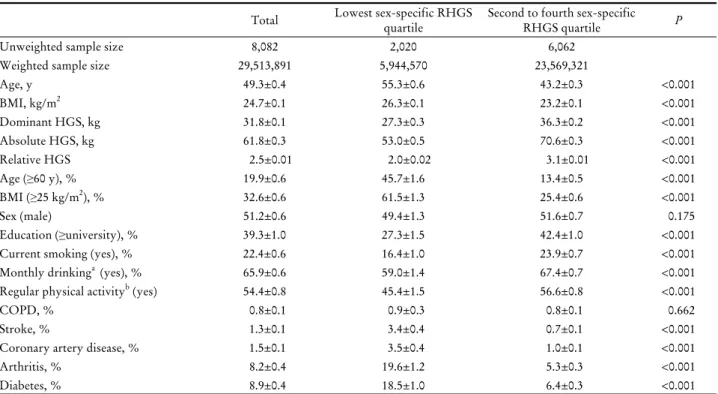
Table 1. Characteristics of participants according to the sex-specific relative handgrip strength quartile (lowest vs. those with higher)
Total Lowest sex-specific RHGS
quartile Second to fourth sex-specific
RHGS quartile P
Unweighted sample size 8,082 2,020 6,062
Weighted sample size 29,513,891 5,944,570 23,569,321
Age, y 49.3±0.4 55.3±0.6 43.2±0.3 <0.001
BMI, kg/m2 24.7±0.1 26.3±0.1 23.2±0.1 <0.001
Dominant HGS, kg 31.8±0.1 27.3±0.3 36.3±0.2 <0.001
Absolute HGS, kg 61.8±0.3 53.0±0.5 70.6±0.3 <0.001
Relative HGS 2.5±0.01 2.0±0.02 3.1±0.01 <0.001
Age (≥60 y), % 19.9±0.6 45.7±1.6 13.4±0.5 <0.001
BMI (≥25 kg/m2), % 32.6±0.6 61.5±1.3 25.4±0.6 <0.001
Sex (male) 51.2±0.6 49.4±1.3 51.6±0.7 0.175
Education (≥university), % 39.3±1.0 27.3±1.5 42.4±1.0 <0.001
Current smoking (yes), % 22.4±0.6 16.4±1.0 23.9±0.7 <0.001
Monthly drinkinga (yes), % 65.9±0.6 59.0±1.4 67.4±0.7 <0.001
Regular physical activityb (yes) 54.4±0.8 45.4±1.5 56.6±0.8 <0.001
COPD, % 0.8±0.1 0.9±0.3 0.8±0.1 0.662
Stroke, % 1.3±0.1 3.4±0.4 0.7±0.1 <0.001
Coronary artery disease, % 1.5±0.1 3.5±0.4 1.0±0.1 <0.001
Arthritis, % 8.2±0.4 19.6±1.2 5.3±0.3 <0.001
Diabetes, % 8.9±0.4 18.5±1.0 6.4±0.3 <0.001
Abbreviations: BMI, body mass index; COPD, chronic obstructive pulmonary disease; HGS, handgrip strength; RHGS, relative handgrip strength.
Values are represented as weighted means or weighted proportions with standard error for continuous or for categorical variables.
P using complex sample cross-tab analysis or linear regression analysis.
aDefined as those consuming alcohol more than once per month in the past year.
bDefined as those engaging in moderate-intensity physical activity at least 150 minutes per week, or high-intensity physical activity for 75 mi- nutes or combination of both (1min of high-intensity physical activity equaled 2 minutes of moderate-intensity activity).
5. 통계
국민건강영양조사는 복합표본설계에 의한 자료이기 때문 에 모든 분석은 가중치와 층화변수, 집락변수를 고려하여 복 합표본분석 통계 방법을 이용하였고, 가중치는 2014년부터 2015년까지의 가중치를 통합하여 사용하였다. 편향된 결과 를 방지하기 위해서 제외된 대상자들은 하위집단으로 간주 하였다. 남성과 여성의 상대 악력을 성별 특이 4분위로 나누 고, 최하위 4분위군과 나머지 상위 1, 2, 3사분위로 양분하여 대상자들의 특성을 기술하였다. 연속변수는 평균과 표준오 차로, 이산변수는 퍼센트와 표준오차로 표시하였다. 상대 악 력의 성별 특이 4분위에서 당뇨병의 유병률을 산출하였다.
인구사회학적 요인(연령, 성별, 교육)과 생활습관요인(흡연, 음주, 규칙적인 신체활동, 비만), 동반질환(만성 폐쇄성 폐질 환, 뇌졸중, 관상동맥질환, 관절염) 등을 보정하여 다중 로지 스틱 회귀분석을 통하여 상대 악력의 성별 특이 4분위 각각 의 당뇨병의 오즈비와 상대 악력 4분위가 1표준편차 감소함 에 따른 당뇨병의 오즈비를 구하였다. 상대 악력의 성별 특이
4분위를 연속변수로 처리하고 다중회귀분석을 사용하여 경 향 분석을 시행하였다. 인구사회학적 요인과 생활습관요인 에 따른 각 계층별로 상대 악력과 당뇨병과의 관련성을 조사 하기 위하여 층화한 변수를 제외한 나머지 혼란변수들을 보 정하여 다중 로지스틱 회귀분석을 시행하였다. 통계분석 팩 키지로는 SPSS ver. 25.0 (IBM Co., Armonk, NY, USA)을 사용하였으며, P값은 0.05 미만일 때 유의한 것으로 간주하 였다.
결 과
8,082명의 대상자의 평균 연령은 49.3세(표준오차, 0.3)였 고, 20세 이상 성인에서 당뇨병의 유병률은 8.3% (표준오차, 0.4)였다. 상대 악력의 성별 특이 최하위 4분위군과 나머지 상위 1, 2, 3사분위로 양분하여 대상자의 특성을 살펴 보았 다. 당뇨병의 유병률은 최하위 4분위에서는 18.5% (표준오 차, 1.0)로 나머지 상위 4분위 6.0% (표준오차, 0.3)보다 유의 하게 높았다(P<0.001). 상대 악력의 성별 특이 최하위 4분위
Table 2. Odds ratios for diabetes mellitus with the change in relative handgrip strength and the sex-specific relative handgrip strength quartiles
1 SD decrease of RHGS Sex-specific RHGS quartiles
Ptrend
Lowest Second Third Highest
Age and sex-adjusted 2.0 (1.8-2.3) 4.7 (3.4-6.5) 2.8 (2.0-4.0) 2.6 (1.8-3.7) 1.0 <0.001
Model I 1.8 (1.5-2.3) 3.4 (2.3-5.2) 2.1 (1.4-3.3) 2.1 (1.4-3.3) 1.0 <0.001
Model II 1.6 (1.3-2.0) 2.7 (1.8-4.3) 1.9 (1.2-2.9) 1.9 (1.3-2.8) 1.0 <0.001
Abbreviations: SD, standard deviation; RHGS, relative handgrip strength.
Values are represented as odds ratio (95% confidence interval).
P by complex sample logistic regression model after adjusting age group, sex, education, physical activity, alcohol use, smoking status, co- morbidity (chronic obstructive pulmonary disease, stroke, coronary artery disease, arthritis) in model I; confounding factors in model I and obesity in Model II.
Table 3. Odds ratios for diabetes mellitus with the change in relative handgrip strength and the sex-specific relative handgrip strength quartiles according to demographic characteristics and health behaviors
1 SD decrease of
RHGS
Sex-specific RHGS quartiles
Ptrend
Lowest Second Third Highest
Sexa
Men 1.6 (1.3-2.0) 2.7 (1.6-4.6) 1.8 (1.1-3.1) 1.8 (1.1-2.9) 1.0 0.001
Women 1.9 (1.2-2.9) 3.1 (1.6-6.4) 2.1 (1.1-4.1) 2.2 (1.2-4.3) 1.0 0.007
Ageb, y
<60 1.9 (1.5-2.6) 3.1 (1.7-5.5) 2.1 (1.2-3.7) 2.0 (1.2-3.4) 1.0 <0.001
≥60 1.4 (1.1-1.7) 1.8 (1.0-3.0) 1.1 (0.6-1.9) 1.3 (0.7-2.2) 1.0 0.012
BMIc, kg/m2
<25 1.6 (1.2-2.1) 2.6 (1.5-4.3) 2.0 (1.2-3.2) 1.7 (1.1-2.6) 1.0 <0.001
≥25 1.7 (1.2-2.3) 2.4 (0.9-6.4) 1.3 (0.5-3.5) 1.8 (0.7-4.9) 1.0 0.032
Educationd
<University 1.5 (1.2-1.8) 2.5 (1.5-4.1) 1.9 (1.2-3.1) 2.0 (1.2-3.1) 1.0 0.001
≥University 2.2 (1.4-3.8) 3.5 (1.4-5.7) 2.4 (1.5-3.7) 2.1 (1.3-3.3) 1.0 0.005
Current smokinge
No 1.4 (1.2-1.8) 2.5 (1.5-4.1) 1.9 (1.2-3.1) 2.0 (1.2-3.1) 1.0 0.001
Yes 2.2 (1.5-3.3) 3.9 (1.8-8.2) 1.3 (0.6-2.7) 1.6 (0.8-3.3) 1.0 0.002
Monthly drinkingf
No 1.6 (1.2-2.2) 3.9 (1.9-8.0) 2.4 (1.2-4.9) 4.1 (2.0-8.4) 1.0 0.010
Yes 1.7 (1.3-2.1) 2.5 (1.5-4.2) 1.7 (1.0-2.8) 1.3 (0.8-2.1) 1.0 <0.001
Regular physical activityg
No 1.6 (1.2-2.1) 2.1 (1.2-3.5) 1.2 (0.7-2.0) 1.4 (0.8-2.2) 1.0 0.012
Yes 1.7 (1.3-2.2) 3.4 (1.7-6.6) 2.8 (1.4-5.6) 2.6 (1.4-4.9) 1.0 0.001
Abbreviations: SD, standard deviation; RHGS, relative handgrip strength.
aValues are represented as odds ratio (95% confidence interval) after adjusting for confounding factors (age group, sex, education, physical ac- tivity, alcohol use, smoking status, obesity, COPD, stroke, coronary artery disease, arthritis) except for sex.
bAll confounding factors except for age group using complex logistic regression model.
cAll confounding factors except for obesity using complex logistic regression model.
dAll confounding factors except for education using complex logistic regression model.
eAll confounding factors except for smoking using complex logistic regression model.
fAll confounding factors except for alcohol drinking using complex logistic regression model.
gAll confounding factors except for physical activity using complex logistic regression model.
인 군에서는 주로 사용하는 손의 악력과 절대 악력 및 상대 악력은 유의하게 낮았으며(P<0.001), 60세 이상, 비만, 뇌졸 중, 관상동맥질환, 관절염을 동반한 비율이 유의하게 높았 고(P<0.001), 흡연자, 대졸 이상, 음주자, 규칙적인 신체활동
군의 비율은 유의하게 낮았다(P<0.01). 남성과 여성의 비율 이나 만성 폐쇄성 폐질환의 비율은 양 군 간에 차이가 없었 다(Table 1).
상대 악력의 성별 특이 4분위에 따른 당뇨병의 유병률은
최하위 4분위부터 각각 18.5% (표준오차, 1.0), 9.7% (표준 오차, 0.7), 7.7% (표준오차, 0.7), 2.7% (표준오차, 0.4)로, 상 대 악력이 감소할수록 당뇨병의 유병률이 유의하게 증가하
였다(Ptrend<0.001). 상대 악력이 당뇨병의 유병률에 미치는
영향을 살펴 보고자 인구사회적 요인(연령, 성별, 교육)과 생활습관요인(흡연, 음주, 규칙적인 신체활동, 비만), 동반한 질병(만성 폐쇄성 폐질환, 뇌졸중, 관상동맥질환, 관절염) 등을 보정하여 다중 로지스틱 회귀분석을 시행하였다. 비만 을 보정하지 않은 모델 I에서는 상대 악력이 1표준편차 감 소함에 따라 당뇨병의 오즈비는 1.8 (95% 신뢰구간, 1.5-2.3;
P<0.001)로 당뇨병과 상대 악력은 유의한 역의 상관관계를
보였다(Ptrend<0.001). 비만을 함께 보정한 모델 II에서도 상
대 악력이 1표준편차 감소함에 따라 당뇨병의 오즈비는 1.6 (95% 신뢰구간, 1.3-2.0; P<0.001)으로 비만을 보정하기 전 보다는 약간 감소하였으나 통계적으로 유의하였으며, 상대 악력은 유의한 역의 상관관계를 보였다(Ptrend<0.001). 혼란 변수를 모두 보정 후에도 상대 악력의 성별 특이 최상위 4 분위와 비교해서 나머지 하위 4분위의 당뇨병의 위험은 1.9-2.7배 증가하는 것으로 나타났다(Table 2).
인구사회학적 요인과 생활습관요인에 따른 계층별 당뇨 병의 오즈비는 계층 이외의 다른 요인을 보정한 이후에도 상대 악력이 1표준편차 감소함에 따라 전 계층에서 1.4-2.2 범 위로 유의하게 증가하였으나, 그 정도는 계층에 따라 차이 를 보였다(Table 3).
고 찰
본 연구 결과 20세 이상의 한국인에서 인구사회학적 요인 과 생활습관요인 및 동반질환을 보정 후에도 상대 악력이 감소할수록 당뇨병의 위험은 독립적으로 증가하였다. 혼란 변수를 보정 후에도 상대 악력의 성별 특이 최상위 4분위와 비교해서 나머지 하위 4분위의 당뇨병의 위험은 1.9-2.7배 증가하는 것으로 나타났으며, 상대 악력이 1표준편차 감소 함에 따라 당뇨병의 위험은 60% 증가하였다. 또한, 이러한 관련성은 성별, 연령그룹, 교육 수준, 흡연, 음주, 신체활동 혹은 비만 여부와 상관없이 전 계층에서 나타났다.
본 연구에서는 성별, 연령그룹, 교육 수준, 흡연, 음주, 신 체활동, 비만 및 동반질환을 보정 후에도 상대 악력의 감소 가 독립적으로 당뇨병의 위험을 증가시키는 것으로 나타났 는데, 이는 악력과 당뇨병과의 관련성을 조사한 과거 연구 결과와 일치하였다.12,15,19-23) 4,544명의 미국인 및 6,030명의 중국인을 대상으로 한 연구와 6인종(네덜란드인 2,086명, 동 남아 수리남인 2,246, 아프리카 수리남인 2,084명, 가나인 1,786명, 터키인 2,223명, 모로코인 2,199명) 12,594명을 대상 으로 한 연구, 그리고 40-69세의 유럽인, 아프리카인, 남아
시아인 418,656명을 대상으로 한 연구에서 악력과 제2형 당 뇨병의 위험은 인종에 상관없이 역의 관련성을 보였
다.15,20,23) 단면적 연구뿐 아니라 악력과 당뇨병과의 관계를
전향적으로 추적한 연구에서도 동일한 결과를 보여주었다. 35세 이상의 호주 남성 1,632명을 대상으로 4.95년간 추적한 연구와 1,903명의 65세 이상 멕시코 미국인들을 19년 동안 추적한 연구12,22) 그리고 394명의 일본계 미국인을 10년간 전향적으로 추적한 연구에서 악력의 감소가 당뇨병의 발생을 증가시키는 것으로 관찰되었다.13) 그러나 17개국 35-70세 139,691명을 4년간 추적 관찰한 Leong 등14)의 연구에서는 혼란변수를 보정하기 전에는 악력과 당뇨병의 발생은 유의 한 역의 상관관계를 보였으나, 혼란변수를 보정한 이후에는 유의한 상관관계를 보이지 않아 당뇨병과 악력과의 관련성 은 혼란변수에 의한 것으로 설명하고 있다. Leong 등14)의 연구는 과거의 다른 전향적 연구와 상반되는 결과를 보였는 데, 이는 기저 당뇨병의 진단과 당뇨병의 발생을 자가 보고 와 사망 진단, 입원 기록 등에 의존하였기 때문에 당뇨병의 정확한 진단이 어려워 의미 없는 결과를 가져왔을 수도 있 어 결과 해석에 유의를 요한다.12)
이처럼 악력의 감소가 당뇨병의 위험을 증가시키는 기전 은 아직 충분히 밝혀져 있지는 않지만, 아래와 같은 가설들 이 있다. 첫째, 악력은 근력 운동의 누적된 결과로 근육 양 의 증가를 반영하고,17,24) 근육 양이 증가하면 근육 수축으로 인한 혈당 소모가 증가되어 인슐린과 무관한 기전으로 혈당 조절과 당뇨병 예방에 도움을 줄 수 있다는 것이다.25) 제2형 당뇨병 환자들을 대상으로 근력 운동의 혈당 조절 효과를 조사한 체계적 고찰에서도 근력 운동을 시행한 군에서 근력 증가와 당화혈색소 감소가 대조군과 유의한 차이를 보이는 것으로 나타나 이 가설을 지지하고 있다.26) 둘째, 근력의 차 이는 근육의 질적 차이를 반영하는데, 근육에 지방이 축적 되면 미토콘드리아의 기능이 감소되고 인슐린 신호에 영향 을 주어 인슐린 저항성 같은 대사 이상이 생겨 제2형 당뇨 병을 유발할 수 있다.27) 제2형 당뇨병 환자에게 근력 운동을 시행하여 근력이 증가하면 근육 양 증가와는 관계 없이 인 슐린의 기능이 향상되는 것이 관찰되었으며, 근력 운동 시 행군의 근육조직검사에서 인슐린 수용체, protein kinase B, 글리코겐 합성 효소의 단백질 함량이 증가한 것도 이 가설 과 일치하는 소견이다.28) 셋째, interleukine-6 (IL-6)나 tumor necrosis factor-alpha (TNF-α), high sensitivity C reactive protein (hsCRP)와 같은 염증 물질이 증가되면 근육단백질 의 생성을 방해하고 분해를 촉진해 근력과 근육 양이 감소 하는 것으로 알려져 있다.24) 또한, 이러한 염증 물질은 인슐 린 저항성을 증가시켜 당뇨병의 발생을 증가시키기 때문에 근력 감소와 당뇨병이 관련되어 있다는 것이다.29) 그러나 35세 이상의 호주 남성을 대상으로 한 연구에서는 TNF-α,
IL-6 등은 악력과 당뇨병과의 관련성에 영향을 미치는 않는 것으로 나타났지만,12) 한국인을 대상으로 한 연구에서는 hsCRP가 악력과 당뇨병과의 관련성에 영향을 주는 것으로 나타나 상반된 결과를 보이고 있다.16) 향후 악력과 당뇨병 과의 관계를 설명할 수 있는 기전에 관하여 더 많은 실험 연구가 필요할 것이다.
본 연구 결과 전 계층에서 상대 악력이 감소할수록 당뇨 병의 위험은 증가하는 것으로 나타났으며, 비만한 그룹과 비만하지 않은 그룹 모두에서 상대 악력이 감소할수록 당뇨 병의 위험이 증가하였다. 6인종을 대상으로 악력과 제2형 당뇨병과의 관련성을 연구한 과거 연구에서도 체질량지수 25 kg/m2 미만인 정상 체중군과 25 kg/m2 이상인 과체중군 모두 악력이 감소할수록 당뇨병의 위험이 증가하였는데 이 는 본 연구의 결과와 일치하는 소견이다.15) 그러나 당뇨병 이 없는 394명의 일본계 미국인을 10년간 전향적으로 추적 하여 악력과 당뇨병 발생과의 관련성을 관찰한 연구에서는 악력이 적은 군에서 당뇨병의 발생이 증가하였지만, 체질량 지수가 높을수록 악력이 당뇨병 발생에 미치는 영향이 감소 하는 것이 관찰되었다.13) 35세 이상의 호주 남성을 전향적 으로 추적 관찰한 연구에서도 체질량지수 30 kg/m2 미만인 군에서만 악력 감소가 당뇨병의 발생을 유의하게 증가시키 는 것으로 나타났다.12) 본 연구와 상반된 결과를 보이는 이 두 가지 연구는 전향적인 연구로 당뇨병의 발생에 초점을 두었기 때문에 연구 디자인 차이에 의한 결과일 수도 있고, 악력의 긍정적인 효과가 오랜 기간 과체중의 부정적인 영향 에 상쇄되어 나타나는 결과라고 생각할 수 있다.15)
본 연구에는 몇 가지 제한점이 있다. 첫째, 본 연구는 단 면적 연구로서 상대 악력과 당뇨병과의 관련성만 알 수 있 을 뿐 그 인과관계를 추정하기는 어려운데, 향후 코호트 연 구를 통하여 전향적으로 악력과 당뇨병 발생과의 관련성을 조사하는 것이 필요하다. 둘째, 본 연구에서 당뇨병의 진단 은 공복 혈당과 설문조사를 통하여 과거에 의사로부터 진단 을 받았거나 당뇨병으로 약물이나 인슐린 치료를 하고 있는 경우로 정의하였다. 따라서, 경구 당부하 검사를 시행했을 때 진단할 수 있는 당뇨병 환자가 당뇨병 군에 포함되지 않 을 가능성이 있지만, 이는 결과를 희석하는 방향으로 작용 할 수 있어 전체적인 결과에는 영향을 주지 않으리라 생각 한다. 셋째, 본 연구는 한국인에 국한된 연구로 근력은 인종 마다 차이가 있는 것으로 알려져 본 연구 결과를 전체 인종 으로 일반화하기는 힘들다.30) 이러한 제한점에도 불구하고 본 연구는 전국 단위의 지역사회 대표성을 갖춘 국민건강영 양조사 자료를 이용하여 20세 이상의 한국인에서 인구사회 학적 요인이나 생활습관요인에 상관 없이 전 계층에서 상대 악력과 당뇨병과의 역의 관련성을 밝힌 한국 최초의 연구라 는 데 그 의의가 있다고 생각한다. 향후 전향적인 연구에서
악력과 당뇨병과의 관련성이 밝혀지고 이에 관한 정확한 기 전이 확인된다면 제2형 당뇨병의 위험을 지닌 대상자들을 선별하고 예방하기 위한 수단으로 악력이 사용될 수 있을 것이다.
요 약
연구배경: 악력은 근력을 평가하는 단순하고 간편하며 경 제적인 도구이다. 악력과 제2형 당뇨병과의 관련성에 관한 연구가 소수 있지만, 아직 논란의 여지가 있다. 본 연구는 20세 이상의 한국인을 대상으로 악력과 제2형 당뇨병과의 관련성을 조사하였다.
방법: 2014년과 2015년에 시행된 국민건강영양조사에 참 여한 20세 이상의 성인 남녀 중 체중과 키, 악력 및 공복 혈 당을 모두 측정한 총 8,082명을 대상으로 하였다. 상대 악력 은 양손의 최대 악력의 합을 체질량지수로 나누어서 사용하 였다. 상대 악력과 당뇨병과의 관련성은 인구사회학적 요인 (성별, 연령그룹, 교육)과 생활습관요인(흡연, 음주, 신체활 동 및 비만), 동반질환(만성 폐쇄성 폐질환, 뇌졸중, 관상동 맥질환, 관절염) 등을 보정하여 복합표본 다중 로지스틱 회 귀분석으로 시행하였으며, 인구사회학적 요인과 생활습관 요인에 따른 계층별 분석도 시행하였다.
결과: 20세 이상 성인에서 당뇨병의 유병률은 8.3% (표준오 차, 0.4)였다. 인구사회학적 요인과 생활습관요인, 동반질환을 보정한 이후에도 상대 악력의 성별 특이 4분위가 감소할수록 당뇨병의 위험이 유의하게 증가하였으며(Ptrend<0.001), 상대 악력이 1표준편차 감소함에 따라 당뇨병의 오즈비가 1.6 (95% 신뢰구간, 1.3-2.0; P<0.001)으로 증가하였다. 인구사회 학적 요인과 생활습관요인에 상관없이 전 계층에서 상대 악력 이 감소함에 따라 당뇨병의 위험은 유의하게 증가하였다.
결론: 20세 이상 한국 성인에서 근력의 지표인 상대 악력 의 감소는 사회경제적인 계층이나 생활습관에 따른 계층에 관계 없이 당뇨병의 위험 증가와 관련이 있었다.
중심 단어: 악력, 제2형 당뇨병, 국민건강영양조사
REFERENCES
1. Celis-Morales CA, Petermann F, Hui L, Lyall DM, Iliodromiti S, McLaren J, et al. Associations between diabetes and both car- diovascular disease and all-cause mortality are modified by grip strength: evidence from uk biobank, a prospective pop- ulation-based cohort study. Diabetes Care 2017;40(12):1710-8.
2. Ministry of Health and Welfare Korea Centers for Disease Control and Prevention. Korea Health Statistics 2017: Korea National Health and Nutrition Examination Survey (KNHANES VII-2). Seoul: Ministry of Health and Welfare;
2019.
3. Rubin RR, Peyrot M. Quality of life and diabetes. Diabetes Metab Res Rev 1999;15(3):205-18.
4. Lawman HG, Troiano RP, Perna FM, Wang CY, Fryar CD, Ogden CL. Associations of relative handgrip strength and car- diovascular disease biomarkers in U.S. adults, 2011-2012. Am J Prev Med 2016;50(6):677-83.
5. Syddall H, Cooper C, Martin F, Briggs R, Aihie Sayer A. Is grip strength a useful single marker of frailty? Age Ageing 2003;
32(6):650-6.
6. Gale CR, Martyn CN, Cooper C, Sayer AA. Grip strength, body composition, and mortality. Int J Epidemiol 2007;36(1):228-35.
7. Di Monaco M, Di Monaco R, Manca M, Cavanna A. Handgrip strength is an independent predictor of distal radius bone miner- al density in postmenopausal women. Clin Rheumatol 2000;
19(6):473-6.
8. Choquette S, Bouchard DR, Doyon CY, Sénéchal M, Brochu M, Dionne IJ. Relative strength as a determinant of mobility in elders 67-84 years of age. A nuage study: nutrition as a determi- nant of successful aging. J Nutr Health Aging 2010;14(3):190-5.
9. Lee WJ, Peng LN, Chiou ST, Chen LK. Relative handgrip strength is a simple indicator of cardiometabolic risk among middle-aged and older people: a nationwide population-based study in Taiwan. PLoS One 2016;11(8):e0160876.
10. Leenders M, Verdijk LB, van der Hoeven L, Adam JJ, van Kranenburg J, Nilwik R, et al. Patients with type 2 diabetes show a greater decline in muscle mass, muscle strength, and functional capacity with aging. J Am Med Dir Assoc 2013;14(8):
585-92.
11. Scott D, de Courten B, Ebeling PR. Sarcopenia: a potential cause and consequence of type 2 diabetes in Australia's ageing pop- ulation? Med J Aust 2016;205(7):329-33.
12. Li JJ, Wittert GA, Vincent A, Atlantis E, Shi Z, Appleton SL, et al. Muscle grip strength predicts incident type 2 diabetes: pop- ulation-based cohort study. Metabolism 2016;65(6):883-92.
13. Wander PL, Boyko EJ, Leonetti DL, McNeely MJ, Kahn SE, Fujimoto WY. Greater hand-grip strength predicts a lower risk of developing type 2 diabetes over 10 years in leaner Japanese Americans. Diabetes Res Clin Pract 2011;92(2):261-4.
14. Leong DP, Teo KK, Rangarajan S, Lopez-Jaramillo P, Avezum A Jr, Orlandini A, et al. Prognostic value of grip strength: find- ings from the Prospective Urban Rural Epidemiology (PURE) study. Lancet 2015;386(9990):266-73.
15. van der Kooi AL, Snijder MB, Peters RJ, van Valkengoed IG.
The association of handgrip strength and type 2 diabetes melli- tus in six ethnic groups: an analysis of the HELIUS study. PLoS One 2015;10(9):e0137739.
16. Lee MR, Jung SM, Bang H, Kim HS, Kim YB. Association be- tween muscle strength and type 2 diabetes mellitus in adults in Korea: data from the Korea national health and nutrition exami- nation survey (KNHANES) VI. Medicine (Baltimore) 2018;
97(23):e10984.
17. World Health Organization IOTF. The Asian-Pacific per-
spective: Redefining obesity and its treatment. In: The Asian-Pacific perspective: Redefining obesity and its treatment.
Geneva: WHO Western Pacific Region; 2000.
18. Lee JW, Kang HT, Lim HJ, Park B. Trends in diabetes preva- lence among Korean adults based on Korean National Health and Nutrition Examination Surveys III-VI. Diabetes Res Clin Pract 2018;138:57-65.
19. Loprinzi PD, Loenneke JP. Evidence of a link between grip strength and type 2 diabetes prevalence and severity among a na- tional sample of U.S. adults. J Phys Act Health 2016;13(5):
558-61.
20. Peterson MD, Duchowny K, Meng Q, Wang Y, Chen X, Zhao Y. Low normalized grip strength is a biomarker for car- diometabolic disease and physical disabilities among U.S. and Chinese adults. J Gerontol A Biol Sci Med Sci 2017;72(11):
1525-31.
21. Peterson MD, Zhang P, Choksi P, Markides KS, Al Snih S.
Muscle weakness thresholds for prediction of diabetes in adults.
Sports Med 2016;46(5):619-28.
22. McGrath R, Vincent BM, Al Snih S, Markides KS, Peterson MD. The association between muscle weakness and incident diabetes in older Mexican Americans. J Am Med Dir Assoc 2017;18(5):452.e7-12.
23. Ntuk UE, Celis-Morales CA, Mackay DF, Sattar N, Pell JP, Gill JMR. Association between grip strength and diabetes prev- alence in black, South-Asian, and white European ethnic groups: a cross-sectional analysis of 418 656 participants in the UK Biobank study. Diabet Med 2017;34(8):1120-8.
24. Beyer I, Mets T, Bautmans I. Chronic low-grade inflammation and age-related sarcopenia. Curr Opin Clin Nutr Metab Care 2012;15(1):12-22.
25. Merry TL, McConell GK. Skeletal muscle glucose uptake dur- ing exercise: a focus on reactive oxygen species and nitric oxide signaling. IUBMB Life 2009;61(5):479-84.
26. Irvine C, Taylor NF. Progressive resistance exercise improves glycaemic control in people with type 2 diabetes mellitus: a sys- tematic review. Aust J Physiother 2009;55(4):237-46.
27. Phielix E, Meex R, Ouwens DM, Sparks L, Hoeks J, Schaart G, et al. High oxidative capacity due to chronic exercise training at- tenuates lipid-induced insulin resistance. Diabetes 2012;61(10):
2472-8.
28. Holten MK, Zacho M, Gaster M, Juel C, Wojtaszewski JF, Dela F. Strength training increases insulin-mediated glucose uptake, GLUT4 content, and insulin signaling in skeletal muscle in pa- tients with type 2 diabetes. Diabetes 2004;53(2):294-305.
29. Pradhan AD, Manson JE, Rifai N, Buring JE, Ridker PM. C-re- active protein, interleukin 6, and risk of developing type 2 dia- betes mellitus. JAMA 2001;286(3):327-34.
30. Haas SA, Krueger PM, Rohlfsen L. Race/ethnic and nativity disparities in later life physical performance: the role of health and socioeconomic status over the life course. J Gerontol B Psychol Sci Soc Sci 2012;67(2):238-48.