INTRODUCTION
It is known that fatigue and chronic fatigue (CF) are com- mon in patients visiting primary care institutions. Since the concept of chronic fatigue syndrome (CFS) emerged in West- ern countries in the 1980s, there have been many epidemio- logical and clinical researches on CF and CFS. The term and definition of CFS were first suggested by the Centers for Dis- ease Control and Prevention (CDC) of the U.S.A. in 1988 and new diagnostic criteria were established by CDC in 1994, which have been widely accepted until now (1, 2). The patho- physiologic mechanism of CFS is not clear yet. However, mul- tiple somatic and psychological symptoms as well as CF sig- nificantly disabling everyday life are distinct in patients with CFS.
According to Western researches, CF disabling everyday life for over six months is found in 5-15% of patients visiting primary care institutions and 1-10% of general population;
and the prevalence of CFS is as low as 0.5-2.5% of patients visiting primary care institutions and 0.2-0.7% of general population (3-6). In a recent study in Korea on 1,000 patients who visited the primary care center of a university hospital, the prevalence of CF was 11.4% and that of CFS 1.22% (7).
However, there have been only a few epidemiological stud- ies on CF and CFS in Korea and no such study has been per- formed in general population or in those visiting primary care institutions in local communities. Thus we conducted this
study to estimate the prevalence of CF and CFS in patients visiting community-based primary care clinics in Korea. We also investigated the sociodemographic and clinical charac- teristics of CF and CFS.
MATERIALS AND METHODS Subjects
The study subjects were 18 yr old or older patients who visited one of eight community-based primary care clinics in Korea. This study was done between the 7th and 17th of May 2001. Among the eight community-based primary care clinics (all were Family Medicine), 5 were in Seoul, the metro- politan area, 1 in Gangwon-do, 1 in Chungcheong-do, and 1 in Jeju-do. Patients who refused to participate in the study or did not answer the questionnaires appropriately were ex- cluded, but there were no other specific exclusion criteria.
During the study period, a total of 1,962 patients attended to eight primary care clinics and 1,648 of them participated in this study.
Questionnaires
All the participants were given self-reporting question- naires, and those who had difficulties in completing the ques-
Cheol Hwan Kim, Ho Cheol Shin, Chang Won Won*
Department of Family Medicine, Sungkyunkwan University School of Medicine, *Department of Family Medicine, College of Medicine, Kyung Hee University, Seoul, Korea
Address for correspondence Cheol Hwan Kim, M.D.
Department of Family Medicine, Kangbuk Samsung Hospital, Sungkyunkwan University School of Medicine, 108 Pyung-dong, Jongno-gu, Seoul 110-746, Korea
Tel : +82.2-2001-2281, Fax : +82.2-2001-1280 E-mail : [email protected]
529
Prevalence of Chronic Fatigue and Chronic Fatigue Syndrome in Korea: Community-Based Primary Care Study
There have been many epidemiological and clinical researches on chronic fatigue (CF) and chronic fatigue syndrome (CFS) since the 1990s, but such studies have been quite limited in Korea. The aim of this study was to investigate the point preva- lence of CF and CFS in patients who visited community-based eight primary care clinics in Korea. The study subjects were 1,648 patients aged 18 yr and over who visited one of eight primary care clinics in Korea between the 7th and 17th of May 2001. The physicians determined the status of the subjects through fatigue-related questionnaires, medical history, physical examination, and laboratory tests. The subjects were categorized into no fatigue, prolonged fatigue, CF and then CF were further classified to medically explained CF (Physical CF and Psychological CF) and medically unexplained CF (CFS and idiopathic chronic fatigue). The point preva- lence of CF and CFS were 8.4% (95% CI 7.1-9.7%) and 0.6% (95% CI 0.2-1.0%).
Medically explained CF was 80.5% of CF, of which 57.1% had psychological caus- es. The clinical characteristics of CFS were distinguished from explained CF. CF was common but CFS was rare in community-based primary care settings in Korea.
Key Words : Prevalence; Epidemiology; Fatigue Syndrome, Chronic; Physicians, Family; Korea
Received : 8 March 2005 Accepted : 7 April 2005
tionnaire were interviewed by trained nurses. The question- naire survey was conducted in two stages. In the first stage, the 1,648 participants were questioned on their socio-demo- graphic characteristics and fatigue. Socio-demographic char- acteristics included age, gender, educational qualification, employment, and marriage as well as habits such as drinking and smoking. In addition, the questionnaire included ques- tions on present and past history of illness and medicines being taken currently. Whether the subject was fatigued or not was determined by the question of ‘Have you ever felt fatigue as disabling your everyday life substantially during the last one month?’ and those who replied ‘Yes’ were directed to a ques- tion how long the fatigue had lasted. The period of fatigue was divided into ‘1-6 months’ and ‘Over 6 months.’ In the second stage, another questionnaire was conduced on 139 patients with CF who replied that their fatigue had contin- ued for over 6 months. The questionnaire was composed of questions on the symptoms of CF based on the case defini- tion of CFS and another eight symptoms, questions to screen depression, and questions to measure the intensity of stress.
The questions related to CFS included the symptoms of CF and another eight symptoms based on the case definition of CFS proposed by CDC in the U.S. in 1994 (2). Depression was screened by the Zung’s self-rating depression scale (8).
The intensity of stress was measured using BEPSI-K (9).
Classification of subjects
The 1,648 subjects participating in the study were classified into ‘No fatigue,’ ‘Prolonged fatigue (fatigue for 1-6 months)’
and ‘CF (fatigue for over 6 months)’ according to whether they had fatigue and how long the fatigue had lasted. Because fatigue for more than one month was clinically significant, the patients complained of fatigue for less than one month were classified as ‘No fatigue’ (10). The physicions evaluated the CF patients through history taking, physical examina- tions, and laboratory tests, and determined whether the cause of CF could be medically explained or not. Laboratory tests- complete blood count with differential, blood chemistry (liver function test, electrolytes, and lipid profiles), thyroid func- tion test, urinalysis, chest radiography, etc.-were selected with reference to the tests for CF patients recommended by CDC in 1994 (2). In addition, additional tests were performed as necessary. Through this process, CF patients were further categorized into four sub-groups. They were categorized as
‘Explained CF’ if the cause of CF could be medically explained, or as ‘Unexplained CF’ if the cause of CF could not be med- ically explained. ‘Explained CF’ was divided into ‘Physical CF’ and ‘Psychological CF’ according to the major cause of CF. If there were two or more causes that could explain CF, the most relevant single cause was considered to be the major problem associated with CF by physicians’ decision. The sub- jects with unexplained CF who met the case definition crite- ria for CFS were classified as CFS and the others of unexplained
CF did not meet the criteria were classified as idiopathic chron- ic fatigue (ICF) (2). The classification of CF patients and diag- nosis of CFS (including ICF) were made by each physician after evaluating the CF patients at least three times.
Analysis
The point prevalence and 95% confidence interval (CI) of CF and CFS were calculated by the percentages of patients classified into CF and CFS among the 1,648 participants.
Because the 314 patients who did not participate in the study were not statistically different from the 1,634 participants in terms of gender and age, they were excluded from analy- sis. We also estimated the age-sex adjusted prevalence of CF and CFS based on the Korean population distribution in 2000.
We estimated the point prevalence of prolonged fatigue and CF according to the age and sex distribution. Comparative multivariate analysis was done on socio-demographic char- acteristics among the three groups-no fatigue, prolonged fatigue, and CF. Major causes of explained CF were identi- fied and their frequencies were counted. In addition, the four groups of CF were compared with regard to their socio-demo- graphic characteristics, the intensity of stress, the frequency of depression, etc. The frequencies of the CF symptoms and another eight symptoms included in the case definition of CFS were comparatively analyzed. The level of statistical sig- nificance was set at 5%, and SAS 6.12 for Windows was used for analyses.
RESULTS
Among the 1,648 subjects, 348 complained of prolonged fatigue, showing a point prevalence of 21.1% (95% CI 19.1- 23.1%), and 139 of CF, showing a point prevalence of 8.4%
CI, Confidence Interval; CF, Chronic Fatigue; Physical CF, CF that the major cause that could explain chronic fatigue were physical problems;
Psychological CF, CF that the major cause that could explain chronic fatigue were psychological problems; CFS, Chronic fatigue syndrome;
ICF, Idiopathic chronic fatigue.
Age-sex adjusted prevalence (95% CI) Prevalence
(95% CI) No.
Prolonged fatigue 348 21.1% (19.1-23.1%) 23.1% (21.0-25.2%) Chronic fatigue 139 8.4% (7.1-9.7%) 9.4% (7.9-1.09%)
Explained CF 112 6.8% (5.6-8.0%) 8.7% (7.2-10.1%) Physical CF 48 2.9% (2.1-3.7%) 3.1% (2.2-4.0%) Psychological CF 64 3.9% (3.0-4.8%) 4.4% (3.3-5.4%) Unexplained CF 27 1.6% (1.0-2.2%) 1.9% (1.2-2.6%)
CFS 10 0.6% (0.2-1.0%) 0.7% (0.3-1.2%)
ICF 17 1.0% (0.5-1.5%) 1.2% (0.6-1.8%)
Table 1.Point prevalence and age-sex adjust prevalence of chronic fatigue and chronic fatigue syndrome among patients aged ≥18 yr who attended to community-based eight primary care clinics in Korea (n=1,648)
(95% CI 7.1-9.7%). Among the cases of CF, 80.5% were ex- plained CF, of which 42.9% (48 patients) were physical CF and 57.1% (64 patients) were psychological CF. The point prevalence of unexplained CF was 1.6% (95% CI 1.0-2.2%), and those of CFS (10 patients) and ICF (17 patients) were 0.6% (95% CI 0.2-1.0%) and 1.0% (95% CI 0.5-1.5%), respectively. Age-sex adjusted point prevalences of CF and CFS were 9.4% (7.9-1.09%) and 0.7% (0.3-1.2%) (Table 1).
The prevalence of CF in men was higher in the age groups over sixty than in the other age groups, and that in women was the highest in the age group fifty to fifty-nine (Table 2).
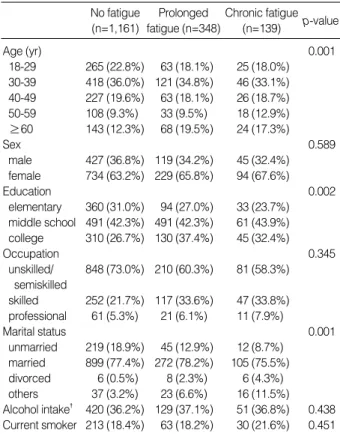
The percentage of patients complaining of prolonged fatigue or CF was relatively higher with aging (p=0.001) and edu- cated population (p=0.002) compared to that of no fatigue.
In addition, compared to those with a spouse, patients who were bereaved of, divorced by, or separated from the spouse tended to complain more of prolonged fatigue or CF (p=0.001) (Table 3).
Among the cases of explained CF, 64 patients (57.1%) had psychosocial causes while 48 patients (42.9%) had physical causes. Stress was found to be the most frequent cause (23 patients, 16.6%), followed by of depression, adjustment dis- order, diabetes (uncontrolled), asthma, anxiety neurosis, chron- ic hepatitis, tuberculosis, etc. (Table 4).
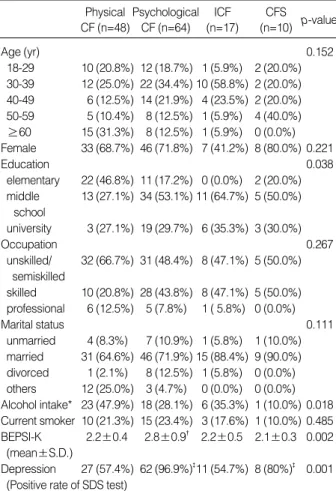
With regard to socio-demographic characteristics and per- sonal habits, the drinking rate was significantly higher in the group of physical CF than in the other three groups (p=0.018), and educational qualification was higher in the group of unex- plained CF than in that of explained CF (p=0.038). However, no statistically significant difference was observed in age, gen- der, occupational characteristics, and marital status among the groups. The frequency of stress was significantly higher in the group of psychological CF than in the other groups (p=0.002), and that of depression was significantly higher in the groups of psychological CF and CFS than in those of physical CF and ICF (p=0.001 in all) (Table 5).
Patients with CFS patients showed high frequencies in all of the eight symptoms included in the diagnostic criteria for
Chronic fatigue (n=139) Prolonged fatigue
(n=348)
Age Subjects No. Prevalence No. Prevalence
(yr) No. (95% CI) (95% CI)
Men
18-29 125 23 18.4% (11.6-25.2%) 10 8.0% (3.2-12.8%) 30-39 225 46 20.5% (15.0-26.0%) 13 5.8% (2.4-9.2%) 40-49 120 19 15.8% (9.3-22.3%) 8 6.8% (1.9-11.5%) 50-59 57 11 19.3% (8.9-29.7%) 5 8.8% (1.5-16.1%)
≥60 64 20 31.3% (19.9-42.7%) 9 14.1% (5.5-22.7%) Women
18-29 228 40 17.6% (11.6-22.8%) 15 6.6% (3.2-9.8%) 30-39 360 75 20.8% (14.3-27.3%) 33 9.2% (5.8-12.6%) 40-49 196 44 22.5% (16.6-28.4%) 18 9.2% (4.8-13.6%) 50-59 102 22 21.6% (13.5-29.7%) 13 12.8% (6.3-19.3%)
≥60 171 48 28.1% (21.3-34.9%) 15 8.8% (4.4-13.2%) Table 2.Point prevalence of prolonged fatigue and chronic fati- gue according to age and sex among patients aged ≥18 yr who attended to community-based eight primary care clinics in
Korea (n=1,648) Chronic fatigue
(n=139) p-value No fatigue
(n=1,161)
Prolonged fatigue (n=348)
Age (yr) 0.001
18-29 265 (22.8%) 63 (18.1%) 25 (18.0%) 30-39 418 (36.0%) 121 (34.8%) 46 (33.1%) 40-49 227 (19.6%) 63 (18.1%) 26 (18.7%) 50-59 108 (9.3%) 33 (9.5%) 18 (12.9%)
≥60 143 (12.3%) 68 (19.5%) 24 (17.3%)
Sex 0.589
male 427 (36.8%) 119 (34.2%) 45 (32.4%) female 734 (63.2%) 229 (65.8%) 94 (67.6%)
Education 0.002
elementary 360 (31.0%) 94 (27.0%) 33 (23.7%) middle school 491 (42.3%) 491 (42.3%) 61 (43.9%) college 310 (26.7%) 130 (37.4%) 45 (32.4%)
Occupation 0.345
unskilled/ 848 (73.0%) 210 (60.3%) 81 (58.3%) semiskilled
skilled 252 (21.7%) 117 (33.6%) 47 (33.8%) professional 61 (5.3%) 21 (6.1%) 11 (7.9%)
Marital status 0.001
unmarried 219 (18.9%) 45 (12.9%) 12 (8.7%) married 899 (77.4%) 272 (78.2%) 105 (75.5%) divorced 6 (0.5%) 8 (2.3%) 6 (4.3%) others 37 (3.2%) 23 (6.6%) 16 (11.5%) Alcohol intake� 420 (36.2%) 129 (37.1%) 51 (36.8%) 0.438 Current smoker 213 (18.4%) 63 (18.2%) 30 (21.6%) 0.451
*p-value: by multivariated analysis adjusted for age, sex, education, occupation, marital status, alcohol intake, and current smoking status,
�≥once per week.
Table 3.General characteristics of no fatigue, prolonged fatigue, and chronic fatigue groups (No. %)
Causes No. (%) Causes No. (%)
Psychosocial and 64 (57.1) Physical problems 48 (42.9) psychiatric problems
Stress 23 (16.6) Diabetes 9 (6.5)
Major depression 12 (8.6) (poorly controlled)
Adjustment disorder 10 (7.2) Asthma 9 (6.5) Anxiety disorder 8 (5.8) Chronic hepatitis 7 (5.0) Sleep disturbance 5 (3.6) Pulmonary tuberculosis 7 (5.0)
Hwabyung 3 (2.2) Hypothyroidism 4 (2.9)
Alcoholism 2 (1.4 ) Iron deficiency anemia 3 (2.2) Panic disorder 1 (0.7) Fatty liver 3 (2.2) Sleep apnea 2 (1.4) Chronic obstructive 2 (1.4)
pulmonary disease
Hyperthyroidism 1 (0.7) Herniated intervertebral 1 (0.7)
disc
All No. (%) represent prevalence among patients with medically explain- ed chronic fatigue.
Table 4.The major problems associated with medically explained chronic fatigue (n=112)
CFS as well as in impaired short-term memory or concentra- tion, unrefreshing sleep, multi-joint pain without arthritis, and post-exertional malaise lasting more than 24 hr. In addi- tion, the tenderness of cervical and axillary lymph nodes and muscle pain showed higher frequencies in the CFS than in that of explained CF (physical and psychological CF) (Table 6).
DISCUSSION
This is the first study that investigated the point prevalence of CF and CFS in patients who visited community-based pri- mary care centers in Korea. There have been many epidemio- logical researches on CF and CFS in Western countries since the 1990s, but such studies have been quite limited in Korea.
A recent Korean study focused on patients who visited a pri- mary care center of a university hospital (7). Although our study is not on the prevalence of CF and CFS representing the general population of Korea, we expanded the scope of subjects to patients who visited one of eight community-based primary care clinics in Korea.
According to the results of this study, the prevalence of CF as serious as disabling everyday life for over 6 months was 8.4%
(95% CI 7.1-9.7%), which was similar to 5-15% in foreign researches (on patients visiting primary care institutions) but was lower than 11.4% in a study in Korea on patients who visited a university hospital (3-7, 11-14). The difference might be due to different study subjects. In this study, 10 out of 1,648 subjects were found to have CFS, so the point preva- lence of CFS was 0.6% (95% CI 0.2-1.0%) and only 7.2%
of CF patients had CFS. We speculate that CFS was distin- guished from most CF by the uncertainty of its cause and several characteristic symptoms including fatigue. And this point prevalence of CFS was lower than 1.22% reported by a previous study in Korea (on patients visiting a university hospital) (7). In addition, this prevalence was lower than 0.2-
ICF (n=17)
CFS
(n=10) p-value Physical
CF (n=48)
Psychological CF (n=64)
Age (yr) 0.152
18-29 10 (20.8%) 12 (18.7%) 1 (5.9%) 2 (20.0%) 30-39 12 (25.0%) 22 (34.4%) 10 (58.8%) 2 (20.0%) 40-49 6 (12.5%) 14 (21.9%) 4 (23.5%) 2 (20.0%) 50-59 5 (10.4%) 8 (12.5%) 1 (5.9%) 4 (40.0%)
≥60 15 (31.3%) 8 (12.5%) 1 (5.9%) 0 (0.0%) Female 33 (68.7%) 46 (71.8%) 7 (41.2%) 8 (80.0%) 0.221 Education 0.038
elementary 22 (46.8%) 11 (17.2%) 0 (0.0%) 2 (20.0%) middle 13 (27.1%) 34 (53.1%) 11 (64.7%) 5 (50.0%)
school
university 3 (27.1%) 19 (29.7%) 6 (35.3%) 3 (30.0%)
Occupation 0.267
unskilled/ 32 (66.7%) 31 (48.4%) 8 (47.1%) 5 (50.0%) semiskilled
skilled 10 (20.8%) 28 (43.8%) 8 (47.1%) 5 (50.0%) professional 6 (12.5%) 5 (7.8%) 1 ( 5.8%) 0 (0.0%)
Marital status 0.111
unmarried 4 (8.3%) 7 (10.9%) 1 (5.8%) 1 (10.0%) married 31 (64.6%) 46 (71.9%) 15 (88.4%) 9 (90.0%) divorced 1 (2.1%) 8 (12.5%) 1 (5.8%) 0 (0.0%) others 12 (25.0%) 3 (4.7%) 0 (0.0%) 0 (0.0%) Alcohol intake* 23 (47.9%) 18 (28.1%) 6 (35.3%) 1 (10.0%) 0.018 Current smoker 10 (21.3%) 15 (23.4%) 3 (17.6%) 1 (10.0%) 0.485 BEPSI-K 2.2±0.4 2.8±0.9� 2.2±0.5 2.1±0.3 0.002
(mean±S.D.)
Depression 27 (57.4%) 62 (96.9%)�11 (54.7%) 8 (80%)� 0.001 (Positive rate of SDS test)
CF, Chronic fatigue; CFS, Chronic fatigue syndrome; ICF, Idiopathic chronic fatigue; SDS, Zung’s self-rating depression scale; S.D., Standard deviation.
*≥once per week, �p<0.01 when compared to chronic fatigue associat- ed physical, chronic fatigue syndrome and idiopathic chronic fatigue sub- jects, �p<0.01 when compared to chronic fatigue associated physical and idiopathic chronic fatigue subjects.
Table 5.Clinical findings of chronic fatigue subgroups accord- ing to major problems associated with chronic fatigue
All symptoms and signs were lasting or repetitive for more than six months. CF, Chronic Fatigue; CFS, Chronic Fatigue Syndrome; ICF, Idiopathic Chronic Fatigue. *from Fukuda K et al. The chronic fatigue syndrome: a comprehensive approach to its definition and study. Ann Intern Med 1994;
121: 953-9. �p<0.05: CFS vs. Physical CF, CFS vs. ICF, Physical CF vs. ICF, Psychological CF vs. ICF. �p<0.05: CFS vs. Physical CF, CFS vs. Psycho- logical CF, Psychological CF vs. ICF. �p<0.05: CFS vs. Physical CF, CFS vs. Psychological CF. ‖p<0.05: CFS vs. Physical CF, CFS vs. Psychological CF, CFS vs. ICF. ¶p<0.05: CFS vs. Physical CF, Physical CF vs. Psychological CF, Physical CF vs. ICF. **p<0.05: CFS vs. Physical CF, Physical CF vs. Psychological CF.
Symptoms and signs Physical CF (n=48) Psychological CF (n=64) ICF (n=17) CFS (n=10) p value Impaired short term memory or concentration� 29 (61.7%) 46 (71.8%) 6 (35.3%) 10 (100%) 0.003
Sore throat 31 (65.9%) 42 (65.6%) 9 (52.9%) 6 (60.0%) 0.061
Tender cervical or axillary lymph nodes� 11 (23.4%) 11 (18.7%) 8 (47.1%) 6 (60.0%) 0.002
Muscle pain� 27 (57.4%) 34 (53.1%) 12 (70.6%) 9 (90.0%) 0.039
Multi-joint pain without arthritis‖ 12 (25.5%) 9 (14.6%) 6 (35.3%) 8 (80.0%) 0.000
Headache of a new type, pattern, or severity¶ 13 (27.7%) 41 (64.1%) 12 (70.6%) 9 (90.0%) 0.000
Unrefreshing sleep** 30 (63.8%) 55 (85.9%) 14 (82.4%) 10 (100%) 0.013
Post-exertional malaise lasting more than 24 hr 34 (72.3%) 40 (62.5%) 14 (82.4%) 10 (100%) 0.051 Table 6.Prevalence of multiple symptoms and signs in CFS case definition* of chronic fatigue subgroups according to major prob- lems associated with chronic fatigue
2.5% reported by researches in Western countries and the difference is thought to have resulted from racial difference.
According to the report of a research on patients at a certain region in the U.S., prevalence of CFS was 1.0% among whites, 2.75% among blacks and 0.12% among Asians (15). And a Japanese study from a nationwide survey reported the preva- lence of CFS was 0.85 per 100,000 persons during 1992 (16).
As for the difference of CFS prevalence between our study and the Japanese study, it should be noted that the diagnos- tic criteria of CFS in the Japanese study was based on CDC in 1988 and the study subjects were general population.
Patients with explained CF were 80.5% of CF cases, and psychosocial causes (57.1%) were more frequent than physi- cal causes (42.9%). The most common cause was stress, fol- lowed by depression, adjustment disorder, diabetes (uncon- trolled), asthma, anxiety disorder, etc. In several researches in Western countries, the major causes of CF were reported to be psychological disorders, and the result of our study is consistent with that of the previous study in Korea (7, 17, 18). Thus, it is considered that stress is the major cause of CF and psychosocial causes are more frequent than physical ones in Korea.
Subjects classified as prolonged fatigue and CF tended to be older, without a spouse, and have higher educational quali- fication compared to those classified as no fatigue. Although several researchers reported that fatigue has no age predilec- tion, it was reported that fatigue is more common in adults than in children and adolescents and its frequency increases with age from middle age to older ages (19, 20). In addition, it was reported that fatigue is inversely proportional to eco- nomic level and the intensity of fatigue is lowest in the high- est socio-economic class (21, 22). These results may be due to the different perception of fatigue, which is a subjective symptom, but further epidemiological research is needed in Korea.
We compared CFS with the other three groups of CF in order to identify their socio-demographic and clinical char- acteristics, but it was difficult to delineate clinical character- istics of CFS because the number of subjects with CFS (10 patients) in our study was too small. In addition, there were no socio-demographic characteristics that showed a signifi- cant difference compared to the other three groups. Howev- er, among the eight other symptoms of the CFS diagnostic criteria except fatigue, the tenderness of cervical or axillary lymph node (60%), multi-joint pain without arthritis (80%), and muscle pain (90%) showed higher frequencies in the CFS group than in the other three CF groups (although the dif- ference was not significant with the ICF group). Since the eight symptoms are included in the diagnostic criteria for CFS, it seems natural that their frequencies are higher in the group of CFS than in explained CF. And due to the bias of this univariate analysis, it was not conclusive whether these symptoms were distinct in CFS from explained CF. However, these symptoms are known to be related to infection resulting
from abnormal immune function, so this result may provide a clue to the opinion that CFS is related to infection or immu- nity. Several researches have shown that many flu-like symp- toms observed in CFS patients are caused by an immune dis- order (23, 24).
Previous researches have demonstrated that CFS is frequent- ly accompanied with emotional disorders such as depression and anxiety (25, 26). And according to the result of a meta- analysis on medically unexplained physical symptoms and depression and anxiety, CFS had a higher frequency of depres- sion than irritable bowel syndrome and a higher frequency of anxiety than fibromyalgia (27). In this study as well, 80%
of CFS showed depression.
The limitations of this study are as follows: since the sub- jects of this study were patients visiting community-based primary care clinics, their point prevalence of CF and CFS may not represent those of the general population. And the population distribution of the patients who visited the eight primary clinics participated in this study might not be con- sistent with the one from the entire community-based pri- mary care in Korea. In addition, because both the previous study in Korea and the present study focused on patients visit- ing medical care institutions, future studies on the general population in Korea may report a lower prevalence of CF and CFS. The second limitation is the possibility that the deci- sions made by physicians in the eight community-based pri- mary care clinics to investigate the cause of CF might not have been completely consistent although they analyzed the cause of CF based on objective criteria. The third limitation is related to the number of subjects. In order to estimate the prevalence of a rare disease like CFS, a larger number of sub- jects are required. If the number of subjects is not big enough, the prevalence may be underestimated or overestimated. Last- ly, not all patients during the study period were included in the study. Among the 1,962 patients who visited medical care institutions during the study period, 15% (314 persons) were excluded from the study. If they were included in the analysis, the point prevalence of CF and CFS was likely to be different. However, no statistical difference was found in terms of age and sex between the 314 non-participants and 1,648 participants.
Despite these limitations, this study is meaningful in that it is the first study on patients visiting one of eight commu- nity-based primary care in Korea to investigate the point pre- valence of CF and CFS. The results of this study are expected to be utilized in future epidemiological research on CF and CFS in the general population in Korea.
ACKNOWLEDGEMENTS
We thank Dr. Haeng Lee, Dr. Soo Young Kim, Dr. Eu Yeol Yun, Jin Ha Kim, Hyo Ee Jun, Hyun Jun Cha, So Hyun Lee, Eun Young Choi, Byong Mo Kim for their efforts to collect
data collection for this study.
REFERENCES
1. Holmes GP, Kaplan JE, Gantz NM, Komaroff AL, Schonberger LB, Straus SE, Jones JF, Dubois RE, Cunningham-Rundles C, Pahwa S, Tosato G, Zegans LS, Putilo DT, Brown W, Schooley RT, Brus I.
Chronic fatigue syndrome: a working case definition. Ann Intern Med 1988; 108: 387-9.
2. Fukuda K, Straus SE, Hickie I, Sharpe MC, Dobbins JG, Komaroff A. International chronic fatigue syndrome study group. The chronic fatigue syndrome: a comprehensive approach to its definition and study. Ann Intern Med 1994; 121: 953-9.
3. Lloyd AR, Hickie I, Boughton CR, Spencer O, Wakefield D. Preva- lence of chronic fatigue syndrome in an Australian population. Med J Aust 1990; 153: 522-8.
4. Bates D, Schmitt W, Buchwald D, Ware NC, Lee J, Thoyer E, Kor- nish RJ, Komaroff AL. Prevalence of fatigue and chronic fatigue syndrome in a primary care practice. Arch Intern Med 1993; 153:
2759-65.
5. Kroenke K, Wood DR, Mangelsdorff AD, Meier NJ, Powell JB.
Chronic fatigue in primary care; prevalence, patient characteristics, and outcome. JAMA 1988; 260: 929-34.
6. Hickie IB, Hooker AW, Hadzi-Pavlovic D, Bennett BK, Wilson AJ, Lloyd AR. Fatigue in selected primary care settings: sociodemo- graphic and psychiatric correlates. Med J Aust 1996; 164: 585-8.
7. Kim CH, Shin HC, Park YW. The prevalence of chronic fatigue and CFS-a hospital based study. J Korean Acad Fam Med 2000;
21: 1288-98.
8. Shin HC, Kim CH, Park YW, Cho BL, Song SW, Yun YH, Ou SW.
Validity of Zung’s self-rating depression scale: Detection of depres- sion in primary care. J Korean Acad Fam Med 2000; 21: 1317-30.
9. Kim KN, Park JY, Shin TS. Jun KJ, Choi EY, Kim HJ, Lee SH, Yoo TW, Huh BY. Degree of stress and stress-related factors by the Kore- an version of the BEPSI. J Korean Acad Fam Med 1998; 19; 559-70.
10. Larkins RG, Molesworth SR. Chronic fatigue syndrome. Clinical practice guidelines. Med J Aust 2002; 176 (Suppl): S17-55.
11. Buchwald D, Sullivan JL, Komaroff AL. Prevalence of ‘chronic Ebstein-Barr virus infection’ in a general medical practice. JAMA 1987; 257: 2303-7.
12. Shahar E, Lederer J. Asthenic symptoms in a rural family practice:
epidemiologic characteristics and a proposed classification. J Fam
Pract 1990; 31: 257-62.
13. McDonald E, David AS, Pelosi AJ, Mann AH. Chronic fatigue in primary care attenders. Psycholo Med 1993; 23: 987-98.
14. Verbrugge LM. Gender differences among patients with chronic fatigue. Clin Res 1989; 26: 156-82.
15. Steele L, Dobbins JG, Fukuda K, Reyes M, Randall B, Koppleman M, Reeves WC. The epidemiology of chronic fatigue in San Fran- cisco. Am J Med 1998; 105: 83S-90.
16. Minowa M, Jiamo M. Descriptive epidemiology of chronic fatigue syndrome based on a nationwide survey in Japan. J Epidemiol 1996;
6: 75-80.
17. Manu P, Lane TJ, Matthews DA. The frequency of the chronic fatigue syndrome in patients with symptoms of persistent fatigue. Ann Intern Med 1988; 109: 554-6.
18. Lawrie SM, Manders DN, Geddes JR, Pelosi AJ. A population based incidence study of chronic fatigue. Psychol Med 1997; 27: 343-53.
19. US Dept of Health and Human Statistics. National Ambulatory Medi- cal Care Survey, USA: 1975-1981 and 1985 Trends. Series 13, No 93. Hyattsville, Maryland, National Center For Health Statistics, 1988.
20. Hammond E. Some Preliminary findings on physical complaints from a prospective study of 1,064,004 men and women. Am J Pub Health 1964; 54: 11-23.
21. Fuhrer R, Wessely S. The epidemiology of fatigue and depression in French primary care study. Psychol med 1005; 25: 895-905.
22. Lawrie SM, Pelosi AJ. Chronic fatigue syndrome in the community:
prevalence and association. Br J Psychiatr 1995; 166: 793-7.
23. Buchwald D, Cheney PR, Peterson DL, Henry B, Wormsley SB, Geiger A, Ablashi DV, Salahuddin SZ, Saxinger C, Biddle R. A chronic ill- ness characterized by fatigue, neurologic and immunologic disorders and active human herpes virus 6 type infection. Ann Intern Med 1992;
116: 103-13.
24. Barker E, Fujimura SF, Fadem MB, Landay AL, Levy JA. Immuno- logic abnormalities associated with chronic fatigue syndrome. Clin Infect Dis 1994; 18 (Suppl): S136-41.
25. Lane TJ, Manu P, Matthews DA. Depression and somatization in the chronic fatigue syndrome. Am J Med 1991; 91: 335-44.
26. David AS, Wessely S, Pelosi AJ. Chronic fatigue syndrome: Signs of a new approach. Br J Hosp Med 1991; 45: 158-63.
27. Henningsen P, Zimmermann T, Sattel H. Medically unexplained physical symptoms, anxiety, and depression: a meta-analytic review.
Psychosom Med 2003; 65: 528-33.