http://dx.doi.org/10.9721/KJFST.2015.47.6.744
744
©The Korean Society of Food Science and Technology
제주산 자색고구마의 분자압축탈수 중 말토덱스트린
Dextrose Equivalent의 영향에 대한 연구
조만재·김현정*
제주대학교 식품생명공학과Effect of the Dextrose Equivalent of Maltodextrin on the Quality
Characteristics of Jeju Purple Sweet Potato (
Ipomoea batatas L.)
during Molecular Press Dehydration
Man Jae Cho and Hyun Jung Kim*
Department of Food Bioengineering, Jeju National University
Abstract Purple sweet potatoes were dehydrated with maltodextrin with different dextrose equivalent (DE) values of 4-7, 13-14-7, 16.5-19.5, and 17-20. Maltodextrin was used as a molecular press dehydrating agent. The molecular dehydration rate of the purple sweet potatoes increased over time. As the DE of maltodextrin increased, the moisture content after 12 h of dehydration decreased from 65.7% to 40.8, 36.1, 34.9, and 28.6% for DE values of 4-7, 13-17, 16.5-17.5, and 17-20, respectively. Additionally, total phenolic content, anthocyanin, and 2,2-diphenyl-1-picrylhydrazyl (DPPH) radical scavenging activities decreased as the DE value of maltodextrin increased. While maltodextrins with DE values of 16.5-19.5 and 17-20 effectively dehydrated the purple sweet potatoes, total phenolic, anthocyanin, and DPPH radical scavenging activities were lowered during dehydration. The DPPH radical scavenging activities correlated to both the total phenolic content (r2=0.96) and anthocyanin contents (r2=0.95) of the purple sweet potatoes. These results indicate that the purple sweet potatoes were effectively dehydrated with maltodextrin whose DE values ranged 16.5-20, although there were losses in the total phenolic and anthocyanin contents.
Keywords: purple sweet potato, maltodextrin, molecular press dehydration, dextrose equivalent, anthocyanin
Introduction
Molecular press dehydration which uses a dehydrating agent is a similar method with the osmotic dehydration and is related to the cytorrhysis phenomenon occurring outside of the plant cell walls (1,2). Molecular press dehydration using polymers take place outside tissue of the cell because the pore size of a polymer is greater than those of the cell wall while solutes at osmotic dehydration move through pores of the cell wall (3). Therefore, molecular press dehydration method dehydrates a large amount of moisture compared to osmotic dehydration (4). Choi and Shin (5) reported that potato slices were dehydrated more effectively using high molecular polymers. Lee et al. (6) reported that molecular press-dehydrated ginseng indicated stable color, grain size, and sensory characteristics.
A high molecular weight maltodextrin has been widely used as an effective dehydrating agent in molecular press dehydration
(7). Characteristically, maltodextrin is a rich and cheap resource of usage without any restriction to use in foods (8,9). Because maltodextrin polymers can not penetrate into the plant cells, molecular press dehydration with maltodextrin can prevent the change of useful components in the cells as well as other chemical reactions such as oxidation and browning (10). Moreover, dehydrated materials could be stable during storage by preventing the spoilage of microorganisms because the materials were coated by dehydrated solution, a high concentration of maltodextrin (11). The recent study reported that high sugar-dehydrated solution had retarded the spoilage of microorganisms during storage at room and low temperature (12). Maltodextrin, a dextrin whose dextrose equivalent (DE) value ranges from 1 to 25 is usually commercialized (13). The higher DE number of maltodextrin possesses the smaller molecular weight compounds consisted with glucose and maltose (14). Therefore, the DE value of maltodextrin may contribute differently to the results of the molecular press dehydration.
Purple sweet potatoes contained greater amounts of vitamin C, vitamin E, β-carotene, and anthocyanin than white, yellow, and orange colored potatoes and were known to retard aging and to enhance immune system (15). Anthocyanin in purple sweet potatoes was known to have antioxidant and antibacterial activities as well as antihypertensive action (16). The recent study *Corresponding author: Hyun Jung Kim, Department of Food
Bioengineering, Jeju National University, Jeju 63243, Korea Tel: +82-64-754-3614
Fax: +82-64-755-3601 E-mail: [email protected]
Received September 24, 2015; revised October 13, 2015; accepted October 18, 2015
reported that purple sweet potatoes had the content of anthocyanin ranging from 20.02 to 40.79 mg/100 g (17). However, beneficial activities of anthocyanin could be lost during food processing, cooking, and storage (18,19). Accordingly, it is necessary to develop food processing methods for the protection of anthocyanin in purple sweet potato. The objective of this study was to investigate the effect of molecular press dehydration according to different DE values of maltodextrin on the quality of purple sweet potatoes harvested in Jeju.
Materials and Methods
Materials
Fresh purple sweet potatoes were provided from Jeju Purple Sweet Potato Farming Association (Jeju, Korea). Maltodextrin with a DE value of 17-20 (Samyang Genex Co., Seoul, Korea) was used as a dehydrating agent for the measurement of dehydration rate and moisture content of the product to determine the optimum concentration of maltodextrin. Maltodextrins with DE values of 4-7, 13-17, and 16.5-19.5 were purchased from Sigma-Aldrich Co. (St. Louis, MO, USA) for the investigation of the dehydration efficiency according to degrees of DE. Folin-ciocalteu reagent and DPPH (2,2-diphenyl-l-picrylhydrazyl) for the measurement of total phenolic content and DPPH free radical scavenging activity were purchased from Sigma-Aldrich Co.
Molecular press dehydration process
Washed purple sweet potatoes were peeled and ground using a blender (SMX-8000EMT, Hanil Electric, Seoul, Korea). For changing the dehydration rate and moisture content by the concentration of maltodextrin, maltodextrin with a DE value of 17-20 was added to the purple sweet potatoes at 0, 20, 40, 60, 80, and 100% (w/w) levels. For the measurement of the quality characteristics as affected by the maltodextrin with different DE values, maltodextrin with DE values of 4-7, 13-17, 16.5-19.5, and 17-20 was added to the purple sweet potatoes (100 g) in LDPE containers (80%, w/w) and were dehydrated for 12 h at 25oC in a shaking (200 rpm) incubator (JSSI-100T, JS Research Inc., Gongju, Korea). Dehydrated purple sweet potatoes were recovered from the dehydrating solution by centrifugation at 3,000×g (H50A-8, Hanil Science Industrial Co., Incheon, Korea) for 5 min.
Dehydration rate
Dehydration rate of molecular press dehydrated purple sweet potatoes were determined for every 2 h during 12 h of dehydration according to the method of Lee et al. (20). Dehydration rate (%) of the product was expressed by the weight proportion of the supernatant to the original weight resulting from the centrifugation of the purple sweet potato and maltodextrin mixture at 3000×g (H50A-8, Hanil Science Industrial Co.) for 5 min.
Moisture content
Moisture contents of molecular press dehydrated purple sweet potatoes were determined by the method of AOAC (21). Determination of total phenolic content
Total phenolic content of dehydrated purple sweet potatoes was measured by the modified method of Wang et al. (22) using Folin-Ciocalteau reagent. Dehydrated purple sweet potatoes (20 g) was immersed in 200 mL of 80% methanol with occasional shaking with hands for 24 h at 15oC and was filtered through Whatman No. 1 filter paper (GE Healthcare UK Ltd., Bucking-hamshire, UK). The 100µL of extracted solution was mixed with 1.5 mL distilled water and 100µL of 2 N Folin-Ciocalteu reagent. After standing for at least 30 s, 300µL of 20% Na2CO3 solution was added and the mixture was allowed to stand for 1 h in a dark room. The absorbance was measured at 765 nm using a UV-Vis spectrophotometer (Optizen 2120UV, Mecasys Co., Daejeon, Korea). Standard gallic acid solutions (50-150 mg/L) were prepared in a similar way to the calibration. Total phenolic acid content was expressed as milligram of gallic acid equivalents per 100 g of sample (mg GAE/100 g).
Determination of total anthocyanin content
Total anthocyanin content of molecular press dehydrated purple sweet potatoes was determined according to the pH-differential method as described by Park et al. (23). The anthocyanin from dehydrated purple sweet potatoes was extracted with 80% ethanol containing 0.1% citric acid (Sigma-Aldrich Co.) for 12 h. The absorbance was measured at pH 1.0 and pH 4.5 with a UV-Vis spectrophotometer (Optizen 2120UV, Mecasys Co.). The anthocyanin yield (mg/100 g) was then calculated using the following equation and expressed as cyanidin-3-glucoside equivalents:
TAC (mg/100 g)= where,
A=(Absorbance at 520 nm−absorbance at 700 nm at pH 1.0) –(absorbance at 520 nm−absorbance at 700 nm at pH 4.5) MW=Cyanidin-3-glucoside molecular weight (449.2 g) DF=Dilution factor
20=Volume of the final concentrated sample (20 mL) 100=Divided value by 10 g of the sample weight of the
extract solution for the change per 100 g of sample ε=Cyanidin-3-glucoside molar absorptivity (26,900 L/cm·mol) 1=Path length in cm
DPPH free radical scavenging activity
For the measurement of antioxidant activity, the hydrogen electron donating ability of molecular press dehydrated purple sweet potatoes was measured by DPPH methods (24). One-gram of the dehydrated purple sweet potatoes was extracted with 9 mL of 99% methanol. After extraction for 24 h at room temperature, the supernatant was collected by centrifugation at
A×MW×DF×20×100 ε 1×
---2,400×g (Labogene, Gyrozen Co., Ltd, Daejeon, Korea) for 20 min. This collected extract (0.2 mL) was mixed with 0.8 mL of 0.4 mM DPPH solution (dissolving in 99% ethanol) and 2 mL of 99% ethanol was added after 10 sec. Then, this mixture was strongly shaken at room temperature for 10 min in a dark room. The absorbance was measured at 517 nm using a UV-Vis spectrophotometer (Optizen 2120UV, Mecasys Co.). Ethanol was used as a control in the same way. Butylated hydroxy anisole (BHA, Sigma-Aldrich Co.) and ascorbic acid (Sigma-Aldrich Co.) were also used for the comparison with samples. The DPPH free radical scavenging activity (%) was calculated by the absorbance difference between the control and dehydrated purple sweet potatoes.
DPPH free radical scavenging activity (%) = ×100 A0: Absorbance of the control
A: Absorbance of the sample Color measurement
Color of dehydrated purple sweet potatoes was measured by a colorimeter (UltraScan & EashMatch VIS, Hunter Lab Inc., Reston, VA, USA) after calibration with a white standard plate. The L* (lightness), a* (redness), and b* (yellowness) values were measured at least 3 times to express as the average value. Statistical analysis
All experiments were performed in triplicate. Data were determined by one-way analysis of variance (ANOVA) followed by Duncan’s multiple range test using SPSS (PASW Statistics 18, SPSS Inc., Chicago, IL, USA). Significant differences were considered at p<0.05.
Results and Discussion
Effect of maltodextrin concentration on dehydration rate and moisture content
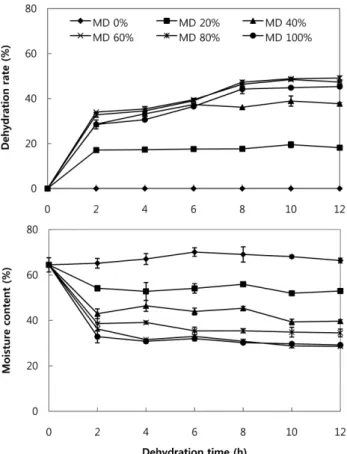
For the determination of the optimum concentration of maltodextrin applicable for molecular press dehydration of purple sweet potatoes, their dehydration rate and moisture content were measured by dehydrating with 0, 20, 40, 60, 80, and 100% maltodextrin as shown in Fig. 1. Purple sweet potatoes were dehydrated with the dehydration rate of 20% or more. Dehydration rate of purple sweet potatoes without added maltodextrin was not changed for 12 h. As the concentration of maltodextrin increased to 20, 40, 60, 80, and 100%, the dehydration rates of purple sweet potatoes increased more or less rapidly to 17.09, 28.61, 34.03, 32.75, and 28.50%, respectively, after 2 h of dehydration. As the duration of the molecular press dehydration was extended to 12 h, the dehydration rates were increased to 18.17 (20%-), 37.72 (40%-), 47.35 (60%-), 49.14 (80%-), and 45.33% (100% maltodextrin). These values were much less than those during the initial 2 h of dehydration. Moisture content of the purple sweet potato without added maltodextrin was remaining unchanged by recording 64.60% at
the end of the treatment of 12 h. At the same moment, as the concentration of maltodextrin increased to 20, 40, 60, 80, and 100%, the moisture contents decreased to 52.95, 39.70, 34.53, 28.59, and 29.20% after 12 h of dehydration, respectively. The increased degrees of molecular press dehydration of purple sweet potatoes according to increasing the concentration of dehydrating agent could be attributed to the increased osmotic pressures of the surroundings outside of the cell walls as provided by the higher concentration of the dehydrating agent. These results showed the same trends as reported by Kim et al. (25), Kim et al. (26), and Kim et al. (27) in which moisture concentrations of green peppers, gingers, and carrots decreased as the concentration of maltodextrin increased.
When purple sweet potatoes were dehydrated by molecular press method with 60 and 80% maltodextrin, there was no noticeable difference in dehydration rate. Dehydration rate and moisture content of purple sweet potatoes treated with 100% maltodextrin were the lowest while moisture content of the purple sweet potatoes dehydrated with 80% maltodextrin was lower than that with 60% maltodextrin although both samples were among the lowest value group. In accordance, the concentration of maltodextrin at 80% was chosen for the further trials to verify the effect of their DE values on the quality characteristics of purple sweet potatoes during molecular press dehydration.
1 A
A0 ---–
Fig. 1 Dehydration rate (A) and moisture content (B) of purple sweet potatoes during molecular press dehydration with different concentration of dextrose equivalent 17-20 maltodextrin. Mean±SD (n=3).
Effect of the dextrose equivalent (DE) of maltodextrin on dehydration rate and moisture content
Dehydration rates of purple sweet potatoes treated with different maltodextrin DE values are shown in Fig. 2(A). As the DE value of maltodextrin increased from 4-7 to 13-17, 16.5-19.5, and 17-20, the dehydration rates after 2 h dehydration increased rapidly from 11.50 to 25.57, 24.46, and 28.50% and dehydration rates after 12 h were 12.55, 42.84, 42.81, and 45.33%, respectively. In particular, the dehydration rate of purple sweet potatoes dehydrated with a DE value of 4-7 was significantly lower than those with other DE values (p<0.05). Because of the low degree of starch hydrolysis of maltodextrin with a DE value of 4-7, a large molecular size slowed down the absorption of moisture compared with maltodextrins with DE values of 13-17, 16.5-19.5, and 17-20 (28). Dehydration rates of purple sweet potatoes dehydrated with DE 13-17 and 16.5-19.5 maltodextrin were not significantly different after 12 h. The maltodextrin with DE value of 17-20 dehydrated purple sweet potatoes with greater dehydration rates than those of 13-17 and 16.5-19.5. This agreed with the study by Lee et al. (28) who reported that ginger was effectively molecular press dehydrated with DE 16.5-19.5 maltodextrin.
Changes in moisture contents of molecular press dehydrated purple sweet potatoes by the DE values of maltodextrin at 80% are shown in Fig. 2(B). Moisture content of the purple sweet
potatoes without added maltodextrin was 66.47% and not much changed after 12 h of dehydration. Purple sweet potatoes quickly lost their moisture and the moisture contents of sweet potatoes dehydrated with maltodextrin with DE values of 4-7, 13-17, 16.5-19.5, and 17-20 were 40.59, 37.59, 38.58, and 36.23%, respectively, after 2 h. As the dehydration time increased to 12 h, the moisture contents of purple sweet potatoes dehydrated with maltodextrin with DE values of 4-7, 13-17, 16.5-19.5, and 17-20 were 40.78, 36.14, 34.92, and 28.59%, respectively. Moisture content of purple sweet potato dehydrated with DE 4-7 maltodextrin, which had large molecular size, was higher than those dehydrated with other DE values of maltodextrin. Purple sweet potato was effectively dehydrated with maltodextrin having a DE value of 17-20. The DE value of maltodextrin affected the loss of moisture in purple sweet potatoes during molecular press dehydration.
Effect of the dextrose equivalent of maltodextrin on total phenolic and anthocyanin contents
Total phenolic contents of molecular press dehydrated purple sweet potatoes with maltodextrin having different DE values are shown in Fig. 3(A). Total phenolic content of purple sweet potatoes without added maltodextrin was 210.75 mg GAE/100 g and not significantly changed during dehydration of 12 h. The phenolic content of purple sweet potatoes decreased during Fig. 2 Dehydration rate (A) and moisture content (B) of purple
sweet potatoes during molecular press dehydration with different dextrose equivalent (DE) values of maltodextrin. Mean±SD (n=3).
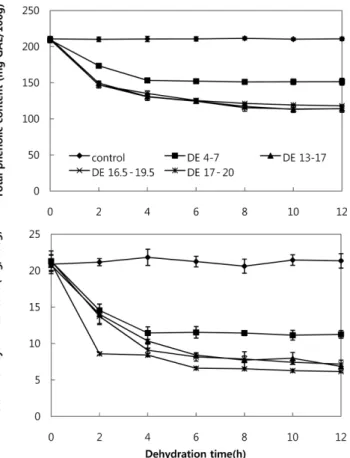
Fig. 3 Total phenolic content (A) and total anthocyanin content (B) of purple sweet potatoes during molecular press dehydration with different dextrose equivalent (DE) values of maltodextrin. Mean±SD (n=3).
molecular press dehydration with maltodextrin at all DE values. The total phenolic contents of dehydrated purple sweet potatoes with maltodextrin with DE values of 4-7, 13-17, 16.5-19.5, and 17-20 after 12 h were reduced from 210.75 to 151.48, 114.28, 114.07, and 118.14 mgGAE/100 g, respectively. As the DE values of maltodextrin increased, the total phenolic contents decreased. Total phenolic contents of purple sweet potatoes dehydrated with maltodextrin with DE values of 13-17, 16.5-19.5, and 17-20 were not significantly different for 12 h of dehydration (p>0.05). Because of low dehydration rate and high moisture content of molecular press dehydrated purple sweet potatoes with maltodextrin having a DE value of 4-7, the loss of total phenolic was lower than those of purple sweet potatoes dehydrated with other DE values of maltodextrins. The phenolic compounds as recognized antioxidants (29) were not regardless protected by molecular press dehydration in purple sweet potatoes.
The change in total anthocyanin contents of purple sweet potatoes during molecular press dehydration with different DE values of maltodextrin is shown in Fig. 3(B). Purple sweet potatoes treated with maltodextrin contained 21.22 mg/100 g anthocyanin which was not changed for 12 h. Total anthocyanin contents in purple sweet potatoes decreased during 2 h dehydration. The anthocyanin contents of purple sweet potatoes dehydrated with maltodextrin with DE values of 4-7, 13-17, 16.5-19.5, and 17-20 after 2 h were 14.56, 14.02, 13.74, and 8.59 mg/100 g, respectively. After 12 h of dehydration, they were reduced to 4.30, 5.09, 4.22, and 9.97 mg/100 g, respectively. As the DE values of maltodextrin increased, the total anthocyanin contents decreased. There were no significant differences with DE 13-17, 16.5-19.5, and 17-20 of maltodextrin (p>0.05). During the molecular press dehydration, purple sweet potatoes lost over 50% of their anthocyanin. When the anthocyanin contents of dehydrating solution were measured, the anthocyanin lost in purple sweet potatoes during molecular press dehydration remained in the solution (data not shown). The similar result reported by Chun et al. (30) showed that anthocyanin from blue berries were lost during molecular press dehydration and remained in molecular press dehydrating solution. Accordingly, dehydrating solution contained useful components including phenolic and anthocyanin flowed out from purple sweet potatoes during molecular press dehydration. Therefore, these results suggested that the dehydrating solution with natural pigments including anthocyanin after molecular press dehydration of purple sweet potatoes could further be applied to develop natural food products.
Effect of dextrose equivalent of maltodextrin on DPPH free radical scavenging activity
DPPH free radical scavenging activity of molecular press dehydrated purple sweet potatoes at different DE values of maltodextrin is shown in Fig. 4. The DPPH free radical scavenging activity of purple sweet potatoes without added maltodextrin was 88.85% and not much changed after 12 h dehydration. The antioxidant capacity of BHA (10% concentration) was 87.39% and the antioxidant capacity of ascorbic acid (10% concentration) was 95.14% for 12 h. The DPPH free radical
scavenging activity of molecular press dehydrated purple sweet potatoes with maltodextrin with DE values of 4-7, 13-17, 16.5-19.5, and 17-20 after 2 h of dehydration decreased to 77.50, 68.26, 68.25, and 65.36%, respectively. The DPPH free radical scavenging activity of molecular press dehydrated purple sweet potatoes with DE 4-7, 13-17, 16.5-19.5, and 17-20 maltodextrin after 12 h were 56.86, 47.90, 45.57, and 48.48%, respectively. As the DE values of maltodextrin increased, the DPPH free radical scavenging activities decreased. The DPPH free radical scavenging activity of purple sweet potatoes dehydrated with maltodextrin with DE values of 13-17, 16.5-19.5, and 17-20 was not significantly different for 12 h of dehydration (p>0.05). The antioxidant capacity of purple sweet potatoes without added maltodextrin was greater than that of BHA while it was lower than that of ascorbic acid. The antioxidant capacity of molecular press dehydrated purple sweet potatoes was decreased during dehydration. On the other hand, the antioxidant capacity of the dehydrating solution was increased during dehydration (data not shown). The DPPH radical scavenging activities were correlated to both total phenolic (r2=0.96) and anthocyanin contents (r2=0.95) of purple sweet potatoes. These results indicated that the antioxidant capacity of purple sweet potatoes decreased during molecular dehydration because the phenolic and anthocyanin flowed out from the purple sweet potatoes to the dehydrating solution. Effect of dextrose equivalent of maltodextrin on color
Changes in the color of purple sweet potatoes dehydrated with maltodextrin with different DE values are shown in Table 1. The color of purple sweet potatoes without added maltodextrin after 12 h changed from L* value 40.34, a* value 25.90, and b* value −8.83 to 34.69, 6.55, and 2.95, respectively. The L* value of molecular press dehydrated purple sweet potatoes with maltodextrin with DE values of 4-7, 13-17, 16.5-19.5, and 17-20 after 12 h were 30.72, 26.72, 26.89, and 26.99, respectively. The a* value of molecular press dehydrated purple sweet potatoes with DE 4-7, 13-17, 16.5-19.5, and 17-20 maltodextrin after 12 h were 9.56, 5.23, 5.20, and 5.36 and b* value were Fig. 4 DPPH radical scavenging activities of purple sweet potatoes during molecular press dehydration with different dextrose equivalent (DE) values of maltodextrin. Mean±SD (n=3).
2.78, 1.05, 1.05, and 1.03, respectively. These results indicated that L* values of molecular press dehydrated purple sweet potatoes for 12 h were lower than that of purple sweet potatoes without added maltodextrin. The a* and b* values of molecular press dehydrated purple sweet potatoes were not significantly different during dehydration. The change of color in purple sweet potatoes during molecular press dehydration was possibly caused by enzymatic browning reaction occurring often in fruits and vegetables by the enzyme of polyphenoloxidase (31).
Conclusion
As the DE value of 80% maltodextrin as a dehydrating agent increased, the dehydration rate of molecular press dehydrated purple sweet potatoes increased; however, moisture content, total phenolic, anthocyanin, and DPPH radical scavenging activities decreased during the molecular press dehydration. These results indicated that molecular press dehydration was the great method to dehydrate moisture from purple sweet potatoes although their antioxidants activities related to total phenolic and anthocyanin contents were reduced. A further study is necessary to provide the optimum conditions of molecular press dehydration to maintain the antioxidant activities of purple sweet potatoes.
Acknowledgment
This project was financially supported by the Research Institute funded from Korea Small and Medium Business Administration (Grant No. C0138673).
References
1. Oparka KJ. Plasmolysis: New insights into an old process. New Phytol. 126: 571-591 (1994)
2. Choi DW, Shin HH, Kim JG. A study of dewatering phenomena of potato slice cytorrhysed by high molecules. Korean J. Food Nutr. 19: 358-365 (2006)
3. Lim EJ. Optimization of molecular press dehydration drying pro-cess of ginseng and its application. MS thesis, Korea Polytechnic University, Siheung, Korea (2008)
4. Yoo MS, Seo HC. Molecular press dehydration method for vege-tative tissue using the solid phase of water soluble polymer sub-stances as a dehydrating agent. Korea Patent 10,044,843 (2004) 5. Choi DW, Shin HH. A study of dewatering model of potato slice
when soaked in concentrated solution. Korean J. Food Nutr. 12: 582-587 (1999)
6. Lee HS, Kwon KH, Jeong JW. Quality characteristics of ginseng powder using molecular press dehydration method. J. Biosystems Eng. 34: 155-160 (2009)
7. Lee HS, Kwon KH, Kim BS, Kim JH, Cha HS, Chung KH. Optimization of the molecular press dehydration method for gin-ger using response surface methodology. Korean J. Food Sci. Technol. 42: 398-406 (2010)
8. Han R, Liu L, Shin HD, Chen RR, Du G, Chen J. Site-saturation engineering of lysine 47 in cyclodextrin glycosyltransferase from Paenibacillus macerans to enhance substrate specificity towards maltodextrin for enzymatic synthesis of 2-O-D-glucopyranosyl-L -ascorbic acid (AA-2G). Appl. Microbiol. Biot. 97: 5851-5860 (2013)
9. Downham A, Collins P. Colouring our foods in the last and next millennium. Int. J. Food Sci. Technol. 35: 5-22 (2000)
10. Torres JD, Talens P, Escriche IA, Chiralt A. Influence of process conditions on mechanical properties of osmotically dehydrated mango. J. Food Eng. 74: 240-246 (2006)
11. Yoo MS. Molecular press dehydrating agents for vegetative tissue comprising starch hydrolysates or their derivatives. Korea Patent 100,478,861 (2005)
12. Seo WJ, Song YB, Yoo MS, Kim GS, Go ES, Lee HS, Song Table 1. Color changes of purple sweet potatoes during molecular press dehydration with different dextrose equivalent (DE) values of maltodextrin
Color Dehydrating agent
(Maltodextrin) Dehydration time 0 h 2 h 12 h L* Non-treated 40.34±3.58a1) 035.58±1.44a2) 34.69±0.79 a DE 4-7 32.06±0.66b 30.72±0.34b 13-17 27.86±0.75b 26.72±0.35c 16.5-19.5 26.71±0.36c 26.89±0.38c 17-20 27.22±0.83c 26.99±0.64c a* Non-treated 25.90±0.50a 6.66±0.27b 6.55±0.32b DE 4-7 9.99±0.37b 9.56±0.27b 13-17 5.24±0.65c 5.23±0.33c 16.5-19.5 5.71±0.19c 5.20±0.36c 17-20 5.44±0.63c 5.36±0.57c b* Non-treated -8.83±0.47c 2.71±0.29a 2.95±0.16a DE 4-7 2.87±0.34a 2.78±0.36a 13-17 1.17±0.39b 1.05±0.19b 16.5-19.5 1.27±0.08b 1.05±0.25b 17-20 1.04±0.39b 1.03±0.25b
Values are mean±SD.
KB. Development of new recoverable spicy vegetables using MPD technology. Ministry of Agriculture, Food and Rural Affairs (MAFEA). Sejong, Korea. (2010)
13. Sun J, Zhao R, Zeng J, Li G, Li X. Characterization of dextrins with different dextrose equivalents. Molecules 15: 5162-5173 (2010)
14. Nagar P, Chauhan I, Yasir M. Insights into polymers: Film form-ers in mouth dissolving films. Drug Invent. Today 3: 280-289 (2011)
15. Rumbaoa RGO, Cornago DF, Geronimo IM. Phenolic content and antioxidant capacity of Philippine sweet potato (Ipomoea batatas) varieties. Food Chem. 113: 1133-1138 (2009)
16. Kim KE, Kim SS, Lee YT. Physicochemical properties of flours prepared from sweet potatoes with different flesh colors. J. Korean Soc. Food Sci. Nutr. 39: 1476-1480 (2010)
17. Ahmed M, Akter MS, Eun JB. Optimization conditions for antho-cyanin and phenolic content extraction from purple sweet potato using response surface methodology. Int. J. Food Sci. Nutr. 62: 91-96 (2011)
18. Cevallos-Casals BA, Cisneros-Zevallos L. Stability of anthocya-nin-based aqueous extracts of andean purple corn and red-fleshed sweet potato compared to synthetic and natural colorants. Food Chem. 86: 69-77 (2004)
19. Lee LS, Rhim JW. Thermal kinetics of color changes of purple sweet potato anthocyanin pigment. Korean J. Food Sci. Technol. 29: 497-501 (1997)
20. Lee HS, Kwon KH, Kim BS, Cha HS. Sensory characteristics of dehydrated ginger rhizomes prepared using recycled dehydrating liquid as an alternative dehydrating agent. Korean J. Food Pre-serv. 17: 358-364 (2010)
21. AOAC. Official Method of Analysis of AOAC Intl. 18th ed. Method 981.05. Association of Official Analytical Chemists, Arlington, VA, USA (2005)
22. Wang SM, Yu DJ, Song KB. Quality characteristics of purple
sweet potato (Ipomoea batatas) slices dehydrated by the addition of maltodextrin. Hort. Environ. Biotechnol. 52: 435-441 (2011) 23. Park HM, Yang SJ, Kang EJ, Lee DH, Kim DI, Hong JH.
Qual-ity characteristics and granule manufacture of mulberry and blue-berry fruit extracts. Korean J. Food Cook. Sci. 28: 375-382 (2012)
24. Liu YN, Jeong DH, Jung JH, Kim HS. Quality characteristics and antioxidant activities of cookies added with purple potato powder. Korean J. Food Cook. Sci. 29: 275-281 (2013)
25. Kim MH, Kim MK, Yu MS, Song YB, Seo WJ, Song KB. Dry-ing of green pepper usDry-ing maltodextrin. Korean. J. Food Preserv. 15: 694-698 (2008)
26. Kim MH, Kim MK, Yu MS, Song YB, Seo WJ, Song KB. Dehydration of sliced ginger using maltodextrin and comparison with hot-air dried and freeze-dried ginger. Korean J. Food Sci. Technol. 41: 146-150 (2009)
27. Kim MK, Kim MH, Yu MS, Song YB, Seo WJ, Song KB. Dehydration of carrot slice using polyethylene glycol and malto-dextrin and comparison with other drying methods. J. Korean Soc. Food Sci. Nutr. 38: 111-115 (2009)
28. Lee HS, Kwon KH, Kim BS, Jeong JW, Kim JH, Sung JM. Dehydration and drying characteristics of gingers using dehydrat-ing agent by dextrose equivalent and molecular weight condition. Korea J. Food Preserv. 17: 763-769 (2010)
29. Manach C, Scalbert A, Morand C, Remesy C, Jimenez L. Polyphenols: Food sources and bioavailability. Am. J. Clin. Nutr. 79: 727-747 (2004)
30. Chun HH, Kim MS, Chung KS, Won MS, Song KB. Dehydra-tion of blueberries using maltodextrin and the physicochemical properties of dried blueberries. Hort. Environ. Biotechnol. 53: 565-570 (2012)
31. Manohan D, Wai WC. Characterization of polyphenol oxidase in sweet potato (Ipomoea Batatas (L.)). J. Adv. Sci. Arts 3: 14-31 (2012)