556
©The Korean Society of Food Science and Technology
HPLC를 이용한 다류 중 카페인, 테오브로민과 테오필린
동시분석 및 함량 조사
윤상순·김 현·장수진·임호수·김신희·김미혜*
식품의약품안전처 식품의약품안전평가원 첨가물포장과
Simultaneous Determination of Caffeine, Theobromine and
Theophylline in Tea Leaves by HPLC
Sang-Soon Yun, Hyun Kim, Su-Jin Jang, Ho-Soo Lim, Sheen Hee Kim, and Meehye Kim* Food Additives and Packaging Division, National Institute of Food and Drug Safety Evaluation,
Ministry of Food and Drug Safety
Abstract This study was aimed at investigating the natural occurrence of caffeine, theobromine, and theophylline in tea leaves. Sample clean-up was based on a simple solid phase extraction (SPE) treatment, and simultaneous analysis was performed by high performance liquid chromatography (HPLC). This method showed good results in terms of linearity, recovery, precision, limit of detection (LOD), and limit of quantitation (LOQ). The caffeine, theobromine, and theophylline contents of tea leaves (n = 228) ranged from 5.4 to 58.2 mg/g, from not detected to 11.2 mg/g, and from not detected to 0.7 mg/g, respectively. The results obtained in this study can be used as fundamental data of caffeine, theobromine, and theophylline contents in tea leaves.
Keywords: tea, caffeine, theobromine, theophylline, HPLC
서
론
카페인(caffeine)은 냄새가 없는 침상의 결정으로 120-178oC에
서 승화되며, 세계적으로 연령에 상관없이 즐겨 마시는 커피 (coffee), 홍차(black tea), 녹차(green tea), 코코아(cocoa), 콜라(cola) 등에 함유 되어 있는 성분이다. 1820년 독일의 화학자 루게(Ruge) 에 의해 처음으로 발견되었으며, 커피의 화학적 화합물 중 하나 로 kaffeine이라 명하고 영문명으로 caffeine이 되었다. 1827년 오 드리(Odry)가 차에서도 카페인을 발견하여 테인(theine)이라고 불 렀으나 커피의 카페인과 동일함을 밝혔다(1). 카페인의 대사과정 은 식물체 내에서 테오필린(theophylline)으로 이화되어 빠르게 이 산화탄소(CO2)로 분해되거나, Pseudomonas cepacia, Pseudomonas
putida, Serratia marcescens를 포함한 카페인 분해 세균 내에서 식 물체와 다르게 테오브로민(theobromine)으로 이화되어 이산화탄소 (CO2)와 암모니아(NH3)로 분해된다(2). 카페인은 하루 0.1-0.2 g 섭취 시 각성효과, 피로의 감소 등의 긍정적인 측면이 나타나지만 1.0 g 이상 섭취 할 경우 불안, 불 면, 감정의 변화, 위장장애 등의 부정적인 측면이 초래될 수 있 다. 카페인 과량 섭취 시 부작용을 예방하기 위하여 식품의약품 안전처에서는 2013년 1월 1일부터 카페인 함량이 mL 당 0.15 mg 이상을 함유하는 액상제품에 대해 카페인 함량을 의무적으로 표시하도록 하고 있다. 또한, 우리나라의 카페인 최대 일일섭취 권고량은 어린이·청소년 2.5 mg/kg·bw 이하, 성인 400 mg 이하, 임산부 300 mg 이하로 정하여 어린이, 청소년 등이 카페인에 과 다 노출되지 않도록 하고 있다(3). 그러나 카페인과 유사한 특성 을 지니고 있는 테오브로민과 테오필린은 식품에 대한 기준은 없 으나 향후 식품에 대한 안전관리 차원에서 함께 조사해 볼 필요 성이 있다. 카페인의 국제적인 공인분석법은 AOAC 방법(4)에 등재되어있 다. 또한 정량법으로 전위차적정법(5), 흡광광도법(6), 가스크로마 토그래피법(7), 고속액체크로마토그래피법(8-12) 등이 보고되어 있 다. 하지만 이 중 전위차 적정법과 흡광광도법, 가스크로마토그 래피법은 시료 중의 카페인을 추출하는 전처리 과정이 장시간 소 모되고 비교적 복잡하여 다수의 시료를 신속하게 분석하는데 어 려운 단점이 있다. 고속액체크로마토그래피(HPLC) 방법의 경우 시료 중의 카페인, 테오브로민과 테오필린을 동시 분석하는 것이 가능하다(13). 그러나 시료 특성에 따라 전처리 조건 및 기기분 석 조건이 달라지므로 적절한 방법을 확립할 필요성이 있다. 다류 중 국내 카페인 함유량 조사현황으로는 녹차에서 26.1 mg/g, 홍차에서 16.7 mg/g, 우롱차에서 11.3 mg/g으로 조사되었으 며(1), 국외 카페인 함유량 조사현황으로 FDA (Food and Drug Administration) 문헌(14)에서는 천연원료인 차나무(Camellia sinen-sis), 마테나무(Ilex paraguarinsis) 등에 카페인이 함유되어 있다고 보고하였으며, 함유량을 보면 찻잎에 4%, 마테에서 0.3-1.7%의 카페인을 함유하고 있고, 0.3-0.9%의 테오브로민을 함유하고 있 었다. Komes 등(15)은 차와 마테차에서의 카페인 함유량을 연구 *Corresponding author: Meehye Kim, Food Additives & Packaging
Division, Ministry of Food and Drug Safety, Cheongju 28159, Korea Tel: +82-43-719-4351
Fax: +82-43-719-4350 E-mail: [email protected]
Received April 23, 2015; revised August 14, 2015; accepted August 24, 2015
한 결과 백차 3.62%, 황차 3.18%, 홍차 2.79%, 우롱차 2.77%, 녹 차 2.35%, 마테차 1.02%의 카페인을 함유하고 있다고 보고하였 다. Zuo 등(16)은 보이차에서 22.4 mg/g, 녹차에서 23.0-26.8 mg/g, 우롱차에서 7.44-18.7 mg/g, 홍차에서 21.6 mg/g의 카페인을 함유 한다고 보고하였다. 이러한 다류 중 카페인, 테오브로민, 테오필 린 함량 조사 연구는 국내에서 뿐만 아니라 국외에서도 연구 현 황이 많지 않아서 국산 및 수입산 다류에 대한 함량 조사 연구 가 필요하다. 따라서 본 연구에서는 신속하고 정확한 함량조사 연구를 위하 여 고속액체크로마토그래프를 이용한 다류 중 카페인, 테오브로 민, 테오필린 동시분석법을 확립하고 녹차, 홍차, 마테 등을 포함 하는 다류 중 카페인 함량조사 연구를 진행하였다. 또한 이러한 결과를 바탕으로 다류 중 카페인 함유량에 대한 천연유래 여부 판단을 위한 기초자료로 활용하고자 한다.
재료 및 방법
분석대상 시료 녹차, 홍차, 보이차, 마테 등을 분석대상 시료로 하여 주요 산 지 및 유통 현황을 파악하여 228건을 구입하였다. 시료는 100 g 씩 균질화하여 밀폐용기에 담아 −20oC 이하에서 냉동보관 후 분 석에 사용하였다. 시약 및 초자 카페인 함량 모니터링 분석을 위해 사용된 카페인(caffeien), 테 오브로민(theobromine), 테오필린(theophylline) 표준품은 Sigma-Aldrich사(St. Louis, MO, USA)로부터 구입하여 사용하였다. 모든 실험에 사용된 메탄올은 Merck사(Darmstadt, Germany), 아세트산 은 Wako사(Osaka, Japan) 제품을 사용하였으며 정제수는 Mili-Q ultrapure water purification system (Milipore Co., Billerica, Massa-chusetts, USA)을 이용하여 18 MΩ-cm 수준으로 정제된 정제수를 사용하였다. 정제과정에서 사용한 카트리지(cartridge)는 C18 카트리지(6 mL, 500 mg, Waters, Milford, MA, USA)이며, HPLC 주 입 전 Whatman사(London, UK)의 nylon, 0.45 µm syringe filter 를 이용하여 정제하였다.
표준용액 조제
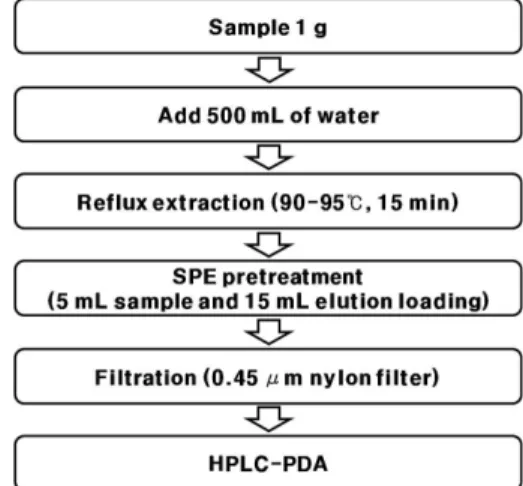
표준원액(stock standard solution)을 조제하기 위하여 표준물질 100 mg을 정밀히 칭량하여 메스 플라스크에 넣고, 증류수를 첨가 하여 완전히 녹인 후 100 mL로 정용하여 1,000 mg/L가 되도록 하였다. 검량선 작성을 위한 표준용액(working standard solution) 조제는 표준 원액을 이동상(메탄올(methanol):아세트산(acetic acid) :물(water)=20:1:79, v/v)으로 희석하여 카페인 0.05-50 mg/L이 되 도록 사용하였고, 테오브로민과 테오필린은 0.005-50 mg/L의 농 도로 희석하여 사용하였다. 전처리 방법 시료 1 g에 증류수 300 mL를 넣고 90-95oC에서 10분 동안 환 류 냉각 추출하여 여과지(Whatman No. 4)로 여과한 용액을 500 mL로 정량하여 추출액으로 사용하였으며, 추출액은 식품 중 식 품첨가물 분석법에 수재되어 있는 카페인 분석방법(17)을 참고하 여 C18 카트리지를 사용한 SPE (solid-phase-extraction) 정제 과정 을 거쳐 0.45 µm syringe filter로 여과하여 시험용액으로 사용하 였다(Fig. 1). 기기 및 분석조건 카페인, 테오브로민과 테오필린을 분석하기 위하여 HPLC-PDA (high performance liquid chromatography-photodiode array detec-tor, Shiseido Fine Chemicals, Tokyo, Japan)를 사용하였으며, 분석 에 사용한 컬럼은 Shiseido사(Tokyo, Japan)의 Capcellpak UG120 C18 (250×4.6 mm, 5µm)이며, 이동상은 메탄올과 아세트산, 그리 고 물을 20:1:79 (v/v)로 조제하여 사용하였다. 이동상의 유속은 1.0 mL/min, 컬럼 온도는 40oC, 파장 조건으로 280 nm, 총 분석시 간은 15분, 시료 주입량은 10 µL로 설정하였다(Table 1). 시험법 유효성 검증 시험법의 유효성 검증을 위하여 직선성(linearity), 검출한계(limit of detection)와 정량한계(limit of quantitation), 회수율(recovery), 정밀성(precision)을 평가하였다. 유효성 검증에 관련된 실험은 모 두 3반복으로 수행하였다. 카페인은 0.05-50 mg/kg, 테오브로민과 테오필린은 0.005-5 mg/kg의 농도에서 직선성을 평가하였으며, 각 농도별로 세기(intensity)를 측정하여 검량선을 작성하였다. 직선 성의 결과는 상관계수(correlation coefficient, r2)로 표현하였다. 검 출한계와 정량한계는 3.3×σ/s, 10×σ/s (σ: standard deviation, s: slop)로 기준을 구하였다. 동일한 분석물질에 대한 실험환경에 따 른 변화를 확인하기 위하여 일내(intra-day) 정밀도와 일간(inter-day) 정밀도를 측정하였다. 일내 정밀도는 1일간 3회 반복하여 얻 Fig. 1. Sample preparation for the analysis of caffeine, theobromine and theophylline.
Table 1. HPLC-PDA operating conditions for the determination of caffeine, theobromine and theophylline
Parameter Condition Instrument HPLC-PDA
(Nanospace SI-2, Shiseido, Tokyo, Japan) Column Capcell-Pak UG120 C18
(5 µm, 4.6 mm×250 mm I.D., Shieseido) Mobile phase Methanol:acetic acid:water=
20:1:79 (v/v) Column temperature 40oC Wavelength 280 nm Injection volume 10 µL Flow rate 1.0 mL/min
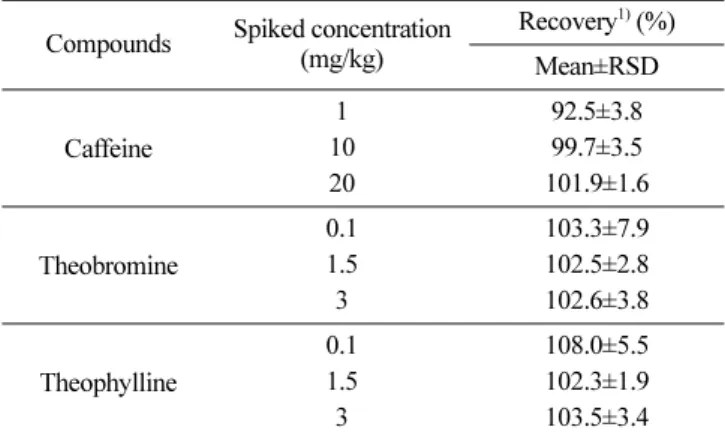
은 회수율의 표준편차를 평균치로 나눈 상대표준편차(RSD, %)로 나타내었으며, 일간 정밀도는 3일 동안 매일 3반복하여 얻은 회 수율의 표준편차를 평균치로 나눈 상대표준편차(RSD, %)로 나타 내었다. 분석방법의 정확한 평가를 위한 지표성분의 회수율 시험 은 전처리 후 시험용액의 농도가 카페인 1, 10, 20 mg/kg, 테오브 로민과 테오필린 0.1, 1.5, 3 mg/kg 되도록 조제하여 디카페인 루 이보스차 시료에 첨가한 후 전처리 과정을 거쳐 3회씩 분석하여 각 농도를 구한 다음 첨가 농도 대비 회수된 농도를 계산하여 회 수율을 측정하였다.
결과 및 고찰
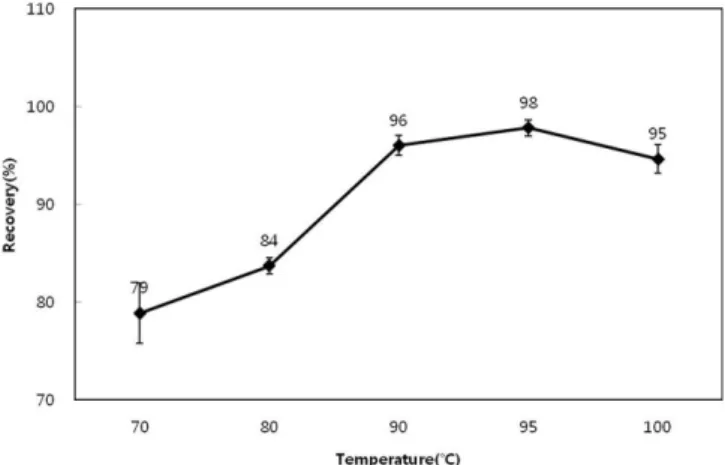
전처리법 검토 전처리 방법은 추출용매와 온도조건을 검토하여 최적 추출조 건을 검토하였다. 용매별로 추출 조건을 검토한 결과 물, 아세톤, 에탄올, 아세토나이트릴, 메탄올 중 물로 추출하였을 때 가장 우 수하였으며(Fig. 2), 그 결과를 바탕으로 물로 추출하였을 때의 추 출 온도는 90-95oC에서 회수율이 96-98%로 가장 높게 나타났다 (Fig. 3). 또한 카페인, 테오브로민, 테오필린을 동시분석 한 결과, Fig. 4A-4B와 같이 각 성분들이 다른 피크의 간섭없이 분리되었 으며, 표준용액과 시료의 피크 머무름 시간이 일치하는 것을 확 인 할 수 있었다. 직선성, 검출한계, 정량한계 및 정밀도 카페인, 테오브로민과 테오필린의 직선성은 상관계수(r2) 값이 0.999 이상이었으며, 검출한계는 각각 0.01, 0.005, 0.006 mg/kg, 정 량한계는 각각 0.04, 0.02, 0.02 mg/kg으로 측정되었다(Table 2). 회 수율은 카페인 92.5-101.9%, 테오브로민 102.5-103.3%, 테오필린 102.3-108.0%이었으며 반복측정에 따른 RSD (%) 값은 8% 이내 로 양호한 결과를 보였다(Table 3). 정밀도는 NIST사(Gaithersburg, MD, USA)에서 구입한 녹차잎 표준품 SRM (standard reference material)으로 1일 3회 반복 실험한 결과 회수율이 카페인은 Fig. 3. Effect of extraction water temperatures on the recovery of caffeine in green tea; 70-100oC.Fig. 2. Effect of extraction solvents on the recovery of caffeine in green tea; water, 25% acetone, 80% ethanol, 50% acetonitrile, methanol.
Fig. 4. HPLC-PDA chromatogram of the standard solution mixture and Pu’er tea leave containing caffeine, theobromine and theophylline at 280 nm under experimental conditions; (A) standard solution mixture, (B) Pu’er tea leave extraction.
102.1%, 테오브로민은 106.5%이었으며, 3일간 서로 다른 날에 반 복하여 분석한 결과 카페인은 99.1%, 테오브로민은 106.5%로 양 호하였다(Table 4). 다류 중 천연유래 카페인, 테오브로민과 테오필린 함유량 조사 국내 유통되고 있는 녹차, 홍차, 보이차, 우롱차 등 228건의 시 료를 구입하여 다류 중 천연유래 카페인, 테오브로민과 테오필린 의 함유량을 조사하였다(Table 5). 분석 결과 평균 카페인 함량은 녹차에서 25.1±6.5 mg/g, 홍차 31.8±7.0 mg/g, 보이차 31.7±6.7 mg/g, 우롱차 25.5±7.1 mg/g, 황차 29.5±7.0 mg/g, 백차 39.1±9.9 mg/g, 마테 13.7±7.9 mg/g이 검출되었다. 이러한 결과는 Komes 등 (15)의 연구결과에서처럼 다른 차에 비하여 마테차의 카페인함량 이 대부분 적게 검출되었으며 백차의 평균 카페인 함량이 가장 높게 검출되었다. 또한 Chen 등(18)의 연구결과와 녹차, 우롱차, 황차, 보이차, 홍차의 카페인함량은 유사하였으나 백차는 더 높 게 검출되었다. 테오브로민 함량은 녹차에서 0.9±0.7 mg/g, 홍차 1.6±0.8 mg/g, 보이차 2.0±1.1 mg/g, 우롱차 0.8±0.5 mg/g, 황차 0.8±0.7 mg/g, 백차 4.2±3.7 mg/g, 마테 1.6±1.4 mg/g이 검출되었다. 테오필린 분석 결과 평균 녹차에서 0.003±0.02 mg/g, 홍차 0.1±0.1 mg/g, 보이차 0.1±0.2 mg/g, 우롱차 0.1±0.1 mg/g, 황차 0.01±0.01 mg/g, 백차 0.1±0.1 mg/g, 마테 0.04±0.10 mg/g이 검출되었다. Chen 등(18)의 연구결과에서는 테오필린은 검출되지 않았으며, 테 오브로민이 보이차와 황차에서 다른 차에 비하여 높게 검출되었 으나 이번 연구 결과에서는 백차에서 가장 높게 검출되었고 테 오필린 또한 미량 검출되었다. 이러한 결과 값의 차이는 추출방 법과 생산 지역의 차이 때문인 것으로 판단된다. 또한 다류에서 는 카페인, 테오브로민, 테오필린 순으로 함유량이 높음을 알 수 있었다.
요
약
본 연구는 다류 중 천연으로 카페인을 함유하고 있는 식물성 원료를 중심으로 천연유래 카페인, 테오브로민, 테오필린 함유량 을 조사하였다. 물을 이용하여 환류냉각 방식으로 추출하였으며, Table 2. Linearity, limit of detection (LOD) and limit of quantification (LOQ) of caffeine, theobromine and theophylline by HPLC-PDACompounds Calibration curve1)2) r2 LOD3) (mg/kg) LOQ4) (mg/kg)
Caffeine Y=10089X+11218 0.9997 0.01 0.04
Theobromine Y=95028X+1813 0.9992 0.005 0.02
Theophylline Y=94932X+2214 0.9990 0.006 0.02
1)Standard concentration used in calibration curve ware caffeine 0.05, 0.5, 1, 5, 12.5, 25, 50 mg/kg and theobromine and theophylline 0.005, 0.05,
0.1, 0.5, 1.25, 2.5, 5 mg/kg.
2)X: concentration (mg/L), Y: peak area. 3)Limit of detection=3.3 σ/S.
4)Limit of quantitation=10 σ/S.
σ=the standard deviation of the response S=the slope of the calibration curve
Table 3. Recoveries of caffeine, theobromine and theophylline in rooibos tea by HPLC-PDA
Compounds Spiked concentration (mg/kg) Recovery1) (%) Mean±RSD Caffeine 1 92.5±3.8 10 99.7±3.5 20 101.9±1.6 Theobromine 0.1 103.3±7.9 1.5 102.5±2.8 3 102.6±3.8 Theophylline 0.1 108.0±5.5 1.5 102.3±1.9 3 103.5±3.4
1)Mean values of triplicates with relative standard deviation.
Table 5. The contents of individual caffeine, theobromine and theophylline in tea leaves
Samples No. Caffeine (mg/g) Theobromine (mg/g) Theophylline (mg/g) Range Concentration1) Range Concentration Range Concentration Green tea 71 6.0-56.2 25.1±6.5 0.1-2.9 0.9±0.7 ND2)-0.1 0.003±0.020 Black tea 68 19.8-46.1 31.8±7.0 0.5-4.1 1.6±0.8 ND-0.5 0.1±0.1 Pu’re tea 38 15.7-46.0 31.7±6.7 0.3-4.6 2.0±1.1 ND-0.7 0.1±0.2 Oolong tea 16 20.0-40.1 25.5±7.1 ND-2.3 0.8±0.5 ND-0.4 0.1±0.1 Yellow tea 12 12.7-35.1 29.5±7.0 0.2-2.2 0.8±0.7 ND-0.03 0.01±0.01 White tea 11 26.4-58.2 39.1±9.9 0.5-11.2 4.2±3.7 ND-0.3 0.1±0.1 Mate 12 5.4-37.7 13.7±7.9 0.1-5.7 1.6±1.4 ND-0.4 0.04±0.10 1)The values are mean±standard deviation.
2)ND: not detected.
Table 4. Precision of caffeine and theobromine from green tea leaves SRM 32541) Certification (mg/g) Recovery2) (%) Intra-day Inter-day Caffeine 23.50±1.85 102.1±1.6 99.1±3.2 Theobromine 0.46±0.05 106.5±2.0 106.5±2.0 1)SRM 3254: standard reference material (NIST).
추출액은 SPE (C18 카트리지)를 이용하여 정제하는 전처리 방법 을 확립하였다. 분석방법의 유효성 검증을 위하여 직선성, 검출한 계, 정량한계, 회수율 등을 측정하여 HPLC를 이용한 동시 분석 법의 유효성을 확인하였다. 확립된 방법으로 다류 중 천연유래 카페인 함량을 측정하기 위하여 228건의 시료를 수거하여 분석 한 결과 카페인은 5.4-58.2 mg/g의 범위로 검출되었으며, 테오브 로민은 ND-11.2 mg/g의 범위로 검출되었고 테오필린은 ND-0.7 mg/ g의 범위로 검출되었다. 본 연구결과를 통하여 다류 중 천연유래 카페인, 테오브로민과 테오필린 함유량을 확인 할 수 있었으며 그 결과를 바탕으로 식품 중 카페인의 천연유래 여부 판단 시 근 거자료로 활용될 수 있는 것으로 사료된다.
감사의 글
본 연구는 2014년도 식품의약품안전처 연구개발사업의 연구비 지원(14161MFDS657)에 의해 수행되었으며, 이에 감사드립니다.References
1. Kim HY, Lee YJ, Hong KH, Lee CW, Kim KS, Ha SC. Devel-opment of analysis method of caffeine and content survey in commercial foods by HPLC. Korean J. Food Sci. Technol. 31: 1471-1476 (1999)
2. Ashihara, H, Crozier A. Caffeine: A well known but little men-tioned compound in plant science. Trends Plant Sci. 6: 407-413 (2001)
3. Harland BF. Caffeine and Nutrition. Nutrition 16: 522-526 (2000) 4. AOAC. Official Method of Analysis AOAC Intl. 19th ed.
Method 979.11, 925.17. Association of Official Analytical Chem-ists, Arlington, VA, USA (2012)
5. Lau OW, Luk SF, Cheung YM. Simultaneous determination of ascorbic acid, caffeine and paracetamol in drug formulations by differential-pulse voltametry using a glassy carbon electrode. Analyst 114: 1047-1051 (1989)
6. Newton JM. Spectrophotometric determination of caffeine in cof-fee products: Collaborative study. J. Assoc. Off. Ana. Chem. 62:
705-708 (1979)
7. Strahl NR, Lewis H, Fargen R. Comparison of gas chromato-graphic and spectrophotometric methods of determination for caf-feine in teas. J. Agr. Food Chem. 25: 233-235 (1977)
8. Blauch JL, Tarka jr SM. HPLC determination of caffeine and theobromine in coffee, tea and instant hot cocoa mixes. J. Food Sci. 48: 745-747 (1983)
9. Perva-Uzunalic A, Škerget M, Knez Ž, Weinreich B, Otto F, Grüner S. Extraction of active ingredients from green tea ( Camel-lia sinesis): Extraction efficiency of major catechins and caffeine. Food Chem. 96: 597-605 (2006)
10. de Aragão NM, Veloso MCC, Bispo MS, Ferreira SLC, de Andrade JB. Multivariate optimisation of the experimental condi-tions for determination of three methylxanthines by reversed-phase high-performance liquid chromatography. Talanta 67: 1007-1013 (2005)
11. Jun X. Caffeine extraction from green tea leaves assisted by high pressure processing. J. Food Eng. 94: 105-109 (2009)
12. Hadad GM, Abdel Salam RA, Soliman RM, Mesbah MK. Rapid and simultaneous determination of antioxidant markers and caf-feine in commercial teas and dietary supplements by HPLC-DAD. Talanta 101: 38-44 (2012)
13. Bispo MS, Veloso MCC, Pinheiro HLC, de Oliveira RFS, Reis JON, de Andrade JB. Simultaneous determination of caffeine, theobromine, and theophylline by high-performance liquid chro-matography. J. Chromatogr. Sci. 40: 45-48 (2002)
14. FDA. Caffeine Intake by the U.S. Population. U.S. Food and Drug Administration. Kensington, CA, USA. pp 4 (2010)
15. Komes D, Hor i D, Belščak A, Kovačevi Ganic K, Baljak A. Determination of caffeine content in tea and maté tea by using different methods. Czech. J. Food Sci. 27: 213-216 (2009)
16. Zuo Y, Chen H, Deng Y. Simultaneous determination of cat-echins, caffeine and gallic acids in green, oolong, black and pu-erh teas using HPLC with a photodiode array detector. Talanta 57: 307-316 (2002)
17. MFDS. Analysis method for food additives in food. Method 11.1. Ministry of Food and Drug Safety. Cheongju, Korea. (2014) 18. Chen QC, Mou SF, Hou XP, Ni ZM. Simultaneous determination
of caffeine, theobromine and theophylline in foods and pharma-ceutical preparations by using ion chromatography. Anal. Chim. Acta. 371: 287-296 (1998)