Association Between Toll-Like Receptors/CD14 Gene
Polymorphisms and Inflammatory Bowel Disease in Korean Population
The innate immune response in patients who develop inflammatory bowel disease (IBD) may be abnormal. However, the exact role of Toll-like receptors (TLRs) / CD14 gene in the pathogenesis of IBD has not been fully elucidated. We aimed to investigate the association between polymorphisms of TLR1, 2, 4, 6, and CD14 gene and susceptibility to IBD in Korean population. A total 144 patients of IBD (99 patients with ulcerative colitis, 45 patients with Crohn’s disease) and 178 healthy controls were enrolled. Using a PCR-RFLP, we evaluated mutations of TLR1 (Arg80Thr), TLR2 (Arg753Gln and Arg677Trp), TLR4 (Asp299Gly and Thr399Ile), TLR6 (Ser249Pro) genes and the -159 C/T promoter
polymorphism of CD14 gene. No TLR polymorphisms were detected in Korean subjects. T allele and TT genotype frequencies of CD14 gene were significantly higher in IBD patients than in healthy controls. In subgroup analysis, T allelic frequency was higher in pancolitis phenotype of ulcerative colitis. In Korean population, the promoter polymorphism at -159 C/T of the CD14 gene is positively associated with IBD, both ulcerative colitis and Crohn’s disease.
Key Words: CD 14; Inflammatory Bowel Diseases; Toll-Like Receptors Eun Jung Kim*, Woo Chul Chung*,
Kang-Moon Lee, Chang Nyol Paik, Sung Hoon Jung, Bo In Lee, Hiun Suk Chae, and Kyu Yong Choi Department of Internal Medicine, St. Vincent Hospital, The Catholic University of Korea, Suwon, Korea
*Eun Jung Kim and Woo Chul Chung contributed equally to this study.
Received: 24 August 2011 Accepted: 1 November 2011 Address for Correspondence:
Kang-Moon Lee, MD
Department of Internal Medicine, St. Vincent’s Hospital, The Catholic University of Korea, 93 Jungbu-daero, Paldal-gu, Suwon 442-723, Korea
Tel: +82.31-249-8151, Fax: +82.31-253-8898 E-mail: [email protected]
http://dx.doi.org/10.3346/jkms.2011.27.1.72 • J Korean Med Sci 2012; 27: 72-77 Gastroenterology & Hepatology
INTRODUCTION
Inflammatory bowel disease (IBD) is a complex disease with both genetic and environmental factors necessary for disease pathogenesis. Particular genetic changes may influence the sus- ceptibility to disease and individual variation of disease pattern.
It has been associated with specific variant alleles (polymor- phism) of gene that are present in a significant proportion of the normal population. Polymorphisms in a wide variety of genes may modify the effect of environmental exposures (1). Recent genome-wide linkage studies and case-control association stud- ies have shown several susceptibility regions for IBD (2-4).
The innate immune system represents the first defense line in preventing infection of bacteria and provides a critical inter- face between microorganisms and their hosts. It can promptly recognize and respond to pathogenic microorganisms. Toll-like receptor (TLR) is one of pathogen pattern recognition receptors for micro-organism-derived pathogenic molecules (5, 6). Clus- ters of differentiation 14 (CD14) is a glycoprotein expressed on the surfaces of monocytes and macrophages, and acts as a pat- tern recognition receptor and contributes to TLR-induced cell activation (5, 7). Both of TLRs and CD14 are considered as the
primary sensors of the innate immune system.
It has been reported that the -159 C/T polymorphism in the CD14 gene plays a significant role in regulating the CD14 expres- sion by increasing production of TNF-α (8). Previously, several studies have reported on the association between IBD and TLRs/
CD14 gene polymorphism (9-15), but there are no consistent results. Different results may be interpreted by genetic hetero- geneity of races. Until now, in Korean population, whether TLRs/
CD14 gene polymorphism is associated with IBD remains un- known.
In this study, we aimed to investigate the frequencies of TLR1, 2, 4, 6, and CD14 gene polymorphism in patients with IBD, and evaluate the association between those polymorphisms and the susceptibility to IBD in Korean population.
MATERIALS AND METHODS Subjects
Healthy control subjects and IBD (ulcerative colitis [UC] and Crohn’s disease [CD]) patients were enrolled from a teaching hospital of the Catholic University of Medicine, St. Vincent’s hos- pital, from September 2007 to February 2008. A diagnosis of UC
was made if all the following three criteria were present: a typi- cal history of diarrhea or blood and pus in stool for longer than 4 weeks; a typical sigmoidoscopic or colonoscopic picture with diffusely granular, friable, or ulcerated mucosa without rectal sparing; and characteristic histopathological signs of infiamma- tion on biopsy (16). Diagnosis of CD was based on the official criteria established by the research committee of the Japan Min- istry of Health and in Western countries (17, 18). Healthy con- trol subjects were asymptomatic and randomly selected from subjects attending regular health screening at the Health Pro- motion Center of the same hospital. They were not affected with colon by endoscopic examination or double contrast barium enema. Blood samples of 10 mL were obtained from all subjects and collected in a test tube containing EDTA or heparin.
Classification
Chronic UC patients were classified according to the location and extension of inflammatory lesions judged by endoscopic findings, the disease activity index following Mayo score, and the need for or the response of steroid and immunomodulator therapy. Chronic CD patients were classified according to the location of lesions and the disease behavior following Montreal classification (19), and the need for or the response of steroid and immunomodulator therapy. Patients who failed to respond to steroid over a period of 4 weeks were defined as ‘steroid refrac- tory’. Patients who initially responded to steroid but then relapsed during tapering, and required re-introduction of steroid therapy to maintain symptoms control, were defined as ‘steroid depen- dent’ (20).
Polymorphism analysis
Genomic DNA was obtained from buffy-coat leukocytes using the AccuPrep Genomic DNA Extraction Kit (Bioneer Corpora- tion, Daejeon, Korea). The CD14 promoter C(-159)T, TLR1 Ar- g80Thr, TLR2 Arg677Trp, TLR2 Arg753Gln, TLR4 Asp299Gly,
TLR4 Thr399Ile, TLR6 Ser249Pro polymorphisms were per- formed using the polymerase chain reaction-restriction frag- ment length polymorphism (PCR-RFLP) method.
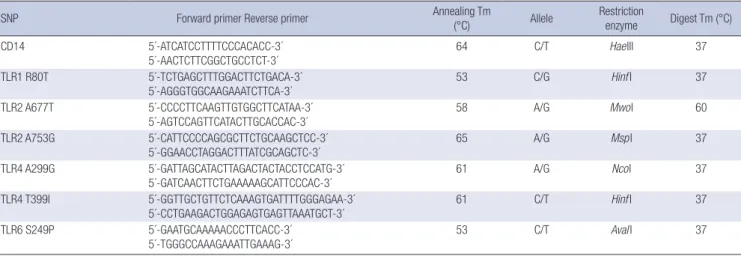
PCR reactions were set up using the i-Star Taq DNA poly- merase (iNtRON Biotechnology, Seoul, Korea). In a total reac- tion volume of 20 μL, 2 μL 10 × buffer, 10 pM each primer, 2 μL genomic DNA, 2 μL dNTP mixture were combined. Reactions were run on a Bio-Rad MyCycler thermal cyclers (BIO-RAD, Phil- adelphia, PA, USA). The primer sequences for amplifying each SNP were shown in Table 1. The PCR conditions were as follows:
an initial denaturation at 95°C for 5 min, followed by 35 cycles of denaturing at 94°C for 30 sec, annealing for 30 sec, extension at 72°C for 30 sec and final incubation at 72°C for 10 min and cooling to 4°C. For 16 hr, the PCR products (3 μL) were used for an overnight digest with the appropriate restriction enzyme (Table 1), and digests were analyzed by electrophoresis in a 3%
agarose gel.
Statistical analysis
The data were analyzed using SPSS software (version 15.0, SPSS, Chicago, IL, USA). Genotype and allele frequencies were calcu- lated by direct counting. Significance of association was deter- mined by chi-square tests or Fisher’s exact test. Departures from Hardy-Weinberg equilibrium in patients and healthy controls were tested by the chi-square method. Continuous data were expressed as mean ± standard deviation and were analyzed us- ing independent samples t-tests. A P value < 0.05 was consid- ered significant for all the tests. For subgroup analysis, Bonfer- roni correction was made for the multiple comparisons.
Ethics statement
This study was approved by the institutional review board of the Catholic University of Korea (VCMC07BR047). Written informed consent was obtained from all subjects after a full explanation of the project.
Table 1. The primer sequences, annealing time, restriction enzymes, and digest time used for PCR-RFLP methods detecting the each single nucleotide polymorphism (SNP)
SNP Forward primer Reverse primer Annealing Tm
(°C) Allele Restriction
enzyme Digest Tm (°C)
CD14 5´-ATCATCCTTTTCCCACACC-3´
5´-AACTCTTCGGCTGCCTCT-3´
64 C/T HaeIII 37
TLR1 R80T 5´-TCTGAGCTTTGGACTTCTGACA-3´
5´-AGGGTGGCAAGAAATCTTCA-3´
53 C/G Hinf I 37
TLR2 A677T 5´-CCCCTTCAAGTTGTGGCTTCATAA-3´
5´-AGTCCAGTTCATACTTGCACCAC-3´ 58 A/G MwoI 60
TLR2 A753G 5´-CATTCCCCAGCGCTTCTGCAAGCTCC-3´
5´-GGAACCTAGGACTTTATCGCAGCTC-3´
65 A/G MspI 37
TLR4 A299G 5´-GATTAGCATACTTAGACTACTACCTCCATG-3´
5´-GATCAACTTCTGAAAAAGCATTCCCAC-3´ 61 A/G NcoI 37
TLR4 T399I 5´-GGTTGCTGTTCTCAAAGTGATTTTGGGAGAA-3´
5´-CCTGAAGACTGGAGAGTGAGTTAAATGCT-3´ 61 C/T Hinf I 37
TLR6 S249P 5´-GAATGCAAAAACCCTTCACC-3´
5´-TGGGCCAAAGAAATTGAAAG-3´
53 C/T AvaI I 37
Tm, temperature.
RESULTS
Demographic characteristics of patients
A total of 144 IBD patients and 178 healthy control subjects were enrolled in the study. There were no significant differences in age and sex between the two groups. The demographic charac- teristics of the patients with UC and CD were shown in Table 2.
TLR polymorphisms
Arg80Thr of TLR 1, Arg677Trp of TLR2, Arg753Gln of TLR2, Asp- 299Gly of TLR4, Thr399Ile of TLR4 and Ser249Pro TLR6 gene polymorphisms were not detected in healthy control subjects and IBD patients.
CD14 polymorphisms
Digestion of the PCR products for the promoter polymorphism at -159 C/T of the CD14 gene yielded bands of 295 bp in TT ho- mozygotes, 140 and 155 bp in CC homozygotes, and all 3 bands (140, 155, and 295 bp) in heterozygotes (Fig. 1). The frequencies of TT genotype and T allele of the CD14 gene were significantly higher in IBD patients than in healthy control group (TT, 32.6%
in IBD vs 14.6% in control, P < 0.01; T allele, 0.57 in IBD vs 0.34
in healthy control, P < 0.01). The frequencies of TT and T allele in each of UC and CD patients were also significantly higher than in controls (Table 3).
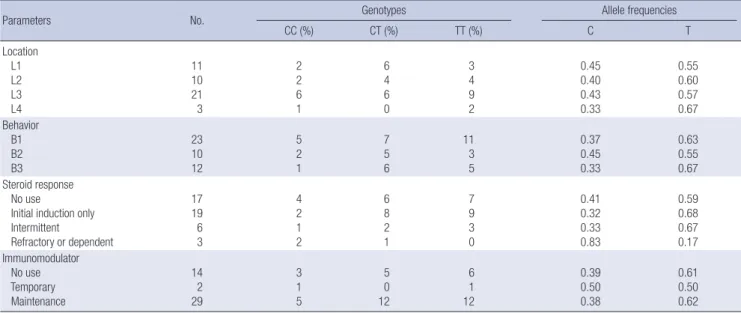
A total 45 patients with CD assigned to divide into the sub- groups according to the Montreal classification. There were no
Table 2. Demographic characteristics of patients with ulcerative colitis and Crohn’s disease
Parameters Ulcerative colitis (n = 99)
Crohn’s disease (n = 45)
Healthy control (n = 178) Age (yr) (mean ± SD) 49.8 ± 14.7 32.1 ± 11.4 47.2 ± 13.0
Male:female 46:53 25:20 88:90
Age at diagnosis (yr) (mean ± SD)
41.9 ± 14.4 27.4 ± 10.8 Disease duration (yr)
(mean ± SD) 7.9 ± 4.6 5.3 ± 5.4
Table 3. Allele and genotype frequencies of the promoter polymorphism at -159 C/T of the CD 14 gene
No. Genotypes Allele frequencies
CC (%) CT (%) TT (%) C T
IBD CD UC
144 45 99
28 (19) 9 (20) 19 (19)
69 (48) 17 (38) 52 (53)
47 (33)*
19 (42)*
28 (28)*
0.43 0.39 0.45
0.57† 0.61‡ 0.55§
Control 178 74 (41) 78 (44) 26 (15) 0.63 0.37
*P < 0.001 vs control; †P < 0.005; ‡P < 0.001; §P < 0.01. CD, Crohn’s disease; UC, ulcerative colitis.
Table 4. Allele and genotype frequencies of the promoter polymorphism at -159 C/T of the CD14 gene in patients with Crohn’s disease
Parameters No. Genotypes Allele frequencies
CC (%) CT (%) TT (%) C T
Location L1 L2 L3 L4
11 10 21 3
2 2 6 1
6 4 6 0
3 4 9 2
0.45 0.40 0.43 0.33
0.55 0.60 0.57 0.67 Behavior
B1 B2 B3
23 10 12
5 2 1
7 5 6
11 3 5
0.37 0.45 0.33
0.63 0.55 0.67 Steroid response
No use
Initial induction only Intermittent
Refractory or dependent
17 19 6 3
4 2 1 2
6 8 2 1
7 9 3 0
0.41 0.32 0.33 0.83
0.59 0.68 0.67 0.17 Immunomodulator
No use Temporary Maintenance
14 2 29
3 1 5
5 0 12
6 1 12
0.39 0.50 0.38
0.61 0.50 0.62 L1, terminal ileum; L2, colon; L3, ileocolon; L4, upper GI proximal to the terminal ileum; B1, nonstricturing nonpenetrating; B2, structuring; B3, penetrating.
M 1 2 3 4 5 6
T/T T/C C/C T/T T/C T/C
300 bp 200 bp
100 bp
Fig. 1. Detection for the -159C/T polymorphism of CD14 gene by using PCR-RFLP.
Digestion of the PCR products yielded bands of 295 bp in TT homozygotes, 140 and 155 bp in CC homozygotes, and all 3 bands (140, 155, and 295 bp) in heterozygotes.
significant differences in TT genotype and T allele frequencies of CD14 gene according to the disease location and behavior, the administration of steroid or immunomodulator, and the re- sponse to treatment (Table 4). Among 99 patients with UC, 24 patients (22.2%) had pancolitis, while 23 patients had the dis- ease limited to the left side and 52 patients had proctitis. In pa- tients with UC, TT and T allele were not associated with the dis- ease activity, the use of steroid or immunomodulator, and the response to each drug, but associated with the disease extent (T allele: 0.65 in pancolitis vs 0.51 in left-sided colitis and proctitis, P = 0.01) (Table 5) (Fig. 2).
DISCUSSION
Although the exact etiology of IBD is unknown, it is considered that inappropriate and exaggerated immune response to lumi-
nal bacteria would be an important role in the pathogenesis of IBD. In the past, numerous endogenous, pathogenic bacteria or mycobacteria have long been suspected as being major con- tributors to the etiology of IBD, but none of them have achieved etiologic status (21). Inappropriate activation of innate immuni- ty is the other arm involved in the pathogenesis of IBD. Recent- ly, genetic studies in humans and mice have made a convincing link between the innate immune system and chronic inflamma- tion (22, 23).
Epidemiological studies show an association between TLR4 polymorphism and susceptibility to IBD. In a Belgian study, the allele frequency of the TLR4 A299G polymorphism was signifi- cantly higher in CD and in UC patients compared with controls, whereas no association with IBD of the TLR4 polymorphim was found in Hungarian and German cohort (24, 25). The study about polymorphisms of TLR1, 2 or 6 in the pathogenesis of IBD are scarce. None of the single nucleotide polymorphisms of TLR1, 2 or 6 were involved with IBD susceptibility. However, a num- ber of variants were found to be associated with disease pheno- types. The TLR2 R753G and TLR1 R80T single nucleotide poly- morphisms (SNPs) were found to be associated with pancolitis in UC (26). In our results, gene polymorphisms of the TLRs were not detected in any Korean subject. It suggested that the contri- bution of genetic determinants might differ significantly between ethnicities.
CD14 gene consists of a single base substitution (C → T) at position -159 in the promoter of the gene (27). This polymor- phism has been reported to influence degree of the density of CD14 expression to secrete inflammatory cytokines by lipopoly- saccharide (LPS) (28). Previously, in several reports from West- ern countries, gene polymorphisms of the CD14 was found to be associated with the development of IBD, more so in the de- velopment of CD than in UC (9, 10). However, in Japanese pop-
%
Proctitis + Left side Pancolitis
colitis
T allele C allele 100
50
0
51
65
49
35 P < 0.01
Fig. 2. Allele frequency of the promoter polymorphism at -159 C/T of the CD14 gene according to disease extent in patients with ulcerative colitis.
Table 5. Allele and genotype frequencies of the promoter polymorphism at -159 C/T of the CD14 gene in patients with ulcerative colitis
Disease status No Genotypes Allele frequencies
CC (%) CT (%) TT (%) C T
Extent Proctitis Left-sided colitis Pancolitis
52 23 24
12 6 2
25 12 13
15 5 9
0.47 0.52 0.35
0.53 0.48 0.65 Disease activity
Mild Moderate Severe
35 46 18
8 9 4
17 23 9
10 14 5
0.47 0.45 0.47
0.53 0.55 0.53 Steroid response
No use
Initial induction only Intermittent Dependent
49 14 19 17
8 6 2 4
26
3 13 9
15 5 4 4
0.43 0.54 0.45 0.50
0.57 0.46 0.55 0.50 Immunomodulator
No use Temporary Maintenance
72 9 18
16 2 4
32 3 11
24 4 3
0.44 0.39 0.53
0.56 0.61 0.47
ulation, the same genotype is associated with UC but not with CD (12, 15), and another study investigating Chinese patients failed to demonstrate any association (13). In our results, T allele and TT genotype frequencies of CD14 gene were significantly higher in IBD patients than in healthy controls. In subgroup anal- ysis, both CD and UC patients had significantly higher T allele frequency compared to healthy controls. In patients with UC and CD, T allele and TT genotype frequencies of CD14 gene were not associated with the disease activity, the use of steroid or im- munomodulator and the response to each drug. It is notewor- thy that the specific allelic frequency of CD14 polymorphism is closely associated with pancolitis phenotype in UC. Since this study includes small numbers of the patients with IBD, especial- ly with CD, it might be difficult to figure out the association be- tween genetic polymorphism and disease phenotype. Moreover, it cannot exclude a type 2 statistical error. To overcome it, the re- searcher can sample as many subjects as cost and time allow.
The distributions of CD14 -159C/T genotypes were signifi- cantly different between Korean and Chinese, and between Ko- rean and Japanese population, which demonstrated ethnic ge- netic differences. Compared with the previous studies, the fre- quency of the CC genotype of healthy controls in Korean popu- lation (41.6%) was higher than in Chinese (15.6%) or Japanese (21.8%), whereas the TT genotype of healthy controls in Korean (14.6%) was lower than in Chinese (36.3%) or Japanese (25.4%) (12, 13). Further study in larger and diverse populations would be needed for elucidation of the association between disease susceptibility of IBD and polymorphism of CD14 gene.
In conclusion, the promoter polymorphism at -159 C/T of the CD14 gene is positively associated with IBD, both UC and CD. In patients with UC, T allele and TT genotype frequencies of CD14 gene are associated with the disease extent, and increased T al- lelic frequency is preferable to pancolitis phenotype of UC in Korean population.
REFERENCES
1. Perera FP, Weinstein IB. Molecular epidemiology: recent advances and future directions. Carcinogenesis 2000; 21: 517-24.
2. Freeman HJ. Familial Crohn’s disease in single or multiple first-degree relatives. J Clin Gastroenterol 2002; 35: 9-13.
3. Ahmad T, Satsangi J, McGovern D, Bunce M, Jewell DP. The genetics of inflammatory bowel disease. Aliment Pharmacol Ther 2001; 15: 731-48.
4. Hugot JP, Thomas G. Genome-wide scanning in inflammatory bowel disease. Dig Dis 1998; 16: 364-9.
5. Aderem A, Ulevitch RJ. Toll-like receptors in the induction of the innate immune response. Nature 2000; 406: 782-7.
6. Akira S, Sato S. Toll-like receptors and their signaling mechanisms. Scand J Infect Dis 2003; 35: 555-62.
7. Antal-Szalmás P. Evaluation of CD14 in host defence. Eur J Clin Invest 2000; 30: 167-79.
8. Lin J, Yao YM, Yu Y, Chai JK, Huang ZH, Dong N, Sheng ZY. Effects of
CD14-159 C/T polymorphism on CD14 expression and the balance be- tween proinflammatory and anti-inflammatory cytokines in whole blood culture. Shock 2007; 28: 148-53.
9. Klein W, Tromm A, Griga T, Fricke H, Folwaczny C, Hocke M, Eitner K, Marx M, Duerig N, Epplen JT. A polymorphism in the CD14 gene is asso- ciated with Crohn disease. Scand J Gastroenterol 2002; 37: 189-91.
10. Gazouli M, Mantzaris G, Kotsinas A, Zacharatos P, Papalambros E, Archi- mandritis A, Ikonomopoulos J, Gorgoulis VG. Association between poly- morphisms in the Toll-like receptor 4, CD14, and CARD15/NOD2 and inflammatory bowel disease in the Greek population. World J Gastroen- terol 2005; 11: 681-5.
11. Leung E, Hong J, Fraser AG, Merriman TR, Vishnu P, Abbott WG, Kris- sansen GW. Polymorphisms of CARD15/NOD2 and CD14 genes in New Zealand Crohn’s disease patients. Immunol Cell Biol 2005; 83: 498-503.
12. Obana N, Takahashi S, Kinouchi Y, Negoro K, Takagi S, Hiwatashi N, Shi- mosegawa T. Ulcerative colitis is associated with a promoter polymor- phism of lipopolysaccharide receptor gene, CD14. Scand J Gastroenterol 2002; 37: 699-704.
13. Guo QS, Xia B, Jiang Y, Morré SA, Cheng L, Li J, Crusius JB, Peña AS. Poly- morphisms of CD14 gene and TLR4 gene are not associated with ulcer- ative colitis in Chinese patients. Postgrad Med J 2005; 81: 526-9.
14. Peters KE, O’Callaghan NJ, Cavanaugh JA. Lack of association of the CD14 promoter polymorphism: 159C/T with Caucasian inflammatory bowel disease. Scand J Gastroenterol 2005; 40: 194-7.
15. Wang F, Tahara T, Arisawa T, Shibata T, Nakamura M, Fujita H, Iwata M, Kamiya Y, Nagasaka M, Takahama K, Watanabe M, Hirata I, Nakano H.
Genetic polymorphisms of CD14 and Toll-like receptor-2 (TLR2) in pa- tients with ulcerative colitis. J Gastroenterol Hepatol 2007; 22: 925-9.
16. Yang SK, Hong WS, Min YI, Kim HY, Yoo JY, Rhee PL, Rhee JC, Chang DK, Song IS, Jung SA, Park EB, Yoo HM, Lee DK, Kim YK. Incidence and prevalence of ulcerative colitis in the Songpa-Kangdong district, Seoul, Korea, 1986-1997. J Gastroenterol Hepatol 2000; 15: 1037-42.
17. Gasche C, Scholmerich J, Brynskov J, D’Haens G, Hanauer SB, Irvine EJ, Jewell DP, Rachmilewitz D, Sachar DB, Sandborn WJ, Sutherland LR. A simple classification of Crohn’s disease: report of the Working Party for the World Congresses of Gastroenterology, Vienna 1998. Inflamm Bowel Dis 2000; 6: 8-15.
18. Caprilli R, Gassull MA, Escher JC, Moser G, Munkholm P, Forbes A, Hommes DW, Lochs H, Angelucci E, Cocco A, Vucelic B, Hildebrand H, Kolacek S, Riis L, Lukas M, de Franchis R, Hamilton M, Jantschek G, Michetti P, O’Morain C, Anwar MM, Freitas JL, Mouzas IA, Baert F, Mitch- ell R, Hawkey CJ; European Crohn’s and Colitis Organisation. European evidence based consensus on the diagnosis and management of Crohn’s disease: special situations. Gut 2006; 55: i36-58.
19. Satsangi J, Silverberg MS, Vermeire S, Colombel JF. The Montreal classi- fication of inflammatory bowel disease: controversies, consensus, and implications. Gut 2006; 55: 749-53.
20. Stange EF, Travis SP, Vermeire S, Beglinger C, Kupcinkas L, Geboes K, Barakauskiene A, Villanacci V, Von Herbay A, Warren BF, Garche C, Tilg H, Schreiber SW, Schölmerich J, Reinisch W; European Crohn’s and Coli- tis Organisation. European evidence based consensus on the diagnosis and management of Crohn’s disease: definition and diagnosis. Gut 2006;
55: i1-15.
21. Ohkusa T, Nomura T, Sato N. The role of bacterial infection in the patho- genesis of inflammatory bowel disease. Intern Med 2004; 43: 534-9.
22. Rakoff-Nahoum S, Paglino J, Eslami-Varzaneh F, Edberg S, Medzhitov R.
Recognition of commensal microflora by toll-like receptors is required for intestinal homeostasis. Cell 2004; 118: 229-41.
23. Lee J, Mo JH, Katakura K, Alkalay I, Rucker AN, Liu YT, Lee HK, Shen C, Cojocaru G, Shenouda S, Kagnoff M, Eckmann L, Ben-Neriah Y, Raz E.
Maintenance of colonic homeostasis by distinctive apical TLR9 signalling in intestinal epithelial cells. Nat Cell Biol 2006; 8: 1327-36.
24. Baumgart DC, Buning C, Geerdts L, Schmidt HH, Genschel J, Fiedler T, Gentz E, Molnar T, Nagy F, Lonovics J, Lochs H, Wiedenmann B, Nickel R, Witt H, Dignass A. The c.1-260C>T promoter variant of CD14 but not the c.896A>G (p.D299G) variant of toll-like receptor 4 (TLR4) genes is as- sociated with inflammatory bowel disease. Digestion 2007; 76: 196-202.
25. Franchimont D, Vermeire S, El Housni H, Pierik M, Van Steen K, Gustot T, Quertinmont E, Abramowicz M, Van Gossum A, Devière J, Rutgeerts
P. Deficient host-bacteria interactions in inflammatory bowel disease?
The toll-like receptor (TLR)-4 Asp299gly polymorphism is associated with Crohn’s disease and ulcerative colitis. Gut 2004; 53: 987-92.
26. Pierik M, Joossens S, Van Steen K, Van Schuerbeek N, Vlietinck R, Rut- geerts P, Vermeire S. Toll-like receptor-1,-2,and-6 polymorphisms influ- ence disease extension in inflammatory bowel diseases. Inflamm Bowel Dis 2006; 12: 1-8.
27. Hubacek JA, Rothe G, Pit’ha J, Skodová Z, Stanëk V, Poledne R, Schmitz G. C(-260)→T polymorphism in the promoter of the CD14 monocyte recep- tor gene as a risk factor for myocardial infarction. Circulation 1999; 99:
3218-20.
28. Schütt C. Fighting infection: the role of lipopolysaccharide binding pro- teins CD14 and LBP. Pathobiology 1999; 67: 227-9.