86
Immune Network
Mutations with HIV Infection in Koreans
Byeong-Sun Choi1,2, Seung-Hun Cha1, Sung Soon Kim1, Yong-Keun Park2 and Joo-Shil Lee1
1Center for AIDS Research, Department of Virology, National Institute of Health, and 2The Graduate School of Biotechnology, Korea University, Seoul, Korea
ABSTRACT
Background: Host genetic polymorphisms in the HIV-1 co-receptor CCR5 and CCR2b and SDF-1, ligand for co-receptor CXCR4, have been known to be associated with the resistance of HIV infection and/or the delayed disease progression in HIV-infected pa- tients. Methods: We examined the frequencies of SDF1-3’A and CCR2b-64I alleles of 354 Koreans including 100 HIV-uninfected persons, 13 discordant spouses of HIV-in- fected persons, and 241 HIV-infected persons. The genotyping assays of SDF1 and CCR2b genes were carried out by polymerase chain reaction-restriction fragment length polymorphism. Results: The frequencies of CCR2b-64I and SDF1-3’A alleles in Ko- reans were very high compared with Caucasians and blacks. Observed frequencies of CCR2b-64I and SDF1-3’A allelic variants were 25.1% and 28.7%, respectively. The fre- quency of the CCR2b-64I allele in Koreans was 2~4 times higher than those of other ethnic groups with the exception of Asian. The frequencies of CCR2b-64I and SDF1- 3’A genotypes did not show the significant difference between HIV-infected and unin- fected Koreans. However, the prevalence of CCR2b-64I genotype of the LTNP group was about two times higher than that of the remainder group (P< 0.05). Four (45%) out of 9 LTNPs (long-term nonprogressors) showed having the SDF1-3’A allele and 7 (78%) out of 9 LTNPs carried the CCR2b-64I allele. 3 (33%) out of 9 LTNPs had both SDF1-3’A and CCR2b-64I alleles. But none of 5 RPs (rapid progressors) appeared to have both SDF1-3’A and CCR2b-64I alleles. Conclusion: The different genetic back- grounds in study populations may affect the disease progression and the AIDS epidemic in each country. Further studies need to define whether high frequencies of CCR2b-64I and SDF1-3’A allelic variants may affect the HIV disease progression. (Immune Net- work 2002;2(2):86-90)
Key Words: Genetic polymorphism, CCR2b-64I allele, SDF1-3'A allele, long-term non- progressor, HIV, Korean
Correspondence to: Joo-Shil Lee, Director of Center for AIDS Research, Department of Virology, National Institute of Health,
#5 Nokbeon-dong, Eunpyeong-gu, Seoul 122-701, Korea. (Tel) 02-380-1511, (Fax) 02-359-1397, (E-mail) [email protected] This study was supported by the grant from Korea Institute of Science and Technology Evaluation and Planning (KISTEP 99-I- 01-04-A-008).
Introduction
Most HIV strains use chemokine receptor mole- cules, CCR5 and CXCR4, as cell surface coreceptors with CD4 molecules for HIV infection and certain HIV strains use additional chemokine receptors CCR2 and CCR3 (1-3). Host genetic polymorphisms in the HIV-1 co-receptor CCR5, CCR2b and SDF-1, ligand for co-receptor CXCR4, have been known to be associated with the resistance of HIV infection
and/or the delayed disease progression in HIV-infect- ed patients (1-4). Although the most previous studies (3,4) reported that the CCR2b-64I and SDF1-3'A polymorphisms were not related with the resistance of HIV infection, Mangano et al. (5) suggested re- cently that CCR2b-64I allele showed the protective effect in mother-to- infant HIV-1 transmission (verti- cal transmission).
The interesting information of genetic polymor- phism is that allelic frequencies of genetic variants are different with ethnic groups. CCR5△32 mutant is mainly restricted to Caucasian populations and is rare in African and Asian populations (6-8). In our pre- vious study, we found that all Koreans examined in- cluding HIV-infected long-term nonprogressors (LTNPs) and rapid progressors (RPs) showed wild types for CCR5 gene (9). However, CCR2b- 64I allele
frequency was very high (34.0%, n=53) in Mongolia population while other studies reported that it was common in all ethnic groups (10,11). In case of SDF1-3’A, the variant frequencies of African Ameri- cans was three to four fold lower than other ethnic groups (4). These studies make us to suppose that the survival time, HIV transmission rate, and disease progression may differ according to ethnic groups having different genetic polymorphism.
To investigate the correlation between host genetic polymorphism and HIV natural history, it needs the information of immunogenetic backgrounds of var- ious ethnic groups. Therefore, we investigated the frequencies of SDF1-3’A and CCR2b-64I alleles.
Materials and Methods
Patients. The study population was composed of 100 HIV-uninfected persons, 13 discordant spouses of HIV-infected persons, and 241 HIV-infected persons including 9 long term nonprogressors (LTNPs) and 5 rapid progressors (RPs). The LTNP was defined as the patient who has lived with HIV for >7 years, CD4+ T cell count of >500 cells/mm3, no symp- toms related to HIV infection, and no history of tak- ing anti-HIV drugs (12). The RP was defined as the patient who has lived with HIV for <5 years and CD4+ T cell counts of <200 cells/mm3. Remainder was the HIV-infected person who did not involved in a LTNP and a RP. The discordant spouse was defined as the individual who remained HIV-unin- fected despite continuous unprotected sexual contact with their HIV-infected husbands.
CCR2b-64I genotyping. Genomic DNA was isolated from cryopreserved PMBCs by using IsoQuick kit (ORCA Research, Inc. Bothell, WA). Suspended PBMCs with Reagent A was mixed with equal vol- ume of Reagent 1 (lysis solution) followed by addi- tion of Reagent 2 (extraction matrix) and Reagent 3 (extraction buffer). After centrifugation at 12,000x g for 5 minutes, the aqueous phase was transferred and precipitated with isopropanol and ethanol. The DNA pellets were suspended in 100μl of RNase-free water.
The CCR2b-64I allele was detected by PCR-restric- tion fragment length polymorphism (PCR-RFLP) as- say. 2μl of genomic DNA was analysed by PCR with 5’-GGATTGAACAAGGACGCATTTCCCC-3’ and 5’-TTGCACATTGCATTCCCAAA GACCC-3’ as for- ward and reverse primers (13). Samples were amplifi- ed with 100μl of PCR mixture containing 10μl of PCR buffer (Boehringer Mannheim, Germany), 8μl of dNTP (10 mM), 4μl of MgCl2 (25 mM), 4μl each of 10 pmol forward and reverse primers, and 10 unit of Taq polymerase (Boehringer Mannheim, Ger- many). All reactions were performed in a 100μl vol- ume. The DNA was amplified using the following
cycling scheme: 14 min of predenaturation at 94oC, 40 cycles of 30 sec at 94oC, 30 sec at 63oC, and 30 sec at 72oC, and 10 minutes elongation at 72oC. 20μl of PCR product was digested with 2 U of Fok I (New England Biolabs, Beverly, MA, USA) for 2h at 37oC and analysed on 2% agarose gel.
SDF1-3’A genotyping. 2μl of genomic DNA was ana- lysed by PCR with primers SDF 3'UTR-F (sense, 5’- CAGTCAACCTGGGCAAAGCC-3') and SDF 3’- UTR-R (antisense, 5’-AGC TTTGGTCCTGAGAG- TCC-3’) (4). Samples were amplified with 100μl of PCR mixture containing 10μl of PCR buffer (Boeh- ringer Mannheim, Germany), 8μl of dNTP (10 mM), 4μl of MgCl2 (25 mM), 4μl each of 10 pmol SDF 3’UTR-F and SDF 3’UTR-R, and 10 unit of Taq polymerase (Boehringer Mannheim, Germany). All reactions were performed in a 100μl volume. The condition of PCR comprised 14 min of predenatu- ration at 94oC, 35 cycles of 1 min at 94oC, 1 min at 50oC, and 1 min at 72oC, and 10 min elongation at 72oC in thermal cycler (Perkin Elmer 2400, Nor- walk, CT, USA). PCR products were verified with 2%
agarose gel. PCR products were digested with Msp1 (New England Biolabs, Beverly, MA, USA) for 2h at 37oC and analysed on 2% agarose gel.
Statistical analysis. The χ2 test or Fisher's exact test was used to compare the CCR2b-64I and SDF1-3’A genotypic and allelic frequencies between the study groups. All analyses were performed using The STATISTICA 6.0 (statsoft, Inc, Tulsa, USA). P values of 0.05 or less were considered significant.
Results and Discussion
The presence of the CCR2b-64I allele was deter- mined by PCR-RFLP analysis. PCR products were digested with Fork 1 and CCR2b genotypes showed one fragment of 380 bp in the CCR2b wild type, three fragments of 165 bp, 215 bp, and 380 bp in the CCR2b-64I heterozygous type, two fragments of 165 bp and 215 bp in the CCR2b-64I homozygous type (Fig. 1). The frequencies of the CCR2b-64I allele were 30.5% in 100 normal persons, 26.9% in 13 dis- cordant spouses of HIV-infected persons, and 22.8%
in 241 HIV-infected persons (Table I). Especially, the prevalence [77.8% (7/9)] of CCR2b- 64I genotype of the LTNP group was significantly higher than 38.8%
(88/227) of the remainder group (P<0.05).
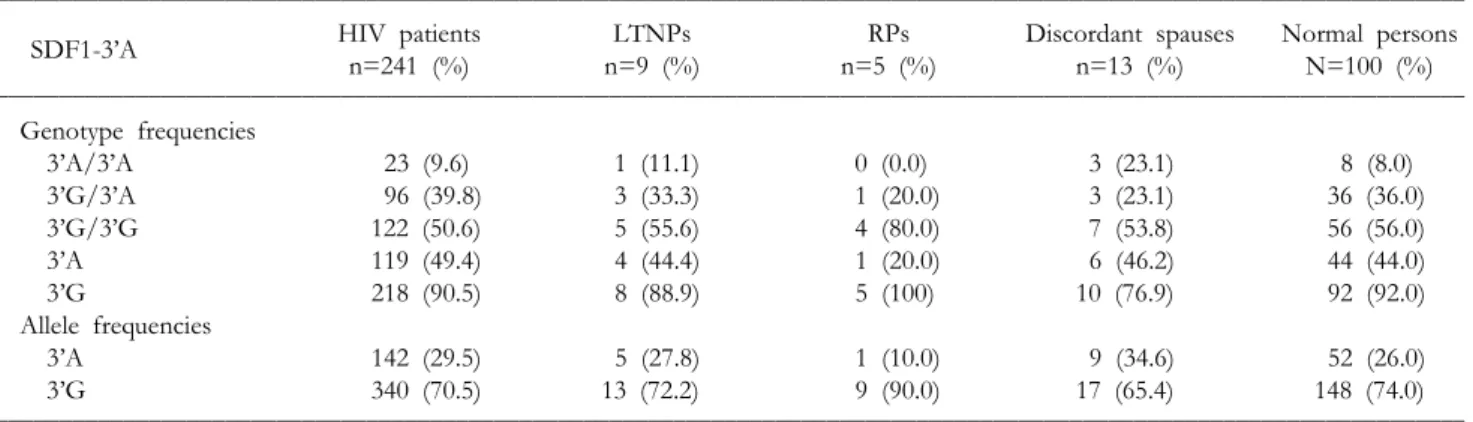
The presence of the SDF1-3’A allele was deter- mined by PCR-RFLP analysis. PCR products were di- gested with Msp1 and SDF1 genotypes showed two fragments of 101 bp and 201 bp in the SDF-1 wild type, three fragments of 101 bp, 201 bp, and 302 bp in the SDF1-3’A heterozygous type, one fragment of 302 bp in the SDF1-3’A homozygous type (Fig. 2).
The frequencies of the SDF1-3’A allele were as fol-
Table I. Frequencies of CCR2b-64I genotype in study groups
HIV patients LTNPs RPs Discordant spauses Normal persons
CCR2b-64I
n=241 (%) n=9 (%) n=5 (%) n=13 (%) n=100 (%)
Genotype frequencies
64I/64I 13 (5.4) 0 (0.0) 1 (20.0) 2 (15.4) 11 (11.0)
64V/64I 84 (34.9) 7 (77.8) 1 (20.0) 3 (23.1) 39 (39.0)
64V/64V 144 (59.8) 2 (22.2) 3 (60.0) 8 (61.5) 50 (50.0)
64I 97 (40.2) 7 (77.8) 2 (40.0) 5 (38.5) 50 (50.0)
64V 228 (94.6) 9 (100) 4 (80.0) 11 (84.6) 89 (89.0)
Allele frequencies
64I 110a (22.8) 7 (38.9) 3 (30.0) 7 (26.9) 61 (30.5)
64V 372b (77.2) 11 (61.1) 7 (70.0) 19 (73.1) 139 (69.5)
64V: Wild type, 64I: Substitution of amino acid residue V (Valine) to I (Isoleucine) at position 64 by a G to A transition at position 190 (counting from ATG start codon) of CCR2b gene. a: RR=0.75, P<0.04, b: RR=1.1, P<0.04
M WT WT Het Het Hom Hom Het
302 bp 201 bp 101 bp 300 bp
200 bp 100 bp
M WT WT Het Het Hom Hom Het
302 bp 201 bp 101 bp 300 bp
200 bp 100 bp
Figure 2. SDF1-3'A UTR mutation genotyping by PCR- RFLP.
Genomic DNA was amplified by PCR using the SDF1- specific primer pair SDF1-3'AF and SDF1-3'AR which flank at position 801 in the 3'UTR. The amplified products were digested with Msp I and the DNA fragments were separated by 2% agarose gel electrophoresis.M: 50 bp DNA ladder marker, WT:
Homozygous wild genotype (2 bands of 201 bp and 101 bp), Het: Heterozygous genotype (3 bands of 302 bp, 201 bp, and 101 bp), Hom: Homozygous genotype (1 band of 302 bp).
M WT WT Het Het Hom Hom Het
380 bp 215 bp 165 bp 300 bp
150 bp200 bp 400 bp
M WT WT Het Het Hom Hom Het
380 bp 215 bp 165 bp 300 bp
150 bp200 bp 400 bp
Figure 1. CCR2b-64I mutation genotyping by PCR-RFLP.
Genomic DNA was amplified by PCR using the CCR2b- specific primer pair CCR2b-64IF and CCR2b-64IR which flank the point mutation sites in the first transmembrane region of CCR2b gene.
The amplified products were digested with Fork I and the DNA fragments were separated by 2% agarose gel electrophoresis.M:
50bp DNA ladder marker, WT: Homozygous wild genotype (1 band of 380 bp), Het: Heterozygous genotype (3 bands of 380 bp, 215 bp, and 165 bp), Hom: Homozygous genotype (2 bands of 215 bp and 165 bp).
Table II. Frequencies of SDF1-3'A genotype in study groups
HIV patients LTNPs RPs Discordant spauses Normal persons
SDF1-3’A
n=241 (%) n=9 (%) n=5 (%) n=13 (%) N=100 (%)
Genotype frequencies
3’A/3’A 23 (9.6) 1 (11.1) 0 (0.0) 3 (23.1) 8 (8.0)
3’G/3’A 96 (39.8) 3 (33.3) 1 (20.0) 3 (23.1) 36 (36.0)
3’G/3’G 122 (50.6) 5 (55.6) 4 (80.0) 7 (53.8) 56 (56.0)
3’A 119 (49.4) 4 (44.4) 1 (20.0) 6 (46.2) 44 (44.0)
3’G 218 (90.5) 8 (88.9) 5 (100) 10 (76.9) 92 (92.0)
Allele frequencies
3’A 142 (29.5) 5 (27.8) 1 (10.0) 9 (34.6) 52 (26.0)
3’G 340 (70.5) 13 (72.2) 9 (90.0) 17 (65.4) 148 (74.0)
3’G: Wild type, 3’A: A G to A transition at position 801 (counting from ATG start codon) in the 3' untranslated region of SDF1 gene.
lows: 26.0% in 100 normal persons, 34.6% in 13 dis- cordant spouses of HIV-infected persons, and 29.5%
in 241 HIV-infected persons (Table II).
As shown in Table I and II, the frequencies of
CCR2b-64I and SDF1-3’A genotypes did not show the significant difference between three groups of HIV-infected, uninfected, and discordant spouse group. But, three out of 9 LTNPs had both SDF1-
Table III. CCR2b-64I and SDF1-3'A allelic frequencies in dif- ferent populations
Allelic
Ethnicity Number Reference
frequency (%)
CCR2b-64I
Korean 100 30.5
Caucasian 146 7.2 Williamson et al. (11) African 180 13.3 Williamson et al. (11) Asian
40 25.0 Smith et al. (3) (unspecified)
Japanese 122 26.2 Hizawa et al. (14) Chinese
71 15.5 Shieh et al. (16) (Taiwan)
Thai 200 15.7 Nookhai et al. (15)
Mongolia 53 34.0 Martinson et al. (10) Hong Kong 49 17.3 Martinson et al. (10) Thailand 60 17.5 Martinson et al. (10) Philippines 66 5.3 Martinson et al. (10) Pakistan 36 2.8 Martinson et al. (10) SDF1-3'A
Korean 100 26.0
Caucasian 145 20.3 Williamson et al. (11) African 198 1.0 Williamson et al. (11) Asian
37 25.7 Winkler et al. (4) (unspecified)
Japanese 15 36.6 Su et al. (17) Chinese
63 28.6 Shieh et al. (16) (Taiwan)
Thai 200 33.2 Nookhai et al. (15)
Allelic frequencies were calculated as (A+2B)/2N, where A is the number of heterozygous mutation genotypes, B is the number of homozygous mutation genotypes, and N is the total number of the healthy population.
3’A and CCR2b-64I alleles but none of 5 RPs appeared to have both SDF1-3’A and CCR2b-64I alleles. Mutant rate of CCR2b gene of the LTNP group was significantly higher than that of the re- mainder group in 241 HIV-infected persons. This re- sult suggests that SDF1-3’A and CCR2b-64I alleles are not related with the resistance of HIV infection but may make a role for the delayed disease progres- sion of HIV-infected Koreans.
The frequencies of CCR2b-64I and SDF1-3’A al- leles in Koreans were very high compared with Cau- casians and blacks. The CCR2b-64I allelic mutation in Koreans displayed a high frequency compared with Caucasians and blacks (25.1% in Koreans, 7.2% in Caucasians, and 13.3% in African-Americans, respec- tively). The frequency of the CCR2b-64I allele in Koreans was 2~4 times higher than those of other ethnic groups with the exception of Asian. In Asian countries, the CCR2b-64I allelic frequency of Ko-
reans was similar to those of Mongolia and Japanese reported by Martinson et al. (10) and Hizawa et al. (14), but it was about 2 times higher than those of Thai, Hong Kong, Thailand, and Chinese reported by Martinson et al. (10), Nookhai et al. (15), and Shieh et al. (16), respectively (Table III). The allelic frequency of the SDF1-3'A gene variant in Koreans was significantly higher than 1.0% of African-Ameri- cans, but was similar to those of Thai, Chinese, and Japanese reported by Nookhai et al. (15), Shieh et al.
(16), and Su et al. (17), respectively (Table III).
Our results suggest that high frequencies of CCR2b-64I and SDF1-3'A allelic variants are not closely related with the resistance of HIV infection.
However, mutant rate of CCR2b gene was about two times higher in the LTNP group than in the remain- der group. One of the interpretations of these phe- nomena is that these allelic variants may affect cell susceptibility after HIV infection. If so, the different genetic backgrounds in ethnic groups can affect the disease progression and the AIDS epidemic in each country. Therefore, we need further studies to define whether high frequencies of CCR2b-64I and SDF1- 3’A allelic variants may affect the HIV disease pro- gression.
References
1. Martin MP, Dean M, Smith MW, Winkler C, Gerrard B, Michael NL, Lee B, Doms RW, Margolick J, Buchbinder S, Goedert JJ, O'Brien TR, Hilgartner MW, Vlahov D, O'Brien SJ, Carrington M: Genetic acceleration of AIDS progression by a promoter variant of CCR5. Science 282;
1907-1911, 1998
2. McDermott DH, Zimmerman PA, Guignard F, Kleeber- ger CA, Leitman SF, Multicenter AIDS Cohort Study, Murphy PM: CCR5 promoter polymorphism and HIV-1 disease progression. Lancet 352;866-870, 1998
3. Smith MW, Dean M, Carrington M, Winkler C, Huttley GA, Lomb DA, Goedert JJ, O’Brien TR, Jacobson LP, Kaslow R, Buchbinder S, Vittinghoff E, Vlahov D, Hoots K, Hilgartner MW, Hemophilia Growth and Development Study (HGDS), Multicenter AIDS Cohort Study (MACS), Multicenter Hemophilia Cohort Study (MHCS), San Fran- cisco City Cohort (SFCC), ALIVE Study, O’Brien SJ:
Contrasting genetic influence of CCR2 and CCR5 variants on HIV-1 infection and disease progression. Science 277;
959-965, 1997
4. Winkler C, Modi W, Smith MW, Nelson GW, Wu X, Car- rington M, Dean M, Ho T, Tashiro K, Yabe D, Buch- binder S, Vittinghoff E, Goedert JJ, O’Brien TR, Jacobson LP, Detels R, Donfield S, Willoughby A, Gomperts E, Vlahov D, Phair J, ALIVE Study, Hemophilia Growth and Development Study (HGDS), Multicenter AIDS Co- hort Study (MACS), Multicenter Hemophilia Cohort Study (MHCS), San Francisco City Cohort (SFCC), O'Brien SJ:
Genetic restriction of AIDS pathogenesis by an SDF-1 chemokine gene variant. Science 279;389-393, 1998 5. Mangano A, Kopka J, Batalla M, Bologna R, Sen L: Pro-
tective effect of CCR2-64I and not of CCR5-delta32 and
SDF1-3'A in pediatric HIV-1 infection. J Acquir Immune Defic Syndr 23;52-57, 2000
6. Martinson JJ, Chapman NH, Rees DC, Liu YT, Clegg JB:
Global distribution of the CCR5 gene 32-basepair dele- tion. Nature 16;100-103, 1997
7. Ansari-Lari MA, Liu XM, Metzker ML, Rut AR, Gibbs RA: The extent of genetic variation in the CCR5 gene.
Nature Genet 16;221-222, 1997
8. Zimmerman PA, Buckler-White A, Alkhatib G, Spalding T, Kubofcik J, Combadiere C, Weissman D, Cohen O, Rubbert A, Lam G, Vaccarezza M, Kennedy PE, Kuma- raswami V, Giorgi JV, Detels R, Hunter J, Chopek M, Berger EA, Fauci AS, Nutman TB, Murphy PM: In- herited resistance to HIV-1 conferred by an inactivating mutation in CC chemokine receptor 5: studies in popula- tions with contrasting clinical phenotypes, defined racial background, and quantified risk. Molec Med 3;23-26, 1997 9. Oh MD, Kim SS, Kim EY, Lee SH, Kim NJ, Park KY,
Kim US, Kim T, Kim TG, Choe KW, Lee JS: The fre- quency of mutation in CCR5 gene among Koreans. Int J STD AIDS 11;266-267, 2000
10. Martinson JJ, Hong L, Karanicolas R, Moore JP, Kostrikis LG: Global distribution of the CCR2- 64I/CCR5-59653T HIV-1 disease-protective haplotype. AIDS 14;483-489, 2000
11. Williamson C, Loubser SA, Brice B, Joubert G, Smit T, Thomas R, Visagie M, Cooper M, van der Ryst E: Allelic frequencies of host genetic variants influencing suscepti- bility to HIV-1 infection and disease in South African
populations. AIDS 14;449-451, 2000
12. Zanussi S, Simonelli C, D'Andrea M, Clerici CC, Tirelli U, Paoli PD: CD8+ lymphocyte phenotype and cytokine production in long-term non-progressor and in progressor patients with HIV-1 infection. Cli Exp Immunol 105;220- 224, 1996
13. Magierowska M, Theodorou I, Debre P, Sanson F, Autran B, Riviere Y, Charron D, Costagliola D: Combined geno- types of CCR5, CCR2, SDF1, and HLA genes can predict the long-term nonprogressor status in human immuno- deficiency virus-1-infected individuals. Blood 93(3);936- 941, 1999
14. Hizawa N, Yamaguchi E, Furuya K, Jinushi E, Ito A, Kawakami Y: The role of the C-C chemokine receptor 2 gene polymorphism V64I (CCR2I) in sarcoidosis in Japa- nese population. Am J Respir Crit Care Med 159;2021- 2023, 1999
15. Nookhai S, Ruxrungtham K, Phanuphak P, Oelrichs R:
Prevalence of CCR2-64I, SDF1-3’A and CCR5-delta32 alleles in healthy Thais. Eur J Immunogenet 27;153-157, 2000
16. Shieh B, Liau YE, Yan YP, Sun HS, Chen MY, Liu YC, Ko NY, Li C: Alleles that may influence HIV-1 patho- genesis in Chinese subjects. AIDS 3;421-423, 1999 17. Su B, Jin L, Hu F, Xiao J, Luo J, Lu D, Zhang W, Chu
J, Du R, Geng Z, Qiu X, Xue J, Tan J, O’Brien SJ, Cha- kraborty R: Distribution of two HIV-1-resistant poly- morphisms (SDF1-3'A and CCR2-64I) in East Asian and world populations and its implication in AIDS epide- miology. Am J Hum Genet 65;1047-1053, 1999