Received:September 22, 2019, Revised:(1st) October 15, 2019, (2nd) October 16, 2019, Accepted:October 16, 2019 Corresponding to:Young Ho Lee http://orcid.org/0000-0003-4213-1909
Division of Rheumatology, Department of Internal Medicine, Korea University Anam Hospital, Korea University College of Medicine, 73 Inchon-ro, Seongbuk-gu, Seoul 02841, Korea. E-mail:[email protected]
Copyright ⓒ 2020 by The Korean College of Rheumatology. All rights reserved.
This is an Open Access article, which permits unrestricted non-commerical use, distribution, and reproduction in any medium, provided the original work is properly cited.
Associations Between Circulating Interleukin-17 Levels and Systemic Lupus Erythematosus and Between Interleukin-17 Gene Polymorphisms and Disease Susceptibility:
A Meta-analysis
Young Ho Lee, M.D., Ph.D., Gwan Gyu Song, M.D., Ph.D.
Department of Rheumatology, Korea University College of Medicine, Seoul, Korea
Objective. To systematically investigate the relationship between circulating interleukin-17 (IL-17) levels and systemic lupus erythematosus (SLE) and associations between polymorphisms in IL17 genes and SLE susceptibility. Methods. We performed a meta-analysis of serum/plasma IL-17 levels in patients with SLE and controls and evaluated the associations between the IL17A rs2275913, IL17F rs763780, and IL17F rs2397084 polymorphisms and IL17F copy number variations (CNVs) and risk of SLE.
Results. Thirteen studies focusing on 2,096 patients with SLE and 2,587 controls were included. Our meta-analysis revealed that IL-17 levels were significantly higher in the SLE group than the control group (standardized mean difference=1.045, 95% con- fidence interval [95% CI]=0.521∼1.568, p<0.001). Subgroup analysis using sample size showed increased IL-17 levels in samples from large (n>100) but not small (n<90) SLE groups. We found no evidence of associations between SLE and the IL17A rs2275913, IL17F rs763780, and IL17F rs2397084 polymorphisms. However, a significant association was found be- tween SLE and IL17F CNVs in a pooled cohort of affected individuals compared to that in pooled controls (odd ratio=3.663, 95% CI=2.466∼5.221, p<0.001). Conclusion. This meta-analysis revealed significantly higher circulating IL-17 levels in pa- tients with SLE and showed evidence of associations between IL17F CNVs and SLE. (J Rheum Dis 2020;27:37-44)
Key Words. Interleukin-17, Polymorphism, Systemic lupus erythematosus
INTRODUCTION
Systemic lupus erythematosus (SLE) is characterized by immune regulation disruption and multisystem involve- ment and is mediated by autoantibodies and immune complex deposits [1]. Disrupted immune regulation via dysregulation of B- and T-cell activation and aberrant pro- duction of cytokines plays a key role in SLE pathogenesis [2]. Although the etiology of SLE is incompletely under- stood, it is clear that genetic components play key roles in SLE pathogenesis [2,3].
A subtype of T cells, Th17 cells, secrete interleukin-17 (IL-17), which is a pleiotropic pro-inflammatory cytokine that enhances T-cell priming and stimulates epithelial,
endothelial, and fibroblastic cells to produce multiple proinflammatory mediators such as tumor necrosis fac- tor-alpha (TNF-α), IL-1β, IL-6, and chemokines [4].
IL-17 plays a critical role in innate and adaptive immune systems by promoting inflammation, cytokine production, B-cell proliferation, and autoantibodies production [4].
IL-17 consists of six protein members [IL-17A, IL-17B, IL17-C, IL-17D, IL-17E (IL-25), and IL-17F] of which IL-17A and IL-17F are responsible for the activity of Th17 cells in the induction of other cytokines and chemokines [5]. IL17A and IL17F are both located on chromosome 6p12, which is a genomic region linked to SLE [6]. In ad- dition to the ability of IL-17 to regulate inflammatory re- actions and immune responses and because of their chro-
mosomal location, these genes are considered potential candidate genes for SLE.
Several studies investigating circulating IL-17 levels in patients with SLE compared to healthy controls and test- ing polymorphisms in different IL17-encoding genes have found associations with SLE susceptibility [7-19]. Thus, we performed a meta-analysis to overcome the limi- tations of individual studies and to resolve the incon- sistencies in their findings. The aim of our meta-analysis was to review systematically available evidence on se- rum/plasma IL-17 levels in patients with SLE compared to those found in controls and to determine whether poly- morphisms in IL17-encoding genes were associated with SLE susceptibility.
MATERIALS AND METHODS
Identification of eligible studies and data extraction
We performed a literature search for studies that exam- ined IL-17 levels in patients with SLE and controls, eval- uated the relationship between circulating (serum or plasma) IL-17 levels, or tested for associations between polymorphisms in IL17 genes and SLE. PUBMED, EMBASE, and Cochrane databases were searched to iden- tify all available articles (up to August 2019). The follow- ing key words and terms were used in the search: “IL-17”,“level OR serum OR plasma”, “polymorphism”, “systemic lupus erythematosus”, and “SLE”. In addition, all refer- ences cited were reviewed to identify additional studies that were not included in the above-mentioned electronic databases. Studies were considered eligible based on the following inclusion criteria: (1) they were case-control, cohort, or cross-sectional studies; (2) they provided data on IL-17 levels in both affected and control groups; (3) they included at least 10 patients with SLE; and (4) they tested IL17 gene polymorphisms in SLE and control groups. Studies were excluded if: (1) they contained over- lapping or insufficient data or (2) they were reviews or case reports. Data on the methods and results were ex- tracted from original studies by two independent reviewers. Discrepancies between the reviewers were re- solved by consensus. We performed the meta-analysis in accordance with PRISMA guidelines [20]. The following information was extracted from each study: primary au- thor, year of publication, country, ethnicity, adjustments for age and sex, number of participants, mean and stand- ard deviation (SD) of IL-17 levels, and allele and genotype frequencies of polymorphisms in IL17 genes. When data
were presented as medians, interquartile ranges, or rang- es, the mean and SD values were derived using previously described formulae [21,22].
Evaluation of statistical associations
We performed a meta-analysis to examine the relation- ship between IL-17 levels and SLE and to evaluate the al- lelic effect of the minor allele versus the major allele of different polymorphisms in IL17 genes. For continuity of data, results were presented as standardized mean differ- ences (SMDs) and 95% confidence intervals (CIs). Odd ratios (ORs) and 95% CIs were calculated for dichoto- mous data. We assessed within-study and between-study variations and heterogeneities using Cochran’s Q-sta- tistics [23]. The heterogeneity test was used to assess the null hypothesis that all studies were evaluating the same effect. When the Q-statistic was significant (p<0.10), in- dicating heterogeneity across studies, a random effect model was used for the meta-analysis; otherwise, a fixed effect model was applied [24]. It was assumed that all studies estimated the same underlying effect and specifi- cally considered within-study variation [23]. We quanti- fied the effect of heterogeneity using I2=100% × (Q-df)/
Q [25], where I2 was a measure of the degree of incon- sistency between studies and determines whether the percentage total variation across studies was due to heter- ogeneity and not chance. I2 ranged from 0% and 100%. I2 values of 25%, 50%, and 75% were referred to as low, moderate, and high estimates, respectively [25]. Statistical determinations were performed using the Comprehensive Meta-Analysis computer program (Biosta, Englewood, NJ, USA).
Evaluation of heterogeneity, sensitivity test, and publication bias
To examine potential sources of heterogeneity observed in the meta-analysis, a meta-regression analysis was per- formed using the following variables: ethnicity, adjust- ment for age and/or sex, publication year, sample size, and data type. A sensitivity test to assess the influence of each individual study on the pooled effect size was per- formed by omitting each study individually. Although funnel plots are often used to detect publication bias, they require diverse study types of varying sample sizes, and their interpretation involves subjective judgment. Therefore, we assessed publication bias using Egger’s linear re- gression test [26], which measures funnel plot asymme- try using a natural logarithm scale of the effect size.
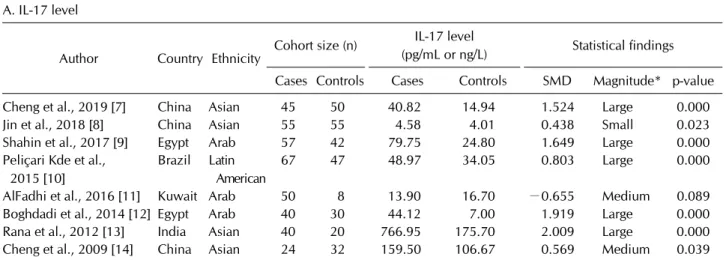
Table 1. Characteristics of individual studies included in the meta-analysis A. IL-17 level
Author Country Ethnicity Cohort size (n) IL-17 level
(pg/mL or ng/L) Statistical findings Cases Controls Cases Controls SMD Magnitude* p-value
Cheng et al., 2019 [7] China Asian 45 50 40.82 14.94 1.524 Large 0.000
Jin et al., 2018 [8] China Asian 55 55 4.58 4.01 0.438 Small 0.023
Shahin et al., 2017 [9] Egypt Arab 57 42 79.75 24.80 1.649 Large 0.000
Peliçari Kde et al., 2015 [10]
Brazil Latin American
67 47 48.97 34.05 0.803 Large 0.000
AlFadhi et al., 2016 [11] Kuwait Arab 50 8 13.90 16.70 −0.655 Medium 0.089
Boghdadi et al., 2014 [12] Egypt Arab 40 30 44.12 7.00 1.919 Large 0.000
Rana et al., 2012 [13] India Asian 40 20 766.95 175.70 2.009 Large 0.000
Cheng et al., 2009 [14] China Asian 24 32 159.50 106.67 0.569 Medium 0.039
IL-17: interleukin-17, SMD: standard mean difference. *Magnitude of Cohen’s d effect size where 0.2 to 0.5 is a small effect, 0.5 to 0.8 is a medium effect, and ≥ 0.8 is a large effect.
B. IL17 polymorphisms
Author Country Ethnicity Cohort size (n) IL17 gene and polymorphism tested
Statistical findings (p-value) Cases Controls
Pasha et al., 2019 [15]
Egypt Arab 80 80 rs2275913 rs2275193 (p=0.048)
Montúfar-Robles et al., 2019 [16]
Mexico Latin American
367 499 rs2275913 NS
Paradowska et al., 2016 [17]
Poland European 139 106 rs763780, rs2397084 rs763780 (p=0.001), rs2275193 (NS) Hammad et al.,
2016 [18]
Egypt Arab 115 259 rs2275913, rs763780,
rs2397084
NS
Yu et al., 2011 [19]-1
China Asian 576 953 IL-17F CNV IL-17F CNV (p<0.001)
Yu et al., 2011 [19]-2
China Asian 441 406 IL-17F CNV IL-17F CNV (p<0.001)
CNV: copy number variation, NS: not significant.
Figure 1. Flow diagram of the study selection process. SLE:
systemic lupus erythematosus, IL-17: interleukin-17.
Figure 2. Meta-analysis of the relationship between circulat- ing IL-17 levels and SLE. IL-17:
interleukin-17, SLE: systemic lupus erythematosus, Std diff:
standard difference, CI: con- fidence interval.
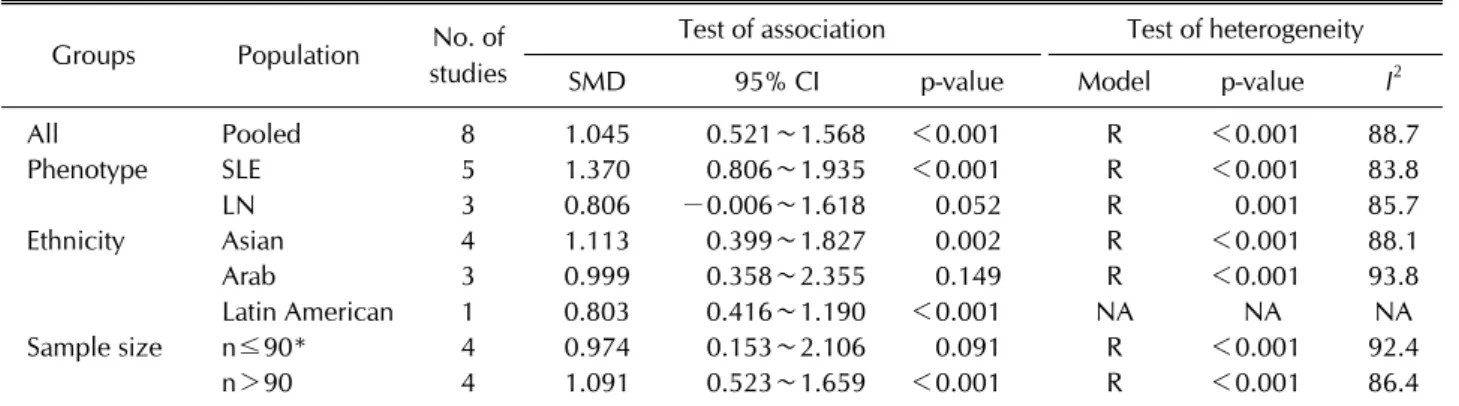
Table 2. Meta-analysis of the association between circulating IL-17 levels and SLE Groups Population No. of
studies
Test of association Test of heterogeneity
SMD 95% CI p-value Model p-value I2
All Pooled 8 1.045 0.521∼1.568 <0.001 R <0.001 88.7
Phenotype SLE 5 1.370 0.806∼1.935 <0.001 R <0.001 83.8
LN 3 0.806 −0.006∼1.618 0.052 R 0.001 85.7
Ethnicity Asian 4 1.113 0.399∼1.827 0.002 R <0.001 88.1
Arab 3 0.999 0.358∼2.355 0.149 R <0.001 93.8
Latin American 1 0.803 0.416∼1.190 <0.001 NA NA NA
Sample size n≤90* 4 0.974 0.153∼2.106 0.091 R <0.001 92.4
n>90 4 1.091 0.523∼1.659 <0.001 R <0.001 86.4
IL-17: interleukin-17, SLE: systemic lupus erythematosus, SMD: standard mean difference, CI: confidence interval, n: number, R:
random effects model, LN: lupus nephritis, NA: not available. *Number of patients with SLE.
RESULTS
Studies included in the meta-analysis
We identified 449 studies using electronic and manual search methods of which 19 were selected for full-text re- view based on the title and abstract, and six were ex- cluded because they either lacked data or provided dupli- cated data. Therefore, 13 articles met our inclusion cri- teria [7-19] (Figure 1). One of the eligible studies con- tained data on two different groups [19], which were treated independently. Fourteen comparisons were ex- amined in the meta-analysis, which consisted of 2,096 pa- tients with SLE and 2,587 controls (Table 1). Eight stud- ies examined IL-17 levels in affected and control groups, and six comparative studies from five articles evaluated polymorphisms in IL17 genes in both the SLE and control groups (Table 1). Meta-analysis of IL17-related poly- morphisms was performed if there were at least two comparisons. Because of the limited number of candi- date-gene association studies, four types of meta-analy- ses were performed: rs2275913 in IL17A and rs763780,
rs2397084, and copy number variations (CNVs) in IL17F.
Characteristic features of the studies included in the meta-analysis are summarized in Table 1.
Meta-analysis of circulating IL-17 levels in patients with SLE compared to those in controls
Using meta-analysis, we found that IL-17 levels were significantly higher in the SLE group than those in the control group (SMD=1.045, 95% CI=0.521∼1.568, p<
0.001) (Table 2, Figure 2). Stratification based on eth- nicity revealed higher IL-17 levels in the SLE group among Asian and Latin American populations but not in Arabs (Table 2). Subgroup analysis using sample size showed significantly higher IL-17 levels for large (n>
100) but not small (n<90) sample groups in the SLE group compared to those found in the control group (Table 2).
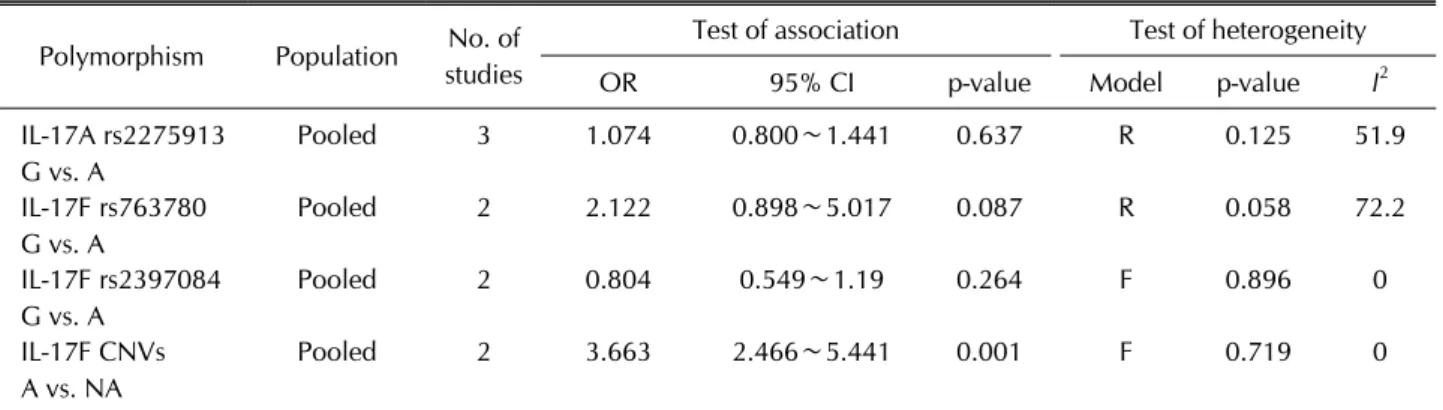
Table 3. Meta-analysis of tests of association between polymorphisms in IL17 genes and SLE Polymorphism Population No. of
studies
Test of association Test of heterogeneity
OR 95% CI p-value Model p-value I2
IL-17A rs2275913 G vs. A
Pooled 3 1.074 0.800∼1.441 0.637 R 0.125 51.9
IL-17F rs763780 G vs. A
Pooled 2 2.122 0.898∼5.017 0.087 R 0.058 72.2
IL-17F rs2397084 G vs. A
Pooled 2 0.804 0.549∼1.19 0.264 F 0.896 0
IL-17F CNVs A vs. NA
Pooled 2 3.663 2.466∼5.441 0.001 F 0.719 0
SLE: systemic lupus erythematosus, OR: odds ratio, CI: confidence interval, R: random effect model, F: fixed effect model, A:
amplification, NA: nonamplification, CNVs: copy number variations.
Meta-analysis of IL17A rs2275913, IL17F rs763780, and IL17F rs2397084 polymorphisms and IL17F CNVs and SLE susceptibility
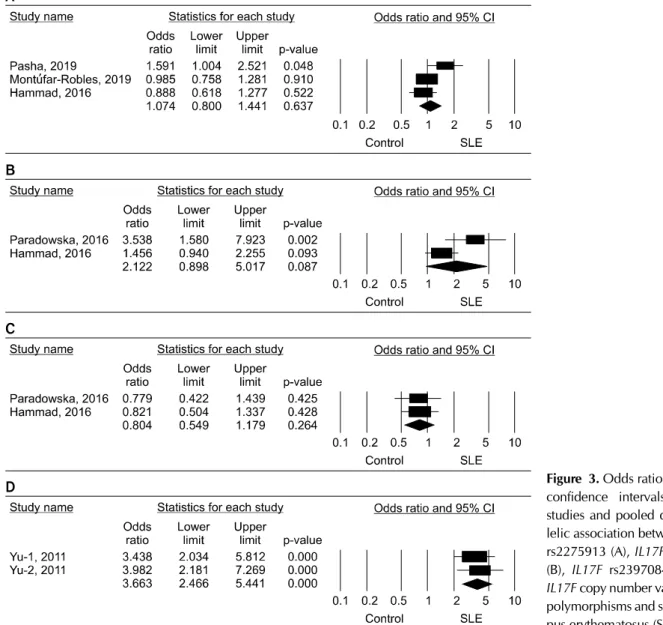
Our meta-analysis revealed no evidence of an associa- tion between the IL17A rs2275913, IL17F rs763780, and IL17F rs2397084 polymorphisms and SLE susceptibility (Table 3, Figure 3). However, our meta-analysis showed a significant association between SLE and IL17F CNVs in a pooled cohort of affected individuals compared to those found in pooled controls (OR=3.663, 95% CI=2.466∼
5.221, p<0.001) (Table 3, Figure 3).
Heterogeneity and publication bias
Between-study heterogeneity was identified during the meta-analyses of IL-17 levels in patients with SLE (Table 2). However, meta-regression analysis showed that eth- nicity, data type, sample size, and adjustment for age and/or sex had no effect on heterogeneity in our meta-analysis of IL-17 levels in patients with SLE (all p>
0.05). Sensitivity analysis showed that no individual study significantly affected the pooled SMD, indicating that the results of this meta-analysis were robust. No het- erogeneity was found in the meta-analyses of poly- morphisms in IL17 genes, with the exception of rs22759136 in IL17A and rs763780 in IL17F. However, the studies included in the meta-analysis for rs763780 showed the same directionality of the ORs (Figure 2).
Publication bias results from a disproportionate number of positive studies and poses a problem for meta- analyses. However, we found no evidence of publication bias for any of the study subjects (i.e., the funnel plot showed no evidence of asymmetry, and from Egger’s re- gression test all p>0.05).
DISCUSSION
In this meta-analysis, evidence for elevated circulating IL-17 levels in SLE and for association between poly- morphisms in IL17 genes and SLE susceptibility were evaluated. Our meta-analysis of 13 studies, which in- cluded 2,096 patients with SLE and 2,587 controls, showed that circulating IL-17 levels were significantly higher in the SLE group than the control group. The rea- son of significantly higher IL-17 levels for large but not small sample groups is unclear, but it may be explained by statistical power due to sample size. In addition, we showed a significant association between IL17F CNVs and SLE susceptibility. These findings indicate that an in- creased IL-17 level may play a role in the pathogenesis of SLE and that CNVs from IL17-encoding genes may be as- sociated with SLE risk. Our meta-analysis provides evi- dence that higher IL-17 levels are correlated with patho- genesis of SLE and, therefore, supports the involvement of Th17 cells in SLE. Th17 cells have been increasingly recognized as important mediators of autoimmune dis- eases [27]. Th17 cells are associated with the production of mediators of inflammation; thus, they have potentially pathogenic roles in autoimmune disease [27]. IL-17, a major effect factor of Th17 cells, is a potent pro-in- flammatory cytokine that is produced by activated T lym- phocytes and is also a potent inducer of TNF-α, IL-1-β, IL-6, IL-8, and G-CSF [4]. Our findings that IL-17 levels increase in the patients with SLE support a role of IL-17 in the pathophysiology of SLE.
Given the potential link between IL-17 and autoimmune diseases, polymorphisms in IL17 genes, which can affect IL-17 expression, have been studied as potential causes of
Figure 3. Odds ratios and 95%
confidence intervals (CIs) of studies and pooled data for al- lelic association between IL17A rs2275913 (A), IL17F rs763780 (B), IL17F rs2397084 (C), and IL17F copy number variation (D) polymorphisms and systemic lu- pus erythematosus (SLE).
autoimmune diseases [28,29]. Our meta-analysis re- vealed an association between IL17F CNVs and SLE, in agreement with the results of functional studies con- ducted on the IL17F CNV polymorphism [19]. Increased copy numbers of IL-17F correlated with elevated mRNA levels [19]. Based on these findings and on those showing that IL17F CNVs are associated with both altered ex- pression of IL-17, which can lead to elevated IL-17 levels, we propose a link between these variants and the devel- opment of SLE. However, our results on the association between the IL17A rs2275913, IL17F rs763780, and IL17F rs2397084 polymorphisms and SLE risk are not consistent with the functional studies of the polymor- phisms. This may be because of the difference in clinical characteristics of the studied populations. In addition, ge-
netic association results sometimes do not coincide with the results of functional studies for complex autoimmune diseases such as SLE. Multiple genes, genetic back- grounds, and environmental factors contribute to SLE development. Our negative results for the IL-17 poly- morphisms might also be due to Type II error.
This meta-analysis has a few limitations. First, most of the recruited studies had small sample sizes, and a lim- ited number of studies tested for evidence of an associa- tion between different polymorphisms in IL17 genes and its levels and SLE. Therefore, our meta-analysis may be underpowered. Second, the studies examined were heter- ogeneous with regard to both demographic character- istics and clinical features. Heterogeneity, confounding factors, and limited clinical information in these study
populations may confound the results. Third, publication bias may adversely affect our analysis because studies with negative findings may not be published or identified in our search. Although we used Egger’s regression test, the possibility of bias cannot be eliminated. Fourth, in- flammatory cytokine level such as IL-17 varies according to disease activity, pre and post-treatment, and treatment drug types, even if measured in the same person.
However, it is not possible to verify that all IL-17 levels of SLE patients were measured under the same conditions because individual papers do not indicate that they were all measured under the same conditions. Nevertheless, this meta-analysis also has its strengths. To the best of our knowledge, our meta-analysis is the first study that pro- vides two parallel lines of evidence examining both IL-17 levels and polymorphisms in IL17-encoding genes in pa- tients with SLE. While individual studies had a limited cohort size ranging from 24 to 576 participants, our pooled analysis had 2,096 patients. In addition, compared to individual studies, our study was able to provide data that were accurate by increasing the statistical power and resolution of the analysis through pooling the results of these independent analyses.
CONCLUSION
In conclusion, our meta-analysis demonstrated that cir- culating IL-17 levels were significantly higher in patients with SLE than the controls and that IL17F CNVs were as- sociated with SLE susceptibility. Based on these findings, we conclude that IL-17 may have an important role in the pathogenesis of SLE. However, further studies are war- ranted to determine whether IL-17 levels directly contrib- ute to the development of SLE.
CONFLICT OF INTEREST
No potential conflict of interest relevant to this article was reported.
AUTHOR CONTRIBUTIONS
Y.H.L. was involved in conception and design of study, acquisition of data, analysis and/or interpretation of data, drafting the manuscript, revising the manuscript crit- ically for important intellectual content. G.G.S. was in- volved in conception and design of study, analysis and/or interpretation of data, drafting the manuscript.
REFERENCES
1. Ruiz-Irastorza G, Khamashta MA, Castellino G, Hughes GR. Systemic lupus erythematosus. Lancet 2001;357:
1027-32.
2. Kotzin BL. Systemic lupus erythematosus. Cell 1996;85:
303-6.
3. Lee YH, Bae SC, Choi SJ, Ji JD, Song GG. Genome-wide pathway analysis of genome-wide association studies on systemic lupus erythematosus and rheumatoid arthritis.
Mol Biol Rep 2012;39:10627-35.
4. Kawaguchi M, Adachi M, Oda N, Kokubu F, Huang SK.
IL-17 cytokine family. J Allergy Clin Immunol 2004;114:
1265-73.
5. Pappu R, Ramirez-Carrozzi V, Sambandam A. The inter- leukin-17 cytokine family: critical players in host defence and inflammatory diseases. Immunology 2011;134:8-16.
6. Choi SJ, Rho YH, Ji JD, Song GG, Lee YH. Genome scan meta-analysis of rheumatoid arthritis. Rheumatology (Oxford) 2006;45:166-70.
7. Cheng Y, Yang X, Zhang X, An Z. Analysis of expression lev- els of IL-17 and IL-34 and influencing factors for prognosis in patients with lupus nephritis. Exp Ther Med 2019;
17:2279-83.
8. Jin L, Bai R, Zhou J, Shi W, Xu L, Sheng J, et al. Association of serum T cell immunoglobulin domain and mucin-3 and interleukin-17 with systemic lupus erythematosus. Med Sci Monit Basic Res 2018;24:168-76.
9. Shahin D, El-Farahaty RM, Houssen ME, Machaly SA, Sallam M, ElSaid TO, et al. Serum 25-OH vitamin D level in treatment-naïve systemic lupus erythematosus patients: re- lation to disease activity, IL-23 and IL-17. Lupus 2017;26:
917-26.
10. Peliçari Kde O, Postal M, Sinicato NA, Peres FA, Fernandes PT, Marini R, et al. Serum interleukin-17 levels are asso- ciated with nephritis in childhood-onset systemic lupus erythematosus. Clinics (Sao Paulo) 2015;70:313-7.
11. AlFadhli S, AlFailakawi A, Ghanem AA. Th-17 related regu- latory network in the pathogenesis of Arab patients with systemic lupus erythematosus and lupus nephritis. Int J Rheum Dis 2016;19:512-20.
12. Boghdadi G, Elewa EA. Increased serum APRIL differ- entially correlates with distinct cytokine profiles and dis- ease activity in systemic lupus erythematosus patients.
Rheumatol Int 2014;34:1217-23.
13. Rana A, Minz RW, Aggarwal R, Anand S, Pasricha N, Singh S. Gene expression of cytokines (TNF-α, IFN-γ), serum profiles of IL-17 and IL-23 in paediatric systemic lupus erythematosus. Lupus 2012;21:1105-12.
14. Cheng F, Guo Z, Xu H, Yan D, Li Q. Decreased plasma IL22 levels, but not increased IL17 and IL23 levels, correlate with disease activity in patients with systemic lupus erythematosus.
Ann Rheum Dis 2009;68:604-6.
15. Pasha HF, Tantawy EA, Youssef MA. Osteopontin and in- terleukin-17A genes polymorphisms in Egyptian systemic lupus erythematosus patients: a relation to disease activity and severity. Gene 2019;702:107-13.
16. Montúfar-Robles I, Barbosa-Cobos RE, Alemán-Ávila I, Ramírez-Bello J. IL-17A haplotype confers susceptibility to systemic lupus erythematosus but not to rheumatoid arthri- tis in Mexican patients. Int J Rheum Dis 2019;22:473-9.
17. Paradowska-Gorycka A, Sowinska A, Stypinska B, Grobelna MK, Walczyk M, Olesinska M, et al. Impact of the IL-17F, IL-23 and IL-23R on susceptibility and phenotype of sys- temic lupus erythematosus. Autoimmunity 2016;49:373-82.
18. Hammad A, Mosaad YM, Hammad EM, Elhanbly S, El-Bassiony SR, Al-Harrass MF, et al. Interleukin-17A rs2275913, Interleukin-17F rs763780 and rs2397084 gene polymorphisms as possible risk factors in Juvenile lupus and lupus related nephritis. Autoimmunity 2016;49:31-40.
19. Yu B, Guan M, Peng Y, Shao Y, Zhang C, Yue X, et al. Copy number variations of interleukin-17F, interleukin-21, and interleukin-22 are associated with systemic lupus ery- thematosus. Arthritis Rheum 2011;63:3487-92.
20. Moher D, Liberati A, Tetzlaff J, Altman DG; PRISMA Group.
Preferred reporting items for systematic reviews and meta-analyses: the PRISMA statement. PLoS Med 2009;6:
e1000097.
21. Hozo SP, Djulbegovic B, Hozo I. Estimating the mean and variance from the median, range, and the size of a sample.
BMC Med Res Methodol 2005;5:13.
22. Ridout KK, Ridout SJ, Price LH, Sen S, Tyrka AR.
Depression and telomere length: a meta-analysis. J Affect
Disord 2016;191:237-47.
23. Egger M, Smith GD, Phillips AN. Meta-analysis: principles and procedures. BMJ 1997;315:1533-7.
24. DerSimonian R, Laird N. Meta-analysis in clinical trials.
Control Clin Trials 1986;7:177-88.
25. Higgins JP, Thompson SG. Quantifying heterogeneity in a meta-analysis. Stat Med 2002;21:1539-58.
26. Egger M, Davey Smith G, Schneider M, Minder C. Bias in meta-analysis detected by a simple, graphical test. BMJ 1997;315:629-34.
27. Zambrano-Zaragoza JF, Romo-Martínez EJ, Durán-Avelar Mde J, García-Magallanes N, Vibanco-Pérez N. Th17 cells in autoimmune and infectious diseases. Int J Inflam 2014;
2014:651503.
28. Jin Y, Deng Z, Cao C, Li L. IL-17 polymorphisms and asthma risk: a meta-analysis of 11 single nucleotide polymor- phisms. J Asthma 2015;52:981-8.
29. Lee YH, Bae SC. Associations between circulating IL-17 lev- els and rheumatoid arthritis and between IL-17 gene poly- morphisms and disease susceptibility: a meta-analysis.
Postgrad Med J 2017;93:465-71.