INTRODUCTION
Endodontically treated teeth usually require using a post inside the root canal for retaining a coronal restoration.1,2Esthetic and strength demands are the most important factors that determine the type of a suitable restoration for these teeth.3In the case of large destruction of coronal tooth structure, the clinical choice may be an esthetic post and core restoration consisting of a com- posite resin core retained by a fiber post which has better stress distribution pattern and esthetic result.2-7Different factors are important in longevity of post and composite core restora- tions, such as: the core material, post type, and the bonding strength between the fiber post and the composite cement, and between post and the composite core restoration.8-11But the fail- ure of these restorations mostly occurs at the junction between the composite resin core and fiber post.4,6,12
One of attempts that have been made to improve the bond- ing strength between composite resin core and fiber posts is the post surface treatment.11For this purpose, chemical or mechan- ical surface treatment procedures were used.4,10,13It is said that mechanical techniques (e.g. sandblasting) are more effec- tive than chemical techniques (e.g. etching with hydrofluoric acid , potassium permanganate, silane and hydrogen perox- ide).2,4,10,14-16Monticelli et al.17stated that the mechanical tech- niques are too aggressive for fiber posts and they can decrease the fiber posts fit in the root canals. However, Chemical treatments can also roughen the post surface and conse- quently increase its mechanical interlock with composite resin core.10,18,19On the other hand, it has been said that there is not any chemical interaction between composite resin and the epoxy resin matrix of fiber posts.11,19However, there are some surface treatments for enhancing resin bonding to the fiber posts
Comparative evaluation of effects of different surface treatment methods on bond strength
between fiber post and composite core
Ramin Mosharraf1*, DDS, MSD, Najmeh Baghaei Yazdi2, DDS
1Department of Prosthodontics and Dental Material Research Center, School of Dentistry, Isfahan University of Medical Sciences, Isfahan, Iran, 2Private Practice, Isfahan, Iran
PURPOSE. Debonding of a composite resin core of the fiber post often occurs at the interface between these two materials. The aim of this study was to evaluate the effects of different surface treatment methods on bond strength between fiber posts and composite core. MATERIALS AND METHODS. Sixty-four fiber posts were picked in two groups (Hetco and Exacto). Each group was further divided into four subgroups using different surface treatments: 1) silanization; 2) sandblasting; 3) Treatment with 24% H2O2, and 4) no treatment (control group). A cylindrical plexiglass matrix was placed around the post and filled with the core resin composite. Specimens were stored in 5000 thermal cycles between 5℃and 55℃. Tensile bond strength (TBS) test and evaluation using stereomicroscope were performed on the specimen and the data were analyzed using two-way ANOVA, Post Hoc Scheffe tests and Fisher's Exact Test (α=.05). RESULTS. There was a significant difference between the effect of different surface treatments on TBS (P<.001) but different brands of post (P=.743) and interaction between the brand of post and surface treatment (P=.922) had no significant effect on TBS. Both silanization and sandblasting improved the bonding strength of fiber posts to composite resin core, but there were not any significant differences between these groups and control group. CONCLUSION. There was not any significant difference between two brands of fiber posts that had been used in this study. Although silanization and sandblasting can improve the TBS, there was not any significant differences between surface treatments used. [J Adv Prosthodont 2012;4:103-8]
KEY WORDS: Composite resins; Fiber reinforced; Bond strengths; Post and core technique
Corresponding author: Ramin Mosharraf
Isfahan University of Medical Sciences, Hezar-Jerib Ave., Isfahan, 81746-73441, Iran Tel. 0098-311-6248238: e-mail, [email protected]
Received February 15, 2012 / Last Revison May 2, 2012 / Accepted May 7, 2012
ⓒ 2012 The Korean Academy of Prosthodontics
This is an Open Access article distributed under the terms of the Creative Commons Attribution Non-Commercial License (http://creativecommons.org/licenses/by- nc/3.0) which permits unrestricted non-commercial use, distribution, and reproduction in any medium, provided the original work is properly cited.
(e.g. coating with priming solutions).17
It has been reported that etching with hydrogen peroxide can provide stronger adhesion between post surface and resin composite.4,20-23Some studies confirmed the benefit of silaniza- tion for enhancing the bond strength of a dual-cure resin core material to fiber posts7,24but there is a large controversy about silane application.25,26
There are many studies about the advantages of doing dif- ferent surface treatments on fiber posts,2,4,7,10,11,18,21,27-31but there has not been any consensus about the most effective treatment for obtaining optimum bonding.
The aim of the present study was to evaluate the effects of some surface treatment methods on the tensile bond strength (TBS) between fiber post and composite core.
The first null hypothesis of this study was that the bond strength between fiber post and composite core with the various sur- face treatments are not significantly different and the second null hypothesis was that the fiber post brand had no significant effect on the tensile bond strength between fiber post and com- posite core.
MATERIALS AND METHODS
In this in vitro study, sixty four glass fiber posts (of two brands but with same composition) with maximum 1.6 mm diameter were selected. The materials used in this study are shown in Table 1. All of the fiber posts were placed in an ultrasonic bath cleaner (Biosonic UC300, Colte`ne/Whaledent, NV, USA) for two minutes at room temperature and then washed with ethanol 96% and were gently air dried. The posts in each group were randomly divided into 4 subgroups of 8 specimens each, according to surface treatments used:
Silane group. A single layer of a silane coupling agent (Ultradent Products Inc., South Jordan, UT, USA) was applied on the post surface for 60 seconds and then dried for 60 sec- onds with gentle air stream.
Sandblasted group The posts in this group were sand- blasted with 50 ㎛ aluminum oxide particles using an oral Microblaster (Dento-prep, Denmark) for ten seconds at 0.25 MPa pressure from a ten millimeter distance and then rinsed with ethanol 96% and were gently air dried.
H2O2 Group At first, the 30% hydrogen peroxide were diluted to 24% hydrogen peroxide and then the posts in this group were immersed in this solution for 10 minutes at room tem- perature and then rinsed under running water for 2 minutes and gently air dried.
Control group This was a control group without any surface treatment.
One layer of bonding resin agent (Voco GmbH, Germany) was applied on all of the prepared post surfaces and then was cured using a halogen light curing unit with 500 mW/cm2inten- sity (Coltolux 50, Coltene, Altstatten, Switzerland) for 20 sec- onds. Apical end of each post was maintained in a dental sur- veyor and positioned vertical to a glass slab. A transparent cylin- drical Plexiglas mold 10 mm in diameter and 2 mm thick (equal to the length of non-tapered portion of the post) was placed around the post and manually adjusted so that the position of the post was exactly at the center. A core build up composite (Kuraray Medical Inc., Japan) was used to fill the cylinder around the post with an incremental technique and each layer was cured separately using the same halogen light curing unit. Before removing the matrix, a further 40 seconds curing was done on the other side of the cylinder to ensure complete polymerization of the core material. With this procedure a cylinder of resin com- posite around the fiber post is made. All of the procedures were performed by the same investigator. All of the specimens were subjected to thermocycling for 5000 cycles at tempera- tures alternating between 5 and 55℃ for 30 seconds each, with an intermediate pause of 15 seconds. The specimens were loaded in a universal testing machine (Electromechanical low-capac- ity testing Machines, walter + bai, AG, Switzerland) at a crosshead speed of 0.5 mm/min until failure occurred. Bond strength was expressed in Mega Pascal (MPa), by using the fol- lowing formula:
Γ = F
πRH
where Γ is the tensile bond strength (MPa), R is the post diam- eter, H is the bonding height and F is the failure mode (N).
Each failed specimen was examined with a stereomicroscope at 15 magnifications (MBC, 10 Number: n 9116734 SF- 100B, LOMO, Russia), in order to evaluate the mode of fail- ure and classify it as adhesive between post and core, cohesive
Table 1. The materials used in this study
Material Batch number Product Manufacturer
Fiber post 15912 Exacto Fiber Post Angelus, Londrina, PR, Brazil
786.917 Hetco Fiber Post Hakim Tous, Mashhad, Iran
Surface treatment B56TT Ultradent Porcelain Silane Ultradent Products Inc., South Jordan, UT, USA - Dento-prep Microblaster Dento-prep, Ronviga, Daugaord, Denmark 107210 Hydrogen Peroxide 24% (H2O2) Merck KGaA, Darmstadt, Germany
Bonding resin agent 1048032 Futurabond DC Voco GmbH, Cuxhaven, Germany
Composite resin 2395AC Clearfil Photo core Composite Kuraray Medical Inc., Tokyo, Japan
within post, cohesive within core and mixed of both types.
The collected data were analyzed (SPSS/PC 16.0; SPSS Inc, Chicago, IL, USA) using Two-way analysis of variance (ANOVA), Post Hoc Scheffe tests and Fisher's Exact Test at P<.05 level of significance.
RESULTS
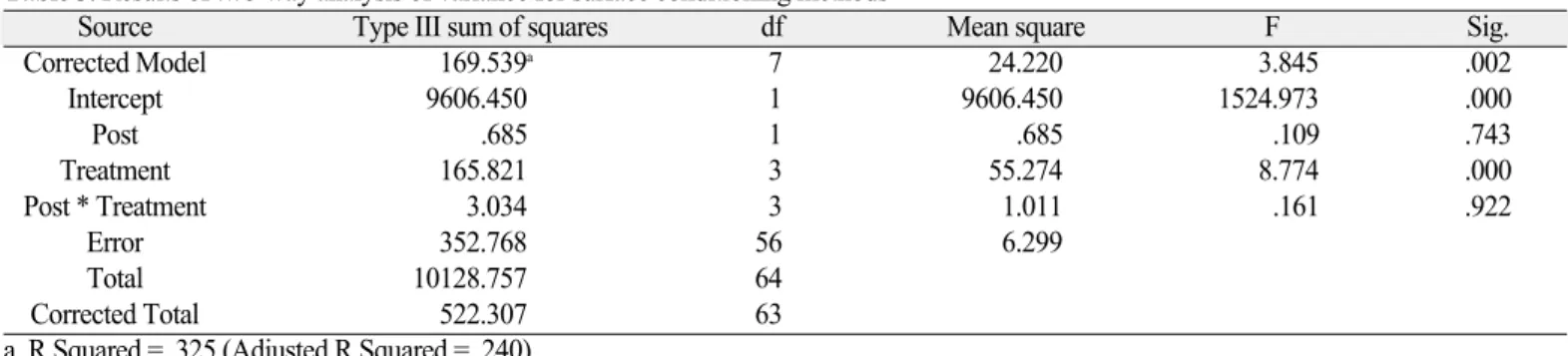
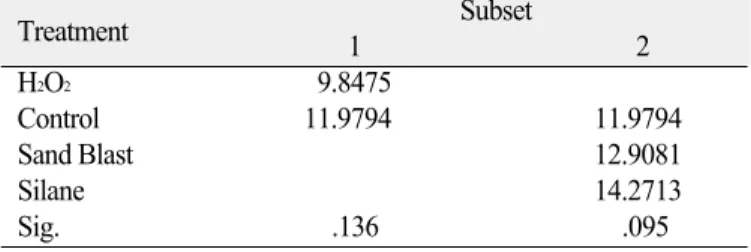
Tensile bond strength mean values and standard deviations for all experimental groups are presented in Table 2. As shown in Fig. 1, in both post brands the H2O2group had the low- est TBS mean value. Analysis results on the effects of post types, surface treatments, and their interaction on TBS are shown in Table 3. The two-way ANOVA revealed that different surface treatments (P<.001) had a significant effect on TBS but dif- ferent brands of post (P=.743) and interaction between the brand of post and surface treatment (P=.922) had no significant effect on TBS. Besides, Post Hoc Scheffe test showed that there were significant difference between H2O2and Silane groups (P<.001) and between H2O2and Sandblast groups (P=.012) but other groups had no significant differences (P>.05) (Table 4).
The results of fracture mode after TBS testing as observed with a stereomicroscope (at ×15 magnification) showed that in this study there were only two types of fracture mode:
one as adhesive between post and core and another as cohe- sive in the core material (Fig. 1). None of the test groups demon- strated cohesive failure within the post material. In the Silane
and Sandblast groups most of the fractures were cohesive but in the other two groups (H2O2and control groups) the pre- dominant fracture pattern was adhesive failure (Table 5).
Fisher's Exact Test showed significant differences between dif- ferent surface treatments in the case of two types of fractures.
Besides, significant differences were seen between Sandblast and Control groups (P=.01) and between Silane and Control groups (P=.003) by using Fisher's Exact Test.
Table 2. Tensile bond strength mean values (MPa) and standard deviations for the eight experimental groups (n = 8)
Post Treatment n Mean SD 95% Confidence interval
Lower bound Upper bound
Hetco Fiber Post Silane 8 14.3875 1.85568 12.8361 15.9389
Sandblast 8 12.8762 3.24750 10.1613 15.5912
H2O2 8 9.8150 2.95970 7.3406 12.2894
Control 8 11.5138 2.99125 9.0130 14.0145
Exacto Fiber Post Silane 8 14.1550 1.23472 13.1227 15.1873
Sandblast 8 12.9400 2.24293 11.0649 14.8151
H2O2 8 9.8800 2.55286 7.7458 12.0142
Control 8 12.4450 2.37187 10.4621 14.4279
Table 3. Results of two-way analysis of variance for surface conditioning methods
Source Type III sum of squares df Mean square F Sig.
Corrected Model 169.539a 7 24.220 3.845 .002
Intercept 9606.450 1 9606.450 1524.973 .000
Post .685 1 .685 .109 .743
Treatment 165.821 3 55.274 8.774 .000
Post * Treatment 3.034 3 1.011 .161 .922
Error 352.768 56 6.299
Total 10128.757 64
Corrected Total 522.307 63
a. R Squared = .325 (Adjusted R Squared = .240)
Fig. 1. Tensile bond strength mean values (MPa) and standard deviations for the eight experimental groups.
Hetco Exacto Post
Error bars: +/- 1 SD 20.00
15.00
10.00
5.00
0.00
Mean TBS ±1SD
Treatment Silane Sand blast H2O2
Control
DISCUSSION
The results of this in vitro study rejected the first null hypothesis that the bond strength between fiber post and composite core with the various surface treatments are not sig- nificantly different. However, the hypothesis that the fiber post brand had no significant effect on the tensile bond strength between fiber post and composite core is accepted.
In this study the composite core material was directly applied on the prepared fiber post surface in a way that was sim- ilar to the method used in some other studies.4,32,33Preparing the specimens and then sectioning them (that is used in most microtensile tests) has some disadvantages like high prema- ture failure rate that can occur during specimen preparation and large data distribution.28,34However, one of the advantages of using the “thin slice”microtensile tests is retrieving multiple specimens from a single fiber post and composite core com- plex.5
In the present study, the highest tensile bond strength was seen in the Silane group in both brands of post (Table 2) but there was not a statistical significant difference between this group and control group (P=.003). This is not in accordance with the results of some other studies.24,25,34,35Increasing the TBS with silane application is due to this fact that silane can increase the surface wettability and creates covalent bonds with hydroxyl- OH groups of inorganic substrates, such as glass.17,36 But some authors stated that there is not any chemical bonding between resin composites and epoxy resin matrix of fiber posts, because epoxy polymers have a highly cross-linked structure.37 Amino-silane coupling agents are generally used for increas- ing the bonding epoxy resin polymers to composite core materials,34,38 and some authors believe that the chemical
bond may be achieved only by using silane between the resin composite and the exposed glass fibers or filler particles of the post.17,26,34Also, some studies claimed that silane did not increase the bond strength of fiber posts.4,13,23,30,39,40However, there is a large controversy about the efficiency of post silanization in improving TBS.17,24,25,30,34,35,37,39-41This inconsistency in the results of the studies may be explained by the differences in the composition of the post and the core materials used and the mode of testing.
Generally, sandblasting is used for pretreating acid-resistant materials.42It can roughen the restoration surface and prepar- ing it for micro-retention.43According to the results of the pre- sent study, sandblasting increased the bonding between fiber post and composite resin core but there was not any statistical significant difference between this group with control group (P<.001). Some other studies concluded that sandblasting can improve the bonding strength of fiber post to composite core.2,15,19,21,23,31,44-46 Several reasons were introduced for this finding. The sandblasting roughens the fiber post surface and produces a mechanical retention for the composite resin.
The composition of the glass-fiber surface is composed of the resin matrix, inorganic filler particles and the glass fibers.2Some authors believed that sandblasting modifies the epoxy resin matrix and creates a larger surface area for bonding.2,19,21,47However, sandblasting is considered as an aggressive pretreatment for fiber posts, because it significantly modifies the post shape.21,29,48 For this reason it is said that Al2O3particle size, as well as the application time and distance, may influence the bonding strength between fiber post and composite core. Radovic et al.45 concluded that sandblasting can improve fiber post-compos- ite resin bond but water aging significantly reduced the bond strength of sandblasted specimens.
Surprisingly, in this study the H2O2 group had the least TBS mean value even in comparison with the control group.
In the present study, there were significant differences between H2O2 and Silane groups (P<.001) and between H2O2 and Sandblast groups (P=.012). This can be due to this fact that in the present study (like the study by Mazzitelli et al.19) the bond- ing agent was used immediately after H2O2application (with- out silane coupling agent as a mediator). Although this type of surface conditioning roughens the post surface and increases the bonding surface area, it may, however, produce substan- tial damage to fiber post substructure. In some other studies, the researchers used the H2O2 as a pretreatment for using silane coupling agent. They concluded that surface treat- ment of quartz and glass fiber posts with hydrogen peroxide significantly enhance the bond strength due to its ability to remove the surface layer of the epoxy resin matrix of post and creat- ing a better chemical bonding between silane and fiber post.4,20,22,23,34One can conclude that using H2O2alone had no ben- efits to increasing TBS, because bonding between exposed post fibers and composite resin cannot be achieved adequately with- Table 4. Post hoc test (Scheffe) for comparing surface treatments
Treatment Subset
1 2
H2O2 9.8475
Control 11.9794 11.9794
Sand Blast 12.9081
Silane 14.2713
Sig. .136 .095
Table 5. The results of fracture mode after TBS testing
Fracture type Treatment
Silane Sandblast H2O2 Control
Adhesive 2 3 7 11
12.50% 18.80% 43.80% 68.80%
Cohesive 14 13 9 5
87.50% 81.20% 56.20% 31.20%
out a mediator.
In a study by Khamverdi et al.10the bond strength values of hydrogen-peroxide-treated posts were higher than the sandblasted posts. However, in some studies application of H2O2had no sig- nificant effect on bonding strength between fiber post and com- posite core material.49,50Also, some authors claimed that pre- treatments are not necessary before silane application.29 Although, the rationale for conditioning the surface of fiber post is creating a surface layer of epoxy resin and producing more quartz fibers available for silanization.19
Each failed specimen was examined microscopically at 15 magnifications in order to classify the mode of failure as adhesive between post and core, cohesive within post, cohe- sive within core and mixed of both types. But the observation of the tested specimens in this study revealed only two failure modes: one as adhesive between post and core and the other as cohesive in the core material (Table 5). In the Silane and Sandblast groups the predominant mode of failure was cohe- sive in the core material but in the two other groups (H2O2and control) the failure mode was primarily adhesive between fiber post and core material. Such a result was seen in the study by Balbosh and Kern,2Wrbas et al.13stated that higher failure rate of adhesive failure is a sign of lack of chemical bonding between fiber post and composite core material. In the present study, it can be said that in the groups with higher TBS the fail- ure mode was primarily cohesive.
Thermocycling and water aging may significantly decrease the bond strength between post and core, although bond strength after prolonged storage in water was not signifi- cantly different between some surface treated groups.10This has been attributed to degradation of the fibers or the matrix and to the difference in thermal expansion coefficients between the two. In this way Sahafi and Peutzfeldt,12 and Bitter et al.34stated that bonding strength between post and core depends more on the post material and the surface treatment of posts than on the storage duration and condition.
One of the limitations of the present study is that only one core composite resin and three surface treatments of the posts were evaluated in the in vitro conditions. Using a com- bination of pretreatments can lead to different results. Another limitation of this study is the pre-treatment of the post imme- diately followed by the application of the bonding resin and composite core material. Further, the surface characteristics of the dislodged posts were analyzed under stereomicroscope and not by using scanning electron microscope.
CONCLUSION
Within the limitations of this study, the tensile bond strength of core resin to fiber posts was affected by the surface treat- ments applied to the post surface. Sandblasting and silaniza- tion of the post surface could result in a slight improvement of
the bonding strength of core resin to fiber posts. However, there were significant differences between H2O2and silane groups and between H2O2 and sandblast groups but other groups had no significant differences. There was not any signifi- cant difference between two brands of fiber posts that had been used in this study.
REFERENCES
1. Morgano SM. Restoration of pulpless teeth: application of tra- ditional principles in present and future contexts. J Prosthet Dent 1996;75:375-80.
2. Balbosh A, Kern M. Effect of surface treatment on retention of glass-fiber endodontic posts. J Prosthet Dent 2006;95:218-23.
3. Kalkan M, Usumez A, Ozturk AN, Belli S, Eskitascioglu G. Bond strength between root dentin and three glass-fiber post sys- tems. J Prosthet Dent 2006;96:41-6.
4. Yenisey M, Kulunk S. Effects of chemical surface treatments of quartz and glass fiber posts on the retention of a composite resin.
J Prosthet Dent 2008;99:38-45.
5. Sadek FT, Monticelli F, Goracci C, Tay FR, Cardoso PE, Ferrari M. Bond strength performance of different resin composites used as core materials around fiber posts. Dent Mater 2007;23:
95-9.
6. Artopoulou II, O'Keefe KL, Powers JM. Effect of core diame- ter and surface treatment on the retention of resin composite cores to prefabricated endodontic posts. J Prosthodont 2006;15:
172-9.
7. Aksornmuang J, Foxton RM, Nakajima M, Tagami J. Microtensile bond strength of a dual-cure resin core material to glass and quartz fibre posts. J Dent 2004;32:443-50.
8. Monticelli F, Osorio R, Toledano M, Goracci C, Tay FR, Ferrari M. Improving the quality of the quartz fiber postcore bond using sodium ethoxide etching and combined silane/adhesive cou- pling. J Endod 2006;32:447-51.
9. Mannocci F, Machmouridou E, Watson TF, Sauro S, Sherriff M, Pilecki P, Pitt-Ford TR. Microtensile bond strength of resin-post interfaces created with interpenetrating polymer network posts or cross-linked posts. Med Oral Patol Oral Cir Bucal 2008;13:E745- 52.
10. Khamverdi Z, Abbasi S, Habibi E, Kasraei S, Azarsina M, Ebadi S. Effect of storage time on microtensile bond strength be- tween quartz fiber post and composite core after different post surface treatments. J Conserv Dent 2011;14:361-5.
11. Monticelli F, Toledano M, Tay FR, Cury AH, Goracci C, Ferrari M. Post-surface conditioning improves interfacial adhesion in post/core restorations. Dent Mater 2006;22:602-9.
12. Sahafi A, Peutzfeldt A. Durability of the bond between resin com- posite cores and prefabricated posts. Acta Odontol Scand 2009;67:271-6.
13. Wrbas KT, Altenburger MJ, Schirrmeister JF, Bitter K, Kielbassa AM. Effect of adhesive resin cements and post surface silaniza- tion on the bond strengths of adhesively inserted fiber posts. J Endod 2007;33:840-3.
14. Valandro LF, Yoshiga S, de Melo RM, Galhano GA, Mallmann A, Marinho CP, Bottino MA. Microtensile bond strength between a quartz fiber post and a resin cement: effect of post surface con- ditioning. J Adhes Dent 2006;8:105-11.
15. D'Arcangelo C, D'Amario M, Prosperi GD, Cinelli M, Giannoni M, Caputi S. Effect of surface treatments on tensile bond strength and on morphology of quartz-fiber posts. J Endod 2007;33:264-7.
16. Bitter K, Priehn K, Martus P, Kielbassa AM. In vitro evaluation of push-out bond strengths of various luting agents to tooth-col- ored posts. J Prosthet Dent 2006;95:302-10.
17. Monticelli F, Osorio R, Sadek FT, Radovic I, Toledano M, Ferrari M. Surface treatments for improving bond strength to prefabricated fiber posts: a literature review. Oper Dent 2008;33:346-55.
18. Ro¨dig T, Nusime AK, Konietschke F, Attin T. Effects of different luting agents on bond strengths of fiber-reinforced composite posts to root canal dentin. J Adhes Dent 2010;12:197-205.
19. Mazzitelli C, Ferrari M, Toledano M, Osorio E, Monticelli F, Osorio R. Surface roughness analysis of fiber post conditioning processes. J Dent Res 2008;87:186-90.
20. Vano M, Goracci C, Monticelli F, Tognini F, Gabriele M, Tay FR, Ferrari M. The adhesion between fibre posts and composite resin cores: the evaluation of microtensile bond strength following various surface chemical treatments to posts.
Int Endod J 2006;39:31-9.
21. Prithviraj DR, Soni R, Ramaswamy S, Shruthi DP. Evaluation of the effect of different surface treatments on the retention of posts: a laboratory study. Indian J Dent Res 2010;21:201-6.
22. Monticelli F, Toledano M, Tay FR, Sadek FT, Goracci C, Ferrari M. A simple etching technique for improving the retention of fiber posts to resin composites. J Endod 2006;32:44-7.
23. de Sousa Menezes M, Queiroz EC, Soares PV, Faria-e-Silva AL, Soares CJ, Martins LR. Fiber post etching with hydrogen per- oxide: effect of concentration and application time. J Endod 2011;37:398-402.
24. Goracci C, Raffaelli O, Monticelli F, Balleri B, Bertelli E, Ferrari M. The adhesion between prefabricated FRC posts and composite resin cores: microtensile bond strength with and without post-silanization. Dent Mater 2005;21:437-44.
25. Perdigão J, Gomes G, Lee IK. The effect of silane on the bond strengths of fiber posts. Dent Mater 2006;22:752-8.
26. Bitter K, Kielbassa AM. Post-endodontic restorations with ad- hesively luted fiber-reinforced composite post systems: a review.
Am J Dent 2007;20:353-60.
27. Monticelli F, Ferrari M, Toledano M. Cement system and sur- face treatment selection for fiber post luting. Med Oral Patol Oral Cir Bucal 2008;13:E214-21.
28. Akgungor G, Sen D, Aydin M. Influence of different surface treat- ments on the short-term bond strength and durability between a zirconia post and a composite resin core material. J Prosthet Dent 2008;99:388-99.
29. Soares CJ, Santana FR, Pereira JC, Araujo TS, Menezes MS.
Influence of airborne-particle abrasion on mechanical proper- ties and bond strength of carbon/epoxy and glass/bis-GMA fiber-reinforced resin posts. J Prosthet Dent 2008;99:444-54.
30. Bitter K, Meyer-Lu¨ckel H, Priehn K, Martus P, Kielbassa AM. Bond strengths of resin cements to fiber-reinforced com- posite posts. Am J Dent 2006;19:138-42.
31. Albashaireh ZS, Ghazal M, Kern M. Effects of endodontic post surface treatment, dentin conditioning, and artificial aging on the retention of glass fiber-reinforced composite resin posts.
J Prosthet Dent 2010;103:31-9.
32. Yavirach P, Chaijareenont P, Boonyawan D, Pattamapun K, Tunma S, Takahashi H, Arksornnukit M. Effects of plasma treatment on the shear bond strength between fiber-reinforced composite posts and resin composite for core build-up. Dent Mater J 2009;28:686-92.
33. Wang YJ, Raffaelli O, Zhang L, Chen JH, Ferrari M. Effect of different bonding procedures on micro-tensile bond strength be- tween a fiber post and resin-based luting agents. J Oral Sci 2007;
49:155-60.
34. Bitter K, Noetzel J, Neumann K, Kielbassa AM. Effect of silanization on bond strengths of fiber posts to various resin ce- ments. Quintessence Int 2007;38:121-8.
35. Aksornmuang J, Nakajima M, Foxton RM, Tagami J. Regional bond strengths of a dual-cure resin core material to translucent quartz fiber post. Am J Dent 2006;19:51-5.
36. Matinlinna JP, Lassila LV, Ozcan M, Yli-Urpo A, Vallittu PK. An introduction to silanes and their clinical applications in dentistry. Int J Prosthodont 2004;17:155-64.
37. Monticelli F, Osorio R, Albaladejo A, Aguilera FS, Tay FR, Ferrari M, Toledano M. Effect of adhesive systems and surface treat- ment of methacrylate resin-based fiber posts on post-resin- dentin bonds. Am J Dent 2007;20:231-4.
38. Park SJ, Jin JS. Effect of silane coupling agent on interphase and performance of glassfibers/unsaturated polyester composites. J Colloid Interface Sci 2001;242:174-9.
39. Wrbas KT, Schirrmeister JF, Altenburger MJ, Agrafioti A, Kielbassa AM. Influence of adhesive systems on bond strength between fiber posts and composite resin cores in a pull-out test design. Dent Mater J 2007;26:401-8.
40. Perdigão J, Gomes G, Lee IK. The effect of silane on the bond strengths of fiber posts. Dent Mater 2006;22:752-8.
41. Spazzin AO, de Moraes RR, Cecchin D, Farina AP, Carlini-Ju′nior B, Correr-Sobrinho L. Morphological analysis of glass, carbon and glass/carbon fiber posts and bonding to self or dual-cured resin luting agents. J Appl Oral Sci 2009;17:476-80.
42. Wegner SM, Kern M. Long-term resin bond strength to zirco- nia ceramic. J Adhes Dent 2000;2:139-47.
43. Kern M, Thompson VP. Sandblasting and silica coating of a glass-infiltrated alumina ceramic: volume loss, morphology, and changes in the surface composition. J Prosthet Dent 1994;71:
453-61.
44. Radovic I, Monticelli F, Goracci C, Cury AH, Coniglio I, Vulicevic ZR, Garcia-Godoy F, Ferrari M. The effect of sand- blasting on adhesion of a dual-cured resin composite to methacrylic fiber posts: microtensile bond strength and SEM eval- uation. J Dent 2007;35:496-502.
45. Radovic I, Monticelli F, Papacchini F, Magni E, Cury AH, Vulicevic ZR, Ferrari M. Accelerated aging of adhesive-mediated fiber post-resin composite bonds: A modeling approach. J Dent 2007;35:683-9.
46. Sahafi A, Peutzfeldt A, Asmussen E, Gotfredsen K. Bond strength of resin cement to dentin and to surface-treated posts of titanium alloy, glass fiber, and zirconia. J Adhes Dent 2003;5:153-62.
47. van Dalen A, Feilzer AJ, Kleverlaan CJ. The influence of sur- face treatment and luting cement on in vitro behavior of two-unit cantilever resin-bonded bridges. Dent Mater 2005;21:625-32.
48. Sahafi A, Peutzfeld A, Asmussen E, Gotfredsen K. Effect of surface treatment of prefabricated posts on bonding of resin cement. Oper Dent 2004;29:60-8.
49. Monticelli F, Osorio R, Tay FR, Sadek FT, Ferrari M, Toledano M. Resistance to thermo-mechanical stress of different coupling agents used as intermediate layer in resin-fiber post bonds.
Am J Dent 2007;20:416-20.
50. Amaral M, Rippe MP, Konzen M, Valandro LF. Adhesion between fiber post and root dentin: evaluation of post surface conditioning for bond strength improvement. Minerva Stomatol 2011;60:279-87.