© 2014 Korean Breast Cancer Society. All rights reserved. http://ejbc.kr | pISSN 1738-6756
INTRODUCTION
Breast cancer is one of the leading causes of cancer deaths worldwide, with an estimated 460,000 deaths globally in 2008 [1]. Despite advances in treatment, many patients with breast cancer progress to locally advanced or metastatic disease. Indi- vidualized treatment strategies consider the patient’s age, per- formance status, and disease stage, but rely primarily on hu- man epidermal growth factor receptor 2 (HER2) and hormone receptor status [2,3]. Thus, treatment is especially challenging for patients with advanced disease that is HER2-negative or
hormone receptor-negative, because there are fewer treatment options. Current pharmacological treatment options include hormone therapy, chemotherapy, and targeted therapy [4].
Angiogenesis plays a critical role in the development, trans- formation, and metastasis of breast cancer. Angiogenesis is as- sociated with metastatic disease, disease recurrence, and re- duced survival, and has hence become an attractive target in many treatment strategies [5,6].
Sorafenib is a multikinase inhibitor with both antiprolifera- tive and antiangiogenic activities, and is indicated for use in unresectable hepatocellular and advanced renal cell carcino- mas [7,8]. Breast cancer studies with sorafenib have focused on its use in combination with established chemotherapy or endocrine treatment regimens [9-12].
However, the efficacy and safety of combination treatments are still controversial, and to date, no meta-analysis has fo- cused on this point. Hence, we conducted a meta-analysis to
Efficacy and Safety Profile of Combining Sorafenib with Chemotherapy in Patients with HER2-Negative Advanced Breast Cancer: A Meta-analysis
Jie Chen, Chun-Xiang Tian, Miao Yu1, Qing Lv, Nan-Sheng Cheng2, Zu Wang3, Xi Wu4
Department of Breast and Thyroid Surgery, West China Hospital, Sichuan University, Chengdu; 1Department of Breast Disease, The Second People’s Hospital of Sichuan, Chengdu; 2Department of General Surgery, 3Tumor Molecular Laboratory, and 4Department of Radiology, West China Hospital, Sichuan University, Chengdu, China
ORIGINAL ARTICLE
Purpose: The aim of the study was to evaluate the efficacy and safety of combining sorafenib with chemotherapy in patients with human epidermal growth factor receptor 2 (HER2)-negative ad- vanced breast cancer. Methods: MEDLINE, EMBASE, Cochrane Central Register of Controlled Trials, American Society for Clinical Oncology abstracts, and European Society for Medical Oncology abstracts were searched. Randomized clinical trials that com- pared the efficacy and safety of sorafenib plus chemotherapy in patients with HER2-negative advanced breast cancer with place- bo plus chemotherapy were eligible. The endpoints were pro- gression-free survival (PFS), overall survival (OS), time to progres- sion (TTP), duration of response (DOR), overall response rate (ORR), clinical benefits, and adverse effects. The meta-analysis was performed using Review Manager 5.2.6 (The Nordic Co- chrane Centre), and the fixed-effect model weighted by the Man- tel-Haenszel method was used. When considerable heterogene- ity was found (p<0.1), further analysis (subgroup analysis, sensi-
tivity analysis, or random-effect model) was performed to identify the potential cause. The results are expressed as hazard ratios or risk ratios, with their corresponding 95% confidence intervals.
Results: The final analysis included four trials comprising 844 pa- tients. The results revealed longer PFS and TTP, and higher ORR and clinical benefit rates in patients receiving sorafenib combined with chemotherapy compared to those receiving chemotherapy and placebo. OS and DOR were similar in the two groups. Mean- while, the incidence of some adverse effects, including hand-foot skin reaction/hand-foot syndrome, diarrhea, rash, and hyperten- sion, were significantly higher in the sorafenib arm. Conclusion:
Sorafenib combined with chemotherapy may prolong PFS and TTP. This treatment was associated with manageable toxicities, but frequent dose interruptions and reductions were required.
Key Words: Breast neoplasms, Meta-analysis, Sorafenib, Treatment outcome
Correspondence to: Nan-Sheng Cheng
Department of General Surgery, West China Hospital, Sichuan University, No. 37 Guoxue Street, Chengdu, Sichuan 610041, China
Tel: +86-28-8542-3822, Fax: +86-28-8542-2467 E-mail: [email protected]
Received: October 13, 2013 Accepted: January 4, 2014
Cancer
evaluate the efficacy and safety of sorafenib combined with chemotherapy in patients with HER2-negative advanced breast cancer.
METHODS
Inclusion criteria
Studies were considered eligible for review if they 1) were randomized controlled trials (RCTs); 2) included overall sur- vival (OS), progression-free survival (PFS), time to progres- sion (TTP), duration of response (DOR), overall response rate (ORR), clinical benefits, and adverse effects as outcomes; 3) compared sorafenib plus chemotherapy for patients with HER2-negative advanced breast cancer with placebo plus che- motherapy; 4) provided sufficient data for analysis; 5) could be accessed in full; and 6) were published in English.
If the above inclusion criteria were not met, the studies were excluded from the analysis.
Search strategy
We searched MEDLINE (1966 to October 2013), EMBASE (1974 to October 2013), the Cochrane Controlled Trials Reg- ister, American Society of Clinical Oncology abstracts, Euro-
pean Society for Medical Oncology abstracts, and the refer- ence lists of the retrieved studies to identify RCTs comparing sorafenib plus chemotherapy for patients with HER2-negative advanced breast cancer with placebo plus chemotherapy.
“Sorafenib AND breast neoplasms” was searched for the meta- analysis, and studies of randomized controlled design were included in the study after reading the titles, abstracts, and full texts.
Trial selection
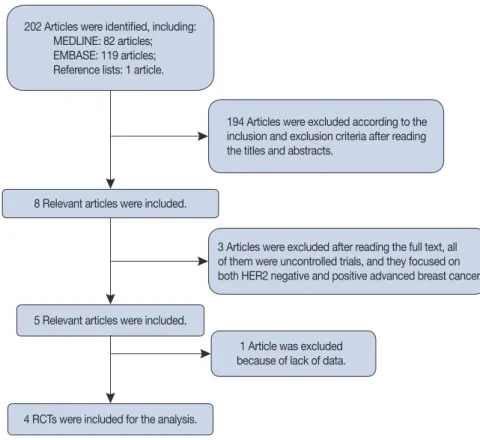
The authors independently reviewed the search results for relevant studies and retrieved the full articles containing the trials. Together, these authors then determined whether each of the selected RCTs fit the inclusion criteria, and studies were excluded accordingly with no discrepancies between the re- viewers. The relevant trial selection process is presented in de- tail in Figure 1.
Quality assessment
The methodological quality of each trial was examined in terms of allocation generation, allocation concealment, blind- ing, and failure to perform follow-up examinations. Based on this assessment, studies were qualitatively classified according
4 RCTs were included for the analysis.
1 Article was excluded because of lack of data.
5 Relevant articles were included.
8 Relevant articles were included.
202 Articles were identified, including:
MEDLINE: 82 articles;
EMBASE: 119 articles;
Reference lists: 1 article.
194 Articles were excluded according to the inclusion and exclusion criteria after reading the titles and abstracts.
3 Articles were excluded after reading the full text, all of them were uncontrolled trials, and they focused on both HER2 negative and positive advanced breast cancer.
Figure 1. Flow chart of trial selection for the meta-analysis.
HER2=human epidermal growth factor receptor 2; RCT=randomized controlled trial.
to the guidelines of the Cochrane Handbook for Systematic Re- views of Interventions 5.2 [13]. Based on the quality assessment criteria, the quality of each study was broadly rated into the fol- lowing three categories: (A) Adequate: all quality criteria were met, indicating a low risk of bias; (B) Unclear: one or more of the quality criteria were only partially met, indicating a moder- ate risk of bias; and (C) Inadequate: one or more criteria were not met, indicating a high risk of bias. Sensitivity analyses were subsequently performed on these quality factors, and differ- ences were resolved by discussion among the reviewers.
Data extraction
Two reviewers (J.C. and C.X.T.) independently performed the data extraction. Types of outcome measure included OS, PFS, TTP, DOR, ORR, clinical benefits, and adverse effects.
We used the methods of summarizing hazard ratio (HRs) of time-to-event data provided by Tierney et al. [14]. The HRs of time-to-event data (OS, PFS, TTP, and DOR) were extracted from the original studies, either directly from the reported number of events and the corresponding p-values of the log- rank statistics, or by reading of survival curves. We used the names of the first author and the year of publication of the ar- ticle for identification.
Statistical analysis
Meta-analysis was performed using Review Manager 5.2.6 (The Nordic Cochrane Centre, The Cochrane Collaboration, Copenhagen, Denmark). If data were sufficiently similar, these data were presented as forest plots (Figure 2, 3, and 4).
The funnel plot of the analysis did not provide evidence of publication bias (Figure 5).
Time-to-event outcomes were compared using HRs. Re- sults are expressed as risk ratios (RRs) for dichotomous out- comes, with 95% confidence intervals (CI). A “fixed-effect”
approach was used if heterogeneity was not significant, or if significant, a “random-effects” statistical model was chosen.
Tests for heterogeneity were carried out using the chi-square test with significance set at p<0.1 [15]. Sensitivity analysis was performed to explore whether the heterogeneity was caused by low quality; and if so, the lowest quality trials were excluded.
RESULTS
In total, four RCTs [9-12] involving 844 patients were in- cluded in the meta-analysis. The relevant trial selection pro- cess is presented in detail in Figure 1. The data were presented as forest plots, and the funnel plot of the analysis did not pro- vide evidence of publication bias.
Characteristic of individual studies
The characteristics of each study are summarized in Table 1.
The trials included in the analysis were conducted in nine dif- ferent countries, located in Europe, North America, and Latin America. The majority (75%, 3/4) of the studies analyzed had a sample size larger than 200; the other 25% (1/4) had a sam- ple size smaller than 200, but larger than 150.
Quality of individual studies
Among the trials included in the meta-analysis, all trials de- scribed the randomization processes and concealed patient al- location, and all of them were multicenter placebo controlled double-blinded trials. Intention-to-treat analyses were all used among the trials included in the meta-analysis (Table 2).
Efficacy of sorafenib for HER2-negative advanced breast cancer
Four RCTs involving 844 patients (426 in the sorafenib
Study or subgroup HR
IV, Fixed, 95% CI
HR, 0.65; 95% CI, 0.56–0.74; p<0.00001 HR, 0.67; 95% CI, 0.56–0.81; p<0.0001 HR, 0.65; 95% CI, 0.51–0.83; p=0.0005 Sorafenib placebo
Total PFS PFS (hormone status positive) PFS (hormone status negative)
Sorafenib placebo Sorafenib placebo
0.01 0.1 1 10 100 0.01 0.1 1 10 100 0.01 0.1 1 10 100
IV, Fixed, 95% CIHR HR
IV, Fixed, 95% CI Baselga et al., 2012 [9]
Gradishar et al., 2013 [11]
Mariani et al., 2011 [12]
Schwartzberg et al., 2013 [10]
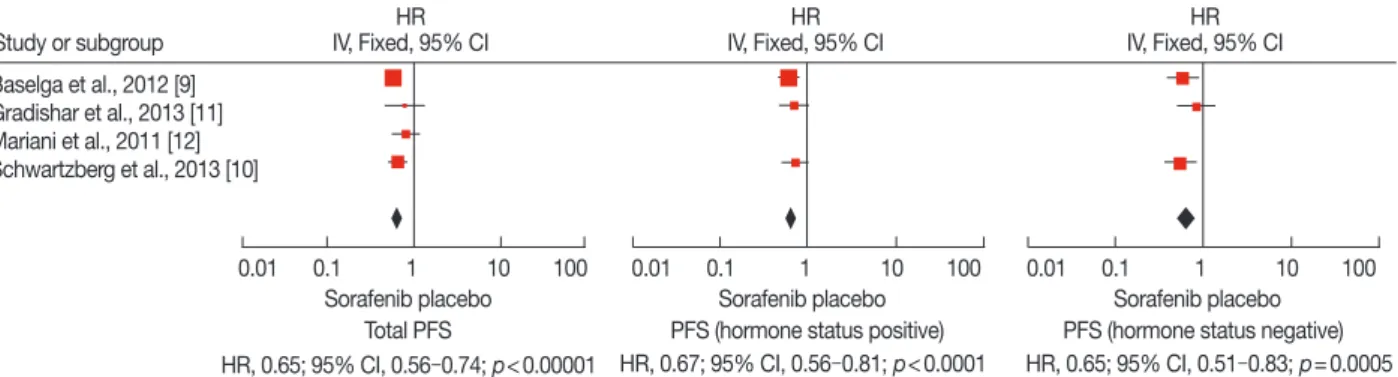
Figure 2. Progression-free survival (PFS) analysis of sorafenib for human epidermal growth factor receptor 2-negative advanced breast cancer com- pared with placebo. Total PFS was significantly longer in sorafenib arm (hazard ratio [HR], 0.65; 95% confidence interval [CI], 0.56–0.74; p<0.00001).
No matter the hormone status is positive or negative, PFS is longer (when treatment) with sorafenib combined with chemotherapy (HR, 0.67, 95% CI, 0.56–0.81, p<0.0001; HR, 0.65, 95% CI, 0.51–0.83, p=0.0005).
IV=inverse variance.
group and 418 in the placebo group) were identified. OS, PFS, TTP, DOR were compared using a HR, and RRs were used for ORR and clinical benefit analysis.
Progression-free survival
Four RCTs were included for total PFS analysis, and three of them were used for subgroup analysis (Figure 2). Subgroup
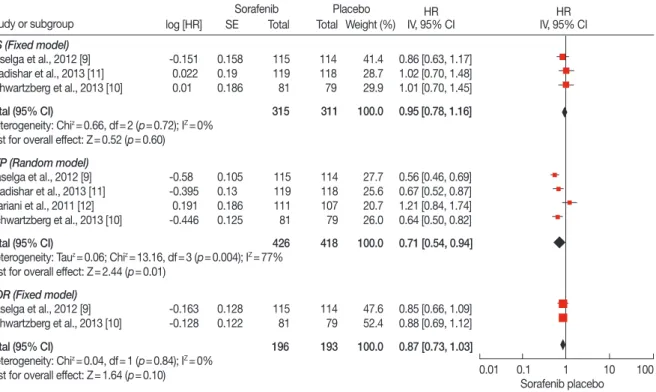
Figure 3. Overall survival (OS), time to progression (TTP), and duration of response (DOR) analysis of sorafenib for human epidermal growth factor re- ceptor 2 (HER2)-negative advanced breast cancer compared with placebo. TTP was significantly longer in sorafenib plus chemotherapy group (hazard ratio [HR], 0.71; 95% confidence interval [CI], 0.54–0.94; p=0.01). While OS and DOR were of no significance between the groups (HR, 0.95, 95% CI, 0.78–1.16, p=0.60; HR, 0.87, 95% CI, 0.73–1.03, p=0.10).
IV=inverse variance; SE=Standard Error.
Study or subgroup OS (Fixed model) Baselga et al., 2012 [9]
Gradishar et al., 2013 [11]
Schwartzberg et al., 2013 [10]
-0.151 0.022 0.01
0.158 0.19 0.186
115 119 81
114 118 79
41.4 28.7 29.9
0.86 [0.63, 1.17]
1.02 [0.70, 1.48]
1.01 [0.70, 1.45]
TTP (Random model)
-0.58 -0.395 0.191 -0.446
0.105 0.13 0.186 0.125
115 119 111 81
114 118 107 79
27.7 25.6 20.7 26.0
0.56 [0.46, 0.69]
0.67 [0.52, 0.87]
1.21 [0.84, 1.74]
0.64 [0.50, 0.82]
Baselga et al., 2012 [9]
Gradishar et al., 2013 [11]
Mariani et al., 2011 [12]
Schwartzberg et al., 2013 [10]
DOR (Fixed model)
-0.163 -0.128 0.128
0.122 115
81 114
79 47.6
52.4 0.85 [0.66, 1.09]
0.88 [0.69, 1.12]
Baselga et al., 2012 [9]
Schwartzberg et al., 2013 [10]
Total (95% CI) 315 311 100.0 0.95 [0.78, 1.16]
Heterogeneity: Chiz=0.66, df=2 (p=0.72); IZ=0%
Test for overall effect: Z=0.52 (p=0.60)
Total (95% CI) 426 418 100.0 0.71 [0.54, 0.94]
Heterogeneity: Tauz=0.06; Chiz=13.16, df=3 (p=0.004); IZ=77%
Test for overall effect: Z=2.44 (p=0.01)
Total (95% CI) 196 193 100.0 0.87 [0.73, 1.03]
Heterogeneity: Chiz=0.04, df=1 (p=0.84); IZ=0%
Test for overall effect: Z=1.64 (p=0.10)
IV, 95% CIHR Sorafenib Placebo
log [HR] SE Total Total Weight (%) HR
IV, 95% CI
Sorafenib placebo
0.01 0.1 1 10 100
Figure 4. Overall response rate (ORR) and clinical benefit analysis of sorafenib for human epidermal growth factor receptor 2 (HER2)-negative advanced breast cancer compared with placebo. ORR and clinical benefit rate were significantly higher in treatment group compared with placebo group (hazard ratio [HR], 1.19, 95% confidence interval [CI], 1.01–1.39, p=0.03; HR, 1.23, 95% CI, 1.03–1.45, p=0.02).
M-H=Man tel-Haenszel . Study or subgroup OS (Fixed model) Baselga et al., 2012 [9]
Gradishar et al., 2013 [11]
Mariani et al., 2011 [12]
Schwartzberg et al., 2013 [10]
44 80 47 16
115 119 111 81
114 118 107 79 35 64 46 10
22.5 41.1 30.0 6.5
1.25 [0.87, 1.79]
1.24 [1.01, 1.53]
0.98 [0.72, 1.34]
1.56 [0.75, 3.23]
54 82 115
119 114
118 41
69 37.3
62.7 1.31 [0.96, 1.78]
1.18 [0.97, 1.43]
Clinical benefit (Fixed model) Baselga et al., 2012 [9]
Gradishar et al., 2013 [11]
Total events
Heterogeneity: Chiz=2.19, df=3 (p=0.53); IZ=0%
Test for overall effect: Z=2.13 (p=0.03)
187 155
Total (95% CI) 426 418 100.0 1.19 [1.01, 1.39]
Total events
Heterogeneity: Chiz=0.31, df=1 (p=0.57); IZ=0%
Test for overall effect: Z=2.36 (p=0.02)
136 110
Total (95% CI) 234 232 100.0 1.23 [1.03, 1.45]
Sorafenib Placebo
Weight (%) Total
Events Total
Events Risk ratio
M-H, Fixed, 95% CI Risk ratio M-H, Fixed, 95% CI
Sorafenib placebo
0.01 0.1 1 10 100
analysis was carried out based on the hormone status. Among the trials included in the analysis, significant differences in total PFS were found in the studies conducted by Baselga et al. [9]
and Schwartzberg et al. [10]. In the study by Gradishar et al.
[11], the addition of sorafenib to chemotherapy provided a nu- merical increase in PFS compared to placebo plus chemothera- py, but this was not statistically significant (median, 6.9 months vs. 5.6 months; p=0.09). In the study conducted by Mariani et al. [12], the total PFS was similar between the groups. No sig- nificant heterogeneity existed among the trials, and the fixed- effects model was chosen for analysis (p>0.1). Based on the analysis, total PFS was significantly longer in the sorafenib arm (HR, 0.65; 95% CI, 0.56–0.74; p<0.00001). No matter if the
hormone status was positive or negative, the PFS was longer with sorafenib combined with chemotherapy compared to pla- cebo with chemotherapy (HR, 0.67, 95% CI, 0.56–0.81, p<
0.0001; HR, 0.65, 95% CI, 0.51–0.83, p=0.0005, respectively).
Overall survival
Three RCTs involving 626 patients were included in the meta-analysis (Figure 3). There was no significant heterogene- ity between the trials, and the fixed-effects model was used (p=0.72). According to the analysis, the OS did not signifi- cantly differ between the groups (HR, 0.95; 95% CI, 0.78–1.16;
p=0.60).
Time to progression
Four RCTs involving 844 patients were included in the analysis (Figure 3). Significant heterogeneity existed among the three trials using the random-effects model (p=0.004).
According to the analysis, the TTP was significantly longer in the sorafenib plus chemotherapy group (HR, 0.71; 95% CI, 0.54–0.94; p=0.01).
Duration of response
Three RCTs involving 389 patients were included in the analysis (Figure 3). There was no significant heterogeneity be- tween the trials and the fixed-effects model was used (p=0.84).
The DOR did not significantly differ between the groups based on the analysis (HR, 0.87; 95% CI, 0.73–1.03; p=0.10).
SE (log [RR])
0.01 0.1 1 10 100 RR
0
0.1
0.2
0.3
0.4
0.5
Figure 5. Funnel plot of the included studies for the meta-analysis. The funnel plots did not provide evidence of publication bias.
SE=standard error; RR=risk ratio.
Table 1. Characteristics of randomized controlled trials included in the present meta-analysis
Clinical studies Design Treatment Control Sample size
Patient resource Treatment Control
Baselga et al., 2012 [9] RCT Sorafenib (400 mg bid) plus capecitabine Placebo plus capecitabine 115 114 Spain, France, and Brazil Gradishar et al., 2013 [11] RCT Sorafenib (400 mg bid) plus paclitaxel Placebo plus paclitaxel 119 118 India, United States, and Brazil Schwartzberg et al., 2013 [10] RCT Sorafenib (400 mg bid) plus GEM/CAP Placebo plus GEM/CAP 81 79 40 Centers in the United States Mariani et al., 2011 [12] RCT Sorafenib (400 mg bid) plus DOC/LET Placebo plus DOC/LET 111 107 Italy, Germany, Poland, and
Russia RCT=randomized controlled trials; bid=twice a day; GEM=gemcitabine; CAP=capecitabine; DOC=docetaxel; LET=letrozole.
Table 2. Quality assessment of individual studies in the meta-analysis Clinical studies Allocation sequence
generation Allocation
concealment Blinding Loss of
follow-up Sample size
calculation Statistical
analysis Quality level
Baselga et al., 2012 [9] A A A 0 Y ITT A
Gradishar et al., 2013 [11] A A A 0 Y ITT A
Schwartzberg et al., 2013 [10] A A A 3 Y ITT A
Mariani et al., 2011 [12] A A A 0 Y ITT A
Based on the quality assessment criteria, the quality of the studies was broadly subdivided into the following three categories: (A) All quality criteria were met (ade- quate): low risk of bias; (B) One or more of the quality criteria were only partly met (unclear): moderate risk of bias; and (C) One or more criteria were not met (inad- equate or not used): high risk of bias.
Y=yes; ITT=intention-to-treat analysis.
Table 3. Meta anlaysis of side effects of sorafenib combined with chemotherapy for treatment of HER2-negative advanced breast cancer Adverse effects Trials included for analysis Sorafenib Placebo
Model Risk ratio (95% CI) p-value
Event Total Event Total
HFSR/HFS [11-13] 202 315 91 311 Random 3.05 (1.06–8.84) 0.0400
Diarrhea [11-13] 130 315 77 311 Fixed 1.67 (1.32–2.10) <0.0001
Rash [11-13] 69 315 35 311 Fixed 1.94 (1.34–2.81) 0.0004
Neutropenia [11-13] 61 315 50 311 Random 1.29 (0.71–2.32) 0.4000
Fatigue [11-13] 90 315 80 311 Fixed 1.10 (0.89–1.37) 0.3800
Mucosal inflammation [11-13] 68 315 61 311 Random 1.19 (0.59–2.40) 0.6300
Dyspnea [11-13] 50 315 50 311 Fixed 0.98 (0.69–1.40) 0.9300
Hypertension [11,12] 38 196 21 193 Fixed 1.78 (1.09–2.92) 0.0200
Abdominal pain [11,12] 25 196 24 193 Fixed 1.02 (0.61–1.72) 0.9300
Asthenia [11,13] 59 234 52 232 Fixed 1.12 (0.81–1.56) 0.4800
Stomatitis [12,13] 44 200 10 197 Fixed 4.32 (2.25–8.27) <0.0001
Vomiting [12,13] 56 200 39 197 Fixed 1.41 (0.99–2.01) 0.0600
Anaemia [12,13] 38 200 27 197 Fixed 1.39 (0.88–2.18) 0.1600
Headache [12,13] 44 200 31 197 Fixed 1.39 (0.93–2.10) 0.1100
Nausea [12,13] 58 200 64 197 Fixed 0.89 (0.69–1.15) 0.3600
Back pain [12,13] 25 200 30 197 Fixed 0.82 (0.50–1.34) 0.4300
Pain in extremity [12,13] 33 200 33 197 Random 1.11 (0.27–4.51) 0.8800
HER2=human epidermal growth factor receptor 2; CI=confidence interval; HFSR/HFS=hand-foot skin reaction/hand-foot syndrome.
Overall response rate and clinical benefit
Four RCTs were included in the analysis of ORR, while three of them were included in the clinical benefit analysis (Figure 4).
No significant heterogeneity existed among the trials, and the fixed-effects model was chosen for analysis (p=0.53 and p=
0.57, respectively). The ORR and clinical benefit rates were sig- nificantly higher in the treatment group compared to the pla- cebo group (HR, 1.19, 95% CI, 1.01–1.39, p=0.03; HR, 1.23, 95% CI, 1.03–1.45, p=0.02, respectively).
Safety of sorafenib for HER2-negative advanced breast cancer Three RCTs were included in the analysis of the safety of sorafenib combined with chemotherapy in the treatment of HER2-negative breast cancer. Adverse effects were compared using RRs. A “fixed-effect” approach was used if heterogeneity was not significant, and a “random-effects” statistical model was chosen if heterogeneity was significant. Based on the analy- sis, the incidence rates of hand-foot skin reaction/hand-foot syndrome (HFSR/HFS), diarrhea, rash, hypertension, and sto- matitis were significantly higher in the sorafenib group. Other adverse effects, including asthenia, fatigue, dyspnea, abdom- inal pain, vomiting, anemia, headache, nausea, back pain, mu- cosal inflammation, neutropenia, and pain in extremities were also commonly observed. However, there were no significant differences between the groups (Table 3).
DISCUSSION
This study reviewed four contemporary RCTs that included
844 participants [9-12]. Our meta-analysis suggests that sorafenib combined with chemotherapy is beneficial for HER2-negative advanced breast cancer patients. Although additional toxicities were noticed among the trials, they were manageable after dose interruptions and reductions. Mean- while, the types of adverse effects were consistent with the known safety profiles of the individual agents. The most fre- quent toxicity associated with the addition of sorafenib was HFSR/HFS, which is non-life threatening and reversible, but which can reduce the quality of life and necessitate treatment modifications or discontinuation.
Sorafenib is a multikinase inhibitor with both antiprolifera- tive and antiangiogenic activities; it is approved multinationally for unresectable hepatocellular and advanced renal cell carci- noma [7,8]. In breast cancer models, there is evidence that the addition of sorafenib to other systemic therapies may provide additive or synergistic activity, and chemosensitization [16-18].
As a monotherapy, sorafenib has demonstrated limited activity in heavily pretreated patients with breast cancer [19-21]. How- ever, sorafenib combined with standard chemotherapy was shown to provide clinical benefits in some trials [9,11].
In our analysis, PFS, TTP, OS, DOR, ORR, clinical benefits, and adverse effects were analyzed. The results revealed longer PFS and TTP, and higher ORR and clinical benefit rates in the patients receiving sorafenib plus chemotherapy, whereas the OS and DOR were similar between the two groups.
As a monotherapy, the most commonly reported adverse events (AEs) of sorafenib for treatment of breast cancer are HFSR, rash, and fatigue, but all toxicities are tolerable [21]. In
general, we here found that the adverse effects of combinatory sorafenib regimens were manageable, although dose interrup- tions and reductions were more common in the sorafenib arm than in the placebo arm. The types of AEs experienced by pa- tients in the sorafenib arm were consistent with those associ- ated with the individual agents, with increased rates for some AEs compared with the placebo. Based on the analysis, the most common AE related to sorafenib treatment was HFSR/
HFS. The incidence of HFSR/HFS was higher in the sorafenib arm (64.1%, 202/315) compared to in the placebo arm (29.3%, 91/311). The incidence of diarrhea, rash, hypertension, and stomatitis were also significantly higher in the sorafenib group.
However, all the toxicities were non-life threatening and re- versible, but capable of reducing the quality of life, and neces- sitating treatment modifications or discontinuation.
As with all meta-analyses, some caveats are pertinent. Pub- lication bias may influence the results, because negative trials are less likely to be published. However, negative trials were also included in the analysis, and the funnel plots do not pro- vide evidence of publication bias (Figure 5).
Although the studies included in the meta-analysis were well designed and the quality reached level A, based on the quality assessment criteria described above; heterogeneity was encountered among these studies. Use of different chemo- therapy regimens among the trials and incomplete balanced characteristics may be the reasons for this heterogeneity. In addition, potential selection biases can influence the homoge- neity of the groups. When heterogeneity among individual studies is considered, meta-analyses will be crucial to assess the efficacy and safety of combining sorafenib with standard chemotherapy in patients with HER2-negative advanced breast cancer.
In conclusion, the addition of sorafenib to chemotherapy provided PFS and TTP benefits in HER2-negative advanced breast cancer patients. Combination treatment was associated with manageable toxicities, but frequent dose interruptions and reductions were required. Meanwhile, no trials were lo- cated in Asia, Africa, and Oceania, so further prospective studies of high quality are still needed to evaluate efficacy and safety of sorafenib for treatment of HER2-negative advanced breast cancer. It should also be noted that all the studies in- cluded in the analysis were phase IIB trials, and a phase III tri- al is still ongoing [22], which we hope will confirm the results of this analysis.
CONFLICT OF INTEREST
The authors declare that they have no competing interests.
REFERENCES
1. Evans WP. Breast cancer screening: successes and challenges. CA Can- cer J Clin 2012;62:5-9.
2. Gao S, Barber B, Schabert V, Ferrufino C. Tumor hormone/HER2 re- ceptor status and pharmacologic treatment of metastatic breast cancer in Western Europe. Curr Med Res Opin 2012;28:1111-8.
3. Gradishar WJ. Sorafenib in locally advanced or metastatic breast cancer.
Expert Opin Investig Drugs 2012;21:1177-91.
4. Redig AJ, McAllister SS. Breast cancer as a systemic disease: a view of metastasis. J Intern Med 2013;274:113-26.
5. Schneider BP, Miller KD. Angiogenesis of breast cancer. J Clin Oncol 2005;23:1782-90.
6. Reddy S, Raffin M, Kaklamani V. Targeting angiogenesis in metastatic breast cancer. Oncologist 2012;17:1014-26.
7. Llovet JM, Ricci S, Mazzaferro V, Hilgard P, Gane E, Blanc JF, et al.
Sorafenib in advanced hepatocellular carcinoma. N Engl J Med 2008;
359:378-90.
8. Escudier B, Eisen T, Stadler WM, Szczylik C, Oudard S, Staehler M, et al. Sorafenib for treatment of renal cell carcinoma: Final efficacy and safety results of the phase III treatment approaches in renal cancer glob- al evaluation trial. J Clin Oncol 2009;27:3312-8.
9. Baselga J, Segalla JG, Roché H, Del Giglio A, Pinczowski H, Ciruelos EM, et al. Sorafenib in combination with capecitabine: an oral regimen for patients with HER2-negative locally advanced or metastatic breast cancer. J Clin Oncol 2012;30:1484-91.
10. Schwartzberg LS, Tauer KW, Hermann RC, Makari-Judson G, Isaacs C, Beck JT, et al. Sorafenib or placebo with either gemcitabine or capecitabine in patients with HER-2-negative advanced breast cancer that progressed during or after bevacizumab. Clin Cancer Res 2013;19:2745-54.
11. Gradishar WJ, Kaklamani V, Sahoo TP, Lokanatha D, Raina V, Bond- arde S, et al. A double-blind, randomised, placebo-controlled, phase 2b study evaluating sorafenib in combination with paclitaxel as a first-line therapy in patients with HER2-negative advanced breast cancer. Eur J Cancer 2013;49:312-22.
12. Mariani G, Burdaeva O, Roman L, Staroslawska E, Udovitsa D, Driol P, et al. A double-blind, randomized phase lib study evaluating the efficacy and safety of sorafenib (SOR) compared to placebo (PL) when adminis- tered in combination with docetaxel and/or letrozole in patients with metastatic breast cancer (MBC): FM-B07-01 Trial. Eur J Cancer 2011;47 Suppl 2:10.
13. Higgins JP, Green S. Cochrane Handbook for Systematic Reviews of Interventions 5.2. Chichester: John Wiley & Sons; 2009.
14. Tierney JF, Stewart LA, Ghersi D, Burdett S, Sydes MR. Practical meth- ods for incorporating summary time-to-event data into meta-analysis.
Trials 2007;8:16.
15. Higgins JP, Thompson SG, Deeks JJ, Altman DG. Measuring inconsis- tency in meta-analyses. BMJ 2003;327:557-60.
16. Ding Q, Huo L, Yang JY, Xia W, Wei Y, Liao Y, et al. Down-regulation of myeloid cell leukemia-1 through inhibiting Erk/Pin 1 pathway by sorafenib facilitates chemosensitization in breast cancer. Cancer Res 2008;68:6109-17.
17. Merz M, Komljenovic D, Zwick S, Semmler W, Bäuerle T. Sorafenib to- sylate and paclitaxel induce anti-angiogenic, anti-tumour and anti-re- sorptive effects in experimental breast cancer bone metastases. Eur J
Cancer 2011;47:277-86.
18. Bonelli MA, Fumarola C, Alfieri RR, La Monica S, Cavazzoni A, Galetti M, et al. Synergistic activity of letrozole and sorafenib on breast cancer cells. Breast Cancer Res Treat 2010;124:79-88.
19. Mina LA, Yu M, Johnson C, Burkhardt C, Miller KD, Zon R. A phase II study of combined VEGF inhibitor (bevacizumab+sorafenib) in pa- tients with metastatic breast cancer: Hoosier Oncology Group Study BRE06-109. Invest New Drugs 2013;31:1307-10.
20. Moreno-Aspitia A, Morton RF, Hillman DW, Lingle WL, Rowland KM Jr, Wiesenfeld M, et al. Phase II trial of sorafenib in patients with meta- static breast cancer previously exposed to anthracyclines or taxanes:
North Central Cancer Treatment Group and Mayo Clinic Trial N0336.
J Clin Oncol 2009;27:11-5.
21. Bianchi G, Loibl S, Zamagni C, Salvagni S, Raab G, Siena S, et al. Phase II multicenter, uncontrolled trial of sorafenib in patients with metastatic breast cancer. Anticancer Drugs 2009;20:616-24.
22. Baselga J, Costa F, Gomez H, Hudis CA, Rapoport B, Roche H, et al. A phase 3 trial comparing capecitabine in combination with sorafenib or placebo for treatment of locally advanced or metastatic HER2-negative breast cancer (the RESILIENCE study): study protocol for a random- ized controlled trial. Trials 2013;14:228.