2002; 7(1): 27-33
새로운 혈관신생인자인 인슐린-유사 성장인자 II (IGF-II)의 전사조절에 관한 연구
부산대학교 자연과학대학 분자생물학과, 1서울대학교 약학대학 약학과 종합약학연구소,
2의과대학 병리학교실
배명호․송현석․배수경․이석기1
이세원1․김철우2․김규원1
Regulation of Transcriptional Activity of Insulin-like Growth Factor II (IGF-II) Myung-Ho Bae, Hyun Seok Song, Soo-Kyung Bae, Seok-Ki Lee
1,
Sae-Won Lee
1, Chul Woo Kim
2and Kyu-Won Kim
1Department of Molecular Biology, Pusan National University, Busan 609-735, Korea,
1
Research Institute of Pharmaceutical Sciences, College of Pharmacy,
2
Department of Pathology, Cancer Research Center,
Seoul National U nive rsity College of Medicine, Seoul 151-742, Korea
It has been known that IGF-II is required for normal pre-natal growth of the liver in rodents and humans and has an angiogenic effect in experimental animals. The human IGF-II gene is a complex transcription unit containing four different promoters, leading to the formation of multiple IGF-II mRNA. The four promoters can be activated in a development-dependent and tissue-dependent manner. The human IGF-II promoter P3 is used in many fetal tissues and is highly active in several tumors, suggesting autocrine effects of IGF-II in tumor progression. In this study, we confirmed increased transcrip- tional activity of IGF-II P3 promoter under hypoxia. In addition, we showed that MAPK pathway is not involved in activation mechanism of IGF-II P3 promoter by using MAPK inhibitors and JNK dominant negative mutants. Moreover, we investigated the effect of hypoxia on the transcriptional activity of Egr-1, possible transcription factor regulating IGF-II. These results may examine the molecular signaling mechanism of carcinogenesis and metastasis in hepatocellular carcinoma and can apply to the development of cancer diagnosis and therapy.
ꠏꠏꠏꠏꠏꠏꠏꠏꠏꠏꠏꠏꠏꠏꠏꠏꠏꠏꠏꠏꠏꠏꠏꠏꠏꠏꠏꠏꠏꠏꠏꠏꠏꠏꠏꠏꠏꠏꠏꠏꠏꠏꠏꠏꠏꠏꠏꠏꠏꠏꠏꠏꠏꠏꠏꠏꠏꠏꠏꠏꠏꠏꠏꠏꠏꠏꠏꠏꠏꠏꠏꠏꠏ Key Words: Insulin like Growth Factor-II, Mitogen activated protein kinase,
Transcriptional activity, Hypoxia
책임저자:김규원, ꂕ 151-742, 서울시 관악구 신림 9동 산 56-1, 서울대학교 약학대학 약학과 Tel: 02-880-6988, Fax: 02-872-1795, E-mail: [email protected]
접수일:2002년 1월 14일, 게재승인일:2002년 3월 2일
서 론
혈관신생과정은 암, 건선, 류마티스 등 다양한 질병에서 나타나는 현상으로, 여러 가지 생리현상 들이 복합적으로 작용하여 일어나는 복잡한 생체 반응이다. 이러한 혈관신생은 그 복잡성으로 인해 논리적 분석이 상당히 힘들다 하겠다. 따라서 이 른 극복하기 위해 다양한 전산기법을 활용하여 새로운 혈관신생인자들을 발굴하려 방법이 개발 되어야 한다. 이를 위해 본 연구진에서는 분자별 로 다양한 정보양태를 보이고, 그 정보량이 점진 적 증가 추세에 있는 혈관신생 관련물질들을 data- base (DB)화하여 체계적인 정보구조를 구축하였 다.1) 또한 DB의 웹연동도 완성했으며, imagemap 을 통한 검색기능도 구현하였고, 이러한 혈관신생 DB는 실시간 검색이 가능하다. 이러한 DB는 혈 관신생관련 유전자들을 검색하고, 미지의 단백질 의 기능을 유추하는 데 중요한 정보를 줄 수 있을 것이다. 한편 혈관신생 연구자들이 1차적으로 검 색할 수 있는 DB로는 NCBI GenBank와 PubMed 등을 들 수 있다. 이러한 DB는 관련물질의 기본 정보와 문헌정보를 직접 검색할 수 있으며, 관련 물질의 작용을 유추할 수 있는 중요한 tool이라 할 수 있다.
본 연구에서는 PubMed를 통한 1차적인 검색으 로 여러 세포의 증식과 분화를 조절하는 인자인 IGF-II의 작용을 주목하게 되었다. IGF-II는 DNA 합성 및 세포증식을 유도하는 인자임이 알려져 있고,2∼7) 발생과정 중에는 mesodermal origin 세포 의 분화를 유도하며,8,9) 간암과 같은 혈관신생과다 악성암에서도 그 발현이 증가되어 있음10)을 Pub- Med 검색으로 알 수 있었다. 또한 본 연구진에 의 해 나온 이전의 결과에 의하면, IGF-II가 암조직 및 초기발생조직에 공통적으로 발현되는 혈관신 생 촉진인자이며 oncofetal 단백질임을 확인하였 다.11) 이상의 결과에 의해 암화과정뿐만 아니라 초기발생의 각 조직 및 단계에 따라서 IGF-II가 조절되고 있음을 시사하고 있다. 뿐만 아니라, IGF-II는 간암과 건선과 같은 혈관신생 관련질환 에서도 VEGF와 같은 강력한 혈관신생인자을 간 접적으로 유도하여, 간암과 건선을 일으키는 인자
임이 밝혀져 있다.10,12) 이와 같은 사실로 추정해 볼 때, IGF-II는 다양한 세포에서 강력한 혈관신생 인자로 작용할 가능성이 매우 높음을 알 수 있다.
위와 같은 일련의 과정을 통해 IGF-II가 혈관신생 인자의 후보자로 선정되었고, 본 연구진에서는 다 양한 실험을 통해 혈관신생인자로 작용할 수 있 음을 증명한 바 있다.10,13)
혈관신생의 유발은 미세조직의 hypoxia와 밀접 한 관련이 있음이 현재 밝혀져 있다. 세포는 hy- poxia에 노출될 경우 산화 환원반응에 관여하는 단백질 구조와 활성의 변화유도, 다양한 신호전달 인자 및 효소활성의 조절, 세포 내 reactive oxygen species (ROS) 생성변화 등 여러 가지 세포반응을 일으켜서 세포의 분열, 분화 및 세포 사멸(apop- tosis) 등의 조절 기전에 관여하므로 미세 조직의 산소 분압은 새로운 세포기능 조절인자로서 최근 에 급속하게 연구가 진행되고 있다. 특히, 세포분 열과 혈관신생이 활발한 고형암에서 hypoxic re- gion이 있음이 밝혀져 있는데 이것은 암세포가 hypoxia 상태를 극복하고 왕성한 세포분열을 위해 혈관신생을 이용함을 증명하는 것이라 할 수 있 다. 세포분열이 활발한 발생 중인 배자에서도 hy- poxic region이 존재하여 이것을 극복하기 위한 방 법으로 활발한 혈관신생이 일어날 가능성이 크다.
즉, 왕성한 세포분열로 인한 미세환경의 hypoxia 가 신호가 되어 활발한 혈관신생을 일으킬 것으 로 예상이 된다.
그러나 세포들이 hypoxia 상태를 어떻게 인지하 고, 그것이 어떤 과정을 거쳐 혈관신생 유전자 발 현으로 전달이 되는 지에 대해서는 알려진 바가 없다. 또한 혈관신생이 일어나서 산소가 공급됨으 로써 hypoxia 상태가 다시 정상 산소분압 상태로 될 때 혈관신생이 어떻게 중지되면서 혈관분화가 일어나는지에 대해서도 연구된 바가 전무한 실정 이다. 그러므로 혈관신생질환들의 예방 및 새로운 치료법의 개발을 위하여 조직에서 산소 양에 따 라 혈관신생이 조절되는 근본적인 기전을 분자수 준에서 규명하고, 혈관신생 질병에서 이 조절기전 의 특정인자 또는 특정 단계가 불활성화 되거나 이상이 있는지를 연구하여야 할 것이다. 특히 산 소의 양에 따른 여러 혈관신생인자의 발현변화는 혈관신생 조절기전의 규명에 도움을 줄 것이며,
이들 혈관신생인자와 결합하는 새로운 인자의 발 견은 혈관신생질환의 기전을 밝혀내는데 결정적 인 역할을 할 것이다.
위의 같은 사실을 바탕으로 하여 IGF-II가 hy- poxia에서 증가되어 혈관신생을 유도할 것으로 생 각해 볼 수 있다. 따라서, 본 연구에서는 각종 문 헌조사(PubMed)를 통하여 IGF-II가 혈관신생인자 로 작용할 수 있는 배경을 조사하였고, IGF-II P3 reporter system을 이용하여 hypoxia 하에서의 IGF- II P3 촉진자의 반응 여부를 transient transfection 및 luciferase assay 방법으로 살펴보았다. 또한 ERK pathway를 특이적으로 차단하는 PD098509와 p38 pathway 저해제인 SB202190, 그리고 JNK do- minant negative mutant를 이용하여 hypoxia 상태에 서 IGF-II P3 촉진자의 반응여부에 MAPK path- way가 관여하는지를 같은 방법으로 살펴보았다.
뿐만 아니라, IGF-II P3 촉진자에 결합할 수 있는 전사인자를 검색하여 검색된 Egr-1 전사인자의 촉 진자 또한 hypoxia 상태에서 반응하는지를 같은 방법으로 살펴보았다.
재료 및 방법 1) HepG2 세포의 배양
American Type Culture Collection에서 구입한 HepG2 cell (HB-8065)을 Gibco BRL에서 구입한 fetal bovine serum (FBS)을 첨가한 Minimal Essen- tial Medium (MEM)에 배양하였다. 분말상태의 배 지를 2차 증류수 1 L로 녹인 후 sodium bicarbonate 2.2 g을 첨가하여 HCl로 pH 7.2를 맞추었다. 0.22 μm Millipore filter로 이를 여과한 다음, 사용직전 에 10% FBS와 1% penicillin-streptomycin (P-S)를 첨가하였다.
2) 이중 가스 주입 배양기를 이용한 hypoxia 조건의 확립
N2와 CO2의 이중 가스 주입이 가능한 CO2
incubator (Vision 과학, VS-9108MS2)를 이용한다.
즉 N2를 주입하여 배양기 내의 O2의 농도를 적당 하게 낮추면서 동시에 CO2를 공급하여 세포를 배 양하여 체내에서 생성되는 hypoxia 상태와 유사한 조건을 제공한다.
3) Reporter vector의 제조
IGF-II 유전자의 promoter 부위에 luciferase re- porter gene에 삽입시켜 reporter vector를 만들어 reporter system을 구축한다.
4) Transient transfection and Luciferase as- says
Reporter pasmid를 간암세포주인 HepG2 세포에 calcium phosphate 방법에 의해 cotransfection 시킨 다. Transfection 후 24기간이 지난 뒤 cell extract를 얻은 뒤 luciferase activity를 측정한다. 이때 in- ternal control로서 β-gal plasmid를 사용하며, 그 activity를 측정하여 보정한다.
결 과
1) IGF-II P3 촉진자의 hypoxia하에서의 반응 여부 조사
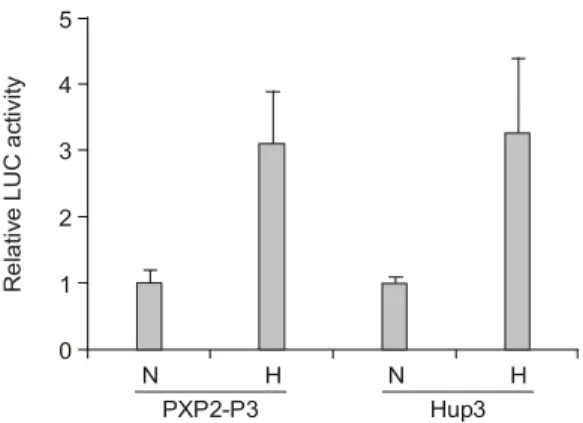
pXP2P3, Hup3와 같은 2종류의 IGF-II P3 repor- ter system을 이용하여 hypoxia 상태에서 IGF-II P3 촉진자의 반응여부를 transient transfection assay를 통해 살펴보았다(Fig. 1). 2종류 모두 hypoxic stress 를 준지 24시간째 3.5배 정도의 증가된 IGF-II의 전사활성 효과를 관찰할 수 있었다. 즉, hypoxia 에 의해 IGF-II P3 촉진자의 전사활성이 증가함을 확인할 수 있었다.
2) ERK, p38 inhibitor를 이용한 IGF-II P3 촉진자의 활성 경로 조사
Hypoxia에 의한 IGF-II P3 촉진자의 활성경로를 조사하기 위하여 널리 알려진 MAPK (ERK, p38) 저해제인 PD98059와 SB202190을 전처리하여 hy- poxic 효과가 억제되는지를 살펴보았다(Fig. 2). 그 러나 두가지의 저해제 모두 처리하지 않은 군과 비교해 보았을 때, 별다른 변화를 관찰할 수 없었 다. 즉 pXP2P3가 가지는 hypoxia에 의한 전사활성 유도가 두 가지의 저해제(PD98059, SB202190)에 의해 억제되지 않는 것을 볼 수 있었다. 따라서 hypoxia가 유도하는 IGF-II P3 촉진자의 전사활성 은 ERK 혹은 p38 pathway를 거치지 않을 거라고 예상할 수 있다.
3) JNK dominant negative mutant를 이용한 IGF-II P3 촉진자의 활성 경로 조사 주로 stress에 의해 작동하는 MAPK인 JNK의 dominant negative mutant를 IGF-II P3 reporter 벡터 와 co-transfection하여 IGF-II P3 촉진자의 활성경 로를 조사해 보았다(Fig. 3). 그러나 Fig. 2의 결과 와 동일하게 co-transfection하지 않은 군과 별다른 차이를 관찰할 수 없었다. 따라서 JNK pathway 또 한 hypoxia에 의한 IGF-II P3 촉진자의 전사활성과 무관한 경로임을 알 수 있다.
4) IGF-II P3 촉진자에 결합할 수 있는 전사 인자의 검색 및 검색된 인자의 촉진자 활 성조사
IGF-II의 전사조절은 IGF-II P3 촉진자에 결합하 는 여러 전사인자들에 의해 될 것으로 추정된다.
이와 관련하여 IGF-II P3 촉진자에 결합하는 전사 인자들을 검색해 본 결과, Egr-1, Sp1, WT1 등의
Fig. 1. Effect of hypoxia on the transcriptional activity of
IGF-II P3 promoter. HepG2 cells were cotransfected with 9μg of the IGF-II P3 promoter-luciferase reporter plas- mids (pXP2P3 and Hup3) and 1μg of pSV β-galac- tosidase plasmid, allowed to recover for 24 h after trans- fection. Transfected cells were incubated for 24 h prior to exposing to hypoxia or maintaining in normoxia for 24 h, and assayed for luciferase and β-galactosidase activities.The relative luciferase activity refers to the ratio of RLU/
β-galactosidase measured in hypoxia-treated cells com- pared to normoxic cells. Values represent the means of at least three independent transfection. The results shown are the mean±SE of three to five experiments.
Relative LUC activity 4
N H N H
0 5
3
2
1
PXP2-P3 Hup3
Fig. 3. Effect of dominant negative mutants of JNK1 on
the transcriptional activity of IGF-II P3 promoter. HepG2 cells were cotransfected with dominant negative mutant (DN-JNK1) and pSV β-galactosidase plasmid, allowed to recover for 24 h after transfection. Transfected cells were incubated for 24 h prior to exposing to hypoxia or main- taining in normoxia for 24 h, and assayed for luciferase and β-galactosidase activities. The relative luciferase acti- vity refers to the ratio of RLU/β-galactosidase measured in hypoxia-treated cells compared to normoxic cells.Values represent the means of at least three independent transfection. The results shown are the mean±SE of three to five experiments.
Relative LUC activity
PXP2 PXP2P3 DN-JNK1
0 6
4
2 1 5
3
Hypoxia Normoxia
Fig. 2. Effect of ERK and p38 inhibitor on the trans-
criptional activity of IGF-II P3 promoter. HepG2 cells were cotransfected with 9μg of the IGF-II P3 promoter- luciferase reporter plasmid and 1μg of pSV β-galactosi- dase plasmid, allowed to recover for 24 h after trans- fection. Transfected cells were incubated for 24 h prior to exposing to hypoxia or maintaining in normoxia for 24 h, and assayed for luciferase and β-galactosidase activities.The relative luciferase activity refers to the ratio of RLU/
β-galactosidase measured in hypoxia-treated cells com- pared to normoxic cells. Values represent the means of at least three independent transfection. The results shown are the mean±SE of three to five experiments.
Relative LUC activity
PXP2 PXP2P3 PD98059 SB202190 0
4
3
2
1
Hypoxia Normoxia
전사인자가 검색되었다. 이 중 hypoxia에 반응하 는 전사인자인 Egr-1 reporter vector를 transient transfection 해 본 결과(Fig. 4), Egr-1 촉진자가 hypoxia에 의해 1.6배의 전사활성 증가현상을 보 이는 것을 확인할 수 있었다.
고 찰
인간의 IGF-II는 태생기 발생과정에서 발견되는 IGF의 주된 형태이며, 서로 다른 4개의 촉진자 (P1-P4)에 의해서 유전자 발현이 조절되는 것으로 보고되어 있다.14,15) 따라서, 인간의 IGF-II 유전자 는 다양한 생리적 조건에서 이들 촉진자에 의해 조절 받게 된다. 즉, 4개의 촉진자는 발생과정과 조직에 따라 활성이 조절되어 다른 크기의 IGF-II mRNA를 생성할 수 있다.10,16) 이전의 보고에서 P2, P3, P4 촉진자는 많은 태생기 조직과 비간장 성 조직에서 쓰이며, 성인의 간에서는 P1 촉진자 만이 활성화될 뿐 나머지 촉진자들은 완전히 억
제된다는 사실이 알려져 있다.17) 특히, IGF-II P3 촉진자는 태생기 조직 및 몇몇 악성종양에서 상 당한 활성을 보이고 있다. P3 촉진자에 의해 생성 되는 IGF-II mRNA의 크기는 약 6.0 kb이고 이것 이 간암생성과정과 초기 발생 단계에서 공통적으 로 활성이 된다. 즉, 이러한 인간 IGF-II P3 촉진 자의 활성은 고형암에서 발견되는 hypoxia 상태에 서 촉진될 것이며, 이 P3 촉진자에 결합하는 전사 인자들의 작용 또한 hypoxia에 의해 조절받게 될 것으로 추측할 수 있다. 또한 이들 전사인자들의 활성조절기작은 여러 신호전달경로에 의해 조절 되는데, 대표적으로 여러 mitogen에 의해 활성화 되는 ERK pathway, 스트레스와 염증물질에 의한 p38, JNK pathway 등의 신호전달 경로가 존재한 다. 따라서 IGF-II P3 촉진자에 결합하는 전사인 자들의 활성 또한 이들 경로에 의해 조절될 것으 로 예상된다.
간암을 비롯한 초기 암의 성장은 암세포 자신 이 분비하는 자가 성장인자에 의존하며, 1∼2 mm3 이상의 크기로 성장한 암조직 내부는 hypoxia 상 태에 이르게 된다. 이러한 상태에서 자신의 대사 과정을 바꾸거나 hypoxia에 대한 저항성을 획득하 지 못한 많은 암세포는 necrosis 또는 apoptosis로 소멸되기도 한다. 이러한 과정에서 hypoxia 상태 를 극복하기 위하여 암세포들은 혈관생성 인자를 분비하여 주변 혈관조직으로부터 새로운 혈관들 을 유발시킬 것으로 추정이 된다. 이렇게 생성된 혈관들은 암세포들의 전이에 대한 통로를 제공하 며 전이를 일으킬 것이다.
일반적으로 hypoxia에 의해 유도되는 단백질은 크게 세 가지 종류로 알려져 있는데, 첫째, 일반 적 hypoxia 상태에 직면한 개체의 경우 산소의 공 급을 원활히 할 수 있는 erythropoietin과 같은 단 백질과, 둘째, local hypoxia에 노출된 조직의 생존 과 관계된 인자, 즉 VEGF와 같은 angiogenic fac- tor, 그리고 셋째, hypoxia에 대한 세포의 adapta- tion에 관여하는 인자, 즉 ATP 공급을 담당하는 glycolytic enzyme이나, AP-1 transcription factor와 같은 세포 내 인자가 hypoxia에 의하여 크게 증가 하는 단백질들이다. 실제로 glioma에서 hypoxia에 의해 VEGF의 발현이 크게 유도하는 것으로 보고 되어 있고 이렇게 증가된 VEGF는 glioma의 혈관
Fig. 4. Effect of hypoxia on the transcriptional activity of
Egr-1 promoter. HepG2 cells were cotransfected with 9μg of the Egr-1 promoter-luciferase reporter plasmids and 1 μg of pSV β-galactosidase plasmid, allowed to recover for 24 h after transfection. Transfected cells were incu- bated for 24 h prior to exposing to hypoxia or maintaining in normoxia for 24 h, and assayed for luciferase and β- galactosidase activities. The relative luciferase activity refers to the ratio of RLU/β-galactosidase measured in hypoxia-treated cells compared to normoxic cells. Values represent the means of at least three independent transfec- tion. The results shown are the mean±SE of three to five experiments.
Relative inciferase activity
N H
0 2
1
Egr-1 reporter vector
생성을 유도하는 것으로 알려져 있다.18,19)
IGF-II는 간암으로의 이행과정에서 그 발현이 급격히 증가되는 것으로 알려져 있다.20) 또한 간 암세포에 다량 존재하는 IGF-II는 간암 진행과정 에서 혈관신생을 유발하는 인자이며, 이러한 IGF- II에 의해 유도된 VEGF의 양은 간암진행의 지표 로 사용될 수 있다.10)
본 연구에서는 hypoxia에 의해 발현이 유도되는 혈관생성인자들의 발현조절 기전을 연구하기 위 해 IGF-II의 촉진자 부위를 포함하는 reporter vec- tor를 제조하고, hypoxia 상태에서의 IGF-II 전사활 성정도를 측정하였다. Hypoxia 상태에서는 증가된 IGF-II의 전사활성정도를 관찰할 수 있었으나, MAPK inhibitor 및 dominant negative mutant를 이 용한 실험으로 MAPK pathway를 거치지 않는 것 으로 판명되었다. 이러한 결과는 IGF-II의 전사활 성을 조절하는 경로는 MAPK pathway 외의 또다 른 경로가 될 수 있음을 시사하고 있다. 뿐만 아 니라, IGF-II 촉진자 부위에 결합할 수 있는 전사 인자들을 검색한 후, 이들 전사인자(Egr-1) 또한 hypoxia에 의해 전사활성이 증가함을 관찰하였다.
따라서 hypoxia 상태에서 증가한 Egr-1 전사인자 가 IGF-II P3 촉진자에 결합하여 IGF-II의 활성을 증가시킴을 알 수 있다. 이러한 연구결과들은 앞 으로 간암의 악성화 과정과 전이기전의 규명에 도움을 줄 것이며 조기진단과 치료방법의 개발에 도 활용될 수 있을 것이다.
결 론
간암진행과정에서 작용하는 혈관신생인자인 IGF- II의 전사활성은 hypoxia에 의해 증가되며, 이러한 hypoxia에 의한 IGF-II의 전사활성 조절은 MAPK pathway를 거치지 않음을 관찰하였다. 또한 IGF-II 의 촉진자에 결합하는 Egr-1 전사인자의 전사활성 도 hypoxia에 의해 증가됨을 증명하였다.
이상의 결과에 의해 간암형성과정 중, hypoxia 에 의해 IGF-II의 전사활성을 조절하는 또다른 경 로가 있음을 유추할 수 있고, Egr-1 전사인자에 의해 IGF-II의 전사활성이 hypoxia에서 조절될 수 있음을 시사하고 있다.
감사의 글
이 연구는 서울대학교 간접연구경비 지원에 의 해 수행되었으므로 이에 감사드립니다.
참고 문헌
1) Sohn TK, Moon EJ, Lee SK, Cho HG, Kim KW.
Angio DB. database of angiogenesis and angiogene- sis-related molecules. Nucleic Acids Res 2002; 30:
369-371.
2) Hill DJ, Milner RDG. Somatomedins and fetal growth.
In the fetus and independent life, Ciba foundation
symposium 1981; 86: 124-151. London: Pitman.
3) Milner RDG, Hill DJ. Fetal growth: The role of in- sulin and related peptides. Clin Endocrinol 1984; 21:
415-433.
4) Underwood LE, D'Ercole AJ. Insulin and somatome- dins/insulin-like growth factors in fetal and neonatal development. In: ed, by Daughaday WH Clinics in Endocrinology and Metabolism vol. 13, Tissue Growth Factors. pp 68-89, East Essex, England: Saunders WB Co, Ltd, 1984.
5) Froesch ER, Schmid C, Schwander J, Zapf J. Actions of insulin-like growth factors. Annu Rev Phsiol 1985;
47: 443-467.
6) Zapf J, Froesch ER. Insulin-like growth factors/soma- tomedins: Struture, secretion, biological actions and physiological role. Homone Res 1986; 24: 121-130.
7) Baxter RC. The somatomedins: Insulin-like growth factors. Adv Clin Chem 1986; 25: 49-115.
8) Plate KH, Breier G, Weich HA, Risau W. Vascular endothelial growth factor is a potential factor in human gliomas in vivo. Nature 1992; 359: 845-848.
9) Nabel EG, Yang Z, Plautz, G, Forough R, Zhan X, Haudenschild DD, Maciag T, Nabel GJ. Recombinant fibroblast growth factor-1 promotes intimal hyper- plasia and angiogenesis in arteries in vivo. Nature 1993; 362: 844-846.
10) Kim KW, Bae SK, Lee OH, Bae MH, Lee MJ, Park BC. Insulin-like Growth factor II (IGF-II) induced by hypoxia may contribute to angiogenesis of Human Hepatocellular carcinoma. Cancer Res 1998; 58: 348- 351.
11) Lee BK, Shin SG, Seo JH, Bae MH, Lee YM, Park SJ, Park BC, Kim KW, Koo JY. Study on the Expression of Insulin-like Growth Factor II (IGF-II)
in Hepatocellular Carcinoma Cells and Developing Rat Embryos. Cancer Research and Treatment 2001;
33: 256-263.
12) Kwon YW, Jang ER, Lee YM, Kim YS, Kwon KS, Jang HS, Oh CK, Kim KW. Insulin-like growth factor II induces interleukin-6 expression via NFkappaB acti- vation in psoriasis. Biochem Biophys Res Commun 2000; 278: 312-317.
13) Bae MH, Lee MJ, Bae SK, Lee OK, Lee YM, Park BC, Kim KW. Insulin-like growth factor II (IGF-II) secreted from HepG2 human hepatocellular carcinoma cells shows angiogenic activity. Cancer Lett 1998;
128: 41-46.
14) Sussenbach JS. Progress Growth Factor Res 1990; 1:
33-48.
15) Ward A, Ellis CJ. The insulin-like growth factors- structure and biological function. Oxford, Oxford
University Press, 1992; pp 46-79.
16) Sussenbach JS, Holthuizen P, Steenbergh PH. Struc-
ture and expression of the human insulin like growth factor genes. Growth Regulation 1992; 2: 1-9.
17) Hothuizen PE, Rodenberg RJT, Van Dijk MA, Koo- nen-Reemst AMCB, Charnay P, Sussenbach JS.
Transcriptional regulation of the human IGF-II gene.
Ann NY Acad Sci 1993; 684: 214-217.
18) Shweiki D, Neeman M, Itin A, Keshet, E. Induction of vascular endothelial growth factor expression by hypoxia and by glucose deficiency in multicell sphe- roids: Implications for tumor angiogenesis. Proc Natl
Acad Sci USA 1995; 92: 768-772.
19) Risau W. VEGF is a potential tumor angiogenesis fac- tor in human glioma in vivo. Nature 1992; 359: 845- 848.
20) Yang DY, Rogler CE. Analysis of Insulin-like Growth Factor II (IGF-II) expression in neoplastic nodules and hepatocellular carcinomas of the woodchuck utilizing in situ hybridization and immunohistochemistry. Car-