• 검색 결과가 없습니다.

Microarray profile of hypothalamic gene expression with acupuncture at<br /> acupoint ST36 in carrageenan induced inflammation in Stat 6 knockout mice

N/A
N/A
Protected

Academic year: 2021

Share "Microarray profile of hypothalamic gene expression with acupuncture at<br /> acupoint ST36 in carrageenan induced inflammation in Stat 6 knockout mice"

Copied!
11
0
0

로드 중.... (전체 텍스트 보기)

전체 글

(1)

Carrageenan으로 염증을 유도한 Stat 6 유전자제거 생쥐의 족삼리 침치료에 대한 시상하부 유전자의

마이크로어레이 프로파일

홍미숙

1

⋅박히준

2

⋅엄윤경

1

⋅정경희

1

⋅김수철

1,3

⋅한미영

1,3

1경희대학교 의과대학 고황의학연구소, 2한의과대학 경혈학교실, 3의과대학 소아심장분과

Microarray profile of hypothalamic gene expression with acupuncture at acupoint ST36 in carrageenan induced inflammation in Stat 6 knockout mice

Mee-Suk Hong

1

, Hi-Joon Park

2

, Yoon-Kyung Um

1

, Kyung-Hee Jung

1

, Soo-Cheol Kim

1,3

, Mi-Young Han

1,3

1

Kohwang Medical Research Institute, College of Medicine,

2

Dept.of Meridianand Acupuncture, College of Korean Medicine,

3

Div.of Pediatric Cardiology, College of Medicine, Kyunghee University Abstract

목 적 : Signal transducers and activators of transcription 6 (Stat 6) 유전자는 면역세포의 발달 에 있어서 중요한 유전인자이며, IL‐4와 같은 사이토카인에 의해 유전자 발현이 조절된다. 본 연구에서는 Stat 6 유전자 제거 생쥐와 정상 (wild type, W/T) 생쥐에 carrageenan으로 염증을 유도한 후 족삼리에 침치료를 시행하여 시상하부에서의 유전자 발현 양상을 분석하고자 하였다.

방 법 : BALB/c (W/T, n=12) and BALB/c‐Stat 6 유전자 제거 생쥐 (n=12)의 발뒤꿈치 표피에 1%

carrageenan을 30 ul 주사하여 염증을 유도하였다. 침은 염증 유도 30분 후에 족삼리(ST36)에 시침하였으며, 염증유도에 의한 부종 증가율은 매 시간마다 측정하여 총 5시간동안 측정하였다. 마이크로어레이는 Stat 6 유전 자 제거 생쥐를 염증 유발 군과 염증유발 후 침을 처치한 군으로 나누고, 시상하부를 적출하여 RNA를 분리한 뒤. 마이크로어레이 프로파일을 분석하였다.

결 과 : 염증에 의한 부종증가율을 비교한 결과, Stat 6 유전자 제거 생쥐 그룹의 부종증가율이 W/T 생쥐 의 부종 증가율보다 약 50 % 정도 감소하였으며, 각 3, 4, 5시간째에 유의한 차이를 나타내었다 (각 p<0.05).

W/T생쥐군과 Stat 6 유전자 제거 생쥐군 모두에서, 침 처치군이 염증 유발 군에 비해, 염증 유발 2시간 후부터 유의한 감소를 나타내었다. 시상하부의 유전자 발현을 관찰한 결과, 39개의 유전자가 3배 이상 감소하였으며, 19 개의 유전자는 3배 이상 증가하였다.

결 론 : W/T 생쥐군과 Stat 6 유전자 제거 생쥐 모두에서 침의 진통효과는 나타나며, 이의 기전에는 시상 하부에서의 침 치료에 의한 염증관련 유전자들의 감소와, 항염증과 관련된 유전자들이 증가가 관여하는 것으로 보인다.

Key words : Stat 6 knockout mice, carrageenan, hypothalamus, microarray, ST36, acupuncture

I. Introduction

Signal transducer and activator of

⋅교신저자 : 홍미숙, 서울특별시동대문구회기동 1번지 경희대학교 의 과대학 약리학교실, Tel. 02-961-0303, Fax. 02-968-0560, E-mail: [email protected]

⋅본 연구는 과학기술부/한국과학재단 우수연구센터육성사업의 지 원으로 수행되었음(R11-2005-014).

⋅투고 : 2007/05/28 심사 : 2007/06/07 채택 : 2007/06/14
(2)

transcription 6 (STAT 6) is a key molecule in immune and inflammatory responses, and is phosphorylated in response to interleukin 4 (IL-4) and the IL‐4 signaling pathway

1)

. IL-4 is an anti

‐inflammatory cytokine that can trigger the development of Th2 cells and regulate the expression of the stat 6 gene; the IL-4 receptor (CD124) is found on several cell types, with the primary receptor signaling occurring through the JAK/STAT 6 pathway and MAPKs. Noran et al .

2)

reported that functional IL-4 receptors are expressed on granule cells of the dentate gyrus. Receptor activation results in the phosphorylation of JAK1 and STAT 6 because the interplay between pro- and anti‐inflammatory responses greatly affects synaptic function in the hippocampus.

Acupuncture has been widely used to treat a variety of functional disorders for more than 2500 years, and evidence is accumulating that it has anti‐

inflammatory effects. A recent study demonstrated that the anti‐inflammatory actions of acupuncture are associated with the suppression of cytokines, such as interleukin‐1β (IL-1β) and interleukin‐6 (IL-6), in rats. Although studies have examined the mechanisms underlying the anti‐inflammatory effect of acupuncture, little is known of the molecular mechanisms that lead to its anti-inflammatory action.

Carrageenan is a high-molecular-weight polysaccharide that has been used to generate an acute inflammation and hyperalgesia animal model

4)

. The acute inflammation produced by carrageenan may be induced by the activation of macrophages, mast cells, and other lymphocytes

5)

. Fecho et al .

6)

reported that this involved a relationship between the inflammation pathway and the pain response in the hypothalamic-pituitary-adrenal (HPA) axis. However, the role of the HPA in the immune processes associated with carrageenan-induced inflammation is not clear.

It has been suggested that the hypothalamus and central immune system play an important role in hyperalgesia and analgesia

7)

. In the early stage of inflammation, several endogenous mediators are produced, including anti-inflammatory cytokines (IL1, IL-6, and TNF), nerve growth factor, and prostalandins

8-10)

. In parallel, anti‐inflammatory cytokines, such as IL-4, IL-10, IL-13, and IL-1 receptor antagonist, are also produced, reducing the initial hyperalgesic effects of pro-inflammatory cytokines

11-13)

. Therefore, inflammatory pain may in part be regulated by the interaction between hyperalgesic and analgesic mediators.

To investigate the action of IL-4 in

acupuncture‐induced anti-inflammation, we

(3)

studied the effects of acupuncture on carrageenan-induced inflammation, and the molecular mechanism involved using microarray profiles of the hypothalamus in Stat 6 knockout mice.

Ⅱ. Methods

1. Animals

Adult male Stat 6-deficient mice on a BALB/c background were purchased from the Jackson Laboratory (Bar Harbor, ME, USA). All mice were housed in pairs under standard temperature (22 ± 3°C) and 12-h light/dark conditions with free access to food and water. All procedures involving animals and their care conformed to the international guidelines set out in the Principles of Laboratory Animal Care (NIH publication no.85-23, revised 1995).

2. Carrageenan-induced paw edema and its measurement

Acute inflammation was induced in the right hind paw of the mice by injecting a 30-µl suspension of 1% freshly prepared lambda carrageenan (Sigma, St. Louis, MO, USA) in saline subcutaneously. The volume of the paw was measured at the tibiotarsal joint using a plethysmometer (Ugo Basile 7140; Plethysmometer, Varese, Italy) before (0 h) and 1, 2, 3, 4, and 5 h after the

injection. The degree of edema was expressed as the difference between the volume of the paw at each time point after injection and the volume before injection using the following equation:

% change in paw volume = 100 × (volume post - volume pre)/volume pre.

3. Experimental groups and acupuncture stimulation

In the acupuncture group (n = 6), a stainless needle (0.2 mm in diameter) was inserted to a depth of 1 to 2 mm in the ST36 acupuncture point on the right side.

The needle was twisted twice a second for 60 s and then removed. The area stimulated corresponded to an acupuncture point in humans. ST36 is located near the knee of the hind limb, 2 mm lateral to the anterior tubercle of the tibia. The control group (n = 12) was immobilized for 60 s.

4. Analysis of cDNA microarray

The cDNA microarray used was the TwinChip™ Mouse-7.4 k set (Digital Genomics, Seoul, Korea). It is a duplicated array containing two identical 7.4 k arrays on the upper and lower parts of each slide.

For parallel comparison of the gene

expression profiles of ten samples (three

hypothalamus samples in carrageenan-induced

(4)

inflammation, and acupuncture treatment after carrageenan-induced inflammation), the gene expression of each sample was compared to that in a pooled equal amount of RNA from the experimental sample. Total RNA was isolated from the hypothalamus using TRIzol‐reagent (Invitrogen, Carlsbad, CA, USA) according to the manufacturer’s instructions, and purified using the RNeasy mini kit (Qiagen, Valencia, CA, USA). For hybridization, 20 µg of total RNA was reverse‐transcribed using aminoallyl-modified dUCP and chemically coupled with fluorescent dyes. Samples from the acupuncture‐treated Stat 6-deficient mice were labeled with Cy5 and those from the carrageenan-induced inflammation mice were labeled with Cy3. Pairs of labeled samples were combined and hybridized on the arrays. The microarrays were imaged using the GenePix 4000B Array Scanner (Axon Instruments, Union City, CA, USA) while the array was wet with 2× PBS under a Lifter Slip glass coverslip (Erie Scientific, Portsmouth, NH, USA). Scanned images were analyzed using GenePix 6.0 software (Axon Instruments) to obtain the gene expression data. Gene expression was normalized using LOWESS regression

14)

.

5. Cluster analysis and data annotation

Hierarchical clustering was selected

differential express genes using software developed at Stanford University

15)

. Genes with at least twofold expression differences were included in the cluster analysis. The functional category classification was based on the National Center for Biotechnology Information LocusLink (http://www.ncbi.nlm.nih) and

Gene Ontology (

http://www.geneontology.org) databases, which classify genes according to molecular function, biological process, and cellular component.

6. Statistical analysis

The results are expressed as percent changes from the control (before acupuncture treatment) values. Values are expressed as means ± standard error (S.E.). A two‐tailed Student’s t- test was used to compare the mean values of the control group with those of the treatment group at each time point. A p value less than 0.05 was considered significant.

Ⅲ. Results

1. Paw edema in carrageenan-induced inflammation in wild-type and Stat 6-deficient mice

The intraplantar injection of carrageenan

into the hind paw elicited inflammation

and a time-dependent increase in paw

(5)

edema that was maximal 3 h after the injection. However, the increase in carrageenan‐induced paw edema in the Stat 6-deficient mice was less than 50% of that compared to the carrageenan-induced paw edema in wild-type mice(Fig. 1).

Fig. 1. The changes of paw edema after carrageenan injection in wild type and Stat 6 knockout mice. Black square:

wild-type control, black circle: Stat 6 knockout control group. *, represents P < 0.05 compared to wild-type control group.

2. Carrageenan‐induced paw edema in wild-type mice with and without acupuncture treatment

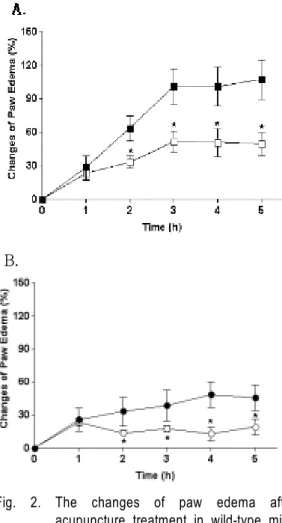
Acupuncture reduced the carrageenan -induced paw edema in wild-type mice. In the control group, the paw volume 1, 2, 3, 4, and 5 h after carrageenan injection was 28.6 ± 10.1, 63.6 ± 11.1, 100.6 ± 15.7, 100.9

± 17.2, and 107.0 ± 17.6% of the control, respectively. In the acupuncture group, the paw volumes 1-5 h after carrageenan

injection increased by 23.6 ± 6.5, 33.5 ± 5.2, 51.5 ± 9.3, 50.9 ± 12.4, and 49.6 ± 10.3% of the control, respectively.

Acupuncture stimulation at acupoint ST36 significantly reduced the volume of paw edema beginning 2 h after injection(Fig. 2).

B.

Fig. 2. The changes of paw edema after acupuncture treatment in wild-type mice (A) and Stat 6 knockout mice (B).

Black square :wild-type control mice, white square: wild-type mice with acupuncture, black circle: Stat-6 knockout control mice, white circle:

Stat-6 knockout mice with acupuncture.

*, represents P < 0.05 compared to

(6)

each control group.

3. Carrageenan-induced paw edema in Stat 6-deficient mice compared to acupuncture treatment

Acupuncture reduced the carrageenan -induced paw edema in Stat 6-deficient mice. In the control group, the paw volume 1, 2, 3, 4, and 5 h after carrageenan injection was 25.7 ± 10.2, 33.2 ± 13.1, 38.5

± 13.9, 48.5 ± 11.6, and 45.5 ± 11.5% of the control, respectively. In the acupuncture group, the respective paw volumes increased by 23.5 ± 3.7, 13.5 ± 2.9, 17.5 ± 2.9, 12.8 ± 6.4, and 19.2 ± 7.4% of the control.

Acupuncture stimulation at acupoint ST36 significantly reduced the volume of paw edema(Fig. 2).

4. Gene expression profile in the hypothalamus

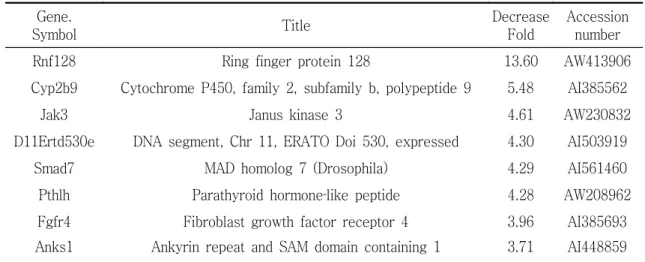
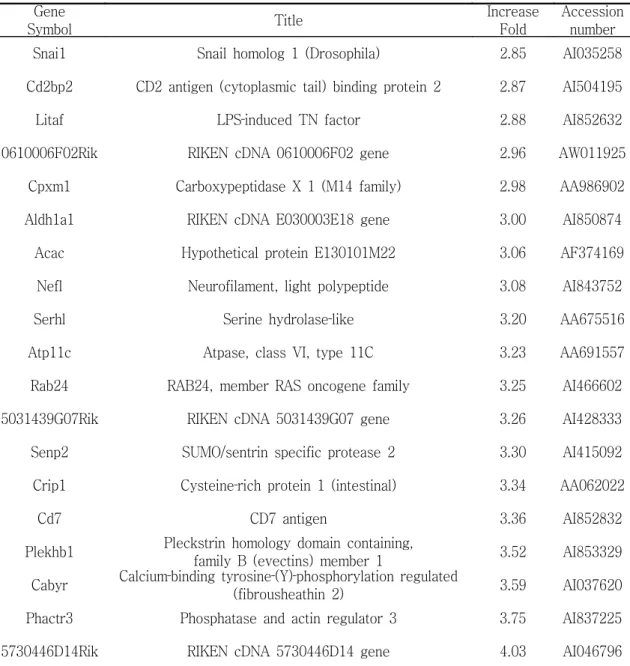
To examine the relationship between brain gene expression and the potential functional consequence in the hypothalamus, we performed hierarchical clustering analysis. Of the 6,108 genes on the cDNA microarray, we found that the expression profiles of interest were up‐ or downregulated in the experimental group compared to the control group (Tables 1 and 2). Nineteen genes were upregulated in the acupuncture treatment (ST36) group, including CD2 antigen (cytoplasmic tail) -binding protein 2 ( Cd 2 bp 2), LPS-induced TN factor ( Litaf ), RAB 24, a member of the RAS oncogene family ( RAB 24), and CD7 antigen. Thirty-eight genes were downregulated in the acupuncture treatment (ST36) group, including Janus kinase 3 ( Jak 3), mad homolog ( Smad 7), zinc finger protein 36 ( Zfp 36), and related IL-4 signaling pathway genes.

Table 1. Gene expression down-regulated with acupuncture therapy.

Gene.

Symbol Title Decrease

Fold

Accession number

Rnf128 Ring finger protein 128 13.60 AW413906

Cyp2b9 Cytochrome P450, family 2, subfamily b, polypeptide 9 5.48 AI385562

Jak3 Janus kinase 3 4.61 AW230832

D11Ertd530e DNA segment, Chr 11, ERATO Doi 530, expressed 4.30 AI503919

Smad7 MAD homolog 7 (Drosophila) 4.29 AI561460

Pthlh Parathyroid hormone‐like peptide 4.28 AW208962

Fgfr4 Fibroblast growth factor receptor 4 3.96 AI385693

Anks1 Ankyrin repeat and SAM domain containing 1 3.71 AI448859

(7)

Gtse1 G two S phase expressed protein 1 3.57 AI505020

Ctsk Cathepsin K 3.54 AW212949

Cbx5 Chromobox homolog 5 (Drosophila HP1a) 3.46 AI893653 Ppp1r2 Protein phosphatase 1, regulatory (inhibitor) subunit 2 3.31 AI324847 Hemt1 Hematopoietic cell transcript 1 3.27 AI152865 Phldb1 Pleckstrin homology‐like domain, family B, member 1 3.23 AI448994

Wbp11 WW domain binding protein 11 3.22 AI853676

Nol8 Nucleolar protein 8 3.21 AI427071

Lox Lysyl oxidase 3.19 W83882

Sh3d4 SH3 domain protein 4 3.18 AI182689

Cog8 Component of oligomeric golgi complex 8 3.09 AI426017 Cpsf6 Cleavage and polyadenylation specific factor 6 3.04 AI448853

Zfp36 Zinc finger protein 36 3.04 AI893411

Pigt Phosphatidylinositol glycan, class T 3.02 AI644374

Gys3 Glycogen synthase 3, brain 3.02 AI385590

Dscam Down syndrome cell adhesion molecule 3.00 AI448860 Prkag1 Protein kinase, AMP‐activated, gamma 1 non‐catalytic

subunit 3.00 AI428451

Gnb2 Guanine nucleotide binding protein, beta 2 2.99 AI448892 Khdrbs3 KH domain containing, RNA binding, signal transduction

associated 3 2.99 AW228724

Es1 Esterase 1 2.99 AI503989

Muc3 Mucin 3, intestinal 2.97 AA688695

Sema3d Sema domain, immunoglobulin domain (Ig, emaphorin) 3D 2.96 AA881885

Proc Protein C 2.90 AI893881

Arid1b AT rich interactive domain 1B (Swi1 like) 2.88 AA762934

Cps1 Carbamoyl‐phosphate synthetase 1 2.88 AI504881

Klra9 Killer cell lectin‐like receptor subfamily A, member 9 2.87 AA739464

Ica1 RIKEN cDNA 5730409L17 gene 2.87 AA763339

Csrp3 Cysteine and glycine‐rich protein 3 2.84 AI385592 Igfbp3 Insulin‐like growth factor binding protein 3 2.84 W89951

Kcnj8 Potassium inwardly‐rectifying channel, subfamily J, member 8 2.83 AI448900

(8)

Table 2. Gene expression up-regulated with acupuncture therapy.

Gene

Symbol Title Increase

Fold

Accession number

Snai1 Snail homolog 1 (Drosophila) 2.85 AI035258

Cd2bp2 CD2 antigen (cytoplasmic tail) binding protein 2 2.87 AI504195

Litaf LPS‐induced TN factor 2.88 AI852632

0610006F02Rik RIKEN cDNA 0610006F02 gene 2.96 AW011925 Cpxm1 Carboxypeptidase X 1 (M14 family) 2.98 AA986902

Aldh1a1 RIKEN cDNA E030003E18 gene 3.00 AI850874

Acac Hypothetical protein E130101M22 3.06 AF374169

Nefl Neurofilament, light polypeptide 3.08 AI843752

Serhl Serine hydrolase‐like 3.20 AA675516

Atp11c Atpase, class VI, type 11C 3.23 AA691557

Rab24 RAB24, member RAS oncogene family 3.25 AI466602 5031439G07Rik RIKEN cDNA 5031439G07 gene 3.26 AI428333 Senp2 SUMO/sentrin specific protease 2 3.30 AI415092 Crip1 Cysteine‐rich protein 1 (intestinal) 3.34 AA062022

Cd7 CD7 antigen 3.36 AI852832

Plekhb1 Pleckstrin homology domain containing,

family B (evectins) member 1 3.52 AI853329 Cabyr Calcium‐binding tyrosine‐(Y)‐phosphorylation regulated

(fibrousheathin 2) 3.59 AI037620

Phactr3 Phosphatase and actin regulator 3 3.75 AI837225 5730446D14Rik RIKEN cDNA 5730446D14 gene 4.03 AI046796

Ⅳ. Discussion

Acute inflammatory pain is characterized by local injury and inflammation, and is regulated by various endogenous molecules.

Pro- and anti‐inflammatory cytokines

play important roles in acute inflammatory

pain. Acupuncture inhibited carrageenan

-induced paw edema, and the anti-

(9)

inflammatory effect of acupuncture is consistent with a recent study showing that electroacupuncture clearly decreased the carrageenan-induced edema volume

17)

. Son et al .

18)

reported that acupuncture stimulation affected multiple pro-inflammatory cytokines in a variety of acute inflammation models.

Another study obtained information on the gene expression profile simultaneously using a microarray

19)

.

STAT 6 is transcription factor that mainly regulates IL-4 signaling in the inflammatory response. The IL-4 receptor consists of the IL-4R alpha and IL-2R gamma chains, and the primary signaling of the receptor is through the JAK/STAT 6 pathway. Dickensheets et al.

20)

consistently demonstrated that IL-4 regulates the activation of STAT 6 in primary human monocytes, and Zhang et al.

21)

showed that IL4-induced activation had a role in carcinogenesis in a human B-lymphoblast cell line. The mechanism underlying IL 4-induced inflammation with acupuncture, however, has not been determined. We therefore investigated the possible hypoalgesic effect of acupuncture in Stat 6-deficient mice. Carrageenan induced hind paw edema in both wild-type and Stat 6-deficient mice, although the volume was reduced in the latter compared to wild-type mice(Fig. 1), and acupuncture evidently reduced the paw volume of

carrageenan-induced inflammation in Stat 6-deficient mice(Fig. 2). It was recently reported that a decrease in the phosphorylation of JAK1 and STAT6 reduced the hippocampal IL-4 concentration, and as activation of the IL-4 receptor regulates the STAT 6 signaling pathway, acupuncture inhibited the IL-4 signal and gene expression profile in the hypothalamus.

The Jak3, Smad7, Zfp36, Fgfr4, and Rnf128 genes were downregulated with acupuncture stimulation compared to the carrageenan -induced Stat 6-deficient mice(Table 1). A previous study reported that Jak3, Fgfr4, and Smad7 had hyperalgesic effects in inflammatory pain

7,8)

, which suggests their involvement in reducing inflammatory responses. In addition, the expression of some anti-inflammatory cytokine receptors (IL-1ra and IL-12) was markedly higher in acupuncture-treated mice(Table 1).

Cunha et al.

11)

reported that IL4 released

by mast cells limits inflammatory

hyperalgesia by inhibiting the production of

JAK3, Smad7, and Fgfr4. A previous study

suggested that IL-10 reduces the

inflammatory hyperalgesia induced by

carrageenan and bradykinin via two

mechanisms: the inhibition of cytokine

production and the inhibition of JAK3

-evoked production

19)

. We also found that

Cd2bp2, Litaf, RAB24, and CD7 antigen

were upregulated in the acupuncture group,

(10)

while pro-inflammatory genes, such as Jak3 and Zfp36, were downregulated in Stat 6-deficient mice(Table 1).

V. Conclusion

Our results suggest that both wild-type and Stat 6-deficient mice showed anti -inflammatory response of acupuncture.

Acupuncture therapy effect has involved down-regulation of inflammation related genes and up-regulation of anti-inflammation related genes in hypothalamus.

Reference

1. Andrews RP, Ericksen MB, Cunningham CM, Daines MO, Hershey GK. Analysis of the life cycle of stat 6. Continuous cycling of STAT 6 is required for IL-4 signaling. J Biol Chem. 2002 ; 277(39) : 36563-9.

2. Zhang WJ, Koitun WA, Thompson JL, Tilberg AF, Galka E, Chomey MJ.

Human B lymphoblast cell lines defective of Stat 6 signaling produce high levels of proinflammatory cytokines IL-12, TNFalpha and IFNgamma. Int J Oncol. 2004 ; 24 : 447-53.

3. Dickensheets HL, Venkataraman C, Schindlen U, Donnelly RP. Interferons inhibit activation of STAT 6 by interleukin 4 in human monocytes by

inducing SOCS-1 gene. Proc. Natl..

Acad. Sci. USA. 1999 ; 96 : 10800-5.

4. Svensson CI, Lucas KK, Hua XY, Powell HC, Dennis EA, Yaksh TL.

Spinal phospholipase A2 in inflammatory hyperalgesia: role of the small, secretary phospholipase A2.

Neuroscience. 2005 ; 133 : 543-53 5. Abe T, Kawamura H, Kawabe S,

Watanabe H, Gejyo F, Abo T. Liver injury due to sequential activation of natural killer cells and natural killer T cells by carrageenan. J. Hepatol. 2002 ; 36 : 614-23.

6. Fecho K, Manning EL, Maixner W, Schmitt CP. Effects of carrageenan and morphine on acute inflammation and pain in Lewis and Fischer rats. Brain Behav Immun. 2007 ; 21 : 68-78.

7. Cabot pJ, Carter L, Gaiddon C, Zhang Q, Schafer M, Stein C et al. Immune cell-derived beta-endorpin. Production, release, and control of inflammatory pain in rats. J. Clin. Invest. 1997 ; 100 : 142-8.

8. Cunha FQ, Poole S, Lorenzetti BB, Ferreira SH. The pivotal role of tumour necrosis factor alpha in the development of inflammatory hyperalgesia. Br. J.

Pharmacol. 1992 ; 107 : 660-4 9. Ferreira SH, Lorezetti BB, Bristow AF,

Poole S. Interleukin-1 beta as a potent

hyperalgesic agent antagonized by a

(11)

tripeptide analogue. Nature. 1988 ; 334 : 698-700.

10. Gold MS. Tetrodotoxin‐resistant Na+

currents and inflammatory hyperalgesia.

Proc. Natl. Acad. Sci. U.S.A. 1999 ; 96 : 7645-9

11. Cunha FQ, Poole S, Lorenzetti BB, Veiga FH, Ferreira SH. Cytokine- mediated inflammatory hyperalgesia limited by interleukin-4. Br. J.

Pharmacol. 1999 ; 126 : 45-50.

12. Lorenzetti BB, Veiga FH, Canetti CA, Poole S, Cunha FQ, Ferreira SH. Cytokine -mediated inflammatory hyperalgesia limited by interleukin-13. Eur Cytokine Netw.

2001 ; 12 : 260-7.

13. Cunha JM, Cunha FQ, Poole S, Ferreira SH. Cytokine‐mediated inflammatory hyperalgesia limited by interleukin-1 receptor antagonist. Br.

J. Pharmacol. 2000 ; 130 : 1418-24.

14. Yang YH, Dudoit S, Luu P, Lin DM, Peng V, Speed TP. Normalization for cDNA microarray data: a robust composite method addressing single and multiple slide systematic variation.

Nucleic Acids Res. 2002 ; 30 : e15 15. Eisen MB, Spllman PT, Brown PO,

Botstein D. Cluster analysis and display of genome-wide expression patterns. Proc. Natl. Acad. Sci. U.S.A.

1998 ; 95 : 14863-8.

17. Zhang SP, Zhang JS, Yung KK, Zhang HQ. Non-opoid-dependent anti- inflammatory effects of low frequency electroacupuncture. Brain Res Bull.

2004 ; 62 : 327-34.

18. Son YS, Park HJ, Kwon OB, Jung SC, Shin HC, Lim S. Antipyretic effects of acupuncture on the lipopolsaccharide‐

induced fever and expression of interleukin-6 and intterleukin-1 beta mRNAs in the hypothalamus of rats.

Neurosci lett. 2002 ; 319 : 45-8.

19. Yin CS, Lee HJ, Hong SJ, Chung JH, Koh HG. Microarray analysis of gene expression in chondrosarcoma cells treated with bee venom. Toxicon. 2005

; 45 : 81-91.

20. Dickensheets HL, Venkataraman C, Schindler U, Donnelly RP. Interferons inhibit activation of STAT 6 by interleukin 4 in human monocytes by inducing SOCS-1 gene expression.

U.S.A. : Proc. Natl. Acad. Sci. 1999 ; 96 : 10800-5.

21. Zhang WJ, Koltun WA, Thompson JL, Tilberg AF, Galka E, Poritz LS.

Human B lymphoblast cell lines

defective of Stat 6 signaling produce

high levels of proinflammatory

cytokines IL‐12, TNFalpha and

IFNgamma. Int J Oncoll. 2004 ; 24 :

447-53.

수치

Fig. 1. The changes of paw edema after  carrageenan injection in wild type and  Stat 6 knockout mice
Table 1. Gene expression down-regulated with acupuncture therapy.
Table 2. Gene expression up-regulated with acupuncture therapy.

참조

관련 문서