• 검색 결과가 없습니다.

Effect of acupuncture treatment on carrageenan-induced inflammation and<br /> NADPH-diaphorase reactivity in the hypothalamus of Stat4 knockout mice

N/A
N/A
Protected

Academic year: 2021

Share "Effect of acupuncture treatment on carrageenan-induced inflammation and<br /> NADPH-diaphorase reactivity in the hypothalamus of Stat4 knockout mice"

Copied!
11
0
0

로드 중.... (전체 텍스트 보기)

전체 글

(1)

Carrageenan 염증 유도된 Stat 4 유전자 제거생쥐의 시상하부에서 NADPH-diaphorase 반응에 대한 침의 영향

홍미숙1,2⋅김미자2,3⋅김진주4⋅박히준5⋅정주호2

1경희대학교 의과대학 BK21 사업단, 2경희대학교 고황의학연구소, 3동덕여대 비만과학대학원,

4약학대학 한약학과한방생리학교실, 5한의과대학 경혈학교실

Effect of acupuncture treatment on carrageenan-induced inflammation and NADPH-diaphorase reactivity in the hypothalamus of Stat4 knockout mice

Mee-Suk Hong

1,2

, Mi-Ja Kim

2,3

, Jin-Ju Kim

4

, Hi-Joon Park

5

, Joo-Ho Chung

2

1

Brain Korea 21 Project Center,

2

Kohwang Medical Research Institute, Kyunghee University School of Medicine,

3

Dept. of Obesity Management, Graduate School of Obesity Science Dongduk Women's University,

4

Dept. of Oriental Physiology, College of Pharmacy,

5

Meridian and Acupuncture, College of Korean Medicine, Kyung Hee University Abstract

목 적 : 본 연구의 목적은 시상하부에서 침처치에 대한 nitric oxide synthase (NOS)발현을 nicotinamide adenine dinucleotide phosphate-diaphorase (NADPH-d)를 이용한 조직화학 염색법으로 관찰하였다.

실험방법 : 동물은 Balb/c (wild type) 와 Stat 4 knockout (KO) 생쥐를 사용하였다. 염증유도는 1%

carrageenan 용액 (20ul/마리)을 발 뒤꿈치 표피에 주사하였고, 침 처치는 족삼리 (ST36)에 시침하였다. 침 처치 후 5시간까지 부종율을 부종측정기로 측정하였으며, 마지막으로 부종을 측정한 후 동물을 희생하여 뇌를 적 출하여 고정하였다. 침에 대한 효과를 확인하기 위하여 NADPH-d 반응의 조직염색을 실시하였다. 염증유도와 그룹간의 유의성 검증은 one-way ANOVA를 사용하였다.

결 과 : 대조군인 Balb/c와 실험군인 stat4 KO 생쥐를 carrageenan으로 염증을 유도시에 대조군은 90%이상 유도된 반면, Stat4 KO 그룹은 50% 정도의 염증만이 유도되었다. 염증을 유도한 생쥐의 족삼리에 침 처치시 대 조군은 1시간에서 약 40%정도 감소하였고 (P<0.05), Stat4 KO 실험군은 유의한 염증 감소율을 보이지 않았다.

시상하부의 lateral hypothalamic area (LHA)와 paraventricular nucleus (PVN)부위의 침에 대한 효과를 NADPH-d 에 양성으로 반응하는 세포수로 비교하여 다음과 같은 결과를 얻었다. (1) 대조군에서 염증 유도시 시 상하부의 PVN는 NADPH-d 양성세포수가 감소하였고, LHA에서는 증가하였다. (2) 염증을 유도한 대조군에 침 을 처치시 PVN은 세포수가 증가하였고, LHA에서는 감소하는 경향을 보였다. (3) 염증을 유도한 Stat4 KO 군에 서는 시상하부의 PVN과 LHA부위 모두에서 NADPH-d 양성세포수가 감소하였고, 염증유도그룹에 침을 처치시 PVN과 LHA부위 모두에서 세포수가 증가함을 관찰 할 수 있었다. (4) 대조군과 실험군 모두에 salicylic acid로 비교하였더니 염증유도 효과 및 NADPH-d 세포 수에서 침 처치와 비슷한 결과를 나타내었다.

결 론 : 침은 염증을 유도한 생쥐에서 염증 감소에 유의한 효과가 있다. 염증을 유도한 Balb/c 와 Stat4 KO 생쥐에 침을 처치 시 시상하부의 NADPH-d 발현이 LHA부위와 PVN에서 서로 다르게 나타나는 것으로 나타 난다. 이러한 현상은 침 효과가 시상하부의 위치에 대한 작용이 다르기 때문이라고 생각된다.

Key words : Stat4 knockout mice, NADPH-diaphorase, acupuncture, carrageenan, hypothalamus, immunohistochemistry

I. Introduction

The signal transducers and activators of

⋅교신저자 : 정주호, 서울특별시 동대문구 회기동 1번지 경희대학 교 의과대학 고황의학연구소, Tel. 02-961-0303, Fax.

02-968-0560, E-mail: [email protected]

⋅본 연구는 과학기술부/한국과학재단 우수연구센터육성사업 (R11-2005-014)과 BK21사업단의 지원으로 수행되었음.

⋅투고 : 2007/11/26 심사 : 2007/12/03 채택 : 2007/12/17

(2)

transcription 4 (STAT 4) is play a role key one of the important molecules during the immune and inflammatory responses.

STAT 4 is activation for interferon gamma (IFN-gamma) induced by interleukin 12 (IL12) signaling pathway

1)

. IL12 is a pro-inflammatory cytokine, and recently, patients receiving IL12 as an immune therapy for several cancers appeared hyperalgesia

2,3)

.

Carrageenan is a high molecular weight polysaccharide and has been used to generate acute inflammation and hyperalgesia animal model

4)

. Carrageenan mediated on acute inflammation, links the pro- inflammatory Th 2 immune response to the early stage cytokines

5)

. Acute inflammation of carrageenan may be induced by the activation of natural killer cells, phagocytes, and other lymphocytes

6)

. However, there has been no information about the effect of Stat4 in carrageenan induced acute inflammation.

Acupuncture has been widely utilized as a clinical treatment for various functional disorders in Korean medicine

7)

. Acupuncture therapy is known to possess many effects, such as analgesia,promotion of homeostasis, and changes in the microcirculatory network as well as improvement in brain circulation

8-10)

. Recently, acupuncture affected several cytokine decreases on carrageenan -induced inflammation such as IL-6,

TIMP-1

11)

and anti-inflammatory effects of electroacupuncture on carrageenan-induced inflammatory model in association with peripheral and spinal COX-2 expression

12)

.

Nitric oxide (NO), endogenously generated from L-arginine by nitric oxide synthase (NOS), is a free radical with signaling functions in the central nervous system (CNS). It has been known to play important roles implicated in numerous physiological and pathological processes in the brain

13)

. Nicotinamide adenine dinucleotide phosphate-diaphorase (NADPH-d) is a histochemical marker specific for NOS in the CNS. Recent evidence demonstrated the nitric oxidase actions of acupuncture are associated with the modulated expression of NOS and c-Fos in hippocampus after transient global ischemia in gerbils

6)

. However, the effects of acupuncture on carrageenan-induced inflammation and on NOS activities in Stat4 KO mice model in hypothalamus have not been reported in the literatures.

The objective of this study was to investigate the effects of acupuncture on hind paw edema and activities of NOS in the hypothalamic regions of Stat4 KO mice.

The activities of NOS were measured using nicotinamide adenine dinucleotide phosphate -diaphorase (NADPH-d) histochemistry.

Ⅱ. Materials and Methods

(3)

1. Experimental animals

Balb/c(wild-type) mice were purchased from The Jackson Laboratory (Bar Harbor, ME). Stat4-/- mice were obtained and backcrossed on a Balb/c background as previously described. Balb/c-Stat4-deficient (Stat4 KO) mice were provided by department of microbiology in Kyung Hee University.

Experimental procedures were performed in accordance with the animal care guidelines of the National Institute for Health (NIH) and the Korean Academy of Medical Sciences. All of animals were housed in cages at room temperatures between 20 and 24℃ with 12:12 h light-dark cycles. Water and food were made available ad libitum. After adapting period, Balb/c (n = 30) and Stat4 KO (n

= 24) groups divided 4 groups (Balb/c and Stat4 KO): control group, carrageenan-induced group (CR), carrageenan -induced with acupuncture group (CR-ACU), and carrageenan-induced with salicylic acid administration group (CR-SA).

2. Carrageenan induced paw edema and measurement

Acute inflammation was induced in the right hind paw of mouse by subcutaneous injection with a 20μl suspension of 1%

freshly prepared gamma carrageenan (Sigma, St Louis, MP, USA) in saline. The volume of the paw was measured at the tibio-tarsal joint using a plethysmometer (Ugo Basile 7140, Plethysmometer, Varese, Italy) before injection (0 h) and then 1, 3, and 5 hours after the injection. The degree of edema was expressed as the difference between the volume of paw at certain time point after injection and the volume before injection using the following equation: % change of paw volume= 100 x (volumepost- injection - volume pre-injection) /volume pre-injection.

3. Experimental groups and acupuncture stimulations

As to acupuncture group (n=7-10), stainless needles (0.2mm in diameter) were inserted about 1-2mm in depth into the right side of ST36 acupuncture points. The needles were twisted twice a second for 60 seconds and then removed. The stimulated areas correspond to acupuncture points in humans. ST36 is located near the knee joint of the hind limb, 2mm lateral to the anterior tubercle of the tibia. The control group (n=7-10) was also immobilized for 60 seconds.

4. NADPH-diaphorase histochemistry

Experimental animals were anesthetized

(4)

and perfused transcardially with 0.05 M phosphate buffered saline (PBS, pH 7.4), followed by chilled 4% Para formaldehyde in 0.1 M phosphate buffer pH 7.4. The brain was removed, post fixed in the same fixative for 2-3 h at 4℃, placed overnight in PBS containing 20% sucrose at 4℃. The coronal sections (40 um in thickness) were prepared by using a freezing microtome (Leica, Nußloch, Germany). Sections were stained for NADPH-d activity according to a previously described protocol.In brief, free-floating sections were incubated at 3 7℃for 60 min in 0.05 M PBS (pH 7.4) containing 0.3% Triton X-100, 0.1 mg/ml nitroblue tetrazolium and 0.1 mg/ml -NADPH. Sections were washed three times with 0.05 M PBS and mounted onto gelatin-coated slides. The slides were air-dried overnight at room temperature, rinsed twice with distilled water and dried again. Covers lips were mountedusing Per mount. Brain sections were analyzed using the atlas by Paxinos and Watson

14)

. The staining intensities of sections stained specifically for NADPH-d were assessed in a quantitative fashion according to a microdensitometrical method based on optical density using an image analyzer (Multiscan, Fullerton, U.S.A.)

15)

.

5. Statistical analysis

All data were presented as mean S.E.M.

Data from hind paw edema and NADPH-d histochemistry were analyzed by ANOVA using the statistical software SPSS (Windowversion 10.5). Specific comparisons were made with Tukey HSD’s post-hoc test. P < 0.05 was considered to indicate statistical significance.

Ⅲ. Result

1. Carrageenan-induced Stat 4 KO mice paw edema comparedto acupuncture treatment

The intra-plantar injection of carrageenan into the mice hind paw elicited an inflammation and a time-dependent increase in paw edema that held amaximum of 5 hours after the injection.

However, increasing carrageenan-induced paw edema in the Stat 4 KO resulted in the significant decrease of mice compare to carrageenan-induced Balb/c mice at 3 and 5 hours (Fig. 1. p<0.05).

The acupuncture stimulation reduced in the carrageenan-induced Balb/c paw edema.

In the Balb/c group, paw volume at 1, 3, and 5 hours after carrageenan injection were 28.6±10.1, 100.6±15.7, and 107.0±17.6

% of control, respectively. In the

acupuncture group, the paw volumes 1, 3,

and 5 hours after carrageenan injection

were increased by 23.6 ± 6.5, 51.5 ± 9.3,

(5)

and 49.6 ± 10.3% of control, respectively.

Acupuncture stimulation at acupoint ST36 significantly reduced the volume of paw edema (Fig. 1. p<0.05).

The acupuncture stimulation reduced paw edema in the carrageenan-induced Stat 4 KO. In the control group, paw volume at 1, 3, and 5 hours after carrageenan injection were 25.7±10.2, 38.5±13.9, and 45.5±11.5% of control, respectively. In the acupuncture therapy, the paw volumes 1, 3, and 5 hours after carrageenan injection were increased by 23.5±3.7, 17.5±2.9, and 19.2±7.4% of Stat 4 KO, respectively.

Acupuncture stimulation at acupoint ST36 significantly reduced the volume of paw edema in Balb/c and Stat4 KO mice (Fig.

1. p<0.05).

The acupuncture stimulation in the carrageenan-induced Stat 4 KO and Balb/c mice reduced paw edema. In the Stat 4 KO mice group, paw volumes at 1, 3, and 5 hours after acupuncture stimulation were 23.5±3.7, 17.5±2.9, and 19.2±7.4 % of control, respectively. In the Balb/c, the paw volumes 3 and 5 hours after acupuncture therapy were reduced by 50.9

±12.4 and 49.6±10.3% of control, respectively. However, acupuncture stimulation at ST36 have not significant reduced the volume of paw edema in the stat 4 KO and Balb/c (Fig. 1).

Fig. 1. Paw edema increase after carrageenan -induced hind paw inflammation in wild type and Stat4 KO mice with acupuncture treatment Black circle, wild type control group: white circle, wild type for acupuncture treatment group: black rectangular, Stat4 KO control group white rectangular, Stat4 KO for acupuncture treatment group. *, represents P < 0.05 compared to control group.

2. NADPH-diaphorase histochemistry

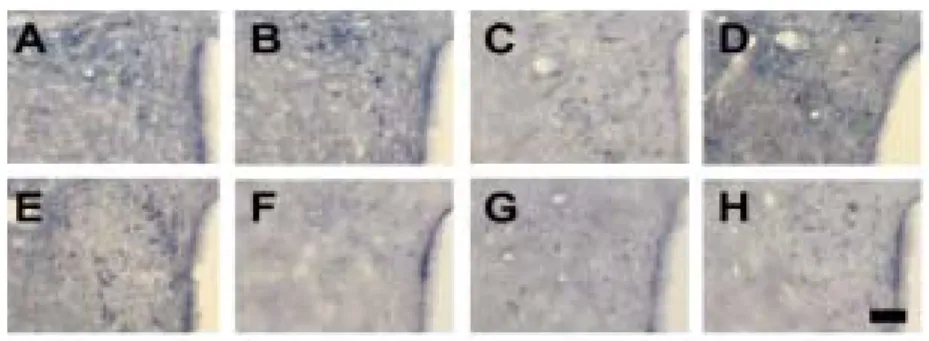
Staining intensities of NADPH-d-positive neurons in the Para ventricular nucleus (PVN) and lateral hypothalamic area (LHA) of Balb/c mice were found to be noticeably lower in comparison to those of the Stat4 KO mice(Fig. 2).

In the PVN of Balb/c and Stat4 KO mice, many stained neuronsand fibers were found in the magnocellular part, and more of such neurons and fibers were seen in the ventral part, while neurons of the medial area exhibited weaker reactions(Fig. 2A;

A-D and 2A; E-H). NADPH-d-positive

cells in the PVN of acupuncture therapy

group increased compared with those of

carrageenan-induced mice(Fig. 2A-B, C and

2A-F, G). NADPH-d-positive cell of

(6)

salicylic acid administration mice in the PVN (Fig. 2A-D and 2B-H) increased, too.

In the LHA of Balb/c mice, NADPH-d-positive cells and fibers were weakly stained, but showed a similar pattern in anatomical distribution to that in acupuncture-Balb/c, acupuncture-Stat4 KO, and salicylic acid-Stat4 KO mice (Fig.

2B-A, 2B-C, 2B-G and 2B-H). Lower staining intensities for NADPH-d-positive neurons and fibers were observed in the LHA of CR-Stat4 KO and salicylic

acid-Stat4 KO mice (Fig. 2B-F and 2B-H), while medium-sized stained neurons and fibers were scattered over the general area of the LHA of con-Stat4 KO and acupuncture-Balb/c mice (Fig. 2B-A and 2B-B). As shown in Fig. 2A & Fig. 2B the optical densities of NADPH-d-positive neurons in the PVN and LHA of Stat4 KO and Balb/c mice were significantly higher than those of acupuncture therapy (P < 0.05).

A. the paraventricular nucleus(PVN) (A) con-Balb/c (B) CR-Balb/c (C) Acu-Balb/c (D) alicylic acid-Balb/c (E) con-Stat4 KO (F) CR-Stat4 KO (G)Acu-Stat4 KO (H) salicylic acid-Stat4 KO

B. lateral hypothalamic area(LHA) (A) con-Balb/c (B) CR-Balb/c (C) Acu-balb/c (D) salicylic acid-Balb/c (E) con-Stat4 KO (F) CR-Stat4 KO (G) Acu-Stat4 KO (H) salicylic acid-Stat4 KO.

Fig. 2. Distribution of NADPH-diaphorase positive neurons in hypothalamic regions Scale bar represents 80

µm.

(7)

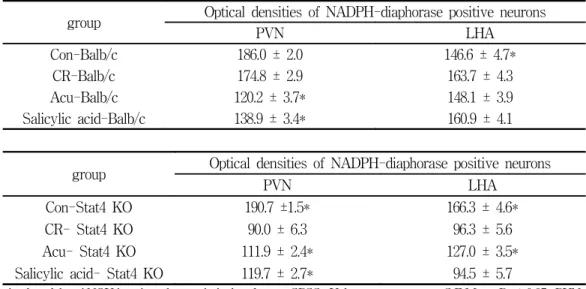
In the PVN, the optical densities of NADPH-d-positive neurons of con-Balb/c, CR-Balb/c, Acu-Balb/c, and salicylic acid-Balb/c mice were 186.0±2.0, 174.8±2.9, 120.2±3.7, and 138.9±3.4 (Table 1.A) respectively. The data of Acu-Balb/c mice was significantly decreased compared to that of the CR-Balb/c mice (P <0.05), but the difference was not significant when compared between Acu-Balb/c and salicylic acid-Balb/c mice. Stat4 KO mice in the PVN, the optical densities of NADPH -d-positive neurons of con-Stat4 KO, CR, Acu, and salicylic acid group were 190.7±1.5, 90.0±6.3, 111.9±2.4, and 119.7±2.6 (Table 1.B) respectively. In the LHA, the optical densities of NADPH-d-positive neurons of con-Balb/c,

CR-Balb/c, Acu-Balb/c, and salicylic-Balb/c mice were 146.6±4.7, 163.7±4.3, 148.1±3.9, and 160.9±4.1(Table 1.A) respectively. Stat4 KO mice in the LHA, the optical densities of NADPH-d-positive neurons of con-Stat4 KO, CR, Acu, and salicylic acid group were 166.3±4.6, 96.3±5.6, 127.0±3.5, and 94.5

±5.7(Table 1.B) respectively. The optical densities of NADPH-d-positive neurons of Acu-Balb/c mice were significantly lower than those of CR-Balb/c mice (P < 0.05), however Acu-Stat4 KO mice significantly increased with CR-Stat KO. This indicates that STAT 4 and acupuncture therapy have different patterns between hyperanalgesia and edema expression of NADPH-d- positive neurons in hypothalamic area.

Table 1. Optical densities of NADPH-diaphorase positive neurons in selected hypothalamic regions

group Optical densities of NADPH-diaphorase positive neurons

PVN LHA

Con-Balb/c 186.0 ± 2.0 146.6 ± 4.7*

CR-Balb/c 174.8 ± 2.9 163.7 ± 4.3

Acu-Balb/c 120.2 ± 3.7* 148.1 ± 3.9

Salicylic acid-Balb/c 138.9 ± 3.4* 160.9 ± 4.1

group Optical densities of NADPH-diaphorase positive neurons

PVN LHA

Con-Stat4 KO 190.7 ±1.5* 166.3 ± 4.6*

CR- Stat4 KO 90.0 ± 6.3 96.3 ± 5.6

Acu- Stat4 KO 111.9 ± 2.4* 127.0 ± 3.5*

Salicylic acid- Stat4 KO 119.7 ± 2.7* 94.5 ± 5.7

Analyzed by ANOVA using the statistical software SPSS: Values are means ± S.E.M. *, P < 0.05: PVN, paraventricular nucleus: LHA, lateral hypothalamic area.

(8)

Ⅳ. Discussion

Seven members of the STAT protein family have beenidentified in mammalian cells

1)

. They play important roles in cytokine signaling in immunocompetent cells. STAT4 is involved in IL-12 signaling, and is expressed in T cells, B cells, NK cells, dendritic cells, and macrophages

4,5)

. STAT4 activated some genes related to Th1 immune responses in these cell lineages. Raman et al.

17)

reported that Stat4 signal pathways regulate inflammation and airway physiology changes in allergic airway inflammation. Sugawara et al.

18)

reported that the role of STAT4 proteins in lymphocyte development, prompted to defense system against mycobacterium infection, such as tuberculosis. These reports showed STAT4 system is associated with infection conditions. Another report stated that STAT4 KO mice enhanced Th2 cell development but impaired IL-12 responses

4)

. Zheng et al.

16)

reported STAT 4 reduced carrageenan-induced inflammation.

Our outcome showed similar results compared to the previous report. Thus, it shows that the STAT4 KO mice and Balb/c have different pattern edema.

The present study demonstrates that acupuncture therapy exerts an inhibitory effect on carrageenan-induced edema

11,12)

. From the results, acupuncture therapy

effect of Acu-Stat4 KO and Acu-Balb/c mice compared to CR-induced group. Lee et al.

12)

mitigation of inflammatory edema and hyperalgesia through the regulation of COX-2 expression and PGE2 production in a model of peripheral inflammation in rats.

Francischi reported that selective inhibitors of cyclo-oxygenase-2 (COX-2) induced hypoalgesia in a rat paw model of inflammation

19)

.

Kataoka et al.

20)

demonstrated that STAT4 in connective tissue-type mast cells in mice plays important role Th1 immune responses. Th1 immune responses are linked with the cytokine regulator on inflammation.

Cytokines responses are associated with peripheral inflammation, and activation throughout the CNS

7,6,21)

. NOS also are known to regulate inflammation cytokine neuron as IL-12

21)

and there may be possible associations with action of STAT4.

However, changes of hind paw edema in CR-induced inflammation and NOS in STAT4 KO mice after acupuncture therapy has not been reported in the literature. The results of our study demonstrate that acupuncture therapy of STAT4 KO hind paw edema was less by 29.0% than that of the CR-Stat4 KO inflammation mice.

Furthermore, the change scale of hind paw

edema has a different pattern between

Balb/c and Stat4 KO mice after

acupuncture therapy. Recent reports

demonstrated that NADPH-diaphorase

(9)

(NADPH-d) might be a histochemical marker for neuronal nitric oxide synthase (nNOS) in the central nervous system.

Nitric oxide (NO), as a gaseous hormone, is synthesized by nitric oxide synthase (NOS) in the brain and other mammalian tissues. Ireland et al.

21)

, IL-12 is efficacious in enhancing recovery from VSV infection of the murine central nervous system that effect is mediated by nitric oxide (NO).

Traub RJ et al.

22)

carrageenan-produced hind paw inflammation in the rat results in a increase in NADPH-d in spinal cord neurons. That nNOS-immunoreactive neurons and NADPH-diaphorase stained neurons are not identical and that nNOS does not increase as a result of hindpaw inflammation. Measuring NADPH-d-positive neurons is correlated with NOS expression.

The optical densities of NADPH-d-positive cells in the hypothalamic PVN were significantly decreased in the Acu-STAT4 KO mice compared to those of the CR-STAT4 KO mice. But, the hypothalamic LHA significantly increased in the Acu-Stat4 KO compare with the CR-Stat4 KO mice. The results between Balb/c and Stat4 KO mice consisted of adifferent pattern in hypothalamic expressions of NADPH-d-positive neurons after acupuncture therapy. Our study showed that the expression of NADPH -d-positive neurons in STAT4 KO mice

significantly increased compared to Balb/c mice the LHA and that responsiveness decreased in the hypothalamic PVN. In the acupuncture therapy, different NOS expression was showed in the hypothalamic PVN and LHA of CR-induced inflammation mice. These indicate STAT4 may be involved in response cytokine inhibited CR-induced inflammation and that acupuncture therapy reduced inflammation.

This is the first report on the endogenous NOS expression in Stat4 KO mice using NADPH-d histochemistry.

In conclusion, our results suggest that hind paw edema in STAT4 KO mice and the different expression of NOS in the hypothalamic regions of Stat4 KO mice using NADPH-d histochemistry may be related. According to the results, it appears to be that Balb/c and STAT4 KO mice’s acupuncturetreatment in inflammation treatment uses different pathway.

Reference

1. Morinobu A, Gadina M, Strober W, Visconti R, Fornace A, Montagna C et al. STAT4 serine phosphorylation is critical for IL-12-induced IFN-gamma production but not for cell proliferation.

Proc Natl Acad Sci U S A. 2002 ; 99(19) : 12281-12286.

2. Gollob JA, Mier JW, Veenstra K,

(10)

McDermott DF, Clancy D, Clancy M et al. Phase I trial of twice-weekly intravenous interleukin 12 in patients with metastatic renal cell cancer or malignant melanoma: ability to maintain IFN-gamma induction is associated with clinical response. Clin Cancer Res. 2000 ; 6(5) : 1678-1692.

3. Weiss GR, O'Donnell MA, Loughlin K, Zonno K, Laliberte RJ, Sherman ML.

Phase 1 study of the intravesical administration of recombinant human interleukin-12 in patients with recurrent superficial transitional cell carcinoma of the bladder. J Immunother (1997). 2003

; 26(4) : 343-348.

4. Svensson CI, Lucas KK, Hua XY, Powell HC, Dennis EA, Yaksh TL.

Spinal phospholipase A2 in inflammatory hyperalgesia: role of the small, secretory phospholipase A2. Neuroscience. 2005 ; 133(2) : 543-553.

5. Kaplan MH, Sun Y-L, Hoey T.

Impaired IL-12 responses and enhanced development of Th2 cells in Stat4- deficient mice. Nature 1996 ; 382 : 174-177.

6. Abe T, Kawamura H, Kawabe S, Watanabe H, Gejyo F, Abo T. Liver injury due to sequential activation of natural killer cells and natural killer T cells by carrageenan. J Hepatol. 2002 ; 36(5) : 614-623.

7. Kang JE, Lee HJ, Kim CJ, et al.

Acupuncture modulates expressions of nitric oxide synthase and c-Fos in hippocampus after transient global ischemia in gerbils. Am J Chin Med.

2003 ; 31 : 581-590.

8. Chang SL, Lin JG, Chi TC, Liu IM, Cheng JT. An insulin-dependent hypoglycaemia induced by electroacupuncture at the Zhongwan (CV12) acupoint in diabetic rats. Diabetologia 1999 ; 42 : 250-255.

9. Kim EH, Kim YJ, Kim CJ. Lee HJ, Huh Y, Chung JH et al. Acupuncture increases cell proliferation in dentate gyrus after transient global ischemia in gerbils. Neurosci Lett 2001 ; 297 : 21-24.

10. Sato A, Sato Y, Suzuki A. Mechanism of the reflex inhibition of micturition contractions of the urinary bladder elicited by acupuncture-like stimulation in anesthetized rats. Neurosci Res. 1992

; 15 : 189-198.

11. Chae Y, Hong MS, Kim GH, Hahm DH, Park HJ, Lee H et al. Protein array analysis of cytokine levels on the action of acupuncture in carrageenan -induced inflammation. Neurol Res.

2007 ; 29 : S55-S58.

12. Lee JH, Jang KJ, Lee YT, Choi YH,

Choi BT. Electroacupuncture inhibits

inflammatory edema and hyperalgesia

(11)

through regulation of cyclooxygenase synthesis in both peripheral and central nociceptive sites. Am J Chin Med 2006

; 34 : 981-988.

13. Garthwaite, J. and C.L. Boulton. Nitric oxide signaling in the central nervous system, Annu Rev. Physiol. 1995 ; 57 : 683-706.

14. Paxinos G, Watson C. The rat brain in stereotaxic coordinates, Academic Press, San Diego, 1997.

15. Kim MJ, Kim Y, Choe BK, Kim SA, Lee HJ, Chung JH et al. Differential expression of nicotinamide adenine dinucleotide phosphate-diaphrase in hypothalamic areas of obese Zucker rats, Neurosci Lett 2000 ; 292 : 60-62.

16. Zheng LT, Cho JJ, Park CS, Hong MS, Chung JH, Yim SV. Paw edema was reduced in carrageenan induced acute inflammation in Stat4 deficient mice.

MOLECULAR & CELLULAR

TOXICOLOGY. 2006 ; 2 : 257-261.

17. Raman K, Kaplan MH, Hogaboam CM, Berlin A, Lukacs NW. STAT4 signal pathways regulate inflammation and airway physiology changes in allergic airway inflammation locally via

alteration of chemokines. The Journal of Immunology, 2003 ; 170 : 3859-3865.

18. Sugawara I, Yamada H, Mizuno S.

Relative importance of STAT4 in murine tuberculosis. Journal of Medical Microbiology 2003 ; 52 : 29-34.

19. Francischi JN, Chaves CT, Moura AC, Lima AS, Rocha OA, Bakhle YS.

Selective inhibitors of cyclo-oxygenase-2 (COX-2) induce hypoalgesia in a rat paw model of inflammation. Br J Pharmacol 2002 ; 137 : 837-844.

20. Kataoka TR, Komazawa N, Morii E, Oboki K, Nakano T. Involvement of connective tissue-type mast cells in Th1 immune responses via Stat4 expression. Blood 2005 ; 105 : 1016-1020.

21. Derek DC, Reiss CS. Expression of IL-12 Receptor by Neurons. Viral Immunology. 2004 ; 17 : 411 -422.

22. Traub RJ, Solodkin A, Meller ST, Gebhart GF. Spinal cord NADPH- diaphorase histochemical staining but not nitric oxide synthaseimmunoreactivity increases following carrageenan-produced hindpaw inflammation in the rat.

Brain Res. 1994 ; 30 : 204-210.

수치

Fig. 1. Paw edema increase after carrageenan  -induced hind paw inflammation in wild type and  Stat4 KO mice with acupuncture treatment  Black  circle,  wild  type  control  group:  white  circle,  wild  type  for  acupuncture  treatment  group:  black  re
Fig. 2. Distribution of NADPH-diaphorase positive neurons in hypothalamic regions  Scale  bar  represents  80  µm.
Table 1. Optical densities of NADPH-diaphorase positive neurons in selected hypothalamic  regions

참조

관련 문서