ABSTRACT
Since mid-December of 2019, coronavirus disease 2019 (COVID-19) has been spreading from Wuhan, China. The confirmed COVID-19 patients in South Korea are those who came from or visited China. As secondary transmissions have occurred and the speed of transmission is accelerating, there are rising concerns about community infections. The 54-year old male is the third patient diagnosed with COVID-19 in Korea. He is a worker for a clothing business and had mild respiratory symptoms and intermittent fever in the beginning of hospitalization, and pneumonia symptoms on chest computerized tomography scan on day 6 of admission. This patient caused one case of secondary transmission and three cases of tertiary transmission. Hereby, we report the clinical findings of the index patient who was the first to cause tertiary transmission outside China. Interestingly, after lopinavir/ritonavir (Kaletra, AbbVie) was administered, β-coronavirus viral loads significantly decreased and no or little coronavirus titers were observed.
Keywords: Coronavirus; COVID-19; Pneumonia; Tertiary Infection; Viral Load;
Brief Communication
Received: Feb 10, 2020 Accepted: Feb 11, 2020 Address for Correspondence:
Sang-Joon Park, MD, PhD
Department of Pulmonary and Critical Care Medicine, Myongji Hospital, 55 Hwasu-ro 14-beon-gil, Deogyang-gu, Goyang 10475, Republic of Korea.
E-mail: [email protected] Baeckseung Lee, PhD
CancerROP, 173 Digital-ro, Geumcheon-gu, Seoul 08511, Republic of Korea.
E-mail: [email protected]
© 2020 The Korean Academy of Medical Sciences.
This is an Open Access article distributed under the terms of the Creative Commons Attribution Non-Commercial License (https://
creativecommons.org/licenses/by-nc/4.0/) which permits unrestricted non-commercial use, distribution, and reproduction in any medium, provided the original work is properly cited.
ORCID iDs Jaegyun Lim
https://orcid.org/0000-0002-3553-0058 Seunghyun Jeon
https://orcid.org/0000-0002-4320-2644 Hyun-Young Shin
https://orcid.org/0000-0001-7261-3365 Moon Jung Kim
https://orcid.org/0000-0003-4148-9116 Yu Min Seong
https://orcid.org/0000-0001-9650-6353 Wang Jun Lee
https://orcid.org/0000-0002-3042-1557
Jaegyun Lim ,1 Seunghyun Jeon ,2 Hyun-Young Shin ,3 Moon Jung Kim ,1 Yu Min Seong ,4 Wang Jun Lee ,5 Kang-Won Choe ,6 Yu Min Kang ,6 Baeckseung Lee ,7 and Sang-Joon Park 8
1 Department of Laboratory Medicine, Myongji Hospital, Hanyang University College of Medicine, Goyang, Korea
2New Horizon Cancer Institute, Myongji Hospital, Goyang, Korea
3Department of Family Medicine, Myongji Hospital, Hanyang University College of Medicine, Goyang, Korea
4Department of Internal Medicine, Myongji Hospital, Goyang, Korea
5 Office of Chief Executive Officer and Chairman, Department of General Surgery, Myongji Hospital, Goyang, Korea
6Department of Infectious Diseases, Myongji Hospital, Goyang, Korea
7CancerROP, Seoul, Korea
8Department of Pulmonary and Critical Care Medicine, Myongji Hospital, Goyang, Korea
Case of the Index Patient Who Caused Tertiary Transmission of Coronavirus Disease 2019 in Korea: the Application of Lopinavir/Ritonavir for the
Treatment of COVID-19 Pneumonia Monitored by Quantitative RT-PCR
Infectious Diseases,
Microbiology & Parasitology
► See the letter “Letter to the Editor: Case of the Index Patient Who Caused Tertiary Transmission of Coronavirus Disease 2019 in Korea: the Application of Lopinavir/Ritonavir for the Treatment of COVID-19 Pneumonia Monitored by Quantitative RT-PCR” in volume 35, number 7, e88.
Kang-Won Choe
https://orcid.org/0000-0003-2003-6492 Yu Min Kang
https://orcid.org/0000-0002-4368-9878 Baeckseung Lee
https://orcid.org/0000-0001-7867-8434 Sang-Joon Park
https://orcid.org/0000-0003-3178-6272 Disclosure
The authors have no potential conflicts of interest to disclose.
Author Contributions
Conceptualization: Lim J. Data curation: Kim MJ, Lee B, Shin HY, Seong YM. Formal analysis:
Jeon S, Kim MJ, Shin HY, Lee B. Methodology:
Lee B. Project administration: Park SJ.
Supervision: Lee WJ, Choe KW. Validation: Lee WJ. Writing - original draft: Park SJ. Writing - review & editing: Choe KW, Kang YM.
A 54-year-old Korean man living in Wuhan, China entered Korea on January 20, 2020 and felt the first symptoms of chills and muscle pain on January 22. After contacting a public health center on January 25, he was isolated in a negative pressure room at Myongji Hospital and confirmed to have COVID-19 on January 26.
At that time the initial confirmation of COVID-19 was made by pan-coronavirus conventional polymerase chain reaction assay and sequencing of the polymerase chain reaction (PCR) amplicons using a throat swab.
The index patient transmitted the virus to his friend (patient A) at a restaurant on the 1st day of the symptoms. And then patient A (confirmed on January 30, 2020) transmitted COVID-19 to his spouse and son (confirmed on January 31, 2020), and a church colleague (confirmed on February 6, 2020). Those were the first cases of tertiary transmission of COVID-19 outside China.
The index patient was a clothing worker at the Wuhan Fashion Center, with a height of 193 cm and weight of 96 kg (body mass index, 25.7), and had no major illness. He denied any smoking and drinking history. On admission day, he had no respiratory symptoms and blood pressure of 152/93 mmHg, pulse rate of 73 beats per minute, respiratory rate of 20 breaths per minute, and a body temperature of 37.0°C. On physical examination, no pharyngeal injection, clear lung sounds, and no haziness on chest X-ray were observed. Tests for Leptospira, Hantan virus, Tsutsugamushi, Malaria, M tuberculosis, human immunodeficiency virus (HIV) Ag/Ab, and venereal disease research laboratory (VDRL) test were all negative.
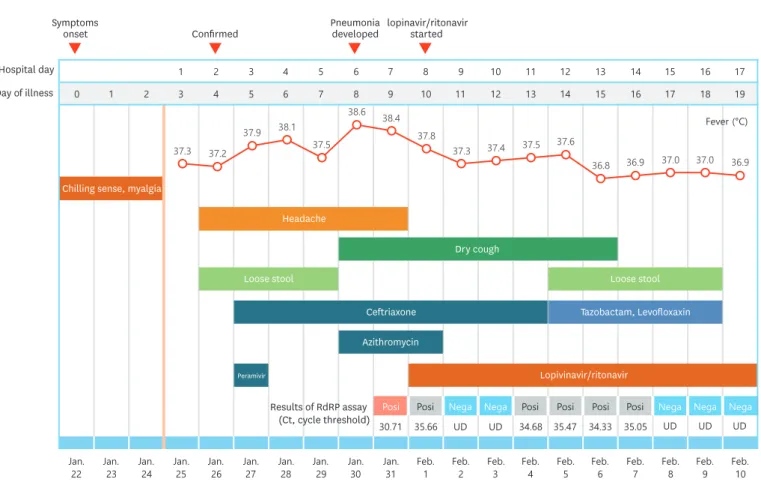
He developed fever and dry cough on days 5 and 7 of illness, respectively, but he had no serious respiratory symptoms such as shortness of breath, productive sputum or chest pain.
Small consolidation in right upper lobe and ground-glass opacities in both lower lobes were observed on high-resolution computed tomography scan (Figs. 1 and 2, Table 1).
The initial viral load could not be measured because real-time PCR was not available when the patient was diagnosed. So we measured viral loads using quantitative reverse transcription (RT)-PCR since Jan. 31, 2020. Viral RNA was extracted from the sputum using QIAamp viral RNA mini kit (Qiagen, Hilden, Germany) according to the manufacturer's instructions. All quantitative real-time PCR amplifications were performed using Quantstudio 1 (Applied Biosystems, Foster City, CA, USA) and PowerCheck™ SARS-CoV-2 Real-Time PCR kit (KogeneBiotech, Seoul, Korea).
There were some reports about lopinavir/ritonavir (Kaletra, AbbVie) for the treatment of COVID-19.1 Lopinavir/ritonavir was started from the hospital day 8 (day 10 of illness); 2 tablets (lopinavir 200 mg/ritonavir 50 mg) were given per oral bid. Interestingly, from the next day of lopinavir/ritonavir administration, β-coronavirus viral load started to decrease and no detectable or little coronavirus titers have been observed since then (Fig. 2 and Supplementary Fig. 1).
It is possible that the decreased load of SARS-CoV-2 resulted from the natural course of the healing process rather than administration of lopinavir/ritonavir, or both. Therefore, more data need to be collected to figure out the direct effect of lopinavir/ritonavir on treatment with COVID-19.
The patient also complained of psychiatric symptoms such as depression, insomnia and suicidal thoughts after isolation. The patient experienced stress regarding people's reactions from the media reports about the COVID-19 patients. In addition, despite mild symptoms of
A B
C
D E
Fig. 1. Radiologic findings of the patient.
(A) Chest X-ray of illness day 3, hospital day 1. (B) Chest X-ray of illness day 9, hospital day 7. (C) Chest X-ray of illness day 15, hospital day 13. (D) HRCT scan of illness day 9, hospital day 7. (E) HRCT scan of illness day 15, hospital day 13.
AP(P) = Anteroposterior (Portable X-ray), HRCT = high-resolution computed tomography.
of the reasons provoking psychological symptoms. Counseling and related medications were provided under the consult of a psychiatrist.2
This case shows that the COVID-19 may induce relatively mild symptoms and a patient can recover when early diagnosis of pneumonia was made.3-5 When lopinavir/ritonavir was used, we found reduced viral loads and improved clinical symptoms during the treatment.
So lopinavir/ritonavir can be recommended to relatively high-risk groups of COVID-19 pneumonia (elderly patients or patients with underlying diseases) from the early stage. But we need more evidence to prove the clinical efficacy of lopinavir/ritonavir based on well controlled clinical trials.
The images are published under agreement of the patient.
ETHICS STATEMENT
Myongji Hospital Institutional Review Board (IRB) approved this study (No. IRB 2020-01- 027) and written informed consent was given by the patient.
1 2 3 4 5 6 7 8 9 10 11 12 13 14 15 16 17
0 1 2 3 4 5 6 7 8 9 10 11 12 13 14 15 16 17 18 19
Chilling sense, myalgia
Headache
Dry cough
Loose stool Loose stool
Ceftriaxone Tazobactam, Levofloxaxin
Azithromycin
Peramivir Lopivinavir/ritonavir
Posi Posi Nega Nega Posi Posi Posi Posi Nega Nega Nega 30.71 35.66 UD UD 34.68 35.47 34.33 35.05 UD UD UD
Jan.
22 Jan.
23 Jan.
24 Jan.
25 Jan.
26 Jan.
27 Jan.
28 Jan.
29 Jan.
30 Jan.
31 Feb.
1 Feb.
2 Feb.
3 Feb.
4 Feb.
5 Feb.
6 Feb.
7 Feb.
8 Feb.
9 Feb.
10 37.3 37.2
37.9 38.1 37.5
38.6 38.4 37.8
37.3 37.4 37.5 37.6
36.8 36.9 37.0 37.0 36.9 Day of illness
Confirmed Pneumonia
developed lopinavir/ritonavir started Hospital day
Results of RdRP assay (Ct, cycle threshold) Symptoms
onset
Fig. 2. Clinical course, treatment and viral load of the patient.
RdRP = RNA-dependent RNA polymerase, Posi = positive, Nega = negative, UD = undeteced, Ct = cycle threshold.
ACKNOWLEDGMENTS
We thank to Myongji Hospital staffs for their efforts to cope with COVID-19 and CancerROP Co., Ltd., for providing a test diagnostic kit to measure SARS-CoV-2 virus titers.
SUPPLEMENTARY MATERIAL
Supplementary Fig. 1
Time course quantification of SARS-CoV-2 by real-time RT-PCR. (A) Quantitative RT-PCR analysis of beta CoV. (B) SARS-CoV-2 in sputum samples collected from the patient. The results showed decline of virus titers with time and no detectable RdRP titer at illness days 12 and 13.
Click here to view Table 1. Serial laboratory results of the patient
Variables Illness day 3
(HD 1) Illness day 6
(HD 4) Illness day 7
(HD 5) Illness day 8
(HD 6) Illness day 10
(HD 8) Illness day 12
(HD 10) Illness day 14
(HD 12) Illness day 16 (HD 14)
White blood cell count, ×103/µL 7,200 5,800 5,200 6,700 6,000 6,700 8,600 9,100
Segment neutrophil, % 59.0 64.2 50.3 69.3 58.8 55.5 63.1 63.0
Lymphocyte, % 28.5 24.0 36.5 19.1 30.9 29.4 24.4 24.9
Monocyte, % 11.5 11.0 11.6 10.7 9.2 13.5 10.9 10.2
Eosinophil, % 0.6 0.3 1.0 0.6 0.8 1.3 1.3 1.5
Hemoglobin, g/dL 16.3 15.4 16.1 15.3 15.2 14.9 14.2 13.9
Platelets, ×103/µL 301 176 212 225 229 287 358 507
Glucose, mg/dL 97 114 - - - - - 103
BUN, mg/dL 13.0 7.0 10.1 9.1 9.6 7.9 6.3 8.1
Creatinine, mg/dL 1.0 0.8 1.2 0.8 1.0 0.8 0.8 0.9
Total bilirubin, mg/dL 0.50 0.47 - 0.35 0.61 0.74 0.85 1.09
AST, U/L 27 31 - 22 127 54 19 17
ALT, U/L 29 37 - 29 106 83 45 30
Uric acid, mg/dL 8.6 7.0 - - - - - -
CK, U/L - 43 - - - 31 30 28
ALP, U/L - 62 - - - 140 113 95
LDH, U/L - 332 - - - - 351 329
Sodium, mmol/L 138 135 138 137 138 138 138 139
Potassium, mmol/L 4.3 4.1 4.8 4.2 4.2 4.3 4.2 4.3
Chloride, mmol/L 104 104 105 104 102 103 103 103
Total protein, g/dL 7.4 6.4 6.8 6.3 6.3 6.4 6.3 6.5
Albumin, g/dL 4.5 3.9 4.1 3.8 3.8 3.8 3.7 3.7
ESR, mm/hr 26 27 - - 66 - - 82
CRP, mg/dL 0.43 1.23 - 4.51 10.94 9.11 11.20 3.60
Pro-Calcitonin, ng/mL - 0.06 - - - - - -
PT, sec 12.5 12.9 - - 13.2 13.1 13.6 13.6
PT INR 0.96 1.00 - - 1.03 1.02 1.07 1.07
aPTT, sec 40.4 38.5 - - 38.8 38.0 40.1 40.7
D-dimer, µg/mL (FEU) - 0.28 - - - - 1.22 -
HD = hospital day, AST = aspartate aminotransferase, ALT = alanine aminotransferase, CK = creatine kinase, ALP = alkaline phosphatase, LDH = lactate dehydrogenase, ESR = erythrocyte sedimentation rate, CRP = C-reactive protein, PT = prothrombin time, INR = international normalized ratio, aPTT = activated partial thromboplastin time, FEU = fibrinogen equivalent units.
REFERENCES
1. Kim JY, Choe PG, Oh Y, Oh KJ, Kim J, Park SJ, et al. The first case of 2019 novel coronavirus pneumonia imported into Korea from Wuhan, China: implication for infection prevention and control measures.
J Korean Med Sci 2020;35(5):e61.
PUBMED | CROSSREF
2. Hamer M, Kivimaki M, Stamatakis E, Batty GD. Psychological distress and infectious disease mortality in the general population. Brain Behav Immun 2019;76:280-3.
PUBMED | CROSSREF
3. Li Q, Guan X, Wu P, Wang X, Zhou L, Tong Y, et al. Early transmission dynamics in Wuhan, China, of novel coronavirus-infected pneumonia. N Engl J Med 2020.
PUBMED | CROSSREF
4. Rothe C, Schunk M, Sothmann P, Bretzel G, Froeschl G, Wallrauch C, et al. Transmission of 2019-nCoV Infection from an asymptomatic contact in Germany. N Engl J Med 2020.
PUBMED | CROSSREF
5. Chang D, Lin M, Wei L, Xie L, Zhu G, Dela Cruz CS, et al. Epidemiologic and clinical characteristics of novel coronavirus infections involving 13 patients outside Wuhan, China. JAMA 2020.
PUBMED | CROSSREF