Received November 15, 2018, Revised January 19, 2019, Accepted for publication March 9, 2019
Corresponding author: Soon Sung Lim, Department of Food Science and Nutrition, Hallym University, 1 Hallymdeahak-gil, Chuncheon 24252, Korea. Tel: 82-33-248-2133, Fax: 82-33-251-0633, E-mail: [email protected] ORCID: https://orcid.org/0000-0003-4548-1285
Xian Hua Zhang, Department of Food Science and Engineering, Jinzhou Medical University, Jinzhou, China. Tel: 86-416-467-3073, Fax: 86-416-458-0464, E-mail: [email protected]
ORCID: https://orcid.org/0000-0001-6732-1704
This is an Open Access article distributed under the terms of the Creative Commons Attribution Non-Commercial License (http://creativecommons.
org/licenses/by-nc/4.0) which permits unrestricted non-commercial use, distribution, and reproduction in any medium, provided the original work is properly cited.
Copyright © The Korean Dermatological Association and The Korean Society for Investigative Dermatology
Ann Dermatol Vol. 31, No. 5, 2019 https://doi.org/10.5021/ad.2019.31.5.502
ORIGINAL ARTICLE
Melandrium firmum Extract Promotes Hair Growth by Modulating 5α-Reductase Activity and Gene Expression in C57BL/6J Mice
Bo Huang, Bueom-Goo Kang1, Soon Sung Lim1, Xian Hua Zhang
Department of Food Science and Engineering, Jinzhou Medical University, Jinzhou, China, 1Department of Food Science and Nutrition, Hallym University, Chuncheon, Korea
Background: In our preliminary study, we screened for their potential to inhibit 5α-reductase, and Melandrium firmum (MF) extract showed the most potent activity as confirmed by high-performance liquid chromatography (HPLC). Objective:
This study aimed to investigate the effects of MF extract on 5 α-reductase activity and its mechanisms of action in the pre- vention or treatment of androgenetic alopecia. Methods:
HPLC was used to measure 5α-reductase activity. The hair growth-promoting effect of MF extract in the shaved dorsal skin of C57BL/6J mice was studied for 30 days. Hair follicles were examined by histological examination. Protein and mRNA levels of growth factors involved in hair growth were determined by western blotting, and reverse transcription- polymerase chain reaction (RT-PCR) and qPCR, respectively.
Cell proliferation was measured by (3-(4, 5-dimethylthia- zol-2-yl)-5-(3-carboxymethoxyphenyl)-2-(4-sulfophenyl)- 2H-tetrazolium) assay. Results: MF extract at 0.5 mg/ml showed 43.5% inhibition of 5α-reductase. MF extract pro-
moted hair growth by inducing anagen phase reflected by skin color, hair density, and the number and size of hair follicles. It not only reduces the expression of transforming growth factor-beta 1 (TGF-β1) and Dickkopf-1 (DKK-1), but also markedly upregulated insulin-like growth factor 1 and keratinocyte growth factor in the dorsal dermal tissue.
Ursolic acid, ecdcysteron, and ergosterol peroxide were identified as active constituents by activity-guided fractiona- tion to inhibit 5α-reductase. They decreased the gene ex- pression of TGF-β1 and DKK-1 in human hair dermal papilla cells. Conclusion: In summary, these finding indicate that MF extract might be a good drug candidate for hair growth promotion. (Ann Dermatol 31(5) 502∼510, 2019)
-Keywords-
Growth factors, Hair follicle, Melandrium firmum, 5α- reductase
INTRODUCTION
The approximately 0.2%∼2% of the world population suf- fer from androgenetic alpopecia1,2. Hair loss occurs due to psychological and physical stress, and dandruff3,4. So far, minoxidil and finasteride was approved as a drug against for the hair loss5-7. Minoxidil is an anti-hypertensive, has been shown to stimulate hair growth in the treatment of vasodilatation on body8; finasteride was promoted hair gro- wth in androgenetic alopecia (AGA) with male patients9. However, these drugs have unpredicatable efficacy and side effects, leading to limited therapeutic use10. There- fore, effective AGA treatment agents should be further developed. Recently, many researchers have reported nat- ural extracts that promote hair growth11,12.
Fig. 1. Extraction and fractionation of Melandrium firmum. Y: yield, I: % inhibition.
Melandrium firmum (MF) is a herbal plant used to treat gonorrhe, anuria and breast cancer and widely distributed in Korea13,14. However, its effect on hair growth has not been reported. The aim of this study was to investigate ef- fects of MF on the prevention or treatment of AGA by se- lectively inhibiting 5α-reductase activity and its action mechanisms. Our study demonstrated that topical MF ex- tract promotes hair growth in C57BL/6J mice.
MATERIALS AND METHODS
Preparation of MF
Whole plants of MF were purchased from Deakwang, Chuncheon, and the plant identification was confirmed by Emeritus Professor Heung Jun Chi (Department of Pharmacy, Seoul National University, Seoul, Korea). The MF was ex- tracted with water (1.0 kg : 10 L) for 3 times, and filtered and concentrated to yield (167.32 g), and then suspended in distilled water and partitioned with hexane, EtOAc, and n-BuOH to give hexane-soluble (33.12 g), EtOAc-soluble (19.89 g), and n-BuOH-soluble (43.39 g) fractions, respect- ively. Among in the hexane-soluble obtained: fraction 1 (2.3 g), fraction 2 (1.6 g), fraction 3 (3.6 g), fraction 4 (2.9 g), fraction 5 (3.1 g), and fraction 6 (2.6 g), respectively. Fi- nally, ursolic acid, ecdcysteron, and ergosterol peroxide were isolated as active principle compounds from fraction 6 by 5α-reductase inhibition (Fig. 1).
5α-reductase assay
The 5α-reductase assay was performed as described pre- viously15 with slight modifications. Inhibitory activity of 5 α-reductase was determined by two special reactions;
first, the replace extract with 0.2 ml of 50% ethanol to complete the reaction (rxn); second, an enzyme blank (ctrl) is added with 5.0 ml of dichloromethane before adding
nicotinamide adenine dinucleotide phosphate. The peak area ratio (r) of testosterone/internal standard was used to calculate the percentage inhibition rate (%) by the follow- ing formula:
−
−
×
Animal experimental protocol
Five-week-old male C57BL/6J mice (n=6) were controlled temperature (23oC±2oC), humidity (50%±10%), and a 12- hour light-dark cycle, and then acclimatization for seven days. All mice were carefully removed from the dorsal areas (2×4 cm) with animal clipper containing wax-rosin mixture16 and MF extract was applied daily on the dorsal skin of mice on day 1 post depilation for 30 days. Animal study was conducted in accordance with the Hallym Uni- versity protocol (Hallym-2012-70-1).
Histological analysis
The dorsal skin samples were fixed in 4% formalin and embedded in paraffin block, cut into 5 μm sections, and stained with hematoxylin and eosin to confirm hair fol- licle. Three different cross-sectional areas and the number of hair follicles were calculated using an image analysis program (Image-Pro Plus ver. 6.0; Media Cybernetics, Silver Spring, MD, USA).
Cell culture and proliferation
The human hair dermal palilla cells (HHDPCs) were in- cubated in mesenchymal stem cell medium (5% fetal bo- vine serum, 1% penicillin-streptomycin, and 1% mesangial stem cell growth supplement) at 37oC in 5% CO2. HHDPCs were plated at 5×10³ cells per well in 96-well plates, and incubated in the presence or absence of ursolic acid, ecd-
Table 1. Primers sequence for RT-PCR and real-time PCR
Gene Sequence of primer (5’→3’) Annealing
temperature (oC)
Forward primer Reverse primer
TGF-β1 AGACTTTTCCCCAGACCTCG TGGGTGGTCTTGAATAGGGG 58
DKK-1 CCATTGACAACTACCAGCCG CTGCAGGCGAGACAGATTTG 58
IGF-1 TCAACAAGCCACAGGGTAT ACTCGTGCAGAGCAAAGGAT 58
KGF GACATGGATCCTGCCAACTT AATTCCAACTGCCACTGTCC 50
Actin GTCGTACCACTGGCATTGTG GCCATCTCCTGCTCAAAGTC 60
RT-PCR: reverse transcription-polymerase chain reaction, PCR: polymerase chain reaction, TGF-β1: transforming growth factor-beta 1, DKK-1: Dickkopf-1, IGF-1: insulin-like growth factor 1, KGF: keratinocyte growth factor.
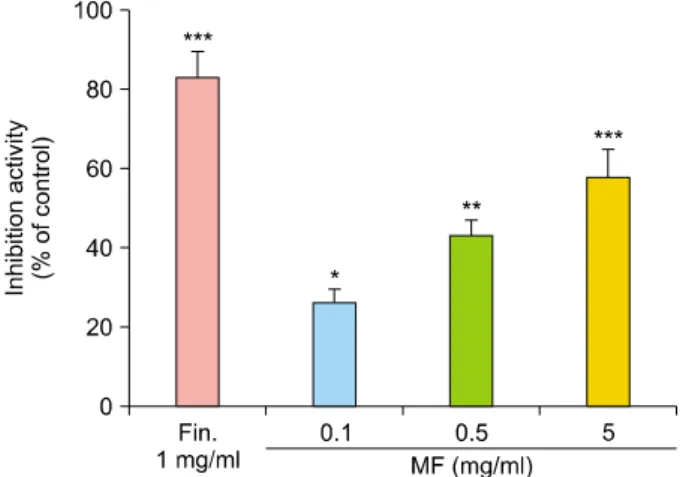
Fig. 2. Measurement of 5α-reductase inhibitory activity. 5α- reductase inhibitory activity was calculated using rat micro- somes. Positive control was Finasteride. *p<0.05, **p<0.01, and ***p<0.001 vs. control. Fin.: finasteride, MF: Melandrium firmum.
cysteron, and ergosterol peroxide. After 24 and 48 hours of culturing HHDPCs, added 20 μl of (3-(4, 5-dimethylth- iazol-2-yl)-5-(3-carboxymethoxyphenyl)-2-(4-sulfop- henyl)-2H-tetrazolium) solution to each well measured op- tical density at 550 nm using a microplate reader (Sensi- dent Scan; Labsystems, Helsinki, Finland).
Reverse transcription-polymerase chain reaction (RT-PCR) and real-time polymerase chain reaction (PCR)
The total RNA was isolated from HHDPCs and dorsal der- mal tissues and quantified using the NanoDrop-2000 (Thermo Fisher Scientific; Waltham, MA, USA). The cDNA synthesis was performed using a cDNA reverse tran- scription kit and real-time PCR was performed using the LightCycler real-time PCR System (Roche Applied Science, Indianapolis, IN, USA). The annealing temperatures and primers used for PCR reactions were listed in Table 1.
Western blot Analysis
The total protein (30 μg) from HHDPCs and dorsal der- mal tissue was lysed in Lysis buffer (Thermo Fisher - Scientific) and separated by sodium dodecyl sulphate-pol- yacrylamide gel electrophoresis and transferred to poly- vinylidene difluoride membranes. After blotting, membra- nes were probed with transforming growth factor-beta 1 (TGF-β1), Dickkopf-1 (DKK-1), insulin-like growth factor 1 (IGF-1), keratinocyte growth factor (KGF), and actin (Santa Cruz Biotechnology, Santa Cruz, CA, USA), and incubation with secondary antibody for 1 hour at romtemp- erature (25oC±1oC), immunoreactive proteins were visual- ized using an enhanced chemiluminescence substrate and quantified by densitometric analysis.
Statistical analysis
Student’s unpaired t-test or one-way ANOVA were calcu- lated with GraphPad Prism program (GraphPad Software Inc., San Diego, CA, USA). A p-value <0.05 were consid- ered statistically significant. Results are represented as the mean±standard error, and multiple comparisons were
carried.
RESULTS
Inhibitory effect of MF extract on 5α-reductase activity First, we investigated the effect of MF extract on 5α-reduc- tase activity. As shown in Fig. 2, 5α-reductase activity was inhibited by 26.4%, 43.5%, and 57.1% in MF extract at concentrations of 0.1, 0.5, and 5 mg/ml, respectively (Fig. 2).
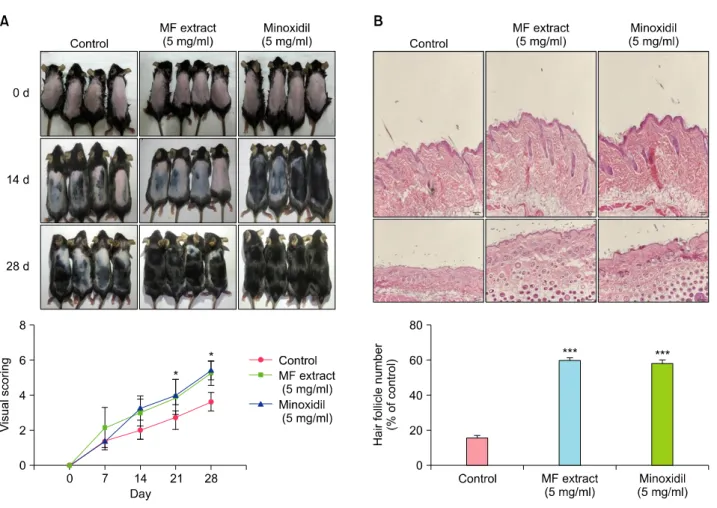
MF extract on hair regeneration in C57BL/6J mice To investigate whether MF extract promotes hair growth, we induced the anagen phase of hair growth in C57BL/6J mice. After 30 days, MF extract induced telogen-to-anagen conversion earlier than vehicle treatment. During the ex- periment, visual scores were given weekly for hair growth (Fig. 3A). In the representative longitudinal section of his- tologic studies showed that MF extracts increased size of hair follicles and longer depth as compared with control
Fig. 3. Effect of Melandrium firmum (MF) extract on hair growth in C57BL/6J mice. (A) Comparison of dorsal skin colors and hair growth on days 0, 14, and 28 after depilation and the visual scoring of the hair growth-promoting effect of MF extract. (B) On the day the mice were executed, longitudinal sections of the dorsal skin were stained with hematoxylin and eosin and the number of hair follicles was determined based on morphology assessment at 200× magnification under bright-field microscopy. *p<0.05 and
***p<0.001 compared with control group.
group (Fig. 3B).
Effect of MF extract on growth factors in dorsal dermal tissues of C57BL/6J mice
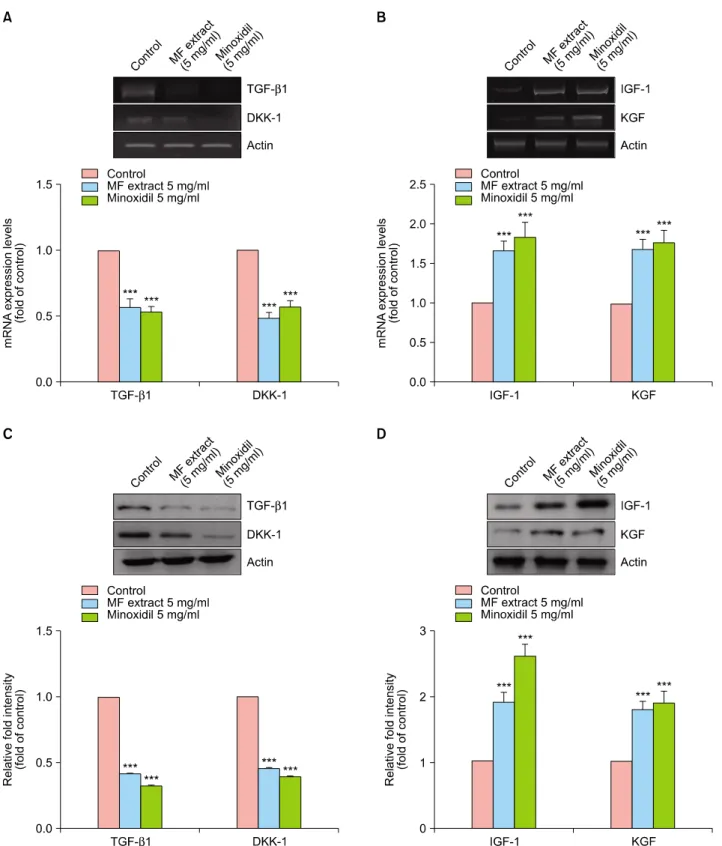
In this study, we measured the gene and protein expres- sion levels of TGF-β1, DKK-1, IGF-1, KGF, and actin. As shown Fig. 4A and C, MF extract downregulated the ex- pression of TGF-β1 and DKK-1 compared to vehicle treatment. However, it upregulated the gene expression of IGF-1 and KGF (Fig. 4B, D).
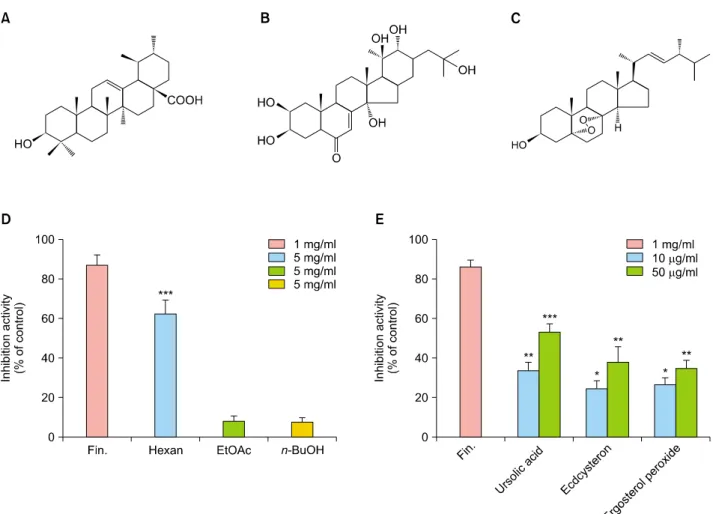
Isolation of active components of the MF extract To achieve a satisfactory separation of the multiple com- ponents in the MF extract, the 5α-reductase activities of each fraction was examined using high-performance liq- uid chromatography (HPLC). The EtOH extract was frac- tionated into hexane, EtOAc, and n-BuOH extracts. The hexane extract significantly inhibited 5α-reductase in- hibition activity by 62.2%, whereas EtOAc and n-BuOH ex-
tracts showed no effect (Fig. 5A). We obtained six frac- tions from the hexane extract, and their 5α-reductase in- hibition activities were assessed. Fraction 6 of the hexane extract significantly inhibited 5α-reductase activity by 63% (data not shown). Furthermore, we identified ursolic acid, ecdcysteron, and ergosterol peroxide as the major active compounds in fraction 6. In addition, 5α-reductase activity was inhibited by ursolic acid, ecdcysteron, and er- gosterol peroxide by 53.2%, 37.7%, and 35.0%, re- spectively (Fig. 5B).
Effect of ursolic acid, ecdcysteron, and ergosterol peroxide on the proliferation and gene expression in HHDPCs To assess the action mechanism responsible for the hair regeneration effects of MF extract in C57BL/6J mice, we investigated the effects of its major compounds on pro- liferation and gene expression in HHDPCs. Minoxidil (100 μM) was used as a positive control. Proliferation of HHDPCs treated with MF extracts at 50 or 100 μg/ml for
Fig. 4. Effect of Melandrium firmum (MF) extract on gene expressions in dorsal dermal tissues of C57BL/6J mice. Expression of TGF-β1 and DKK-1 (A and C), IGF-1 and KGF (B and D) mRNA and protein levels were measured by RT-PCR and real-time PCR. Three independent experiments were carried out; ***p<0.001 compared with control. TGF-β1: transforming growth factor-beta 1, DKK-1:
Dickkopf-1, IGF-1: insulin-like growth factor 1, KGF: keratinocyte growth factor, RT-PCR: reverse transcription-polymerase chain reaction, PCR: polymerase chain reaction.
Fig. 5. Molecular structures of (A) ursolic acid; (B) ecdcysteron; (C) ergosterol peroxide; (D) inhibition of 5α-reductase as mesured by high-performance liquid chromatography with various fractions of Melandrium firmum extract (5 mg/ml) and (E) its major active compounds (10 μg/ml and 50 μg/ml). *p<0.05, **p<0.01, and ***p<0.001 compared with control. Fin.: finasteride.
Fig. 6. Effect of Melandrium firmum (MF) extract and its major compounds on the proliferation of human hair dermal palilla cells (HHDPCs). (A) The cells were treated with various concentrations of MF extracts for 24, 48, and 72 hours. (B) HHDPCs were incubated with different concentrations of ursolic acid, ecdcysteron, and ergosterol peroxide or minoxidil for 24, 48, and 72 hours. Lanes: 1, ursolic acid; 2, ecdcysteron; 3, ergosterol peroxide. Three independent experiments were performed. *p<0.05 compared with control.
Min.: minoxidil.
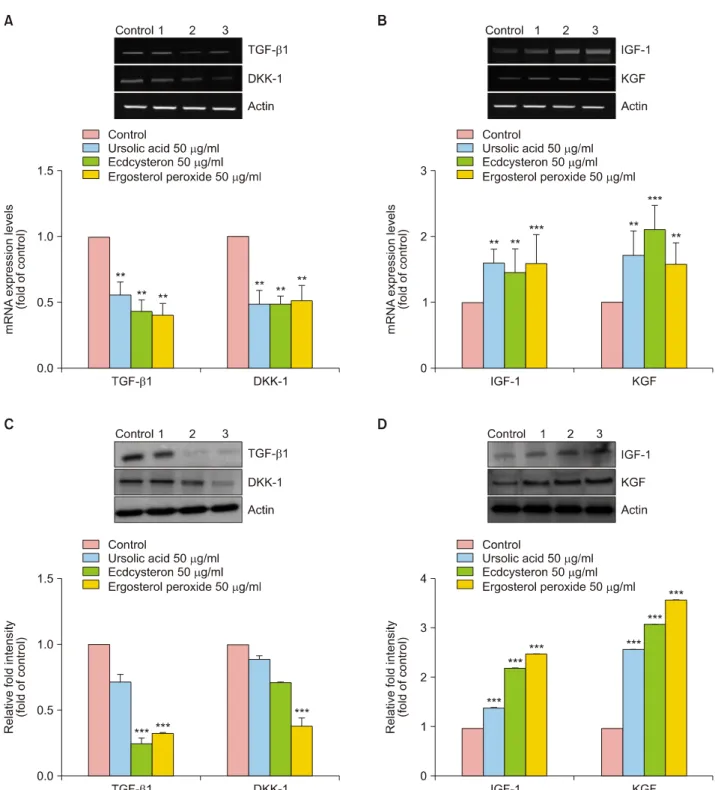
Fig. 7. Effect of ursolic acid, ecdcysteron, and ergosterol peroxide on gene expression in human hair dermal palilla cells. Expression of TGF-β1 and DKK-1 (A and C), IGF-1 and KGF (C and D) mRNA and Protein were estimated by RT-PCR and real-time PCR. Lanes:
1, ursolic acid; 2, ecdcysteron; 3, ergosterol peroxide. Three independent experiments were carried out; **p<0.01 and ***p<0.001 compared with control. TGF-β1: transforming growth factor-beta 1, DKK-1: Dickkopf-1, IGF-1: insulin-like growth factor 1, KGF: keratinocyte growth factor, RT-PCR: reverse transcription-polymerase chain reaction, PCR: polymerase chain reaction.
72 hours was 121.8% and 119.0% higher, respectively, than that of the control group (Fig. 6A). Furthermore, ur- solic acid, ecdcysteron, and ergosterol peroxide also im- proved the proliferation of HHDPCs in time- and dose- de-
pendent manner (Fig. 6B). We also examined the expres- sion of genes responsible for androgen signaling and hair cycle regulation in HHDPCs. As shown in Fig. 7A and C, the gene and protein expression TGF-β1 and DKK-1 were
lower in cells treated with ursolic acid, ecdcysteron, and ergosterol peroxide than in control cells. However, these compounds induced the expression of IGF-1 and KGF, re- sponsible for hair growth, in HDDPCs (Fig. 7B, D).
DISCUSSION
Hair is not only provides protective but also used to ex- press personal beliefs or social position. Therefore, andro- genic alopecia is considered a serious cosmetic problem in modern society. In our preliminary study, we screened 100 plants and found that MF extract showed the most ef- fective 5α-reductase inhibitory activity as confirmed by HPLC (data not shown). Based on this previous result, we explored whether MF extract promotes the growth of HHDPCs and hair regeneration in C57BL/6J mice. In the present study, our findings suggest that MF extract contrib- utes to hair growth-promoting effect and regulated the ex- pression of growth factors and inhibited 5α-reductase activity.
The conversion of testosterone to dihydrotestosterone (DHT) by the enzyme 5α-reductase, and DHT causes hair loss9,17. Therefore, 5α-reductase is considered as one of the most important targets for the development of hair loss drugs. In addition, TGF-β1 and DKK-1 are important dif- fusion factors regulation the interaction between papil- la-epithelium18,19. The expression of the Wnt (wingless- type MMTV integration site family) ligand antagonist DKK-1 has been found to be up-regulated in response to DHT and reported to cause apoptosis in the bald scalp of patients with AGA20,21. On the other hand, hair growth factor has also become one of the targets of hair loos treat- ment22. It is well known that IGF-1 and KGF is fundamental to stimulate the growth of hair follicles in HHDPCs23,24. In the present study, MF extract inhibits 5α-reductase activ- ity as well as downregulates TGF-β1 and DKK-1 gene and protein expression in C57BL/6J mice and stimulated increases in IGF-1 and KGF mRNA and protein levels in HHDPCs.
Based on these observations, MF extract represents a nov- el 5α-reductase inhibitor and has been selected for fur- ther research, including screening of active component. In this study, we identified and isolated active components of MF, such as ursolic acid, ecdcysteron, and ergosterol peroxide, guided by a 5α-reductase inhibition assay using HPLC. Among them, ursolic acid showed an inhibition of 53.2% at 50 μg/ml in accordance with previous results25; it was obtained from fraction 6 of MF extract (hexane frac- tion). Interestingly, the inhibitory activity of ursolic acid was not greater than that of the MF extract and other com- ponents. Thus, synergistic effect, two other major compo-
nents isolated from the MF extract (hexane fraction), which are ecdcysteron and ergosterol peroxide, also showed lower inhibitory activity than that of the MF extract. There- fore, the three compounds have synergistic effects and are ubiquitous phenomena in natural products26. To under- stand their hair growth-promoting effects in HHDPCs, the androgen signaling pathway and key growth factor genes was studied. In in vivo study, we examined the expression of genes responsible for affecting the health of hair fol- licles and their growth in AGA. As shown in Fig. 7, the mRNA and protein expression of TGF-β1 and DKK-1 were decreased by ursolic acid, ecdcysteron, and ergoster- ol peroxide in HHDPCs when compared to control. How- ever, these compounds markedly increased the expression of growth factors, such as IGF-1 and KGF, in HHDPCs.
Therefore, our findings indicate that these bioactive com- pounds may be further studied for the treatment of AGA.
Collectively, our results demonstrated that MF extract has a potent hair growth-promoting effect on C57BL/6J mice, suggests that MF extract and its active compounds may be- come a good candidate for promoting hair growth.
ACKNOWLEDGMENT
This research was funded by the Priority Research Centers Program through the National Research Foundation of Korea (NRF) funded by the Ministry of Education, Science and Technology (NRF-2009-0094071) and the Ministry of Trade, Industry and Energy (MOTIE), and Korea Institute for Advancement of Technology (KIAT) through the center for Efficacy Assessment and Development of Functional Foods and Drugs at Hallym University (B0008864) Korea, and supported by research grants (no. 201602285, 201602334) form Natural Science Foundation of Liaoning Province, and thanks to Soo Kyeong Lee for providing their assistance in performing the experiments.
CONFLICTS OF INTEREST
The authors have nothing to disclose.
ORCID
Bo Huang, https://orcid.org/0000-0002-1613-4885 Bueom-Goo Kang, https://orcid.org/0000-0003-0211-4354 Soon Sung Lim, https://orcid.org/0000-0003-4548-1285 Xian Hua Zhang, https://orcid.org/0000-0001-6732-1704
REFERENCES
1. Kerscher M, Williams S, Dubertret L. Cosmetic dermatology
and skin care. Eur J Dermatol 2007;17:180-182.
2. Paik JH, Yoon JB, Sim WY, Kim BS, Kim NI. The prevalence and types of androgenetic alopecia in Korean men and women. Br J Dermatol 2001;145:95-99.
3. Kang JI, Kim SC, Han SC, Hong HJ, Jeon YJ, Kim B, et al.
Hair-loss preventing effect of Grateloupia elliptica. Biomol Ther (Seoul) 2012;20:118-124.
4. Ellis JA, Sinclair R, Harrap SB. Androgenetic alopecia: patho- genesis and potential for therapy. Expert Rev Mol Med 2002;
4:1-11.
5. Hadshiew IM, Foitzik K, Arck PC, Paus R. Burden of hair loss: stress and the underestimated psychosocial impact of telogen effluvium and androgenetic alopecia. J Invest Der- matol 2004;123:455-457.
6. Burton JL, Marshall A. Hypertrichosis due to minoxidil. Br J Dermatol 1979;101:593-595.
7. Kaufman KD, Olsen EA, Whiting D, Savin R, DeVillez R, Bergfeld W, et al. Finasteride in the treatment of men with androgenetic alopecia. Finasteride Male Pattern Hair Loss Study Group. J Am Acad Dermatol 1998;39:578-589.
8. Shorter K, Farjo NP, Picksley SM, Randall VA. Human hair follicles contain two forms of ATP-sensitive potassium channels, only one of which is sensitive to minoxidil.
FASEB J 2008;22:1725-1736.
9. Murata K, Noguchi K, Kondo M, Onishi M, Watanabe N, Okamura K, et al. Promotion of hair growth by Rosmarinus officinalis leaf extract. Phytother Res 2013;27:212-217.
10. Patel S, Sharma V, Chauhan NS, Thakur M, Dixit VK. Hair growth: focus on herbal therapeutic agent. Curr Drug Discov Technol 2015;12:21-42.
11. Kang JI, Kim SC, Hyun JH, Kang JH, Park DB, Lee YJ, et al.
Promotion effect of Schisandra nigra on the growth of hair.
Eur J Dermatol 2009;19:119-125.
12. Park HJ, Zhang N, Park DK. Topical application of Poly- gonum multiflorum extract induces hair growth of resting hair follicles through upregulating Shh and β-catenin expres- sion in C57BL/6 mice. J Ethnopharmacol 2011;135:369- 375.
13. Rahman MA, Yang H, Lim SS, Huh SO. Apoptotic effects of Melandryum firmum root extracts in human SH-SY5Y neuro- blastoma cells. Exp Neurobiol 2013;22:208-213.
14. Zheng MS, Hwang NK, Kim DH, Moon TC, Son JK, Chang HW. Chemical constituents of Melandrium firmum Rohrbach and their anti-inflammatory activity. Arch Pharm Res 2008;
31:318-322.
15. Matsuda H, Sato N, Yamazaki M, Naruto S, Kubo M. Testos- terone 5alpha-reductase inhibitory active constituents from
Anemarrhenae Rhizoma. Biol Pharm Bull 2001;24:586-587.
16. Müller-Röver S, Handjiski B, van der Veen C, Eichmüller S, Foitzik K, McKay IA, et al. A comprehensive guide for the accurate classification of murine hair follicles in distinct hair cycle stages. J Invest Dermatol 2001;117:3-15.
17. Tan JJY, Pan J, Sun L, Zhang J, Wu C, Kang L. Bioactives in Chinese proprietary medicine modulates 5α-reductase acti- vity and gene expression associated with androgenetic alo- pecia. Front Pharmacol 2017;8:194.
18. Inui S, Fukuzato Y, Nakajima T, Yoshikawa K, Itami S.
Androgen-inducible TGF-beta1 from balding dermal papilla cells inhibits epithelial cell growth: a clue to understand paradoxical effects of androgen on human hair growth.
FASEB J 2002;16:1967-1969.
19. Inui S, Fukuzato Y, Nakajima T, Yoshikawa K, Itami S. Iden- tification of androgen-inducible TGF-beta1 derived from der- mal papilla cells as a key mediator in androgenetic alope- cia. J Investig Dermatol Symp Proc 2003;8:69-71.
20. Kwack MH, Sung YK, Chung EJ, Im SU, Ahn JS, Kim MK, et al. Dihydrotestosterone-inducible dickkopf 1 from balding dermal papilla cells causes apoptosis in follicular keratino- cytes. J Invest Dermatol 2008;128:262-269.
21. Andl T, Reddy ST, Gaddapara T, Millar SE. WNT signals are required for the initiation of hair follicle development. Dev Cell 2002;2:643-653.
22. Zhao J, Harada N, Kurihara H, Nakagata N, Okajima K.
Dietary isoflavone increases insulin-like growth factor-I production, thereby promoting hair growth in mice. J Nutr Biochem 2011;22:227-233.
23. Rajendran RL, Gangadaran P, Bak SS, Oh JM, Kalimuthu S, Lee HW, et al. Extracellular vesicles derived from MSCs activates dermal papilla cell in vitro and promotes hair follicle conversion from telogen to anagen in mice. Sci Rep 2017;7:15560.
24. Werner S, Smola H, Liao X, Longaker MT, Krieg T, Hofschneider PH, et al. The function of KGF in morpho- genesis of epithelium and reepithelialization of wounds.
Science 1994;266:819-822.
25. Jena AK, Vasisht K, Sharma N, Kaur R, Dhingra MS, Karan M. Amelioration of testosterone induced benign prostatic hyperplasia by Prunus species. J Ethnopharmacol 2016;190:
33-45.
26. Christensen KB, Petersen RK, Kristiansen K, Christensen LP.
Identification of bioactive compounds from flowers of black elder (Sambucus nigra L.) that activate the human peroxi- some proliferator-activated receptor (PPAR) gamma. Phytother Res 2010;24 Suppl 2:S129-S132.