• 검색 결과가 없습니다.

Fixation of Traumatic Sternal Fractures Using SternaLock Plating System

N/A
N/A
Protected

Academic year: 2021

Share "Fixation of Traumatic Sternal Fractures Using SternaLock Plating System"

Copied!
3
0
0

로드 중.... (전체 텍스트 보기)

전체 글

(1)

Korean J Thorac Cardiovasc Surg 2013;46:309-311 □ Case Report □ http://dx.doi.org/10.5090/kjtcs.2013.46.4.309 ISSN: 2233-601X (Print) ISSN: 2093-6516 (Online)

− 309 −

Department of Thoracic and Cardiovascular Surgery,

1

Gangneung Asan Hospital,

2

Asan Medical Center, University of Ulsan College of Medicine Received: October 4, 2012, Revised: December 26, 2012, Accepted: December 31, 2012

Corresponding author: Won Chul Cho, Department of Thoracic and Cardiovascular Surgery, Gangneung Asan Hospital, University of Ulsan College of Medicine, 38 Bangdong-gil, Gangneung 210-711, Korea

(Tel) 82-33-610-3267 (Fax) 82-33-641-8070 (E-mail) [email protected]

C

The Korean Society for Thoracic and Cardiovascular Surgery. 2013. All right reserved.

CC
This is an open access article distributed under the terms of the Creative Commons Attribution Non-Commercial License (http://creative- commons.org/licenses/by-nc/3.0) which permits unrestricted non-commercial use, distribution, and reproduction in any medium, provided the original work is properly cited.

Fixation of Traumatic Sternal Fractures Using SternaLock Plating System

Jong Bin Park, M.D.

1

, Han Pil Lee, M.D.

2

, Dong Gon Yoo, M.D.

1

, Jong Wook Kim, M.D.

1

, Won Chul Cho, M.D.

1

A 43-year-old man experienced chest trauma due to a car accident. Compound sternal fractures with severe dis- location were seen on computed tomography of the chest. Using a SternaLock plating system with manual reduc- tion, fixation of the sternal fracture was successfully performed. There were no complications related to the operation.

Key words: 1. Sternum 2. Fracture 3. Fixation

CASE REPORT

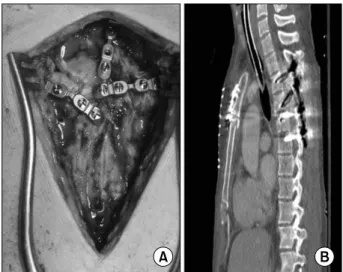
A 43-year-old man, impacted in his chest by a car acci- dent, complained of severe chest pain in his anterior chest wall with palpable sternal instability. Computed tomography (CT) of the chest showed a displaced compound mid-body sternal fracture (Fig. 1). Troubled with fracture of several cer- vical bones accompanied by sternal fracture, he was sched- uled for open sternal fixation 3 days after the trauma because of combined operation with spine surgery. Open reduction and internal fixation of the sternum was performed using the SternaLock system (Biomet Microfixation Inc., Jacksonville, FL, USA).

After a midline longitudinal incision over the sternum, the fracture site was carefully debrided of any fibrous union and old hematoma to expose healthy bone. Before plate fixation, manual reduction of the sternal fracture was assisted by the use of bone reduction forceps placed within the surrounding

intercostal spaces. Three 4-holed straight plates were used vertically and horizontally due to compound sternal fracture (Fig. 2), manually contoured to the underlying sternum, and secured using self-drilling, self-tapping screws. The screw length was 10 mm, which was chosen by the thickness of the sternum (as measured on chest CT) at each point of screw placement. The wound was irrigated and closed. The patient was not discharged because he was receiving rehabilitation treatment for his leg, which had been paralyzed due to the cervical spine trauma. The 3-month follow-up demonstrated normal wound healing with no complaints of symptoms asso- ciated with instability. The repair was palpably stable and non-tender.

DISCUSSION

Sternal fractures are common after severe chest wall

trauma. More than 95% of sternal fractures are treated con-

(2)

Jong Bin Park, et al

− 310 − Fig. 1. (A) The preoperative computed tomography scan shows a displaced compound sternal fracture. (B) Intraoperative picture of a compound sternal fracture.

Fig. 2. (A) After the successful reduction, the sternum was rigidly fixed with three 4-holed SternaLock straight-plates. (B) A post- operative computed tomography scan shows reduction and rigid fixation of the fractured sternum.

servatively, and there are few reports on the late sequelae or evolution of such fractures [1,2].

Surgery is a viable option when severely displaced frac- tures of the sternum entail physical deformity and prolonged pain [2]. The rationale for surgical repair in our case was evident physical deformity associated with a relatively young age, uncontrolled pain, and combined surgery for cervical spine fractures.

Open reduction and stainless steel wiring has been the mainstay of treatment [3]. However, the advantage of this technique is only that it is less expensive than plating. This technique takes advantage of the non-rigid nature of the wires, and the potential for wire pull-through can result in secondary sternal fractures or sternal nonunion [3]. Moreover, this technique is barely suitable for compound sternal frac- tures, which are not stabilized by the non-rigid wire. More rigid fixation using a plate and screw system minimizes these risks [4]. In our case, the patient had a compound sternal fracture (Fig. 1). Sternal plating systems, such as the Sterna- Lock system we used, incorporate a thinner cuttable section that spans the fracture line and can be easily divided using common wire cutters [5].

In contrast with other plating systems, the strongest point of SternaLock uses self-drilling and self-tapping screws, elim- inating the need for drilling and reducing the chance of in-

jury to mediastinal structures [5]. Therefore, SternaLock may enable more secure reductions.

In summary, we report the successful treatment of trau- matic compound sternal fracture with open reduction and rig- id internal fixation using the SternaLock plating system. We think this system is easier to use and safer than others.

CONFLICT OF INTEREST

No potential conflict of interest relevant to this article was reported.

REFERENCES

1. Porter RS, Zhao N. Patterns of injury in belted and unbelted individuals presenting to a trauma center after motor vehicle crash: seat belt syndrome revisited. Ann Emerg Med 1998;

32:418-24.

2. De Oliveira M, Hassan TB, Sebewufu R, Finlay D, Quinton DN. Long-term morbidity in patients suffering a sternal frac- ture following discharge from the A and E department.

Injury 1998;29:609-12.

3. Hendrickson SC, Koger KE, Morea CJ, Aponte RL, Smith PK, Levin LS. Sternal plating for the treatment of sternal nonunion. Ann Thorac Surg 1996;62:512-8.

4. Chou SS, Sena MJ, Wong MS. Use of SternaLock plating

(3)

SternaLock Plating System

− 311 − system in acute treatment of unstable traumatic sternal fractures. Ann Thorac Surg 2011;91:597-9.

5. Wu LC, Renucci JD, Song DH. Sternal nonunion: a review

of current treatments and a new method of rigid fixation.

Ann Plast Surg 2005;54:55-8.

수치

Fig. 2. (A) After the successful reduction, the sternum was rigidly  fixed with three 4-holed SternaLock straight-plates

참조

관련 문서

A laboratory experiment was performed to investigate the removal of nitrogen and phosphorus from plating factory effluent using the soil column.. Soil,

Purpose: Calcaneal fracture is a rare fracture, which accounts for about 2% of all fractures, but is one of the most common fractures in the ankle bone.. There is

High complication rate in locking plate fixation of lower periprosthetic distal femur fractures in patients with total knee arthroplasties.. Management and

Also, the quasi-infraversion is larger for the inferior safe insertion limit direction (Fig. In practical design of a screw guiding device, targeted safe angles can

ƒ Reduction (환원) : reduction of metal oxides using gases such as.. ƒ Reduction (환원) : reduction of metal oxides using gases such as hydrogen

3,4 Therefore, to date, studies have been conducted to examine the absorbable fixation plate manufactured using polymer and a fixation screw that can

Conclusion: In Neer type II distal clavicle fracture treatment, both groups showed satisfactory result in clinical and radiological outcomes, but the hook plate

Purpose: To evaluate the radiographic and clinical results of patellar comminuted fractures using modified tension band wiring. Materials and Methods: Thirty