• 검색 결과가 없습니다.

Factors Influencing the Duration of Occlusal Appliance Treatment for Patients with Temporomandibular Joint Internal Derangement JOMP

N/A
N/A
Protected

Academic year: 2021

Share "Factors Influencing the Duration of Occlusal Appliance Treatment for Patients with Temporomandibular Joint Internal Derangement JOMP"

Copied!
8
0
0

로드 중.... (전체 텍스트 보기)

전체 글

(1)

pISSN 2288-9272 eISSN 2383-8493 J Oral Med Pain 2016;41(3):110-117 http://dx.doi.org/10.14476/jomp.2016.41.3.110

Factors Influencing the Duration of Occlusal Appliance Treatment for Patients with Temporomandibular Joint Internal Derangement

So-Youn Lee, Jin-Seok Byun, Jae-Kwang Jung, Jae-Kap Choi

Department of Oral Medicine, School of Dentistry, Kyungpook National University, Daegu, Korea

Received August 19, 2016 Revised September 12, 2016 Accepted September 12, 2016

Purpose: The purpose of this study is to determine factors influencing the duration of occlusal appliance (OA) treatment for patients with temporomandibular joint (TMJ) internal derange- ment.

Methods: Ninety patients were included for this study, who satisfied the following including criteria: (i) those who were diagnosed as disc displacement of TMJ by taking magnetic reso- nance imaging (MRI) and (ii) those who were finished OA treatment. The subjects were clas- sified into three groups according to the period of OA treatment: (i) early response group (<6 months), (ii) moderate response group (6 months-1 year), and (iii) delayed response group (>1 year). Demographic data, data from chief complaints and past history of temporomandibular disorder, data from clinical examination and diagnostic imaging including panoramic view and TMJ MRI were compared among groups. One-way ANOVA and chi-square analysis were used to test statistical significance.

Results: There were no significant differences in demographic data, data from chief complaints and TMJ imaging. However, only the prevalence of oral parafunctional habits including brux- ism, clenching, and unilateral chewing showed significant differences among groups.

Conclusions: Oral parafunctional habits could be factors to influence the duration of OA treat- ment in the patients with TMJ internal derangement.

Key Words: Conservative treatment; Occlusal appliance; Oral parafunction; Temporomandibu- lar joint internal derangement

Correspondence to:

Jae-Kap Choi

Department of Oral Medicine, School of Dentistry, Kyungpook National University, 2177 Dalgubeol-daero, Jung-gu, Daegu 41940, Korea Tel: +82-53-600-7321 Fax: +82-53-426-2195 E-mail: [email protected]

JOMP

Journal of Oral Medicine and Pain

Copyright Ⓒ 2016 Korean Academy of Orofacial Pain and Oral Medicine. All rights reserved.

CC This is an open-access article distributed under the terms of the Creative Commons Attribution Non-Commercial License (http://creativecommons.org/licenses/by-nc/4.0/),

INTRODUCTION

Temporomandibular joint internal derangement (TMJID) describes an abnormal positional relationship of the articu- lar disc to the mandibular condyle and the articular emi- nence. The disorder has been associated with characteristic clinical findings such as pain, joint sounds, and irregular or deviating jaw function.

It is generally accepted concept that temporomandibu- lar disorder (TMD) is self-limiting and the natural course of disc displacement of the TMJ is relatively favorable and the management goals for TMJID are similar to those of other orthopedic conditions, namely, reduction of pain and

adverse loading, improvement of function, and restoration of normal, daily activities. Several studies of conservatively treated patients showed that a series of fairly predictable adaptations were likely to occur in the majority of TMJID.

1)

The emphasis should be on conservative treatment that fa- cilitates the musculoskeletal system’s natural healing ca- pacity and treatment that involves the patient in the physi- cal and behavioral management of their own problem. A multidisciplinary model that includes patient education and self-care, cognitive behavioral intervention, pharmacother- apy, physical therapy, and orthopedic appliance treatment is endorsed for the management of nearly all TMD patients.

2)

Among several noninvasive and reversible treatments,

(2)

occlusal appliance (OA) has been predominantly recom- mended for the TMD treatment.

3)

The use of OA relieves the amount of load placed on the condyle and protects the TMJ and articular disc from degeneration as well as the exces- sive tension placed on the joint.

4)

In the research of Fricton et al.,

3)

it has been supported that a group treated with OA shows the highest efficacy compared to the groups either treated with non-occluding appliance or with no OA in pa- tients with TMJ pain. Since the principles of mechanism and the efficiency of OAs have been proven in many re- searches, OAs are widely used as an initial and long-term treatment for TMD with pain.

Because clinical characteristics and other considerable contributing factors vary among patients, it is difficult to predict the outcome of conservative treatment, specifically OA treatment for TMD. There have been many studies on the comparisons on influential factors and predictive factors for the treatment outcome of TMD.

5)

According to Ekberg and Nilner,

6)

male patients showed more positive influence and severe pain at the initial visit showed more negative impact on the treatment outcome. Emshoff

7)

had proposed the onset of pain is the most important factor determining the prognosis of OA treatment. In addition, Grossi et al.

8)

concluded that neuropsychological and psychosocial prob- lems yield poor treatment outcome. As mentioned above, several studies have been suggested that the treatment out- come may be affected by various factors, such as demo- graphic factor, pain history, clinical findings and psycho- logical problems.

Most patients wonder about the period of treatment and the frequency of their visits to dental clinics to conserva- tively treat and alleviate their TMJ problems at their first visit to the clinic. Yet, because it is difficult to propose the exact period of treatment to the patients according to their varying symptoms, some patients quit receiving the treat- ment when the period of the treatment is prolonged than they expected. Moreover, 10% of TMD patients show no sign of improvement despite their efforts and time spent.

Surprisingly, this group of patients account for more than 40% of the expenses for the entire TMD patients.

5)

Therefore, it is important for the clinicians to be able to dis- tinguish patients who would respond to certain treatment and who would not, so that the optimal treatment option

can be selected according to their varying symptoms to an- ticipate the best treatment results. However, there has been no attempt to predict the duration of the treatment based on patients’ predisposing factors by dividing the patients into groups of different treatment termination period and analyzing clinical characteristics of each group. Moreover, although the duration of treatment with OAs to relieve symptoms can be generally expected with clinical experi- ences, it is difficult to accurately estimate how the period of treatment would change depending on each symptom.

We expect that patients would show improved patient’s compliance without mid-treatment withdrawal if the treat- ment period of conservative treatment, specifically OA treatment, were predicted based on the information ac- quired at the patient’s initial visit. The purpose of this study was to classify the patients with TMJID, who had received conservative treatments including OAs, into three groups of different response rates and to analyze various clinical fac- tors observed at the initial visit of each group in order to predict the patient’s treatment period with the factors.

MATERIALS AND METHODS

1. Subjects and Data Collection

Subjects in this study were selected from patients who visited the Department of Oral Medicine at Kyungpook National University Hospital (Daegu, Korea) with disc dis- placement in TMJ from January 2011 to March 2014. Ninety patients were included for this study, who satisfied the fol- lowing including criteria: (i) those who were diagnosed as disc displacement of TMJ by taking magnetic resonance im- aging (MRI) and (ii) those who were finished OA treatment.

No subject had undergone invasive and surgical treatment.

The subjects were classified into three groups according to the period of OA treatment: (i) early response group (<6 months), (ii) moderate response group (6 months-1 year), and (iii) delayed response group (>1 year).

The criteria of the end of treatment were as follows:

1) The pain or discomfort during TMJ movement or func- tion is completely alleviated.

2) The normal activities of mandible are allowed.

3) Active range of motion (AROM) is greater than 38 mm.

4) No progressive sign of TMJ degenerative change.

(3)

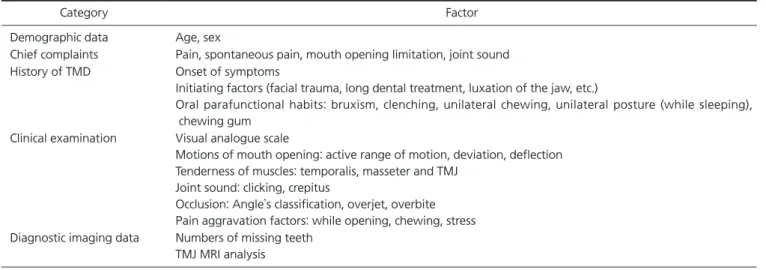
The data were recorded when patients visited the Depart- ment of Oral Medicine at Kyungpook National University Hospital for the first time. The data were based on modi- fied Research Diagnostic Criteria for Temporomandibular Disorders (RDC/TMD). Demographic data, data from chief complaints and past history of TMD, data from clinical ex- amination and diagnostic imaging including panoramic view and TMJ MRI were collected and compared among groups. Bruxism was exceptionally assessed by patient’s questionnaire and wear facets of the OA (Table 1). The study protocol was approved by the Institutional Review Board of Kyungpook National University Hospital (KNUH 2015-11-025-001).

2. Statistical Analysis

The one-way ANOVA and the chi-square analysis were used to test differences between the early response group, the moderate response group and the delayed response

group. The one-way ANOVA test was performed to compare the differences in age, onset of symptoms, visual analogue scale (VAS), AROM, overjet and overbite and the numbers of missing teeth between the three groups. The Pearson chi- square test was used to analyze the differences in extra fac- tors between the three groups. A difference of p<0.05 was considered statistically significant. Statistical evaluation of the data was performed using the IBM SPSS Statistics ver.

22.0 for Windows (IBM Co., Armonk, NY, USA), including the one-way ANOVA test and the Pearson chi-square test.

RESULTS

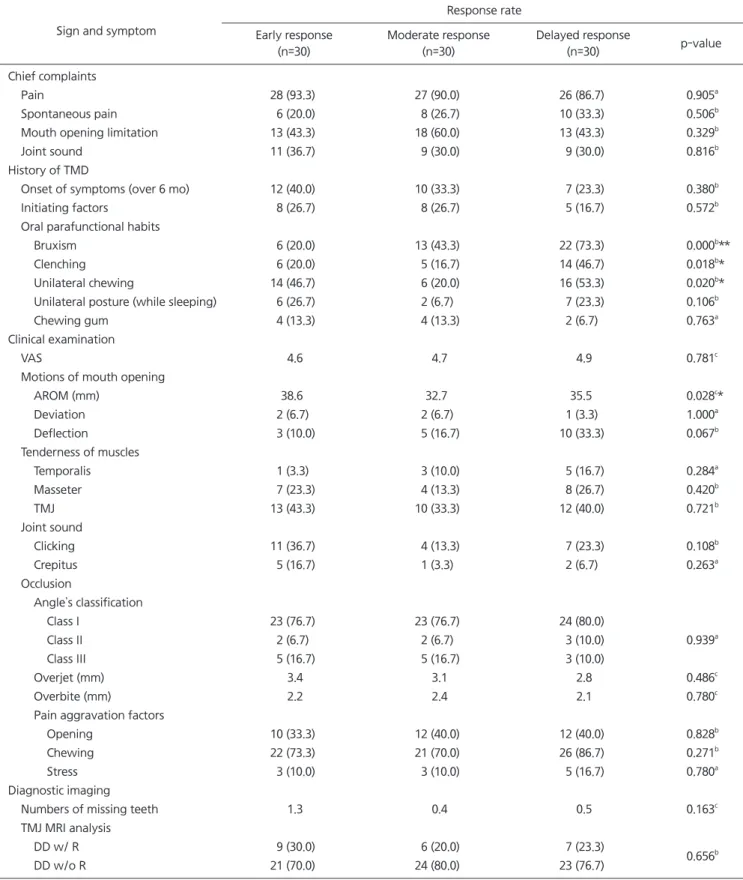
There were no significant differences in demograph- ic data, data from chief complaints and TMJ imaging.

However, only the prevalence of oral parafunctional hab- its including bruxism, clenching, and unilateral chewing showed significant differences among groups (Tables 2, 3).

Table 1. Summary of factors collected of patient’ s initial visit

Category Factor

Demographic data Age, sex

Chief complaints Pain, spontaneous pain, mouth opening limitation, joint sound

History of TMD Onset of symptoms

Initiating factors (facial trauma, long dental treatment, luxation of the jaw, etc.)

Oral parafunctional habits: bruxism, clenching, unilateral chewing, unilateral posture (while sleeping), chewing gum

Clinical examination Visual analogue scale

Motions of mouth opening: active range of motion, deviation, deflection Tenderness of muscles: temporalis, masseter and TMJ

Joint sound: clicking, crepitus

Occlusion: Angle’ s classification, overjet, overbite Pain aggravation factors: while opening, chewing, stress Diagnostic imaging data Numbers of missing teeth

TMJ MRI analysis

TMD, temporomandibular disorder; TMJ, temporomandibular joint; MRI, magnetic resonance imaging.

Table 2. Comparison of demographic data (n=90)

Demographic data Response rate

Early response Moderate response Delayed response p-value

Number of patients 30 (33.3) 30 (33.3) 30 (33.3)

Female 25 (83.3) 23 (76.7) 22 (73.3)

0.638

a

Male 5 (16.7) 7 (23.3) 8 (26.7)

Mean age (y) 31.8 31.3 32.5 0.953

b

Values are presented as number (%) or number only.

a

Chi-square.

b

One-way ANOVA.

(4)

Table 3. Comparison of signs and symptoms

Sign and symptom

Response rate Early response

(n=30)

Moderate response (n=30)

Delayed response

(n=30) p-value

Chief complaints

Pain 28 (93.3) 27 (90.0) 26 (86.7) 0.905

a

Spontaneous pain 6 (20.0) 8 (26.7) 10 (33.3) 0.506

b

Mouth opening limitation 13 (43.3) 18 (60.0) 13 (43.3) 0.329

b

Joint sound 11 (36.7) 9 (30.0) 9 (30.0) 0.816

b

History of TMD

Onset of symptoms (over 6 mo) 12 (40.0) 10 (33.3) 7 (23.3) 0.380

b

Initiating factors 8 (26.7) 8 (26.7) 5 (16.7) 0.572

b

Oral parafunctional habits

Bruxism 6 (20.0) 13 (43.3) 22 (73.3) 0.000

b

**

Clenching 6 (20.0) 5 (16.7) 14 (46.7) 0.018

b

*

Unilateral chewing 14 (46.7) 6 (20.0) 16 (53.3) 0.020

b

*

Unilateral posture (while sleeping) 6 (26.7) 2 (6.7) 7 (23.3) 0.106

b

Chewing gum 4 (13.3) 4 (13.3) 2 (6.7) 0.763

a

Clinical examination

VAS 4.6 4.7 4.9 0.781

c

Motions of mouth opening

AROM (mm) 38.6 32.7 35.5 0.028

c

*

Deviation 2 (6.7) 2 (6.7) 1 (3.3) 1.000

a

Deflection 3 (10.0) 5 (16.7) 10 (33.3) 0.067

b

Tenderness of muscles

Temporalis 1 (3.3) 3 (10.0) 5 (16.7) 0.284

a

Masseter 7 (23.3) 4 (13.3) 8 (26.7) 0.420

b

TMJ 13 (43.3) 10 (33.3) 12 (40.0) 0.721

b

Joint sound

Clicking 11 (36.7) 4 (13.3) 7 (23.3) 0.108

b

Crepitus 5 (16.7) 1 (3.3) 2 (6.7) 0.263

a

Occlusion

Angle’ s classification

Class I 23 (76.7) 23 (76.7) 24 (80.0)

0.939

a

Class II 2 (6.7) 2 (6.7) 3 (10.0)

Class III 5 (16.7) 5 (16.7) 3 (10.0)

Overjet (mm) 3.4 3.1 2.8 0.486

c

Overbite (mm) 2.2 2.4 2.1 0.780

c

Pain aggravation factors

Opening 10 (33.3) 12 (40.0) 12 (40.0) 0.828

b

Chewing 22 (73.3) 21 (70.0) 26 (86.7) 0.271

b

Stress 3 (10.0) 3 (10.0) 5 (16.7) 0.780

a

Diagnostic imaging

Numbers of missing teeth 1.3 0.4 0.5 0.163

c

TMJ MRI analysis

DD w/ R 9 (30.0) 6 (20.0) 7 (23.3)

0.656

b

DD w/o R 21 (70.0) 24 (80.0) 23 (76.7)

TMD, temporomandibular disorder; VAS, visual analogue scale; AROM, active range of motion; TMJ, temporomandibular joint; MRI, magnetic resonance imaging; DD w/ R, disc displacement with reduction; DD w/o R, disc displacement without reduction.

Values are presented as number (%) or mean number only.

a
Fisher exact.

b

Chi-square.

c

One-way ANOVA.

*p<0.05. **p<0.001.

(5)

1. Demographic Data

Of the total 90 patients, 70 was females and 20 was male.

There was no gender difference in the patient of all three groups. There were no statistically significant differences in age of patient between group means as determined by one- way ANOVA (F(2,87)=0.048, p=0.953) even though the old- est was in delayed response group and the youngest was in early response group.

2. Chief Complaints

1) Pain and spontaneous pain

Pain was observed the highest in early response group as 93.3% and the lowest in delayed response as 86.7%. There was no significant difference in all groups. In spontaneous pain, the highest in delayed group was observed without a significant difference.

2) Mouth opening limitation and joint sound

There was no significant difference between mouth open- ing limitation and joint sound, while being the highest in early response group.

3. History of TMD

1) Onset of symptoms (over 6 months)

There was no significant difference in onsets of TMD be- tween each group, although it gradually increased from de- layed response group to early response group.

2) Initiating factors

There was no significant difference in initiating factors between each group, despite the lowest was in delayed re- sponse group.

3) Oral parafunctional habits

Bruxism and clenching in delayed response group were significantly higher than those in the other groups. There was significant difference in unilateral chewing between in all three groups. There was no significant difference in uni- lateral posture (while sleeping) and chewing gum between each group.

4. Clinical Examination 1) VAS

The average of VAS was 4.7 and there were no statistical- ly significant differences in VAS between group means as determined by one-way ANOVA (F(2,87)=0.248, p=0.781).

2) Motions of mouth opening

AROM in moderate response group was significantly lower than AROM in early response group. There was sta- tistically significant difference in AROM between groups as determined by one-way ANOVA (F(2,87)=3.741, p=0.028).

Post hoc comparisons using the Tukey honestly significant differences (HSD) test indicated the the mean score of the moderate response group (32.73±8.60) was significantly dif- ferent than the early response group (38.63±7.94). However, the delayed response group (35.47±8.53) did not signifi- cantly differ from the moderate and early response groups.

While there was no significant difference in deviation and deflection between each group, deflection was most frequently observed in delayed response group.

3) Tenderness of muscles

Despite the response rate depending on tenderness of masseter muscle and temporalis muscle scored the highest in delayed response group, there was no significant differ- ence between all groups.

4) Joint sound

Clicking and crepitus scored the highest in early response group, but there was no significant difference between the groups.

5) Occlusion

(1) Angle’s classification

Class I was observed most frequently than the other clas- sifications in all response groups, but there was no signifi- cant difference between the groups.

(2) Overjet and overbite

There was no statistically significant differences in over-

jet and overbite between group means as determined by

one-way ANOVA (overjet, F(2,87)=0.727, p=0.486; overbite,

F(2,87)=0.249, p=0.780).

(6)

6) Pain aggravation factors

Stress was scored the highest that aggravates pain in de- layed response group, but there was no significant differ- ence between the groups. There was no significant differ- ence in opening and chewing between the groups.

5. Diagnostic Imaging

1) Numbers of missing teeth

There was no statistically significant differences in num- bers of missing teeth between group means as determined by one-way ANOVA (F(2,87)=1.850, p=0.163).

2) TMJ MRI analysis

Although disc displacement without reduction (DD w/o R) constituted higher than disc displacement with reduction (DD w/ R) in every group, there was no significant differ- ence in DD w/ R and DD w/o R.

DISCUSSION

TMJID is the most common form of temporomandibular disorders, which shows clinical symptoms and signs such as pain, joint sounds, and irregular or deviating jaw func- tion. TMJID appears when the positional relationship of the articular disc to the mandibular condyle change. The primary treatment of TMJID, including conservative and non-surgical treatments, should be emphasized on the re- duction of pain and the improvement of mouth opening.

9)

Conservative treatment involves patient education, phar- macotherapy, physical therapy, and OA treatment. OA al- lows TMJ to be replaced in the most orthopedically stable position and establishes optimal occlusal condition that re- structures myoneural reflex, which consequently reinforces normal myofunction and diminishes abnormal muscular activities.

10)

In several studies regarding the effectiveness of treatment with OAs in TMJID patients, it has been sug- gested that the treatment outcome may or may not be in- fluenced by numerous factors, such as demographic factor, pain history, clinical findings and psychological problems.

Our results showed that there were no significant differ- ences in demographic data, data from chief complaints and diagnostic imaging. However, only the prevalence of oral parafunctional habits including bruxism, clenching, and

unilateral chewing showed significant difference among groups. Before conducting the study, it was predicted that the more severe the initial symptoms presented, the more delayed response rate for the treatment would be. However, there was no significant difference between most of the initial symptoms and treatment response rate. In previous study, Emshoff

7)

reported that the time since pain onset is a critical factor determining the prognosis of OA treatment.

Additionally, it was supported that the patients with chronic pain lasting longer than 6 months were much more difficult to treat because they often accompany muscle disorders.

11)

Furthermore, pain severity, considered as a negative factor affecting the treatment of TMD, is suggested as a significant factor predicting the treatment outcome.

6,7)

According to Clark et al.,

12)

the treatment responses to physical medicine and OA were much lower when the degree of jaw func- tion interference was more severe. Although several studies mentioned above revealed that the onset of symptom, pain severity, and jaw function limitation are important factors in determining therapeutic outcome, in this study, it was difficult to find a significant difference between the groups in most of the initial symptoms.

The reasons for dissimilarity between the results of our

study and the anticipated results or the results of previ-

ously investigated studies may be contributed to the multi-

dimensional nature of the etiologies of TMD, patients’ psy-

chological factors that could not be included in the study,

differences in patients’ compliance to the treatment, the

limitation of retrospective study of failing to rule out the

influence of other conservative treatments, and the differ-

ences between the clinicians in regard to the termination

of the treatments. Since the etiology of TMD is multidi-

mensional, various factors, including biomechanical, neu-

romuscular, biopsychosocial, and neurobiological factors,

may affect the disorder as predisposing, initiating and ag-

gravating factors.

2,13)

Furthermore, it is suggested that when

a patient accumulates various factors, even if each of these

factors is not particularly intense, the effect of all these fac-

tors together may exceed the threshold to induce pain.

14)

In

the same context, it can be understood from our study that

because various factors influence one another and accumu-

lation of these factors cause TMD symptoms, it is difficult

to simply distinguish the clinical factors at the initial visit

(7)

as positive or negative factors by means of their intensities and existence.

Psychological factor in TMJID patients was not consid- ered in the present study. In the research of Grossi et al.,

8)

neuropsychologic and psychosocial assessments of TMD patients showed none or low level of response to treatments when the patients were predisposed to greater memory defi- cits, sleep disturbances, depression, fatigue and lower ener- gy levels. Moreover, it was reported that distinguishing the responders and non-responders with maximum inter-incisal opening and muscle tenderness were difficult to measure.

8)

Further, Gale and Funch

15)

demonstrated that psychosocial factors are more important factor than clinical and demo- graphic factors in predicting the treatment efficiency. As responses to treatments that are affected by psychosocial factors, health locus and patients’ compliance to treatments also influence the treatment outcomes. Wig et al.

16)

sug- gested that if a patient had a greater pain and limited TMJ movement at the initial visit, the level of compliance of the patient becomes higher. Likewise, more severe symptoms of a patient motivate oneself to carry out the treatment rec- ommendations more thoroughly to relieve the symptoms.

16)

Thus, it may be assumed that the reason for the result of this study not showing slow response rate to the treatment depending on the severity of initial symptoms is that sam- ples with fair patients’ compliance are unaffected by the se- verity of the symptoms and show rapid response rate to the treatment.

Bruxism is a common oral parafunctional habit activity that includes grinding or clenching of the teeth. It has been universally accepted that bruxism is responsible for particu- lar facial pain and discomfort of the mandible.

17)

According to Magnusson et al.,

18)

there is a significant correlation be- tween bruxism and TMD symptoms and it may be used as a predicting factor for TMD treatment. Manfredini and Lobbezoo

19)

reported that although bruxism has been re- garded as a risk factor for masticatory muscle disorder, it is uncertain whether bruxism is a potential cause of either excessive load on the joint or muscle damage. The research of Pergamalian et al.

17)

also showed that there is an inverse correlation between bruxism and TMJ with pain. Yet, be- cause the research of Pergamalian et al.

17)

relies only on patients’ self-reports, unconscious bruxism may have been

neglected. Considering many subjects are unaware of their oral parafunctional habits, actual frequency of the bruxism may have been higher.

10)

Wear facets of the OA as well as patient’s questionnaires were evaluated in our study because many patients are unaware of their bruxism. Moreover, un- like other factors, which were evaluated only with the re- cords at the initial visits, bruxism was also evaluated with records extended to follow-up visits in this report.

It can be inferred that there is a significant relationship between bruxism and treatment response because consid- erably many patients in delayed response group showed bruxism. The reason for a remarkably significant relation- ship between bruxism and TMD symptoms compared to other previous researches is that the patients with nocturnal bruxism shows higher psychological demand for using the appliance in spite of the alleviation from pain and the re- covery of TMJ function. Moreover, due to the continued use of OAs even after eliminating the symptoms for protection of the joint structure and function, the patients with brux- ism may have been included in delayed response group.

Even if the association between bruxism and TMD re- mains unclear, this result could explain that bruxism may be a negative factor for the recovery of TMJ function. It may also be understood that clenching and unilateral chew- ing, as oral parafunctional habits that apply excessive loads to the joint, act as factors hindering the process of adapta- tion of the joint. According to Glaros et al.,

20)

oral parafunc- tional habits, which cause an increase to muscle pain, is a strong predictor of the jaw pain in TMD patients.

In conclusion, persistent oral parafunctional habits could influence the duration of OA treatment in the patients with TMJ internal derangement. Because the treatment response rate was turned out to be significantly related to the pres- ence of bruxism, clenching and unilateral chewing. This implies that continuous patient education and the clini- cian’s effort to increase patient’s compliance to control the oral parafunctional habits should be given to the patients for better treatment outcome.

CONFLICT OF INTEREST

No potential conflict of interest relevant to this article

was reported.

(8)

REFERENCES

1. de Bont LG, Dijkgraaf LC, Stegenga B. Epidemiology and natural progression of articular temporomandibular disorders. Oral Surg Oral Med Oral Pathol Oral Radiol Endod 1997;83:72-76.

2. McNeill C. Evidence-based TMD guidelines. J Orofac Pain 1997;11:93.

3. Fricton J, Look JO, Wright E, et al. Systematic review and meta- analysis of randomized controlled trials evaluating intraoral orthopedic appliances for temporomandibular disorders. J Orofac Pain 2010;24:237-254.

4. Liu F, Steinkeler A. Epidemiology, diagnosis, and treatment of temporomandibular disorders. Dent Clin North Am 2013;57:465- 479.

5. Anastassaki A, Magnusson T. Patients referred to a specialist clin- ic because of suspected temporomandibular disorders: a survey of 3194 patients in respect of diagnoses, treatments, and treatment outcome. Acta Odontol Scand 2004;62:183-192.

6. Ekberg E, Nilner M. The influence of stabilisation appliance ther- apy and other factors on the treatment outcome in patients with temporomandibular disorders of arthrogeneous origin. Swed Dent J 1999;23:39-47.

7. Emshoff R. Clinical factors affecting the outcome of occlusal splint therapy of temporomandibular joint disorders. J Oral Reha- bil 2006;33:393-401.

8. Grossi ML, Goldberg MB, Locker D, Tenenbaum HC. Reduced neuropsychologic measures as predictors of treatment outcome in patients with temporomandibular disorders. J Orofac Pain 2001;15:329-339.

9. Naeije M, Te Veldhuis AH, Te Veldhuis EC, Visscher CM, Lob- bezoo F. Disc displacement within the human temporomandibular joint: a systematic review of a ‘noisy annoyance’. J Oral Rehabil 2013;40:139-158.

10. Okeson JP. Management of temporomandibular disorders and oc- clusion. 7th ed. St. Louis: Mosby; 2012. pp. 375-398, 102-128.

11. Emshoff R, Rudisch A. Likelihood ratio methodology to identify

predictors of treatment outcome in temporomandibular joint arthralgia patients. Oral Surg Oral Med Oral Pathol Oral Radiol Endod 2008;106:525-533.

12. Clark GT, Baba K, McCreary CP. Predicting the outcome of a physical medicine treatment for temporomandibular disorder pa- tients. J Orofac Pain 2009;23:221-229.

13. Suvinen TI, Reade PC, Hanes KR, Könönen M, Kemppainen P.

Temporomandibular disorder subtypes according to self-reported physical and psychosocial variables in female patients: a re- evaluation. J Oral Rehabil 2005;32:166-173.

14. Kino K, Sugisaki M, Haketa T, et al. The comparison between pains, difficulties in function, and associating factors of patients in subtypes of temporomandibular disorders. J Oral Rehabil 2005;32:315-325.

15. Gale EN, Funch DP. Factors associated with successful outcome from behavioral therapy for chronic temporomandibular joint (TMJ) pain. J Psychosom Res 1984;28:441-448.

16. Wig AD, Aaron LA, Turner JA, Huggins KH, Truelove E. Short- term clinical outcomes and patient compliance with temporo- mandibular disorder treatment recommendations. J Orofac Pain 2004;18:203-213.

17. Pergamalian A, Rudy TE, Zaki HS, Greco CM. The association be- tween wear facets, bruxism, and severity of facial pain in patients with temporomandibular disorders. J Prosthet Dent 2003;90:194- 200.

18. Magnusson T, Egermarki I, Carlsson GE. A prospective investiga- tion over two decades on signs and symptoms of temporoman- dibular disorders and associated variables. A final summary. Acta Odontol Scand 2005;63:99-109.

19. Manfredini D, Lobbezoo F. Relationship between bruxism and temporomandibular disorders: a systematic review of literature from 1998 to 2008. Oral Surg Oral Med Oral Pathol Oral Radiol Endod 2010;109:e26-e50.

20. Glaros AG, Williams K, Lausten L. The role of parafunctions,

emotions and stress in predicting facial pain. J Am Dent Assoc

2005;136:451-458.

수치

Table 1. Summary of factors collected of patient’ s initial visit
Table 3. Comparison of signs and symptoms

참조

관련 문서

Inclusion and Inclusiveness: Shared Vision of Youth for Local, National, and Global Village Inclusion at large stands for embracing populations with disabilities and

웹 표준을 지원하는 플랫폼에서 큰 수정없이 실행 가능함 패키징을 통해 다양한 기기를 위한 앱을 작성할 수 있음 네이티브 앱과

It is impossible to change the voltage across a capacitor by a finite amount in zero time, for this requires an infinite current through the capacitor.. (A capacitor resists

The key issue is whether HTS can be defined as the 6th generation of violent extremism. That is, whether it will first safely settle as a locally embedded group

A frame size error in a frame that could alter the state of the entire connection MUST be treated as a connection error (Section 5.4.1); this includes any frame carrying a

1 John Owen, Justification by Faith Alone, in The Works of John Owen, ed. John Bolt, trans. Scott Clark, &#34;Do This and Live: Christ's Active Obedience as the

The purpose of this descriptive correlational study was to identify the factors affecting sleeping patterns among hospitalized elderly patients.. The findings

The Mann-whitney U test was used to compare and analyze the salivary cortisol concentration according to the duration of symptoms in the temporomandibular disorder patient group