pISSN 2765-7833 eISSN 2765-7841
Journal of implantology and applied sciences 2021; 25(2): 95-103
https://doi.org/10.32542/implantology.2021010
Received: May 15, 2021
Revised: June 6, 2021
Accepted: June 10, 2021
ORCID
Yuseung Yi
https://orcid.org/0000-0001-9116-2328 Copyright © 2021. The Korean Academy of Oral &
Maxillofacial Implantology
This is an Open Access article distributed under the terms of the Creative Commons Attribution Non-Commercial License (http://creativecommons.
org/licenses/by-nc/4.0/) which permits unrestricted non-commercial use, distribution, and reproduction in any medium, provided the original work is properly cited.
OPEN ACCESS
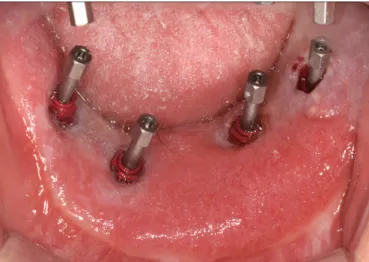
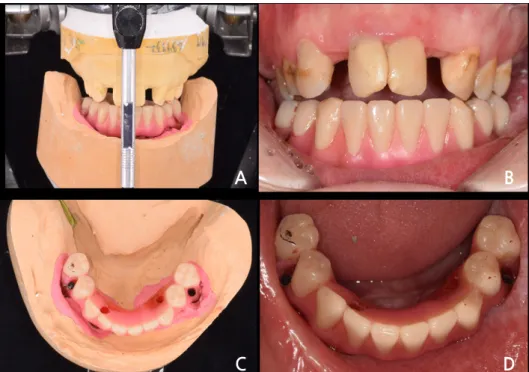
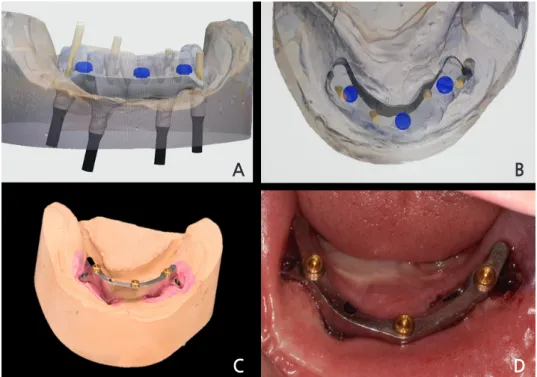
This clinical report describes the oral rehabilitation of a patient who underwent total mandibulectomy and subsequent fibular free flap reconstruction. The patient had adverse soft tissue conditions for a tissue-borne prosthesis and placement of a sufficient number of implants to support a fixed prosthesis was not possible. Therefore, a titanium milled bar supported by four implants was fabricated, and a fabricated overdenture was placed on the milled bar without overlying soft tissue using CAD-CAM technology. A series of treatment procedures for the patient and their follow-up has been presented in this report.
Keywords: CAD-CAM, Fibular free flap, Implant restoration, Milled bar, Total mandibulectomy
Ⅰ. Introduction
The primary treatment goal for patients who undergo mandibular resection has been to restore esthetic, phonetic, and masticatory functions through prosthetic dental rehabilitation, where adequate jaw reconstruction should be supported.
1 The micro-vascularized fibular free flap (FFF) has been considered the gold standard for maxillary or mandibular-based reconstruction.
2, 3 The FFF has many advantages, including harvesting of adequate quality and quantity of the grafted bone with soft tissue, which is ideal for anastomoses, and can easily be arranged to follow the shape of the mandible.
4 FFF is reliable for long-span mandibular reconstruction,
4 where the quality of life in patients could be further improved through implant-supported prostheses.
5 It also offers sufficient bone volume and quality to allow osseointegration of the implants, consequently restoring esthetic and masticatory function.
6
Implant-supported dental prostheses may be the best treatment option for patients who
Abstract
* Corresponding author: Yuseung Yi, Department of prosthodontics, Seoul National University Dental Hospital, School of Dentistry, Seoul National University, 101 Daehak-ro, Jongno-gu, Seoul 03080, Korea.
Overdenture after Reconstruction with a Fibular Free Flap: A Clinical Report
Yuseung Yi, DDS, PhD
*
Clinical Professor, Department of Prosthodontics, Seoul National University Dental Hospital, School of Dentistry,
Seoul National University, Seoul , Korea