• 검색 결과가 없습니다.

Effect of Hyaluronic Acid Injection for a Dysphagia Patient Who Has Unilateral Vocal Fold Paralysis due to a Lateral Medullary Infarction: A Case Report

N/A
N/A
Protected

Academic year: 2021

Share "Effect of Hyaluronic Acid Injection for a Dysphagia Patient Who Has Unilateral Vocal Fold Paralysis due to a Lateral Medullary Infarction: A Case Report"

Copied!
6
0
0

로드 중.... (전체 텍스트 보기)

전체 글

(1)

Received: July 28 2018, Revised: October 12 2018, Accepted: October 12 2018

Corresponding author: Jung Hyun Cha, Department of Physical Medicine and Rehabilitation, Myongji Hospital, 55 Hwasu-ro 14beon-gil, Deogyang- gu, Goyang 10475, Korea

Tel: +82-31-810-6806, Fax: +82-31-810-5259 E-mail: [email protected]

Copyrights ⓒ The Korean Dysphagia Society, 2019.

Effect of Hyaluronic Acid Injection for a

Dysphagia Patient Who Has Unilateral Vocal Fold Paralysis due to a Lateral Medullary Infarction: A Case Report

Kyun Yeon Lee, M.D. 1 , Jang-won Lee, M.D. 2 , Jung Hyun Cha, M.D. 1

1

Department of Physical Medicine and Rehabilitation, Myongji Hospital, Goyang,

2

Department of Physical Medicine and Rehabilitation, Masan Woori Hospital, Changwon, Korea

This paper reports a case of a female patient aged 48 years diagnosed with a right lateral medullary infarction and dysphagia after the onset period. In a video fluoroscopic swallowing study (VFSS), significant manifestations were not observed in the oral phase, but during swallowing aspiration, a larger amount of post-swallowing residue were observed on the test of swallowing of semisolid and liquid. After the VFSS, a laryngoscopy was performed, which indicated paralysis and para-median fixation in the right vocal fold. In this case, swallowing with rightward head rotation was adopted as a compensation technique to reduce the aspiration caused by the para-median fixation of the right vocal fold, but it was not enough to improve the dysphagia in this case. To medialize the right vocal fold, hyaluronic acid was injected with laryngoscopic guidance. In a VFSS conducted after the injection, aspiration was not observed on the test of swallowing a semisolid and liquid. The injection of hyaluronic acid is less invasive than surgical operations, does not require general anesthesia, and makes the recovery time shorter. Therefore, it is expected to be an alternative to the treatment of unilateral vocal fold paralysis (UVFP) accompanied with dysphagia. (JKDS 2019;9:40-45)

Keywords: Dysphagia, Fluoroscopy, Vocal fold Paralysis, Hyaluronic Acid

INTRODUCTION

Dysphagia is likely to cause aspiration pneumonia, dehydration and malnutrition as well, and continuous untreated dysphagia may even lead to death

1

.

Leder et al. reported that vocal fold paralysis occurred in 426 (29%) out of 1452 dysphagia patients

2

. It is known that a brain injury may cause dysphagia,

and vocal fold paralysis is also known to be its cause.

The larynx plays an important role in airway pro-

tection, respiration, and phonation. The immobility of

the vocal fold exerts a great influence on the laryngeal

movements, causing a phonation disorder and the

incomplete closure of the vocal fold. In case the vocal

fold does not close completely, food may penetrate

or be aspirated, deglutitive subglottic pressure falls,

(2)

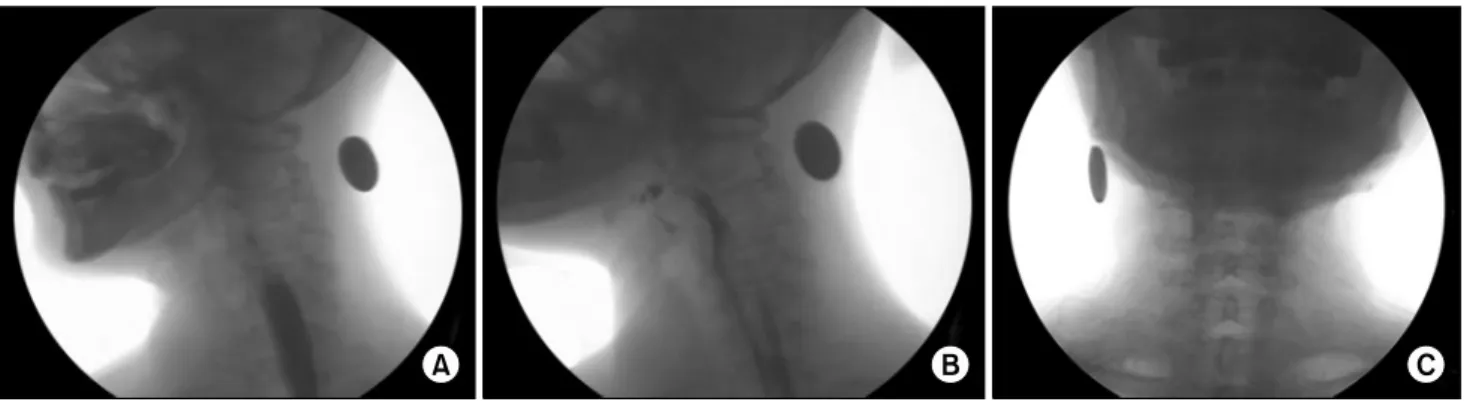
Fig. 1. The baseline results of VFSS. (A) During swallowing aspiration is observed on the test of semisolid. (B) During swallow- ing aspiration is observed on the test of liquid. (C) On anteroposterior view of VFSS, Post swallowing aspiration is observed on the right side. VFSS: video fluoroscopic swallowing study.

which can eventually lead to dysphagia

3

.

Dysphagia is an important task upon rehabilitation.

In recent years, several interventional treatments have actively been applied to dysphagia. For instance, a balloon can be used to strengthen the upper sphincter of the pharynx or the esophagus

4

, or Botox can be injected into the upper esophageal sphincter in the cases of dysphagia accompanied with cricopharyngeal dysfunction

5

. On the other hand, not many inter- ventional treatments for the larynx are available, and moreover this issue has not attracted much scholarly attention.

This case report was based on a hypothesis that the injection of hyaluronic acid (Restylane

, Q-Med.

Uppsala, Sweden) would induce the medialization of the vocal fold and its complete closure and thus would improve the dysphagia in the patients with brain injuries accompanied with unilateral vocal fold paralysis (UVFP). The results were compared with the VFSS.

CASE REPORT

The patient was a female aged 48 years old with no particular medical history. After being diagnosed with right lateral medullary infarction accompanied with vertebral artery dissection, she received in- jections of tissue plasminogen activators (t-PAs) and had conservative treatments in the department of

neurology. After being diagnosed with right lateral medullary infarction, she complained of dysphagia.

She had to get a nasogastric tube inserted. For dys- phagia treatement, she was transferred to the depart- ment of rehabilitation medicine 4 weeks after the onset of the symptoms. Thereafter Video fluoroscopic swallowing study (VFSS) was conducted, and practiced on the patient ingesting 4cc of semisolid and the same amount of liquid. On the VFSS, post swallowing residue was measured by the initial remnant of the first swallowing and corresponded to the area of the food retained in the pharyngeal space in the two- dimensional projection. The area was measured with a 2D screen AutoCAD (Autodesk, San Francisco, CA, USA), and the guideline for length was a 100 Won Korean coin attached to the neck (23 mm in dia- meter). During swallowing aspiration and post swal- lowing residue reached about 80% on the test of swallowing of semisolid. In addition, on the liquid swallowing test, during swallowing aspiration was observed. On an anteroposterior view of the VFSS, the semisolid residue on the right side was observed to cause post swallowing aspiration.(Fig. 1) Before the procedure, the Penetration Aspiration Scale (PAS) score was 7 points, and Functional Dysphagia Scale (FDS) was 72 points.

The patient had no problems with cognition, getting

30 points in a mini-mental state examination (MMSE),

and did not show significant problems on a cranial

(3)

Fig. 3. VFSS after the hyaluronic acid injection. (A) Aspiration is not observed on the test of semisolid. (B) Aspiration is not ob- served on the test of liquid. (C) On anteroposterior view of VFSS, Post swallowing aspiration is not observed on the right side.

VFSS: video fluoroscopic swallowing study.

Fig. 2. (A) Before the Injection.

(B) After the Injection of Hyaluro- nic acid (Restylane

Q-Med. Uppsala, Sweden) in Right Vocal fold. The right vocal fold has been mediali- zed after the injection of hyalur- onic acid (the black arrow). VFSS:

video fluoroscopic swallowing study.

nerve function test except for the vagus nerve. The paitent complained of the difficulty with phonation, so laryngoscopy was practiced through a laryngo- scope (MAJ-992

, Olympus, Japan). The laryngo- scopy found the para-median fixation of the right vocal fold that seemed to be the paralysis of the right vocal fold.

In this case, swallowing with the rightward head rotation was chosen as the compensation technique.

The aim was to decrease the anatomical space of the pyriform sinus on the affected side and therefore to reduce the food residue that caused post swallowing aspiration. The compensation technique attempted swallowing was performed with viscous water mixed with thickener or yogurt in the rightward head rota-

tion during occupational therapy.

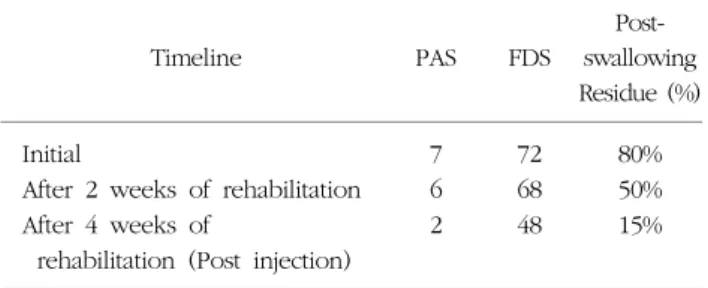
After 2 weeks, the results were checked with a VFSS in a situation of swallowing with rightward head rotation. During swallowing aspiration was not observed on the test of semisolid swallowing. However, although the residue was slightly reduced from 80% to 50%, post swallowing aspiration is observed. Furthermore, on the liquid swallowing test, during swallowing aspi- ration was observed. The PAS score was 6 points, and FDS score was 68 points.

The medialization of the right vocal fold was

attempted after 4-weeks of dysphagia treatment. Hya-

luronic acid (Restylane

, Q-Med. Uppsala, Sweden)

was injected into the right vocal fold with the gui-

dance of a laryngoscope (MAJ-922

, Olympus, Japan).

(4)

Table 1. Dysphagia parameter before and after injection.

Timeline PAS FDS

Post- swallowing Residue (%)

Initial 7 72 80%

After 2 weeks of rehabilitation 6 68 50%

After 4 weeks of

rehabilitation (Post injection)

2 48 15%

All procedures were performed under local anesthesia, and the patient inhaled a 4% lidocaine nebulizer for 15 minutes. To anesthetize the nasal cavity, 4% lido- caine was sprayed into the nasal passage. To anesthe- tize the larynx, 4% lidocaine was dripped onto the base of the tongue, the epiglottis, the arytenoids, and the vocal folds, while the patient phonated. A hyaluro- nic acid gel (Restylane

Q-Med. Uppsala, Sweden) was injected. A 25-G needle was passed through the cricothyroid membrane, and the process was monitored using a transnasal flexible fiberscope (MAJ-922

Olym- pus, Japan). The gel was slowly injected into the vocalis muscle anterior to the vocal process, and the injection was continued until a slight overcorrection was evident. The mean volume of material injected was 0.5 ml.(Fig. 2)

The results were checked with a VFSS in a situation of swallowing with rightward head rotation, 3 days after the injection. During the swallowing of semi- solids, aspiration was not observed. The residue was remarkably reduced from 50% to 15%. During the swallowing of liquids, aspiration was not observed either.(Fig. 3) After the procedure, the PAS score was 2 points and FDS score was 48 points.(Table 1) DISCUSSION

The larynx is important in phonation and protects the airway in the process of deglutition

3

. It functions as a physical barrier between the hypopharynx and the trachea, and this is made possible by the mecha- nical closure the glottis between the hypopharynx and the trachea. Moreover, the larynx is involved in epiglo- ttic deflection and laryngeal elevation

6

.

In the case of UVFP, clinically, the principal com- plaint is hypophonesis, whereon many studies have been carried out. However, there have been few studies on dysphagia. Heitmiller conducted a retro- spective study and reported that aspiration occurred in 38% of UVFP patients, and that laryngeal pene- tration occurred in 12%

7

. There are considerable numbers of UVFP patients who complain of dys- phagia. In particular, fatal problems are likely to arise in the patients with pulmonary function insufficiency.

Head rotation toward the paralyzed side can be a compensatory rehabilitation technique for the dys- phagia of UVFP patients

8

. This technique aims to decrease the anatomical space of the pyriform sinus on the affected side,thereby reducing the food residue and, by extension, lowering the aspiration rate

9

.

A surgical method is type-1 thyroplasty to insert an implant, e.g., cartilage, so that the vocal fold on the affected side can be medialized. It is regarded as the criterion standard of surgical treatment for patients with vocal fold paralysis

10

.

In addition, injection laryngoplasty can be an alter- native treatment for medialization of vocal fold. Para- ffin was the first injection into the vocal fold. In 1911, Brunning used it first, but its use was stopped soon afterward due to severe foreign body reactions and side effects

11

. The next substance was autologous fat graft, but it has the disadvantage of quick absorp- tion

12

. Bovine collagen causes a foreign body reaction and the subsequent respiratory obstruction, so the patient has to have hassle with a skin test. Recently, Restylane

(Q-Med. Uppsala, Sweden), based on hya- luronic acid produced within the body, has been used a lot. It has been reported to be highly biocompatible and to hardly cause a foreign body reaction. It is also absorbed into surrounding tissues, but in that process it brings on isovolemic degradation and attracts more moisture, and as a result, its volume remains about the same until complete absorption

13

.

In the case of this patient, UVFP was the main

cause of dysphagia, so hyaluronic acid (Resytlen

,

Q-Med. Uppsala, Sweden) was injected into her vocal

fold. This procedure is less invasive than surgical

(5)

operations, makes the recovery time shorter, and does not cause side effects, because it does not require general anesthesia. Furthermore, its effect lasts longer than fat grafting, and compared to paraffin or bovine collagen, it is less likely to cause granulomas or auto- immune responses. As a result, aspiration was reduced in the process where semisolid and liquid are taken in, and dysphagia was improved.

A possible mechanism involved here is an improve- ment in the mechanical protection resulting from the medialization of the vocal fold, which might make it possible to reduce not only intra-deglutitive aspiration into the airway, but also post-deglutitive aspiration caused by the food residue in the piriform sinus

14

. Another possibility is hypopharyngeal sump pressure made after the complete closure of the vocal fold.

The force makes food in the oral cavity go down lower than the pharynx, clearing thus the pharynx and the esophagus, and therefore clears the post- deglutitive residue. Before the procedure, hypopharyn- geal sump pressure was reduced due to the para- median fixation of the right vocal fold. But after the injection of hyaluronic acid, hypopharyngeal sump pressure was increased due to the complete closure of the vocal fold. As a result, it might clear the bolus much more and reduce aspiration caused by post- deglutitive residue

14

.

In the long run, the complete closure of the vocal fold will improve cough strength. Then, it may more strongly clear intra-deglutitive aspiration, food that had penetrated the larynx, and post-deglutitive aspi- ration caused by post-deglutitive residue, wherefore the morbidity rate of aspiration pneumonia is ex- pected to be reduced

7

.

In this case, the patient showed improvement in dysphagia with only vocal fold injection, although, in many clinical situations, the role of vocal fold media- lization alone is limited to treat dysphagia. Therefore, to improve dysphagia due to other causes, not only vocal fold medialization, but also other treatment options such as endoscopic balloon dilatation, Botox injection, and type 1 thyroplasty are needed to be considered to treat each individual appropriately.

In conclusion, for cases of UVFP accompanied with dysphagia, it is recommended to inject hyaluronic acid (Restylane

, Q-Med. Uppsala, Sweden) into the vocal fold. In addition, a further study needs to be carried out with a control group in order to further clarify the utility and suitability of hyaluronic acid (Restylane

, Q-Med. Uppsala, Sweden).

REFERENCES

1. Kim HJ, Yun DH, Kim SH, Kim DY, Kim HS, Kim HJ.

Endoscopic botulinum toxin injection for the treatment of dysphagia caused by cricopharyngeal hypertonicity: a case report. J Korean Acad Rehabil Med 2006;30:398- 401.

2. Leder SB, Ross DA. Incidence of vocal cord immobility in patients with dysphagia. Dysphagia: Spring;2005. p.163- 7.

3. Sasaki CT, Isaacson G. Functional anatomy of the larynx.

Otolaryngologic Clinics of North America 1988;21:595- 612.

4. Kim JC, Kim JS, Jung JH, Kim YK. The effect of balloon dilatation through video-fluoroscopic swallowing study (VFSS) in stroke patients with cricopharyngeal dysfunc- tion. J Korean Acad Rehabil Med. 2011;35:23-26.

5. Ahsan SF, Meleca RJ, Dworkin JP. Botulinum toxin in- jection of the cricopharyngeus muscle for the treatment of dysphagia. Otolaryngol Head Neck Surg. 2000;122:

691-5.

6. Logemann JA, Kahrilas PJ, Cheng J, et al. Closure mech- anism of the laryngeal vestibule during swallow. Am J physiol 1992;262:338-344.

7. Heitmiller RF, Tseng E, Jones B. Prevalence of aspira- tion and laryngeal penetration in patients with unilateral vocal cord motion impairment. Dysphagia 2000;15:184-7 8. Perlman AL, Schultz JG, VanDaele DJ. Effects of age,

gender, bolus volume, and bolus viscosity on orophar- yngeal pressure during swallowing. Journal of Applied Physiology 1993;75:33-37.

9. Baek SS, Park SB, Lee SG, Lee KM, Kim SH. The effect of neck posture in swallowing of stroke patients. J Korean Acad Rehabil Med. 1997;21:8-12.

10. Isshiki N, Morita H, Okamura H, Hiramoto M. Thyro- plasty as a new phonosurgical technique. Acta Oto- laryngol. 1974;78(5-6):451-457.

11. Bergamini, Giuseppe, Presutti, Livio, Molteni, Gabriele.

Injection laryngoplasty: Spring;2015. p.31-41.

12. Mikaelian DO, Lowry LD, Sataloff RT. Lipoinjection for unilateral vocal cord paralysis. Laryngoscope. 1991;101:

465-8.

13. Friedman PM, Mafong EA, Kauyar AN, Geronemus RG.

Safety data of injectable nonanimal stabilized hyaluronic

acid gel for soft tissue augmentation, Dermatolsurg 2002;

(6)

28:491-4.

14. Flint PW, Purcell LL, Cummings CW. Pathophysiology and indications for medicalizationthyroplasty in patients

with dysphagia and aspiration. Otolaryngeal Head Neck

Surg 1997;116:349-54.

수치

Fig.  1.  The  baseline  results  of  VFSS.  (A)  During  swallowing  aspiration  is  observed  on  the  test  of  semisolid
Fig.  2.  (A)  Before  the  Injection.
Table  1.  Dysphagia  parameter  before  and  after  injection. Timeline PAS FDS  Post-swallowing  Residue (%) Initial 7 72 80%

참조

관련 문서