Korean Journal of Pediatric Urology Vol. 4, No. 1: 29-31, 2012
29
CASE REPORT
방광요관역류 소아환자에서 시행한 내시경적 주입술 중 발생한 동맥성 출혈
Arterial Bleeding during Endoscopic Injection Therapy in Children with Vesicoureteral Reflux
Yong Seung Lee, Young Jae Im, Hyeyoung Lee, Chang Hee Hong, Sang Won Han
From the D epartm ent of U rology and U rological Science Institute, Yonsei U niversity College of M edicine, Seoul, K orea 이용승ㆍ임영재ㆍ이혜영
홍창희ㆍ한상원 연세대학교 의과대학 비뇨기과학교실
We report our unique experience with arterial bleeding and its manage- ment during endoscopic injection of Dextranomer/Hyaluronic Acid (Dx/HA) Copolymer (Deflux, Q-Med Scandinavia, Uppsala, Sweden) in children with vesicoureteral reflux (VUR). Bilateral Dx/HA copolymer in- jection was performed on a 40-month-old male child with left grade IV VUR and a history of right grade IV VUR. After 1.0 cc Dx/HA copolymer subureteric injection to left side, pulsatile arterial bleeding was noted at the injection site. An additional subureteric injection of 0.2 cc Dx/HA co- polymer was performed and the bleeding was stopped. Additional in- jection of Dx/HA copolymer could be considered as an emergent treatment option in the situation of abrupt arterial bleeding.
Key Words: Bladder, Ureter, Vesico-ureteral reflux, Blood loss, Surgical (Received: May 30, 2012, Accepted: June 12, 2012)
교신저자 한상원
연세대학교 의과대학 비뇨기과학교실
서울시 서대문구 신촌동 성산로 250, 120-752 Tel: 02-2228-2316 Fax: 02-312-2538 E-mail: [email protected]
Vesicoureteral reflux (VUR) is one of the most significant risk factors for acute pyelonephritis in children.1 Endoscopic management of VUR has widened its territory over the last 20 years to be one of the current major treatment options.2,3 The technique for endoscopic injection is quite simple, and it can be performed as an outpatient procedure with less post operative morbidity.
The long-term complications of endoscopic injection found in animal studies include poor therapeutic outcome in high grade VUR as compared to open antireflux surgery and migration of injected materials.4,5 Post-operative complication includes ureteral obstruction and hematuria.6,7 However, little is reported as an intraoperative complication.4
CASE REPORT
Bilateral Dextranomer/Hyaluronic Acid (Dx/HA) copolymer injection was performed on a 40-month-old male child. He
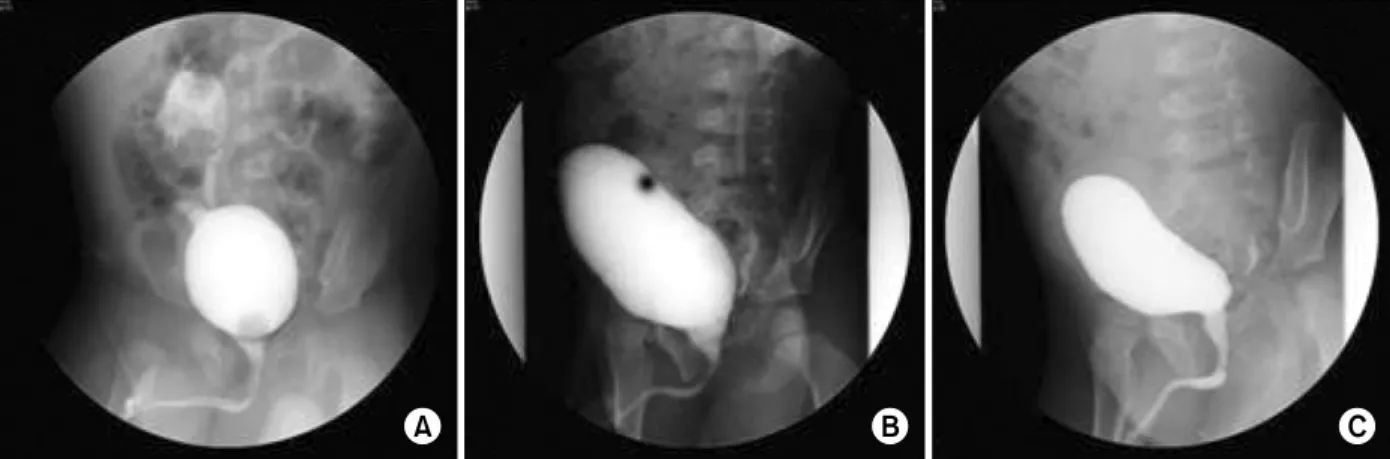
had been diagnosed with bilateral VUR at 2 month (Fig. 1) during evaluation of prenatally detected hydronephrosis and referred to our tertiary medical center. He was continuously managed with low-dose prophylactic antibiotics because of persistent VUR on annual follow up, voiding cystourethro- graphy (VCUG). Follow up VCUG at 36 months revealed left grade IV VUR and mild narrowing of the bulbous urethra with absent right side VUR. The patient’s parents wanted surgical management and Dx/HA copolymer injection with visual internal urethrotomy was planned.
Under general endotracheal anesthesia, the patient was placed in the lithotomy position. The urethra and bladder were carefully examined with a pediatric cystourethroscope.
A mild narrowing portion was noted on the bulbous urethra. Visual internal urethrotomy was performed using a cold knife and followed by a 0.8 cc Dx/HA copolymer injection to right side. Then, a 1.0 cc Dx/HA copolymer injection to the left side was performed using the STING
30 Korean Journal of Pediatric Urology Vol. 4, 29-31, 2012
Fig. 1. Serial voiding cystourethrographys performed at 2 months (A), 36 months (B) and 45 months (5 months after treatment) (C). (A) Revealed bilateral grade IV vesicoureteral reflux (VUR). During follow-up, the right VUR disappeared, but mild urethral narrowing was observed. After treatment, decreased left VUR with improvement of urethral lesion was seen.
Fig. 2. Arterial bleeding after withdrawal of needle (A), additional injection of Dextranomer/Hyaluronic Acid Copolymer (B), and after the additional injection (C).
method.8 Upon withdrawal of the injection needle, pulsatile arterial bleeding was noted from left injection site (Fig. 2).
We attempted to compress the bleeding site using a cystourethroscope. The amount of bleeding was temporarily decreased during compression only and then persisted after withdrawal. It could be classified as grade III complication according to Clavien Classification.9 An additional submuco- sal injection of 0.2 cc Dx/HA was performed 5-6 mm below the bleeding site and the arterial bleeding stopped completely. After a period of observation, further bleeding was not noted and operation was finished. There were no abnormalities in vital signs or bedside neurologic exam after the operation. On follow up VCUG, left grade II VUR remained.
DISCUSSION
Endoscopic injection therapy could cause possible damage to blood vessels distributed in the bladder or distal ureter.
It is generally recommended to compress the bleeding site using a cystoscope in such a situation.10 Bar-Yosef et al11 reported two cases of venous bleeding after endoscopic injection that were managed conservatively, however, there have been no reports regarding intraoperative arterial bleeding. To our knowledge, this is the first report of the occurrence and management of arterial bleeding during endoscopic injection for treatment of VUR. In our case, cystoscopic compression was only partly effective during
Yong Seung Lee, et al: Arterial Bleeding during Endoscopic Injection 31
compression and was followed by more bleeding after withdrawal of instrument. Coauglation using bugbee electrode could be considered, however, we did not use that method for the possibility of ureteral orifice damage.
Injected material migration should be considered in this situation. Dextranomer-based implant migration during endoscopic injection was not found in an animal study12 and there have been no case reports of migration into blood vessel in humans. Nevertheless, injection near the bleeding site could be dangerous due to possible direct migration into the blood vessel, as a regurgitation test is impossible with Dx/Ha copolymer injections. For this reason, we introduced the additional injection needle 5-6 mm below the bleeding site rather than at the exact site.
As we experienced only one ‘lucky’ case, it is difficult to judge the feasibility of additional injection as an initial management of arterial bleeding. However, it seems to be one of emergent options to try after compression of the bleeding site.
REFERENCES
1. King LR. The development of the management of vesico- ureteric reflux in the USA. BJU Int 2003;92 Suppl 1:4-6 2. Chertin B, Puri P. Endoscopic management of vesicoure- teral reflux: does it stand the test of time? Eur Urol 2002;42:598-606
3. Kaplan WE, Dalton DP, Firlit CF. The endoscopic
correction of reflux by polytetrafluoroethylene injection. J Urol 1987;138:953-5
4. Heidenreich A, Ravery V; European Society of Oncological Urology. Preoperative imaging in renal cell cancer. World J Urol 2004;22:307-15
5. Aaronson IA, Rames RA, Greene WB, Walsh LG, Hasal UA, Garen PD. Endoscopic treatment of reflux: migration of Teflon to the lungs and brain. Eur Urol 1993;23:394-9 6. Vandersteen DR, Routh JC, Kirsch AJ, Scherz HC, Ritchey
ML, Shapiro E, et al. Postoperative ureteral obstruction after subureteral injection of dextranomer/hyaluronic Acid copolymer. J Urol 2006;176:1593-5
7. Romero NP, Romo MI, Vegas AG, Izquierdo JB, Varela JC, Arteche AH, et al. Deflux injections for vesicoureteral reflux in transplanted kidneys. Transplant Proc 2010;42:
2892-5
8. O'Donnell B, Puri P. Treatment of vesicoureteric reflux by endoscopic injection of Teflon. Br Med J (Clin Res Ed) 1984;289:7-9
9. Dindo D, Demartines N, Clavien PA. Classification of surgical complications: a new proposal with evaluation in a cohort of 6336 patients and results of a survey. Ann Surg 2004;240:205-13
10. Campbell MF, Wein AJ, Kavoussi LR. Campbell-Walsh urology. 9th ed. Philadelphia, PA: Saunders Elsevier; 2007 11. Bar-Yosef Y, Binyamini J, Sofer M, Matzkin H, Ben-Chaim
J. Endoscopic injection of dextranomer/hyaluronic acid for vesico-uretera reflux--preliminary results. Harefuah 2005;
144:613-5
12. Stenberg AM, Sundin A, Larsson BS, Läckgren G, Stenberg A. Lack of distant migration after injection of a 125iodine labeled dextranomer based implant into the rabbit bladder. J Urol 1997;158:1937-41