Background: The purpose of this study was to investigate the characteristics and direction of treatment for peripheral facial palsy (PFP) based on medical collaboration between Western and Korean medicine departments.
Methods: There were 195 outpatients with PFP identified retrospectively by examining electronic medical records. These patients were treated with Korean and Western medicine from January 1
st, 2018 to December 31
st, 2018 at the Kyung Hee University hospital. Records were analyzed according to the patients’
demographic characteristics and clinical features of the collaborative combined treatment.
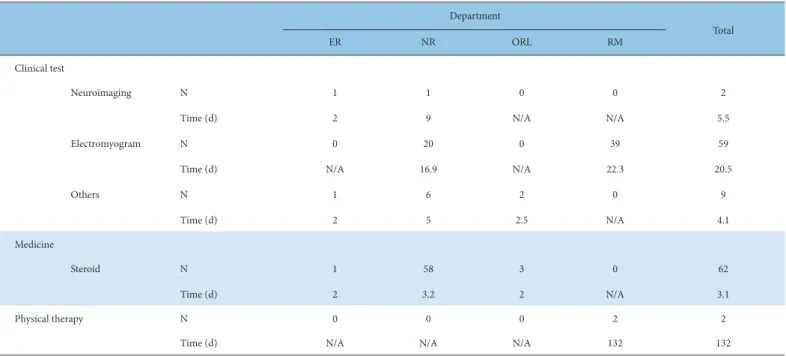
Results: According to the collaborative treatment pathway, the number of patients consulted from Western medicine departments was more than consulted from Korean department for the first time. The time taken by the Western medicine departments to consult with the patients at the Korean center for the first time was 14.9 days from the onset of symptoms. Acupuncture was the most frequently used Korean medicine treatment. The total treatment period for Korean medicine sessions and intervals were 91.9 days, 23 times and 3.6 days, respectively. When the Korean medicine center consulted with Western medicine departments, the time taken until the first consultation was 8.5 days from the onset of symptoms. Medication was the most used treatment, prescribed after 3.1 days. The most frequently used clinical test was an electromyogram, and this was performed after 20.5 days. The total treatment period, sessions and intervals were 21.2 days, 2.8 times and 5 days, respectively.
Conclusion: The clinical status of collaborative treatment for PFP was determined including the timing and interval of consultation according to treatments.
©2020 Korean Acupuncture & Moxibustion Medicine Society. This is an open access article under the CC BY- NC-ND license (http://creativecommons.org/licenses/by-nc-nd/4.0/).
Article history:
Submitted: April 21, 2020 Revised: May 06, 2020 Accepted: May 13, 2020 Keywords:
peripheral facial palsy, medicine consultation, medicine collaboration, Korean traditional medicine
https://doi.org/10.13045/jar.2020.00115 pISSN 2586-288X eISSN 2586-2898
Original Article
A Clinical Study of Collaboration between Western and
Korean Medicine for the Treatment of Peripheral Facial Palsy in a Korean Medicine Hospital
Jaewon Kim *, Yongsuk Kim
Department of Acupuncture and Moxibustion Medicine, Kyung Hee University Hospital of Korean Medicine, Seoul, Korea
ABSTRACT
Journal of Acupuncture Research
Journal homepage: http://www.e-jar.org
Introduction
Collaboration between Western medicine and Korean medicine is a clinical practice based on sharing patients’ medical information and discussing cases, which can improve treatment effects by taking advantage of each type of medicine [1]. In Korea, the first project to demonstrate collaboration between Korean and Western medicine started in 2016. Medical fee structures, identifying diseases for collaborative treatment, and the institution of consultation have been further developed since then. The third project of collaboration started in October 2019, and grades the institution by evaluating its performance with respect to medical collaboration, and a differential medical fee is applied according
to grade [2]. Previous research has reported on the perception, satisfaction, and process of medical collaboration [3].
Peripheral facial palsy (PFP) is a disease that is included as a good candidate project for collaboration between Korean and Western medicine; it is a common disease for medical consultation [4]. Although several studies have reported on quality of life, treatment effects, and the medical fees of consultations for PFP patients, there are few reports on consultation timing or duration [4-10].
In this study, we examined the records of PFP outpatients who were treated by way of collaboration between Korean and Western medicine at Kyung Hee University hospital from January 1
st, 2018 to December 31
st, 2018. We investigated the timing, department,
* Corresponding author. Jaewon Kim
Department of Acupuncture and Moxibustion Medicine, Kyung Hee University Hospital of Korean Medicine, Seoul, Korea E-mail: [email protected]
ORCID: Jaewon Kim https://orcid.org/0000-0002-5253-7331, Yongsuk Kim https://orcid.org/0000-0002-2655-5405
©2020 Korean Acupuncture & Moxibustion Medicine Society. This is an open access article under the CC BY-NC-ND license (http://creativecommons.org/licenses/by-nc-
nd/4.0/).
treatment period and interval of medical consultation. The aim of this study was to determine the direction of PFP treatment by comparing with guidelines and providing basic data for research on models for PFP medical collaboration.
Materials and Methods Patients
There were 457 outpatients with facial palsy who were treated with Korean and Western medicine from January 1
st, 2018 to December 31
st, 2018, as determined by the electronic medical records of Kyung Hee University hospital. Of the 457 patients who were treated for facial palsy in both the Western and Korean medicine departments, 262 did not meet the inclusion criteria.
Inclusion criteria
Patients who visited the facial palsy center in the Kyung Hee University Korean medicine hospital from January 1st, 2018 to December 31st, 2018, who were older than 18 years, who were diagnosed with PFP according to the Korean standard classification of diseases Version 7, and who were treated with combined Korean-Western medical treatments were included in this study.
Therefore, 195 patients were enrolled in this study (Fig. 1).
Exclusion criteria
Patients who were admitted with PFP and those who first visited the facial palsy center before 2018 or whose chief complaint was a sequelae of facial palsy, were excluded from this study.
Ethics statement
This study was approved by the Institutional Review Board of Kyung Hee Korean Medical Hospital (IRB no.: KOMCIRB-2019-07-004). To protect patients’ privacy, personal information was managed with an identification code which was stored using a locked computer with limited access.
Assessment methods General information
The demographic characteristics included patients’ gender and age. The pathway of medical consultation was classified as Korean or Western department, according to where the initial consultation was requested. Western medicine departments were separate from the Kyung Hee University hospital and other hospitals.
Clinical features of Korean medicine consultation
The time taken until the first consultation from the day of onset of symptoms was investigated, with Day 0 representing the day that the patient was treated in the Korean medicine department on the day of onset of treatment. Consultations requested in Western medicine departments were also considered.
Korean medicine treatments on the first consultation were classified as herbal medicine, acupuncture, heat therapy, moxibustion or cupping therapy. Only oral medicine was included in herbal medicine. Acupuncture was classified as conventional, electroacupuncture, or pharmacoacupuncture. Heat therapy was either infrared therapy or mugwort hot pack. Duplicate treatments were not considered for each treatment.
The period and sessions involved in Korean medicine treatments were investigated. The treatment interval for each patient was calculated by dividing the total treatment period by the number of sessions. The total treatment period, sessions and interval for all patients were calculated by averaging the data of each patient.
A treatment interval within 2 weeks of onset was separately investigated to identify differences in the acute stage.
Clinical features of Western medicine consultation
The time taken for the first consultation from the day of onset of symptoms was investigated, with Day 0 representing the day that the patient was treated in the Western medicine departments on the day of onset of treatment. All Western medicine departments in Kyung Hee University were included in this study. The time taken until the first consultation based on Western medicine was investigated and classified according to each department. Western treatments were classified as clinical tests, medicine, and physical therapy. Clinical tests included neuroimaging, electromyogram and others. Steroid treatment was included in the medicine category.
Duplicate treatments were was not considered for each treatment and data for each patient was collected for up to 5 consultations.
The period and sessions of Western treatment for each patient were investigated. The treatment interval for each patient was calculated by dividing the total treatment period by the number of sessions. The total treatment period, sessions and intervals for all patients were calculated by averaging the data of each patient. The treatment sessions were also investigated by department.
Results
General information
Distribution by gender and age
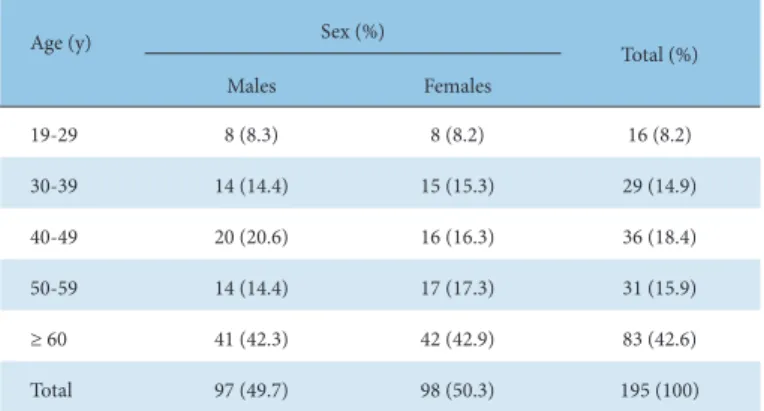
There were 97 males and 98 females included in this study, with a mean age of 53.61 ± 16.19 years (Table 1). Most patients (n = 83) were ≥ 60 years old (42.6%), followed by patients in their 40s (18.4%), 50s (15.9%), 30s (14.9%) and 19 to 29 year-olds (8.2%;
Table 2).
Pathway of the initial medical consultation
On the first consultation, 109 patients (55.9%) were referred from Western medicine departments to the Korean medicine
Fig. 1. Study flowchart.
PFP, peripheral facial palsy.
Fig. 1. Study flowchart
Patients who visited both Korean and Western medicine ce nters in Kyung Hee University with facial palsy in 2018
(n = 457)
Excluded patients (n = 262) (1) Under 19 years of age
(2) Diagnosis other than peripheral facial palsy (3) Visited facial palsy center before 2018 with PFP (4) The chief complaint was a sequelae of facial palsy (5) Admitted with PFP
Included patients (n = 195)