http://dx.doi.org/10.5369/JSST.2018.27.3.160 pISSN 1225-5475/eISSN 2093-7563
Wide Dynamic Range CMOS Image Sensor with Adjustable Sensitivity Using Cascode MOSFET and Inverter
Donghyun Seong, Byoung-Soo Choi, Sang-Hwan Kim, Jimin Lee, and Jang-Kyoo Shin
+Abstract
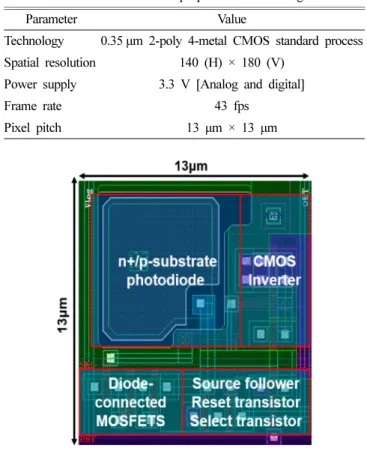
In this paper, a wide dynamic range complementary metal-oxide-semiconductor (CMOS) image sensor with the adjustable sensitivity by using cascode metal-oxide-semiconductor field-effect transistor (MOSFET) and inverter is proposed. The characteristics of the CMOS image sensor were analyzed through experimental results. The proposed active pixel sensor consists of eight transistors operated under various light intensity conditions. The cascode MOSFET is operated as the constant current source. The current generated from the cascode MOSFET varies with the light intensity. The proposed CMOS image sensor has wide dynamic range under the high illu- mination owing to logarithmic response to the light intensity. In the proposed active pixel sensor, a CMOS inverter is added. The role of the CMOS inverter is to determine either the conventional mode or the wide dynamic range mode. The cascode MOSFET let the current flow the current if the CMOS inverter is turned on. The number of pixels is 140 (H) × 180 (V) and the CMOS image sensor architecture is composed of a pixel array, multiplexer (MUX), shift registers, and biasing circuits. The sensor was fabricated using 0.35 µm 2-poly 4-metal CMOS standard process.
Keywords: CMOS image sensor, Wide dynamic range, Logarithmic response, Adjustable sensitivity.
1. INTRODUCTION
Recently, developments of the CMOS image sensors have received increased attention. Above all, the dynamic range of CMOS image sensors is important in order to recognize the object exactly regardless of the light intensity. There are many techniques for the wide dynamic range operation of CMOS image sensors. These include the mid-reset technique during exposure time, lateral overflow integration capacitor, sensitivity- controllable pixel, multiple-sampling, and so on. [1-7] However, these techniques are limited to the dynamic range for sensing in extremely high illumination conditions. Therefore, the logarithmic CMOS image sensor is suitable to capture images in high illumination condition.
In the logarithmic CMOS image sensor, the pixel output voltage responds exponentially to the light intensity. Thus, the dynamic
range of the logarithmic CMOS image sensor is extremely wide.
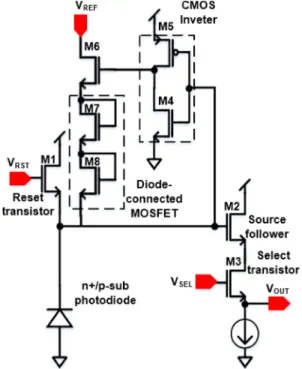
The logarithmic operation is performed using the cascode MOSFET. By using the reference voltage applied to the cascode MOSFET, the pixel output voltage is affected by the constant current from the cascode MOSFET. [8] However, the sensitivity of the pixel array is controlled at the same time. The pixel array of the logarithmic CMOS image sensor has the same sensitivity.
The disadvantage of the logarithmic CMOS image sensor is that the sensitivity changes at low illumination conditions. To solve this problem, the CMOS inverter circuit is added to the unit pixel.
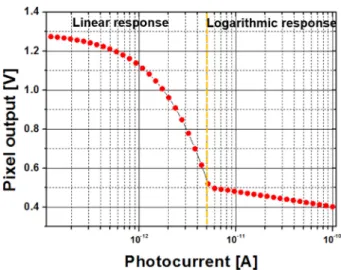
The CMOS inverter circuit decides the switching point called knee point which is the conversion point between the linear mode and wide dynamic range mode. If the cascode MOSFET is off, the pixel is in the linear mode. Otherwise, the pixel is in the logarithmic mode. The pixel array of the proposed CMOS image sensor has different sensitivity according to the light intensity.
In this paper, the active pixel sensor of the proposed CMOS image sensor consists of three circuit blocks. First, a cascode MOSFET is included for the logarithmic response according to the light intensity. Second, a CMOS inverter is included for the switching operation. Finally, a three-transistor active pixel sensor structure is used. Among them, the CMOS inverter and cascode MOSFET are the key-elements for adjustable sensitivity in response to the high illumination condition. The rest of the paper is organized as follows. The operating principle of the logarithmic School of Electronics Engineering, Kyunpook National University, 80
Daehakro, Bukgu, Daegu 41566, Korea
+