Letter to the Editor
424 Ann Dermatol
Received June 4, 2013, Revised July 5, 2013, Accepted for publication July 7, 2013
Corresponding author: Eun-So Lee, Department of Dermatology, Ajou University School of Medicine, 164 WorldCup-ro, Yeongtong-gu, Suwon 443-380, Korea. Tel: 82-31-219-5190, Fax: 82-31-219-5189, E-mail: [email protected]
This is an Open Access article distributed under the terms of the Creative Commons Attribution Non-Commercial License (http://
creativecommons.org/licenses/by-nc/3.0) which permits unrestricted non-commercial use, distribution, and reproduction in any medium, provided the original work is properly cited.
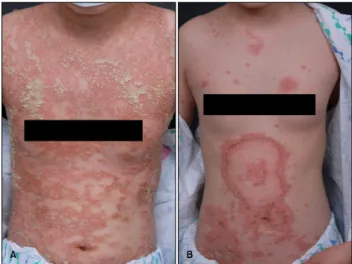
Fig. 1. More extensive and aggressive pustular patches (A) covering >90% of the body surface area compared to those observed in the previous attack (B).
http://dx.doi.org/10.5021/ad.2014.26.3.424
Gene Mutation Analysis in a Korean Patient with Early-Onset and Recalcitrant Generalized Pustular Psoriasis
Hyo Sang Song, Su Jin Yun1, Sun Park1, Eun-So Lee
Departments of Dermatology, 1Microbiology and Immunology, Ajou University School of Medicine, Suwon, Korea
Dear Editor:
Generalized pustular psoriasis (GPP) is a multisystemic in- flammatory disorder showing extensive pustular eruptions over the entire body1. Recently genetic studies with GPP patients have shown mutations in interleukin-36 receptor antagonist (IL-36RN)2-4. A 17-year-old girl visited the emer- gency department with generalized pustules. Three days before visit, she complained of a febrile sensation follo- wed by extensive pustular eruptions on whole body. Phy-
sical examination revealed pustular patches covering >90%
of body surface area that formed a more aggressive pattern comparing with the previous attack (Fig. 1). Fever (39.1oC), leukocytosis (white blood cell count, 27,000/μl), increa- sed erythrocyte sedimentation rate (59 mm/h), and increa- sed C-reactive protein level (14.52 mg/dl) were noted. She was diagnosed with GPP at 4 years of age and had under- gone regular follow-up. Flare-ups, large and small, had occurred along with extensive pustules. Whenever the pa- tient suffered from acute flare-ups, systemic corticoste- roids, methotrexate, cyclosporin, and even infliximab was used to effectively control symptoms. Recently, however, her symptoms had worsened with systemic symptoms such as high-grade fever, malaise, and myalgia. Skin le- sions were also more extensive pustules. On the contrary, the empirical treatments were ineffective. In particular, the efficacy of infliximab, which was initially high, had gra- dually decreased, requiring additional medication. We considered this patient’s condition recalcitrant and tried to determine a genetic problem. Genomic DNA extracted from her blood mononuclear cells was subjected to nu- cleotide sequencing and polymerase chain reaction using the primers as previously described4. The patient was he- terozygous for a point mutation in intron 3 designated as c.115+6T>C, which led to the skipping of exon 3 at the transcript level and the production of a premature termination codon (Fig. 2A). This finding is partially com- patible with that of a Japanese report in which a c.115+
Letter to the Editor
Vol. 26 No. 3, 2014 425 Fig. 2. Mutation c.115+6T>C observed in a Korean patient (A).
At the protein level, a higher expression of interleukin-36 (IL-36) is noted on keratinocytes below the pustules (B) compared to those of psoriasis vulgaris (C) (B, C: polyclonal anti-IL-36α/IL-1F6 antibody, ×200)
6T>C mutation was observed but differed in that no c.368C>G or c.28C>T mutation was noted in this case4. Furthermore, at the protein level, we observed overex- pression of IL-36 on the keratinocytes below the pustular lesions using polyclonal anti-IL-36α/IL-1F6 antibody (di- luted 1 : 200; R&D systems Inc., Minneapolis, MN, USA) (Fig. 2B, C). IL-36 activates inflammatory pathways such as the nuclear factor-κB pathway and are regulated by IL-36RN5. Several reports have performed mutation anal- yses of GPP patients showing that patients with IL36RN mutations are related to severe episodic GPP and these patients are affected at a relatively younger age2-4. In our
case, onset of the disorder was early (age 4 years), and the patient’s clinical course seemed to be worsening; there- fore, we conducted gene mutation analysisto detect hete- rozygousity of point mutation in intron3. Compound hete- rozygosity or homozygous mutations have been reported in Europe and Japan4. On the other hand, in our case, only 1 point mutation in intron 3 was noted, and no mu- tations at the other 3 sites that were reported in earlier cases were found. We regard our patient as the first Ko- rean GPP case in which the mutation was confirmed at the genetic and protein levels. We propose that physicians must consider gene mutation analysis for patients with early-onset and recalcitrant GPP.
REFERENCES
1. Griffiths CE, Barker JN. Pathogenesis and clinical features of psoriasis. Lancet 2007;370:263-271.
2. Marrakchi S, Guigue P, Renshaw BR, Puel A, Pei XY, Fraitag S, et al. Interleukin-36-receptor antagonist deficiency and ge- neralized pustular psoriasis. N Engl J Med 2011;365:620- 628.
3. Onoufriadis A, Simpson MA, Pink AE, Di Meglio P, Smith CH, Pullabhatla V, et al. Mutations in IL36RN/IL1F5 are associated with the severe episodic inflammatory skin disease known as generalized pustular psoriasis. Am J Hum Genet 2011;89:432-437.
4. Farooq M, Nakai H, Fujimoto A, Fujikawa H, Matsuyama A, Kariya N, et al. Mutation analysis of the IL36RN gene in 14 Japanese patients with generalized pustular psoriasis. Hum Mutat 2013;34:176-183.
5. Debets R, Timans JC, Homey B, Zurawski S, Sana TR, Lo S, et al. Two novel IL-1 family members, IL-1 delta and IL-1 epsilon, function as an antagonist and agonist of NF-kappa B activation through the orphan IL-1 receptor-related protein 2.
J Immunol 2001;167:1440-1446.