Regular Article
J F E S
Journal of Forest and Environmental Science
pISSN: 2288-9744, eISSN: 2288-9752
Journal of Forest and Environmental Science Vol. 33, No. 1, pp. 74-77, February, 2017 https://doi.org/10.7747/JFES.2017.33.1.74
74 Journal of Forest and Environmental Science http://jofs.or.kr
Thinning Intensity for Large Diameter Trees in Korean White Pine Plantation of South Korea
Daesung Lee1, Yeongwan Seo2, Jiyoung Park1 and Jungkee Choi1,*
1Department of Forest Management, College of Forest and Environmental Sciences, Kangwon National University, Chuncheon 24345, Republic of Korea
2Institute of Forest Science, Kangwon National University, Chuncheon 24345, Republic of Korea
Abstract
The purpose of this study is to analyze the effect of thinning intensity on the growth of large diameter trees in Korean white pine (Pinus koraiensis S. et Z.) plantation. Eight thinning plots were analyzed by categorizing into heavy thinning, light thinning, no thinning (control) according to thinning intensity. As a result, average DBH increased more in heavy thinning plots than in light thinning or unthinned plots. The number of large trees (DBH>25 cm) were obviously shown the most in heavy thinning plots. It is considered that heavy thinning is needed for the production of the large diameter trees.
Key Words: heavy thinning, light thinning, no thinning, DBH, Korean white pine
Received: February 10, 2017. Revised: February 16, 2017. Accepted: February 20, 2017.
Corresponding author: Jungkee Choi
Department of Forest Management, College of Forest and Environmental Sciences, Kangwon National University, 188-77, Gonji-ro, Chuncheon 24345, Republic of Korea
Tel: 82-33-250-8337, Fax: 82-33-259-5617, E-mail: [email protected]
Introduction
In Korea, Korean white pine (Pinus koraiensis S. et Z.) has been planted in 440,000 ha as a representative commercial tree species since 1960s (Korea Forest Research Institute 2012). At present, P. koraiensis plantation accounts for 18.7% of the coniferous plantation area in Korea (Korea Forest Service 2016). P. koraiensis plantation should be sus- tainably managed for wood production, and thinning is re- quired because P. koraiensis plantation is mostly distributed in age class IV (Bae et al. 2010).
In general, thinning improves site productivity, diameter growth of residual trees, and production at stand level (Nyland 1996). Also, thinning increases production of large diameter trees and improves wood values through qualitative improvement of wood (Smith 1986). For these reasons, thinning researches to produce large diameter trees
have been proceeded through permanent monitoring plots in developed countries (Burkhart and Bredenkamp 1989;
Amateis and Burkhart 2005).
In Korea, thinning studies of P. koraiensis had conducted through permanent monitoring plots, but were not con- tinued for major tree species. In the past, several re- searchers have studied about growth by thinning method (Kim et al. 2004; Lee 2003). Also, studies on growth mon- itoring through repeated measure were conducted (Choi and Choi 1998; Choi and Choi 1999; Choi et al. 2003;
Kang et al. 2004). Some researchers were studied about the initial diameter growth and environmental factors accord- ing to thinning (Hwang et al. 2008; Bae et al. 2010).
However, studies on the production of large diameter trees by thinning intensity are not sufficient for P. koraiensis.
Therefore, the objective of this study is to analyze how the number of large diameter trees by thinning intensity changes
Lee et al.
J For Env Sci 33(1), 74-77 75
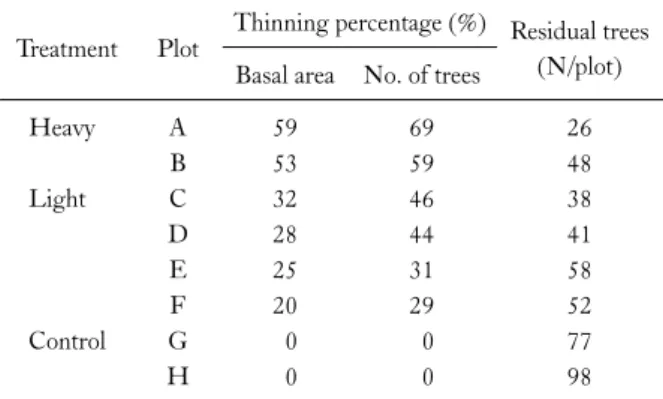
Table 1. Thinning intensity and residual trees in 1996
Treatment Plot Thinning percentage (%) Residual trees (N/plot) Basal area No. of trees
Heavy A 59 69 26
B 53 59 48
Light C 32 46 38
D 28 44 41
E 25 31 58
F 20 29 52
Control G 0 0 77
H 0 0 98
Table 2. Growth change of DBH and height by thinning intensity
Year
(Age) Treatment
Average DBH
(cm)
Average height
(m)
Stand density (N/ha)
1996 (19) Heavy 13.5 9.5 1,056
Light 13.4 9.3 1,605
Control 13.5 9.2 3,009
2001 (24) Heavy 17.8 11.1 1,043
Light 16.8 11.1 1,605
Control 16.5 10.8 2,378
2008 (31) Heavy 21.6 13.3 1,043
Light 19.7 13.1 1,556
Control 19.2 12.7 1,916
2014 (37) Heavy 23.1 16.1 1,013
Light 21.1 15.4 1,465
Control 20.5 15.1 1,731
over time.
Materials and Methods
Study areas and plot design
The study area is located in P. koraiensis plantation in the Research Forest of Kangwon National University, Gangwon province, South Korea (Choi et al. 2014a). Trees in this stand was planted in 1977 with 3,000 seedling per hectare and stand age is 40 year in 2017. In order to study thinning effect, the eight permanent plots were established in 1996, and each plot size is 0.04 ha with 20 m×20 m, respectively (Choi 1996).
First thinning was operated at the time of establishing the plots with the consideration of qualitative and quantita- tive thinning (Choi 1996). Thinning intensity ranged from 20-59% based on basal area, and the control plots were maintained with no thinning (Table 1). Overall status of the stand condition was reported by Choi et al. (2014a) in detail. For this study, 8 plots were grouped by categorizing 3 treatment groups based on the thinning intensity of basal area: heavy thinning treatment group (53-59%), light thin- ning treatment group (20-32%), unthinned treatment group (0%).
Tree inventory and analysis
Thinning plots were investigated four times: 1996, 2001, 2008, and 2014 (Choi 1996; Choi and Ji 1998; Choi et al.
2001; Choi et al. 2010; Choi et al. 2014b). All the trees were labelled and tree location were collected in XY coor- dinate system with measuring tape. DBH (Diameter at
breast height) was measured at 1.2 m above ground and marked for re-measuring every time (Choi et al. 2014b).
Tree height was investigated using Vertex-IV. For growth analysis, buffer zone was computed and outliers were ex- cluded to prevent external effect other than thinning.
Results and Discussion
Average growth by thinning intensity over time Stand growth was summarized by thinning intensity treatment over time (Table 2). Average DBH was not dif- ferent among thinning intensities right after thinning at age 19. However, average DBH of heavy thinning treatment was 2.6 cm larger than unthinned treatment at age 37.
Average height was not clearly different between thinning intensity at both age 19 and 37. Dead trees were occurred the most in unthinned treatment over time. Thus, the num- ber of residual trees was similarly maintained over time in heavy thinning treatment, but evidently decreased in un- thinned treatment.
The growth in heavy thinning treatment of this study was compared with the Standard Manual of Forest Resource Management by KFRI (Korea Forest Research Institute 2005). When compared with silvicultural method of the large diameter log goal, DBH of this study in 24 yr was 1.8 cm higher than DBH of KFRI in 25 yr. Also, the DBH in 37 yr was 2.1 cm higher than DBH of KFRI in 35 yr
Thinning Intensity for Large Diameter Trees in Korean White Pine Plantation of South Korea
76 Journal of Forest and Environmental Science http://jofs.or.kr
Table 3. Growth comparison of Korean white pine plantation between our study and Korea Forest Research Institute (KFRI 2005)
Our studya) KFRIb)
Age (yr) DBH (cn) Height (m) Trees (N/ha) Age (yr) DBH (cn) Height (m) Trees (N/ha)
19* 13.5 9.5 1,056 25* 16 10 800
24 17.8 11.1 1,043 35* 21 16 400
31 21.6 13.3 1,043 60* 30 21 250
37 23.1 16.1 1,013 90 45 250
a)Growth of heavy thinning plot, b)Growth by standard manual for large diameter tree (DBH>45 cm).
*Thinning treatment age.
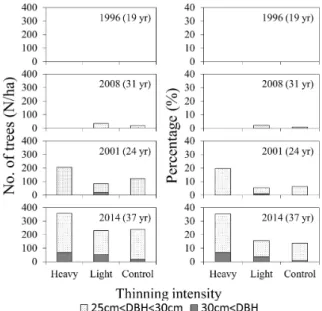
Fig. 1. Appearance of large diameter trees by thinning intensity over time.
(Table 3). The DBH growth is higher in this study, consid- ering the number of residual trees.
Large timber by thinning intensity over time The large diameter trees (DBH>30 cm) and candi- dates (25 cm<DBH<30 cm) were compared calculating the number of trees per hectare by thinning intensity (Fig.
1). No large diameter tree candidates were appeared in all plots at age 19. A few large diameter tree candidates were shown at age 24:36 trees/ha in light thinning treatment and 18 trees/ha in unthinned treatment.
The trees with DBH>25 cm in heavy thinning plot was more than in light thinning and unthinned treatment at age 31. The number of the trees in heavy, light, and no thinning treatment were 205, 85, and 123 trees/ha, respectively, with
19.7%, 5.4%, and 6.4%.
The number of the trees with DBH>25 cm of heavy thinning treatment were differentiated from light and no thinning treatment at age 37, while it was not different be- tween the light and no thinning treatment. The number of the trees were 358, 230, and 238 trees/ha, respectively, with 35.4%, 15.7%, and 13.8% at age 37. Also, the number of large diameter trees (DBH>30 cm) was the most in heavy thinning treatment at age 37. It is considered that heavy thinning treatment is appropriate to produce large diameter trees.
Conclusion
This study was performed to figure out the thinning in- tensity to produce large diameter trees in Korean white pine plantation. For this study, DBH growth change was com- pared and the number of large diameter trees were analyzed by thinning intensity treatment through 4 time measurements.
As a result, the DBH growth was higher in heavy thinning treatment than in light thinning or unthinned treatment.
When compared with Standard Manual by KFRI, DBH of heavy thinning treatment in our study was similar to large diameter trees in Standard Manual of KFRI.
The number of large diameter trees (DBH>30 cm) and candidates (25 cm<DBH<30 cm) was analyzed by thinning intensity over time. Large diameter trees and can- didates were clearly observed at age 31. The number of large diameter trees was the most in heavy thinning treatment.
However, the number is not clearly different between light thinning treatment and unthinned treatment. Therefore, it is judged that heavy thinning is needed for large timber production. Overall, this study is expected to be used as a
Lee et al.
J For Env Sci 33(1), 74-77 77 reference for thinning intensity and time of P. koraiensis
plantation in South Korea.
Acknowledgements
This study was carried out with the support of ‘full-time faculty research project (Project No. 520150250)’ funded by Kangwon National University in 2015 and the support of ‘Science and Engineering Individual Basic Research Project (Project No. NRF-2016R1D1A1B02011648)’ fund- ed by National Research Foundation of Korea in 2016.
References
Amateis RL, Burkhart HE. 2005. The influence of thinning on the proportion of peeler, sawtimber, and pulpwood trees in loblolly pine plantations. South J Appl For 29: 158-162.
Bae SW, Hwang JH, Lee ST, Kim HS, Jeong JM. 2010. Changes in soil temperature, moisture content, light availability and di- ameter growth after thinning in Korean pine (Pinus koraiensis) plantation. J Korean For Soc 99: 397-403. (in Korean with English abstract)
Burkhart HE, Bredenkamp BV. 1989. Product-class proportions for thinned and unthinned loblolly pine plantations. South J Appl For 13: 192-195.
Choi IH, Ji BY. 1998. Investigation of thinning experimental plots of Korean white pine stand (II). J Res For Kangwon Natl Univ 18: 115-130. (in Korean)
Choi IH, Kim JH, Ji BY, Shim WS, Kim HS. 1996. Establish- ment of thinning experimental plots of Korean white pine stand (I). Res Bull Exp For Kangwon Nat’l Univ 16: 152-160. (in Korean)
Choi IH, Won HK, Choi JK. 2001. Investigation of thinning ex- perimental plots of Korean white pine stand (III). J Res For Kangwon Natl Univ 21: 142-154. (in Korean)
Choi JK, Choi IH. 1998. A study of stand structure and growth on Pinus koraiensis plantations. Korean J For Meas 1: 27-35. (in Korean with English abstract)
Choi JK, Choi IH. 1999. Investigation of permanent sample plot in the artificial stand of Pinus koraiensis (III). J Res For Kangwon Natl Univ 19: 113-120. (in Korean with English abstract)
Choi JK, Lee BK, Lee DS, Choi IH. 2014a. Growth monitoring of Korean white pine (Pinus koraiensis) plantation by thinning intensity. J Korean For Soc 103: 422-430. (in Korean with English abstract)
Choi JK, Lee DS, Seo YW, Choi IH. 2014b. Investigation of thin- ning experimental plots (1),(2) of Korean white pine stand (II). J Res For Kangwon Natl Univ 34: 1-26. (in Korean with English abstract)
Choi JK, Woo JC, Kim JS, Seo YW, You BO, Jang JY. 2003.
Analysis of growth comparison on Pinus koraiensis plantations. J Res For Kangwon Natl Univ 23: 57-63. (in Korean with English abstract)
Choi JK, Lee BK, Cho BM, Shin JW, Choi IH. 2010. Investiga- tion of thinning experimental plots (1), (2), (3) of Korean white pine stand (I). J Res For Kangwon Natl Univ 30: 81-105. (in Korean)
Hwang JH, Bae SW, Lee KJ, Lee KS, Kim HS. 2008. Short-term effect of thinning on aboveground carbon storage in Korean pine (Pinus koraiensis) plantation. J Korean For Soc 97: 605-610. (in Korean with English abstract)
Kang SH, Hong SW, You BO, Choi JK, Choi IH. 2004. Growth monitoring by time series in Pinus koraiensis plantation -In case of permanent Korean pine plot in KNU-. Korean J For Meas 7:
1-8. (in Korean with English abstract)
Kim SK, Lee KJ, Bae SW, Lee KS, Kim HS. 2004. A study on the diameter growth and thinning effects using dial dendrometer in Pinus koraiensis stand. Korean J For Meas 7: 10-16. (in Korean with English abstract)
Korea Forest Research Institute. 2005. Standard Manual for Sustainable Forest Resource Management. Korea Forest Research Institute, Seoul, pp 289. (in Korean)
Korea Forest Research Institute. 2012. Commercial tree species 3 Pinus koraiensis. Korea Forest Research Institute, Seoul, pp 168.
(in Korean)
Korea Forest Service. 2016. Statistical Yearbook of Forestry. pp 414 (in Korean)
Lee KJ. 2003. A study on systematization of silvicultural practice by analyzing growth and structure of Korean pine plantation in the central region of Korea. PhD thesis. Konkuk University, Seoul, Korea, pp 150. (in Korean with English abstract) Nyland RD. 1996. Silviculture: Concepts and Applications.
McGraw-Hill, New York, pp 633.
Smith DM. 1986. The Practice of Silviculture. 8th ed. Wiley, New York, pp 527.