44
Lab Anim Res 2018: 34(1), 44-47 https://doi.org/10.5625/lar.2018.34.1.44
ISSN 1738-6055 (Print) ISSN 2233-7660 (Online)
Anti-coccidial activity of the ethanol extract of Tribulus terrestris fruits on Eimeria tenella
Sunhwa Hong
1, Mi-Na Moon
1, Eun-Kyung Im
1, Jum-Soon Won
1, Ji-Hyun Yoo
2, Okjin Kim
1,3,*
1
Center for Animal Resource Development, Wonkwang University, Iksan, Korea
2
Technlogy Service Division, National Institute of Animal Science, Rural Development Administration, Wanju, Korea
3
Institute of Animal Experiment & Efficacy Evaluation, Animal Disease Research Unit, Wonkwang University, Iksan, Korea
Anti-coccidial effects of the fruits of Tribulus terrestris (Tribuli fructus) ethanol extract (TTE) were studied with animal experiment following per oral administration with Eimeria (E.) tenella. This experiment was performed on the 3-day-old chicks (n=30). The animals were divided with 3 groups; TFE 15mg per animal+infected (n=10), TTE untreated+infected (n=10) and non-infected control (n=10). Animals were administrated with or without TTE during 1 week, and then inoculated with E. tenella. The anti-coccidial activity were evaluated with oocysts shedding numbers in stools, body weights changes and food intake changes. The TTE-inoclated animals revealed significantly decreased stool oocysts numbers (P<0.05) when compared to the TTE untreated animals. Also, TTE-treated animals showed more increased body weight gains (P<0.05) than the TTE untreated animals. These results demonstrate that TTE produce anticoccidial activities against E. tenella. TTE could be a promising treatment for the coccidiosis.
Keywords: Coccidiosis, Eimeria, antiprotozoal, Tribuli fructus, Tribulus terrestris
Received 5 October 2017; Revised version received 1 January 2018; Accepted 26 January 2018
Coccidiosis is an infectious disease by protozoa Eimeria and an important parasitic zoonotic disease [1].
It induced severe losses of mortality, morbidity in the poultry industry. In addition, a lot of anti-coccidial medications to prevent Eimeria infection have revealed the decreased efficacy because some Eimeria species have developed resistance activity to anti-coccidials [2].
Coccidiosis is an important disease in the poultry industry [2]. Eimeria (E.) tenella is one of the most virulent species of Eimeria that causes hemorrhagic cecal coccidiosis in young poultry [3].
Tribulus terrestris is a creeping herb of the family Zygophyllaceae. It is 30 to 70 cm high and has pinnate leaves and yellow flowers. It is widely growing in tropical and moderate regions of the world, including Africa, Western Asia, China, Japan, Korea and southern Europe [4]. It has been used since ancient times in fork
medicine for treating tonic, aphrodisiac, analgesic, astringent, stomachic, diuretic, hypertension, edema, eye problems, sexual impotency, inflammation, anti-infective, lithon-triptic, and rheumatoid arthritis [5-8]. Previous studies have found that the fruits of T. terrestris (Tribuli fructus) contains steroidal saponins, protodioscin, alkaloids and flavonoids [9].
Recently, many natural herbal compounds have been studied to develop an alternative anti-coccidial drug [1].
However, the effects of Tribuli fructus ethanol extract (TTE) on coccidiosis has not been reported. Therefore, we are intend to evaluate the anticoccidial activity of the TTE in chicks following per oral inoculation with E.
tenella.
We bought the dried Tribulus terrestris from an Oriental Pharmacy (Iksan, Korea). It was prepared following to the standard operation procedure as Korean
Letter
*Corresponding author: Okjin Kim, Center for Animal Resources Development, Wonkwang University, 460 Iksandaero, Iksan, Jeonbuk 54538, Korea
Tel: +82-63-850-6668; Fax: +82-63-850-7308; E-mail: [email protected]
This is an Open Access article distributed under the terms of the Creative Commons Attribution Non-Commercial License (http://creativecommons.org/licenses/
by-nc/3.0) which permits unrestricted non-commercial use, distribution, and reproduction in any medium, provided the original work is properly cited.
45 Sunhwa Hong et al.
Lab Anim Res | March, 2018 | Vol. 34, No. 1
Pharmacopoeia and Korean Herbal Pharmacopoeia, which are the official compendia of standard. Thereafter, we prepare TTE as following procedures. The dried Tribuli fructus was cut into pieces with 100 g. Then, those extracted 2 times with 50% (v/v) ethanol as 600 mL at 80
oC during 3 hours. After filtration with a 400- mesh net, the remnant was retreated with No. 5 Whatman filter paper. Then, it was concentrated with a rotary evaporator (EYELA, Tokyo, Japan) and the concentrated remnant was completely dried with freezing dryer (Labconco, USA). Thereafter, the dried remnant was collected in sterile tube and stored at −20
oC.
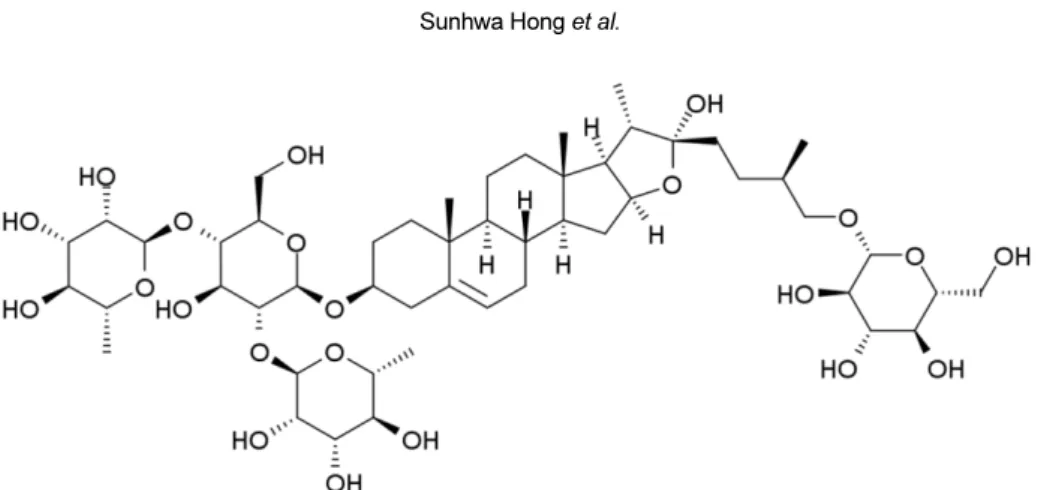
Protodioscin was prepared in order to use the standard compound of TTE. It was obtained from Sigma Aldrich (USA). The chemical structures of protodioscin was presented in Figure 1. We analyzed the protodioscin content in TFE compound with liquid chromatography (Waters Corp., USA). The column of LC was 2.1×50 mm, 1.7 µm C18 type ACQUITY UPLC BEH (Waters Corp., USA). The wavelength of the LC UV detector was adjusted to 300 nm. The temperature of LC column was adjusted to 30
oC with a flow rate of mobile phase at 0.6 mL/min (0.1% H
3PO
4/Acetonnitrile).
This experiment was performed on the 3-day-old chicks (n=30) in the animal facility of Center for Animal Resources Development, Wonkwang University, Korea.
The chicks were raised and acclimatized in a poultry facility room with standard temperature (28±2
oC), humidity (50±5%) and light/dark cycle (12/12 hours).
The chicks were provided a post-broiler feed without antibiotics and anti-coccidial compounds (Hanil Feed Co., Yongin, Korea) and tab water ad libitum. The animals were raised in grower wire-floored cages during experimental period. All procedures of animal experiments were conducted in accordance with the IACUC
Guidelines by Wonkwang University and approved by the Institutional Animal Care and Use Committee of Wonkwang University (Approval No. WKU16-105).
We made every effort to reduce the pain of the animals in this study.
Anti-coccidial activity of TTE were studied in chicks following per oral inoculation with E. tenella. The chicks were divided with 3 groups; TFE 15 mg per animal+
infected (n=10), TTE untreated+infected (n=10) and non-infected control (n=10). We decided the dose of TFE following as the recommended feed additive concentration Animals were administrated with or without TTE during 1 week, and then inoculated with E.
tenella. The anti-coccidial activity were evaluated with oocysts shedding numbers in stools, body weights changes and food intake changes.
Fecal oocysts were floated and gathered with 5.25%
sodium hypochlorite. Then, those samples washed triples with phosphate buffered saline. Chicks were administrated per oral with sonde using a 24 gauge, animal feeding catheter stainless steel sonde for mouse (Popper & Sons, Inc., New York, USA) attached to a 3 mL syringe. The dose of administration for per oral infection has been approximated 10
4of E. tenella oocysts in 1 mL of phosphate buffered saline. The animals of control group (n=10) were inoculated orally with phosphate buffered saline.
During the experimental procedure, the chicks were monitored twice daily for clinical signs, morbidity and mortality. Also, body weight gains and diet intake changes were evaluated with experimental animals.
During 10 days post-infection, body weight gains and diet intake changes were individually checked.
Stools of the experimental animals were gathered from 6 to 10 days post-infection. The stool specimens were
Figure 1. Structures of protodioscin extracted from the fruits of Tribulus terrestris
Anti-coccidial effects of the Tribulus terrestris 46
Lab Anim Res | March, 2018 | Vol. 34, No. 1
examined for the numbers of Eimeria oocysts using a standard fecal flotation method [10]. Briefly, 5 mL from each specimens was pelleted by centrifugation at 1500 g for 5 min. Thereafter, the pellet remnant was re- suspended in aqueous saturated sodium chloride and filtered with a 1 mm size mesh to remove coarse fecal debris. The filtrates were submitted to the fecal flotation using 22 mm×22 mm coverslips. Then, the coverslip was put on a slide glass and observed in its entirety for Eimeria oocysts. Total number of oocysts was obtained using the following formula: [total number of oocysts=
oocyst count×dilution factor×(fecal specimen volume/
counting chamber volume)/number of chickens per cage].
Differences in mean oocysts secretion and mean weight changes between the 3 groups were evaluated by using one-way analysis of variance (ANOVA; GraphPad InStat; GraphPad Software Inc., San Diego, CA) and considered significant at P<0.05.
The extract yield of Tribuli fructus with 50% ethanol was 20.60% from the first prepared dry mass. We analyzed TTE contents with liquid chromatography. The chemical structure of protodioscin, the standard composition of TTE content, like as Figure 1. The composition of protodioscin in TTE was 310 µg/mL.
As shown in Table 1, oocyst secreting numbers was significantly higher in the infected animals than in the uninfected control animals (P<0.05). The oocysts number in stool was highest on day 8 post-infection (Table 1).
TTE-treated animals revealed significantly decreased shedding oocysts in stool (P<0.05) when compared to TTE untreated animals. Also, TTE-treated animals showed more increased body weight gains (P<0.05) than the TTE untreated animals. TTE prevented the body weight decreases induced by coccidiosis in this study (Table 2). Also, diet intake was decreased in the TTE untreated chickens when compared to TTE-treated chickens (Table 3).
Table 1. Oocyst shedding numbers in the chicks infected with Eimeria tenella with or without the ethanol extract of Tribulus terrestris fruits
Group Oocysts shedding numbers (x10
6)/Days post-infection
6 7 8 9 10
Control 0±0* 0±0* 0±0* 0±0*. 0±0*
Infected control
a17±2.3
035±5.8
.78±7.2 36±11.1 13±4.4
TTE+Eimeria
b09±2.8* 013±4.0*
029±3.3* 02±1.1* 0±0*
a
The chicks infected with the oocysts of Eimeria tenella.
b
The chicks infected with the oocysts of Eimeria tenella and fed with the ethanol extract of Tribulus terrestris fruits (TTE).
*Significantly difference compared to the infected control group (P<0.05)
Table 2. Body weight changes (g) of the chicks infected with Eimeria tenella with or without the ethanol extract of Tribulus terrestris fruits
Group Body weights (g)/Days post-infection
1 3 5 7 10
Control 117±2.1 141±2.7* 181±3.4* 223±2.3* 265±6.9*
Infected control
a117±1.2 133±3.8 144±5.3 171±4.2 185±4.6
TTE+Eimeria
b117±2.3 138±3.2* 180±4.4* 219±3.2* 261±4.6*
a
The chicks infected with the oocysts of Eimeria tenella.
b
The chicks infected with the oocysts of Eimeria tenella and fed with the ethanol extract of Tribulus terrestris fruits (TTE).
*Significantly difference compared to the infected control group (P<0.05)
Table 3. Diet intake changes (g) of the chicks infected with Eimeria tenella with or without the ethanol extract of Tribulus terrestris fruits
Group Diet intake changes (g)/Days post-infection
1 3 5 7 10
Control 5.3±0.95 8.4±1.65 11.6±0.97* 13.8±1.03* 18.3±1.34*
Infected control
a5.2±0.79 7.6±1.71 09.7±1.06 10.9±0.99 14.6±1.65
TTE+Eimeria
b5.3±0.67 8.2±1.48 11.4±0.52* 13.3±1.16* 18.2±1.55*
a
The chicks infected with the oocysts of Eimeria tenella.
b